India remains one of the world’s largest importers of edible oils, and palm oil accounts for roughly 60% of India’s edible oil imports by volume. For entrepreneurs evaluating an import-based palm oil refinery feasibility study, the central question is straightforward: can you import crude palm oil, refine it domestically, and sell finished products at a margin that justifies the capital invested and the risks assumed?
This article examines that question through a financial and operational lens – covering crude palm oil landed cost in India, palm oil import customs duty, refining economics, working capital intensity, investment risks and the sensitivity of margins to variables that promoters often underestimate.
Key Takeaways
India imports approximately 90% of its palm oil requirement, making the country structurally dependent on international supply from Indonesia and Malaysia. The global palm oil market was valued at approximately USD 71.23 billion in 2023, and India is among its largest buyers. Setting up a palm oil refinery in India involves investment ranging from INR 25 to 600 crore depending on capacity, integration level and location.
The following points summarise the article’s core findings:
- Import-based palm oil refinery feasibility in India depends primarily on crude palm oil landed cost, customs duty structure, refining spreads, capacity utilisation and working capital – not just on machinery cost or indicative refining margins.
- Crude palm oil landed cost is driven by CIF price, USD/INR exchange rate, CBIC-notified tariff value, basic customs duty, applicable cesses, port charges and financing costs. Even a 3–5% movement in any single variable can materially alter profitability.
- Importing crude palm oil and refining domestically is viable only when the duty differential between crude and refined imports, combined with refining cost per MT and by-product realisations, produces a consistent gross refining margin above operating and finance costs.
- Palm oil refinery investment risks are multi-dimensional – covering global price volatility, FX movements, duty changes, capacity utilisation shortfalls and working capital funding gaps. A professional feasibility study with sensitivity analysis is essential before committing INR 5–100+ crore.
- Serious promoters should obtain a customised import-based palm oil refinery feasibility report with landed-cost modelling, DSCR, IRR and bankable projections from a professional adviser before approaching banks or investors.
Introduction – Is an Import-Based Palm Oil Refinery Financially Viable in India?
India is the world’s second most populous country and imports about 60% of its edible oil needs. Palm oil is the most widely consumed vegetable oil globally, and India’s rising demand for cooking oil, processed foods and industrial fats ensures steady demand for this commodity. In January 2026 alone, India imported 706,000 metric tons of palm oil, underlining the sheer scale of import dependence.
Palm oil competes with soybean oil, sunflower oil and other vegetable oils on price. It remains cost-competitive for bulk consumers – the food industry, food processors, bakery fats manufacturers and packaged foods companies – but its economics are highly sensitive to international crude oil price trends, ocean freight and government policy changes.
The five parameters that determine whether an import-based refinery is financially viable are: crude palm oil landed cost India, palm oil import customs duty India, palm oil refinery profit margin India, operating efficiency and palm oil refinery investment risks. Each of these interacts with the others. A favourable CIF price means little if customs duty increases or capacity utilisation falls below break-even.
Refinery viability cannot be judged solely from indicative refining spreads quoted by equipment suppliers or from global benchmark margins. Real profitability depends on procurement discipline, efficient operations, refining yield, working capital management and the ability to realise competitive domestic selling prices. A promoter who focuses only on machinery quotations without modelling landed cost, duty exposure and financing requirements is building a project on incomplete foundations.
For promoters evaluating large-scale projects, a structured approach to financial feasibility is essential. A comprehensive large-scale edible oil refinery project report should cover all these dimensions before capital is committed.

Understanding the Import-Based Palm Oil Refinery Business Model
The import-based palm oil refinery model involves procuring crude palm oil from overseas – primarily from Indonesia and Malaysia, which together dominate global production levels – shipping it to an Indian port, clearing customs, storing it in bulk tank farms, and then refining and optionally fractionating it into finished products for domestic sale.
The main product streams from crude palm oil refining include:
- RBD (Refined, Bleached, Deodorised) palm oil – the primary refined output
- Palm olein – the liquid fraction used for cooking oil
- Palm stearin – the solid fraction used in bakery fats, vanaspati and industrial applications
- PFAD (Palm Fatty Acid Distillate) – a by-product with industrial and oleochemical value
- Palm kernel oil, which is derived from the seed of the oil palm fruit, requires separate kernel crushing and is not produced through CPO refining alone
Palm oil is a key ingredient in food processing due to its high oxidative stability. It is used in cooking oil, margarine and processed foods. It is also used in soaps, detergents and biodiesel, making palm oil products relevant to multiple demand segments. Fresh fruit bunches are the main input for palm oil manufacturing at the plantation level, and a palm oil mill must process fruit within a day of harvest – but at the Indian refining stage, the input is already crude oil, not fresh fruit.
The typical process flow for an import-based refinery is:
Overseas CPO Supplier → Vessel Shipment → Indian Port → Customs Clearance → Bulk Storage / Tank Farm → Refinery (Physical/Chemical) → RBD Palm Oil → Optional Fractionation → Palm Olein / Palm Stearin → Domestic B2B / HoReCa / FMCG Sales
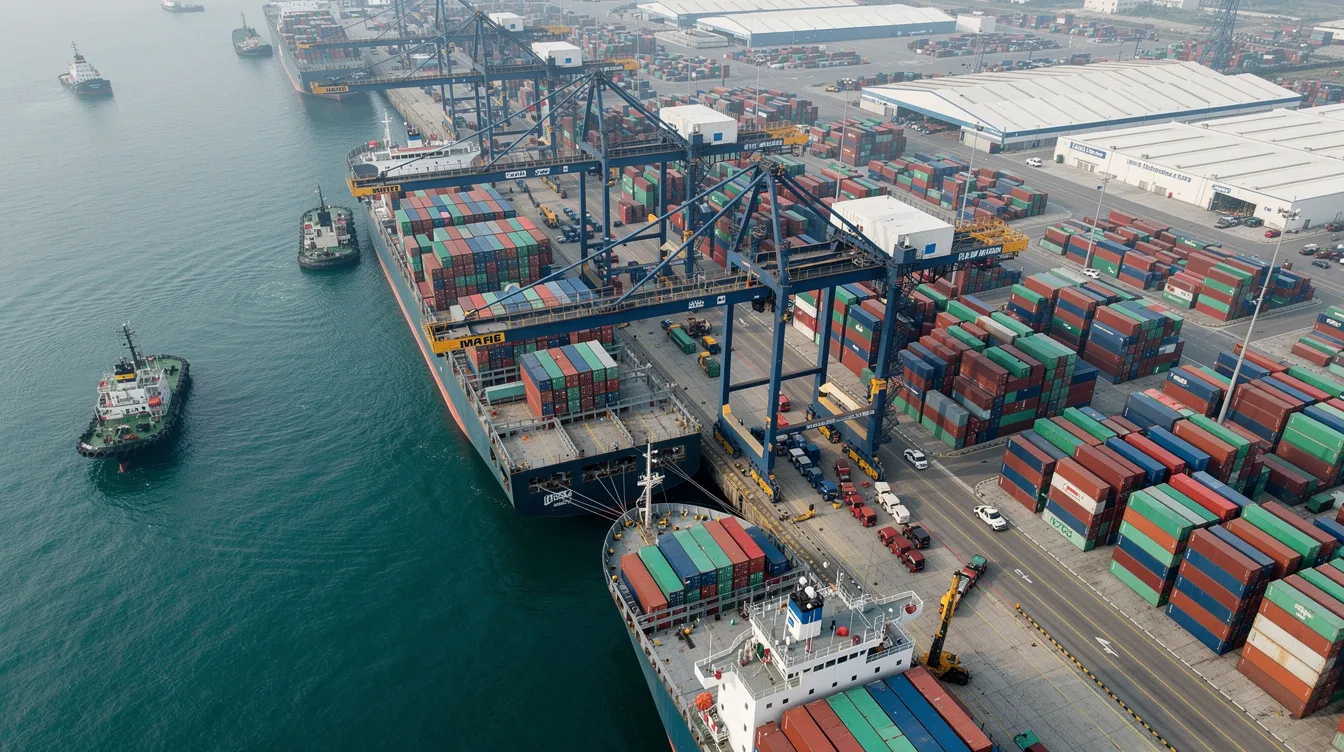
Port-based refineries near Kandla, Mundra, JNPA, Haldia or Chennai benefit from lower crude palm oil transport cost, established tank farm infrastructure and shorter working capital cycles. Inland refineries located closer to major consumption centres may reduce distribution costs for finished products but incur higher inbound freight on raw materials and often face weaker storage infrastructure.
The choice between physical vs chemical refining of edible oils and between stand-alone refining and integrated fractionation has a significant bearing on capital cost, yield, by-product revenue and product mix. The detailed crude palm oil refining process covers these technical routes comprehensively.
Crude Palm Oil Landed Cost in India – Complete Calculation
Crude palm oil landed cost India is the single most critical parameter in import-based palm oil refinery feasibility. When CIF prices, exchange rates and duties interact, even a small percentage change in any component can compress or expand refining margins by thousands of rupees per metric tonne.
Import duties and tariffs significantly impact the landed cost of CPO. Assessing the feasibility of importing palm oil requires evaluating both regulatory and economic factors in detail. Logistics for palm oil import involve temperature-controlled transport to prevent solidification, adding to handling cost.
Key Trade Terms
- FOB (Free on Board): seller’s cost until loading at origin port
- CFR (Cost and Freight): FOB plus ocean freight
- CIF (Cost, Insurance, Freight): CFR plus marine insurance – the standard basis for Indian customs valuation
As of late October 2026, FOB Malaysia for crude palm oil was approximately USD 1,088/MT, while CIF India was reported around USD 1,290–1,300/MT, indicating that freight, insurance and transshipment add approximately USD 120–200/MT depending on port and vessel.
Illustrative Landed Cost Build-Up (Per Metric Tonne)
The following table uses clearly identified illustrative assumptions. Actual costs will vary by contract, port, shipment date and prevailing policy.
| Cost Component | Basis of Calculation | Amount per MT (₹) | Explanation |
|---|---|---|---|
| CIF price (illustrative) | USD 1,290/MT × ₹84/USD | ₹1,08,360 | Converted at assumed exchange rate |
| Basic Customs Duty (BCD) | 5% of assessable value | ₹5,418 | Per Notification 31/2026-Customs |
| AIDC | 5% of assessable value | ₹5,418 | Agriculture Infrastructure & Development Cess |
| Social Welfare Surcharge | 10% on BCD | ₹542 | Levied on BCD amount |
| Import IGST (5%) | On CIF + duties | ₹5,987 | Typically recoverable as input tax credit |
| Port handling, survey, testing | Estimated | ₹2,500 | Varies by port |
| Inland transport to refinery | Estimated (port-based plant) | ₹1,500 | Lower for port-adjacent refineries |
| LC charges, financing cost | Estimated | ₹1,500 | Depends on LC terms and bank |
| Handling losses (~0.5%) | On CIF value | ₹542 | Transit, unloading, transfer losses |
| Total Cash Outflow | ₹1,31,767 | Before netting IGST credit | |
| Less: Recoverable IGST | Input tax credit | (₹5,987) | If eligible for full credit |
| Economic Landed Cost | ₹1,25,780 | Net of recoverable taxes |
Economic Landed Cost per MT = CIF Value in ₹ + Non-Recoverable Customs Duties & Cesses + Port & Logistics + Directly Attributable Costs – Recoverable Taxes (if netted)
Customs valuation must follow CBIC-notified tariff values and exchange-rate notifications. The notified tariff value for crude palm oil is USD 1,190/MT, which applies if the transaction value is lower than the tariff value. Promoters should always align landed-cost assumptions with the latest CBIC circulars and RBI reference rates.
Palm Oil Import Customs Duty in India – Current Rules and Duty Differential
Precise HS Code classification is essential for correct palm oil import customs duty India calculations. Crude palm oil falls under HS 1511.10, while refined palm oil and palmolein fall under sub-heads of 1511.90. Incorrect classification can lead to duty disputes, delays and financial penalties.
The Indian government had earlier reduced basic customs duty on crude palm oil to 10%, with an effective duty on crude oils of approximately 16.5% including AIDC. Refined palm oil import duty remained at 32.5%, with an effective rate of approximately 35.75%.
Subsequently, effective 24 September 2026, Notification No. 31/2026-Customs further reduced BCD on crude palm oil from 10% to 5%, with corresponding adjustments to refined oil duties to maintain a duty differential of approximately 19.25% between crude and refined edible oils.
The government aims to keep cooking oil prices low through import tax adjustments while simultaneously protecting domestic refining capacity through this differential.
Illustrative Customs Duty Comparison (Post September 2026)
| Product | HS Code | BCD (Illustrative) | AIDC (Illustrative) | SWS | IGST | Indicative Effective Duty % |
|---|---|---|---|---|---|---|
| Crude Palm Oil | 1511.10 | 5% | 5% | 10% on BCD | 5% | ~16–17% |
| Refined Palm Oil (RBD) | 1511.90 | 27.5% | Varies | 10% on BCD | 5% | ~35–37% |
| Palm Olein | 1511.90 | 27.5% | Varies | 10% on BCD | 5% | ~35–37% |
Note: Rates shown are indicative and must be verified against the latest CBIC notifications on the date of shipment. CBIC periodically revises notified tariff values based on global prices, affecting assessable value even without a change in invoice price.
The duty differential between crude and refined edible oil imports is the cornerstone of domestic refining economics in India. A narrowing of this differential would directly reduce the margin advantage available to domestic refiners, while widening it would improve their competitive position. Large projects should build scenarios for possible future duty revisions in their feasibility models.
Imported CPO Versus Imported Refined Palm Oil – Which Is More Economical?
Whether importing crude palm oil for domestic refining or directly importing refined palm oil is more economical depends on the prevailing duty differential, refining cost per MT, logistics cost and working capital requirements. There is no universal answer.
The profitability of refining depends on the differential between CPO and refined product prices. Returns can improve with kernel crushing and refining processes integrated into the same facility.
| Parameter | Direct Import of Refined Oil | Import CPO + Refining | CPO + Refining + Fractionation |
|---|---|---|---|
| Key Duties | Higher BCD (~27.5%) | Lower BCD (~5%) | Lower BCD (~5%) |
| Capex Level | Nil / Low | Medium | High |
| Operating Cost | Distribution only | Refining + distribution | Refining + fractionation + distribution |
| By-Products | None | PFAD, stearin | PFAD, stearin (separated) |
| Working Capital Intensity | Medium | High | Very High |
| When Favoured | Narrow duty gap, small volumes | Wide duty gap, stable FX | Wide duty gap, large volumes, diverse product demand |
When the crude–refined duty gap is strong and refining yields are good, domestic refining extracts more value. Efficient utilisation of by-products can influence the overall margin of a refinery significantly – PFAD alone trades at approximately USD 1,000/MT internationally.
The palm olein fractionation plant project report examines how integrated fractionation can enhance overall contribution when capacity utilisation is high and product demand supports both palm olein and palm stearin offtake.
Palm Oil Refinery Investment Cost and Capacity Planning
Typical industrial capacities considered for import-based edible oil refinery projects in India range from 100 TPD to 1,000 TPD. Setting up a palm oil plant costs INR 25–600 crore, depending on capacity, degree of integration, automation level and site characteristics. Refinery capacity affects profitability due to the relationship between fixed and variable costs – larger plants achieve lower per-MT fixed-cost allocation.
Main Capital Cost Blocks
- Land and site development (port-based or inland industrial zone)
- Civil construction and factory buildings
- Refinery plant and machinery (physical or chemical refining)
- Tank farms for crude and refined oil storage
- Boilers, steam generation and power infrastructure
- Water supply and effluent treatment
- Laboratory and quality control equipment
- Fractionation facilities (if integrated)
- Installation, EPC costs and commissioning
- Pre-operative expenses and contingency
- Initial working capital margin
Illustrative Investment Framework
| Capacity (TPD) | Broad Capex Range (₹ crore, indicative) | Fixed Assets Components | Initial Working Capital (₹ crore, indicative) |
|---|---|---|---|
| 100 | 25–60 | Basic refining, limited storage | 15–30 |
| 300 | 60–150 | Refining + fractionation, moderate tank farm | 40–80 |
| 500 | 120–250 | Integrated plant, larger storage | 70–140 |
| 1,000 | 200–600 | Fully integrated, automated, large tank farm | 150–300+ |
Figures are illustrative for a 2026 cost environment and should not be treated as quotations.
Technology choices – physical vs chemical refining, degree of automation, and EPC structure – significantly change project cost. Detailed capex breakdown is covered in the palm oil refinery setup cost guide, while technology and contractor selection is discussed in the edible oil refinery machinery and EPC selection article.
Promoters should avoid underestimating initial working capital requirements, especially at 500–1,000 TPD capacities where CPO inventory and receivables can easily require tens of crores beyond fixed asset investment.

Palm Oil Refining Cost per Metric Tonne
Refining cost per MT comprises direct variable costs and allocated fixed overheads. A realistic estimate is central to any palm oil refinery financial feasibility assessment.
High free fatty acid (FFA) levels in crude palm oil increase refining losses and operational costs, making quality control at procurement stage commercially important. Oil processing efficiency directly affects yield and, therefore, margin.
Illustrative Refining Cost Build-Up
| Cost Head | Basis (per MT) | Illustrative Rate | Cost per MT (₹) |
|---|---|---|---|
| Steam | ~300 kg/MT | ₹3.5/kg | ₹1,050 |
| Electricity | ~40 kWh/MT | ₹9/kWh | ₹360 |
| Bleaching earth | ~15 kg/MT | ₹18/kg | ₹270 |
| Chemicals (phosphoric acid, caustic, etc.) | Lump | – | ₹200 |
| Filter aids & consumables | Lump | – | ₹100 |
| Direct labour & supervision | Per MT allocated | – | ₹150 |
| Repairs & maintenance | Allocated | – | ₹200 |
| QC & laboratory | Allocated | – | ₹100 |
| Factory overheads | Allocated | – | ₹300 |
| Packaging & dispatch (bulk) | Per MT | – | ₹250 |
| Total Refining Cost | ₹2,980 |
Assumptions are illustrative. Actual costs depend on scale, fuel cost, automation and location.
Financing costs (interest on working capital and term loans) should be separated from operating costs to allow clearer EBITDA margin calculation. Utility sizing and consumption norms for different capacities are detailed in the edible oil refinery utility requirements guide.
Process losses during refining – neutral oil loss, evaporation, handling losses – typically range from 2–4%. Even a 0.1–0.2% difference in yield has meaningful financial impact at industrial scale, where throughput runs into tens of thousands of tonnes per year.
Palm Oil Refinery Profit Margins in India – Financial Analysis
A well-run palm oil plant earns a 20–30% gross margin under favorable conditions, but this range is wide because margins depend on procurement cost, duty structure, refining yield, product mix and realisation prices.
The gross refining margin (GRM) for an import-based refinery is the spread between realisable value of finished products and the crude palm oil landed cost, net of direct refining expenses. Profitability depends on fruit supply at the plantation level and international oil prices at the refining level. Economic viability requires careful assessment of cost structures and expected returns.
Illustrative Per-MT Refining Margin
| Item | Per MT (₹) |
|---|---|
| A. CPO Economic Landed Cost | 1,25,780 |
| B. Product Sales Value (blended: RBD, olein, stearin, PFAD) | 1,38,000 |
| C. Refining Operating Cost | 2,980 |
| D. Distribution & Logistics | 1,500 |
| E. Gross Contribution (B – A – C – D) | 7,740 |
| F. Fixed Overheads (admin, insurance, etc.) | 1,500 |
| G. Approx. EBITDA per MT | 6,240 |
Annual Capacity Illustration
For a 300 TPD refinery operating 330 days at 80% capacity utilisation:
- Annual throughput: 300 × 330 × 0.80 = 79,200 MT
- Annual EBITDA (illustrative): 79,200 × ₹6,240 = ₹49.4 crore
- After interest, depreciation and tax, net profit would be substantially lower
International price spreads alone cannot determine real profitability. Demurrage, domestic discounts, credit terms, hedging costs and FX effects all create slippage between theoretical and realised margins.
Detailed financial modelling covering projected GRM, EBITDA, PBT and cash flows is covered in the palm oil refinery financial projections guide. The compound annual growth rate of the palm oil market supports long-term demand, but short-term margin volatility remains a constant feature.
Working Capital Requirements for Import-Based Palm Oil Refineries
High working capital requirements are characteristic of import-based palm oil refineries. In many projects, the working capital requirement rivals or exceeds the fixed capital investment, driven by high-value CPO inventory, material in transit, minimum stock norms and trade receivables.
Illustrative Working Capital Computation (300 TPD Refinery)
| Item | Holding Period (Days) | Base Cost | Amount (₹ crore) |
|---|---|---|---|
| CPO inventory (at refinery) | 30 | ₹1,25,780/MT | 30.4 |
| CPO in transit | 15 | ₹1,25,780/MT | 15.2 |
| Finished goods inventory | 10 | ₹1,38,000/MT | 11.1 |
| Receivables from B2B buyers | 20 | ₹1,38,000/MT | 22.2 |
| Less: Supplier credit / LC usance | 30 | ₹1,25,780/MT | (30.4) |
| Working Capital Gap | 48.5 | ||
| Less: Bank WC finance (~70%) | (33.9) | ||
| Promoter Margin Required | 14.6 |
Figures are illustrative for a 300 TPD plant at 80% utilisation.
Commodity inventory creates a significantly larger funding requirement than many promoters initially anticipate. Import dependence on large volumes of crude imports means the operating cycle can stretch considerably.
An increase in working capital interest directly erodes palm oil refinery profit margin, especially when gross refining margins are thin. This relationship must be captured in edible oil refinery financial projections with realistic interest rate and inventory assumptions.
Bank Finance, CMA Data, DSCR and Project Financial Feasibility
Banks evaluating an import-based palm oil refinery feasibility proposal look for clarity on total project cost, realistic means of finance, demonstration of sustainable DSCR, acceptable promoter contribution and resilience under adverse scenarios.
The typical capital structure involves promoter equity (25–35% of project cost), term loan for fixed assets, and separate working capital limits (cash credit, LC, packing credit). Banks evaluate DSCR, project IRR, minimum capacity utilisation and projected financial ratios before sanctioning.
CMA Data and DPR preparation must include 5–7 year projected P&L, balance sheet and cash flow, with detailed assumptions on CPO prices, refining spreads, oil prices realisation, operating costs, interest, depreciation and repayment schedules.
Illustrative Financial Indicators
| Indicator | Illustrative Range | Interpretation |
|---|---|---|
| Project IRR | 14–22% | Depends on margins and capex efficiency |
| Equity IRR | 18–30% | Higher due to leverage effect |
| Average DSCR | 1.5–2.2x | Banks typically require ≥1.5x |
| Minimum DSCR | 1.2–1.5x | Stress year, usually Year 1–2 |
| Break-even Capacity Utilisation | 45–60% | Lower is better |
| Payback Period | 4–7 years | Depends on margin sustainability |
Ranges are indicative and must be customised for each project.
A commercially attractive project on paper may fail DSCR or promoter contribution norms when realistic CPO prices, duties and working capital are modelled. A detailed DPR helps assess profitability and risks before lenders commit. Project Report Bank prepares lender-ready DPRs, financial models and CMA Data based on current policy – the edible oil refinery feasibility study guide illustrates the analytical approach.
Major Investment Risks in Import-Based Palm Oil Refinery Projects
Palm oil refinery investment risks span commodity price exposure, FX risk, policy risk, operational risk and financing risk. A feasibility study must quantify these exposures, not merely list them.
India’s palm oil imports are influenced by global production cycles. Oil palm plantations in Indonesia and Malaysia face weather disruptions, labour shortages and evolving biodiesel mandates that can sharply alter supply and palm oil prices. Sustainability certifications like RSPO are crucial for market access in certain export and institutional segments, and ethical concerns around palm oil sourcing can affect buyer preferences and international trade opportunities.
Risk Matrix
| Risk | Financial Impact | Severity | Mitigation Strategy |
|---|---|---|---|
| CPO price spike (+10%) | Landed cost ↑ ₹10,000+/MT | High | Staggered procurement, partial hedging |
| INR depreciation (5%) | Landed cost ↑ ₹5,000+/MT | High | Natural hedging, FX cover |
| Customs duty increase | Direct margin compression | High | Scenario planning, policy monitoring |
| Duty differential narrowing | Refining advantage eroded | High | Diversify product mix, reduce cost |
| Global supply disruption | Price volatility, supply gaps | Medium | Multiple sourcing origins |
| Port congestion / demurrage | ₹1,000–3,000/MT extra cost | Medium | Pre-book berth slots, efficient documentation |
| Inventory price loss | Mark-to-market losses | High | Faster inventory turnover, hedging |
| Low capacity utilisation (<60%) | Fixed cost per MT increases | High | Secure offtake agreements |
| Poor refining yield | Revenue loss on every MT | Medium | Quality control, equipment maintenance |
| LC default by buyer | Receivable write-off | Medium | Credit insurance, advance payments |
| Rising WC interest rates | Direct margin erosion | Medium | Conservative leverage, surplus liquidity |
| Regulatory / FSSAI non-compliance | Production stoppage | Medium | Proactive compliance, dedicated QC |
Mitigation can reduce but not eliminate risk. Disciplined procurement, staggered purchases, conservative leverage and liquidity buffers are practical measures. Promoters should also model adverse scenarios in their detailed feasibility study rather than planning only for favorable conditions.
Sensitivity Analysis – Impact of CPO Prices, USD/INR and Customs Duty
Sensitivity analysis for an import-based palm oil refinery tests how changes in key variables affect EBITDA, net profit and DSCR. The following illustrative scenarios use the base case from earlier sections.
Illustrative Sensitivity Table (Base: 300 TPD, 80% Utilisation)
| Scenario | Change Assumed | Landed Cost per MT (₹) | EBITDA per MT (₹) | Annual EBITDA (₹ crore) | DSCR Impact |
|---|---|---|---|---|---|
| Base Case | – | 1,25,780 | 6,240 | 49.4 | Base |
| CIF +5% | CPO price ↑ | 1,31,200 | 820 | 6.5 | Severe decline |
| CIF –5% | CPO price ↓ | 1,20,360 | 11,660 | 92.3 | Strong improvement |
| INR depreciates 5% | ₹84 → ₹88.2 | 1,32,100 | (80) | Negative | Below threshold |
| BCD +3% (from 5% to 8%) | Duty increase | 1,29,030 | 2,990 | 23.7 | Marginal |
| Selling price –5% | Market pressure | 1,25,780 | (660) | Negative | Below threshold |
| Capacity utilisation –10% | 80% → 70% | 1,25,780 | 4,740 | 33.1 | Moderate decline |
| WC interest +2% | Rate increase | 1,25,780 | 5,040 | 39.9 | Moderate decline |
All figures are hypothetical and for educational illustration only.
The combination of CIF price increase and INR depreciation is typically the most damaging scenario. Note that refined product prices often move with crude prices but not always by the same magnitude or timing, leading to temporary margin compression. This lag effect – where raw material cost rises before selling prices adjust – can create serious cash flow pressure.
Promoters should insist on structured sensitivity and scenario analysis in their DPR and revisit the model whenever customs notifications or major FX movements alter the economics materially.
Port-Based Versus Inland Palm Oil Refineries
Location strategy is a core part of import-based palm oil refinery feasibility. Port-adjacent plants reduce raw material logistics cost, minimise handling steps and shorten the working capital cycle. Inland sites may offer cheaper land, state incentives and proximity to consumption clusters.
Key Port Locations for Edible Oil Imports
- Kandla / Deendayal Port: Established edible oil handling infrastructure, large tank farms, strong connectivity to western India
- Mundra: Private port with efficient bulk handling, industrial zone availability
- JNPA / Nhava Sheva: Major container port, but bulk liquid handling more limited
- Haldia: Gateway for eastern India consumption
- Chennai / Ennore: Access to southern and south-eastern markets
Qualitative Comparison
| Parameter | Port-Based | Inland |
|---|---|---|
| Raw material logistics cost | Low | Higher (freight on crude oil) |
| Finished goods distribution | Moderate (depends on market distance) | Lower (closer to consumers) |
| Land & infrastructure cost | Higher (port-zone premium) | Lower (industrial zones) |
| Working capital impact | Lower (shorter pipeline) | Higher (longer transit inventory) |
| Typical use case | Large-capacity, export-oriented or multi-product | Regional supply, state incentive-driven |
Port-tank leasing versus owned tank farms, access to rail sidings and reliable road connectivity significantly influence both operational cost and working capital. These location-specific factors must be incorporated into site-specific DPR assumptions. The edible oil refinery capacity planning guide discusses how processing capacity interacts with location economics across 100–1,000 TPD ranges.
Regulatory Approvals and Import Compliance
An import-based palm oil refinery must comply simultaneously with customs, DGFT, FSSAI, environmental and factory regulations. Requirements differ by state, plant configuration and product category.
Key Approvals and Registrations
- Importer Exporter Code (IEC): Mandatory for all imports
- ICEGATE registration: For electronic customs clearance and documentation
- DGFT compliance: Edible oils generally under Open General License; verify current policy
- FSSAI Central Licence: Required for edible oil refining and packing; compliance with Indian standards for edible oils, labelling and fortification norms
- State Pollution Control Board: Consent to Establish and Consent to Operate; effluent treatment approval
- Environmental clearance: Where applicable based on capacity and location
- Boiler and pressure vessel clearances: For steam generation systems
- Factory registration and fire safety NOC: For large flammable liquid storage
- Banking documentation: LC opening, KYC, purchase contracts, insurance policies, adherence to RBI foreign exchange management norms
Sustainable practices in procurement and processing are increasingly relevant for institutional and export-oriented buyers. Food security considerations also influence government policy on import volumes and duty structure.
When Is an Import-Based Palm Oil Refinery Financially Attractive?
This section provides a decision framework rather than a universal yes or no answer. The conditions under which import-based palm oil refinery feasibility tends to be strong include:
Positive conditions: Stable crude–refined duty differential of at least 15–20%, competitive CIF CPO prices versus competing edible oils, reliable supply contracts from Indonesia and Malaysia, strong regional demand from FMCG, HoReCa and food processors, access to efficient refining technology with high yield, and support farmers and consumers through competitive pricing of imported oil products.
Financial prerequisites: Promoters with sufficient equity for both capex and working capital margin, acceptable project IRR and DSCR based on conservative margin assumptions, capacity utilisation achievable above break-even levels, and robust risk management.
When to be cautious: Highly volatile global oil market conditions, uncertain customs policy, weak demand outlook, overcapacity among existing refineries, or when bankable DSCR cannot be achieved without aggressive assumptions. Import substitution strategies at the government level can also alter the competitive landscape.
| Factor | Favourable (Green) | Caution (Amber) | High Risk (Red) |
|---|---|---|---|
| Duty differential | ≥19% | 12–18% | <12% |
| Capacity utilisation | >75% | 55–75% | <55% |
| Promoter equity | ≥30% of project cost | 25–30% | <25% |
| DSCR (average) | ≥1.8x | 1.3–1.8x | <1.3x |
| Product offtake | Contracted/committed | Partially secured | Entirely speculative |
| FX exposure management | Hedged/natural hedge | Partial | Fully unhedged |
Mills in mature zones earn higher profit margins due to established supply chains and market relationships. The same principle applies to refineries operating in well-connected port locations with strong buyer networks – they tend to achieve more value per MT processed than isolated facilities.
Why a Detailed Project Report Is Essential Before Investment
A professionally prepared Detailed Project Report for an import-based edible oil project goes well beyond generic templates. It must model crude palm oil landed cost under multiple duty and FX scenarios, project refining yields by product stream, calculate working capital requirements realistically and test margin sustainability through structured sensitivity analysis.
Essential contents of a sector-specific DPR include:
- Market analysis for palm oil and competing edible oils, consumption patterns and regional demand
- Technical configuration including refining and fractionation options and processing capacity
- Capex breakdown with land, building, machinery, tanks, utilities, pre-operative expenses
- Working capital estimation linked to operating cycle, inventory and receivables
- Landed-cost and customs duty modelling with tariff value and exchange rate scenarios
- Revenue assumptions with realistic domestic selling prices and by-product revenue
- 5–7 year financial projections: P&L, balance sheet, cash flow
- DSCR, IRR, NPV, payback period, break-even capacity utilisation
- Sensitivity analysis covering oil prices, duty, FX, utilisation and interest rate changes
- Investment risk assessment and mitigation framework
Project Report Bank, led by CA Manish Gugliya, prepares customised palm oil refinery DPRs, CMA Data and project finance documentation. The large-scale edible oil refinery project report and palm oil refinery financial projections guides illustrate the depth of analysis required.
A well-researched DPR also supports internal decision-making – helping promoters decide whether to scale up, phase capacity, change location or defer the project based on quantitative evidence rather than assumptions.
Frequently Asked Questions
How frequently should landed-cost assumptions be updated in an import-based refinery DPR?
CPO prices in the global market, customs duties and FX rates change frequently. Serious investors should refresh key assumptions at least monthly during project appraisal and again before financial closure. A stale DPR based on six-month-old palm oil prices and outdated duty rates can lead to materially incorrect feasibility conclusions.
Can an import-based refinery also process domestically produced crude palm oil or other crude edible oils?
Multi-seed refineries can be designed to handle different crude oils – including domestic crude palm oil from India’s limited plantation area, as well as crude soybean oil or sunflower oil. However, technical design, tank segregation, the clarification system, bleaching earth requirements, and quality-control implications must be factored into the DPR. Processing other countries’ crude oils alongside imported CPO adds flexibility but increases complexity.
What role do long-term offtake contracts play in reducing project risk?
Firm or semi-firm contracts with FMCG companies, food processors and institutional buyers can stabilise margins and provide revenue visibility for bank appraisal. However, such contracts must be structured to reflect input price volatility – fixed-price offtake agreements without CPO price pass-through clauses can become unviable when raw material costs rise. The final product pricing mechanism is as important as the contract volume.
Is it necessary to hedge CPO and FX exposure for an import-based refinery?
Partial hedging and natural hedging (aligning import cost timing with sales revenue cycles) may reduce volatility, but involve costs and basis risks. Hedging does not eliminate risk – it transfers and transforms it. Any hedging policy must align with the company’s overall risk framework, bank guidelines and RBI regulations on foreign exchange management. Promoters should avoid assuming that hedging guarantees margins.
At what project stage should promoters engage a DPR and project-finance adviser?
Ideally, before land purchase or major capex commitments. Engaging a specialist at the planning stage allows financial feasibility, duty scenarios and funding structure to be optimised before irreversible costs are incurred. A palm oil project with ₹50–100+ crore at stake deserves professional financial analysis before the promoter signs land agreements, places machinery orders or approaches banks.
Conclusion – Evaluate Landed Cost, Refining Margins and Financial Risks Before Investment
Import-based palm oil refinery feasibility in India hinges on accurately modelling crude palm oil landed cost, understanding palm oil import customs duty structures and duty differentials, controlling refining cost per MT, securing competitive product realisations and structuring adequate working capital and risk buffers. No single parameter – not machinery cost, not indicative GRM, not capacity alone – can determine viability in isolation.
Palm oil refinery profit margin in India is inherently volatile due to global benchmarks, currency movements and policy changes. Realistic DSCR and IRR outcomes require conservative assumptions and comprehensive sensitivity analysis before promoters commit capital. The oil palm industry offers genuine international trade opportunities and the demand outlook in India remains strong, but the economics of every individual project must stand scrutiny under adverse scenarios, not just base-case projections.
Professional DPR & Financial Feasibility Advisory
Promoters and investors evaluating import-based palm oil refinery projects should assess landed cost, customs duty exposure, refining margins, capital investment and working capital before committing substantial funds.
CA Manish Gugliya, FCA, DISA (ICAI), provides professional assistance in preparing detailed project reports, financial feasibility studies, CMA Data, bank finance projections and investor-ready financial models for industrial projects.
Website: www.projectreportbank.com
Serious industrial promoters are welcome to share their proposed capacity, plant location, estimated investment, funding structure and processing configuration for a project-specific feasibility discussion.
This article provides educational analysis based on publicly available data and illustrative assumptions as of November 2026. Promoters must verify all customs, tax and regulatory data against current government notifications and seek project-specific professional advice before investing. Financial projections and return estimates discussed in this article are illustrative and do not constitute guarantees of future performance.