Key Takeaways
- This integrated palm oil refinery project report covers the full spectrum of port-based crude palm oil refining, palm olein and palm stearin fractionation, heated tank farm storage, ship unloading systems and bulk dispatch infrastructure in India, written from a project-finance and DPR viewpoint for industrial investors.
- An integrated palm oil refinery project report must address both processing economics (crude palm oil to refined edible oil conversion, yields, losses) and infrastructure economics (tank farm capex, pipelines, marine unloading, dispatch throughput, terminal revenue models). Evaluating only plant machinery misses more than half the investment.
- This article is authored from the perspective of CA Manish Gugliya (Project Report Bank), focusing on capital investment structure, operating costs, financial projections, DSCR, IRR and realistic feasibility rather than generic templates or machinery-catalogue descriptions.
- All numbers, ratios and worked examples in this article are illustrative. Actual integrated palm oil refinery setup cost and palm oil storage terminal project cost must be determined through a customised feasibility study incorporating live market data, verified vendor quotations and project-specific assumptions.
- The content is India-focused, aligned with bankable DPR requirements, and meant for promoters considering 100 to 1,000 TPD integrated palm oil refinery and storage terminal projects.
Introduction to Integrated Palm Oil Refinery and Storage Terminal Projects in India
An integrated palm oil refinery project report is fundamentally different from a standalone refinery document. Where a typical inland oil refinery DPR addresses plant machinery, production capacity and basic financials, an integrated project brings together crude palm oil import logistics, heated bulk liquid storage, physical refining and fractionation, and distribution infrastructure into a single capital-investment framework. The distinction matters because the economics of each component are interdependent; a refinery without adequate storage faces demurrage on ships, and a tank farm without refining capacity becomes a low-margin warehouse.
India imported approximately 16.0 to 16.5 million metric tonnes of edible oils during the 2024-25 marketing year, with palm oil (crude and refined) constituting roughly 47% to 57% of total volume. Domestic edible oil production covered only about 44-45% of consumption in 2023-24, according to data published by the Ministry of Consumer Affairs. This structural import dependence, concentrated on crude palm oil shipments from Indonesia and Malaysia, creates a continuous commercial case for port-based integrated refining and storage projects.
Integrating refining, fractionation, storage and dispatch at one location offers several operational advantages:
- Crude palm oil moves directly from ship to heated storage to refinery feed, eliminating intermediate road transport and double-handling losses.
- Demurrage exposure drops when adequate tank capacity absorbs full ship parcels (typically 15,000 to 25,000 MT) without waiting for refinery processing.
- Refining margins improve when the project captures the value spread between crude palm oil and refined products (RBD palm oil, palm olein, palm stearin, PFAD) rather than paying third-party terminal charges.
- Terminal infrastructure can generate independent revenue through third-party tank leasing and throughput-based handling services.
At the same time, integrated projects demand higher capital investment, complex project planning, port authority agreements for jetty access and pipeline corridors, and substantially larger working capital facilities than a standalone refinery. The roles of port connectivity, tank farm capacity, ship unloading rates, pipeline distance and road tanker dispatch throughput collectively determine whether the project’s financial projections support debt servicing and adequate returns.
An integrated palm oil refinery processes crude palm oil into refined products; the rest of this article walks through technology, capacity planning, capital investment, feasibility analysis, financial projections and risk assessment from a bankable DPR perspective.
What Is an Integrated Palm Oil Refinery, Storage Terminal and Bulk Handling Facility?
An integrated palm oil processing plant combines four operational blocks under unified management: crude palm oil receiving and storage, refining and fractionation, finished product storage, and bulk dispatch. Each block has its own capacity parameters, and the DPR must plan them so that tank turnover, unloading rate, refinery utilisation and dispatch capability remain balanced.
The complete configuration typically includes the following components:
- Crude palm oil receiving and unloading. Marine unloading arms or flexible composite hoses at the jetty transfer crude palm oil from vessels into heated pipelines. Road tanker receiving bays supplement marine receipts for smaller parcels or alternative sourcing.
- Crude palm oil storage terminal and heated tanks. Large carbon-steel tanks (cone or dome roof) store crude palm oil at 40 to 55°C using steam tracing or thermal oil heating. The final oil is stored at around 50°C to prevent solidification. Tank capacity must absorb full ship parcels while maintaining a buffer for refinery feed.
- Quality inspection and laboratory. Incoming crude palm oil is tested for free fatty acid content, moisture, impurities and colour before acceptance. Quality control measures should focus on free fatty acid content and product purity throughout the process chain.
- CPO transfer pumps and pipelines. High-capacity centrifugal or positive-displacement pumps move crude palm oil from storage to the refinery. Pipeline diameters and pump sizing determine achievable flow rates.
- Degumming, bleaching and deodorisation units. These form the core refining block, converting crude palm oil into RBD palm oil through physical refining.
- RBD palm oil production and storage. Refined oil is held in dedicated tanks, separate from crude inventory, before fractionation or direct sale.
- Palm olein and palm stearin fractionation. Controlled cooling, crystallisation and membrane filtration separate RBD palm oil into liquid olein and solid stearin fractions for different edible oil and industrial uses.
- Finished goods storage. Separate tank systems for palm olein, palm stearin (requiring heating to maintain pumpability) and PFAD.
- Bulk road tanker loading. Loading gantries with bottom or top loading arms, weighbridges and inline metering handle dispatch to distributors and processors.
- Metering, SCADA and terminal management systems. Automated tank gauging, pipeline flow measurement, remote valve operation and safety interlocks provide operational control across the entire facility.
The distinction between these capacity measures is central to any DPR: refining capacity is measured in TPD of crude palm oil processed; storage capacity in MT or KL of crude and refined oil held at any point; unloading capacity in MT per hour at the jetty or truck bay; and dispatch throughput in MT per day of bulk oil shipped out. Some promoters also operate the tank farm as an independent edible oil storage terminal for third parties, generating rental and handling revenue alongside their own refining operations.
Market Opportunities and Commercial Demand in India
India’s per capita edible oil consumption rose from approximately 15.8 kg per year in 2013 to roughly 19.8 kg by 2024, driven by rising demand across food processing, institutional buyers and household consumption. The global palm oil market was valued at USD 59.15 billion in 2025 and is expected to reach USD 80.05 billion by 2034, reflecting the position of palm oil as the most widely consumed vegetable oil worldwide. Malaysia and Indonesia produce approximately 85% of global palm oil, making India’s supply chain almost entirely dependent on these two countries.
Domestic demand for palm-based edible oils comes from several channels: bulk edible oil traders distributing through major trading centers, branded cooking oil companies, FMCG manufacturers using palm olein and palm stearin in snacks, bakery, confectionery and processed foods, HORECA and institutional buyers, and oleochemical manufacturers producing soap stock, industrial chemicals and palm oil derivatives. Market demand for refined palm oil includes uses in food processing and oleochemicals.
Existing port-based palm oil refineries in India are concentrated at locations like Kandla, Mundra, Kakinada, Krishnapatnam, Haldia and JNPT. Many of these operators combine refining and terminal operations. Port-based refineries importing crude palm oil enjoy lower logistics costs compared to inland refineries receiving RBD palm oil or palm olein by rail or road, though the former requires larger working capital commitments for bulk cargo handling and inventory.
Opportunities exist for new integrated palm oil refinery and storage terminal investments at emerging ports with edible oil demand in the hinterland, brownfield expansion of existing edible oil bulk liquid terminals to add refining and fractionation capacity, and third-party palm oil bulk handling infrastructure services, subject to port norms and commercial agreements. Project reports typically include demand-supply analyses for refined palm oil products to validate the commercial basis for investment. The economic viability of palm oil projects is influenced by market price fluctuations, domestic import duty changes, trade policy shifts and competition from other vegetable oils such as soybean and sunflower oil. The NITI Aayog’s edible oil strategy document outlines that major palm oil suppliers include Indonesia (60-65%) and Malaysia (30-35%) of India’s total palm oil imports.
Integrated Palm Oil Refinery Project Capacity Planning
Plant capacity planning is essential for aligning production with market demand and infrastructure investment. The following table provides an illustrative comparison across four standard refinery sizes:
| Refinery Capacity (TPD) | Typical Investor Profile | Indicative Land Requirement | Broad Capex Band | Integrated Features |
|---|---|---|---|---|
| 100 | Medium-scale processor or regional player | 3-5 acres (refinery only); 8-15 acres (with small tank farm) | Moderate | Basic fractionation; limited tank farm; may use common-user terminal |
| 300 | Large industrial refinery; multi-product edible oil player | 10-20 acres | High | Dedicated fractionation; own crude and finished goods tanks; truck loading bays |
| 500 | Large integrated refinery; commodity trader or infrastructure developer | 20-35 acres | High to Very High | Full fractionation; dedicated tank farm; port pipeline; multi-bay truck loading |
| 1,000 | Very large processing complex; multi-national or conglomerate | 40-60+ acres | Very High | Multiple fractionation lines; extensive tank farm; dedicated jetty interface possible |
These categories are illustrative, not regulatory classifications. Actual land requirements depend on tank farm size, safety setbacks, road layouts and expansion provisions.
Worked example for a 500 TPD integrated palm oil refinery:
Assuming 330 operating days per year and crude palm oil input of 500 TPD, annual throughput reaches 165,000 metric tonnes. At a typical RBD palm oil yield of approximately 94.7%, the refinery produces around 156,255 MT of RBD palm oil. PFAD recovery at 4-5% yields roughly 6,600 to 8,250 MT per year. From RBD palm oil, dry fractionation at a 70:30 split produces approximately 109,379 MT of palm olein and 46,877 MT of palm stearin annually.
For crude palm oil storage, holding 20 to 30 days of inventory requires 10,000 to 15,000 MT of tank capacity. Using a crude palm oil density of 0.89 to 0.92 MT per KL, this translates to approximately 10,870 to 16,850 KL of tank volume. Finished goods inventory at 15 to 20 days adds further tank requirements for RBD palm oil, olein and stearin.
Tank sizing must also factor shipment sizes. A standard Handymax vessel carries 15,000 to 25,000 MT; if only 10,000 MT of crude storage is available, demurrage risk increases. Integrated palm oil projects can achieve economies of scale through operational integration, but the planning must ensure unloading capacity, refinery throughput and dispatch capability are mutually consistent. Promoters can refer to Project Report Bank’s guidance on edible oil refinery capacity planning for 100 to 1,000 TPD operations for supplementary methodology.
Palm Oil Storage Terminal and Tank Farm Infrastructure
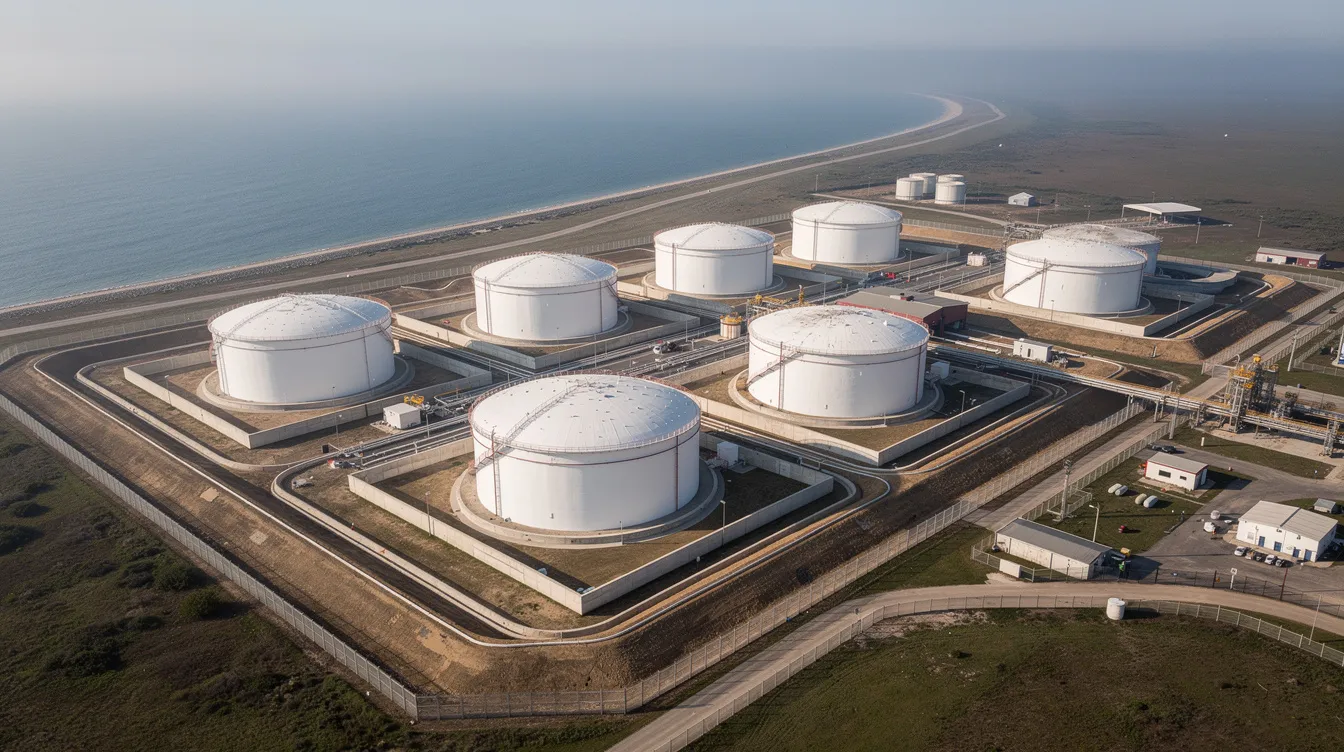
The crude palm oil storage tank farm and refined oil tank farm serve different functions in an integrated configuration. Crude palm oil tanks receive and hold imported cargo until processed; refined product tanks hold RBD palm oil, palm olein and palm stearin awaiting dispatch. Where third-party tank leasing is offered, the terminal operator provides storage space to external traders or processors for a monthly rental per KL plus handling charges.
Palm oil is transported in heated tanks to maintain liquidity, and this requirement extends to the entire tank farm. Crude palm oil and palm stearin must be maintained at specific temperature bands (typically 40-55°C) to remain pumpable. Steam tracing or thermal oil heating systems running through tank walls and pipelines consume fuel or gas continuously, creating a fixed operating cost that persists regardless of tank occupancy.
| Component | Typical Features | Key Design Parameters | Commercial Impact |
|---|---|---|---|
| Crude palm oil tanks | Cone roof, mild steel, heated | 1,000-5,000 KL per tank; steam or thermal oil coils | Determines ship-parcel absorption and refinery feed continuity |
| RBD palm oil tanks | Cone roof, mild steel, mild heating | 500-3,000 KL per tank | Buffers refinery output before fractionation or sale |
| Palm olein tanks | Cone roof, mild steel | 500-3,000 KL; moderate temperature maintenance | Primary finished product; needs segregation from stearin |
| Palm stearin tanks | Heated, insulated, cone roof | 200-1,500 KL; higher heating requirement (stearin solidifies below ~40-45°C) | Higher energy cost per KL; dispatch scheduling critical |
| Bund walls and fire safety | RCC or earthen bunds; foam/hydrant network | Bund capacity ≥110% of largest tank; fire corridor widths per port norms | Statutory compliance; insurance requirement |
| Transfer pumps and pipelines | Centrifugal/gear pumps; insulated pipelines | Sized for target MT/hour flow; piggable sections for product changeover | Throughput bottleneck if undersized |
| Temperature control | Steam tracing, electrical heat tracing, insulation | Maintain 40-55°C; insulation thickness based on ambient conditions | Steam/fuel cost is a recurring operating expense |
| Automation and instrumentation | Tank gauging, level sensors, SCADA | Remote monitoring of level, temperature, flow | Reduces manual errors; enables terminal management |
When converting storage requirements from MT to KL, promoters should use a crude palm oil density of approximately 0.89 to 0.92 MT per KL. For example, 10,000 MT of crude palm oil storage requires approximately 10,870 to 11,235 KL of usable tank volume. Tank foundations in coastal areas must account for soil bearing capacity and corrosion protection. Statutory requirements for edible oil tank farms differ from petrochemical terminals; promoters should validate specific bund wall, leak detection and fire protection norms with local port authority guidelines.
Palm Oil Bulk Handling Infrastructure and Port Logistics
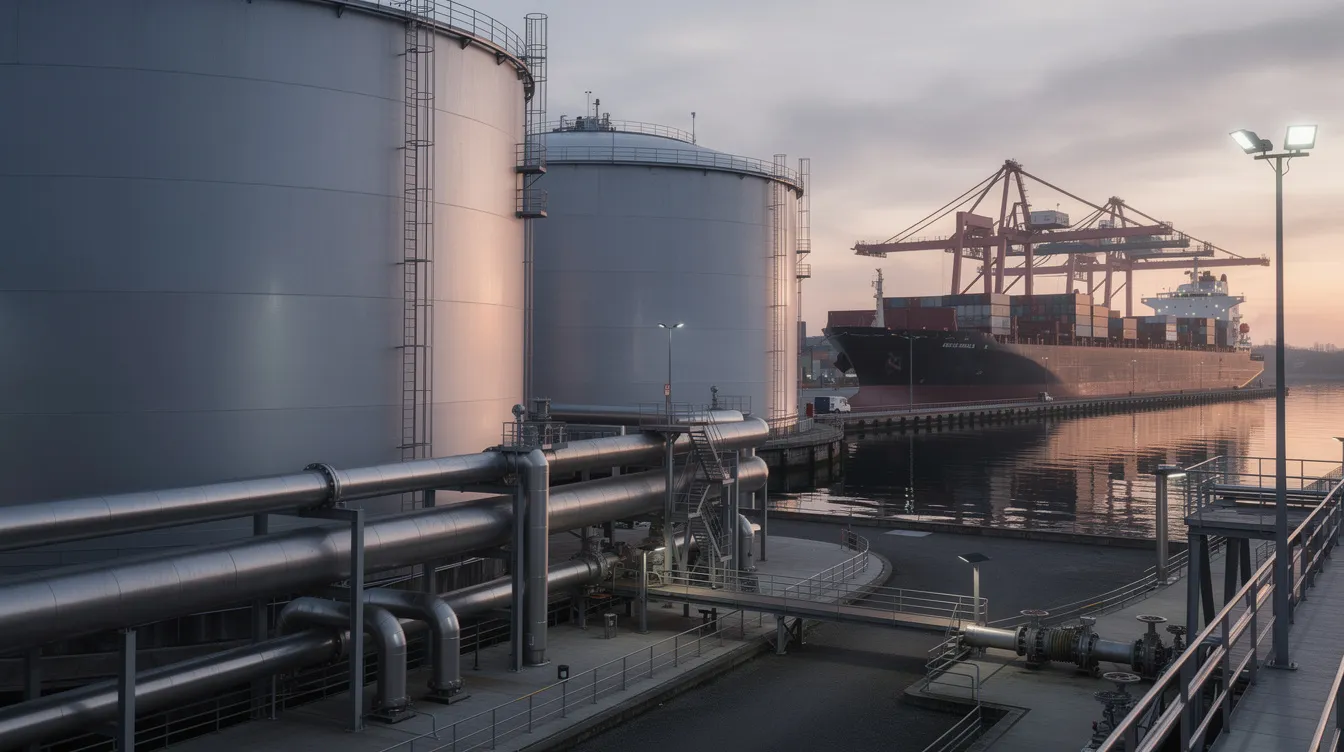
Marine unloading forms the entry point of the supply chain. Dedicated marine loading and unloading arms at the jetty transfer crude palm oil from vessel manifolds into heated pipelines running to the tank farm. Flexible composite hoses are an alternative where fixed arms are not feasible. Pipeline diameters are selected to achieve target MT-per-hour flow rates; larger diameters reduce vessel turnaround time and demurrage cost. Transporting palm oil requires strict quality control to prevent contamination, particularly when multiple edible oils share the same pipeline corridor. Piggable pipeline sections and cleaning protocols prevent cross-contamination between crude palm oil, palm olein and other edible oils.
Bulk liquid transfer equipment includes high-capacity centrifugal or screw pumps, custody-transfer flow meters, strainers, isolation valves and emergency shutdown systems. Higher unloading rates (500-1,000 MT per hour) reduce vessel berthing time from days to hours, cutting demurrage charges that can run to thousands of dollars per day.
Road tanker loading facilities handle finished product dispatch. Key elements include the number of loading bays (sized for daily dispatch volume), top or bottom loading arms, weighbridges with Legal Metrology-approved scales, inline metering, sampling points and seal arrangements that meet edible oil quality standards.
A port-adjacent integrated palm oil refinery with direct jetty pipeline offers the lowest logistics cost per MT, eliminates double-handling of crude palm oil, and shortens the working capital cycle. An inland refinery relying on railway or road tankers from third-party edible oil terminals faces higher transportation costs, longer inventory cycles and greater quality-control complexity. The difference in capex is substantial: the port-based model requires investment in jetty interface and pipeline infrastructure, while the inland model spends more on ongoing logistics and typically pays third-party storage and handling charges.
Jetty connectivity and pipeline rights-of-way are subject to specific port trust or port authority approvals and long-term agreements. These must be evaluated individually; a generic assumption of port access is not sufficient for a bankable DPR.
Palm Oil Refining and Fractionation Technology
An integrated palm oil refinery processes crude palm oil into refined products through a defined sequence of unit operations. At the plantation level, oil palm trees yield fresh fruit bunches that must be processed within 24 hours of harvest; palm oil mills are located near plantations to reduce transit time. Palm oil processing involves sterilization, threshing, and pressing. Fresh fruit bunches are sterilized using high-pressure steam in the initial extraction stage, and fruit separation, pressing and oil clarification removes impurities from the extracted oil. Crude palm oil extraction rates typically range from 18-22% of fresh fruit bunches, with extraction rates of palm oil reaching 23-24% per bunch from high-quality fruit. Palm oil processing plants handle 3 to 60 tonnes of FFB per hour, and extraction efficiency varies from 55% to 90% depending on technology. Continuous systems can achieve extraction efficiencies of 70-90%, while a motorised horizontal digester can process 500-1000 kg FFB per hour. Mechanical presses can extract oil using dry or wet methods, and screw presses are commonly used in the pressing stage, which applies mechanical pressure to extract oil.
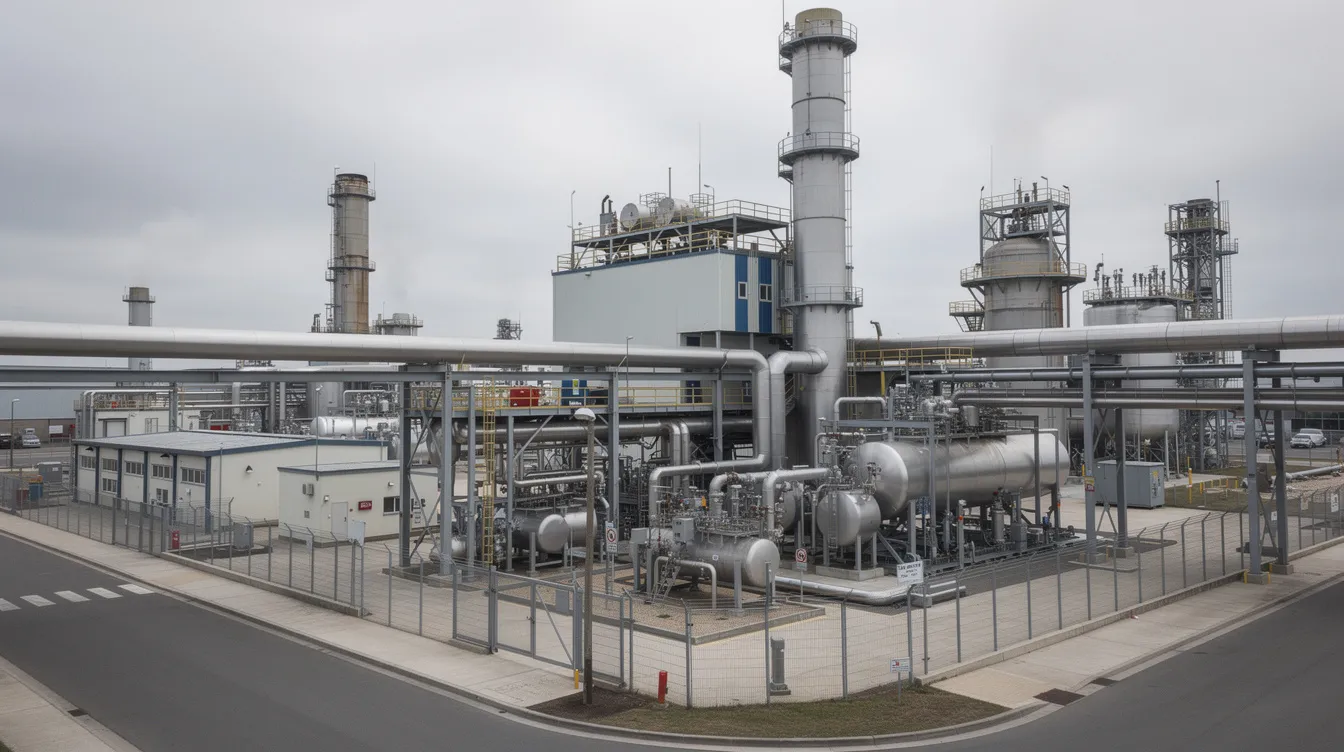
For the refinery block, the standard crude palm oil refining sequence is: receipt and quality testing, preheating, degumming (using phosphoric acid), bleaching (with bleaching earth at 0.8-1.2% w/w dosage, contact time 20-30 minutes at 95-110°C), filtration, and physical refining through deacidification and deodorisation at 240-260°C under deep vacuum (2-4 mbar). PFAD recovery yields a by-product stream sold to oleochemical or soap manufacturers. Refining includes degumming, bleaching, deodorization, and fractionation processes.
RBD palm oil then moves to the fractionation plant for controlled cooling and crystallisation in crystallisers, followed by membrane filter presses that separate palm olein (liquid fraction, approximately 70-80% of RBD input) from palm stearin (solid fraction, approximately 20-30%). For a detailed understanding of crude palm oil refining technology and palm olein and palm stearin fractionation, promoters can refer to Project Report Bank’s dedicated articles.
Illustrative material balance for 100 MT crude palm oil input (example values, not guaranteed performance):
- RBD palm oil output: ~94.7 MT (94.7% yield)
- PFAD recovery: ~4.3 MT (4.3%)
- Refining losses: ~1.0 MT (1.0%)
- From 94.7 MT RBD palm oil: palm olein ~66.3 MT (70%), palm stearin ~28.4 MT (30%)
Key yield and quality drivers include incoming crude palm oil quality (FFA, moisture, impurities), efficiency of degumming and bleaching, stripping steam quality and deodorisation vacuum depth, operating temperature and residence time in the deodoriser, and crystallisation profile and cooling curve in fractionation. Technology choice (batch versus continuous, level of automation) will influence palm oil refinery machinery cost, energy consumption, labour requirement and overall project economics.
Integrated Palm Oil Refinery Process Flow Diagram (Text-Based)
Main process flow:
Imported CPO → Ship Unloading / Road Tanker Receiving → Jetty Manifold & Pipelines → Heated CPO Storage Tanks → Quality Testing & Sampling → Refinery Feed Pumping & Preheating → Degumming → Bleaching → Filtration → Deacidification & Deodorisation → PFAD Recovery (by-product stream) → RBD Palm Oil Storage → Fractionation (Cooling & Crystallisation) → Filtration / Membrane Press → Palm Olein Storage → Palm Stearin Storage → QC Release → Bulk Tanker Loading → Distribution
PFAD is recovered as a separate refinery output stream during deodorisation. It carries commercial value, typically sold to manufacturers of oleochemical products, soap stock and animal feed, adding to overall project revenue. Financial projections should assess operational costs and revenue potential from by-products like PFAD.
Three distinct material flows may coexist within the same integrated facility:
- Oil fully processed through the refinery and sold as refined edible oil or palm fractions.
- Crude palm oil stored and sold without refining (if commercially viable and contractually permitted).
- Third-party crude or refined edible oil stored in the same terminal under physical segregation and separate commercial accounting.
In an integrated palm oil processing plant DPR, the process-flow section should be accompanied by an equipment list and process and instrumentation diagram (P&ID) prepared by qualified process engineers or EPC providers.
Land, Buildings and Utility Requirements
Site selection for an integrated facility prioritises proximity to a deep-draft port with edible oil handling capability, access to national highways and rail for tanker dispatch, availability of industrial utilities (power, water, fuel for steam), zoning clearance for edible oil and tank farm operations, and provision for future capacity expansion.
Indicative land area ranges (illustrative and subject to detailed engineering layouts): 100 TPD integrated facility: 8-15 acres; 300 TPD: 15-25 acres; 500 TPD: 25-40 acres; 1,000 TPD: 45-70+ acres. These include refinery block, fractionation building, tank farm footprint, boiler house, pump houses, control room, administrative block, laboratory, maintenance workshop, truck parking, weighbridge area and internal roads suitable for tanker circulation.
Utility requirements for the refinery and tank farm include:
- Steam. After energy optimisation, steam consumption for refining runs approximately 400-450 kg per tonne of crude palm oil. For a 500 TPD plant operating 330 days, this translates to roughly 66,000-74,000 tonnes of steam per year. Boilers fuelled by natural gas, furnace oil or biomass generate this steam. Biomass waste from palm oil processing can be utilised for energy generation where available.
- Electrical load. Power consumption for refining is approximately 18-22 kWh per tonne of crude palm oil, yielding 3.0-3.6 million kWh annually for the refining section alone. Transformer capacity, DG backup and internal distribution must be sized accordingly.
- Water. Process water, cooling tower makeup, boiler feed and fire-fighting network demand a reliable water source. Cooling towers and air compressors add to the utility footprint.
- ETP and waste management. Effluent treatment plants are required for managing wastewater in palm oil refineries. Environmental compliance in palm oil refining includes managing boiler emissions and wastewater. State Pollution Control Board norms govern discharge limits. Waste management in palm oil refineries is crucial for sustainability and regulatory compliance.
Energy-efficient processes are recommended to reduce operational costs in refineries; heat recovery systems on deodorisers, for instance, can reduce steam consumption by 15-20%. For detailed utility sizing methodology, promoters can refer to Project Report Bank’s article on utility requirements for edible oil refineries.
Integrated Palm Oil Refinery Setup Cost in India
All capital investment figures discussed below are indicative modelling assumptions for a hypothetical project (FY 2026-27 reference). They must not be treated as supplier quotations, verified market prices or sanctioned bank terms. Palm oil processing plant setup costs involve significant initial investment, and actual figures require customised engineering estimates and vendor negotiations.
Capital expenditures cover land, equipment, and operational costs for refinery setup. The major cost segments for an integrated project include:
- Land acquisition or long-term lease and site development
- Civil construction, structural works and foundations
- Refining plant and machinery (degumming, bleaching, deodorisation)
- Fractionation plant (crystallisers, membrane filter presses)
- Crude palm oil and refined product storage tanks
- Thermal oil or steam heating systems and insulation
- Transfer pipelines and pumps
- Marine unloading and truck loading facilities
- Electrical systems and substation
- Boilers, compressors, cooling towers
- Laboratory, QC equipment and automation/SCADA
- Fire-fighting and safety systems
- Environmental management (ETP, emissions control)
- Engineering and EPC services
- Pre-operative and preliminary expenses
- Interest during construction (IDC)
- Contingency and price escalation
- Margin for working capital
Illustrative capex distribution for a 500 TPD integrated palm oil refinery (percentage of total project cost):
| Cost Head | Approximate Share (%) |
|---|---|
| Land and site development | 5-8 |
| Civil construction and structures | 10-14 |
| Refining and fractionation plant and machinery | 20-28 |
| Storage tanks (crude and finished goods) | 12-18 |
| Heating, insulation and thermal systems | 3-5 |
| Pipelines, pumps and bulk handling equipment | 5-8 |
| Marine unloading and truck loading | 3-6 |
| Electrical, utilities, boilers | 6-10 |
| Automation, lab, fire safety, environmental | 3-5 |
| EPC, engineering, pre-operative, IDC, contingency | 10-15 |
| Margin for working capital | 5-8 |
A small non-integrated edible oil refinery (30-100 TPD) costs roughly ₹10-50 crore excluding land and stock. Larger integrated plants, depending on capacity, location, level of automation and whether jetty or pipeline works are included, fall in the range of ₹300-600 crore. Capital investment for palm oil processing ranges widely depending on scale and scope; at the plantation extraction level, even basic units require investment of $5,000 to $15,000 per tonne of hourly capacity. Capex intensity per TPD decreases for core refinery machinery as capacity scales up, but tank farm, pipeline and jetty infrastructure costs are relatively lumpy and do not scale proportionally.
Whether external port infrastructure (jetty construction, common-user pipelines outside the plot boundary, dredging) is provided by the port operator or the project company itself changes the total integrated palm oil refinery setup cost by a large amount. Promoters should clarify this allocation early in project planning. For granular capex benchmarking, refer to Project Report Bank’s articles on palm oil refinery setup cost and edible oil refinery project cost and investment.
Palm Oil Storage Terminal Project Cost and Investment Economics
Tank farm and bulk handling capex should be separated from core refinery capex in any DPR because these two blocks have different cost drivers, revenue streams and risk profiles.
| Dimension | Refinery Block | Storage & Bulk Handling Block |
|---|---|---|
| Major Components | Degumming, bleaching, deodorisation, fractionation equipment | Tanks, pumps, pipelines, unloading/loading systems, fire protection |
| Nature of Cost | Process equipment, chemicals, skilled operators | Civil, mechanical fabrication, thermal systems, automation |
| Revenue Streams | Refining margin (spread between crude and refined product prices) | Captive cost saving; or third-party tank rental (₹/KL/month), throughput handling charges (₹/MT) |
| Risk Drivers | Commodity spread, yield, capacity utilisation | Occupancy rate, customer lock-in, port congestion, heating fuel cost |
Main cost drivers for the storage terminal include number and capacity of tanks, tank construction material, insulation and heating arrangements, pump houses and manifolds, interconnecting pipeline length and diameter, fire-fighting hydraulics and foam systems, automation and gauging, and port connectivity fees or pipeline corridor rights.
Revenue models for the terminal block include captive storage only (cost centre enabling refinery operations), third-party tank leasing with monthly or annual rental per KL, throughput-based handling charges on receipts and dispatches, and value-added services like heating, blending and quality testing. These depend on port licences and commercial contracts. A palm oil storage terminal project cost analysis must examine expected throughput volumes, lock-in contracts, customer credit profiles and minimum guaranteed off-take commitments before assuming any bankable third-party revenue.
Raw Material Procurement and Working Capital Requirements
Crude palm oil procurement follows a defined chain: sourcing from suppliers in Indonesia, Malaysia or other origins in South East Asia and West Africa (tropical countries where oil palm is cultivated); contracting on CIF, CNF or FOB basis; determining shipment sizes, laycan periods and quality specifications (FFA, moisture, impurities); and arranging payment through letters of credit. Proximity to raw material sources affects transportation costs and operational efficiency. Key recommendations for project success include securing long-term supply agreements for consistent supply of crude palm oil.
Illustrative landed-cost build-up for crude palm oil at Indian port (hypothetical structure, not live prices):
| Cost Component | Basis |
|---|---|
| International crude palm oil price | CIF per MT (varies daily) |
| Ocean freight | Vessel type and route dependent |
| Marine insurance | Percentage of CIF value |
| Indian customs duty (BCD + AIDC) | Effective ~27.5% on crude palm oil (as of September 2024 revision) |
| Port charges and wharfage | Per MT, port-specific |
| Survey and inspection | Per shipment or per MT |
| Pipeline and storage charges | Per MT or per KL/month |
| GST (where applicable) | Per prevailing rate |
Working capital assessment for a 500 TPD refinery must capture crude palm oil inventory (20-30 days), WIP in refinery (1-2 days), finished goods inventory (15-20 days for RBD palm oil, palm olein, palm stearin), receivables from bulk buyers (15-30 days), and creditor days from suppliers (LC tenor, typically 30-90 days). First-year operational costs are projected to be substantial due to the high value of raw materials held in inventory. Operating expenses account for 70-80% of total costs, with crude palm oil dominating the cost structure. Foreign exchange exposure (INR versus USD), commodity price risk and basis risk between crude palm oil and refined product prices must be addressed in any integrated palm oil refinery project report. Detailed project reports include risk assessments for supply chain and market uncertainties.
The distinction between term-loan financing for fixed assets and working capital facilities (cash credit, LC limits, buyer’s credit) is critical. A profitable refinery can face cash-flow stress if working capital is underestimated.
Palm Oil Refinery Operating Cost and Production Economics
Operating costs are driven by raw material consumption, accounting for 70-80% of total production cost. The remaining conversion cost includes chemicals, utilities, manpower, maintenance, insurance and finance charges on working capital.
Illustrative operating cost structure per MT of refined palm oil (relative weighting):
| Cost Head | Approximate Share of Total Cost |
|---|---|
| Crude palm oil (raw material) | 85-90% |
| Refining chemicals (phosphoric acid, bleaching earth, filter aids) | 0.5-1.0% |
| Steam and fuel | 1.5-3.0% |
| Power | 0.5-1.0% |
| Manpower | 0.5-1.5% |
| Repairs, maintenance, tank coatings | 0.5-1.0% |
| Storage terminal operations | 0.5-1.5% |
| Quality testing, insurance, port charges | 0.3-0.8% |
| Finance cost on working capital | 1.5-3.0% |
Gross refining margin is computed as the weighted-average realisation from RBD palm oil, palm olein, palm stearin and PFAD minus crude palm oil landed cost and process cost. Gross profit margins for palm oil processing range between 20-30% at the conversion level (excluding raw material). Gross refining margin is not equal to net profit; it must cover fixed costs, depreciation, interest on term loans and taxes.
Under-utilisation raises fixed cost per MT and reduces DSCR. For new integrated projects, conservative ramp-up assumptions in financial projections are prudent: typically 50-60% utilisation in year one, reaching 75-85% by year three or four. Variable costs scale with throughput, but fixed costs (manpower, heating, insurance, port fees) persist regardless of utilisation levels. For deeper margin-analysis methods, promoters can consult Project Report Bank’s guides on import-based palm oil refinery feasibility.
Financial Projections, CMA Data and Bank Finance
From a project-finance perspective, the financial model for an integrated palm oil refinery must integrate total capital investment, means of finance, sales projections by product, cost of production, and year-wise projected profit and loss, cash flow and balance sheet over 7-10 years. Financial projections assess capital investment, operating costs, and demand outlook. Net Present Value and Internal Rate of Return are key financial indicators for project viability.
CMA Data for Indian banks requires projected balance sheets, profit and loss statements, fund flow statements, working capital assessment (including Maximum Permissible Bank Finance), and ratio analysis. Where the integrated project offers terminal services, CMA Data must capture both manufacturing revenue and infrastructure revenue.
Key formulas used in the financial model:
- DSCR = (Profit After Tax + Depreciation + Interest on Term Loan) / (Term Loan Principal Repayment + Interest on Term Loan)
- Break-even capacity utilisation = Total Fixed Costs / (Selling Price per MT minus Variable Cost per MT) expressed as a percentage of installed capacity
- Working capital cycle (days) = Inventory days + Receivable days minus Creditor days
Illustrative financial indicators for a hypothetical 500 TPD integrated plant (mature-year operation):
| Indicator | Illustrative Range |
|---|---|
| EBITDA margin (on net sales) | 4-8% (palm oil refining is a thin-margin, high-turnover business) |
| Average DSCR (over loan tenor) | 1.3x-1.8x (depends on leverage, margin, utilisation) |
| Interest coverage ratio | 2.0x-4.0x |
| Simple payback period | 6-10 years |
| Project IRR (pre-tax) | 12-18% (indicative; sensitive to refining spread) |
Indian banks scrutinise project cost reasonableness, promoter contribution (typically 25-33% of total project cost, though not universally fixed), sensitivity of DSCR to margin fluctuations, adequacy of working capital, experience of promoters in edible oil or commodity trading, and reliability of supply and off-take linkages. For detailed guidance on structuring palm oil refinery financial projections and CMA Data, promoters can refer to Project Report Bank’s dedicated article.
Palm Oil Refinery and Storage Terminal Feasibility Analysis
Feasibility studies analyse financial sustainability and operational efficiency of projects across six dimensions.
Technical feasibility examines whether the selected refining and fractionation technology matches the planned capacity and product slate (RBD palm oil, palm olein, palm stearin, PFAD). Integration between tanks, pumps, pipelines and the process plant must function without bottlenecks, and quality-control systems must meet FSSAI and buyer specifications.
Market feasibility assesses crude palm oil sourcing reliability from South East Asia, domestic demand projections for palm-based edible oil blends, the competitive landscape at the target port region, and whether anchor customers exist for third-party storage or toll refining. Market research must go beyond generic industry trends to examine specific hinterland consumption patterns and market forecasts.
Financial feasibility requires testing profitability, cash generation, DSCR, IRR and NPV under base, optimistic and conservative cases. Realistic assumptions on capacity ramp-up, refining spreads and working capital funding costs determine whether the business plan supports the proposed debt structure.
Infrastructure feasibility evaluates port access, jetty allocation, pipeline corridor rights, land suitability, power and water availability, road connectivity for tankers and potential constraints like port congestion.
Regulatory feasibility covers FSSAI norms, State Pollution Control Board approvals, environmental clearance thresholds, port by-laws and fire-safety regulations. Regulations for palm oil refineries often require environmental impact assessments. Specific statutory applicability must be checked project-wise.
Commercial feasibility compares a standalone refinery versus an integrated refinery and storage terminal model, weighing incremental capex against savings in logistics, demurrage, storage charges and potential terminal revenue.
Before proceeding to full-scale implementation, an investor should confirm answers to these questions:
- Is jetty access or pipeline corridor secured or securable at the chosen port?
- Are indicative offtake or throughput agreements available from credible counterparties?
- Has a lender expressed preliminary interest in financing the project at the proposed scale?
- Is the promoter’s equity contribution confirmed and deployable within the implementation schedule?
- Does a realistic sensitivity analysis show DSCR remaining above 1.0x even under adverse conditions?
- Are all critical statutory approvals identified, and is the timeline for obtaining them mapped?
For a comprehensive comparison of refinery models and return analysis, promoters may consult Project Report Bank’s edible oil refinery feasibility and profitability guide.
Financial Risk and Sensitivity Analysis
Palm oil refining operates on thin margins with high raw material intensity. A 2-3% movement in crude palm oil prices can shift EBITDA by 20-40% because raw materials constitute 85-90% of production cost.
Key risk drivers include crude palm oil import price volatility, refined palm oil and palm olein realisation changes, foreign exchange movements (INR versus USD), customs duty and GST structure changes, shifts in competing oil prices (soybean, sunflower), capacity utilisation changes from demand or technical downtime, variation in steam and fuel costs, interest rate increases, port congestion and demurrage, and construction and commissioning delays.
Illustrative sensitivity matrix (relative impact on mature-year EBITDA and DSCR):
| Scenario | Change Assumed | Impact on EBITDA | Impact on Average DSCR |
|---|---|---|---|
| Base Case | As per model assumptions | Reference level | Reference level (e.g., 1.5x) |
| High CPO Price Case | +10% crude palm oil cost, product prices unchanged | EBITDA drops ~30-50% | DSCR falls below 1.2x |
| Low Margin Case | Refining spread narrows by ₹1,000/MT | EBITDA drops ~25-40% | DSCR under pressure |
| Low Capacity Case | Utilisation at 55% vs 75% base | EBITDA drops ~20-30%; fixed costs not absorbed | DSCR may breach 1.0x |
| Currency Depreciation | INR weakens 5% vs USD | Crude cost rises ~5%; margins compressed if product prices lag | DSCR impacted in near term |
Stress-testing loan repayment schedules and covenant compliance under adverse conditions is essential in any serious integrated palm oil refinery project report. Project Report Bank, under the guidance of CA Manish Gugliya, performs detailed sensitivity and scenario analysis as part of customised financial modelling for integrated refinery and terminal projects.
Government Approvals and Regulatory Requirements
The following approvals are typically required, subject to project configuration and location:
Entity-level: Company incorporation (or LLP/partnership registration), PAN/TAN, GST registration, Import Export Code (IEC) from DGFT for crude palm oil imports.
Factory-level: Building plan approval from local authority, Factory Licence under Factories Act, boiler registration with Chief Inspector of Boilers, electrical safety clearances, labour law registrations covering wages, welfare and working conditions.
Environmental: Consent to Establish (CTE) and Consent to Operate (CTO) from State Pollution Control Board. Prior Environmental Clearance (EC) may be triggered depending on project size and location. Requirements cover ETP, boiler emission norms and sludge disposal. Environmental compliance in palm oil refining includes managing boiler emissions and wastewater discharge within prescribed limits.
Food safety and quality: FSSAI licence for manufacturing and refining edible oil. Standards apply for RBD palm oil, blended edible oil declarations, packaging and labelling for retail packs.
Port and customs: Agreements with port authority for jetty or berth allocation, pipeline corridor permissions, bonded warehouse or tank approvals from Customs where applicable, import documentation and EDI integration.
Legal Metrology: Requirements apply where retail or bulk-pack cartons are sold with declared weights. Specific licences, fees and compliance timelines should be confirmed with relevant authorities at the project-planning stage.
Project Implementation Schedule
| Stage | Description | Tentative Duration (Months) |
|---|---|---|
| 1 | Preliminary feasibility and concept note | 1-2 |
| 2 | Market and location study; configuration freeze | 2-3 |
| 3 | Detailed project report preparation; lender and investor discussions | 2-3 |
| 4 | Statutory approvals and port permissions | 3-6 (can overlap with DPR) |
| 5 | EPC and major equipment vendor finalisation | 2-4 |
| 6 | Financial closure and loan documentation | 2-4 |
| 7 | Detailed engineering, procurement and civil works | 6-10 |
| 8 | Tank farm fabrication and erection | 6-10 (partially overlaps) |
| 9 | Mechanical and electrical installation; pipeline and jetty interface | 4-8 |
| 10 | Pre-commissioning, trial runs and performance tests | 2-3 |
| 11 | Commercial operations date (COD) | Month 18-30 from project start |
Actual schedule depends on port approvals, EPC capacity, monsoon impact and supply-chain conditions. The critical path typically runs through land possession, port allocation decisions and long-lead equipment deliveries (deodoriser columns, vacuum systems, large storage tanks). Delays in these items push COD and increase interest during construction. Promoters should maintain buffer time and contingency budgets and consider phased commissioning; for example, completing the storage terminal first to begin earning handling revenue while refinery installation continues.
Investor-Ready DPR for an Integrated Palm Oil Refinery
For medium-to-large projects (300-1,000 TPD plus tank farm), lenders, equity investors and infrastructure funds expect a detailed project report that integrates technical configuration, capex estimates, operating assumptions, market analysis and fully-linked financial projections. A template-based document does not meet this standard.
Key components of a robust DPR include:
- Executive summary and project rationale
- Industry and market analysis for palm oil and edible oils, covering industry trends and emerging markets
- Technical configuration, capacity planning and manufacturing process description
- Detailed capex and project cost estimates with basis of estimate
- Operating cost benchmarks and manning plan
- Implementation schedule and EPC contracting strategy
- Regulatory and risk analysis
- Projected P&L, cash flows, balance sheets, ratios, DSCR and sensitivity analysis
- Working capital assessment and CMA Data for banks
Project Report Bank, under CA Manish Gugliya, brings together project-finance experience, financial modelling capability and bank appraisal understanding to prepare customised DPRs for integrated palm oil refinery and storage terminal feasibility, tailored to each promoter’s capacity, port location and funding structure. Technical input (detailed engineering, equipment specs, plant layouts) must be provided by competent process engineers or EPC firms; the DPR’s financial and commercial robustness is the domain of professional financial consultants.
For promoters exploring strategic investors or PE funds, an investor-ready DPR, pitch deck and valuation support are essential. Project Report Bank’s guide on raising equity funding in India addresses this requirement in detail.
For professional DPR preparation, financial feasibility advisory, CMA Data and project finance support for integrated palm oil refinery and storage terminal projects, contact CA Manish Gugliya through www.projectreportbank.com.
Every project requires an independent assessment based on location, installed capacity, storage configuration, financing structure and commercial assumptions. The numbers and examples in this article are illustrative models; they are not promises, guaranteed bank norms or investment assurances.
Frequently Asked Questions
The following FAQs address common questions about integrated palm oil refinery and storage terminal projects in India. Answers are general guidance based on typical project configurations; project-specific professional advice is recommended before committing capital. All financial figures discussed are illustrative and not guaranteed outcomes.
What minimum capacity makes sense for an integrated palm oil refinery and storage terminal in India?
While a 100 TPD refinery can technically be integrated with a small tank farm, the economics of port pipelines, jetty interfaces and dedicated infrastructure usually favour capacities of 300 TPD and above. At lower capacities, promoters may prefer using common-user terminals or third-party tanks and focusing only on refining. At 500-1,000 TPD scale, dedicated integrated configurations become more compelling because the per-MT cost of infrastructure is spread over larger throughput. The optimum size depends on available crude palm oil sourcing, hinterland demand, promoter balance sheet strength and lender comfort with project risk.
Can an integrated palm oil refinery also process other edible oils?
Many modern edible oil refineries in India are designed as multi-seed edible oil plant facilities capable of processing soybean, sunflower and rice bran oils with suitable changeover, but tank segregation, pipeline cleanliness and separate storage are essential for product quality and FSSAI labelling compliance. Designing a multi-seed refinery at the outset improves asset utilisation through the rising global population’s demand for diverse edible oils, but adds complexity and incremental capex. Promoters should define the target product mix early so that EPC vendors configure appropriate flexibility.
How long is the typical payback period for an integrated palm oil refinery project?
Based on broad industry experience, payback periods for well-structured integrated projects often lie in the 6-10 year range depending on capacity, capex, refining margins, high yield realisation and utilisation levels, but can be shorter or longer depending on market cycles. Any payback estimate must be derived from a detailed financial model incorporating realistic base-case and downside-case refining margins. A feasibility study prepared with realistic raw material requirements and market sizing provides a defensible basis for payback calculations, rather than generic percentage assumptions.
Is it necessary to have long-term offtake agreements before approaching banks?
While not legally mandatory, long-term offtake or throughput agreements with reputed buyers strengthen the bankability of integrated projects. Banks look favourably at anchor customers, brand tie-ups or board resolutions from group companies committing volumes, especially for greenfield projects at emerging ports. Where firm contracts are not possible, promoters should at least provide evidence of demand mapping and historical trade flows through the chosen port.
What are common mistakes promoters should avoid in planning these projects?
Typical pitfalls include underestimating working capital needs, overestimating achievable refining margins, assuming high capacity utilisation from year one, and not securing clear port and pipeline rights before committing major capex. Additional issues include inadequate redundancy in pumps and heat tracing systems, limited tank turnover flexibility, and neglecting proper risk and sensitivity analysis in the DPR submitted to banks. Promoters should invest time in a robust feasibility study and independent detailed project report before locking in land acquisition costs, EPC contracts or large debt facilities.