A palm olein fractionation plant project report is the foundational document for any entrepreneur or refiner planning to invest in downstream edible oil processing in India. This article provides a structured, project-finance-oriented guide covering fractionation technology, machinery, capacity planning, capital investment, yields, operating economics, profitability and bank-finance feasibility for palm oil fractionation plants sized between 50 and 500 TPD.
Key Takeaways
- Palm olein (liquid fraction) and palm stearin (solid fraction) are obtained by dry fractionation of RBD palm oil through controlled cooling and membrane filtration – a distinct process from crude palm oil refining.
- A palm olein fractionation plant project report must integrate technology selection, olein and stearin recovery assumptions, commodity price spreads and detailed financial projections including DSCR, IRR and sensitivity analysis.
- Palm oil fractionation plant cost and profitability depend heavily on RBD palm oil landed price, recovery yield (typically 70–80% olein), energy consumption and working capital intensity.
- Standalone fractionation plants and integrated refining-cum-fractionation complexes carry different capex, opex and risk profiles – both must be compared before committing capital.
- Project Report Bank, led by CA Manish Gugliya, FCA, DISA (ICAI), prepares customised bankable DPRs, CMA Data and financial models for palm oil and edible oil processing projects.
Introduction – Palm Olein & Palm Stearin Fractionation Plant Project Report in India
Palm oil is the most fractionated oil globally. The palm oil fractionation process separates RBD palm oil into palm olein – a liquid oil used widely as cooking and frying oil – and palm stearin, a higher-melting solid fraction used in margarine, shortening, bakery fats and oleochemical production. This fractionation sits downstream in the edible oil processing chain: crude palm oil is first refined into RBD palm oil, which then enters the fractionation plant.
Indian refiners and entrepreneurs consider palm oil fractionation for several reasons:
- India imports large volumes of palm oil; domestic fractionation adds value and reduces dependence on imported fractionated products.
- Demand from food industry segments – frying oil users, bakery, confectionery and vanaspati – continues to grow.
- It reduces dependence on imported specialty fats for refineries producing functional products.
A standalone fractionation plant purchases RBD palm oil externally, while an integrated refinery-cum-fractionation complex processes crude palm oil end-to-end. The choice materially affects palm oil fractionation plant cost, utility sharing and working capital. A detailed DPR should cover plant setup, machinery, yields, project cost, means of finance, DSCR, IRR and risk analysis before any investment commitment. For upstream context, promoters may review palm oil refinery setup cost, capacity and capital investment.
Understanding Palm Olein and Palm Stearin
Palm olein is the comparatively liquid fraction, clear at tropical ambient temperatures, with a lower melting point and higher iodine value (typically IV 56–60). Olein fractions are used for frying and cooking oils across retail, institutional and food processing segments. Palm oil’s saturated fatty acids provide better oxidation stability, making olein suitable for repeated high-temperature frying.
Palm stearin is the higher-melting solid fraction (IV approximately 30–36), used in margarine and shortening production, bakery fats, biscuits, confectionery coatings and as oleochemical feedstock. Mid-fractions enhance product functionality in baked goods and specialty confectionery applications.
| Parameter | Palm Olein | Palm Stearin |
|---|---|---|
| Physical state (25–30 °C) | Clear liquid oil | Semi-solid to solid |
| Melting point range | Lower (cloud point 7–10 °C) | Higher (slip MP 45–55 °C) |
| Iodine value | 56–60 | 30–36 |
| Typical applications | Cooking oil, frying oil, vanaspati blending | Shortening, margarine, bakery fats, soaps |
| Key quality specs | Cloud point, IV, FFA, colour | Melting point, solid fat content, IV |
| Commercial considerations | High volume, price-sensitive | Lower volume, grade-dependent pricing |
Consistent oil quality in both fractions commands better market realisations; off-spec material may require discounting or reprocessing.
Palm Olein and Stearin Fractionation Process – Industrial Technology
Fractionation technology has been applied for almost 150 years. Hippolyte Mège-Mouriès invented a method for fat separation in 1869, and early fractionation relied on gravity for phase separation. The fractionation industry boomed in the 1960s due to palm oil production increases. Modern fractionation uses techniques like centrifuges and membrane filters for efficient solid-liquid separation.
Dry fractionation is the preferred method for separating palm oil without chemicals. The fractionation process consists of these stages:
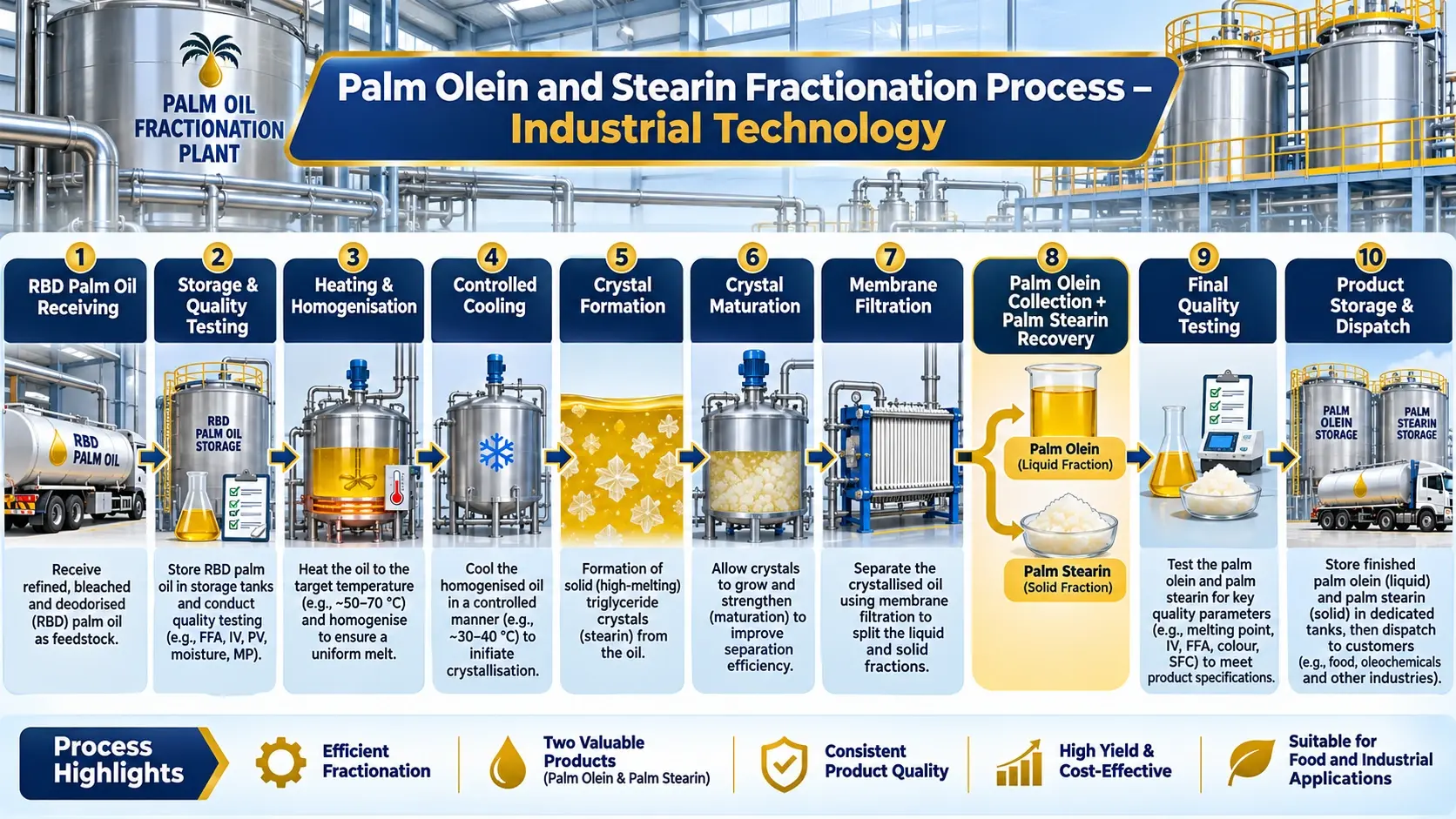
RBD Palm Oil Receiving → Storage & Quality Testing → Heating & Homogenisation → Controlled Cooling → Crystal Formation → Crystal Maturation → Membrane Filtration → Palm Olein Collection + Palm Stearin Recovery → Final Quality Testing → Product Storage & Dispatch
The palm oil fractionation process includes thermal conditioning, controlled cooling, and filtration. Crystallization occurs in a controlled cooling process where high-melting triglycerides crystallize first at lower temperatures, forming crystals that can be separated from the remaining liquid phase. Cooling rates affect crystal size and filtration efficiency – slower cooling (typically 0.2–3 °C per hour) produces larger, more filterable crystals. Membrane press filters are commonly used for solid-liquid separation, applying squeeze pressures of 6–30 barg to improve fraction purity.
Multi-stage fractionation increases marketable output by 5–10%, allowing refiners to extract additional fractions from palm oil. Mid-fractions enhance product functionality for industrial applications and multi-stage fractionation integrates with margarine and shortening production lines. However, only larger or specialty-fat producers typically adopt such configurations.
Dry fractionation differs fundamentally from solvent fractionation (which uses solvents like hexane) and detergent-assisted methods. It is preferred for edible oil in India due to the absence of solvent residues and simpler regulatory compliance.
Refining operations – degumming, neutralisation, bleaching, deodorisation – are upstream steps in edible oil processing and are not part of fractionation itself.
Palm Oil Fractionation Plant Capacity Planning
Plant capacity typically ranges from 25 to 200 metric tons per day for mid-scale operations, while larger integrated refiners may install 300–500 TPD units. Nameplate capacity reflects feed throughput under defined operating hours, but effective daily throughput depends on crystallisation batch times, filtration cycle duration and maintenance downtime.
Round-the-clock operation (three shifts) is standard in oil fractionation plants to optimise chilling energy and spread fixed costs. Promoters should distinguish input capacity (TPD of RBD palm oil processed) from saleable output capacity after accounting for process losses and product specifications. Capacity selection should synchronise with upstream refining throughput and downstream market commitments.
Palm Oil Fractionation Plant Machinery and Equipment
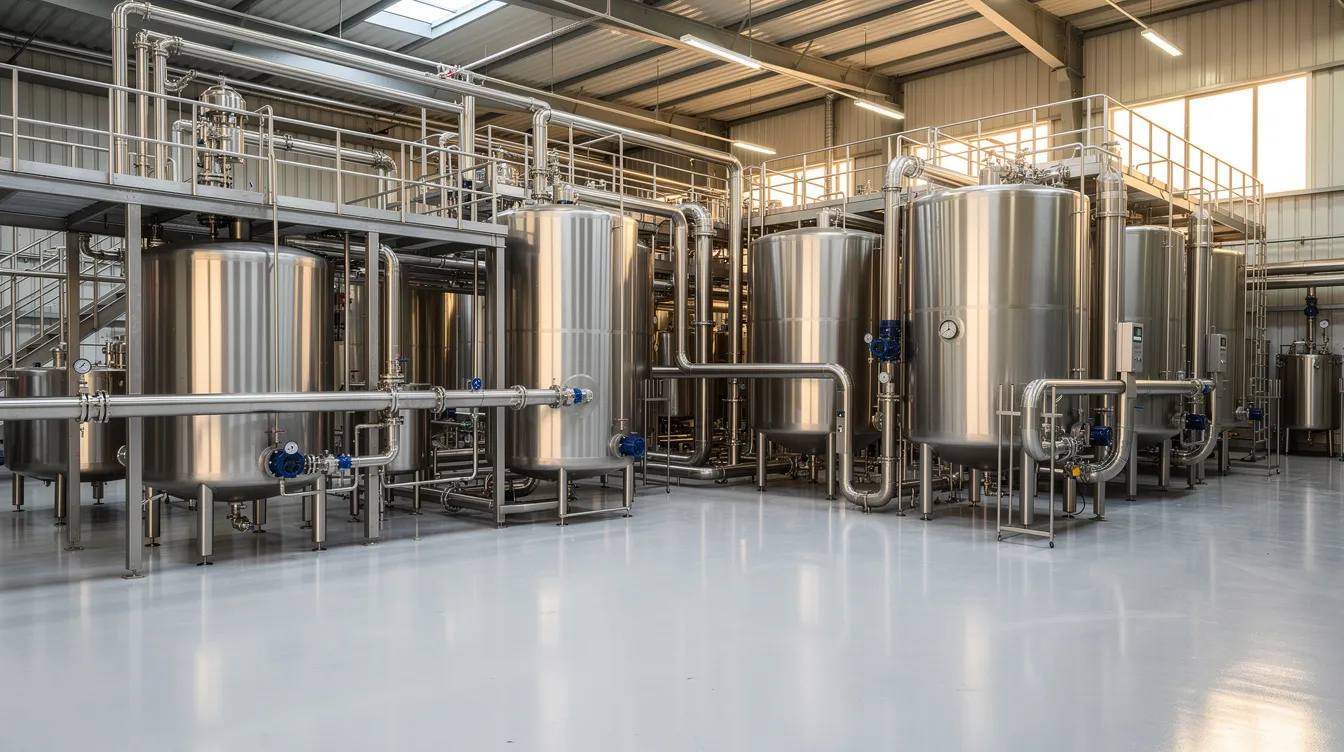
Major palm oil fractionation plant machinery includes RBD palm oil storage tanks, feed transfer pumps, heat exchangers, crystallisation vessels with cooling and agitation systems, temperature control instrumentation, refrigeration or chilled-water systems, membrane filter press units, olein collection tanks, stearin discharge and handling equipment, polishing filters, product storage tanks, piping and valves, electrical panels, PLC/SCADA automation and laboratory instruments.
| Equipment | Function | Key Cost Drivers |
|---|---|---|
| Crystallisers | Controlled cooling and crystal growth | Cooling surface area, volume, insulation |
| Membrane filter press | Solid-liquid separation of formed crystals from liquid phase | Filtration area, squeeze pressure, cycle time |
| Refrigeration system | Chilled water supply for crystallisers | Cooling capacity, compressor efficiency |
| PLC/SCADA | Automated temperature ramp and process control | Complexity, sensor integration |
Crystalliser design and membrane filter-press capacity are the most critical determinants of both product quality and achievable throughput. Process efficiency depends heavily on getting these specifications right. Promoters evaluating edible oil refinery machinery, technology and EPC selection will find similar vendor evaluation principles applicable here.
Land, Building, Plant Layout and Utility Requirements
Proper site selection criteria include proximity to raw materials and transport links – ideally near ports or refinery clusters. The factory building requires a temperature-controlled crystallisation area, a filtration section with adequate headroom for filter presses, a utility room for chillers and heating systems, and a QC laboratory.
Key utilities include electrical power (connected load dominated by chillers and pumps), thermal oil or steam for preheating RBD palm oil, cooling water systems (approximately 0.16 m³/t feed as make-up), compressed air, and fire safety infrastructure. Environmental regulations require wastewater management and effluent treatment where applicable. A standalone plant needs its own complete utility block, whereas an integrated facility shares these with the refinery.
Palm Oil Fractionation Plant Cost and Capital Investment
Palm oil fractionation plant cost varies substantially with capacity, automation and site conditions. Major capital cost heads include land and civil works, crystallisers and cooling systems, membrane filter press, storage tanks, refrigeration units, electrical and instrumentation, PLC/SCADA, erection and commissioning, engineering, contingencies and interest during construction.
For smaller standalone plants (50–100 TPD), the fractionation module capex may range approximately ₹10–30 crore depending on location and imported versus domestic equipment. For larger units within integrated complexes, fractionation module investment may represent 15–25% of total project cost. Refrigeration and crystallisation equipment usually account for a significant share of total cost. For comparison with upstream investment, promoters may reference edible oil refinery project cost and investment structures.
Palm Olein and Palm Stearin Yield, Recovery and Material Balance
The typical product yield for palm olein ranges from 70% to 80% of RBD palm oil input in single-stage dry fractionation, with palm stearin at 18–30% and process losses around 1%. The project aims to achieve a balance between recovery rates and product quality in fractionation – higher olein yield (softer cut) may result in higher cloud point, potentially requiring price discounts.
Product quality in palm oil fractionation is influenced by raw material quality and processing conditions, including feedstock IV, crystallisation temperature programme, cooling rate and filtration pressure. The triglycerides present in RBD palm oil determine the achievable separation.
Illustrative example (100 TPD, 330 operating days, 80% olein recovery):
- Annual feed: 33,000 tonnes
- Palm olein output: ~26,400 tonnes
- Palm stearin output: ~6,270 tonnes
- Process losses: ~330 tonnes
A 5-percentage-point drop in olein recovery (from 80% to 75%) would reduce annual olein output by approximately 1,650 tonnes – a material impact on contribution margin and overall palm oil fractionation plant profitability.
Palm Olein and Palm Stearin Market Opportunities in India
Market analysis identifies target customers and assesses demand-supply dynamics for edible oils. India’s palm oil consumption spans retail packed oils, institutional frying, snack food manufacturing and processed foods. Stearin demand comes from bakery and confectionery manufacturers, shortening producers and oleochemical companies.
Locating near ports such as Kandla, Mundra or Chennai reduces freight on both RBD palm oil inputs and fractionated oil dispatch. As of mid-2026, RBD palm olein CIF India was approximately USD 1,236/MT and stearin around USD 1,135/MT. Commodity price volatility in global palm oil markets, exchange rates and import duties affect both input costs and output realisations. Promoters should examine recent market data rather than relying on historical high spreads.

Palm Oil Fractionation Plant Operating Costs
Operating costs are dominated by RBD palm oil procurement (typically 70–80% of total cost). Other components include electricity and refrigeration (approximately 15–25 kWh per tonne of feed), heating utilities, manpower, repairs and maintenance, filtration consumables and factory overheads. Staffing needs should be evaluated in the plant’s organizational structure, covering operators, QC staff and management.
Energy efficiency improvements – such as upgrading chillers – can reduce electricity consumption from approximately 20–25 kWh/t to 15–16 kWh/t, yielding meaningful per-tonne savings across annual throughput. Joint-product costing should allocate total cost rationally between olein and stearin; the full feedstock cost cannot be independently charged to both products.
Palm Oil Fractionation Plant Profitability and Revenue Model
Financial viability is determined by the relationship between input costs and product selling prices. The processing technology yields two revenue streams:
Total Revenue = (Olein Quantity × Olein Price) + (Stearin Quantity × Stearin Price)
Gross Processing Contribution = Total Revenue − RBD Palm Oil Cost − Variable Processing Costs
This contribution must cover fixed costs, depreciation and interest to generate net profit. A decline in stearin realisation – even while olein demand remains strong – can materially weaken overall plant economics. The spread between weighted-average product realisations and landed feedstock cost is the central variable in any fractionated palm oil business model. Operational flexibility to adjust the olein-stearin cut based on market conditions provides some commercial advantage.
Working Capital Requirements
Working capital for a palm oil fractionation plant can be substantial due to high-value RBD palm oil inventory, finished goods in tanks and customer receivables. Rising palm oil prices increase the rupee value of physical inventory, expanding bank drawing power requirements. Promoters should model realistic inventory holding periods and credit terms rather than assuming immediate customer payment or generous supplier credit.
Financial Projections, Bank Finance, DSCR, IRR and Investment Feasibility
Financial projections should include capital and operational expenditures along with profitability analysis, typically modelled over 7–10 years. Capacity utilisation should ramp up realistically – for example, 60% in year one, 75% in year two, and 85–90% from year three onward. Banks focus primarily on DSCR and cash flow rather than headline accounting profit.
| Financial Indicator | What It Represents | Importance for Lenders |
|---|---|---|
| DSCR | Cash available versus debt-servicing obligations | Primary loan repayment adequacy test |
| IRR (Project) | Time-adjusted return on total investment | Indicates project-level viability |
| Break-even | Sales volume covering all costs | Margin-of-safety assessment |
| Payback period | Time to recover capital investment | Risk indicator for capital recovery |
Feasibility studies assess the technical, financial, and market aspects of project viability – not just projected profit.
Sensitivity Analysis and Financial Risks
Even a 2–3% adverse movement in price spread or yield can turn a marginally viable fractionation project into a stressed one. Key risks include RBD palm oil price increases, lower olein or stearin realisations, reduced recovery, higher power tariffs, extended customer credit and commissioning delays. Mitigation strategies include conservative debt structuring, diversified customer relationships, long-term sourcing contracts and energy-efficient equipment selection.
Statutory Approvals, Food Safety and Regulatory Compliance
Quality control measures are essential to ensure compliance with food safety standards. Key requirements include FSSAI central licence for edible oil manufacturing, factory licence, State Pollution Control Board consents, fire safety clearance, GST registration, legal metrology compliance and applicable BIS product standards. Import-related customs documentation applies if the promoter directly imports RBD or crude palm oil. Incentive schemes vary by state and must be verified individually.
Standalone Fractionation Plant vs Integrated Palm Oil Refinery
A standalone palm oil fractionation plant depends on external RBD palm oil supply – simpler to set up but potentially tighter on spreads. An integrated refinery-cum-fractionation complex involves higher total capex but offers shared utilities, better supply control and potentially superior margins across the complete edible oil processing chain. Integration is generally favourable at larger volumes and port-based locations; standalone models suit regional demand or partnership-based sourcing from nearby refiners.
How to Prepare a Bankable Palm Olein Fractionation Plant Project Report
A bankable DPR differs fundamentally from generic downloadable templates. It integrates validated technical data – palm olein and stearin recovery, energy consumption, crystallisation conditions – with commercially defensible financial assumptions. Banks and investors scrutinise consistency among project cost, funding pattern, capacity, raw material availability, sales volumes and profitability. Every assumption must be cross-checked: production figures must reconcile with revenue, which must reconcile with working capital and cash flow.
How CA Manish Gugliya Assists Palm Oil Fractionation Project Promoters
From a project finance perspective, I recommend that promoters approach fractionation investments with the same rigour applied to any capital-intensive manufacturing project. Through ProjectReportBank.com, I provide customised DPR preparation, project cost assessment, financial projections, CMA Data for bank loans, DSCR and repayment analysis, IRR modelling and sensitivity analysis specifically tailored to palm oil fractionation and edible oil processing projects. Each project is evaluated individually considering location, capacity, technology choice, upstream linkages and target market. No guarantee is offered regarding loan sanction or specific returns, as these depend on multiple external factors.

Frequently Asked Questions
What is a palm olein and palm stearin fractionation plant?
It is an oil fractionation plant that takes RBD palm oil and, through a crystallization process involving controlled cooling and membrane filtration, separates it into liquid palm olein and solid palm stearin fractions. It does not crush oilseeds or refine crude palm oil – it is a downstream edible oil processing facility focused on physical separation based on differences in melting point and chemical properties of the triglycerides present.
Is palm oil fractionation different from palm oil refining?
Yes. Palm oil refining converts crude palm oil into RBD palm oil by removing free fatty acids, colour pigments and odour through degumming, bleaching and deodorisation. Fractionation is a subsequent physical separation step applied to already-refined oil, producing fractionated palm oil products without altering the basic chemical composition. The two processes use different equipment and serve different purposes in the oil processing value chain.
What capacity is suitable for a new fractionation plant in India?
Commercially, many Indian projects consider 50–250 TPD for mid-sized operations and 300–500 TPD for large integrated players. However, plant capacity selection should be driven by secure RBD palm oil supply, confirmed market for both olein and stearin fractions, and financial modelling comparing processing costs and spreads at different scales. Even among soft oils and other vegetable oils, palm oil fractionation involves distinct temperature and separation requirements.
Can banks finance a palm olein fractionation project?
Banks routinely finance manufacturing projects including edible oil processing, provided the DPR demonstrates adequate DSCR, realistic capacity utilisation ramp-up, conservative pricing assumptions and sufficient promoter contribution. The advantages of a professionally prepared proposal include consistency between technical assumptions and financial projections, which improves the chances of obtaining finance.
What factors most affect profitability?
The spread between RBD palm oil landed cost and weighted-average realisations from olein and stearin sales is the primary determinant. Secondary crystallization strategies, energy costs, stearin fractions pricing, shelf life considerations for stored products and physical properties of the obtained fractions all influence processing margin. Even modest adverse movements in any of these factors can significantly affect returns.
Conclusion – Assessing the Financial Viability of Palm Olein & Palm Stearin Fractionation Projects
Palm olein and palm stearin fractionation projects offer meaningful downstream value addition in the Indian edible oil processing chain. However, the commercial case rests on four interlinked pillars: secure RBD palm oil sourcing at competitive landed cost, efficient fractionation process and machinery delivering consistent yields, strong market linkages for both fractionated oil products, and robust financial projections demonstrating adequate working capital and debt-servicing capacity.
The numbers should tell a logical business story. Conservative yield assumptions, realistic capacity utilisation ramp-up, current commodity pricing and properly modelled sensitivity scenarios are essential – not optimistic projections designed merely to support a loan application.
Planning a Palm Olein & Palm Stearin Fractionation Plant in India?
CA Manish Gugliya, FCA, DISA (ICAI), through ProjectReportBank.com, provides customised Detailed Project Reports, financial feasibility studies, financial projections, CMA Data and bank finance documentation for industrial edible oil processing projects. With rich experience across manufacturing project finance advisory, each engagement is based on project-specific analysis and practical assumptions.
Serious project promoters, existing refiners and investors may initiate an enquiry through the website’s WhatsApp contact option.
Website: https://projectreportbank.com/