Key Takeaways
- This guide covers the complete planning framework for a large-scale edible oil refinery project report in India, targeting industrial capacities of 100–1,000 TPD, from the professional DPR and project-finance perspective of CA Manish Gugliya.
- Promoters must integrate technical design – including refining technology selection, fractionation, utility planning and regulatory compliance – with detailed financial modelling, working capital assessment, DSCR analysis and structured risk evaluation before committing capital.
- A customised, bankable DPR covering project cost, means of finance, profitability, IRR and a realistic implementation roadmap is essential for investments typically ranging from ₹5–15 crore to ₹200 crore or more, depending on capacity and integration.
- The guide differentiates between standalone edible oil refinery plants, integrated edible oil refinery and fractionation plants, and fully integrated oilseed complexes – explaining when each configuration is commercially suitable.
- Project Report Bank, led by CA Manish Gugliya, provides professional DPR preparation, CMA data, financial projections and project finance advisory for serious edible oil refinery and fractionation projects across India.
Introduction – Role of Large-Scale Edible Oil Refinery Projects & DPRs in India
India’s edible oil market reached approximately 25.33 million tonnes in 2025 and is projected to reach 28.47 million tonnes by 2034, driven by rising population, urbanisation and health-conscious consumer preferences. Despite steady growth in domestic oilseed production, India continues to import roughly 55–60% of its edible oil requirements – primarily crude palm oil, soybean oil and sunflower oil. This structural import dependence makes large-scale edible oil refining a strategically important segment of India’s food processing industry.
An edible oil refinery plant converts crude vegetable oils into refined, bleached, deodorised edible oil suitable for retail consumers, HoReCa channels and industrial users. When combined with fractionation – particularly for palm oil – the refinery can produce value-added products such as palm olein and palm stearin, widening the revenue base. The scope can extend further into a fully integrated oilseed-processing complex incorporating oil extraction, solvent extraction and packaging. Each configuration carries distinct capital requirements, operating risks and margin structures.
A large-scale edible oil refinery project report provides the technical and financial roadmap that promoters, banks and investors require before committing substantial capital. Project reports are used to secure financing and ensure regulatory compliance. The DPR must translate operational assumptions – capacity, feedstock quality, refining losses, utilities, market access – into defensible financial projections that can withstand scrutiny from lenders and equity partners. This article, written from the analytical perspective of CA Manish Gugliya, examines the key technical, commercial and financial dimensions of planning such projects across 100–1,000 TPD capacities under Indian conditions.
Overview of Large-Scale Edible Oil Refinery & Fractionation Projects in India
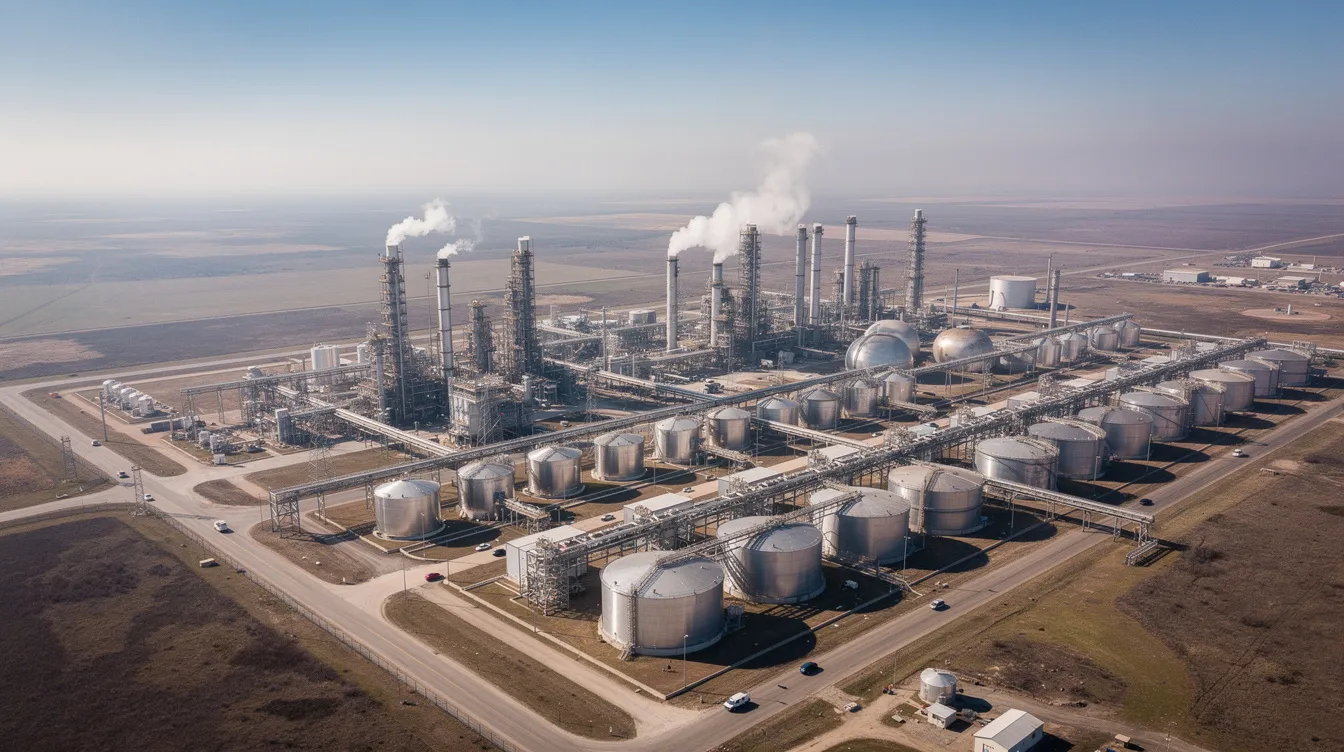
India processes a wide range of crude oils – palm oil, soybean, sunflower, rice bran oil, cottonseed, mustard and groundnut – through industrial refineries. Government initiatives support investment in modern refining facilities, and recent duty structures maintain a differential of approximately 19.25% between crude and refined oil imports, creating a clear economic incentive for domestic refining.
Market analysis includes evaluation of domestic consumption trends and competitor analysis. Market studies should include consumption forecasts for the next 5–10 years. Project reports evaluate demand and supply dynamics for refined oils, and India’s edible oil consumption growth makes refinery investment attractive.
Promoters must decide among three principal configurations at the outset. A raw material procurement strategy focused on reliable sourcing and supplier agreements is essential regardless of configuration.
| Parameter | Standalone Refinery | Refinery + Fractionation | Integrated Crushing + Refining Complex |
|---|---|---|---|
| CAPEX Level | Moderate | Moderate–High | High |
| Technical Complexity | Standard refining | Refining + crystallisation/separation | Crushing, extraction, refining, fractionation |
| Import Dependence | High (crude oil imports) | High | Lower (domestic oilseeds possible) |
| Margin Structure | Refining margin only | Refining + fractionation premium | Seed-to-oil integrated margin |
| Logistics | Port-based preferred | Port-based preferred | Oilseed-belt or port-based |
| Project Risk | Moderate | Moderate | Higher (multiple process stages) |
Strategic decisions at this stage include target markets (bulk vs branded), choice of oils, degree of integration, location near ports vs consumption centres, and alignment with future expansion plans. Promoters processing soybean oil or sunflower oil may evaluate different configurations than those focused on palm oil fractionation.
Edible Oil Refinery Capacity Planning – 100 to 1,000 TPD
Common refinery capacities include 5 TPD to 500 TPD for standard projects, while large industrial plants extend to 1,000 TPD. Refinery capacities range from 5 TPD to 500 TPD at the common level, but the industrial plants covered in this guide operate at 100 TPD and above. Optimal plant capacity depends on several factors: crude oil sourcing arrangements, market reach, finance availability and the promoter’s risk appetite.
A medium-sized refinery requires approximately 1–3 acres of land. Larger operations at 500–1,000 TPD need proportionally more land, driven by tank farm requirements, fractionation infrastructure and future expansion corridors.
| Capacity (TPD) | Approximate Annual Throughput (330 days) | Typical Shifts | Indicative Tank Farm | Workforce |
|---|---|---|---|---|
| 100 | ~33,000 MT | 2–3 | Moderate | 40–80 |
| 200 | ~66,000 MT | 2–3 | Medium | 60–120 |
| 300 | ~99,000 MT | 3 | Medium–Large | 80–150 |
| 500 | ~165,000 MT | 3 | Large | 120–200 |
| 1,000 | ~330,000 MT | 3 | Very Large | 200–350 |
Capacity utilisation typically ramps from 50–60% in year one to 80–90% by year three or four. Under-utilisation severely affects fixed-cost absorption and can weaken DSCR in early years. Key factors influencing capacity choice include proximity to ports for imported crude, access to local oilseeds and solvent extraction plants, strategic tie-ups with major buyers, and provision for future expansion in land and utilities.
Edible Oil Refinery Project Cost, Capital Investment & Integrated Project Economics
For capacities above 100 TPD, total project cost encompasses land, buildings, plant and machinery, utilities, pre-operative expenses, interest during construction, contingencies and working capital margin. Capital expenditure should encompass land, machinery and utilities as core components.
Indicative cost allocation for a 200–300 TPD edible oil refinery and fractionation plant:
- Land costs typically account for 10–20% of total investment
- Civil construction and site development: 10–15%
- Machinery costs typically account for 35–50% of total investment (capital investment for an edible oil refinery ranges from 35–50%)
- Utilities costs represent 10–15% of total investment
- Installation and commissioning costs are about 5–10% of total investment
- Pre-operative expenses, IDC, contingencies: 5–10%
- Working capital margin: project-specific
Data from Rabo India studies indicates capital cost for soybean oil processing at port-based refineries ranges from approximately ₹13.4 crore for 200 TPD to ₹37.5 crore for 1,000 TPD (machinery and core process only). For a 600 TPD refinery with fractionation and packing, IMARC estimates total project cost at ₹200–300 crore.
Technology choice – physical vs chemical refining – level of automation, local vs imported equipment and integration with fractionation significantly affect both CAPEX and long-term operating costs. Financial projections include capital and operational expenditure breakdowns tailored to each project’s specific configuration. For deeper cost analysis, refer to Edible Oil Refinery Setup Cost, Capital Investment & Integrated Project Cost in India.
Machinery, Equipment, Refining Technology & EPC Contractor Selection
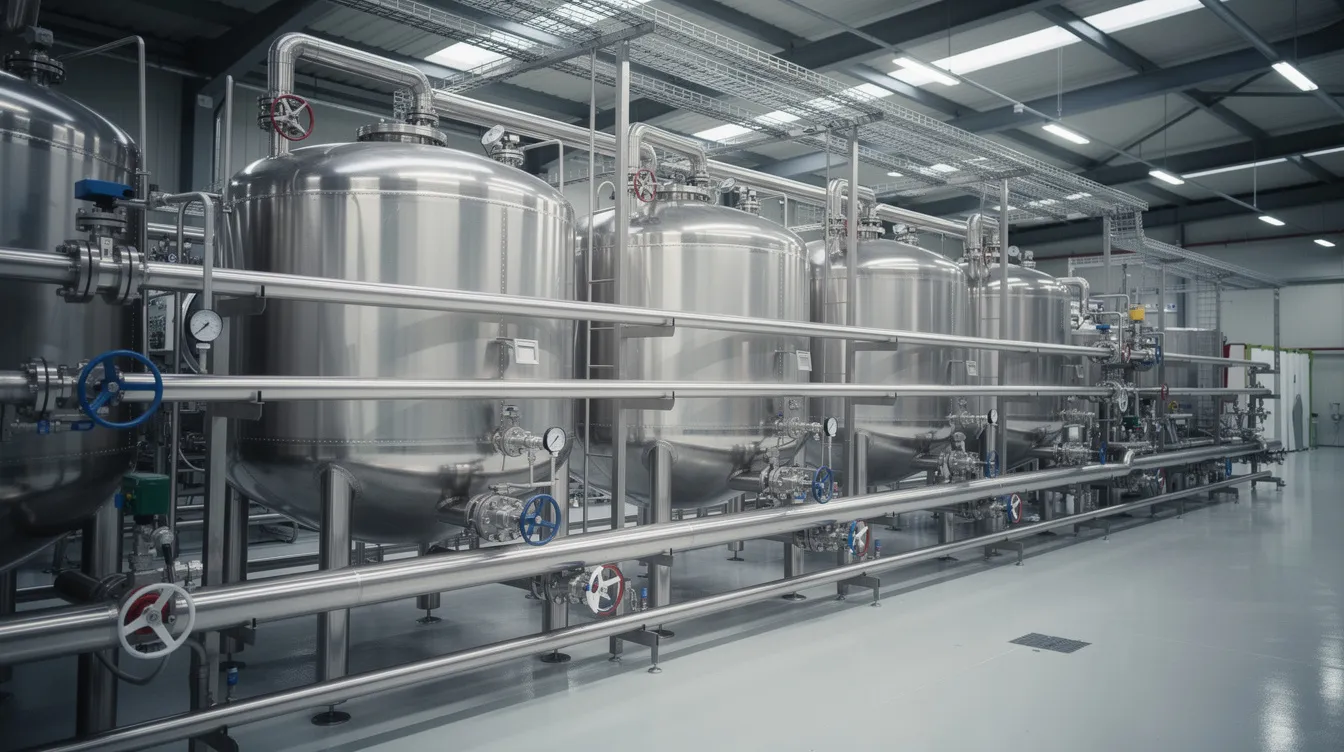
Machinery selection and EPC contracting are core determinants of oil recovery, utility consumption, refining losses and long-term profitability. Detailed equipment specifications are vital for a competent project report.
Major refinery equipment includes:
- Degumming equipment that removes gums and phospholipids from crude oil
- Neutralisation equipment that eliminates free fatty acids using caustic soda
- Bleaching vessels that remove pigments and impurities from oil
- Deodorizers that eliminate odour and volatile compounds from oil
- Filters (leaf, pressure or belt type)
- Heat exchangers, transfer pumps and vacuum systems
- Crude oil storage tanks, which typically hold 10–500 MT of oil
For plants with fractionation: crystallisers, controlled cooling/refrigeration systems, membrane or filter presses, insulated pipelines and dedicated olein/stearin storage.
Support infrastructure includes steam boilers, thermic-fluid heaters, cooling towers, compressors, PLC/SCADA automation and in-house quality-control laboratories.
Turnkey EPC contracts provide single-party accountability, integrated process design and guaranteed performance parameters, but carry a margin premium. Multi-vendor procurement may reduce cost but places coordination risk and interface management responsibility on the promoter. Supplier evaluation should consider past track record in 100–1,000 TPD plants, energy efficiency benchmarks, guaranteed refining loss levels, local service support and clarity of performance-test conditions.
Lifecycle cost – encompassing spare availability, downtime risks and scalability – matters more than the lowest capital quote. See Edible Oil Refinery Machinery, Equipment, Process Technology & EPC Selection for a detailed equipment and EPC framework.
Physical vs Chemical Refining – Technology Selection & Commercial Impact
Modern large-scale edible oil refineries in India adopt either chemical refining, physical refining, or a combination. Technical specifications detail the oil types and process selection for refining based on feedstock characteristics.
| Parameter | Physical Refining | Chemical Refining |
|---|---|---|
| Crude Oil Suitability | Palm, coconut, rice bran (low phospholipids) | Soybean, sunflower, cottonseed (higher gums) |
| FFA Removal | Steam stripping during deodorisation | Alkali neutralisation with caustic soda |
| Refining Loss | ~1–2% under suitable conditions | ~2–5% depending on FFA and gum levels |
| Chemical Consumption | Lower (minimal alkali) | Higher (caustic soda, acid, wash water) |
| Effluent Load | Lower | Higher (soapstock, wash water) |
| Equipment Precision | Higher vacuum/temperature requirements | More neutralisation and washing equipment |
| Operating Cost per Tonne | Generally lower | Generally higher |
Physical refining yields better recovery and lower ongoing chemical cost but requires good-quality crude with low phospholipids. Chemical refining handles challenging crude oils but generates more soapstock and effluent.
Final selection should follow laboratory analysis of representative crude oil samples, pilot-plant trials where necessary and detailed process-engineering input – not generic assumptions or supplier marketing alone. For detailed comparison, see Physical vs Chemical Refining of Edible Oils: Technology, Operating Cost & Project Feasibility.
Edible Oil Refinery Manufacturing Process Flow – From Crude Oil Receipt to Dispatch
While the edible oil refining process varies by feedstock and technology, a modern refinery broadly follows this sequence:
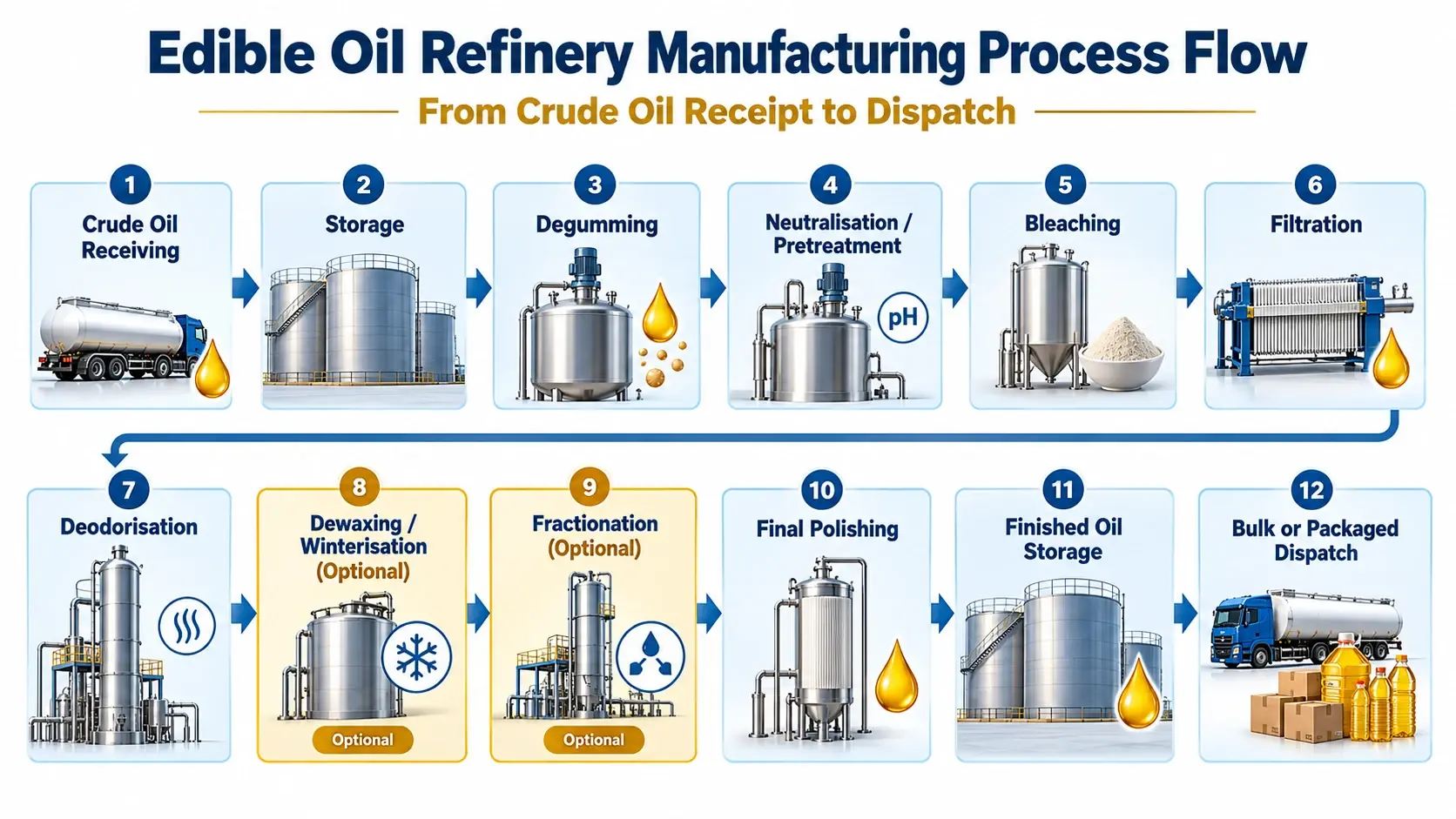
Crude Oil Receiving → Storage → Degumming → Neutralisation/Pretreatment → Bleaching → Filtration → Deodorisation → Dewaxing/Winterisation (optional) → Fractionation (optional) → Final Polishing → Finished Oil Storage → Bulk or Packaged Dispatch
At each stage:
- Degumming removes phospholipids and gums from crude oil
- Neutralisation removes free fatty acids using caustic soda (in chemical refining)
- Bleaching eliminates pigments and trace contaminants from oil using bleaching earth
- Deodorisation removes odour compounds and volatile impurities through high-temperature vacuum steam stripping
- Winterisation removes waxes for clarity in specific oils like sunflower and rice bran
Material balance is critical: crude input versus refined oil output, by-product streams (soapstock, fatty acid distillate, gums) and the impact of refining losses on project profitability. Quality control measures are necessary for ensuring consistent oil quality. In-plant laboratories monitor FFA, moisture, colour, peroxide value and phosphorus content at critical process points to maintain consistent product quality and regulatory compliance.
Fractionation (separation based on melting point into olein and stearin) and winterisation/dewaxing (removal of minor wax components) are distinct processes and should not be treated as interchangeable refining stages. For step-wise process details, see Edible Oil Refinery Process Flow: Degumming, Neutralisation, Bleaching & Deodorisation.
Land, Building, Steam, Power, Water & Utility Requirements
Large-scale edible oil refinery projects are utility-intensive. Utilities required by refineries include electricity, steam and water supply as the primary consumption drivers.
Indicative land: 2–3 acres for 100–200 TPD; proportionally more for 500–1,000 TPD depending on tank farm size and integration with fractionation or crushing. Key built-up areas include the process block, tank farm bunds, boiler/utility area, finished-goods warehouse, ETP, administration building and laboratory.
A utility-planning checklist should cover:
- Steam generation: boiler fuel options (gas, coal, biomass, fuel oil)
- Electricity: grid power availability, transformer capacity, DG backup
- Cooling water: cooling tower sizing, fire-water storage
- Vacuum systems for deodorisation
- Compressed air and nitrogen where required
- Effluent treatment: environmental compliance includes managing wastewater and air pollution control
Safety infrastructure – fire-fighting systems, spill-containment bunds, hazardous-area electrical design – and utility optimisation (heat recovery, condensate return, variable-frequency drives, insulation) can significantly reduce operating costs per tonne of refined oil. Health and safety management plans are essential in the refinery industry. See Edible Oil Refinery Land, Building, Steam, Power, Water, ETP & Utility Requirements in India for detailed planning guidance.
Edible Oil Fractionation & Winterisation Plant – Technology, Products & Investment
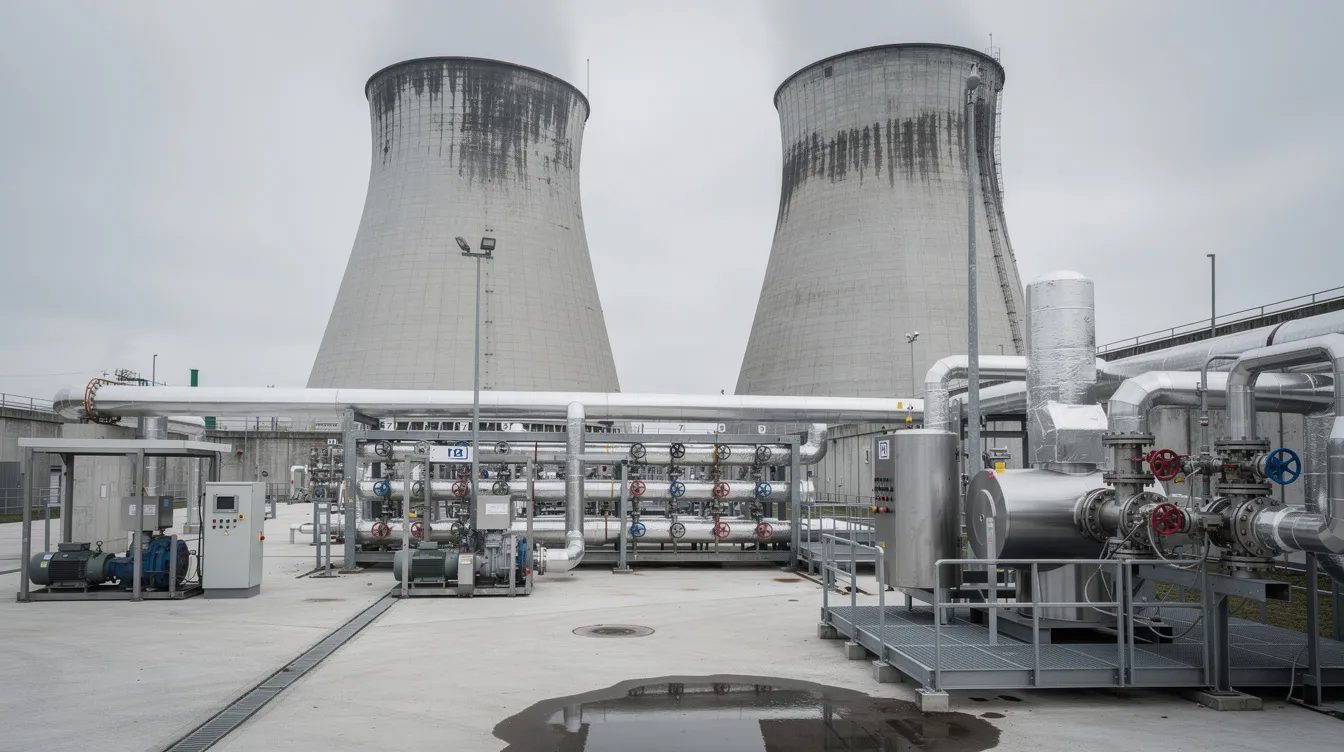
Fractionation and winterisation are optional but commercially important extensions of the refining process. Palm oil fractionation separates refined palm oil into palm olein (liquid fraction – cooking and frying oil) and palm stearin (solid fraction – bakery fats, soaps, industrial applications) through controlled cooling, crystallisation and membrane/filter press separation.
Winterisation and dewaxing apply to oils like sunflower and rice bran oil, removing wax components through chilling and filtration to prevent cloudiness and ensure premium clarity for bottled oils.
Additional CAPEX includes chillers, refrigeration systems, crystallisers, filters, insulated tanks and pipelines, and incremental energy loads. These should be captured as a separate cost head in an integrated edible oil refinery project report.
Commercial drivers include higher realisation from premium palm olein, industrial stearin sales, winterised oil premiums, and improved contribution margins. The impact on payback period and IRR should be modelled explicitly in the DPR. See Edible Oil Fractionation & Winterisation Plant Project Report, Investment & Technology for project-specific planning.
Financial Projections, Working Capital, CMA Data & DSCR for Edible Oil Refineries
Edible oil refining operates on thin per-tonne margins but large throughputs. Operating costs are primarily driven by raw material consumption – typically 82–88% of total operating expenditure. Financial projections include capital and operational expenditure breakdowns that must reflect this reality.
Key assumptions for a 10-year financial model include: installed capacity, capacity utilisation ramp-up, crude oil purchase prices, refining loss percentage, by-product realisation, refined oil selling prices and operating days per year.
Working capital deserves particular attention. Crude oil inventory often spans 15–60 days depending on sourcing pattern, with finished goods stock, receivables and trade payables completing the cycle. Financing structures include working capital assessments and loan repayment analysis. Even when the processing margin per tonne is relatively modest, substantial edible oil inventories create significant working capital requirements.
CMA data – covering multi-year projections of balance sheet, profit and loss, cash flow, fund flow and ratio analysis – is what Indian banks require to appraise term loans and working-capital limits. DSCR examines whether projected cash accruals adequately cover principal and interest obligations. Lenders typically require minimum DSCRs of 1.2–1.3 in early years.
Sensitivity analysis helps assess the impact of variables on project profitability. The DPR should model +/- changes in crude oil price, refining margin, capacity utilisation, interest rate and exchange rate on EBITDA, cash flow, DSCR and IRR. For detailed financial modelling guidance, see Edible Oil Refinery Financial Projections, Working Capital, CMA Data & DSCR.
Edible Oil Refinery Feasibility Study, Profitability, ROI & IRR
Financial viability analysis involves assessing ROI, IRR and break-even points – not merely projected profit. The principal drivers of profitability include the crude-to-refined price spread, total refining loss percentage, by-product realisation, energy efficiency, capacity utilisation and interest burden.
Processing cost per tonne falls steeply with scale: from approximately ₹2,741/tonne at 50 TPD to ₹1,743/tonne at 1,000 TPD, based on MoFPI/Rabo India data. Gross margins in well-run large plants range approximately 10–20%, with net margins around 5–12%.
A three-scenario framework should be developed:
- Base case: Stable duty regime, moderate utilisation ramp-up, current procurement costs
- Downside case: Crude price increase, lower utilisation, duty differential narrowing
- Upside case: Better duty differential, premium products, stronger margins
NPCS sample data for a 12 TPD refinery shows break-even at approximately 43% capacity and payback of roughly 4.1 years – illustrating that even smaller operations can be viable if assumptions are realistic. For larger integrated projects, payback periods of 3–6 years are typical depending on scale, operational efficiency and financing structure. See Edible Oil Refinery Feasibility Study: ROI, IRR, Refining Losses & Profitability in India.
Project Financing, Bank Loan & Equity Investment Planning
Large-scale edible oil refinery and fractionation projects typically require a balanced mix of promoter equity, term loans and working-capital limits. Sources include promoter equity and unsecured loans, term loans from banks or financial institutions, working-capital cash-credit limits, LC facilities for crude oil imports, and potentially equipment finance.
Debt–equity ratios depend on project risk, cash-flow stability, collateral availability and lender appetite. Lenders evaluate promoter integrity and experience, DPR quality, crude oil and off-take arrangements, projected DSCR, security cover and compliance with internal bank guidelines.
For large integrated projects, equity investors assess scalability, brand-building potential, equity IRR, exit routes and risk-mitigation strategy. A professionally prepared bankable DPR with CMA data, sensitivity analysis and implementation plan strengthens the case for finance sanctions considerably. Project Report Bank assists promoters with robust documentation and commercially sound financial structuring but does not guarantee finance approvals.
Regulatory Approvals, Environmental Compliance & Food Safety
Large edible oil refinery plants must comply with multiple regulatory frameworks. Regulatory approvals should be secured early to avoid delays. Core requirements include:
- Business entity registration, PAN, GST, IEC (for imports/exports), Udyam registration where eligible
- FSSAI licence – mandatory for edible oil manufacturing in India, covering applicable food standards, packaging and labelling rules
- Factory licence – necessary under the Factories Act as administered by state authorities
- Pollution Control Board NOC – required for compliance, including Consent to Establish (CTE) and Consent to Operate (CTO)
- Boiler inspection and certification, pressure-vessel compliance, electrical safety
- Fire NOC, building and land-use permissions, municipal/panchayat approvals
Environmental compliance includes managing wastewater and air pollution control. The DPR should map out a regulatory-compliance checklist and broad timeline, while specific approvals must be confirmed through local consultants and authorities during implementation.
Key Risks in Large-Scale Edible Oil Refinery Projects & Mitigation Strategies
Risk assessment should identify potential project risks and mitigation strategies. Refining and fractionation projects operate in a high-volume, low-margin environment:
- Supply and price risks: Dependence on imported crude oils, global commodity-price volatility, shipping disruptions, foreign-exchange fluctuations, import duty changes
- Operational risks: Higher-than-expected refining losses, equipment underperformance, utility outages, suboptimal operational efficiency elevating costs
- Market risks: Slower ramp-up, competition from established branded players, delayed receivables, customer concentration
- Financial risks: Working-capital underestimation, interest rate movements, DSCR covenant breaches
- Regulatory risks: Approval delays, tightening environmental norms, changes in GST or import-duty structures
Mitigation approaches include long-term contracts for crude supply where feasible, performance guarantees in EPC contracts, adequate insurance, conservative financial gearing and stress scenarios in DPR sensitivity analysis.
Implementation Roadmap for an Industrial Edible Oil Refinery & Fractionation Plant
Timely implementation significantly influences project cost, interest during construction and time-to-cash-flow. Documentation preparation reduces approval timelines significantly. A stage-wise roadmap:
- Initial project concept and capacity selection
- Preliminary market and feedstock study
- Technology route decision (physical vs chemical refining, fractionation needs)
- Site shortlisting and infrastructure due diligence
- Preliminary layout and utility estimates
- RFQs and techno-commercial evaluation of machinery and EPC offers
- Detailed financial modelling and risk analysis
- Preparation of bankable edible oil refinery DPR in India, including CMA data
- Bank and investor discussions and financial closure
- Detailed engineering, statutory approvals and order finalisation
- Civil construction, machinery manufacturing and delivery
- Erection, installation and commissioning
- Trial runs, performance testing and commercial production
Indicative project timeline: 12–18 months for a 200–500 TPD plant depending on land status, approvals and vendor schedules. Implementation-related risks and milestones should be captured in a Gantt-style schedule within the DPR.
Why a Professional DPR Is Essential for Large Industrial Edible Oil Refinery Investments
A professional, well-structured large-scale edible oil refinery project report acts as both an investment decision document and a bank-finance application backbone. A standard project report covers sections like executive summary and market analysis, but a comprehensive DPR goes substantially further.
Essential components include:
- Technical sections: Process technology, machinery list, utility requirements, quality-control systems, environmental management
- Financial sections: Complete project cost, means of finance, 7–10 year projected P&L, balance sheet, cash flow, working capital assessment, CMA data, DSCR
- Investment appraisal: Break-even analysis, payback period, project IRR, equity IRR, sensitivity and scenario analysis, structured risk assessment
A well-designed DPR makes assumptions transparent, highlights project strengths and risks honestly, and gives banks and investors confidence. Project Report Bank prepares project-specific DPRs based on detailed discussions with promoters, preliminary engineering inputs and current market data – not generic templates.
Professional DPR & Financial Feasibility Advisory by CA Manish Gugliya – Project Report Bank
ProjectReportBank.com is a Chartered Accountant-led professional advisory platform providing customised DPRs, financial modelling and project finance advisory for industrial projects, including large edible oil refinery and fractionation plants.
Core services for edible oil refinery promoters include:
- Customised bankable DPR preparation
- Project-cost estimation and means-of-finance structuring
- Detailed financial projections and CMA data for bank loans
- DSCR and repayment modelling
- Working-capital assessment for crude and refined oil stocks
- Feasibility studies, sensitivity analysis and risk assessment
- Investor-ready DPR and information memoranda preparation
All analysis is prepared under the professional oversight of CA Manish Gugliya, FCA, DISA (ICAI), with more than 20 years of experience in project finance and industrial DPRs across MSME and mid-corporate segments in India.
Promoters planning 100–1,000 TPD edible oil refining and fractionation projects may connect through the enquiry and WhatsApp contact options available on ProjectReportBank.com, sharing proposed capacity, location, crude oil type, estimated project cost and current stage of planning.
Explore Our Detailed Edible Oil Refinery & Fractionation Project Guides
The following linked guides provide deeper technical and financial insights on specific aspects of edible oil refinery and fractionation projects in India:
- Edible Oil Refinery Project Cost & Investment – Capital expenditure, fixed investment and integrated project costing
- Edible Oil Refinery Machinery, Technology & EPC Selection – Processing equipment and EPC procurement planning
- Physical vs Chemical Refining of Edible Oils – Technology comparison, operating costs and process suitability
- Edible Oil Refinery Process Flow – Refining stages, process design and manufacturing operations
- Edible Oil Refinery Capacity Planning – Capacity selection for industrial refinery projects
- Edible Oil Refinery Utility Requirements – Land, buildings, steam, electricity, water and ETP
- Edible Oil Refinery Financial Projections – Working capital, CMA data, projections and DSCR
- Edible Oil Refinery Feasibility & Profitability – ROI, IRR, refining losses and financial viability
- Edible Oil Fractionation & Winterisation Plant Project Report – Fractionation, winterisation, product recovery and technology
These resources together form a cohesive knowledge base for promoters planning integrated edible oil refining and fractionation projects, complementing this main guide.
FAQ – Large-Scale Edible Oil Refinery & Fractionation Project Report
The following questions address common practical queries from Indian promoters and lenders that are not fully covered in the main sections above.
What is the typical investment range for a 100–500 TPD edible oil refinery in India?
Investment depends on technology choice, automation level, land cost, integration with fractionation or winterisation, and utility choices. A 100–500 TPD edible oil refinery plant often falls in a multi-crore range – for example, ₹5–15 crore for smaller standalone refineries and significantly higher for larger integrated configurations. Exact figures must be estimated through a customised DPR using current vendor quotations, site-specific civil costs and the final product mix. No single figure applies universally across capacities and configurations.
Should I start with a standalone edible oil refinery or include palm oil fractionation from day one?
This depends on feedstock mix, target markets and capital availability. If the project is heavily palm-oil focused and targets bulk palmolein and industrial stearin buyers, integrating fractionation from the outset may create commercial value. If the promoter is handling multiple crude oils or testing market channels, a phased approach – starting with refining alone and planning fractionation as a future expansion – may be more prudent. The decision should be evaluated through a structured feasibility analysis within the DPR.
How do I choose between setting up near a port and near consumption centres?
Port-based edible oil refinery plants reduce inland freight on imported crude and simplify LC-based procurement, which is why many large refineries operate near major ports. Plants near consumption hubs may save on finished-goods transportation costs and enable stronger distribution networks. The optimal choice depends on the distance to ports, local infrastructure, land pricing, state incentives and the split between bulk and branded sales. A structured location analysis within the project report should compare these trade-offs quantitatively.
Can the same refinery handle multiple types of crude edible oils?
Modern edible oil refinery plants can be designed with sufficient flexibility to handle more than one crude – such as palm oil, soybean oil and sunflower oil – but this requires appropriate process design, tank-farm segregation, scheduling protocols and quality-control systems. The DPR and engineering design should clearly define the range of feedstocks, changeover procedures and any impact on refining losses or product quality when switching between different crude oils.
When should a promoter engage a professional for preparing the edible oil refinery DPR?
Promoters should involve a professional DPR and financial-advisory firm once the basic concept – capacity band, location preference, crude oil mix, broad budget – is defined but before locking in major machinery orders or construction commitments. This allows technical, financial and regulatory aspects to be aligned from the beginning and helps in structured bank and investor discussions from an early stage. The objective is not merely document preparation but building a financial model that the promoter can understand, defend and use for decision-making.