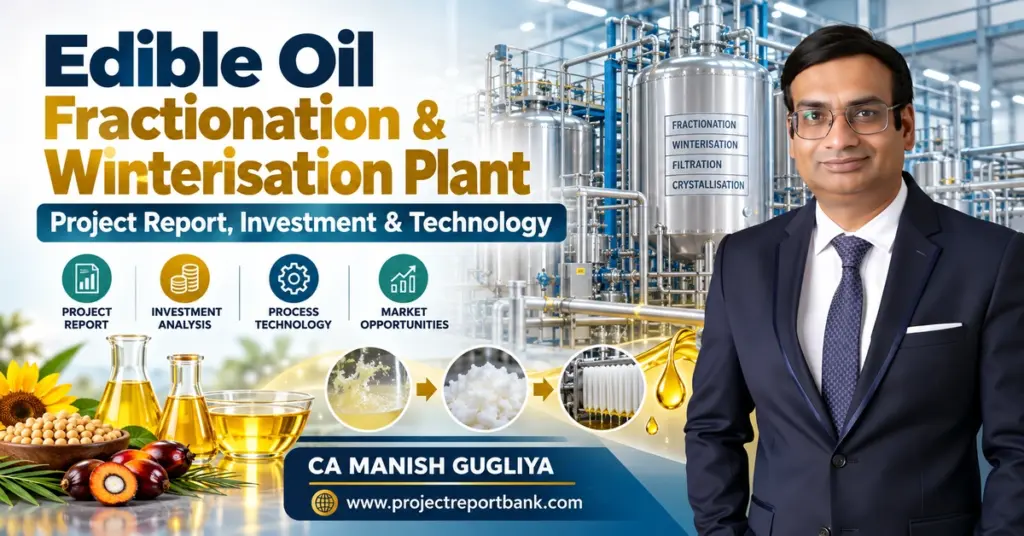
Edible oil processing in India increasingly demands value-added downstream operations beyond basic refining. Fractionation and winterisation enable processors to convert refined oil into commercially distinct products – palm olein for cooking and frying, palm stearin for bakery fats and industrial applications, and cold-stable sunflower or rice bran oil for retail markets. The commercial logic is straightforward: separated fractions command different prices, and the spread between feed oil cost and weighted realisation from individual fractions determines processing margin.
However, not every fractionation plant investment is financially viable. Technology selection, fraction yields, refrigeration costs, raw material costs, capacity utilisation and product-price volatility all influence whether a project generates adequate returns. A comprehensive edible oil fractionation plant project report must evaluate these variables through defensible assumptions before capital is committed.
Key Takeaways
- Fractionation induces partial crystallization of edible oil to separate it into a liquid fraction (olein) and a solid fraction (stearin), while winterisation removes waxes from oils like sunflower oil and rice bran oil to improve clarity and enhanced stability at low temperatures.
- Plants can handle capacities from 25 TPD to 500 TPD and beyond; commercially common scales in India range from 100 to 300 TPD for standalone units.
- Dry fractionation technology is widely used in the edible oil industry for palm oil, requiring lower CAPEX than solvent-based alternatives.
- Project viability depends on olein/stearin yield split, energy consumption for refrigeration, feed oil pricing and fraction price spreads – a 1–2% change in olein recovery can materially shift margins.
- A bankable edible oil fractionation plant project report must include project cost, means of finance, working capital assessment, DSCR, IRR and sensitivity analysis.
- Project Report Bank, led by CA Manish Gugliya, prepares customised DPRs, CMA Data and financial models for fractionation and winterisation projects across India.
What Is an Edible Oil Fractionation and Winterisation Plant?
Fractionation is a thermomechanical process where refined edible oil undergoes controlled cooling so that different triglycerides crystallize selectively. The resulting crystals (higher-melting fraction) are separated from the remaining liquid by filtration. The liquid fraction is called olein and the solid is stearin – each with distinct chemical properties and market applications. In palm oil fractionation, olein serves primarily as cooking oil and frying oil, while stearin goes into bakery fats, shortenings, vanaspati and oleochemical production.
Winterisation (or dewaxing) addresses a different problem. Dewaxing plants improve oil clarity and stability at low temperatures by chilling oils such as sunflower, rice bran oil and corn oil so that waxes and high-melting lipids crystallize and can be removed through filtration. The goal is not to split bulk triglyceride fractions but to ensure bottled oil remains clear during cold weather.
Both processes always follow upstream refining. Edible oil refining plants process oils like soybean and sunflower through neutralisation, bleaching and deodorisation before fractionation or winterisation can be applied. For a detailed understanding of upstream operations, refer to the guide on edible oil refinery process flow and manufacturing technology.
| Parameter | Refining | Fractionation | Winterisation / Dewaxing |
|---|---|---|---|
| Primary purpose | Removal of impurities, free fatty acids, colour, odour | Separation of oil into olein and stearin fractions | Removal of waxes for cold stability |
| Typical oils | All crude vegetable oils | Palm oil (primary), some specialty fats | Sunflower, rice bran, cottonseed, groundnut oil |
| Operating temperature | 60–260 °C (various stages) | 70 °C down to 15–25 °C (crystallisation) | 10–15 °C (chilling) |
| Key equipment | Neutraliser, bleacher, deodoriser | Crystallisers, membrane filter presses | Plate chillers, filter presses |
| Main quality outcome | Refined, bland, stable oil | Distinct olein and stearin with target IV and melting points | Clear, haze-free oil at low temperatures |
Edible Oil Fractionation Plant Business Opportunities in India
India’s vegetable oil imports exceeded 16 million tonnes in recent years against domestic oil production of approximately 9.6 million tonnes. Palm oil constitutes a major share of imports, and much of it requires fractionation to produce palm olein for the cooking oil market and palm stearin for industrial buyers. Market analysis should project demand for refined palm olein and palm stearin based on food processing growth, hotel and restaurant consumption and oleochemical applications.
Business models differ significantly. A standalone fractionation plant purchases refined oil from the market and sells separated fractions – margin depends entirely on price spreads. An integrated refinery adds fractionation downstream, sharing utilities and reducing incremental CAPEX. Some promoters integrate industrial solvent extraction and multi-oilseed processing with refining and fractionation, though extraction is a fundamentally different upstream process. Toll processing offers a third model where the processor charges a conversion fee while the client retains inventory risk.
Buyer segments include branded edible oil companies, bulk institutional buyers, bakery and confectionery manufacturers, and export-oriented packers seeking oil products with specific cold-test and quality specifications.
Types of Edible Oil Fractionation and Winterisation Technologies
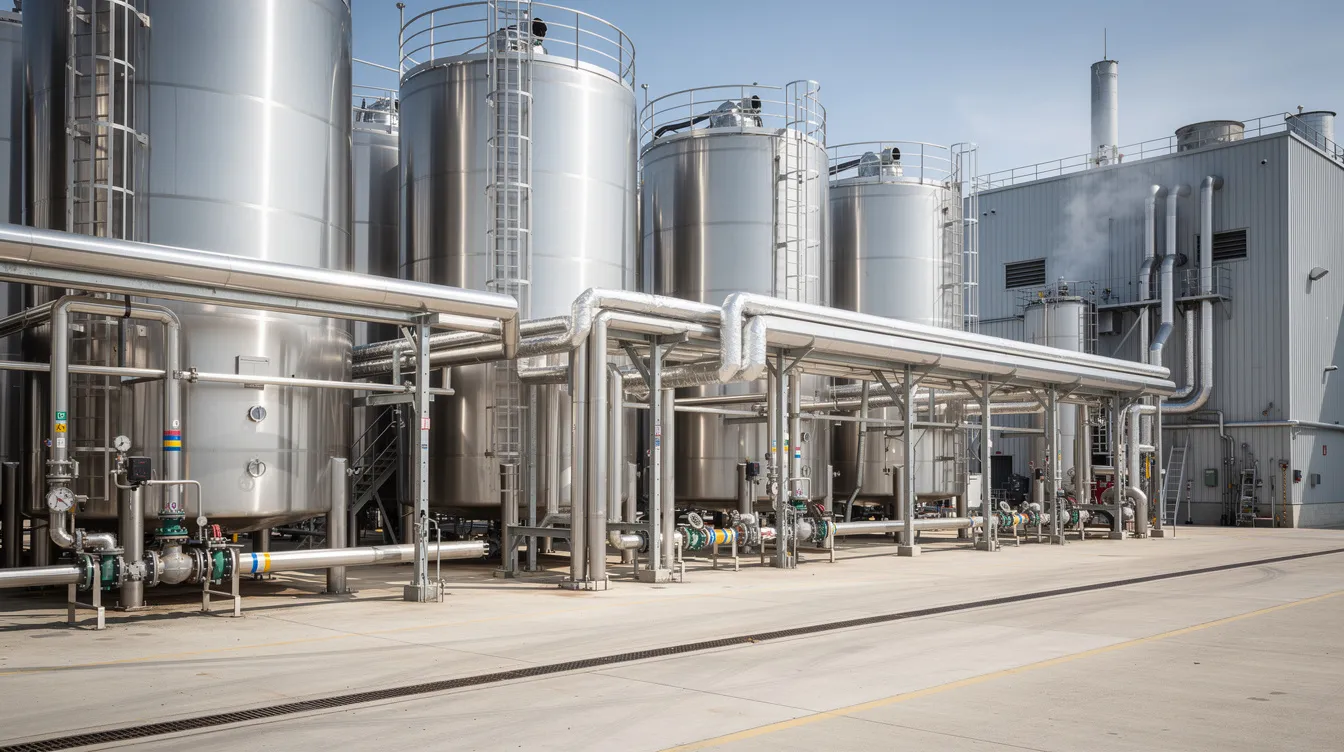
Dry fractionation is the dominant commercial technology for palm oil fractionation in India. The fractionation process consists of controlled cooling of fully refined oil in insulated crystallisers, gradual crystal growth and maturation, and separation using membrane filter presses. No solvent or chemical additive is required, keeping CAPEX and regulatory complexity lower.
Solvent fractionation dissolves oil in an organic solvent (acetone, hexane), enabling sharper separation and higher-purity fractions – suitable for specialty fats like cocoa butter equivalents. However, it demands solvent recovery systems, explosion-proofing and higher energy consumption. Detergent fractionation uses surfactants to assist phase separation but creates effluent management challenges and finds limited commercial application. Continuous refining is suitable for large-scale production in integrated complexes, while intermittent refining is ideal for small and medium scales.
The choice between physical versus chemical refining of edible oils is a separate upstream decision that does not change the fractionation process itself.
| Technology | Typical Oils | Investment Intensity | Refrigeration Load | Safety / Environmental | Commercial Use in India |
|---|---|---|---|---|---|
| Dry fractionation | Palm oil | Moderate | Significant | Low risk, no solvents | Most common |
| Solvent fractionation | Specialty fats, mid-fractions | High | Very high | Solvent handling, explosion risk | Niche |
| Detergent fractionation | Limited applications | Moderate–High | Moderate | Effluent treatment required | Rare |
| Winterisation / Dewaxing | Sunflower, rice bran, corn | Lower | Moderate | Minimal | Widely used |
Edible Oil Fractionation Process Flow and Manufacturing Technology
The production process for palm oil dry fractionation follows a defined sequence. RBD palm oil is first heated to approximately 70–75 °C for complete melting and homogenisation. It then enters crystallisers where controlled cooling brings the temperature down gradually. Crystal growth depends on cooling rate, agitation speed and holding time. Palm oil fractionation typically takes about 5.5 hours at 0 °C for the crystallisation stage. Crystallization in fractionation occurs at controlled cooling rates – faster cooling produces many small crystals that are difficult to filter, while slower cooling yields larger crystals enabling better separation.
After maturation, the mixed slurry passes through membrane filter presses where the liquid phase (olein) is separated from solid stearin. The fractionated oil products are then pumped to separate storage tanks.
For winterisation, refined and bleached sunflower or rice bran oil undergoes pre-cooling, followed by precise chilling to 10–15 °C, holding for 4–8 hours, and filtration to remove crystallised waxes. The first step is always ensuring feed oil quality meets refinery specifications.
| Process Step | Palm Oil Dry Fractionation | Winterisation / Dewaxing |
|---|---|---|
| Feed preparation | Heating to 70–75 °C, melting | Pre-cooling of refined oil |
| Cooling / Crystallisation | Gradual cooling to 15–25 °C over hours | Chilling to 10–15 °C |
| Maturation | Holding with gentle agitation | Holding 4–8 hours |
| Separation | Membrane filter press | Pressure leaf or plate filter press |
| Output | Palm olein + palm stearin | Clear, cold-stable oil + wax cake |
Exact temperatures and cooling curves must be set as per specific oil composition and supplier recommendations. Process optimization requires adjusting these variables based on feed oil iodine value and desired fraction specifications.
Palm Olein and Palm Stearin Recovery, Yield and Product Quality
Profitability depends directly on attainable yields and the quality of separated palm oil fractions. Key parameters include iodine value (IV), slip melting point, cloud point, solid fat content profile, free fatty acids level, moisture and colour. Olein with higher IV and lower cloud point commands premium pricing for frying applications, while stearin with higher melting point and SFC is suitable for bakery fats.
According to AOCS technical literature, membrane press filtration can achieve approximately 82% olein yield with olein IV of 56–57, compared to roughly 72% with vacuum filtration. NIFTEM data reports a 65:35 olein-to-stearin ratio under standard dry fractionation conditions.
| Component | Quantity (Tonnes) | Remarks |
|---|---|---|
| Feed: RBD Palm Oil | 100 | Input |
| Palm Olein (obtained) | 78 | Illustrative – depends on separation efficiency |
| Palm Stearin (separated) | 20 | Solid fraction |
| Processing Losses | 2 | Filtration, handling, partial removal of impurities |
| Total Output | 100 | Reconciled with input |
All figures are illustrative assumptions. Actual yields depend on feed oil composition, crystallisation conditions and filtration technology.
A 1–2% drop in olein recovery on 100 tonnes of feed means 1–2 tonnes less of the higher-value fraction. At large plant scales processing thousands of tonnes monthly, this temperature difference in crystallisation control can shift annual margins by several crore rupees.
Edible Oil Fractionation Plant Capacity Planning – 100 to 1,000 TPD
Capacity planning must align with secure feed oil sourcing, market demand for fractions and available project finance. For broader context on scaling edible oil operations, see the guide on edible oil refinery capacity planning for industrial projects.
| Capacity | Typical Profile | Crystallisers / Filters | Suitability |
|---|---|---|---|
| 100 TPD | Regional player or refinery add-on | 2–3 batch crystallisers, 1–2 filter presses | Standalone or integrated |
| 200–300 TPD | Mid-range; improving economies of scale | 4–6 crystallisers, 2–3 membrane presses | Common starting point in India |
| 500 TPD | Large industrial; port-based integration | Multiple crystalliser trains, dedicated filtration | Integrated refinery complexes |
| 1,000 TPD | Major investment; strong brands or export | Large continuous/semi-continuous systems | Only with assured demand and contracts |
Continuous refining plants have higher initial investments than intermittent ones, and the same logic applies to fractionation: larger crystalliser trains and filtration systems require proportionally higher CAPEX. Promoters should avoid over-sizing relative to realistic supply and demand – under-utilisation of a 500 TPD plant carries heavier fixed-cost burden than operating a well-utilised 200 TPD unit.
Edible Oil Fractionation Plant Machinery and Equipment
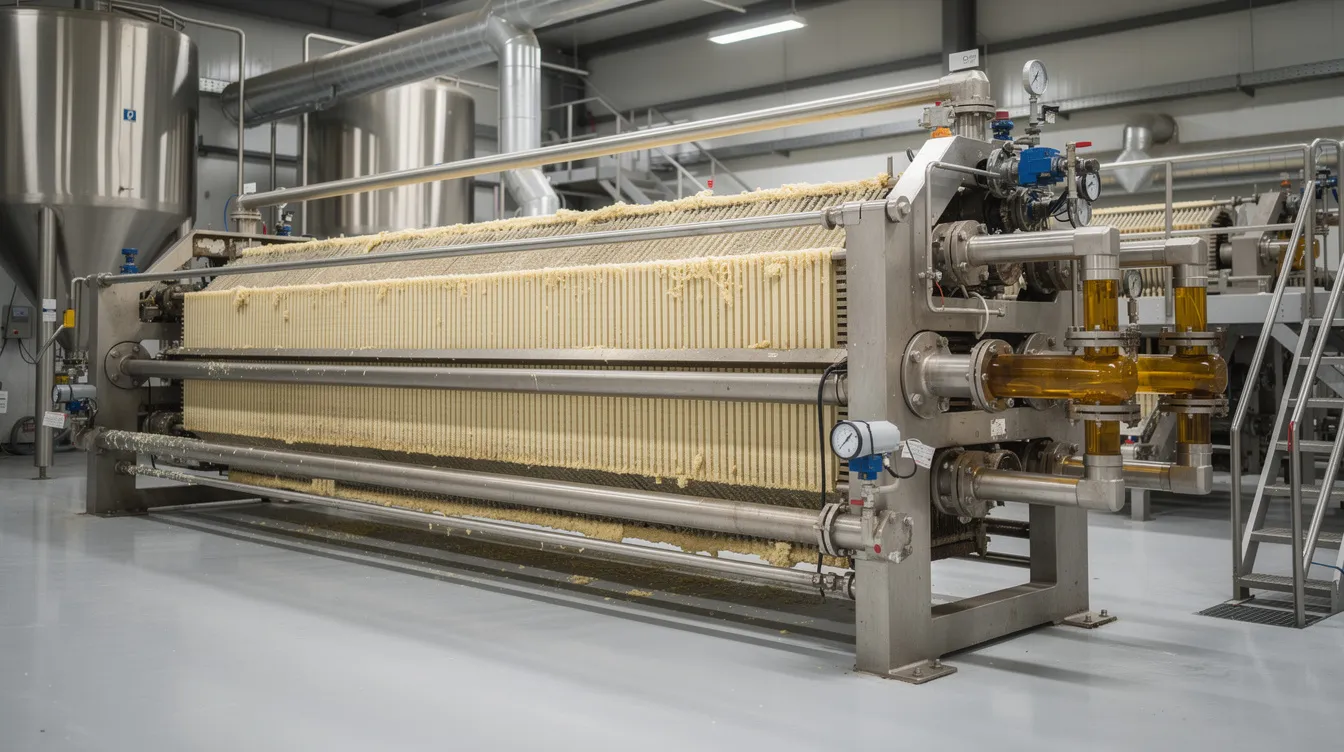
Core equipment categories include feed oil storage tanks (mild steel or stainless steel with heating coils for palm oil), heating and melting systems (shell-and-tube heat exchangers, thermic fluid heaters), batch or continuous crystallisers with temperature-controlled agitation, and membrane filter presses for olein-stearin separation. Filtration systems are critical – membrane presses achieve higher olein recovery than simpler vacuum filters.
Supporting utilities include refrigeration compressors, cooling towers, chilled water lines, steam boilers, compressed-air systems for filter press operation, and interconnecting vessel and piping networks. PLC/SCADA-based control panels monitor temperatures, pressures and flow rates, enabling consistent product quality and energy efficiency.
Laboratory equipment for cloud point, slip melting point, moisture, free fatty acids, acid value and wax content testing is essential. After sales service commitments from equipment vendors should be evaluated carefully during procurement. For guidance on vendor evaluation and contract structuring, refer to the article on edible oil refinery machinery, technology and EPC selection.
Edible Oil Fractionation Plant Cost and Capital Investment in India
Actual edible oil fractionation plant cost must be confirmed through current vendor offers and project-specific design. The figures below provide contextual benchmarks rather than final quotations.
According to IMARC Group data, the fractionation and dewaxing section accounts for approximately 10–14% of total CAPEX in a 600 TPD port-based vegetable oil refinery plant. For context, setting up an edible oil refinery costs approximately Rs 2,00,00,000 for basic configurations, while a palm oil refinery plant costs around Rs 1,10,00,000 at entry scale. Small oil refinery units can cost as low as $22,800, and mid-scale edible oil refinery plants can cost around $55,769, though fractionation adds significant incremental investment for crystallisation and refrigeration systems.
Detailed project reports should outline the means of finance and project cost estimation covering land, building, machinery, refrigeration, storage tanks, electricals, automation, pre-operative expenses, interest during construction and contingencies.
| Capacity | Relative CAPEX Index | Key Cost Drivers |
|---|---|---|
| 100 TPD | 1.0 (base) | Basic crystallisation train, single filter press line |
| 200 TPD | 1.6–1.8 | Additional crystallisers, larger refrigeration |
| 300 TPD | 2.2–2.5 | Multiple filtration trains, expanded tank farm |
| 500 TPD | 3.0–3.5 | Dedicated utility block, higher automation |
| 1,000 TPD | 5.0–6.0 | Full-scale integrated infrastructure |
Index values are illustrative and will vary with technology, automation level and site conditions. Greenfield costs differ substantially from incremental CAPEX for adding fractionation to an existing refinery.
For comprehensive investment analysis, see the detailed guide on edible oil refinery project cost and investment in India.
Land, Building, Electricity, Refrigeration, Water and Utility Requirements
Plant layout should facilitate efficient movement of materials and personnel across the process block, tank farm, utility block, laboratory and administrative areas. A 200–300 TPD fractionation plant typically requires adequate covered process area plus open tank farm and utility zones. Technical specifications must include utility requirements for power, water, and thermal energy.
Electrical loads for crystallisation, chillers, pumps and automation are substantial. High-efficiency refrigeration systems can reduce kWh per ton processed – industrial benchmarks suggest 70–150 kWh per tonne depending on ambient temperature and equipment quality. Production processes require a reliable supply of utilities and energy, with backup power for refrigeration to prevent crystallisation batch losses.
Steam or thermal oil heating is needed for melting feed oil and re-melting stearin. Cooling water circulation, compressed air for filter presses and inert gas blanketing for certain storage tanks are additional requirements. For detailed infrastructure planning, refer to the guide on edible oil refinery land, building and utility requirements.
Production Cost and Operating Economics of a Fractionation Plant
The objective is to understand conversion cost per tonne under realistic Indian conditions. Feed oil procurement is the largest variable cost – typically 80–85% of total operating expenditure in an integrated operation. Power and electricity (especially refrigeration), steam, filtration consumables and direct labour form the balance.
Three business models carry different cost and risk profiles:
- Model A (Standalone plant): Purchases refined palm oil or sunflower oil; margin depends on fraction price spreads. Full commodity-price exposure.
- Model B (Integrated refinery): Feed oil transferred internally; shared utilities reduce incremental costs. Better margin control.
- Model C (Toll processing): Client supplies oil; processor charges per-tonne fee. Lower market risk but thinner margins.
| Conversion Cost Component | Approximate Share of Processing Cost (excl. feed oil) |
|---|---|
| Power & refrigeration | 40–50% |
| Labour (direct + supervisory) | 15–20% |
| Maintenance & consumables | 10–15% |
| Overheads & QC | 15–20% |
Process optimization through efficient cycle times, reduced filtration losses and better capacity utilisation can significantly reduce conversion cost per tonne.
Palm Olein and Palm Stearin Profitability Analysis
Processing Margin = Revenue from Saleable Fractions − Feed Oil Cost − Variable Processing Cost.
| Item | Quantity (Tonnes) | Price (₹/Tonne) | Value (₹ Lakh) |
|---|---|---|---|
| Feed: RBD Palm Oil | 100 | 85,000 | 85.00 |
| Revenue: Palm Olein | 78 | 90,000 | 70.20 |
| Revenue: Palm Stearin | 20 | 75,000 | 15.00 |
| Total Revenue | – | – | 85.20 |
| Less: Processing Cost | 100 | 1,500 | 1.50 |
| Contribution Margin | – | – | -1.30 |
All prices are hypothetical and for illustration only. Actual margins depend on prevailing market prices, which are volatile and location-specific.
This example shows that at narrow spreads, profitability becomes marginal. A ₹2,000/tonne improvement in olein realisation or 2% higher olein recovery would shift the contribution meaningfully. Market prices for palm oil, sunflower and other oils fluctuate significantly – promoters must use current data for their feasibility assessment.
Working Capital Requirements for an Edible Oil Fractionation Plant
Although conversion costs are moderate, edible oil fractionation plants tie up substantial funds in feed oil inventory, finished olein and stearin stock, and trade receivables. Even 10 days of feed oil inventory at ₹85,000/tonne for a 200 TPD plant represents approximately ₹17 crore blocked in raw materials alone.
Banks typically finance working capital through cash credit facilities against stock and receivables (drawing power), requiring promoters to bring margin money. Seasonal and commodity-price volatility in edible oil markets means working capital needs can spike sharply when palm oil or sunflower oil prices rise.
Financial Projections, CMA Data, DSCR, ROI and IRR
Financial feasibility models are essential for evaluating project profitability and investment return. A 10-year projection model should cover phased capacity utilisation (55–60% in year 1, rising to 80–90%), annual production volumes by fraction, revenue by product, manufacturing expenses, EBITDA, depreciation, interest and net profit.
Projected financial statements include profit and loss statements, balance sheets, and cash flow statements. DSCR analysis compares cash accruals against principal and interest obligations – lenders focus on average and minimum DSCR over the full loan tenure. Project IRR, equity IRR, NPV and payback period provide additional investment metrics, though all are highly sensitive to feedstock and product price assumptions. For a deeper understanding of projection formats, see the guide on edible oil refinery financial projections, CMA Data and DSCR.
Fractionation Plant Feasibility Study and Sensitivity Analysis
Sensitivity analysis assesses project risks related to market fluctuations and operational capacity. A robust study must test multiple scenarios rather than depending on a single base case.
| Scenario | EBITDA Impact | DSCR Impact | Payback Impact |
|---|---|---|---|
| Base case | Moderate positive | Comfortable | Within projection |
| Feed oil price +10% | Strong negative | Stressed | Extended |
| Olein price -5% | Significant negative | Tight | Extended |
| Utilisation at 60% vs 80% | Moderate negative | Below comfort | Significantly extended |
| Power tariff +15% | Mild negative | Marginal impact | Slightly extended |
Banks and investors increasingly expect stress testing for commodity-processing projects. For comprehensive investment metrics, refer to the guide on edible oil refinery feasibility study, ROI, IRR and profitability.
Government Approvals, FSSAI and Regulatory Compliance in India
Statutory approvals vary by region and include environmental clearances and safety licenses. Core requirements include FSSAI licence for food processing, Factory Act registration, state Pollution Control Board consents (Consent to Establish and Consent to Operate), building plan approval, fire-safety NOC and electrical inspector approvals. Environmental compliance includes obtaining necessary regulatory clearances and licenses before commissioning.
Quality control tests ensure compliance with product specifications for food safety standards – particularly BIS and FSSAI parameters for refined oils, palm olein, palm stearin, moisture, free fatty acids and cloud point. GST registration and proper classification of edible oil fractions is mandatory. Promoters should verify eligibility for state-level industrial promotion policies from official notifications rather than assuming universal applicability.
Major Risks in Edible Oil Fractionation and Winterisation Projects
The project should establish operational procedures for maintenance and safety standards to mitigate technical risks. Project implementation typically spans activities from feasibility study to commissioning, and delays at any stage create financial stress.
| Risk | Mitigation |
|---|---|
| Feedstock price volatility | Long-term supply contracts, hedging strategies |
| Fraction price spread compression | Diversified product mix, multiple buyer relationships |
| Crystallisation inefficiency | Performance-linked EPC contracts, operator training |
| Refrigeration failure | Backup systems, preventive maintenance |
| Energy cost escalation | Energy-efficient design, power purchase agreements |
| CAPEX overruns | Detailed engineering before ordering, contingency provision |
| Under-utilisation | Conservative capacity sizing, phased expansion |
| DSCR shortfall | Conservative gearing, adequate promoter contribution |
Bankable DPR for an Edible Oil Fractionation and Winterisation Plant
A comprehensive project report evaluates technical viability and compliance across all project dimensions. Guidelines for project reports include sections covering market analysis and financial projections, technology selection, material balance, machinery configuration, utilities, manpower and implementation schedule.
A bankable DPR must contain detailed project cost, means of finance, working capital assessment, projected P&L, balance sheet, cash flows, DSCR analysis, IRR, payback and sensitivity scenarios. Lenders use the DPR as a key appraisal input but do not treat it as a guarantee of loan sanction – promoter strength, collateral and assumption quality remain critical. Project Report Bank prepares customised DPRs aligned with bank formats and CMA Data requirements.
Professional DPR and Project Finance Advisory by CA Manish Gugliya
As a practising Chartered Accountant with more than 20 years of professional experience in project finance, DPR preparation and financial modelling, I work with promoters across India on customised project documentation for edible oil fractionation and winterisation investments. My firm, Manish Gugliya & Company, Chartered Accountants (Ratlam, Madhya Pradesh), provides services through Project Report Bank.
Services include customised palm oil fractionation plant project reports, edible oil winterisation plant feasibility studies, capital investment and project cost assessment, financial projections, CMA Data preparation, DSCR and repayment analysis, ROI/IRR evaluation and bank loan proposal assistance. While our expertise covers financial structuring and project economics, detailed machinery sizing and performance guarantees require specialist engineering inputs from qualified EPC vendors.
Serious promoters considering fractionation or winterisation investments are welcome to connect via WhatsApp through Project Report Bank. Please share proposed capacity, location, target oil types, project configuration and approximate funding requirement for more targeted guidance.
Frequently Asked Questions
What is an edible oil fractionation plant in simple terms?
A fractionation plant takes refined oil – usually palm oil – and through controlled cooling and filtration, splits it into a liquid part (olein used for cooking and frying) and a solid part (stearin used in bakery fats and industrial applications). The process does not use chemicals in dry fractionation and is a physical separation based on melting-point differences among triglycerides.
How is winterisation different from fractionation?
Winterisation is mainly used for oils like sunflower oil and rice bran oil to remove waxes and high-melting components so bottled oil stays clear in cold weather. Fractionation focuses on separating major liquid and solid fat fractions from palm oil for distinct commercial uses. The equipment, operating temperatures and commercial objectives differ significantly.
Can I add fractionation to my existing edible oil refining plant?
Many refineries add fractionation or winterisation lines downstream of the deodoriser. Advantages include shared utilities, existing tank infrastructure and lower incremental CAPEX. However, refrigeration capacity, layout constraints, storage and electrical load must be carefully assessed in a detailed engineering and financial study before committing investment.
What capacity is realistic for a new palm oil fractionation project?
In the Indian context, capacities around 100–300 TPD are common starting points depending on feedstock access and market linkage. Very large capacities (500–1,000 TPD) are usually justified only by large integrated players with strong brands, export contracts or established third-party processing demand. Minimum economic scale for standalone fractionation is generally higher than for a winterisation line added to an existing refinery.
Do I need a DPR and CMA Data for bank finance?
For term loans and working capital limits, banks normally expect a structured DPR along with CMA Data formats, financial projections and DSCR analysis. Project Report Bank supports promoters in preparing these documents aligned with bank appraisal requirements, ensuring that assumptions are defensible and financial projections are internally consistent.
Conclusion – Evaluate Technology, Recovery and Financial Viability Before Investment
Commercial success in an edible oil fractionation or winterisation project depends on selecting appropriate technology, tuning process conditions for reliable olein/stearin or dewaxed-oil recovery, controlling power and refrigeration costs, and matching plant capacity with secure market demand.
- Promoters should test multiple financial scenarios – base, downside and upside – and build adequate buffers for working capital and commissioning delays before finalising investment size and borrowing structure.
- Engaging both competent process-engineering vendors and an experienced financial advisor helps ensure that the project-specific, bankable DPR reflects realistic assumptions rather than generic templates or supplier brochures.
- If you are actively considering an edible oil fractionation or winterisation investment in India, initiate a structured feasibility and DPR exercise before placing machinery orders or committing major capital. Reach out to Project Report Bank to begin a project-specific assessment.