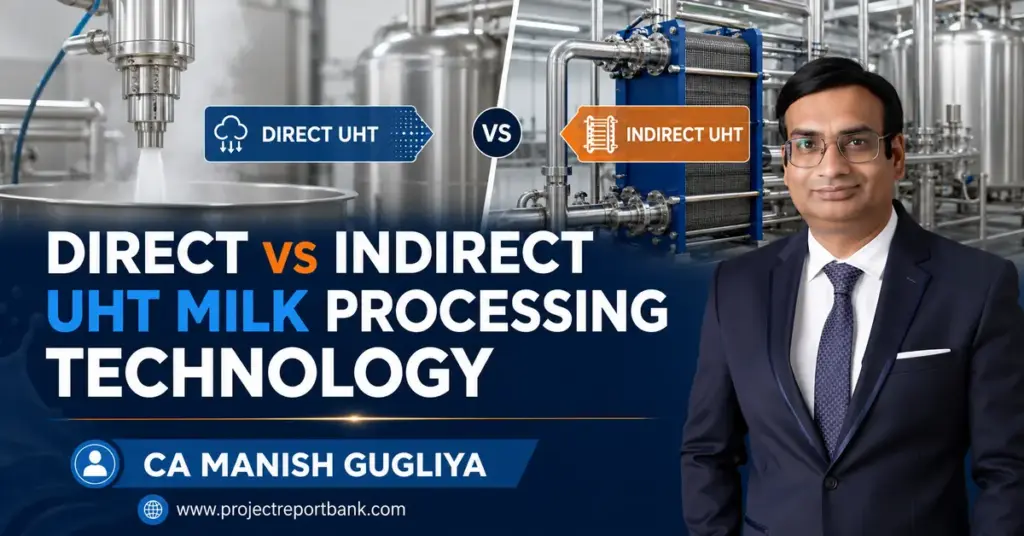
Selecting between direct and indirect UHT milk processing technology is one of the most consequential decisions a dairy entrepreneur or investor will face when planning a new UHT milk processing plant. This choice does not merely affect which equipment appears on the factory floor-it determines product quality, capital investment, energy consumption, maintenance intensity, production flexibility and, ultimately, the financial viability of the entire project. Whether you are evaluating a greenfield dairy plant or upgrading an existing facility, understanding how the two principal methods of ultra high temperature processing differ in practice-not just on paper-is essential before finalising your Detailed Project Report (DPR) or approaching a lender.
The short answer: Direct UHT processing delivers superior flavour retention and lower thermal damage, making it the preferred choice for premium UHT milk and heat sensitive product lines where sensory quality commands a price premium. Indirect UHT processing offers higher energy recovery, simpler utility requirements and greater product flexibility, making it better suited for standard UHT milk, viscous dairy products and cost-sensitive operations. The choice between direct and indirect UHT processing involves trade-offs between quality and efficiency-neither technology is universally superior, and the right selection depends on your product mix, capacity, capital budget and market positioning.
What Is UHT Milk Processing Technology?
Ultra high temperature processing-commonly referred to as UHT treatment-involves heating milk to temperatures exceeding 135°C for a very short period, typically between 1 and 10 seconds. The purpose of this heat treatment is to achieve commercial sterilization: the elimination of all viable microorganisms, including heat-resistant spores, so that the product is commercially sterile and safe for ambient storage. UHT treatment kills heat-resistant spores in milk, which is the critical distinction from standard pasteurisation.
UHT milk has a shelf life greater than 6 months and can be stored at room temperature without refrigeration, provided the product is filled into pre sterilized containers under a sterile atmosphere using aseptic processing technology. The relationship between the sterilization process and aseptic packaging is inseparable-the heat treatment alone does not guarantee long shelf life unless downstream packaging integrity and sterile handling are maintained throughout. This is why UHT processing extends shelf life beyond 6 months only when combined with proper aseptic filling and laminated packaging or other suitable packaging materials.
The specific temperature–time combination for any UHT process depends on several quality factors: the product’s composition (fat content, total solids, viscosity), the target microbial reduction, regulatory requirements (such as those of FSSAI, Codex Alimentarius or EU regulations), and the equipment design itself. There is no single universal parameter-processing conditions must be validated for each product and each plant. For a detailed understanding of the complete UHT milk processing flow, entrepreneurs should review the step-by-step manufacturing process before evaluating technology options.
Hygienic design is equally important. Equipment surfaces must be clean and sterile, dead spaces must be minimised, and every component downstream of the sterilisation point must maintain sterile atmosphere conditions. Without this discipline, even the best thermal processing will fail to deliver safe, shelf-stable food products.
What Is Direct UHT Processing?
In direct UHT processing, the heating medium comes into direct contact with the milk. High pressure steam-of potable or culinary quality-physically mixes with the product, causing extremely rapid heating. This fast heating and equally rapid flash cooling through a vacuum chamber result in minimal come up and cool down time, which leads to a significantly lower cumulative heat load compared with indirect methods. Direct UHT processing uses steam to heat milk through direct contact, and there are two principal methods used in commercial dairy processing: direct steam injection and steam infusion.
Direct Steam Injection
In direct steam injection (DSI), culinary quality steam is forced into the milk through a steam injector or distributing nozzle. The steam condenses instantly upon contact, raising the product temperature to the sterilisation range-direct heating reaches 140°C in as little as 4 seconds. After a brief holding period in a holding tube, the milk passes into a vacuum chamber where flash cooling occurs. This vacuum step serves a dual purpose: it rapidly reduces the product temperature and removes the water added by steam condensation, thereby restoring the original solids concentration.
Steam quality is critical. The steam must be of potable or culinary quality-free from chemical contaminants, off-odours and dissolved solids-because it becomes part of the product. Any compromise in steam quality introduces flavour defects or food safety risks. Direct UHT processing requires strict control of steam quality and energy management to deliver consistent results.
The main advantage of DSI is its impact on product quality. Research comparing DSI at 143°C with 1–2 seconds holding against indirect UHT at the same temperature with 3–4 seconds holding showed that DSI produced approximately 27.5% lower whey protein denaturation than the indirect method, with particle size distributions closer to those of raw and HTST-pasteurised milk. Direct heating minimizes thermal damage to sensitive products, retains more heat-sensitive vitamins due to its shorter exposure times, and produces fewer cooked and sulphur-based off-flavours.
Steam Infusion
Steam infusion takes a different approach within the same direct heating systems category. Instead of injecting steam into milk, the milk is introduced-as a thin film, falling stream or fine droplets-into a chamber filled with high pressure steam. Heating is extraordinarily rapid, often reaching the target elevated temperature in as little as 0.1 seconds. A key distinction is that the liquid does not contact hot metal surfaces during the sterilisation phase, which virtually eliminates localised scorching or burning.
After the required holding time, the heated milk enters a vacuum chamber for flash cooling, which simultaneously removes condensed steam and dissolved oxygen. This oxygen removal is significant-direct systems typically reduce dissolved oxygen to approximately 1 ppm compared with up to 10 ppm in indirect systems, lowering oxidation risk during storage.
Studies comparing steam infusion (INF-dUHT) with indirect UHT processing have confirmed that infusion-treated milk retains a higher fraction of native whey proteins, produces fewer undesirable volatile organic compounds, and delivers aroma profiles closer to HTST or raw milk. However, the equipment complexity is substantially higher: infusion chambers are large pressure vessels requiring precise control of film thickness, steam distribution and vacuum conditions, and they demand higher skilled operators for consistent operation.
What Is Indirect UHT Processing?
Indirect UHT processing heats milk using a physical barrier such as a heat exchanger-a metal surface separating the product from the heating medium (steam or hot water). At no point does the steam come into direct contact with the milk. All heating and cooling stages occur through indirect heating via heat exchanger surfaces. This approach results in slower heating and cooling rates and, consequently, longer total heat exposure compared with direct systems.
Indirect systems require higher pressures to prevent boiling as the product temperature rises above 100°C within the enclosed heat exchanger passages. The longer thermal exposure is the fundamental reason why indirect UHT processing can result in greater protein denaturation and changes in viscosity, and may lead to a cooked flavor due to longer heating duration.
Plate Heat Exchangers
Plate heat exchangers are widely used for pasteurisation and UHT processing of standard fluid milk. They consist of corrugated metal plates arranged in a frame, creating thin channels for product and heating medium to flow on alternating sides. Their defining strength is regeneration efficiency-plate heat exchangers can recover up to approximately 90% of the energy from hot outgoing milk to preheat cold incoming milk, making them highly energy-efficient for continuous flow operations.
However, plate heat exchangers have clear limitations. They are less suitable for viscous products, formulations with particulates, or dairy products containing stabilisers. Higher viscosity increases pressure drop and fouling rates, limits particle size that can pass through the narrow channels, and compromises heat transfer uniformity.
Tubular Heat Exchangers
Tubular heat exchangers use concentric tubes or multi-tube configurations to transfer heat. They can handle higher pressures, accommodate more viscous products, and tolerate moderate levels of solids or particles if designed with larger bore tubes. Hygienic design is well-established, and they are generally more robust than plate systems for demanding dairy processing applications.
Fouling remains a concern. Protein and mineral deposits accumulate on hot tube surfaces during extended runs. Tubular systems may achieve production run times of approximately 16–20 hours before requiring cleaning-in-place (CIP), somewhat longer than plate systems but still a significant operational constraint.
Scraped-Surface Heat Exchangers
Scraped surface heat exchangers are specialised equipment used primarily for very viscous dairy products, thick creams, or formulations with stabilisers and particulates that would foul conventional surface heat exchangers. A rotating blade mechanically scrapes product deposits from the heat transfer surface during operation, preventing buildup and maintaining heat transfer efficiency.
These systems are more complex and costly, offer lower energy recovery than plate or tubular designs, and are not commonly used as primary UHT sterilisation equipment. Their role is typically supplementary-handling specific product types within a broader processing line.
Direct vs Indirect UHT Processing: How They Compare at a Glance
The following comparison table summarises the key differences across the parameters that matter most for technology selection:
| Parameter | Direct UHT Processing | Indirect UHT Processing |
|---|---|---|
| Heating principle | Steam condenses directly in milk | Heat transfers through metal surface |
| Contact between steam and milk | Direct contact | No contact-separated by exchanger wall |
| Heating speed | Very fast (0.1–0.5 s to reach target) | Slower (several seconds through exchanger) |
| Cooling speed | Rapid-vacuum flash cooling | Slower-cooled via plates or tubes |
| Total heat exposure | Low cumulative heat load | Higher cumulative heat load |
| Flavour retention | Superior-closer to fresh milk taste | More cooked/sulphur off-flavours |
| Colour changes | Minimal browning | More Maillard-reaction browning |
| Nutrient impact | Better vitamin and whey protein retention | Greater protein denaturation, vitamin loss |
| Steam-quality requirement | Potable or culinary quality mandatory | Standard steam/hot water acceptable |
| Product dilution risk | Yes-requires vacuum flash to remove condensate | None |
| Vacuum-system requirement | Essential | Not required |
| Heat-regeneration efficiency | ~50% | Up to ~90% |
| Energy consumption | Higher-more energy intensive | Lower per litre processed |
| Fouling tendency | Lower-minimal hot-surface contact | Higher-deposits on exchanger surfaces |
| Cleaning requirements | Less frequent CIP | More frequent CIP (every 8–20 hours) |
| Equipment complexity | Higher-pressure vessels, vacuum, steam purity | Moderate-standard heat exchangers |
| Capital cost | Generally higher | Generally lower |
| Operating cost | Higher utility costs | Lower energy, higher cleaning costs |
| Maintenance requirement | Specialised-steam systems, vacuum | Standard-gaskets, seals, surfaces |
| Product flexibility | Best for low-viscosity, standard milk | Better for viscous, particulate products |
| Suitability for standard milk | Excellent | Good |
| Suitability for premium milk | Preferred | Acceptable |
| Suitability for viscous products | Limited | Better (tubular/scraped surface) |
| Plant capacity considerations | Higher CAPEX better amortised at scale | Suitable across capacity ranges |
The headline takeaway: direct UHT processing technology delivers measurably better product quality at the cost of higher capital investment and energy consumption, while indirect UHT processing technology offers superior energy recovery and greater versatility at the expense of higher thermal damage to the product.
Product Quality and Sensory Impact
Product quality is often the decisive factor for food manufacturers positioning their UHT milk in competitive retail markets, and the differences between direct and indirect systems are well-documented.
Direct UHT processing consistently produces milk with sensory profiles closer to fresh pasteurised milk. UHT processing minimizes thermal damage to milk quality when direct methods are used-the rapid heating and cooling cycle limits the formation of cooked and sulphury off-flavours, reduces non-enzymatic browning (Maillard reaction), and preserves a higher proportion of native whey proteins, particularly β-lactoglobulin. Direct UHT processing retains more heat-sensitive vitamins due to its shorter exposure times.
Indirect UHT processing may lead to a cooked flavor due to longer heating duration. The slower heating and cooling ramps allow more time for chemical reactions-protein aggregation, furosine formation, browning, and generation of volatile sulphur compounds. Studies have confirmed that indirect UHT milk shows higher furosine concentrations and more pronounced browning compared with direct-processed milk.
Indirect UHT processing can result in greater protein denaturation and changes in viscosity, which may also influence sediment formation during storage. The higher dissolved oxygen levels in indirect systems (approximately 10 ppm versus approximately 1 ppm in direct systems) increase oxidation risk, potentially affecting colour stability and nutritional qualities over the product’s shelf life.
However, it is important to recognise that final product quality depends on far more than the heating method alone. Raw milk quality, homogenisation parameters, deaeration, formulation, packaging integrity, storage temperature and light exposure all influence the sensory and nutritional properties of the finished product. UHT milk retains similar calories and calcium as pasteurized milk regardless of the processing method, and UHT processing reduces the risk of thermal damage to sensitive products when properly controlled.
Winner: Direct UHT processing – for product quality and sensory characteristics, direct systems are measurably superior. However, indirect systems can produce commercially acceptable UHT milk for markets where price rather than premium flavour drives purchasing decisions.
Energy Consumption and Heat Recovery
Energy consumption is a critical operating cost driver and a significant differentiator between the two technologies.
Indirect systems excel in heat recovery. Through regenerative heat exchange-where hot outgoing milk preheats cold incoming milk-indirect systems can recover up to approximately 90% of thermal energy, substantially reducing steam and hot-water consumption per litre of processed milk. This efficiency makes indirect heating particularly attractive for high-throughput, continuous flow operations where utility cost is a primary concern.
Direct systems sacrifice energy recovery for product quality. Because flash cooling in the vacuum chamber evaporates water and releases heat that cannot be fully recovered, direct systems typically achieve regeneration of only approximately 50%. Steam consumption per kilogram of processed milk is higher, and the steam must be of culinary quality, adding to utility cost. Vacuum systems (pumps, condensation equipment) consume additional electricity. Overall, direct heating systems are more energy intensive per unit of production.
However, evaluating energy consumption at the equipment level alone can be misleading. Indirect UHT systems have high energy demand and water use when CIP frequency, product losses during cleaning, and cooling-water requirements are factored in. Implementing best practices can reduce emissions by up to 46%, water use can be reduced by up to 44%, and product losses can decrease by up to 59% with optimised UHT lines-improvements that apply to both technologies. The total plant utility consumption-including boiler capacity, refrigeration, compressed air, water treatment and effluent handling-should be evaluated holistically during DPR preparation.
Winner: Indirect UHT processing – for energy efficiency and heat recovery, indirect systems hold a clear advantage. The trade-off is that direct systems deliver this energy saving at the cost of greater thermal damage to the product.
Capital Cost and Operating Cost Comparison
From a project-finance perspective, the cost differences between direct and indirect UHT systems are significant but must be evaluated on a lifecycle basis rather than on equipment purchase price alone.
Capital cost (CAPEX): Direct UHT systems generally require higher capital investment. The additional cost comes from culinary steam generation systems (boilers capable of producing potable or culinary quality steam), vacuum flash-cooling chambers (which are large pressure vessels), precise instrumentation and controls, and safety systems. Steam infusion systems, in particular, require substantial pressure-vessel infrastructure. For reference, leading equipment suppliers offer direct infusion systems with capacities up to approximately 35,000 litres per hour.
Indirect UHT systems typically have lower CAPEX for the core processing equipment-plate or tubular heat exchangers, regeneration sections, and standard steam/hot-water heating. However, total plant cost also includes the aseptic filling line, homogeniser, CIP system, automation, utilities and civil works. For a detailed breakdown of UHT milk plant machinery and equipment cost, entrepreneurs should consult the dedicated guide.
Operating cost (OPEX): Direct systems carry higher utility costs-more steam (of higher quality), vacuum power, and electricity. Indirect systems have lower energy costs per litre but may incur higher maintenance, CIP chemical and water costs due to more frequent fouling. Equipment fouling is a higher risk in indirect UHT processing compared to direct methods, translating into more downtime and product losses.
Actual costs depend on capacity, product mix, automation level, equipment origin (imported versus domestic), packaging system, site conditions and local utility rates. Universal cost estimates are unreliable-project-specific quotations from equipment suppliers are essential. The cost of setting up a UHT milk plant varies considerably based on these factors.
Winner: Indirect UHT processing – for lower initial capital outlay and lower per-litre energy costs. However, when lifecycle costs including cleaning, downtime, product losses and potential quality premiums are considered, the gap narrows substantially, and direct systems may offer better value for premium product lines.
Fouling, Cleaning and Maintenance
Fouling-the accumulation of milk protein and mineral deposits on heat-transfer surfaces-is one of the most practically important differences between direct and indirect UHT systems.
In indirect systems, fouling is a persistent operational challenge. Milk deposits form on plate and tubular surfaces at high temperature, reducing heat transfer efficiency, increasing pressure drop, and eventually forcing a production shutdown for CIP cleaning. Plate heat exchanger systems may require CIP every 8–12 hours of continuous operation; tubular systems typically achieve 16–20 hours before significant fouling necessitates cleaning. Each CIP cycle consumes cleaning chemicals, water and time, and generates product losses during flushing and re-sterilisation.
Direct systems experience significantly less fouling because the milk does not contact hot metal surfaces during the critical sterilisation phase. In steam infusion, heating occurs in a steam-filled chamber without surface contact; in steam injection, the heating is so rapid that deposit formation is minimised. Some fouling may still occur in holding tubes, downstream heat exchangers or vacuum-system components, but production run times between cleaning are generally longer.
However, maintenance requirements differ in nature rather than simply in severity. Direct systems require rigorous maintenance of steam generators and boilers to preserve culinary quality steam standards, vacuum chambers and condensate-removal systems, and precision controls. Indirect systems require maintenance of heat exchanger surfaces, gaskets and seals (in plate systems), and management of pressure-related wear. Spare parts for direct systems-steam injectors, vacuum pumps, infusion chambers-may be more specialised and expensive, with availability depending on the equipment supplier’s local support infrastructure.
Winner: Direct UHT processing – for lower fouling, longer production runs and reduced CIP frequency. The trade-off is more specialised maintenance requirements and potentially higher spare-parts costs for direct-system components.
Direct Steam Injection vs Steam Infusion
Within the category of direct heating systems, the choice between steam injection and steam infusion deserves separate consideration, as the two technologies differ meaningfully in their product-steam interaction and operational characteristics.
Product-steam interaction: In steam injection, steam is forced through a steam injector or distributing nozzle directly into the flowing milk, creating intense turbulence as steam bubbles condense. This turbulence can produce a partial homogenisation effect. In steam infusion, milk enters a steam-filled chamber as a thin film or droplet stream, and heating occurs by surrounding steam condensing onto the product surface. Infusion avoids the localised hotspots that can occur at injection nozzle tips.
Heating uniformity: Steam infusion generally offers more uniform heating because all portions of the milk film are exposed to steam simultaneously. However, controlling film thickness and distribution within the infusion chamber is technically demanding. Steam injection heating is rapid but less inherently uniform, depending heavily on nozzle design and flow dynamics.
Vacuum flash cooling: Both technologies require vacuum chambers for flash cooling and condensed-steam removal. Infusion systems may require larger or more precisely engineered vacuum chambers because of the volume of steam condensate involved.
Operational complexity: Infusion systems are more complex-they require large pressure vessels, precise control of steam conditions and product distribution, and higher skilled operators. Injection systems, while still more complex than indirect alternatives, can be simpler in smaller-capacity installations.
Applications: For heat sensitive product lines where flavour retention is paramount-premium UHT milk, lactose-free milk, fortified dairy beverages-steam infusion may offer a marginal quality advantage. Steam injection is a well-proven technology suitable for a broader range of capacities and may be easier to integrate into existing plants.
Winner: There is no universal winner between the two. Steam infusion edges ahead for premium product quality in larger-capacity installations; steam injection offers a more practical entry point for food manufacturers seeking direct-system benefits with somewhat simpler equipment and controls.
Direct vs Indirect UHT Processing: Which Should You Choose?
- Choose Direct UHT if your business strategy centres on premium product quality, you are targeting markets where fresh-milk taste and superior flavour retention command a measurable price premium, your product mix is focused on standard fluid milk or heat-sensitive dairy beverages, and your capital budget accommodates the higher initial investment and utility infrastructure.
- Choose Indirect UHT if your priority is operating costs and energy efficiency, your product portfolio includes viscous products, creams, flavoured milks with particulates or products containing stabilisers, you need simpler utility arrangements and lower steam-quality requirements, or your market does not differentiate significantly on UHT milk sensory characteristics.
For projects combining UHT milk with other dairy products-such as curd, paneer, ghee or flavoured milk-the technology choice becomes more nuanced, and an integrated dairy processing plant project report may be necessary to evaluate the full processing and financial picture.
The lowest machinery quotation does not necessarily produce the lowest lifecycle cost. A cheaper indirect system with high fouling, frequent downtime and inferior product quality may cost more over a 10-year project life than a well-specified direct system operating at higher capacity utilisation with premium product pricing. Final selection should consider the entire processing and aseptic-packaging line as an integrated system.
Technology Selection According to Product Mix
The suitability of each UHT processing technology varies significantly across product types:
- Standard UHT milk: Both technologies produce commercially sterile milk. Indirect systems are cost-effective for standard-grade products; direct systems are preferable where flavour differentiation is important. UHT milk is preferred in warmer climates due to transportation costs and extended shelf life advantages in the supply chain.
- Premium UHT milk: Direct systems (infusion or injection at short hold times) deliver measurably better sensory characteristics. UHT processing allows for larger packaging sizes without affecting quality, making direct-processed premium milk suitable for both retail and food service applications in large containers.
- Flavoured and fortified milk: Indirect systems may handle added solids and flavouring ingredients more reliably. However, direct systems may better preserve delicate flavour compounds and added vitamins. Product trials with the specific formulation are essential.
- Lactose-free milk and dairy beverages: These products often have modified composition and may be more heat-sensitive. Direct systems can reduce thermal damage, preserving the physical properties and nutritional qualities of these specialised products.
- Cream and high-fat products: Indirect systems with tubular heat exchangers or scraped surface heat exchangers are generally more suitable. Direct systems are less well-suited for high-viscosity formulations because the vacuum flash-cooling step limits particle size and may not handle thick products effectively.
- Products with stabilisers or particulates: Indirect systems-particularly tubular designs with larger bore sizes-can accommodate these formulations more reliably. Direct systems may struggle with solids that do not disperse well in the steam-contact and vacuum-cooling phases.
For specialised or novel products, pilot trials and vendor guarantees under local conditions are strongly recommended before committing to a technology platform. The container size and packaging format should also be considered alongside processing technology.
Factors to Consider Before Selecting a UHT System
Before finalising UHT technology for a new or expanded dairy processing plant, the following checklist should be systematically evaluated:
Capacity and throughput:
- Planned processing capacity (litres per day)
- Hourly throughput requirements
- Number of operating hours per day and operating days per year
- Planned capacity utilisation in the first three years
Product and quality:
- Product portfolio-single product or multiple dairy products
- Raw milk quality and seasonal variation
- Desired shelf life and storage conditions
- Expected sensory quality standards
- Packaging format and packaging materials
Utilities and infrastructure:
- Steam availability and steam quality (culinary quality capability)
- Water availability and water-treatment capacity
- Electrical power supply and backup
- Refrigeration and chilled-water capacity
- Effluent treatment
Operations and maintenance:
- Operator skill level available locally-direct systems typically require higher skilled operators
- Automation level and process control requirements
- CIP system design and cleaning frequency
- Maintenance support and spare-parts availability from the equipment supplier
- Local technical support infrastructure
Financial:
- Total capital budget including civil works, utilities and working capital
- Working-capital requirements for raw milk procurement and inventory
- Projected capacity utilisation and revenue assumptions
- Expected profitability and debt-servicing capacity
- Future expansion provisions
Financial and Bankability Implications
The technology decision directly influences the financial structure and bankability of a UHT milk processing project. From a project-finance perspective, the following parameters are affected:
- Total project cost: Direct systems increase the machinery and utility-infrastructure components, raising total investment. Indirect systems typically result in lower total project cost for the same processing capacity.
- Means of finance and term-loan requirement: Higher project cost increases the equity and debt requirement, affecting the promoter’s contribution and term-loan quantum.
- Production cost per litre: Direct systems carry higher utility and steam costs; indirect systems have higher cleaning and maintenance costs. The net effect depends on capacity utilisation, product mix and local utility rates.
- Capacity utilisation: Direct systems may achieve longer production runs due to lower fouling, potentially improving effective capacity utilisation. Indirect systems require more downtime for CIP.
- Break-even level: Higher fixed costs (from higher CAPEX) in direct systems may raise the break-even point, while lower variable costs at high utilisation may improve margins.
- DSCR (Debt Service Coverage Ratio): The interplay of investment, operating cost and revenue determines DSCR. A well-specified project with appropriate technology and realistic utilisation assumptions will demonstrate adequate debt-servicing ability.
- Sensitivity analysis: Both technologies should be stress-tested against changes in raw milk prices, energy costs, capacity utilisation and selling prices.
The DPR should be prepared using actual quotations from equipment suppliers, realistic capacity assumptions based on market assessment, product-specific selling prices, and operating costs derived from the proposed plant’s utility configuration. Generic projections are inadequate for bank-finance applications. For a comprehensive understanding of UHT milk plant investment requirements, entrepreneurs should review the project-cost guide and obtain project-specific quotations.
Common Mistakes While Selecting UHT Technology
Based on experience with dairy processing plant project reports, the following mistakes are commonly observed:
- Comparing only equipment prices without evaluating total installed cost, utility infrastructure, aseptic filling integration and lifecycle operating costs.
- Ignoring utility loads. A cheaper indirect system may require significantly more CIP chemicals, water and energy when fouling frequency is accounted for. Conversely, a direct system’s culinary steam and vacuum requirements may be underestimated.
- Underestimating culinary-steam requirements. Food manufacturers choosing direct systems sometimes budget for standard boilers without accounting for the additional cost and complexity of producing potable or culinary quality steam continuously.
- Selecting technology without product trials. Assuming that one technology will work for all products in the planned portfolio without conducting pilot trials under local conditions with representative raw milk.
- Ignoring fouling and CIP downtime. Failing to account for the process time lost to cleaning, the product losses during flushing, and the impact on annual production volume and revenue.
- Mismatching processing and filling capacities. The UHT processing line and aseptic filling system must be balanced; a mismatch leads to bottlenecks, product waste and lower effective utilisation.
- Assuming full capacity utilisation from the first year. Most new UHT plants require 12–24 months to build market share. Projections should reflect a realistic ramp-up.
- Ignoring local technical support. Direct systems with specialised components require vendor support for maintenance, calibration and spare parts. If the nearest service engineer is thousands of kilometres away, downtime costs escalate.
- Preparing projections without vendor quotations. Financial projections based on assumed costs rather than actual supplier quotations lack credibility with lenders and understate or overstate the true investment requirement.
- Failing to provide adequate contingency and working capital. UHT milk plants have significant working-capital requirements for raw milk procurement, packaging inventory and finished-goods storage. Inadequate provisions lead to cash-flow difficulties during the critical early months of operation.
Frequently Asked Questions
What is the main difference between direct and indirect UHT processing?
Direct UHT processing uses steam in direct contact with milk for rapid heating and flash cooling, while indirect UHT processing heats milk through a heat exchanger surface without steam-milk contact. This fundamental difference affects heating speed, product quality, energy efficiency and equipment requirements.
Is direct UHT processing better for milk flavour?
Yes. Direct systems produce UHT milk with flavour profiles closer to fresh pasteurised milk due to lower cumulative heat exposure. Indirect UHT processing may lead to a cooked flavor due to longer heating duration and greater protein denaturation.
Is indirect UHT processing more energy-efficient?
Generally, yes. Indirect systems achieve heat regeneration of up to approximately 90%, compared with approximately 50% for direct systems. However, total plant energy consumption should include CIP frequency, product losses and cooling requirements.
What is the difference between steam injection and steam infusion?
In steam injection, steam is injected into the milk through nozzles. In steam infusion, milk is introduced into a steam-filled chamber. Both are direct heating methods, but infusion typically offers more uniform heating and avoids hot-surface contact, while injection may be simpler in design at smaller capacities.
Which heat exchanger is used for indirect UHT processing?
Plate heat exchangers are most common for standard fluid milk. Tubular heat exchangers handle higher pressures and more viscous products. Scraped surface heat exchangers are used for very viscous formulations or products prone to heavy fouling.
Does direct UHT processing dilute milk?
Steam condensation during direct heating does add water to the product. However, the subsequent vacuum flash-cooling step removes this condensed water, restoring the original solids concentration. Proper process control ensures no net dilution.
Which UHT system has a lower plant cost?
Indirect UHT systems generally have lower equipment and installation costs. However, total lifecycle cost-including energy, maintenance, downtime, product quality and market pricing-may favour direct systems for certain product mixes and capacities.
Which technology is suitable for flavoured milk?
Indirect UHT systems, particularly those using tubular heat exchangers, are generally better suited for flavoured milk containing particulates, stabilisers or added solids. Direct systems may not handle these formulations as effectively.
Can the same UHT line process multiple dairy products?
Yes, with appropriate design, CIP protocols and process-parameter adjustments. However, product changeover time, cleaning requirements and potential cross-contamination risks must be carefully managed. The range of products a single line can handle depends on equipment design, automation and the physical properties of each product.
How should an entrepreneur select UHT technology for a new plant?
Start with the planned product mix and target market positioning. Evaluate the sensory-quality requirements, capital budget, utility infrastructure, operator capabilities and maintenance support. Obtain quotations from multiple equipment suppliers, conduct product trials where possible, and prepare a DPR with project-specific financial projections.
Does UHT processing require aseptic packaging?
Yes. UHT processing achieves commercial sterilization of the product, but this sterility must be maintained through aseptic filling into pre sterilized containers under sterile conditions. Without aseptic processing and packaging, the extended shelf life benefit of UHT treatment is lost. UHT processing allows for longer shelf life without refrigeration only when combined with proper aseptic packaging.
What information should be included in a UHT milk plant DPR?
A comprehensive DPR should include project description, technology selection rationale, machinery specifications and quotations, civil and utility requirements, capacity and product-mix assumptions, raw material and packaging costs, manpower plan, project cost with means of finance, profitability projections, break-even analysis, cash-flow statements, DSCR calculations, sensitivity analysis and all supporting documentation required by the financing institution.
Conclusion
The selection between direct and indirect UHT milk processing technology is not a simple question of which is “better”-it is a strategic decision that must balance product quality, product mix, plant capacity, utility infrastructure, investment budget, operating costs and long-term financial feasibility. Direct systems deliver superior sensory quality and lower fouling at the cost of higher investment and energy consumption. Indirect systems offer better energy recovery and product flexibility at the cost of greater thermal damage and more intensive cleaning requirements.
The right choice depends on your specific project-your target market, your product portfolio, your capital structure and your operational capabilities. UHT processing allows for larger packaging sizes without affecting quality, and UHT milk is preferred in warmer climates due to transportation costs, making the technology decision inseparable from your broader market and supply chain strategy. The environmental impact of each technology also deserves consideration as the food industry moves towards more sustainable dairy processing practices.
CA Manish Gugliya, FCA, DISA (ICAI), assists entrepreneurs, dairy businesses and investors with customised UHT milk processing plant project reports, Detailed Project Reports (DPRs), CMA data, financial projections, break-even analysis and bank-finance assessments. Each project report is prepared based on the specific project’s technology selection, capacity, product mix, equipment quotations and financial requirements-ensuring that the document is bankable, realistic and aligned with the promoter’s business plan. For professional assistance with your UHT milk plant project report, reach out through www.projectreportbank.com.