Key Takeaways
- An aseptic carton packaging system for UHT milk combines separately sterilized product and packaging material, filled and sealed in a sterile environment, giving UHT milk a shelf life of up to 90 days at ambient temperature without refrigeration.
- The right filling machine selection directly impacts CAPEX (from ₹ 0.6 crore for entry-level to ₹ 25+ crore for high-speed lines), operating cost per litre, bankability and long-term profitability of the dairy project.
- Entrepreneurs must evaluate machinery configuration (roll-fed vs blank-fed), pack sizes, line capacity in packs per hour, and packaging material cost before finalising investment.
- All costs discussed here are indicative ranges based on Indian dairy projects and must be validated through supplier quotations and a detailed project report (DPR).
- This article is written from the professional perspective of CA Manish Gugliya, FCA, DISA (ICAI), combining technical clarity with financial and DPR implications for project planning.
What Is an Aseptic Carton Packaging System for UHT Milk?
An aseptic carton packaging system for UHT milk is a process where UHT-sterilized milk and separately sterilized packaging material are brought together and sealed inside a controlled sterile environment. This method is created to deliver a long shelf life of 3–9 months at ambient temperature, eliminating the need for a continuous cold chain during distribution of UHT milk.
Milk is a prime medium for bacterial growth if not processed properly. UHT milk is subjected to heating at 135°C to 150°C for 2 to 4 seconds – commonly at 145°C for 4 seconds – to destroy all harmful bacteria and microorganisms. The rapid UHT heating process preserves the nutritional value and taste of milk, keeping proteins and vitamins largely intact. Aseptic processing extends milk shelf life up to 90 days, and in many cases well beyond that.
The carton packaging material is sterilized separately using hydrogen peroxide, UV or heat before it enters the aseptic zone. Inside the aseptic chamber, maintained under positive sterile-air pressure, the sterilized product and package meet. Hermetically sealed packages prevent microbial recontamination of UHT milk. This is fundamentally different from ordinary paper carton packing, which requires chilled distribution and offers only a short shelf life.
The aseptic carton line connects to the UHT section through a sterile balance tank and aseptic pipelines. For a complete understanding of the UHT milk manufacturing process and flow chart, refer to our detailed guide. Note that the choice of direct versus indirect UHT milk processing technology affects product temperature at the filler, holding times and integration design.
Aseptic packaging ensures safe protection against contamination, and an aseptic carton packaging system allows UHT milk to be stored at ambient temperatures. UHT processing eliminates the need for refrigeration during storage, giving the dairy access to distant markets. Aseptic packaging solutions support efficient distribution of dairy products including UHT white milk, flavoured milk, cream and even yoghurt-based drinks. Today, this makes packaging-line selection a key strategic decision affecting investment size, working capital and market reach.
Major Components of an Aseptic Carton Packaging Line
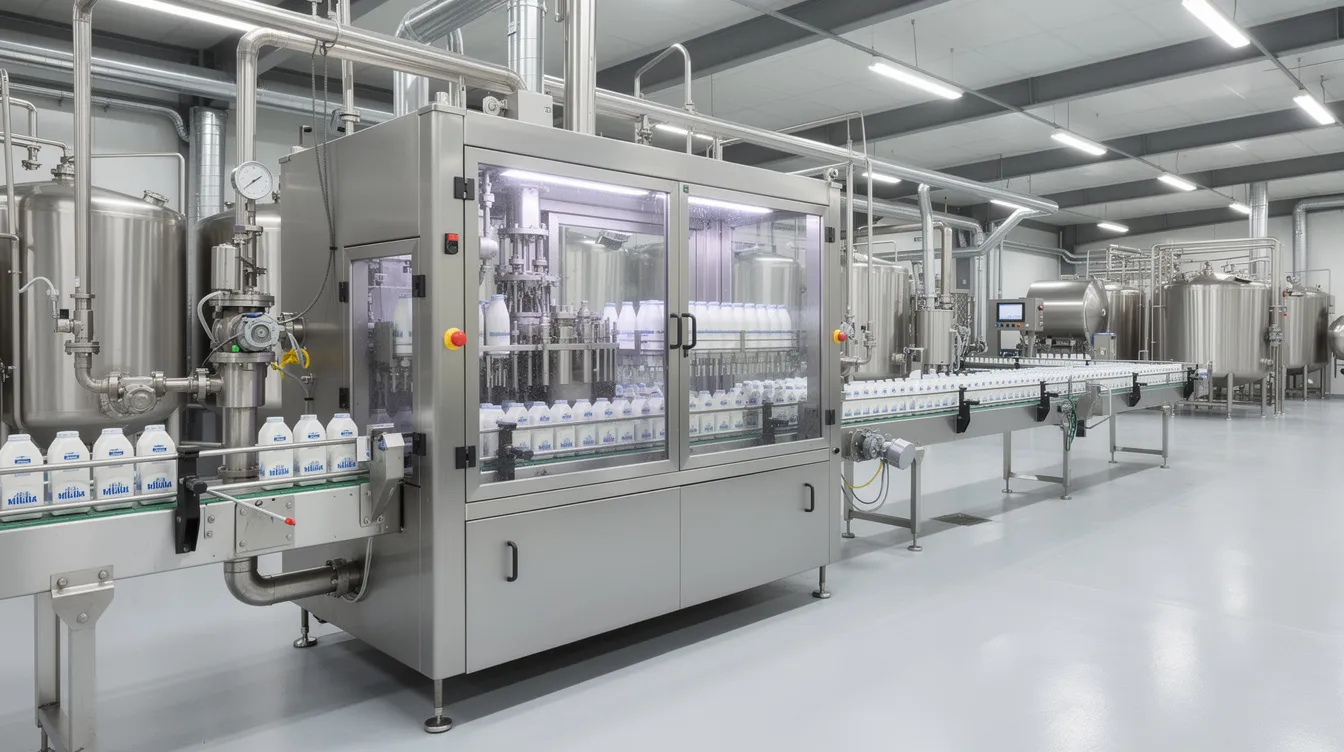
A UHT milk aseptic carton packaging machine is only one device within the complete line. The full aseptic carton packaging line includes product handling, filling, inspection, secondary packing, palletisation and supporting utilities. Aseptic filling machines ensure high food safety standards, and aseptic filling machines utilize advanced cleaning-in-place systems. CIP systems are essential for maintaining hygiene in milk processing across all line components.
| Equipment or Section | Primary Function | Selection Consideration | Cost Implication |
|---|---|---|---|
| Packaging-material feeding (reels or blanks) | Supplies carton material to the machine | Roll-fed vs blank-fed; storage design | Medium |
| Packaging-material sterilization unit | Sterilizes cartons via H₂O₂, UV or heat | Chemical consumption, validation | Medium |
| Aseptic chamber | Maintains sterile filling environment | Air filtration, overpressure reliability | High |
| Sterile buffer tank and aseptic valves | Holds sterilized milk before filling | Volume, CIP/SIP integration | Medium |
| Aseptic filling and sealing machine | Fills and hermetically seals each carton | Speed, pack-size range, automation | Very High |
| Cap/closure or straw applicator | Applies screw caps or straws | Closures compatibility, format number | Medium |
| Date coding and batch printers | Prints date, batch, MRP | Ink type, speed, regulatory compliance | Low |
| Vision inspection and checkweigher | Verifies fill weight and seal quality | Accuracy, reject-handling method | Medium |
| Leak-testing equipment | Checks package integrity | Test method, sampling rate | Low–Medium |
| Secondary packaging (shrink-wrapper, case packer) | Groups cartons into shippers/trays | Automation level, throughput | High |
| Palletising system | Stacks cases on pallets | Manual vs robotic, floor space | Medium–High |
| Compressed-air and sterile-air system | Provides clean air for aseptic zone | Capacity in Nm³/hour, HEPA filters | Medium |
| Electrical panel, PLC, HMI, SCADA | Controls and logs all line operations | Brand, data logging, remote access | Medium |
The central aseptic carton filling and sealing machine typically accounts for the largest share of line cost. However, secondary packaging equipment, conveyors and inspection systems commonly add 30–100% more to the base filler price depending on the level of automation. Do not confuse the filler price with the full line cost. For a deeper understanding of sterilization, sterile filling and critical control points, see the guide on aseptic filling and packaging process for UHT milk.
Types of Aseptic Carton Packaging Systems
Commercial aseptic carton packaging systems for UHT milk are broadly of two types based on how carton material is supplied to the filling machine: roll-fed (web-fed) and blank-fed (sleeve-fed). Each method has distinct implications for UHT milk packaging plant investment, production flexibility and operating cost.
Roll-Fed Aseptic Carton Systems
In roll-fed systems, packaging material comes in large printed laminate reels. The system sterilizes the web using a hydrogen peroxide bath and hot-air drying, then forms it in-line into a continuous tube, fills the tube with sterilized UHT milk, and seals and cuts individual cartons. Typical commercial machines from suppliers like Tetra Pak can operate at up to 15,000 packs per hour for 125–200 ml packs.
Roll-fed lines offer higher speed, lower packaging-material storage volume per pack and generally lower material cost per pack for standard brick formats. However, they have less flexibility for frequent format changes, involve more complex web-handling mechanics and carry a typically higher aseptic carton filling machine price in India.
Blank-Fed or Sleeve-Fed Systems
Blank-fed systems use pre-cut, pre-creased and pre-printed carton blanks or sleeves. Each blank is sterilized individually, formed into a carton, filled aseptically and sealed. This method offers better format flexibility, simpler changeovers between pack sizes (such as shifting between 200 ml and 1-litre packs), and is often suitable for medium production volumes or dairies testing new markets.
Considerations include bulkier storage for blanks, slightly higher material cost per pack in some cases, and line speeds that may be lower than the fastest roll-fed UHT milk packaging machinery.
Comparison of Roll-Fed and Blank-Fed Systems
There is no universally superior technology. The right choice depends on product mix, required capacity, available capital and local support from UHT milk packaging machine suppliers in India.
| Parameter | Roll-Fed | Blank-Fed |
|---|---|---|
| Material form | Reels/rolls | Pre-cut blanks or sleeves |
| Typical line speed | Higher (up to 15,000+ packs/hr) | Moderate (commonly 3,000–8,000 packs/hr) |
| Format flexibility | Lower | Higher |
| Changeover time | Longer (hours for format change) | Shorter |
| Material storage needs | Less (compact rolls) | More (bulky blanks) |
| Initial investment level | Higher | Lower to moderate |
| Maintenance complexity | Higher | Moderate |
| Suitability | Large cooperatives, corporate dairy lines | Smaller private dairies, value-added SKUs |
From a DPR and bank-finance perspective, roll-fed high-speed lines may suit large cooperatives, while blank-fed equipment can match smaller dairies focusing on niche products with greater consistency across shorter runs.
Aseptic Carton Shapes, Formats and Pack Sizes
UHT milk carton packaging formats influence marketing, shelf presence, logistics and total aseptic carton packaging cost per litre. Over 90% of aseptically filled foods are packaged in carton bricks, and similarly over 90% of UHT milk is packaged in carton bricks – the dominant format in India and globally.
Common shapes include standard brick cartons, slim and edge-shaped cartons for premium positioning, portion packs (100–200 ml) with straws for children and institutional supply, and family packs (500 ml to 1 litre) with screw-cap closures for easier pouring. Flat-top and slanted-top configurations are emerging but less common.
| Pack Size (ml) | Typical Application | Closure Option | Likely Market Channel | Capacity Implication |
|---|---|---|---|---|
| 100–125 | Sampling, kids’ packs, school milk | Straw | Government schemes, institutional | Very high packs/hr needed |
| 180–200 | Single-serve UHT milk, flavoured milk | Straw or tear opening | Modern trade, general trade | High packs/hr |
| 250 | On-the-go consumption | Screw cap or straw | Modern trade, HoReCa | High |
| 500 | Smaller family, price-sensitive | Screw cap | General trade, door-to-door delivery | Moderate |
| 750 | Targeted markets (less common) | Screw cap | Niche retail | Moderate |
| 1,000 | Family pack, home consumption | Screw cap | All retail channels | Base capacity |
More pack sizes mean more SKUs, more changeovers, more artwork cylinders and higher inventory of packaging material – all of which must be carefully justified in financial projections.
Packaging Material Used for UHT Milk Cartons
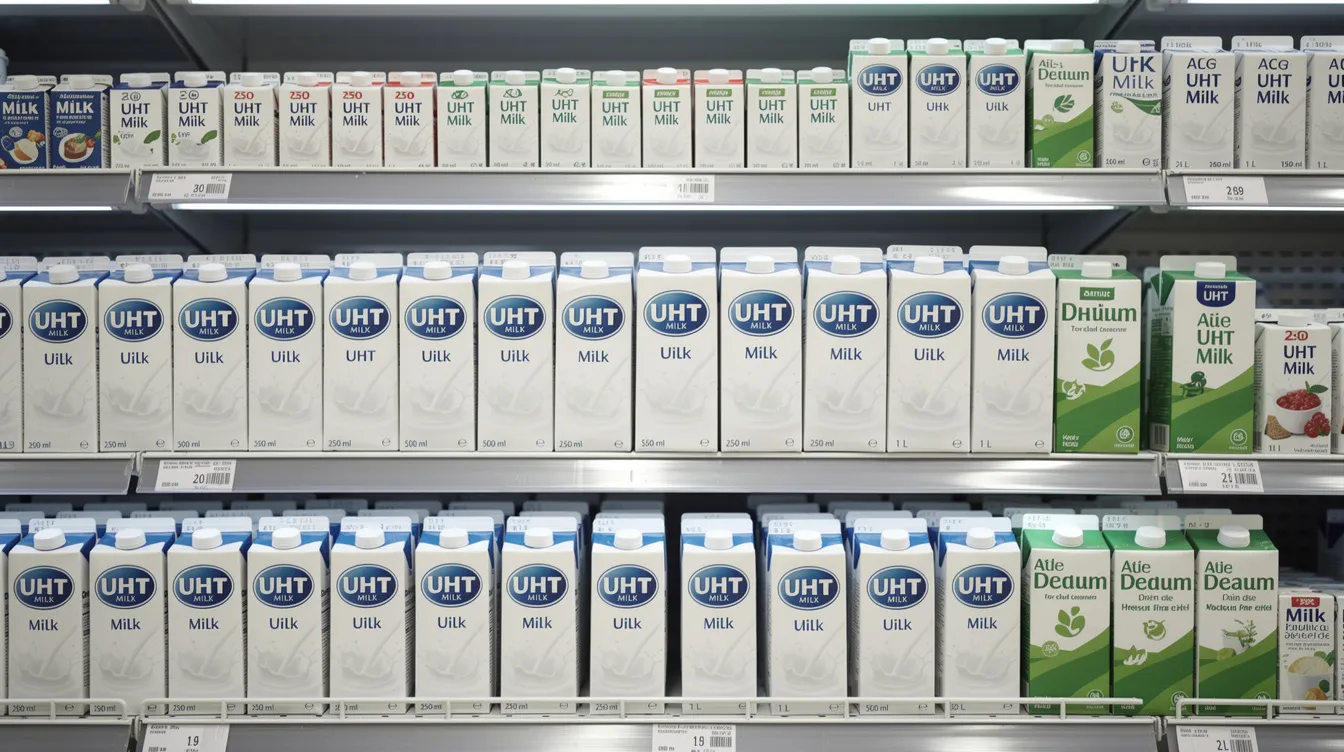
The packaging for UHT milk typically consists of multi-layer materials including paperboard, polyethylene, and aluminum foil – usually a six-layer laminated structure. The packaging material specification must match the aseptic carton filling machine, desired shelf life and food product type.
- Paperboard provides stiffness and a printable surface for brand design and regulatory information
- Polyethylene layers create moisture barrier and enable heat sealing through contact with the sealing device
- Aluminum foil acts as a barrier against oxygen and light
Aseptic cartons provide barriers against light and oxygen, preventing spoilage. The multilayer structure of aseptic cartons helps retain product quality over time by protecting nutritional content and preventing oxidation. Aseptic carton packaging reduces the need for chemical preservatives in UHT milk, which customers increasingly value.
Practically, Indian projects must budget for printing cylinders, minimum order quantities and lead times for artwork changes. Storage of packaging material requires dry, temperature-controlled conditions. Unused carton stock has a limited shelf life; obsolete inventory from design changes or volume shortfalls is a real financial risk.
In the DPR, carton packaging material cost should be kept as a separate line item with realistic rates per 1,000 packs for each size. This is a document that bankers will scrutinise.
Filling Capacity: LPH Versus Packs Per Hour
UHT plants are sized in litres per hour (LPH), while an aseptic carton packaging system is specified in packs per hour. Matching these correctly is essential in plant design. UHT milk production can achieve a capacity of 15,000 litres per hour at the processing stage, and aseptic filling machines can achieve outputs of up to 15,000 pouches or packs per hour depending on format.
The core formula is:
Required packs per hour = Product volume in litres per hour ÷ Pack volume in litres
Consider Overall Equipment Effectiveness (OEE), which accounts for start/stop losses, CIP/SIP cleaning time, format changeover and small stoppages. Effective saleable output is always less than nominal speed.
Illustrative calculation (not a supplier guarantee):
- A 5,000 LPH plant packing 1-litre cartons needs 5,000 packs/hour theoretically. At 80% OEE, select a machine with about 6,000–6,500 packs/hour nominal speed.
- The same 5,000 LPH in 200 ml cartons needs 25,000 packs/hour – likely requiring a very high-speed machine or multiple lines.
Actual UHT milk carton filling machine capacity and price must be confirmed with suppliers. ESL (Extended Shelf Life) products packaged on similar lines may have different sterilization requirements that affect throughput.
Indicative Cost of Aseptic Carton Packaging Systems in India
Aseptic milk packaging machine cost varies significantly by brand, speed, configuration, imported content, tax treatment and exchange rates. Only formal supplier quotations valid at the DPR date should be used as the financial base. Do not rely on a marketplace page or informal quote.
OneStep technology reduces operational costs for UHT dairy products and also reduces environmental impact, which some newer lines now incorporate. This trend is worth evaluating when comparing equipment options.
Broad indicative cost ranges (excluding GST, freight may vary):
| Cost Component | What It Includes | Key Cost Driver | DPR Treatment |
|---|---|---|---|
| Main aseptic carton filling and sealing machine | Filler, sterilization unit, forming/sealing | Speed, brand, pack-size range | Plant & Machinery (capitalised) |
| Cap/straw applicator | Closure application device | Number of closure types | Plant & Machinery |
| Secondary packaging equipment | Shrink-wrapper, case packer, palletiser | Automation level | Plant & Machinery |
| Conveyors and inspection | Checkweigher, vision, leak test, conveyors | Line length, number of inspection points | Plant & Machinery |
| Utilities integration | Compressors, sterile air, water, CIP lines | Capacity, place of installation | Utilities (capitalised) |
| Civil modifications near filling room | Hygienic walls, drainage, controlled access | Room size, existing building condition | Civil Works |
| Installation and commissioning | Erection, testing, validation, training | Imported vs local, commissioning timeline | Pre-operative Expenses |
| Initial spares and packaging-material development | Spare-parts kit, artwork cylinders, trial runs | Number of SKUs | Pre-operative / Contingency |
Indicative price range for the filler alone (based on available market data):
- Small-to-medium capacity (2,000–5,000 packs/hr): ₹ 0.5–1.5 crore
- Medium capacity (8,000–12,000 packs/hr): ₹ 3–8 crore
- High capacity/premium OEM (15,000+ packs/hr): ₹ 10–25+ crore
Secondary packaging and downstream equipment add 30–100% to the base machine cost. Installation, commissioning and initial spares typically add 10–20% of the CFR machine cost. A contingency of 5–10% on packaging-line CAPEX is prudent for exchange-rate movement and scope changes.
These packaging-line costs are separate from total UHT plant investment. For processing equipment details, see our guide on UHT milk plant machinery and equipment cost. For the complete project CAPEX picture including building, land and utilities, refer to the UHT milk processing plant setup cost in India.
Packaging Cost Per Carton and Per Litre
Capital cost is a one-time investment. Recurring aseptic carton packaging cost per pack directly affects contribution margin and the price at which you can sell UHT milk competitively.
Key operating cost heads include printed packaging material, screw caps or straws, corrugated shippers, coding inks, hydrogen peroxide for sterilization, electricity and compressed air, packing labour, maintenance and spare parts, and normal wastage from rejected packs.
Packaging cost per saleable pack = Total packaging-related operating cost ÷ Number of saleable packs
Packaging cost per litre = Packaging cost per pack ÷ Pack volume in litres
From FAO data, carton material cost for UHT milk in rectangular cartons is approximately US$ 60 per 1,000 litres. At current exchange rates, this translates to roughly ₹ 5–8 per litre for carton material alone in India, before adding closures, secondary packaging and other overheads.
A 200 ml pack may cost ₹ 2–3 per pack in material, but per-litre packaging cost works out to ₹ 10–15 – significantly higher than a 1-litre pack at ₹ 5–8 per litre. Each SKU’s packaging cost should be calculated separately in the DPR gross-margin working rather than using one blended number.
New Versus Used Aseptic Carton Filling Machinery
Given the high aseptic carton filling machine price in India, many entrepreneurs consider used imported equipment. This decision carries both technical and financial consequences.
New equipment offers full OEM warranty, latest control systems, better energy efficiency and higher reliability. It integrates more easily with modern automation and data-logging requirements. Banks generally prefer new, reputed-brand equipment with documented OEM support.
Used equipment has a lower upfront price but carries risks: hidden wear, missing parts, re-validation of sterility, possible obsolescence of control systems and limited OEM support. Packaging-material compatibility may lock you into specific suppliers. Valuation, depreciation rates and insurance treatment also differ for second-hand imports.
A proper independent technical inspection report should accompany any used aseptic carton packaging system included in a DPR. The decision should rest on lifecycle cost – CAPEX plus operating cost plus downtime risk – not solely on invoice price.
How to Select the Right Packaging System
Selection of an aseptic carton packaging system for UHT milk should follow a structured evaluation combining technical suitability, commercial terms and financial feasibility.
Practical checklist:
- Planned daily and seasonal milk-processing capacity and utilisation
- Product portfolio: plain UHT white milk, flavoured variants, cream, fortified liquids
- Present and future pack sizes and shapes
- Target markets and distribution channels (local, all-India, export)
- Required shelf life based on distribution distance
- Preferred automation level and available manpower
- Availability and pricing of aseptic packaging material in India for selected formats
- Local technical support, response time and spare-part stocking
- Energy and water consumption
- Flexibility for line extension or additional formats in 3–5 years
Weighted selection matrix example:
| Criteria | Weight | Machine A Score | Machine B Score |
|---|---|---|---|
| Technical fit | 25% | – | – |
| Operating cost per litre | 25% | – | – |
| Investment level (CAPEX) | 20% | – | – |
| Service support and reliability | 15% | – | – |
| Future scalability | 15% | – | – |
This structured method helps during technical and financial appraisal with banks and investors, as assumptions remain transparent and defensible.
Brand and Supplier Considerations
Global suppliers like Tetra Pak and SIG are well-known for dairy aseptic packaging machinery. Tetra Pak A3/Flex can convert between different package types easily, which is relevant for dairies planning multiple SKUs. Domestic manufacturers such as IDMC, Goma Engineering and others also offer machines at lower price points for smaller production scales.
Obtain quotations from multiple suppliers. Ensure scope is comparable. Check long-term availability of compatible packaging material in required volumes. Review packaging-material supply agreements for offtake commitments and price-indexation clauses. Evaluate service contracts, remote-support options and training arrangements. Request detailed technical offers, utility lists and line-layout drawings in pdf format before making a final decision.
This article does not endorse any specific OEM.
Infrastructure and Utility Requirements
Aseptic carton packaging for UHT milk requires a controlled, hygienic filling hall and reliable utilities – often excluded from the base equipment quotation.
Infrastructure: hygienic filling room with washable walls, proper drainage, positive air pressure, controlled access, adequate ceiling height, separate packaging-material warehouse with humidity control, and finished-goods warehouse for ambient storage to store packed UHT milk safely.
Utilities: electrical power with backup, compressed air and sterile air for the aseptic chamber, process water, chilled water where required, steam or thermal-oil heating, CIP return lines and chemical handling, and effluent treatment for water and chemical discharge.
Budget infrastructure and utility upgrades separately from aseptic packaging-line CAPEX and cross-reference with your complete UHT milk plant investment analysis.
Regulatory and Quality-Control Considerations
Aseptic carton packaging for UHT milk must comply with FSSAI food product standards, Legal Metrology Act provisions and applicable BIS standards in India. Requirements can change, so verify them at the project stage.
Quality assurance ensures milk is free from harmful microorganisms. Key quality-control measures include validation of commercial sterility through incubation tests, routine leak testing and seal-strength checks, regular verification of fill weight using calibrated checkweighers, and maintenance of cleaning and sanitation records including CIP/SIP validation. Aseptic filling extends the shelf life of milk products significantly, but only if safety protocols are consistently followed.
Consult qualified food technologists and regulatory experts to design testing protocols and document procedures. Budget this operational cost accordingly.
DPR and Bank Finance Implications
From my professional experience as CA Manish Gugliya, the selection of an aseptic carton packaging system for UHT milk has direct implications on total project cost, working capital and debt-servicing capacity – all evaluated in a DPR and by bankers.
CAPEX impact: The packaging line affects term-loan requirement and promoter contribution. Imported machines may have longer delivery and commissioning timelines, increasing interest during construction (IDC). Foreign-exchange risk on USD/EUR contracts should be addressed through sensitivity analysis in the DPR.
Working capital impact: Packaging material is commonly ordered in large minimum order quantities with defined lead times. Finished-goods inventory of UHT products can grow since they can be stored longer, but this ties up working capital and affects drawing power.
Profitability and banking ratios: Contribution margin per litre must account for packaging-material cost. Break-even volume for each SKU, DSCR and repayment capacity should be modelled under realistic utilisation and margin assumptions. A ±10–15% variation in carton cost or sales volume should be stress-tested.
DPR assumptions on UHT milk packaging machinery cost, capacity and per-litre packaging cost must be based on formal quotations and technical offers – not catalogue prices or marketplace listings. This is a number that demands precision and reliability.
Common Mistakes to Avoid
- Selecting an aseptic carton filling machine only on lowest purchase price without evaluating service support or operating cost
- Underestimating packaging-material cost and its escalation over time
- Mismatching processing capacity (LPH) with packaging capacity (packs/hour), causing idle UHT capacity or bottlenecks
- Opting for too many pack sizes at start-up, which reduces effective line speed and increases inventory challenges
- Ignoring changeover and CIP/SIP time in capacity planning
- Omitting secondary packaging, coding and inspection equipment from the project budget
- Purchasing used imported machines without independent technical inspection or clarity on OEM support
- Assuming nominal speed equals consistent saleable output in DPR calculations
- Preparing financial projections without sensitivity analysis on packaging-material rates or sales volume
Careful planning at the DPR stage prevents expensive mid-course corrections after commissioning.
Practical Conclusion
- An aseptic carton packaging system for UHT milk is a critical investment combining complex machinery, specialised packaging materials and precise manufacturing practices.
- The correct configuration must balance market-required pack formats, technical compatibility with UHT processing, capital budget, packaging cost per litre and service support.
- A well-chosen aseptic carton packaging system for UHT milk strengthens overall project bankability and competitive positioning in the market.
- Approach machinery selection and financial planning together – not in isolation – to build a sustainable and profitable UHT milk business.
Frequently Asked Questions
The following answers address common practical questions with concise, finance-and-operations-focused responses.
What machinery is required for a complete UHT milk carton packaging line?
A complete line includes the aseptic carton filling and sealing machine, sterile product buffer tank, cap or straw applicators, conveyors, batch-coding printers, vision inspection and checkweigher, leak-testing equipment, secondary packaging (shrink-wrapper or case packer) and palletising system, plus utilities like compressors and sterile-air generation. These are in addition to core UHT processing equipment – for which refer to the guide on complete UHT processing equipment requirements.
What factors mainly determine UHT milk carton packaging machine price in India?
- Brand, model and country of manufacture
- Technology type (roll-fed vs blank-fed)
- Speed in packs per hour and number of supported pack sizes
- Inclusion of cap applicator, straw applicator and inspection systems
- Level of automation
- Import content and prevailing foreign-exchange rate
- Scope of after-sales service and training
Lifecycle cost – including packaging-material rates and downtime risk – matters more than the ex-works price alone.
Is aseptic carton packaging always better than pouches for UHT milk?
Aseptic cartons generally offer better branding, convenience and product protection than a pouch, but may have a higher packaging cost per litre. The choice depends on target customers, distribution distance and price positioning. This article focuses on carton systems; other UHT milk packaging options should be evaluated separately for CAPEX, OPEX and market strategy.
How should I reflect packaging-line investment in my DPR?
The DPR should clearly break out aseptic carton packaging CAPEX, secondary packaging, utilities and civil work as separate line items. Show the impact on total project cost, depreciation and term-loan requirement. Include sensitivity analysis on packaging-material cost per litre and utilisation levels so that bankers can see how DSCR and repayment capacity change under different scenarios.
Is Tetra Pak the only aseptic carton packaging option?
No. While Tetra Pak is the most recognised name, other global suppliers like SIG and domestic manufacturers also offer aseptic packaging equipment for dairy plants. Patents on some carton forms have expired, opening the door to competition. Evaluate multiple suppliers on an equivalent-scope basis covering machine cost, packaging-material availability, service support and lifecycle cost.
Call to Action
If you are an entrepreneur, dairy cooperative or investor planning a UHT milk project, I invite you to connect through ProjectReportBank.com for professional assistance with:
- UHT milk plant project reports and detailed project reports (DPRs)
- Project-cost estimation for aseptic carton packaging lines
- CMA data preparation and financial projections
- Working-capital assessment
- DSCR and repayment analysis
- Bank-finance assessment and feasibility review
Professional assistance improves project planning and bankability, but it does not guarantee loan sanction, subsidies or profitability. Outcomes depend on multiple commercial, technical and regulatory factors.
- CA Manish Gugliya, FCA, DISA (ICAI)