Key Takeaways
- A pea starch manufacturing plant project report is the foundational document that promoters, banks and investors use to evaluate the technical feasibility, financial viability and risk profile of a pea starch extraction facility in India. It should cover project cost, manufacturing process, machinery, capacity planning, working capital, revenue projections and sensitivity analysis.
- The pea starch manufacturing process based on wet extraction involves soaking, crushing, fibre separation, protein–starch separation, starch purification through hydrocyclones, dewatering and drying. Dry fractionation is an alternative but produces lower-purity starch fractions. The DPR must clearly document the chosen process route and its yield assumptions.
- Pea starch plant setup cost depends heavily on capacity, technology selection and location. Machinery costs typically form the largest portion of capital expenditure. A structured cost framework covering land, civil works, pea starch processing machinery, utilities, ETP, working capital margin and contingencies is essential for any bankable project report.
- Project economics should be examined through EBITDA, DSCR, IRR, payback period and break-even analysis, using transparent assumptions. Operating costs for starch plants are driven by raw materials, typically accounting for 70–80% of total operating expenditure. Sensitivity analysis on pea prices, starch selling price and capacity utilisation is critical before committing capital.
- CA Manish Gugliya and Project Report Bank provide customised pea starch extraction plant DPR preparation, CMA Data, financial projections, and bank finance advisory for Indian entrepreneurs and investors evaluating this sector.
Introduction: Pea Starch Manufacturing Plant Project Report Overview
Pea starch is a value-added product extracted from yellow peas, with applications across the food industry, the pharmaceutical industry and personal care sectors. It is gluten-free and non-GMO, which makes it increasingly attractive for clean-label food formulations, dairy alternatives and convenience food processing. India, producing approximately 7.02 million tonnes of peas in FY 2024-25, has a strong raw material base that remains underutilised for starch extraction.
A pea starch manufacturing plant project report – also referred to as a pea starch extraction plant DPR – is the core document that a promoter needs when approaching banks for term loans, preparing investor presentations, or evaluating whether the proposed investment makes commercial sense. This article, written from the perspective of CA Manish Gugliya, a practising Chartered Accountant with more than 20 years of experience in project finance advisory, covers the manufacturing process, machinery, plant setup cost, project economics, feasibility and documentation requirements for Indian promoters. Combining financial analysis with practical advice helps guide investment decisions in this emerging segment.
Project Snapshot
| Parameter | Illustrative Details |
|---|---|
| Location | Central India (MP, UP, Rajasthan belt) |
| Raw Material | Yellow peas (dried peas) |
| Illustrative Capacity | 50 TPD raw pea input |
| Products | Native pea starch (food-grade), protein-rich fraction, fibre |
| Key Investment Components | Land, building, processing machinery, utilities, ETP, working capital |
| Target Customers | Food processors, ingredient blenders, pharma excipient buyers |
Pea Starch Market Opportunity in India
Indian demand for pea starch is tied to several rapidly expanding sectors. Processed foods – instant noodles, snack coatings, soups, sauces, baked goods – require thickening and texturing agents. Pea starch enhances texture in food products while meeting clean-label requirements that consumers and multinational food companies increasingly demand. The global starch market was valued at USD 64.76 billion in 2025, and the shift towards non-corn, non-wheat, allergen-free starches represents a meaningful opportunity.
Beyond food, pea starch is used as an excipient in pharmaceuticals (binder, disintegrant in tablet formulations), has moisture-retaining properties for skincare products in personal care applications, is utilised in plant-based meat analogs for structure and binding, and improves palatability in pet food. These end-use sectors across various industries are growing in India and globally.
India currently imports specialty starches that domestic pea starch production could partially substitute. With rising demand for plant-based ingredients and established pea-growing belts in Uttar Pradesh, Madhya Pradesh, Rajasthan and Punjab, regional plants can access both raw materials and growing domestic markets. The competition landscape includes corn starch majors and limited existing pea starch capacity, creating investment opportunities for niche regional players. Industry trends point clearly towards non-GMO, allergen-free native starch – exactly the positioning that pea starch occupies.
Raw Materials: Yellow Peas and Supporting Inputs
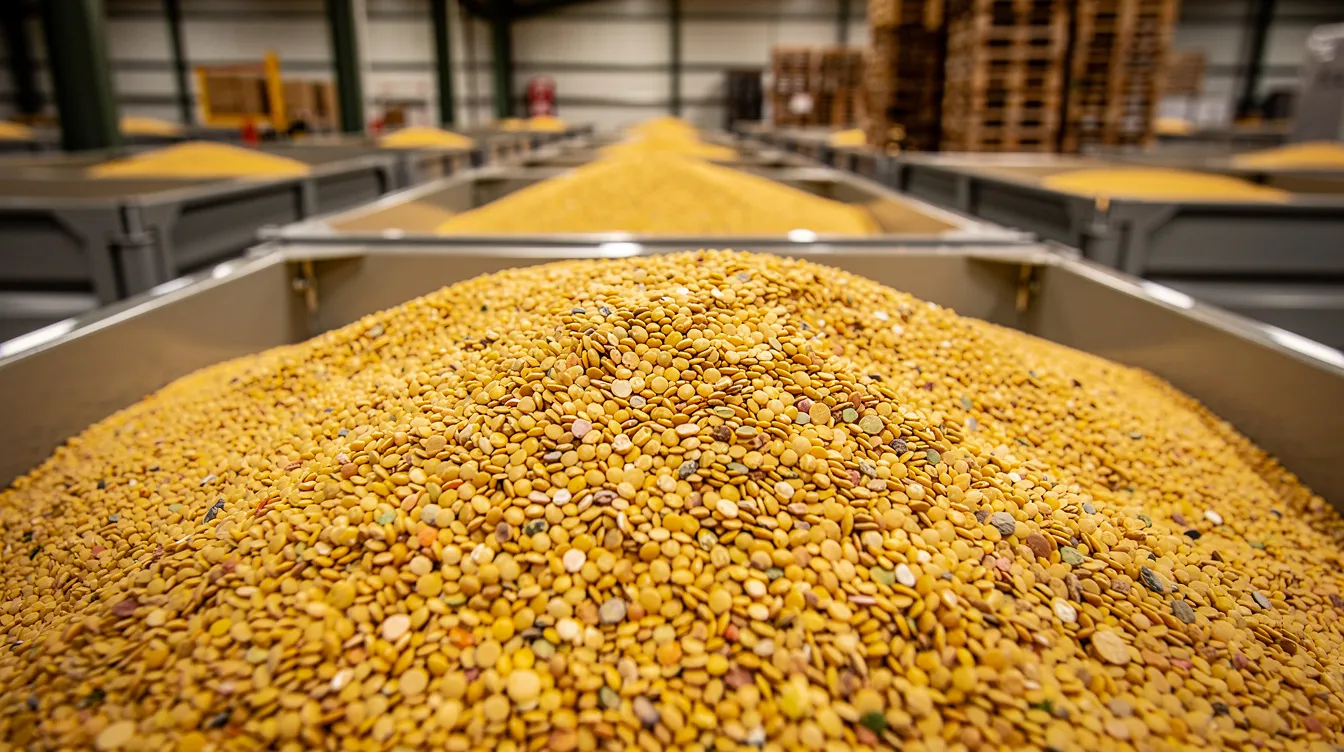
Yellow peas are the primary raw material for pea starch extraction. Their starch content typically ranges between 45–51% on a dry-mass basis, with an amylose proportion of 31–49% that influences functional properties. Moisture in raw peas should ideally be 12–14%; higher moisture increases drying costs and spoilage risk. The variability between smooth and wrinkled peas affects starch content and extraction behaviour.
Raw material requirements for a medium-scale plant are substantial. Sourcing options include direct procurement from mandis in pulse-growing states, aggregators, or contract farming arrangements. Consistency in quality is critical – size uniformity, foreign matter levels, damaged or broken grains, and moisture all directly influence starch recovery and plant downtime.
Key quality parameters buyers and plant operators should monitor:
- Moisture content (target: 12–14%)
- Foreign matter and stones (must be minimal for efficient cleaning)
- Broken and damaged grains (reduce recovery, increase fibre contamination)
- Starch content of the specific pea variety (varies between 45–51%)
Auxiliary raw materials and consumables include packaging material (25 kg and 50 kg bags), chemicals for CIP cleaning, lubricants, filter aids where applicable, and laboratory reagents for quality control.
Seasonality is important: pea arrivals concentrate in specific months, which means procurement planning must account for storage capacity, working capital for bulk buying, and price volatility during lean periods. These seasonal patterns directly affect the working capital cycle that must be modelled in the DPR.
Pea Starch Product Grades and Specifications
A pea starch manufacturing plant can produce multiple product types depending on process design and market targeting:
- Native pea starch (food-grade): high purity (>90–95%), white colour, suitable for food and pharma applications
- Technical-grade starch: slightly lower purity, used in certain industrial applications such as paper coating, adhesives
- Modified starch variants: produced through subsequent processing (chemical, physical or enzymatic modification) for specific functional properties
Key quality parameters that buyers evaluate include starch purity percentage, moisture (<12%), ash content, microbiological limits, whiteness index, viscosity profile, and absence of off-odours. Food safety certifications – FSSAI licence, adherence to relevant Codex-style standards – are typically mandatory for supplying to multinational food companies. Customer-specific audits are common.
By-products include a pea protein-rich fraction and fibre. Their specifications and commercial value differ depending on whether the plant is primarily starch-focused or is part of an integrated protein–starch–fibre facility. The protein fraction can range from a low-value animal feed ingredient to a higher-value food ingredient depending on processing choices.
The project report should include target product specifications aligned with intended customer segments, as these specifications directly influence the production process design and machinery selection.
Pea Starch Manufacturing Process: Wet Extraction
This section describes the traditional wet extraction process commonly used for producing food-grade native pea starch. The production process involves several unit operations, each affecting starch recovery, purity and energy consumption.
Pea starch production involves soaking, crushing, and drying processes as core steps. Here is a description of each unit operation:
- Raw material cleaning and destoning: Remove fine impurities, stones, metal, dust and foreign matter using destoners, sieves and magnets
- Soaking and conditioning: Dried peas are soaked in water (typically 6–12 hours) to soften the structure and facilitate starch release
- Wet milling and disintegration: Soaked peas are passed through disc mills or attrition mills to break cell structures and release starch granules
- Fibre separation: Coarse fibre and fine fibers are removed using centrifugal sieves and screening systems
- Protein–starch separation: The starch slurry is processed through decanter centrifuges or clarifiers to separate protein from the high concentration starch slurry
- Starch purification: Hydrocyclone stations wash and concentrate the starch, removing residual protein and ash through fine filtration and further separation stages
- Dewatering: Vacuum filters or peeler centrifuges reduce moisture in the wet material before drying
- Starch drying: Flash dryers or fluid bed dryers achieve instant drying to bring moisture below 12%; dryer temperature is controlled (<60–70°C) to avoid damaging starch properties
- Sieving and quality testing: Dried starch is sieved, tested for purity, moisture and microbial parameters
- Packaging: Final product is packed in food-grade bags per packaging requirements
Basic Process Flow:
Cleaning → Soaking → Wet Milling → Fibre Separation → Protein–Starch Separation → Starch Purification → Dewatering → Drying → Sieving → Packing
Water quality and circulation are central to the extraction process. Large volumes of clean water are needed for soaking, milling and purification. Process water reuse, clarification and recycling are essential for both cost control and environmental compliance. The effluent from wet starch extraction has high organic load (BOD/COD), which must be addressed through a properly designed ETP.
Process conditions – soaking time, milling finesse, number of hydrocyclone stages, dryer settings – directly affect starch recovery, energy consumption and product quality. Pulse Canada data confirms that pea starch content averages 45–51% of dry mass, but actual recovery depends on variety, dehulling, and process efficiency. These parameters should be modelled in the DPR as assumptions, not guaranteed numbers.
Alternative Technologies: Wet Extraction vs Dry Fractionation
Dry fractionation is an alternative approach where pea flour is milled and then separated using air classification to obtain a protein concentrate and a starch-rich fraction – without requiring large volumes of process water.
The key differences:
| Parameter | Wet Extraction | Dry Fractionation |
|---|---|---|
| Starch purity | >85–90% | 65–85% (starch-rich flour) |
| Protein output | Higher-purity isolate possible | Protein concentrate (~50–60% protein) |
| Water usage | High (requires ETP) | Low |
| Capital costs | Higher | Lower |
| Energy consumption | Higher (drying costs) | Lower |
| Product positioning | Food-grade native starch | Starch-rich flour for specific applications |
Dry-fractionated protein concentrates do not automatically yield highly purified food-grade pea starch. If high-purity native starch is the target product, wet extraction remains the standard industrial route. Integrated projects may combine dry and wet steps or operate a dedicated wet-starch line alongside a dry-fractionation unit for protein concentrate. Promoters exploring pea protein concentrate production through dry fractionation can study the <a href=”https://projectreportbank.com/pea-protein-concentrate-manufacturing-project-report/”>Pea Protein Concentrate Manufacturing Project Report</a> for additional process and market context.
Feasibility studies should compare both options on capex, opex, water and energy consumption, and market positioning before finalising the pea starch extraction plant DPR. The technology choice must align with the target product portfolio and available capital.
Pea Starch Processing Machinery and Equipment
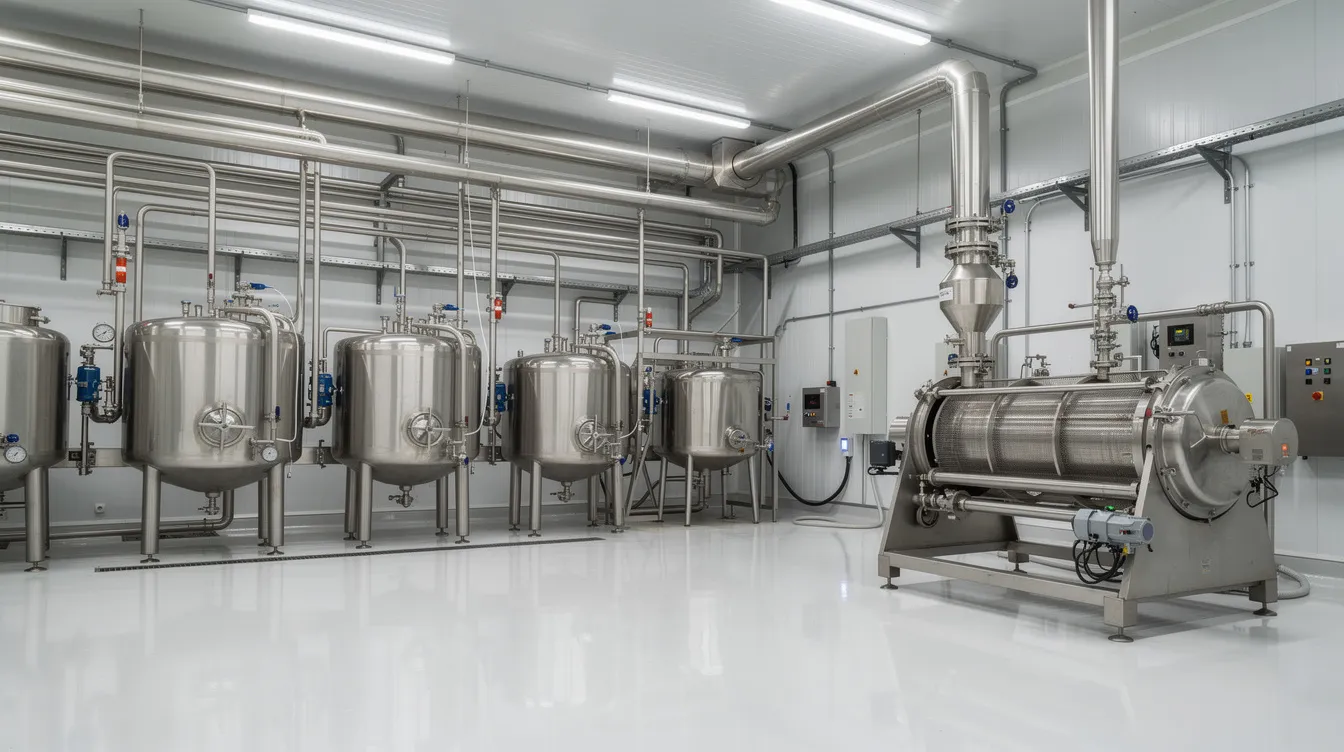
Pea starch extraction requires specialised processing equipment configured as a complete production line. The unit operations involved in wet extraction demand specific machinery types:
- Cleaning and grading system: Destoner, vibrating sieves, magnetic separator – for raw material cleaning
- Soaking tanks: Stainless steel tanks with agitation – for conditioning peas before milling
- Wet mills: Disc mills or attrition mills – for disintegrating soaked peas and releasing starch
- Centrifugal sieves: For separating coarse and fine fibers from the starch slurry
- Decanter centrifuges: For protein–starch separation from the initial extraction slurry
- Hydrocyclone station: Multi-stage hydrocyclone stack for starch purification and washing
- Dewatering equipment: Peeler centrifuges or vacuum filters – to reduce moisture before drying
- Starch dryer: Flash dryer or fluid bed dryer – to achieve instant drying to target moisture levels; dehydration treatment improves shelf stability and product quality
- Sieving and packaging machines: For grading and packing finished starch
Capacity sizing must ensure throughput matching across equipment. A 50 TPD raw pea line requires each piece of equipment rated for the corresponding flow of starch slurry, protein slurry and fibre at that scale. Designing for future modular expansion is prudent.
Automation levels range from manual to fully PLC-controlled plants. Semi-automatic systems may suit smaller capacities, but production efficiency, consistency, labour costs, training and food-safety compliance all favour higher automation for medium and large plants. This also affects human resource requirements – a PLC-controlled plant typically needs fewer but more skilled operators.
Equipment is available from Indian manufacturers (commonly in SS304 construction; SS316 for pharma-grade applications) as well as European suppliers for high-capacity or specialised units. For reference on machinery requirements and equipment cost structures in related processing industries, promoters may find the <a href=”https://projectreportbank.com/specialty-flour-plant-machinery-equipment-cost/”>Specialty Flour Plant Machinery & Equipment Cost</a> discussion useful. Actual machinery costs and vendor selection should be based on quotations aligned with the project’s specific capacity and product specifications.
Plant Capacity, Production Planning and Basic Process Flow
Common capacity scenarios for Indian pea starch plants include:
| Capacity (Raw Pea Input) | Scale | Typical Suitability |
|---|---|---|
| 25 TPD | Small | Pilot/regional, limited economies of scale |
| 50 TPD | Medium | Practical entry point for bank-funded projects |
| 100+ TPD | Large | Better economics, higher capex, needs strong market |
Starch manufacturing plants globally operate at ranges from 50,000 to 200,000 MT capacity annually, depending on the region and feedstock. For Indian promoters, a 50 TPD plant operating 300 days/year processes approximately 15,000 MT of raw peas annually.
Operating assumptions typically include 280–330 working days per year, one or two-shift operation, and a ramp-up curve: approximately 60% utilisation in Year 1, 75% in Year 2, 85% in Year 3 and 90%+ by Year 4. Production capacity planning must account for this ramp-up in the financial model.
Recovery assumptions should be treated as indicative: if raw peas contain ~45–50% starch on a dry basis and the wet extraction process achieves 85–90% starch purification efficiency, the overall yield of dried native starch may range from approximately 40–45% of raw pea input weight. By-product protein and fibre fractions account for additional recoverable mass. Process losses occur at cleaning, hull removal, protein separation, washing and drying stages.
Production planning should synchronise monthly pea procurement, plant loading, finished goods inventory norms and customer dispatch schedules. The DPR should contain a clear flow diagram and mass-balance sheet aligned with selected technology and various feedstocks under consideration.
Land, Building, Utilities and Infrastructure Requirements
For a medium-scale plant (50–100 TPD), indicative land requirements range from 1.5 to 3 acres depending on production capacity, future expansion plans and location analysis. Actual land needs should be engineered project-wise based on site development plans and local zoning regulations.
Key building blocks include:
- Raw material godown (with moisture control)
- Processing block (designed for food-grade hygiene standards)
- Finished goods warehouse
- Utilities block: boiler house, compressor room, cooling tower
- ETP area
- Administrative building, canteen and laboratory
- Weighbridge and loading/unloading area
Major utility requirements include:
- Electrical power: For grinders, pumps, hydrocyclones, centrifuges, dryers and automation systems
- Thermal energy: Steam or thermal oil for drying – the most energy-intensive operation
- Process water: Large volumes required; water recycling systems are essential
- Compressed air: For pneumatic controls and some cleaning applications
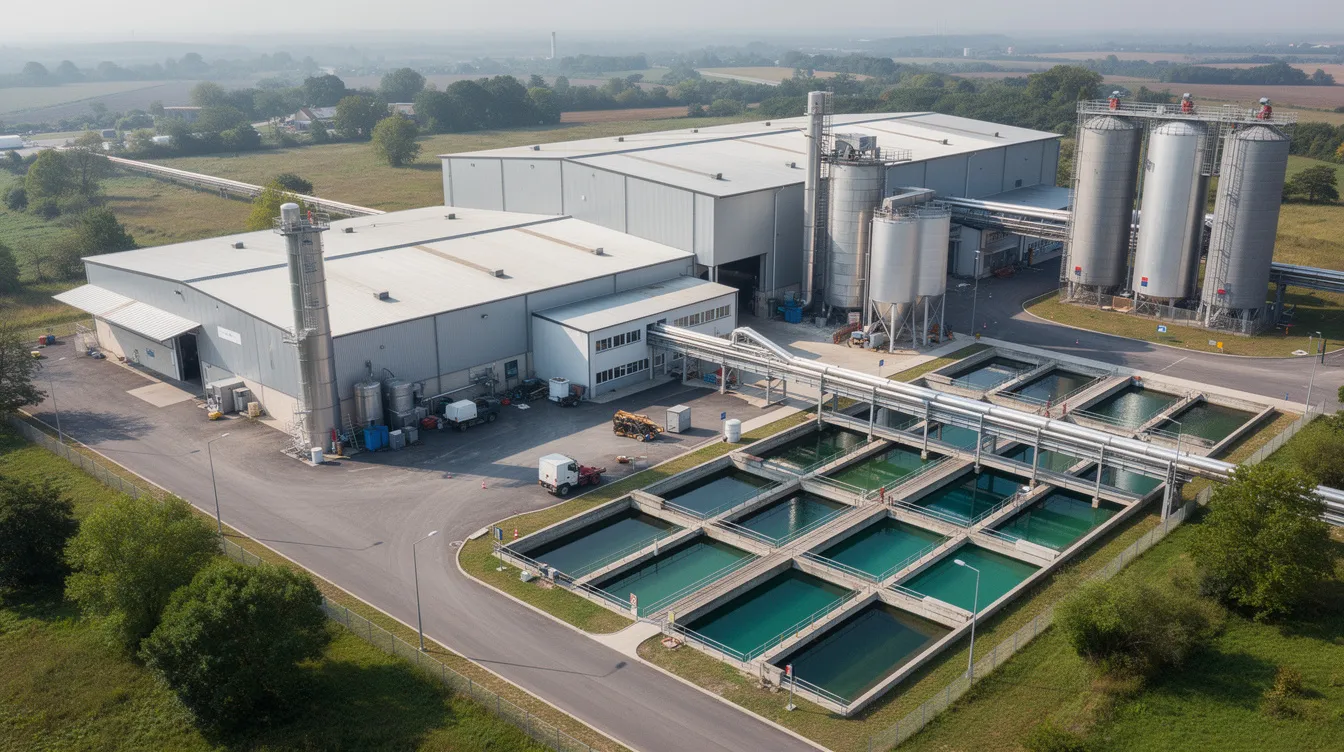
Environmental infrastructure is critical: the effluent treatment plant must handle high-organic wastewater from wet extraction. Compliance with State Pollution Control Board norms is mandatory. In water-stressed regions, zero-liquid-discharge (ZLD) systems may be required. Transportation requirements for raw peas and finished starch dispatch should also factor into site selection.
Food-safety infrastructure includes hygienic flooring and drainage, pest-control systems, controlled storage for packaging material, and laboratory space for microbial, chemical and physical testing. Provision for future certifications such as HACCP or ISO 22000 should be built into the layout from the start.
Pea Starch Plant Setup Cost and Project Cost Structure
This section provides a structured framework for pea starch plant setup cost rather than exact rupee figures, as actual investment varies with capacity, technology, location and automation level. Infrastructure costs can differ significantly across Indian states.
Capital costs for a pea starch manufacturing plant typically break down as follows:
| Cost Head | Approximate Share of Fixed Capital | Notes |
|---|---|---|
| Plant and machinery (incl. installation) | 50–55% | Machinery costs are the largest portion of capital expenditure |
| Building and civil works | 18–22% | Includes construction costs for processing block, godowns, utilities |
| Land and site development | 8–12% | Varies with location; industrial area vs agricultural land |
| Electrical and instrumentation | 5–7% | Higher for PLC-automated plants |
| Utilities (boiler, WTP, ETP, cooling) | 5–8% | ETP sizing is critical for wet extraction |
| Preliminary and pre-operative expenses | 3–5% | Company formation, consultancy, interest during construction, trial runs |
| Contingency | 3–5% | Essential buffer for unforeseen cost escalations |
Working capital margin must be included as part of the total project cost. For plants holding substantial pea inventory (especially due to seasonal procurement) and maintaining finished goods stock, working capital can be a significant component.
As a broad reference: analogous maize starch plants at 150 TPD input scale involve total capital investment of approximately ₹117.5 Crores, with machinery alone at roughly ₹37 Crores. Pea starch plants at a smaller 50 TPD scale would naturally require proportionally lower investment, but the cost per TPD may be higher due to reduced economies of scale. These are illustrative benchmarks, not direct quotations for pea starch facilities.
The DPR should present at least one detailed cost scenario (for example, a medium-sized 50 TPD line) with broad cost ranges and allow for scaling adjustments in customised based financial models.
Working Capital Assessment for Pea Starch Projects
The working capital cycle for pea starch projects has several distinctive characteristics:
- Raw material procurement: Peas arrive seasonally, requiring bulk purchases post-harvest. Staggered procurement across the year is possible but at fluctuating prices.
- Inventory holding: Raw peas may need to be stored for 2–4 months. Combined with packaging material and finished starch stock, inventory can block substantial funds.
- Processing time: Relatively short (1–2 days from pea to dried starch), but continuous operation requires steady input.
- Receivables: B2B customers in the food industry and starch industry typically expect 30–60 days credit. Longer cycles increase working capital pressure.
Raw materials account for 70–80% of operating expenses in starch processing, making pea procurement the dominant working capital driver. Seasonal price movements – price trends can vary 15–25% between peak and lean seasons – directly impact cash-credit requirements and operating costs.
A structured working capital assessment in the CMA Data should include drawing power calculations on stocks and receivables, margin requirements, and clear differentiation between term-loan and cash-credit finance. The pricing mechanism for raw pea purchases and the credit terms negotiated with customers and suppliers must be based on the promoter’s actual market positioning, not on optimistic assumptions.
Revenue Model, Profitability and Project Economics
Core revenue streams for a pea starch plant include:
- Native pea starch sales: The primary revenue driver, sold to food processors, pharma buyers, personal care manufacturers
- Protein-rich by-product: Sold as animal feed ingredient or, with additional processing, as a food-grade protein fraction – these are valuable co-products
- Fibre/hull fraction: Typically sold as animal feed, fibre supplement or biomass fuel
A conceptual financial assumptions framework:
| Assumption | Illustrative Basis |
|---|---|
| Capacity utilisation | 60%–90% over Years 1–5 |
| Starch realisation | Per kg, based on prevailing market rates for food-grade native starch |
| By-product realisation | Lower per-kg rates for protein/fibre fractions |
| Raw pea cost | Per tonne, adjusted for seasonal procurement and quality |
| Power and fuel | Based on connected load and drying energy requirements |
| Labour and overheads | Based on manpower plan and local wage structures |
| Packaging | Per unit of finished goods |
Starch plant gross profit margins typically range between 25–35%, though actual margins depend heavily on raw material costs, starch selling prices and by-product recovery. Expected ROI for starch projects typically falls in the range of 25–35%, subject to capacity utilisation and operating efficiency.
Key profitability metrics that promoters and bankers evaluate include EBITDA margin, PAT margin, break-even production level, contribution per kg of starch, DSCR, ROI, IRR and payback period. By the fifth year, operational costs are expected to increase significantly due to inflation, which must be factored into profit projections.
Actual project economics depend on technology guarantees, negotiated starch selling prices, by-product offtake contracts and operational efficiency. All key variables should be sensitised in the financial model. Market segmentation – identifying which customer segments offer the most stable demand and best pricing – directly influences revenue assumptions.
Feasibility Analysis, Risks and Sensitivity Assessment
Major risk factors for pea starch projects include:
- Raw material price volatility: Pea prices can swing 15–25% seasonally
- Recovery variability: Actual starch yield may differ from assumed values due to pea quality, variety or process inefficiencies
- Selling price fluctuations: Competitive pressure from corn starch, sweet potato starch, bean starch or imported starches
- Water and energy costs: Wet extraction is water- and energy-intensive; tariff increases directly impact margins
- Customer qualification delays: Food and pharma customers often require 6–12 months of testing and audits before placing commercial orders
- Working capital pressures: Seasonal procurement and extended receivables can strain cash flows
Sensitivity analysis should test the impact on DSCR and IRR when:
- Raw pea cost increases by 10–20%
- Starch selling price declines by 10%
- Capacity utilisation in Year 1 drops to 50% instead of 60%
- Energy costs rise by 15%
Feasibility studies assess project economics, including CapEx and OpEx, under multiple scenarios. Mitigation strategies include long-term raw material sourcing tie-ups, diversification into multiple downstream applications, flexible plant design to handle different pulse varieties, and hedging through integrated product portfolios.
Environmental and regulatory risks – tighter effluent norms, water-usage restrictions in water-stressed areas, and potential ZLD requirements – must also be evaluated. The current scope of environmental compliance varies by state and industrial zone.
Promoters should treat the pea starch manufacturing plant project report as a decision tool rather than a sales brochure, using it to test multiple scenarios before committing large capital. Key factors in feasibility include location analysis, market access, raw material catchment strength and the promoter’s ability to finance working capital through the ramp-up period.
Bank Finance, CMA Data and DPR Documentation for Pea Starch Plants
When approaching Indian banks for term loans and working capital finance for pea starch manufacturing projects, the Detailed Project Report is the primary evaluation document.
A bankable DPR for a pea starch plant should include:
- Project rationale and market context
- Technical details of the pea starch manufacturing process and selected technology
- Production capacity and plant layout
- Detailed project cost estimates with supporting quotations
- Means-of-finance plan (promoter contribution, term loan, working capital)
- Five- to seven-year financial projections
- DSCR and loan repayment analysis
- Risk assessment and sensitivity analysis
A Detailed Project Report includes capital and operational expenditure analysis. DPRs assess raw material, machinery, and manpower requirements for the proposed plant. Financial projections in DPRs cover income and expenditure estimates over the projection period. DPRs evaluate project viability through ROI and NPV analysis.
CMA Data preparation includes projected balance sheets, profit and loss statements, cash-flow statements, fund-flow statements and working capital assessment tables required by banks for credit appraisal.
While a Chartered Accountant can assist in preparing realistic projections and documentation, projections are based on agreed assumptions and are not independent certifications of profitability. Financial projections include capital investment, operating costs, and profitability analysis – but they remain estimates of future performance.
A strong DPR and CMA Data package improves the quality and speed of credit appraisal but does not guarantee sanction. Bank decisions depend on overall risk assessment, collateral, promoter profile, sector outlook and business requirements.
Licences, Registrations and Compliance
Typical registrations for a pea starch manufacturing unit in India include:
- Entity registration (company, LLP or proprietorship), PAN, GST registration
- Factory registration under the relevant State Factories Act
- Applicable labour law registrations
- FSSAI licence for food manufacturing (Central or State, depending on capacity and turnover)
- Consent to Establish and Consent to Operate from the State Pollution Control Board
- Clearance for water withdrawal and effluent discharge
- Fire and safety clearances; building plan approvals
- Boiler and pressure-vessel approvals where relevant
A DPR outlines the necessary regulatory procedures for project approval. For export-oriented production, additional documentation and quality certifications may be needed. Customer audits for large food and pharma buyers often require demonstrated compliance with HACCP, ISO 22000 or equivalent food-safety management systems.
Regulatory requirements vary by state and change periodically. Promoters should verify specific compliance needs with local authorities or qualified consultants at the time of planning.
Integrated Pea Starch, Pea Proteins and Fibre Processing Opportunities
An integrated plant that recovers pea starch, pea protein and fibre from the same raw material creates multiple revenue streams and spreads commercial risk. This approach aligns with the broader shift in the starch processing and food industry towards complete utilisation of pulse raw materials.
Promoters exploring comprehensive pulse-processing setups should study the <a href=”https://projectreportbank.com/pulse-protein-starch-fibre-processing-plant-project-report/”>Integrated Pulse Protein, Starch & Fibre Processing Plant Project Report</a> for a broader perspective on multi-product facility economics.
Integrating pea protein isolate manufacturing with starch extraction can enhance project economics by capturing higher-value protein products. However, this significantly increases capex, technical complexity and quality-control requirements. The <a href=”https://projectreportbank.com/pea-protein-isolate-manufacturing-plant-project-report/”>Pea Protein Isolate Manufacturing Plant Project Report</a> provides detailed coverage of the additional processing steps and market dynamics involved.
A conceptual comparison:
| Parameter | Standalone Starch Plant | Integrated Starch + Protein Plant |
|---|---|---|
| Capital investment | Lower | Significantly higher |
| Revenue diversification | Limited | Multiple product streams |
| Technical complexity | Moderate | High |
| Customer qualification | Shorter for starch | Longer for protein products |
| Margin potential | Moderate | Higher if protein markets are accessed |
The choice between standalone and integrated configurations should be driven by market access, technical team strength, capital budget and risk appetite, validated through comparative feasibility analysis.
Environmental Impact and Sustainability Considerations
The environmental impact of wet pea starch extraction centres on:
- Water consumption: Large volumes of process water required; reuse and recycling are essential
- Effluent load: High organic content (BOD/COD) in wastewater requiring effective ETP
- Energy consumption: Drying is the most energy-intensive step; fuel costs are significant
- Solid waste: Screenings, hull residues and fibre by-products need proper handling or commercial utilisation
Good-practice measures include process-water recycling, efficient ETP design with possible biogas recovery, selection of energy-efficient dryers with heat recovery, and adoption of renewable energy where feasible. Technological advancements in dryer design and water treatment continue to improve the sustainability profile of starch processing plants.
A well-prepared pea starch extraction plant DPR should cover environmental impact qualitatively and, where data is available, include estimated water and energy footprints per tonne of starch produced. Responsible environmental management improves project acceptability with lenders, investors and regulatory bodies. For export-oriented customers, environmental and sustainability credentials are increasingly becoming business differentiators, not merely compliance requirements.
How CA Manish Gugliya and Project Report Bank Can Assist
Project Report Bank, led by CA Manish Gugliya (FCA, DISA (ICAI)), specialises in customised DPRs and financial models for manufacturing projects including pea starch and broader pulse-processing plants. Educational content published on the platform covers project planning and financial analysis topics relevant to entrepreneurs evaluating new industrial investments. The topical authority framework built through detailed, sector-specific content helps promoters access practical, commercially relevant guidance.
Key professional services for pea starch projects include:
- Customised bank finance DPR preparation
- Project cost estimation and means-of-finance planning
- Financial projections, financial modelling and CMA Data for bank loans
- Working capital assessment and cash-credit structuring
- DSCR, ROI, IRR and viability analysis
- Sensitivity analysis and risk assessment
- Investor-ready financial models and project presentations
Bank Finance DPR and Loan Proposal Assistance for pea starch plants typically starts from ₹25,000, with actual professional fees depending on project size, technology complexity and deliverables required.
Each assignment is handled on a project-specific basis, with assumptions, process details and financials customised to the client’s location, capacity plan and strategic goals. Evergreen content planning on the platform generates long-lasting organic traffic, but the real value lies in customised professional advisory for serious promoters.
Entrepreneurs and promoters interested in a pea starch manufacturing plant project report can share their project details and objectives through the WhatsApp contact mechanism available on the Project Report Bank website.
Frequently Asked Questions (FAQ)
The following questions address practical doubts that promoters frequently raise when evaluating pea starch manufacturing projects. These problem-solving queries cover areas not fully addressed in the main sections above. Effective focus keywords depend on niche, audience, and business goals – and long-tail content optimization captures specific high-converting queries from serious project promoters.
What minimum capacity is practical for a pea starch manufacturing plant in India?
Very small capacities (below 20–25 TPD of raw peas) generally struggle with economies of scale in wet extraction, particularly because hydrocyclone stations, decanters and flash dryers have minimum efficient operating thresholds. In practice, medium-scale units – around 25–50 TPD of raw peas upwards – are more realistic for bank-funded projects, subject to local raw material supply and market access.
The optimal capacity should be finalised only after a location-specific feasibility study and demand assessment, which can be incorporated into the customised pea starch manufacturing plant project report. Local intent keywords and region-specific market research help identify catchment areas with sufficient pea supply.
Can an existing dal mill or pulse-processing unit be upgraded to add pea starch production?
Existing cleaning, destoning and storage infrastructure from a dal mill can sometimes be leveraged, reducing initial investment. However, the wet extraction process – including soaking, milling, centrifugal separation, hydrocyclones, drying and ETP – requires entirely new equipment and dedicated building space. The production line for starch is fundamentally different from dal milling.
Diversification from a dal mill into pea starch should be evaluated through a separate DPR that compares incremental investment with expected additional margins and risks. Labor costs and additional manpower requirements also need careful assessment.
How long does it usually take to obtain bank finance for a pea starch plant after DPR preparation?
Timelines vary across banks and schemes. Once a complete DPR, CMA Data, collateral details and KYC documents are submitted, appraisal and sanction may typically take a few weeks to a few months. Well-prepared documentation, clear promoter contribution and realistic projections can significantly reduce back-and-forth with lenders. Primary branded keywords and brand credibility of the promoter also influence lender confidence.
Is it necessary to start with integrated pea protein and starch, or can I begin with starch only?
Many promoters prudently start with a simpler, starch-focused configuration that monetises protein and fibre as lower-value by-products (animal feed, fibre supplements), then consider upgrading to higher-value protein products once markets, capabilities and customer qualifications develop. This staged approach reduces initial capex and technical risk.
The choice should be informed by market access, technical team strength, capital budget and risk appetite, ideally validated through comparative feasibility analysis in the DPR. Long-tail service keywords related to both standalone and integrated configurations often surface in promoter research.
How often should the financial projections in my Pea Starch Extraction Plant DPR be updated?
Projections should be reviewed and updated whenever there is a material change in assumed pea prices, energy tariffs, starch selling prices, technology configuration or capacity plan. At minimum, projections should be refreshed before submitting to a new lender or investor.
Updated projections help promoters make course corrections early and maintain better control over DSCR, cash flows and expansion decisions. Digital marketing of the project to potential investors also benefits from current, credible financial documentation.