Machinery is the single largest capital investment in any milk powder manufacturing project. Whether you are setting up an SMP, WMP, or dairy whitener plant, the equipment you select – and how accurately you budget for it – will determine your project’s financial viability, bank-loan eligibility, and long-term profitability. This guide provides a practical, India-focused overview of milk powder plant machinery cost, equipment selection, and the financial considerations every promoter must address before approaching lenders or finalising a DPR.
Key Takeaways
- Machinery and equipment typically account for 45–65% of total fixed capital cost in a medium-to-large milk powder plant, making it the dominant CAPEX head.
- A complete milk powder plant requires reception, standardization, evaporation, spray drying, powder handling, packing, CIP, utilities, and quality control equipment – not just a spray dryer.
- “Machinery price” and “installed machinery cost” are fundamentally different; promoters must separately budget for installation, piping, electrification, utility systems, and commissioning.
- All cost figures in this article are indicative planning ranges for India (2024–2025 conditions). Actual project budgets must be based on detailed quotations and technical offers from equipment suppliers.
- For professional support with DPR preparation, financial projections, CMA Data, and project finance planning, promoters can reach out through ProjectReportBank.com.
Milk Powder Plant Machinery Cost in India – Overview
For a medium-to-large skimmed milk powder, whole milk powder, or dairy whitener plant, machinery and equipment typically form 45–65% of total fixed capital cost. The production process involves several steps from milk reception to packaging, and each stage requires dedicated machines sized to the project’s specific capacity.
There is no single “standard price” for milk powder plant machinery. Vendors design every line based on litres of milk processed per day, evaporation rate (kg of water per hour), targeted powder output, product mix, and operating hours. Machinery cost for a milk powder plant varies based on processing capacity and automation level – a basic milk powder plant may cost around ₹50 lakh per piece at entry level, while an automatic milk powder plant can be priced at approximately ₹4.50 crore. For reference, a 1000 litre per hour milk powder plant costs around ₹50 lakh, whereas a mini dairy plant can cost around ₹5 lakh for very small-scale operations. Milk powder plants require high-efficiency equipment for production at any meaningful commercial scale.
Key cost drivers include:
- Milk handling capacity (e.g., 50,000 to 5,00,000 litres/day)
- Evaporation capacity and spray dryer evaporation load
- Number of product lines (SMP, WMP, dairy whitener)
- Machine body material specifications (SS304 vs SS316)
- Automation level – from manual operation to PLC–SCADA based systems
- Heat recovery, CIP automation, and hygienic design
- Domestic vs imported milk powder plant equipment choices
Typical capital expenditure includes land acquisition and civil construction alongside machinery investment. As a planning thumb-rule based on published project data, a 5–10 TPD powder plant may require machinery investment starting from a few crores, while a 30–50 TPD industrial milk powder manufacturing plant can go into several tens of crores.
It is critical to distinguish between: (a) basic machinery purchase price, (b) installed and commissioned machinery cost including erection, piping, and electrics, and (c) total project cost including land, building, and working capital. Machinery is only one component of total project investment. Promoters evaluating the complete investment should also review our detailed guide on milk powder plant setup cost in India.
Complete Milk Powder Plant Machinery & Equipment List
A modern milk powder plant is a continuous process line that converts fresh milk – which is approximately 87% water – into stable powdered milk. Cost estimation must cover all stages of this milk powder process, not only the spray dryer. Since raw milk has such high water content, filtration removes about 60% of water content, evaporation removes an additional 25%, and the final drying stage uses hot air to remove remaining moisture.
While exact machinery lists vary with process design and vendor, most SMP, WMP, and dairy whitener plants share a common backbone of equipment. Equipment sizing – tank volumes, pump capacities, evaporator effects, dryer diameter – should always come from process engineers or machinery OEMs and then be translated into cost for DPR purposes. This section covers each block in the milk powder making sequence.
Raw Milk Reception Equipment
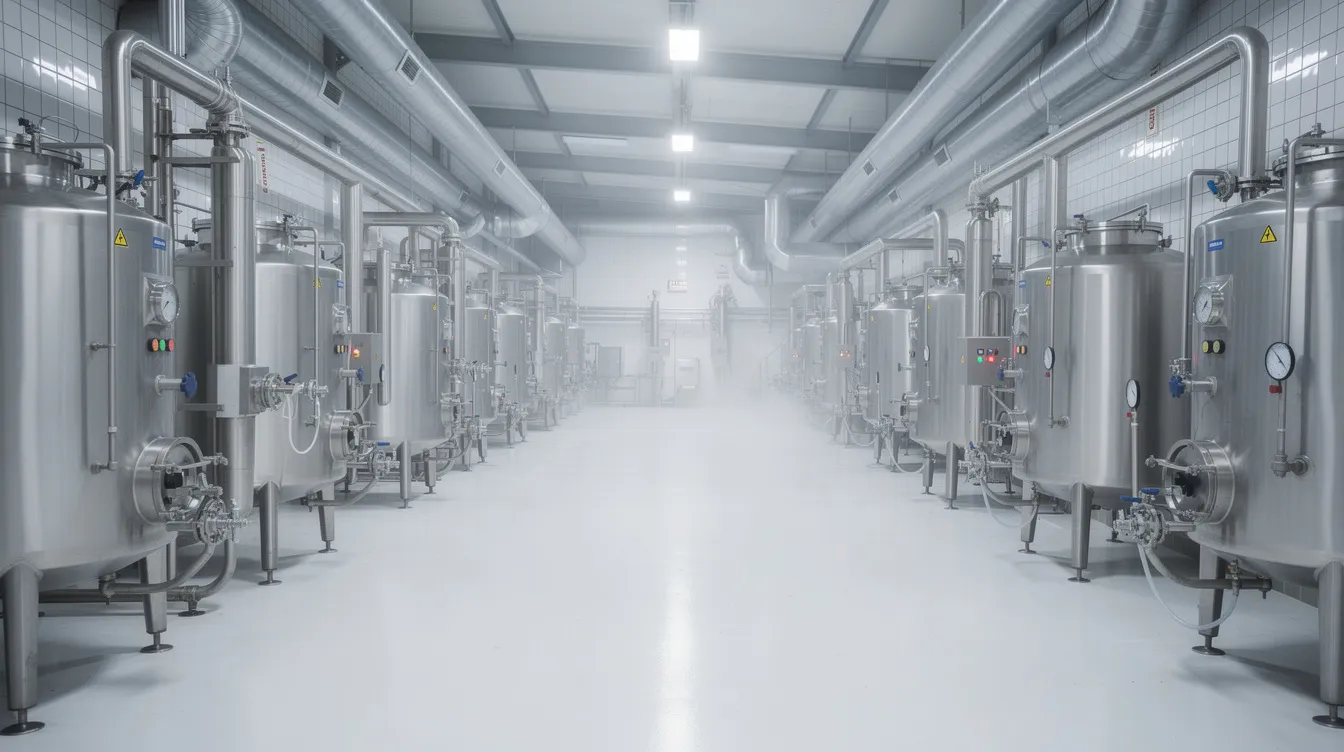
The reception section is the entry point of the dairy plant, handling fresh milk from road tankers. Key equipment includes:
- Reception and dump tanks
- Weighing scales and load cells
- Inline filters and clarifiers
- Plate-type milk chillers (a milk chilling plant typically costs between ₹1.50 lakh to ₹5.60 lakh depending on capacity)
- Sanitary transfer pumps and samplers
- Raw milk storage silos sized for 8–12 hours of intake
Higher capacities increase not only tank sizes but also the number of unloading bays, pumps, and chillers. Reception equipment is generally a smaller part of total CAPEX compared to the evaporator and spray dryer, but it is crucial for maintaining milk quality and smooth operation. In DPRs, these items are grouped as “milk reception and chilling section.”
Milk Standardization and Processing Equipment
Before entering the evaporator, liquid milk is clarified, separated, and standardized to achieve desired fat and SNF levels. Key machines include:
- Cream separator and standardization system
- Homogenizer (especially important for WMP and dairy whiteners to achieve consistent quality and creamy texture)
- Pasteurizer (plate or tubular type)
- Balance tanks, processing tanks, pumps, valves, and sanitary pipelines
Processing equipment includes pasteurizers and high-energy spray dryers for powder production. SMP plant machinery requires more emphasis on separation and skim milk handling, while WMP lines need robust homogenization. Pasteurization capacity is sized to match peak milk flow into the evaporation system. Promoters should ensure quotations include all pumps, valves, fittings, and instrumentation – not just major vessels.
Milk Evaporation System
Evaporators concentrate milk solids before drying, reducing the concentrated milk from around 12–14% total solids to 45–50% before spray drying. This drastically reduces the load on the spray dryer and overall energy consumption. Evaporator systems are critical for managing high volumes of wastewater during processing.
Technologies widely used include falling-film multiple-effect evaporators (2–5 effects), thermal vapour recompression (TVR), and mechanical vapour recompression (MVR) in larger plants for higher steam economy. Key cost determinants include feed rate, number of effects, vapour recompression system, and material specifications.
The evaporator is one of the most expensive machines in a powder plant. According to vendor data from Vikrama Innovative Technologies, a multi-effect evaporation system for dairy industries ranges from ₹20 lakh to ₹2 crore depending on capacity and specifications. Industrial units for 5–30 TPH evaporation load require multi-crore investments.
In financial projections and DSCR analysis, the evaporator influences not only depreciation but also operating margins through its impact on steam and power consumption per kg of milk powder produced.
Spray Dryer for Milk Powder Plant
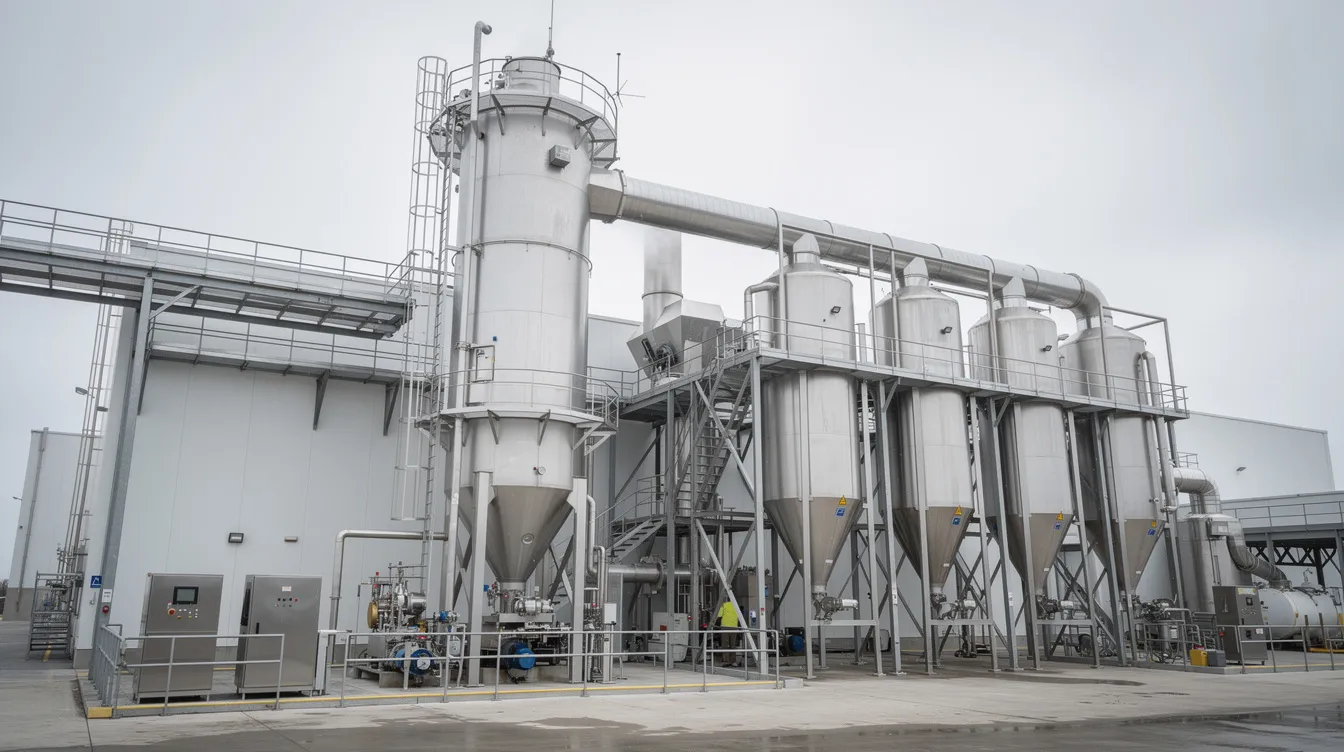
The spray dryer is the heart of a milk powder processing plant, transforming concentrated liquid milk into free-flowing powder form by atomizing it into hot air. Spray dryer plants are commonly used for milk powder production across the world. Main components include:
- Feed system and atomizer (pressure nozzle or rotary)
- Drying chamber and air heating unit
- Cyclone separators or bag filters
- Powder recovery system
- Integrated fluid bed (where applicable)
- Exhaust-air handling with fans and ducts
Spray dryer capacity is expressed in terms of water evaporation rate (kg/hour) and powder output (kg/hour). For medium-sized plants, the spray dryer system cost alone often runs into multiple crores. KAMRIT project data indicates that for a 15 MT/day SMP line, European high-efficiency dryers with heat recovery cost ₹8–15 crore, while Indian OEMs may quote 20–30% lower for similar output.
Comparing quotations only on ex-works price can be misleading. Promoters must evaluate thermal efficiency, powder recovery percentage, cleaning time, downtime, and long-term maintenance costs. Milk powder plants can process up to 1000 liters per hour at appropriate scale, and the dryer must be matched to this throughput.
Fluid Bed Dryer / Powder Cooling System
After exiting the main drying chamber, milk powder often passes through fluid bed dryers or coolers for final moisture adjustment, cooling to safe storage temperatures, and sometimes agglomeration for instantization properties. Properly stored milk powder has a shelf life of over one year when moisture is precisely controlled at this stage.
Cost is affected by design (static vs vibrating fluid bed), air-handling systems, and automation. In large plants, the fluid bed may add 10–20% over the spray dryer block CAPEX.
Powder Handling and Conveying Equipment
Once dried and cooled, powder must be gently transferred to intermediate storage or packing without contamination or losses. Equipment includes air slides, pneumatic conveying systems, vibratory screens, sieves, metal detectors, magnetic traps, and powder silos. Design choices – dense-phase vs dilute-phase conveying, nitrogen blanketing – influence both CAPEX and product quality.
Milk Powder Packing Machinery
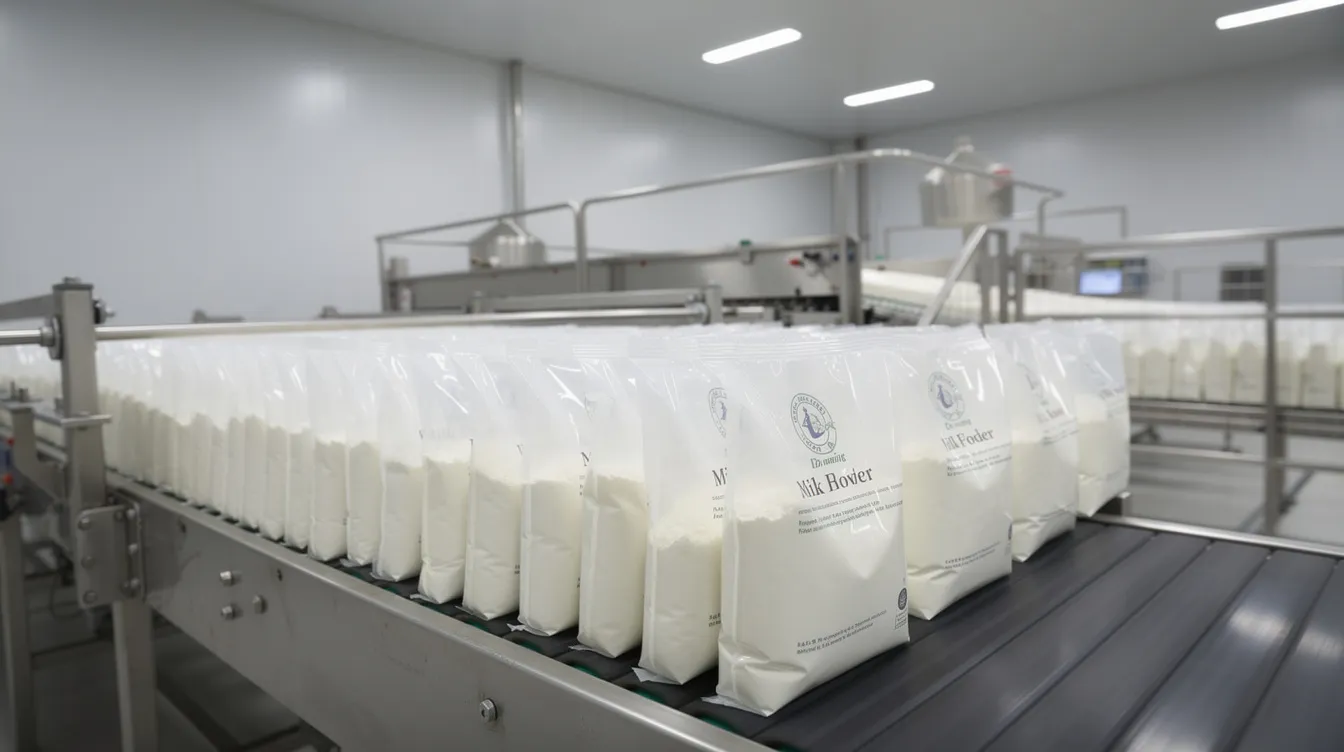
Packaging format has a major impact on milk powder packing machine price and project economics. Packaging materials contribute significantly to operational costs, especially for retail-facing products. Options include:
- Bulk bagging systems (10–25 kg bags packed for industrial supply)
- FFS pouch machines for retail pouches and sachets
- Can-filling and seaming lines
- Nitrogen flushing, check weighers, metal detectors, coding, and labelling systems
High-speed automatic packing lines for large FMCG brands are more capital-intensive than semi-automatic bagging for bulk sale. Products are often packed in various containers suitable for different markets – from bakery ingredient suppliers to retail brand owners. Promoters should break out packaging as a separate head in DPRs, considering multiple lines may be needed for different SKUs and more products.
CIP System and Hygiene Equipment
Cleaning-in-Place systems are compulsory in modern dairy plants to maintain hygiene, product safety, and compliance. Components include CIP tanks for acid, caustic, and hot water; dosing and recirculation pumps; inline heaters; return lines; and automated sequencing panels.
Many first-time promoters underestimate CIP cost. A well-designed CIP system reduces downtime, ensures reliable cleaning cycles, and positively affects plant capacity utilisation and DSCR over the project life.
Utility Equipment Required for Milk Powder Manufacturing
Production machinery cannot operate without robust utility systems. Utility CAPEX sometimes reaches 25–40% of core process-machinery cost. Key utilities include:
- Boiler and steam generation (sized to evaporator and dryer thermal duty)
- Refrigeration plant and chilled water systems
- Cooling towers and water-treatment plant (softening, RO)
- Compressed-air system with dryers and filters
- Electrical distribution – transformer, PCC/MCC panels, DG backup
- Effluent treatment plant (ETP)
- Fire-fighting infrastructure and utility piping
Operational expenditure involves procurement of raw milk, utilities, and labor costs – and utility efficiency directly impacts margins. Banks increasingly focus on energy efficiency and environmental compliance when assessing long-term viability of milk powder projects.
Laboratory and Quality-Control Equipment
Every milk powder plant requires a quality control laboratory. Quality control equipment tests microbial load, fat content, and moisture in milk and finished powder. Essential instruments include milk analyzers, lactometers, moisture analyzers, microbiological incubators, pH meters, and weighing balances.
While lab equipment represents a smaller fraction of CAPEX, it should be budgeted explicitly – not treated as a miscellaneous afterthought. It is essential for maintaining consistent quality and meeting buyer specifications across industries.
SMP Plant Machinery
Skimmed milk powder plants focus on producing low-fat powder. Skim milk powder requires milk separation while whole milk powder retains fat content – this fundamental difference drives SMP-specific machinery configuration. Key equipment includes high-capacity cream separators, skim milk storage and pasteurization, multiple-effect evaporators, spray dryers, and bulk or retail packing. Banks examine capacity utilisation, raw milk availability, and by-product revenue (cream, butter) in financial projections.
WMP Plant Machinery
Whole milk powder plants retain milk fat, requiring careful standardization and effective homogenization to create stable, free-flowing powder with good flavor and creamy texture. While basic equipment blocks remain the same as SMP, WMP plants need enhanced packaging (nitrogen flushing) to achieve required shelf life. WMP plant machinery cost is comparable to SMP for the same throughput, but packing systems can be more capital-intensive.
Dairy Whitener Manufacturing Machinery
Dairy whitener is a formulated product based on milk solids, sugar, and sometimes stabilisers. Additional machinery may include dry or wet blenders, sugar handling equipment, dissolving tanks, mixing systems, and dedicated packing lines for retail pouches. Some plants manufacture SMP or WMP first and then blend, while others integrate blending into the wet stage before drying. DPRs must treat dairy whitener as a distinct project concept. Note that specialised variants like coconut milk powder plants also exist as a specific type of milk powder plant with different process requirements.
Indicative Milk Powder Plant Machinery Cost by Equipment
The following table provides a structured planning-level view. These figures are approximate for India (2024–2025) and cannot substitute detailed vendor quotations.
| Machinery / Equipment | Function | Major Cost Driver | Indicative Cost Consideration |
|---|---|---|---|
| Milk reception & chilling | Raw milk intake, cooling | Capacity (L/hr), chilling load | ₹20–50 lakh (small); ₹1–2 crore (large) |
| Storage tanks | Milk and cream storage | Volume, SS grade | Scales with intake volume |
| Separator & clarifier | Fat separation, standardization | Flow rate, automation | Part of processing section budget |
| Pasteurizer & homogenizer | Safety, fat distribution | L/hr rating, pressure | ₹10–30 lakh (small); ₹2–5 crore (large) |
| Multiple-effect evaporator | Pre-concentration | Effects, evaporation rate, TVR/MVR | Top 3 cost heads; ₹20 lakh to several crores |
| Spray dryer with fluid bed | Drying to powder | Evaporation load, stages, automation | Largest single machine cost; multi-crore |
| CIP system | Cleaning, hygiene | Circuits, automation | ₹5–20 lakh (small); ₹50 lakh–₹2 crore (large) |
| Powder handling & conveying | Transfer, sieving, storage | Conveying distance, silos | ₹5–20 lakh (small); ₹1–2 crore (large) |
| Packaging line | Bulk and retail packing | Speed, format, automation | ₹5–15 lakh to ₹3+ crore |
| Boiler & steam system | Steam generation | Fuel type, steam duty | Linked to evaporator/dryer load |
| Refrigeration & chilled water | Cooling, chilling | Tonnage, redundancy | Significant in hot climates |
| Water treatment & RO | Feed water quality | Flow, treatment level | Depends on source water |
| Electrical & automation | Power distribution, controls | PLC/SCADA scope, VFDs | 10–25% addition to mechanical cost |
| ETP | Effluent treatment | Discharge norms, volume | Regulatory requirement |
| Laboratory equipment | QC testing | Parameters, accreditation | ₹2–50 lakh depending on scale |
Milk Powder Plant Machinery Cost by Capacity
Machinery cost does not increase linearly with capacity. Larger plants benefit from economies of scale but need more sophisticated utilities and automation. Illustrative scenarios:
- ~5 TPD powder output: Milk intake ~40,000–50,000 litres/day. Machinery block roughly ₹3.5–6 crore installed.
- ~15–20 TPD: Intake ~1,20,000–1,50,000 litres/day. Machinery ₹10–18 crore depending on scope.
- ~30–50 TPD: Full MEE with heat recovery, imported-technology dryers possible. Machinery ₹20–30 crore or more.
Operating hours per day (16–20 hours vs 24-hour operation) significantly impact machinery sizing. During DPR and project finance evaluation, capacity assumptions are closely scrutinised because they underpin machinery cost, turnover potential, and DSCR calculations.
Domestic vs Imported Milk Powder Plant Machinery
Indian manufacturers offer lower initial price in INR, better local service and spares availability, and easier communication. Companies such as Pranam Ji Engineering Works and other suppliers based in states like Uttar Pradesh provide equipment suited to Indian conditions with a dedicated team for after-sales support. Ji Engineering and similar firms cater to clients across the range of plant sizes.
Imported machinery may be considered for very large capacities or specialised technology not widely available domestically. However, imported equipment involves foreign currency exposure, higher insurance and freight, and longer delivery periods. For bank appraisal, both can be financed, but total landed and installed cost – including customs duties, GST, freight, erection, commissioning, and future spares – must be compared, not just ex-works price.
Automation Cost in a Milk Powder Plant
Automation in a milk powder process plant includes PLC-based controls, SCADA monitoring, field instrumentation, VFDs, automatic valves, and automated CIP. Automatic milk powder plants enhance production efficiency by reducing manpower, human error, and batch variability.
Higher automation increases initial CAPEX by roughly 10–25% but improves long-term profitability and DSCR. Quotations should clearly separate base mechanical cost and automation cost so that the DPR correctly reflects both, and banks can assess the technology level. The speed and precision of automated systems also help maintain product specifications and consistent quality.
Installation, Erection and Commissioning Cost
“Machinery price” quoted by OEMs typically excludes several items required to make the plant operational. Major additional cost heads include:
- Inland freight and insurance
- Foundations and structural supports
- Erection and alignment of heavy equipment
- SS process piping and utility piping (steam, water, compressed air)
- Insulation, cladding, electrical cabling
- Trial runs, calibration, training, and OEM site visits
In many DPRs, installation and electrification charges are provisioned at approximately 10–15% over basic machinery value for smaller plants, and 15–25% for larger, more complex projects. Banks evaluate the landed and installed cost for collateral and funding requirements.
Hidden Machinery Costs Project Promoters Often Miss
In my experience preparing DPRs and assessing milk powder plant projects, promoters frequently overlook costs that later cause budget overruns:
- Interconnecting pipelines, extra valves, and fittings beyond supplier scope
- Stand-by pumps and additional electrical panels
- Spares and consumables to be stocked from day one
- Safety systems – explosion vents, fire detection around spray dryers
- Laboratory equipment, ETP mechanicals, building services
- Utility connections and minor on-site fabrication
Raw materials are the highest recurring operational cost in milk powder production, but underestimating machinery-related CAPEX at the outset creates funding gaps that are harder to manage. A realistic contingency margin of 10–15% on machinery cost is prudent, particularly for first-time entrants in the dairy industry.
How Machinery Cost Is Considered in a Milk Powder Plant DPR
While preparing DPRs as a Chartered Accountant, I treat machinery cost as the backbone of fixed-asset planning. The machinery schedule lists each major machine or section with supplier details, indicative value, taxes, freight, and installation, grouped under “plant and machinery” in the project cost summary.
Machinery values drive depreciation in projected P&L accounts, affecting net profit and tax burden. They also determine interest during construction (IDC) – since equipment like spray dryers and evaporators have long lead times and staged payments. Typical operating expenses for milk powder production include raw milk and utilities, and accurate machinery CAPEX is essential for projecting these correctly.
Term-loan requirement and promoter contribution are calculated after factoring in the full installed machinery cost. These in turn determine DSCR, break-even point, and IRR. For bankable DPRs, major machinery assumptions should be supported by at least budgetary quotations, supplier brochures, and clearly stated inclusions and exclusions.
Machinery Quotation Checklist for DPR and Bank Loan
When approaching machinery suppliers, promoters should insist on the following details:
- Equipment description with model, capacity (litres/hour, kg water/hour, kg powder/hour)
- Material of construction, thickness, design pressure, and temperature
- Connected electrical load, steam consumption, compressed air, and cooling water requirements
- Basic price, GST, packing, freight, erection, and commissioning charges
- Warranty period, delivery lead time, payment terms, and quotation validity
- Exclusions – civil foundations, interconnecting piping, insulation, control panels, cabling, or lab equipment
Reading exclusions carefully is essential. An inquiry that does not capture these details can lead to significant underestimation of actual project cost. Always contact suppliers for written specifications before finalising DPR assumptions.
How to Select Milk Powder Plant Machinery
Selection should start from clear business objectives: targeted annual powder volume, product mix, quality specifications, target markets (whether domestic supply or export to destinations as diverse as Papua New Guinea, the Turks and Caicos Islands, or any island nation with food import demand), and desired shelf life.
Evaluate these parameters:
- Capacity and future expansion provisions
- Energy consumption per kg of powder (steam and power)
- Powder recovery efficiency
- CIP and hygiene features, cleaning time
- Availability of local service support and spares
- Robustness in Indian operating conditions
- Required operating manpower and skill level
- Vendor track record with similar-sized plants
Compare lifecycle economics – operating cost, maintenance, downtime, product losses – not only purchase price. A reliable supplier with proven technology may offer better value than the cheapest quotation. Professional advisory support can help align machinery selection with DPR assumptions and long-term financial viability, helping promoters create a sustainable business in the dairy industry.
FAQ
Below are brief answers to questions promoters commonly ask about milk powder plant machinery cost and planning.
How much does milk powder plant machinery cost in India?
Cost depends primarily on plant capacity, technology, and automation. Even a modest commercial plant can require a few crores of rupees. Medium-to-large industrial plants often need multi-crore investments for machinery alone – for example, a 15 TPD SMP plant’s machinery block may range from ₹10–18 crore. Accurate budgeting requires detailed quotations from equipment suppliers based on your specific capacity and scope. The origin and manufacture location of the equipment also influences pricing significantly.
Which is the most expensive machine in a milk powder plant?
The multiple-effect evaporator and the spray dryer (including associated fluid bed and powder recovery systems) are typically the two most capital-intensive pieces of equipment. Together, they may account for the majority of total process-machinery CAPEX, particularly in higher-capacity automatic plants.
Is an evaporator necessary for a milk powder plant?
For commercial-scale production, an evaporator is practically essential. It pre-concentrates milk, reducing the load on the spray dryer, improving energy efficiency, and enabling economical operation. Only very small pilot lines might use direct drying without extensive evaporation, which is not usually viable for large-scale manufacture.
Are utility systems included in milk powder machinery cost?
Many vendor quotations focus on process equipment only. Boilers, refrigeration, water treatment, compressors, electrical systems, and ETP are often quoted separately. Promoters must explicitly add utility-equipment CAPEX when preparing DPRs and bank loan applications. The sales documentation from suppliers should clearly state what is included and excluded.
Can banks finance milk powder plant machinery through term loans?
Yes. Banks and financial institutions in India routinely finance milk powder plant machinery as part of term loans for dairy projects. Lenders generally expect a detailed DPR, machinery quotations, project cost break-up, financial projections, and DSCR analysis. For projects above ₹10 crore, debt-equity of 70:30 is common; smaller MSME projects may see 60:40 ratios.
Machinery selection should not be based solely on initial purchase price. Evaluate capacity, product mix, energy efficiency, powder recovery, automation, utility consumption, maintenance, expansion capability, installed cost, and lifecycle economics before making your final choice.
For professional assistance with your Milk Powder Manufacturing Plant Project Report, DPR, financial projections, CMA Data, means of finance, or bank-finance planning, reach out through ProjectReportBank.com.