Key Takeaways
- A milk powder plant feasibility study in India must go beyond machinery quotations and installed capacity. It must rigorously test whether the plant can procure sufficient milk year-round, operate at realistic capacity utilisation and generate adequate cash flow to repay bank loans under base-case and stressed-case assumptions.
- This article is written in first person by CA Manish Gugliya, FCA and DISA (ICAI), drawing on over 20 years of experience in preparing DPRs, CMA Data, financial projections, feasibility studies and manufacturing plant project reports for dairy and MSME projects across India.
- The feasibility exercise must cover market demand, product mix (SMP, WMP, dairy whitener and by-products), milk procurement planning, technical design of the manufacturing process, capital expenditure, operating cost, working capital and key ratios such as DSCR, break-even, ROI and IRR.
- The focus is specifically on Indian conditions: seasonal milk availability, energy costs, bank appraisal practices, subsidies and risk factors that affect milk powder plant commercial viability and financial sustainability.
- By the end, you will have a step-by-step framework for converting a milk powder project idea into a bankable, evidence-based business plan and DPR, including what information and documents you should keep ready.
Introduction: Why Milk Powder Plant Viability Needs Rigorous Evaluation
A milk powder manufacturing plant in India is a capital-intensive manufacturing project. Depending on scale, a plant can involve a project cost running from a few ₹ crore for a small unit to ₹25–50 crore or more for a larger integrated facility. Viability depends on year-round availability of raw milk, efficient conversion of liquid milk into powder through energy-intensive processes, and sustainable sales realisations for dairy products such as skimmed milk powder, whole milk powder and dairy whitener. One of the core advantages of powdered milk is that it can increase shelf life from just a few days for fresh milk to 18–24 months, making it suitable for storage, transport and industrial applications.
A milk powder plant feasibility study converts a project idea into a structured techno-economic evaluation, linking technical assumptions with commercial, financial and risk parameters. As a Chartered Accountant engaged in preparing project reports, feasibility studies and financial projections, I evaluate milk powder projects not merely by installed capacity or machinery cost, but by the plant’s ability to procure milk consistently, operate efficiently, earn sufficient contribution and service its debt under realistic assumptions.
In this article, you will learn how to assess market and industry trends, design the manufacturing process flow, prepare a detailed project report, estimate project cost and means of finance, and test project viability through ratios and sensitivity analysis before committing capital. The discussion is focused on Indian conditions around the mid-2020s (reference 2024–2026 period) and actual numbers are illustrative, varying by location, technology and business model.
What Is a Milk Powder Plant Feasibility Study?
A milk powder plant feasibility study is a structured assessment of whether a proposed milk powder manufacturing unit is technically feasible, commercially sound, financially viable and capable of repaying its bank loan over the proposed tenure. A feasibility study for a milk powder plant evaluates technical, operational, and financial viability in an integrated manner. It includes market demand assessment, technical viability, and financial projections as its core pillars.
The study distinguishes among several dimensions. Technical feasibility examines the production process, machinery, utilities and layout. Market feasibility evaluates demand, competition, pricing and customer segments. Operational feasibility covers staffing, procurement and logistics. Commercial viability assesses the margin structure and competitiveness. Financial feasibility analyses profitability, cash flow, DSCR and ROI. Funding and debt-servicing viability tests the debt–equity mix and repayment capacity. Regulatory feasibility reviews approvals and compliances. Risk-adjusted viability examines how the project behaves under adverse scenarios.
A preliminary feasibility study is a high-level assessment used to decide whether to proceed further. A Detailed Project Report (DPR) or manufacturing plant project report, on the other hand, is a comprehensive document typically required by banks and investors before sanctioning funds. A bankable milk powder plant DPR in India should integrate technical notes, the manufacturing process description, layout, project cost, cost analysis, financial projections and risk assessment into one consistent document-not merely a list of machinery quotations.
Why Project Viability Must Be Assessed Before Investment
Purchasing land, ordering a spray dryer or signing milk-procurement contracts before detailed viability assessment can lock promoters into high fixed costs even if the project later proves only marginally feasible.
A feasibility study should ideally precede buying land or building sheds, finalising plant capacity in LLPD (lakh litres per day) or TPD (tonnes per day of powder output), placing orders for evaporators and dryers, entering long-term milk-procurement arrangements and applying for a term loan or bringing in investors. Consider this illustration: a hypothetical 10 LLPD plant commissioned on the assumption of 70% capacity utilisation in year 2 and 85% in year 3, but where actual utilisation remains below 45% due to overestimated milk availability. The result is poor DSCR, cash-flow stress and an inability to service bank instalments.
Overestimating selling prices, underestimating energy and labour costs, or assuming generous credit periods from suppliers and customers can similarly distort break-even and return on investment. Assessing project viability upfront saves time, avoids sunk costs in non-viable configurations and supports more constructive discussions with bankers and partners.
Key Questions a Milk Powder Plant Feasibility Study Must Answer
This section should serve as a practical checklist for any serious feasibility exercise. Before a project can be considered bankable, the study must answer questions such as: Is sufficient raw milk available throughout the year, and what seasonal variation exists in availability and prices? What products will be manufactured-SMP, WMP, dairy whitener, ghee, butter, fat? Is the selected capacity appropriate for the milk catchment area? Can the plant achieve the projected production capacity utilization? What is the expected powder recovery and fat utilisation? Are steam, electricity, refrigeration and water available at reasonable cost? Is adequate working capital available? What selling prices and contribution margins are realistic? Can the project service interest and loan instalments? What happens if milk cost rises or selling prices decline? Is the project viable under conservative assumptions?
Promoters should treat this checklist as a living document during project development. Questions may be refined as new data from surveys, quotations and customer feedback becomes available. These questions form the backbone of the milk powder plant DPR and are later translated into assumptions in financial projections, DSCR calculations and sensitivity analysis. Entrepreneurs across states such as Gujarat, Maharashtra, Rajasthan, Uttar Pradesh, Andhra Pradesh and Karnataka should relate these questions directly to their proposed locations.
Market Feasibility and Demand Assessment
Market feasibility must be built around specific products-skimmed milk powder, whole milk powder, dairy whitener, ingredient-grade powder for bakeries and confectionery, institutional blends, consumer-packed pouches and, where relevant, export-oriented products-instead of just generic “milk powder demand.” Market demand and product mix evaluation must examine both domestic and export markets. The global milk powder market was valued at USD 38.47 billion in 2025 and is expected to reach USD 61.76 billion by 2034, with demand for milk powder growing at 8–12% per annum globally. In India, the SMP market alone is forecast to grow from approximately ₹21,831 crore in FY2026 to ₹55,078 crore by 2033.
Market analysis should focus on consumer demands and trends for different types of milk powder. Institutional users include biscuit manufacturers, bakery chains, chocolate and confectionery units and tea and coffee premix suppliers. Retail consumers buy sachets and jars. Bulk users include ice-cream plants and reconstituted milk facilities. India exports skimmed milk powder to Gulf countries and Southeast Asia. Infant nutrition and food processing are key applications for milk powder, and the rising consumer demand in processed foods and the food processing industry is expanding addressable volumes. Milk powder can also lower transport costs by 60–70% per kg compared to liquid milk, making distribution across geographies economically viable.
Feasibility should be based on realistic, achievable volume commitments and price ranges (for example, recent domestic SMP price bands like ₹260–₹320 per kg, clearly labelled as illustrative), not only on optimistic global milk powder market trends. Validate demand through discussions with potential institutional buyers, distributor feedback, the competitive landscape and, where relevant, export enquiries and regulatory requirements for markets like GCC, Bangladesh or Nepal.
Product Mix and Its Effect on Project Viability
The chosen product mix-SMP, WMP, dairy whitener, fat-filled powder, ghee, butter, cream and buttermilk powder-has a direct impact on milk composition requirements, fat and SNF utilisation, powder recovery, realisations and overall project viability.
An SMP manufacturing plant project focuses on non-fat solids while fat is converted into ghee, butter or cream as by-products. A Whole Milk Powder manufacturing project retains fat in the powder and commands different market pricing and regulatory standards. Whole milk powder is primarily used in chocolate and high-quality retail packs. Skimmed milk powder is widely used in bakery and confectionery products. Dairy whitener is a modified milk powder used in tea and coffee, and a dairy whitener manufacturing plant project report would have its own capital intensity and market positioning.
Revenue must not be evaluated from powder alone. In an SMP model, ghee, butter or cream may contribute significantly to overall margins. Shifting the product mix-for instance, allocating more milk to dairy whitener during festival seasons-can change the overall contribution margin, inventory profile and risk. Flexibility in plant design and DPR assumptions is essential to capture these variations. The milk powder industry continues to diversify into milk powder products for specialised applications, making product mix decisions even more consequential.
Milk Procurement and Raw Material Feasibility
Milk procurement is often the single most critical factor in milk powder plant commercial viability in India. A technically sound plant with inadequate or expensive milk supply will struggle to operate at sustainable capacity and cost. Milk procurement fluctuations can significantly impact operational efficiency. Identifying reliable suppliers is crucial for consistent milk procurement.
The feasibility study should assess the milk catchment area: typical daily milk availability within a 50–100 km radius, presence of competing dairies and cooperatives, historical flush (winter) and lean (summer) season patterns, average fat and SNF levels and transportation infrastructure. The feasibility study assesses raw milk availability within a viable transport radius. India’s total milk production reached about 239.3 million tonnes in 2023–24, but availability varies enormously by district. A milk powder plant typically requires 500–2,000 litres of raw milk per hour depending on scale, and the study must quantify minimum milk volume needed to run evaporators and spray dryers without frequent start-stops.
Procurement models-direct farmer collection, village collection centres, tanker supplies and cooperative tie-ups-each carry different cost, quality and reliability characteristics. Quality aspects like bacterial load, adulteration risk, rejection rates and the need for on-farm or collection-centre interventions affect both manufacturing process efficiency and product quality. For extended coverage, refer to the guide on milk procurement and raw material planning.
Capacity Planning and Capacity Utilisation
Installed capacity-expressed in LLPD, LPD (litres per day) or TPD of powder-must be aligned with realistic milk availability, product mix, operating hours and sales capacity, rather than selected only on the basis of machinery supplier suggestions. Technical assessment determines plant capacity and equipment sizing based on procurement potential and market offtake.
Balancing milk reception, storage, standardisation, evaporation and spray drying capacities is essential to avoid bottlenecks. Seasonal milk availability shapes feasible annual capacity utilisation profiles: higher utilisation during flush months, possible part-load operation in lean months. Nameplate capacity (say, 10 TPD powder output) differs from achievable capacity utilisation when you account for cleaning-in-place schedules, maintenance shutdowns, utility constraints and market offtake. Assuming 85–90% utilisation from year one can inflate revenue and distort DSCR.
As an illustration only: a 5 LLPD plant operating 20 hours per day, processing milk at average SNF content, might translate into an approximate annual powder output that feeds directly into the feasibility model-but actual numbers must be derived from project-specific data. For more detailed approaches to capacity selection and ramp-up planning, refer to milk powder plant capacity planning.
Technical Feasibility of the Manufacturing Process
The manufacturing process must be technically proven, energy-efficient and capable of delivering consistent product quality that meets FSSAI and, where applicable, export-market standards. Quality control must be maintained through all stages of the milk powder production process. Safety protocols must be implemented throughout the manufacturing process.
The main unit operations involved include: milk reception and testing (lactometer, fat/SNF tests, adulterant checks), chilling and raw milk storage, clarification, standardisation of fat and SNF, pasteurisation, cream separation where required, multi-effect evaporation to concentrate milk, homogenisation for specific products, spray drying, fluid-bed drying or cooling, sieving, packing via a packaging line, and finished-goods storage, along with cleaning-in-place (CIP) and quality control protocols. This detailed process flow converts raw materials into finished milk powder products in a controlled, repeatable manner.
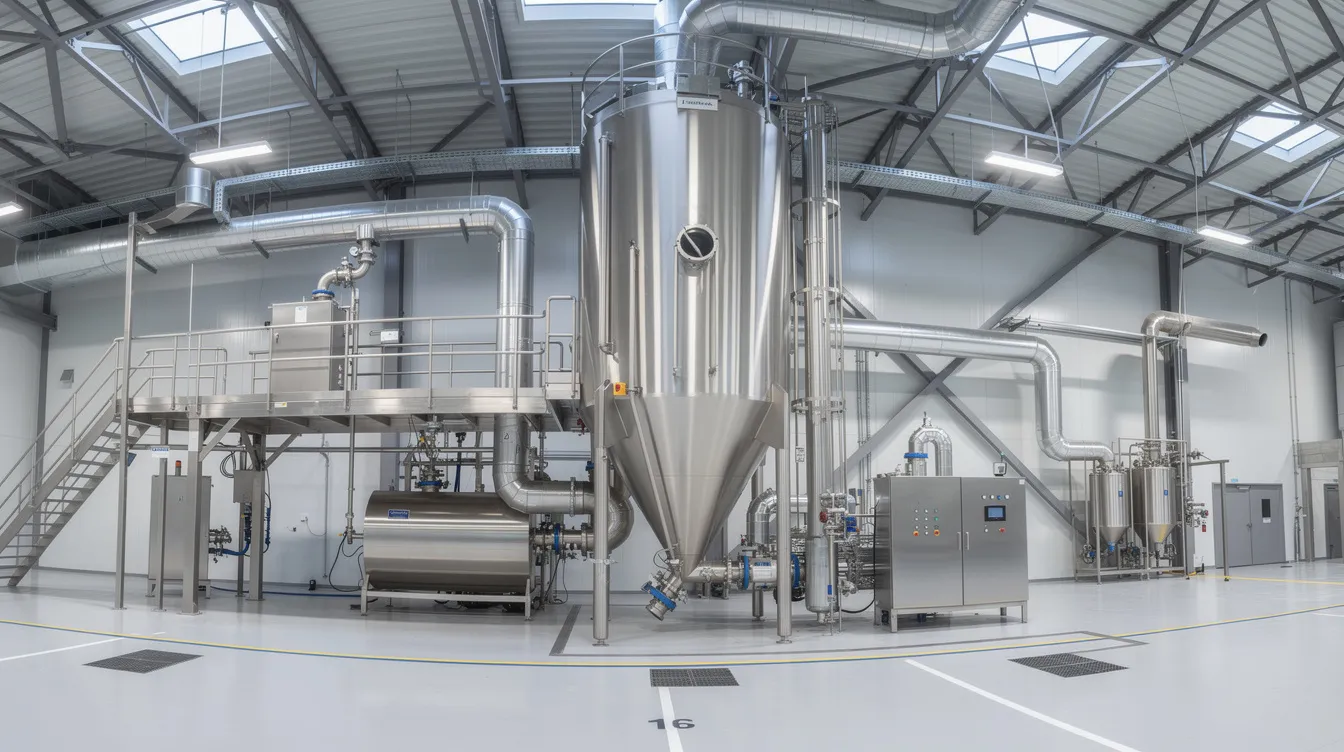
Spray drying is a highly energy-intensive process and requires careful balancing with evaporator capacity. Technical feasibility assessment should evaluate plant balancing (no over- or under-sized equipment stages), process losses, expected powder recovery, moisture control, microbial stability, automation level and capacity for recipe control. Vendor track record, local technical support, spare-parts availability and after-sales service for key components like spray dryers, evaporators, boilers and compressors deserve careful attention. The detailed process diagrams and SOPs generally form part of the DPR and technical annexures.
Machinery and Technology Assessment
Machinery selection goes beyond choosing the lowest quotation. It must align with product mix, desired automation, energy efficiency, hygiene standards and expansion plans, influencing both capital expenditure and operating costs. Equipment must comply with industry standards for safety and efficiency. Choosing the right processing technology impacts product quality and operational efficiency.
The main equipment groups include: milk reception and chilling equipment, pasteurisers, cream separators, standardisation systems, multi-effect evaporators, high-pressure pumps, spray dryers, fluid bed dryers or coolers, powder silos, packing machines, utility equipment (boilers, chillers, compressors, generators) and laboratory instruments. Different technology options-single-stage vs two-stage drying, different evaporator configurations, heat-recovery systems-can change fuel and power consumption, affecting the plant’s cost analysis and long-term competitiveness.
The feasibility study should compare multiple quotations on a like-for-like basis, considering scope of supply, installation support, warranty terms, control systems and future upgradability. A separate note on milk powder plant machinery and equipment cost provides detailed cost benchmarking.
Land, Building and Infrastructure Feasibility
Land and building decisions influence logistics cost, regulatory approvals, expansion potential and insurance premia. Mistakes here are difficult to correct later. Site analysis evaluates geographic location in relation to milk sheds and target markets. Site selection must ensure access to raw milk supplies.
Typical functional areas required include: raw milk reception and tanker parking, processing block with hygienic zoning, utility block (boilers, refrigeration, compressors), powder packing hall, finished-goods warehouse, cold storage if needed, laboratory, administration and QC block, effluent treatment plant (ETP), internal roads, parking and space for future capacity expansion. Land selection should consider proximity to milk-producing villages, access to highways, power and water availability, local pollution-control norms and industrial zoning regulations.
The feasibility study should estimate built-up area based on proposed capacity, automation level and storage strategy, and should examine whether leasing an existing building is viable compared to greenfield construction. A detailed discussion on land, building and infrastructure requirements covers these aspects further.
Utility Feasibility-Power, Steam, Water and Refrigeration
Milk powder plants are energy-intensive, with substantial requirements of steam (for pasteurisation and evaporation), electricity (for drives, pumps, fans and instrumentation), water (process, CIP and cooling) and refrigeration (for raw milk chilling). Effective utility management is vital for the operational sustainability of milk powder plants. Utility planning calculates requirements for water and power.
The feasibility study must quantify connected power load (in kW), boiler capacity (in TPH), refrigeration tonnage, daily water requirement and fuel type (coal, briquettes, PNG, FO, biomass), and must check local availability, tariffs and reliability of each utility. Energy costs account for 10–15% of total operating expenses, and higher boiler efficiency, condensate recovery, variable-frequency drives and appropriate insulation can materially improve operating margins.
Practical Indian considerations such as power outages, requirement of DG sets, water-table limitations, effluent-treatment obligations and long-term fuel-cost escalation must be captured in the financial model. More detailed utility sizing and costing is covered in the guide on power, steam, water and refrigeration requirements.
Regulatory and Quality-Control Feasibility
Regulatory feasibility means identifying all licences, registrations, consents and standards applicable to the proposed location and product range, and ensuring timelines and costs are factored into the DPR. Manufacturing milk powder requires adhering to strict food safety and quality control standards. Compliance with stringent food safety standards is essential in milk processing.
Key areas typically relevant in India include: FSSAI registration and licensing (regulatory compliance includes obtaining a Central FSSAI License), local food and health licences, State Pollution Control Board consents, factory registration, fire-safety clearances, boiler approvals, high-tension electricity connection, groundwater or municipal water permissions, Legal Metrology compliance for retail packs, labour registrations and, where relevant, BIS standards, export certifications and packaging-labelling regulations. Regulatory compliance includes obtaining relevant food safety certifications. Effluent treatment is a critical component of environmental compliance in dairy processing, and environmental assessments are integral to the feasibility study for dairy processing facilities.
Regulations evolve, and specific approvals and procedures must be confirmed from official sources. Quality systems such as HACCP or ISO 22000 can improve market acceptance and may be required by institutional buyers. Robust quality assurance criteria-microbiological and chemical testing facilities, documented SOPs for sampling, in-process checks, finished-goods release, traceability and recall procedures-are particularly important for products going into infant nutrition or export markets.
Estimating the Total Project Cost
An accurate estimate of total project cost is central to any milk powder plant feasibility study. Underestimation can create funding gaps during implementation and jeopardise project completion. The capital expenditure for milk powder plants is substantial due to machinery and infrastructure costs.
Major cost heads include: land and site development, building and civil works, plant and machinery, utility equipment, electricals, laboratory and quality-control equipment, ETP and environmental systems, storage and material-handling equipment, furniture and office infrastructure, pre-operative expenses (interest during construction, salaries, trial-run expenses), technical consultancy, contingency and margin for working capital. Equipment costs and civil works often account for the largest shares of total capital investment.
Capital investment for a small milk powder plant can start from ₹50–80 lakhs for very basic setups, but initial investment for a realistic commercial-scale unit typically runs into several ₹ crore. For reference, CapEx for SMP production plants in India ranges from approximately ₹3.5 crore for small regional units to ₹27 crore or more for larger 30+ TPD integrated facilities. A 30 TPD milk powder project executed by Parag Milk Foods was estimated at approximately ₹50 crore including factory expansion and utilities. Different configurations-greenfield vs brownfield, leased building vs owned land, higher automation vs manual packing-will materially change capital expenditure. For deeper cost breakdowns, refer to the notes on milk powder plant setup cost in India and project cost and means of finance.
Means of Finance and Funding Structure
Once project cost is reasonably firm, the next step is to design the means of finance-how the project will be funded through promoter equity, term loans, unsecured loans, equity investors and eligible subsidies-while keeping the debt-servicing burden within realistic limits.
Typical Indian funding structures for MSME milk powder plants involve promoter contribution (often 25–35% of project cost), term loans from banks or NBFCs, unsecured loans from promoters or related parties, and working-capital limits (cash credit, WCDL, LC/BG facilities) based on assessed working-capital requirement. Government policies support dairy processing through the Production Linked Incentive scheme, PMKSY and state dairy incentives. However, subsidies should be treated as potential upside; feasibility should not depend critically on subsidy unless eligibility criteria, timing of release and conditions are clearly understood and documented.
The feasibility study should test multiple funding scenarios-higher equity, lower debt, or staggered implementation-to observe their effect on DSCR, break-even and promoter returns. Banks will also look at collateral security, promoter net worth, past repayment track record and existing liabilities while deciding loan amount and repayment terms.
Revenue Model and Profitability Assessment
The revenue model for a milk powder plant in India is built from the bottom up: raw milk intake volume, recovery yields, product mix, capacity utilisation schedule, selling quantities and net realisation per kg for each product and by-product.
Daily milk intake translates into annual powder output using assumed recovery. For example, approximately 7.5–8.5 litres of milk per kg of SMP at given SNF (clearly illustrative). Total output is split into SMP, WMP, dairy whitener and by-products in line with the chosen product mix. Realistic net selling prices should reflect historical price volatility, discounts to institutional buyers, packing configuration, GST implications and distribution costs. Gross profit margins for milk powder plants generally range between 20–30%, and a plant with 1,000 litres per hour capacity processing SMP can achieve 18–24% gross margin under efficient plant operations-though these are illustrative ranges, not guarantees.
Contribution per kg of powder and contribution per litre of milk processed are more relevant for viability than gross revenue figures alone. They help compare alternative product mixes and drive the business plan forward. A separate explainer on milk powder plant revenue model and profitability covers pricing and margin scenarios in greater detail.
Operating Cost Assessment
The main categories of operating costs in a milk powder manufacturing business include: raw milk and other raw materials, packing materials, fuel, power, water, refrigeration, direct labour, repairs and maintenance, quality testing, transport, selling and distribution expenses, insurance, administrative overheads, interest and depreciation. These fixed and variable costs together determine the production cost per kg.
Raw milk typically accounts for 75–85% of total operating expenses in India, though actual percentages vary by state, season, product mix and procurement model. Raw material cost dominates the cost structure, and location-specific procurement data should be used instead of generic industry averages. Operating costs tend to increase significantly by the fifth year of operation as maintenance requirements, raw material consumption and overhead commitments escalate.
Energy costs-boiler fuel and electricity-for evaporation and spray drying have a significant impact on cost per kg, especially under scenarios of fuel price escalation or power tariff revisions. The feasibility study should build a monthly or quarterly cost sheet reflecting seasonal milk and energy prices, staff ramp-up, maintenance provision and selling costs so that variations in profitability and cash flow across the year are visible. Sensitivity analysis on key operational costs is essential because small percentage changes can materially alter gross profit margins.
Financial Projections Required for Project Viability
A bankable milk powder plant feasibility study must culminate in integrated financial projections, typically for 7–10 years, reflecting ramp-up of production capacity utilization, realistic pricing and cost assumptions. Financial modeling projects capital costs and return metrics over a 7- to 10-year horizon. A detailed financial model should include revenue forecasts and cash flow analyses.
The core financial statements and annexures include: projected profit and loss account, projected balance sheet, cash-flow statement, fund-flow statement, production and sales estimates, cost-of-production statement, working-capital assessment, term-loan repayment schedule, DSCR calculation, break-even analysis, ROI, IRR (and net present value), payback period and sensitivity analysis. These projections and CMA Data are prepared on the basis of information provided by promoters, quotations, market inputs and reasonable assumptions-they do not guarantee actual performance.
Lenders use these projections to test whether the project can meet interest and instalments from internal cash accruals, and to compare viability under base-case and stressed-case scenarios. For a more technical treatment, refer to milk powder plant financial projections.
Working Capital Feasibility
Even a profitable milk powder plant can face liquidity stress if working capital-funding of inventory, receivables and operating expenses-is insufficient or poorly structured.
Key working-capital elements specific to milk powder plants include: seasonal build-up of raw milk and consumables, powder stocks held during low-price periods for later sale, credit given to institutional buyers, export credit cycles and statutory dues such as GST. The feasibility study should estimate month-wise inventory holding (in days or months) for raw materials, work-in-process and finished goods, expected debtor days, creditor terms from milk suppliers and vendors, and the resulting working-capital gap to be funded through bank limits and promoter contribution.
Working-capital interest cost, bank charges and margin money must be built into the profitability and cash-flow model, especially during the first 2–3 years when the plant is ramping up. For a 15 MTPD plant, working capital for raw milk purchase during a 45-day procurement cycle may itself run into ₹40–60 lakh, while larger plants may see peaks of ₹3–4 crore during high-volume season. The separate note on milk powder plant working capital requirement explains this assessment from a banker’s perspective.
DSCR and Loan-Repayment Capacity
DSCR (Debt Service Coverage Ratio) is the ratio of cash available for servicing debt (profit after tax plus depreciation plus interest and other non-cash charges, adjusted appropriately) to the total term-loan obligations (interest plus instalments) in a given year.
Lenders in India typically look at year-wise DSCR as well as average DSCR over the repayment period, paying special attention to the first 3–5 operational years when capacity utilisation and margins are stabilising. Repayment schedule design-moratorium period, total tenure, ballooning vs equated instalments-affects DSCR, and the feasibility study should test alternative structures to arrive at a practical schedule. Accounting profit alone does not guarantee repayment capacity; cash accrual, working-capital movements and capex commitments must be considered.
For readers seeking a more formula-driven discussion and numerical examples, refer to milk powder project DSCR and loan repayment capacity.
Break-Even Analysis
Fixed costs are costs that do not vary with production in the short term. Variable costs vary per kg of powder. Contribution is the difference between selling price and variable cost per kg. Break-even is the level where total contribution equals total fixed costs.
Break-even can be expressed in terms of annual sales volume (kg of powder or ₹ crore of sales) and capacity utilisation percentage. Cash break-even (ignoring non-cash items like depreciation) is also useful for evaluating short-term liquidity resilience. As a purely illustrative example, for a given fixed-cost base and contribution per kg, a plant might need 55–60% capacity utilisation to break even-this is not a standard benchmark. The break-even point depends on maintaining a reliable milk supply chain because procurement disruptions can push actual utilisation below break-even levels during lean months.
A project with very high break-even utilisation-above realistic lean-season utilisation-carries elevated risk. Promoters should compare break-even capacity with conservative utilisation assumptions. For detailed methodology, refer to milk powder plant break-even analysis.
ROI, IRR and Payback Assessment
Investors and promoters typically use ROI (Return on Investment), IRR (Internal Rate of Return) and payback period to judge whether a milk powder project justifies the capital and risk compared to alternative opportunities.
ROI compares average annual profit with total investment. IRR reflects the discount rate that makes net present value of project cash flows zero. Payback period measures the time taken to recover initial investment from net cash flows. Illustratively, mid-scale plants might show an IRR of 18–25% and payback of 3–5 years under base-case assumptions. However, these metrics are only as reliable as the underlying assumptions. A high IRR based on optimistic milk prices, high capacity utilisation and understated costs may not be achievable in practice.
Promoters should review assumptions regarding milk cost, selling prices, price trends, working-capital cycle and residual value. Feasibility reports should present base-case, conservative-case and aspirational-case return metrics so that promoters, investors and lenders can see how sensitive returns are to key variables.
Sensitivity and Scenario Analysis
Sensitivity analysis tests how changes in key assumptions affect project outcomes. Scenario analysis combines multiple changes to simulate realistic best-case and worst-case situations. Sensitivity analysis is important in assessing the financial feasibility of a milk powder project.
Variables to stress-test include: raw milk price increase, fall in powder selling price, lower capacity utilisation, reduced powder recovery, higher fuel cost, higher power tariff, increase in project cost, delay in commissioning, longer debtor days, higher interest rates and delayed receipt of subsidies.
| Scenario | Key Assumptions | Typical Impact |
|---|---|---|
| Base Case | Expected milk cost, projected utilisation, current selling prices | DSCR, IRR, break-even at planned levels |
| Moderate Stress | 5–10% adverse movement on 2–3 key variables | DSCR declines, payback extends, margins compressed |
| Adverse Case | Combined shocks on milk cost, selling price and utilisation | DSCR may fall below comfort levels, project requires mitigation |
Note: Percentages are illustrative and must be tailored to the project’s risk profile.
For each scenario, the feasibility study should recompute DSCR, break-even, cumulative cash flow and key profitability indicators. A robust milk powder plant financial feasibility analysis is one where the project remains at least marginally viable under moderate stress and where mitigation plans exist for adverse scenarios.
Major Risks in a Milk Powder Manufacturing Project
Milk powder projects face multiple risks-from milk-supply volatility and energy costs to regulatory and market risks. Risk analysis identifies potential supply and operational challenges in milk processing. Recognising these early allows promoters to design mitigation strategies.
Key risks and practical mitigations include:
- Seasonal milk scarcity → Diversify procurement sources and geographies
- Sharp raw material cost increases → Build cost escalation into pricing models, maintain flexibility in product mix
- Selling-price volatility for SMP and WMP → Diversify customer base across institutional, retail and export channels
- High dependence on few buyers → Develop multiple offtake relationships
- Energy-cost spikes → Install energy-efficient systems, consider biomass or alternative fuels
- Under-utilised plant capacity → Match capacity to realistic milk surveys, not peak-season projections
- Product-quality failures → Implement preventive quality control and HACCP systems
- Machinery breakdown → Schedule preventive maintenance, maintain critical spares
- Working-capital shortages → Arrange adequate bank limits, monitor cash flow monthly
- Regulatory non-compliance → Track evolving FSSAI and pollution-control norms proactively
- Project implementation delays → Build contingency into timelines and cost estimates
Some risks, such as movements in the global milk powder industry or government policy changes, cannot be fully controlled. Feasibility evaluation should consider the promoter’s risk appetite and financial resilience. Risk assessment should be revisited periodically during planning, implementation and early operations.
How Banks Evaluate Milk Powder Project Viability
Banks in India view milk powder projects as specialised agro-processing units within the dairy processing industry and examine both technical and financial aspects in detail.
Key appraisal points include: promoter background and experience in dairy or food manufacturing, net worth and proposed contribution, milk-procurement strategy, product mix and market tie-ups, technical arrangements, detailed project cost, means of finance, security and collateral, projected profitability, cash accruals, DSCR, break-even, working-capital assessment, sensitivity analysis and status of regulatory approvals. Lenders may also benchmark the project against industry norms, past performance of similar units in the region and internal risk models.
A professionally prepared milk powder plant DPR with realistic assumptions and coherent financial analysis can substantially improve the quality and speed of appraisal, but cannot guarantee loan approval. Promoters should treat the feasibility study as a communication tool that transparently presents both strengths and risks, not as a document designed only to show optimistic returns.

Indicators of a Potentially Viable Milk Powder Project
This section serves as a positive checklist helping readers recognise when their project idea is on the right track. Indicators of potentially viable projects include: strong and diversified milk catchment with documented surveys; realistic installed capacity aligned to milk availability and market offtake; well-balanced processing and utility capacities; identified institutional and retail customers; diversified product mix including SMP, WMP, dairy whitener or by-products; reasonable project cost supported by multiple quotations; adequate promoter contribution; properly assessed working capital; sustainable contribution margins demonstrated through base-case and conservative-case projections; break-even utilisation attainable under lean-season conditions; satisfactory DSCR across the repayment period; resilience under sensitivity analysis; and availability of a competent technical and managerial team.
If most of these indicators are present and no major unresolved risk remains, the project may be a good candidate for moving from feasibility to detailed DPR and bank appraisal. Each project is unique and these indicators must be validated with location-specific data and expert inputs.
Warning Signs That Require Reassessment
Just as there are positive signs, there are red flags which should prompt promoters to pause and reassess before committing further capital.
Common warning signs include: plant capacity chosen without a proper milk survey; business model relying entirely on peak-season milk volumes; machinery quotations excluding critical utilities such as boilers, refrigeration or ETP; revenue projections built using only optimistic selling prices; no clear market plan for by-products like ghee, butter or whey; underestimated working-capital requirement; very high break-even utilisation; weak DSCR in early years; excessive dependence on subsidy to make projections viable; absence of sensitivity analysis; inadequate promoter funds; and unclear regulatory or land-title position.
Encountering multiple red flags does not necessarily mean the project must be abandoned. It does mean project parameters-capacity, location, product mix, funding structure-should be reworked. Sometimes a phased approach, starting with smaller capacity and then expanding, can convert a risky idea into a manageable one. Promoters should seek independent professional advice rather than relying only on vendor or intermediary estimates.
Step-by-Step Process for Preparing the Feasibility Study
The following is a practical roadmap from concept to DPR. Step 1: define the project concept and product mix-SMP, WMP, dairy whitener, contract drying, etc. Step 2: conduct milk-supply and market surveys. Step 3: select appropriate capacity and location. Step 4: finalise the manufacturing process and technology options. Step 5: obtain machinery, utilities and civil-work estimates. Step 6: estimate project cost and design means of finance. Step 7: prepare operating-cost estimates and working-capital assessment. Step 8: build production, sales and price assumptions. Step 9: prepare integrated financial projections. Step 10: calculate key ratios-DSCR, break-even, ROI and IRR. Step 11: conduct sensitivity and risk analysis. Step 12: review regulatory requirements and implementation schedule. Step 13: compile all into a structured milk powder plant DPR and revisit assumptions before final investment and loan submission.
In my professional practice, these steps are often iterative. Feedback from a bank may prompt adjustments to capacity, funding mix or repayment tenure, which then require updating projections and risk analysis. Documenting assumptions clearly at each stage ensures that future variances in actual performance can be traced back to their source. Promoters should maintain a project file with survey notes, quotations, approvals and draft financial models to keep the feasibility study auditable and updatable.
Documents and Information Required
A thorough feasibility study and DPR require specific data from promoters. Incomplete information often leads to weak or unrealistic projections.
Categories of documents and information typically requested include: promoter KYC and background, business constitution documents (proprietorship, partnership, LLP, company), net-worth and existing liability details, land and building documents or lease proposals, milk-availability survey reports, proposed product-mix and target markets, machinery quotations and technical brochures, civil and utility cost estimates, latest raw-milk and energy price data, indicative selling prices and any customer discussions or intent letters, manpower estimates, status of key approvals, proposed means of finance, draft loan terms and, where applicable, financial statements of existing business entities.
Providing this information early allows the feasibility study to address banker queries proactively. Confidential financial details such as personal net-worth statements are used only for assessing funding capacity. Promoters should maintain updated financial records and tax returns, as banks review these alongside the project report and CMA Data.
Professional Perspective of CA Manish Gugliya
Over two decades of preparing feasibility studies, detailed project reports, CMA Data and bank-finance proposals for manufacturing and MSME units have shaped my approach to milk powder plant projects. I have seen projects succeed because their feasibility was tested rigorously, and I have seen projects struggle because assumptions were not grounded in field data.
A milk powder project becomes financially meaningful only when litres of milk procured, product recovery percentages, capacity utilisation, selling prices, operating costs, working capital movements and loan-repayment schedules are integrated into one coherent financial model. Each number must connect back to a verifiable assumption. That is the difference between a project report that supports sound decision-making and one that merely fills a compliance requirement.
Through projectreportbank.com, I assist entrepreneurs and businesses with feasibility studies, milk powder plant DPRs for bank loans, CMA Data preparation, financial projections, working-capital assessment, DSCR and repayment analysis and sensitivity analysis. All projections are prepared on the basis of available data and assumptions and do not constitute guarantees. I encourage anyone serious about the milk powder sector to treat feasibility work as an investment in disciplined decision-making.
Conclusion
The viability of a milk powder plant in India rests on the combined strength of market demand, secure milk procurement, realistic capacity utilisation, appropriate technology, sound project cost estimation, robust operating margins, adequate working capital, healthy debt-servicing capacity and resilience to risk. A comprehensive milk powder plant feasibility study examines all of these dimensions in an integrated manner, rather than evaluating them in isolation.
Merely purchasing equipment or preparing a superficial powder manufacturing plant project report is not enough. Promoters, investors and lenders should insist on integrated techno-economic analysis, DSCR evaluation, break-even study and sensitivity testing before committing substantial capital. Each project’s parameters differ by state, procurement model, product mix, scale, energy source and market strategy, so feasibility must always be customised.
If you are planning a milk powder manufacturing plant in India-whether as an entrepreneur, dairy cooperative or corporate-I invite you to reach out through www.projectreportbank.com for preparation of a customised feasibility study, detailed project report, financial projections and bank-finance proposal aligned with your specific project.
Frequently Asked Questions
Is a milk powder manufacturing plant profitable in India?
Many Indian milk powder plants can be profitable when they secure reliable milk procurement at competitive prices, maintain efficient conversion costs and sell at sustainable realisations. Profitability varies widely by region, capacity, product mix (SMP, WMP, dairy whitener), utilisation and financial structure. Illustrative gross margins sometimes quoted in the milk powder industry (for example, 18–24% for SMP before accounting for all overheads) are not guarantees. An individual project’s profitability must be established through a customised feasibility study and financial model. No article or consultant can assure profitability; actual performance depends on implementation quality, market conditions and leading milk powder manufacturers’ competitive dynamics over time.
What is included in a milk powder plant feasibility study?
A typical feasibility study includes market and demand assessment, milk-procurement analysis, technology and process review, capacity planning, project-cost estimation, means-of-finance structure, operating-cost analysis, revenue modelling, financial projections (P&L, balance sheet, cash flow), key ratios (DSCR, break-even, ROI, IRR), sensitivity and risk analysis, and an outline of regulatory and implementation aspects. Unlike a basic project profile, a proper feasibility report links numbers back to underlying assumptions so that promoters and lenders can test their reasonableness. This feasibility exercise usually becomes the basis for a more detailed milk powder plant DPR submitted to banks. The milk powder market performed well in recent years, but feasibility must be grounded in achievable volumes, not headline statistics.
How is milk powder plant project viability calculated in practice?
In practice, project viability is evaluated by building a multi-year financial model based on assumed milk intake, recovery, product mix, selling prices, operating costs, project cost and funding structure, then calculating profitability, cash accruals, DSCR, break-even utilisation, ROI, IRR and payback period. Viability is considered stronger when the project shows reasonable profits, adequate DSCR in every year, manageable break-even capacity and resilience under sensitivity scenarios such as higher milk cost or lower selling prices. No single ratio should be viewed in isolation; lenders and investors look at the overall picture, including promoter strength and risk profile.
What capacity utilisation is generally required for a milk powder plant to be viable?
There is no universal percentage applicable to all plants. Required capacity utilisation depends on the fixed-cost structure, contribution per kg, funding pattern and product mix. Many projects aim to reach at least 60–70% utilisation within 3–4 years, but some may break even at lower levels if fixed costs and debt are modest, while others with high capital cost may require higher utilisation. This must always be derived from project-specific break-even and DSCR analysis. Promoters should treat any “standard” utilisation benchmark with caution and insist on a tailored utilisation ramp-up schedule in their feasibility study.
Can a feasibility study guarantee bank-loan approval for a milk powder project?
A feasibility study, however detailed, cannot guarantee bank-loan approval. It is a decision-support document that helps both promoters and lenders understand the project’s strengths, risks and numbers. Banks also consider factors outside the feasibility report-promoter credit history, collateral, existing exposure, regulatory guidelines and internal risk policies. A well-prepared milk powder plant DPR and financial model can improve the quality of appraisal and reduce queries, but final sanction always rests with the lending institution’s credit committees and policies at the time of appraisal.