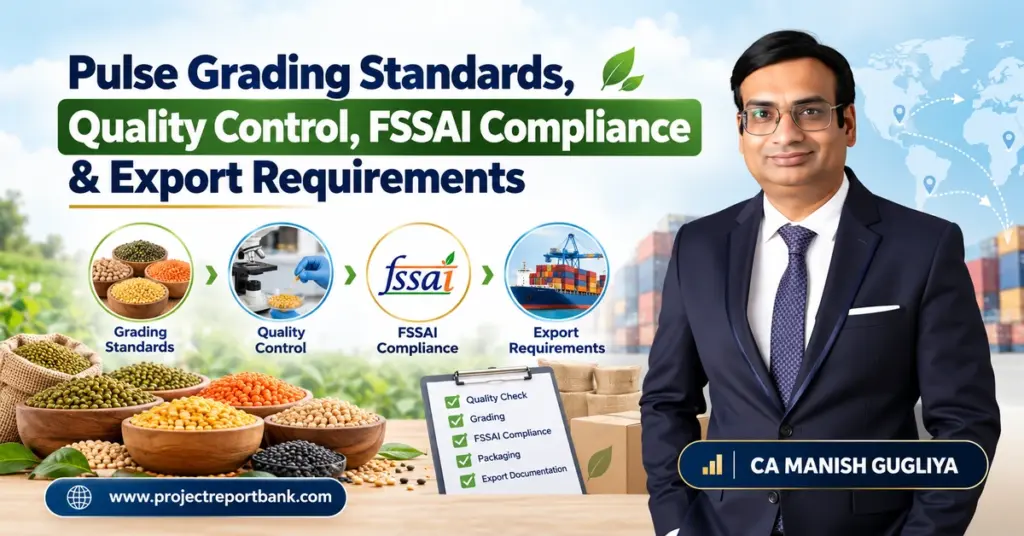
Key Takeaways
- Pulse grading standards in India are governed by a combination of FSSAI food safety regulations, AGMARK grade specifications under the Agricultural Produce (Pulses Grading and Marking) Rules, 2019, and buyer-specific contractual requirements-each addressing different aspects of quality, safety and commercial acceptability.
- Core grading parameters such as moisture content, foreign matter limits, damaged grains and insect damage directly affect processing recovery, rejection rates, shelf life and export eligibility for pulse milling and packing operations.
- Proper pulses grading enhances market access and allows producers to leverage better pricing, while non compliance with FSSAI or export regulations can attract penalties up to ₹10 lakh, shipment rejections and disruption in bank finance disbursement.
- Project promoters must integrate realistic quality control costs-including optical sorting equipment, laboratory testing, compliance documentation and grading losses-into their Detailed Project Reports and financial projections for bank finance.
- Project Report Bank, led by CA Manish Gugliya, FCA, DISA (ICAI), assists entrepreneurs and MSME promoters in preparing bankable DPRs that incorporate accurate compliance assumptions, achievable recovery rates and commercially defensible quality parameters for pulse processing plants.
Introduction – Importance of Pulse Grading Standards in India
India is the largest producer of pulses globally, with approximately 7,000 dal processing mills operating across the country. Pulse milling is India’s third largest food processing business, and the average capacity of each pulse milling industry is about 10 tonnes per day. The sector exported 410,375.89 MT of pulses worth ₹2,834.23 crores in 2021-22. These numbers underscore a large, commercially significant industry where quality standards are no longer optional.
Historically, much of the domestic pulses trade operated on informal quality assessment-visual inspection, buyer trust and negotiated discounts for impurities. That approach is no longer sustainable. The introduction of formal regulatory standards by FSSAI, updated AGMARK grading specifications, and increasingly stringent requirements from export buyers have transformed how pulses are procured, processed, graded and sold. Grading standards protect consumers by ensuring quality and safety of the pulses they purchase, while also providing transparency for farmers and improving their bargaining power.
From a project viability perspective, the connection between quality control and profitability is direct. A plant that consistently delivers lower foreign matter, controlled moisture and uniform product commands better realisations. It also experiences fewer customer complaints, lower rejection rates and stronger repeat business. For promoters planning a new integrated multi-pulse cleaning, grading and packing plant, understanding these standards is essential before finalising machinery, estimating processing costs or approaching a bank for project finance. This article, written from the perspective of CA Manish Gugliya, a practising Chartered Accountant advising on DPRs, CMA Data and bank finance for pulse processing projects, examines the regulatory framework, quality parameters, export requirements and financial implications of pulse grading standards in India.
Overview of Pulse Grading and Quality Standards in India
Pulse grading standards in India do not derive from a single unified code. They emerge from a combination of statutory norms, voluntary quality marks and private commercial specifications. Promoters must understand each layer to design plants, procure raw material and price their finished products correctly.
Key concepts to understand:
- Pulses grading refers to classifying cleaned pulses into quality tiers based on defined physical parameters such as size, colour, moisture, defects and purity. Grading affects cooking consistency and buyer satisfaction.
- Sorting refers to the physical process of removing unwanted materials-stones, husk, discoloured grains, broken pieces-from the lot. Sorting removes unwanted materials like stones and husk to improve the lot before grading.
- Foreign matter includes any non-pulse material present in a lot: mineral matter (stones, grit), organic non-edible matter (pods, stems, weed seeds) and extraneous edible material (other grain species mixed in).
- FAQ quality (Fair Average Quality) is a trade term commonly used in domestic wholesale markets, referring to the typical minimum quality expected for a particular pulse type at a particular market.
- FSSAI standards address food safety-contaminants, moisture ceilings, adulteration limits-while AGMARK grade designations address commercial quality tiers for agricultural commodities.
- Buyer contracts, particularly for export and institutional supply, often overlay additional specifications on top of statutory requirements.
There is no single universal national pulse grading code covering every pulse and every grade. Project promoters must map their product range-whether toor dal, chana dal, urad dal, moong dal, masoor or kabuli chana-to the applicable standard or buyer specification. More than 75% of pulses are marketed as dehulled splits in India, and the quality expectations for whole pulses differ from those for split dal. Pulses contain 20 to 25 percent protein by weight, making them a critical food product where quality standards have direct nutritional and safety implications.
Quality standards influence everything from plant layout and machinery selection to working capital requirements. Stricter grading implies higher procurement cost for cleaner raw lots but also better realisation on the finished product. The trade-off must be evaluated in the DPR.
Key Quality Parameters Used in Pulses Grading
Grading in India is primarily based on visual and physical parameters, many of which are referenced in FSSAI food products standards and AGMARK grade specifications for agricultural produce. The permissible limits for defects vary by pulse type and are specified in the grading rules.
The major parameters that determine quality in pulses grading are:
- Moisture content: Affects shelf life and storability of pulses. Excess moisture promotes fungal growth, insect infestation and weight disputes. FSSAI mandates a maximum moisture limit of 12.5% for raw pulses. Moisture content above 14% can invite mould growth and insect infestation in stored pulses.
- Foreign matter: Includes stones, dust, metallic fragments, husks, stems and weed seeds. Extraneous matter in pulses should not exceed 1% by mass to ensure quality under FSSAI norms.
- Broken and split grains: Excessive brokens reduce saleable yield and are separately graded. FSSAI allows slight defects up to 7% by weight, of which broken grains may account for approximately 3%.
- Damaged grains: Includes mechanically damaged, weather-damaged or biologically damaged kernels. The presence of damaged or weevilled grains is restricted to a low percentage across all major standards.
- Insect-damaged or infested grains: Weevilled grains are counted by number rather than weight. Insect damage not only affects appearance but also indicates storage or handling failure.
- Discoloured grains: Discoloration indicates poor handling and affects grading. FSSAI permits up to approximately 3% discoloured seeds for many pulse categories.
- Size and shape uniformity: Grading classifies pulses into quality tiers based on size. Uniform size improves cooking consistency, visual appeal and packaging efficiency.
- Admixture of other edible grains: Presence of other pulse species or grains beyond specified limits affects product purity. FSSAI generally allows approximately 2% other edible grains.
- Immature or shrivelled grains: These affect both visual quality and cooking performance, and are counted among slight defects.
Specific numerical limits for each parameter depend on the pulse type and the applicable standard-FSSAI, AGMARK or buyer contract-and must be checked against the latest official notifications.
Comparison of Statutory, AGMARK and Contractual Standards
Indian pulse processors typically navigate three layers of quality standards. Mandatory legal standards come primarily from FSSAI. Voluntary but formally recognised grade marks come from AGMARK. Private contractual specifications are set by large domestic buyers, institutional purchasers and overseas importers. Understanding the distinctions is critical for accurate project planning.
AGMARK certifications focus on commercial grading while FSSAI ensures food safety standards. Higher grades of pulses require strict limits on impurities and defects.
| Type of Standard | Issuer / Authority | Scope | Typical Use Case in Pulses Trade | Legal Status |
|---|---|---|---|---|
| FSSAI Regulations | Food Safety and Standards Authority of India | Food safety: contaminants, moisture, adulterants, hygiene | All food products sold for human consumption in India | Mandatory |
| AGMARK Grade | Directorate of Marketing & Inspection (DMI), Ministry of Agriculture | Commercial quality grading: physical parameters, grade designations | Government tenders, institutional procurement, quality branding | Voluntary (may be contractually required) |
| Codex Alimentarius (CXS 171) | FAO/WHO Codex Commission | International benchmark: moisture, extraneous matter, toxic seeds | Export contracts referencing international standards | Advisory / contractual |
| Buyer / Importer Contract | Private buyer or importing company | Specific quality, packaging, testing, documentation requirements | Export shipments, large retail or institutional contracts | Contractual |
Key clarifications:
- FSSAI focuses on safety parameters including contaminants, biological hazards, pesticide residues, heavy metals and moisture ceilings. These are non-negotiable legal requirements.
- AGMARK provides grade designations based on physical quality-foreign matter, damaged grains, moisture, weevilled count-with more restrictive tolerances for higher grades.
- Buyer contracts often overlay additional limits on colour uniformity, packaging standards, traceability and documentation that go beyond either FSSAI or AGMARK requirements.
- Banks and promoters must read actual purchase orders and letters of credit when preparing DPRs and CMA data, rather than assuming that AGMARK limits will match contractual specifications.
Precise grade thresholds should be cross-checked with the Directorate of Marketing & Inspection and FSSAI websites.
Moisture Content Standards in Pulses
Moisture is among the most critical determinants of storability, fungal growth risk, weight claims and rejection risk in pulses, both domestically and in export consignments.
- Indian food safety regulations prescribe maximum moisture limits for various grains and pulses. FSSAI mandates a maximum moisture limit of 12.5% for raw pulses. However, exact values differ by commodity category, and these are periodically updated, so project promoters must verify current limits from official FSSAI regulations such as the Food Products Standards and Food Additives Regulations, 2011, as amended.
- Under AGMARK for specific pulses like kabuli chana, moisture limits are more stringent for higher grades-approximately 11% for Special grade and 12% for Standard grade-while General grade may allow up to 16%.
- Moisture content affects shelf life and storability of pulses directly. Plants typically use rapid moisture meters at raw-material intake and before final packing to ensure lots are within the acceptable range for their intended market.
- Higher-moisture purchases may appear heavier initially, giving an illusion of favourable procurement rates. However, they can lead to dry-out losses during storage, mould development, insect infestation, or disputes over actual weight and quality at the destination. Lower, stable moisture typically commands a premium in both domestic branded retail and export markets.
For export consignments travelling long distances by sea-particularly to hot and humid destinations-buyers frequently impose moisture limits tighter than Indian domestic norms to prevent deterioration during transit.
Foreign Matter, Impurities and Defective Grains
Foreign matter and impurities in the context of agricultural produce and pulses grading in India refer to any material present in a pulse lot that is not the intended pulse itself. This encompasses a wide range of contaminants, from stones and dust to weed seeds and mixed grain species.
The key categories are:
- Inorganic foreign matter: Stones, metal fragments, glass, soil and mineral matter. FSSAI limits mineral matter to not more than 0.25% by weight within the overall 1% foreign matter ceiling.
- Organic non-edible matter: Husks, stems, pods, stalks, weed seeds and similar plant debris. These overload aspiration systems and reduce throughput if not removed during pre cleaning.
- Edible but extraneous material: Other grain species or pulse varieties accidentally mixed in. For instance, red gram mixed into a lot of bengal gram, or green gram contaminating a batch of black gram or urad dal.
- Damaged grains: Includes mechanically damaged, weather-damaged and biologically degraded kernels. FSSAI defines “serious defects” at up to 1% maximum for pulses and dal.
- Insect-damaged grains: Weevilled grains counted by number. AGMARK limits for kabuli chana, for example, allow approximately 1% weevilled count in Special grade, rising to 10% in General grade.
- Impurities of animal origin: Limited to not more than 0.10% under both FSSAI and Codex Alimentarius CXS 171 standards.
Foreign matter is not only a food safety concern but also an equipment and yield issue. Stones damage destoners and dehuskers. Excess husk overloads aspiration systems and reduces throughput. Metallic foreign matter can damage machinery and pose serious consumer safety risks.
Export buyers often impose tighter foreign matter limits than domestic wholesale markets. Failure to meet these can trigger non compliance claims, shipment rejection and financial penalties. The cost of thorough cleaning and foreign matter removal must be factored into processing cost estimates in the DPR.

Pulse Milling and Grading Process Flow – Quality Control Perspective
The end-to-end pulse milling and pulses grading flow follows a structured sequence, and each step has a specific quality control objective.
- Raw material reception: Incoming lots are visually assessed and sampled for moisture, foreign matter and general condition. FSSAI compliance requires rigorous quality intake protocols for raw pulses.
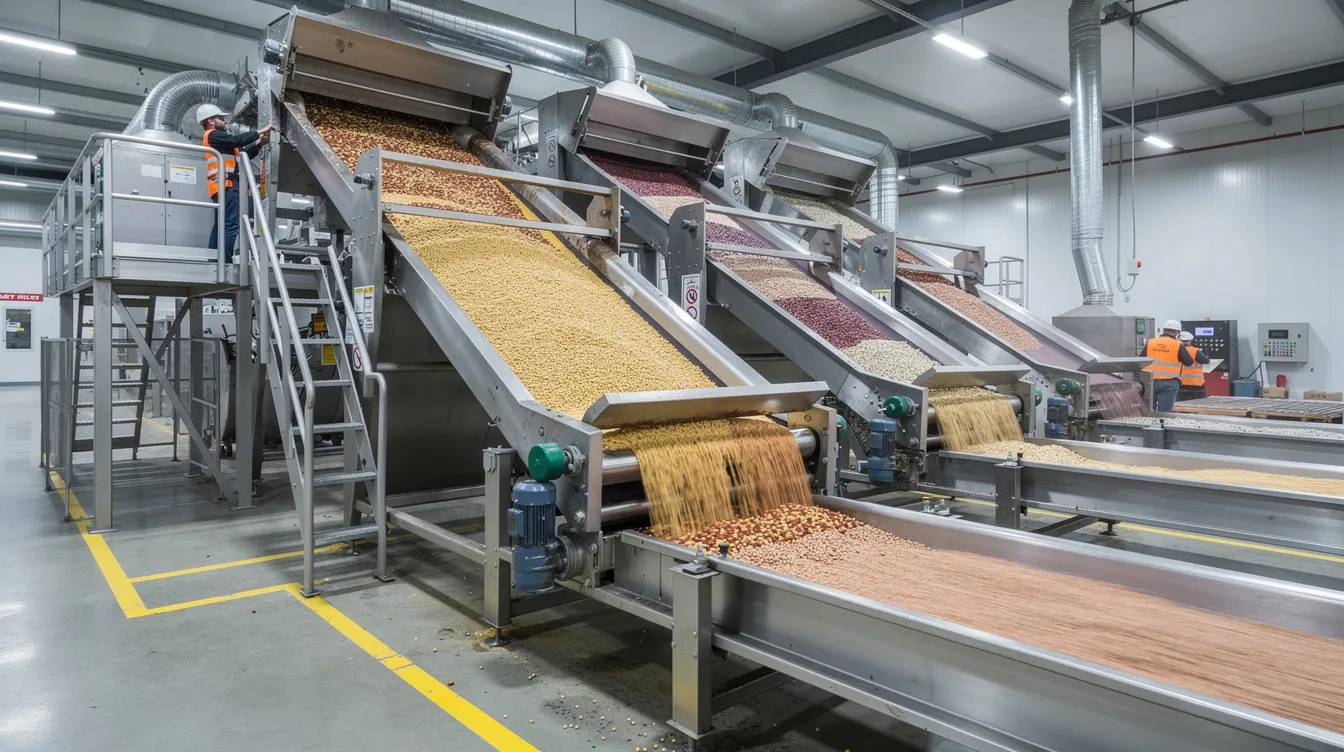
- Pre cleaning: Drum screens, air classifiers and vibratory sieves remove dust, light impurities and oversized debris. This step reduces the dust load entering downstream equipment.
- Destoning: Gravity-based destoners separate stones and heavy inorganic foreign matter from the pulse stream. Critical for protecting dehusking and splitting machinery.
- Size grading: Grading screens classify pulses by size to ensure uniform lots. This improves cooking consistency, packaging uniformity and buyer satisfaction.
- Gravity separation: Separates immature, shrivelled or lower-density grains from sound kernels based on specific gravity differences.
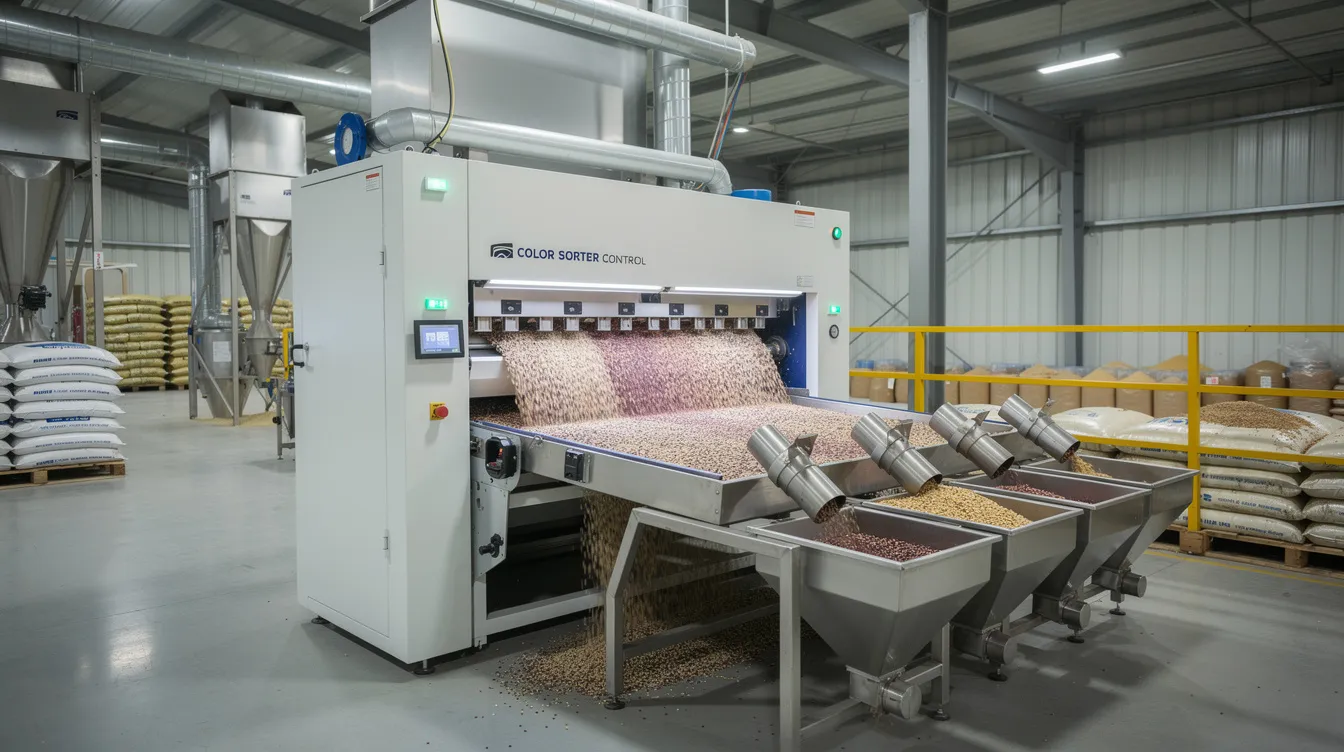
- Optical colour sorting: Automated colour sorters reject discoloured, insect-damaged and off-colour grains at high speed. This is the primary technology for achieving export-grade visual quality.
- Polishing (if applicable): Water polishing or dry polishing improves surface appearance. Buyers may specify “unpolished” or “water-polished only” to avoid essential oils or vegetable oils being used as coating agents.
- Weighing and packing: Accurate weighing into multiple bags or consumer packs. Packaging must comply with FSSAI labelling and weight regulations.
- Storage and dispatch: Finished goods stored under controlled conditions. Pest control and temperature monitoring are ongoing requirements.
For detailed technical descriptions of each stage, promoters may refer to pulse cleaning, grading, sorting and packing process flow documentation. The degree of sophistication-manual sorting versus multi-channel optical sorting-must be aligned with the target market. Each processing step corresponds to a measurable quality parameter in inspection reports, and neglecting any stage typically shows up as higher rejections or lower grade realisation.
Stage-Wise Pulse Quality Control – From Intake to Dispatch
Robust quality control in pulses is a stage-wise system, not a single final inspection. Documenting each stage is important for both FSSAI compliance and export traceability.
| Stage | Key QC Checks | Test / Instrument Used | Record / Document Maintained |
|---|---|---|---|
| Raw material procurement | Supplier approval, lot history, visual assessment | Sampling probe, visual inspection | Supplier register, purchase order |
| Intake sampling | Moisture, foreign matter, insect infestation | Moisture meter, laboratory sieves | Intake test report, lot number |
| Pre cleaning | Dust removal efficiency, screen condition | Visual check, reject weight measurement | Pre cleaning log |
| Destoning | Stone removal effectiveness, pulse loss in rejects | Spot checks, reject sampling | Destoner performance log |
| Size grading | Screen accuracy, uniformity of output fractions | Calibrated sieves, sample weighing | Grading output record |
| Gravity separation | Separation of immature/light grains | Visual check, sample weighing | Gravity table log |
| Optical colour sorting | Reject rate, defect removal accuracy | Colour sorter calibration, sample review | Sorter reject log, calibration record |
| Final packaging | Weight accuracy, label correctness, seal integrity | Weighing balance, visual inspection | Packing slip, batch record |
| Warehouse monitoring | Temperature, humidity, pest activity | Thermometer, hygrometer, pest traps | Warehouse condition log |
| Dispatch inspection | Lot verification, documentation completeness | Document check, seal verification | Dispatch note, quality certificate |
Supporting notes:
- This table can be converted into an internal SOP or integrated with a HACCP plan for systematic food safety management.
- Proper QC documentation supports dispute resolution and audits from buyers and regulators. Without records, defending against quality claims becomes extremely difficult.
- Each stage’s reject weight and defect type should be tracked to identify trends and improve process control over time.
- Promoters planning new facilities will find it useful to align this framework with the machinery and process layout in their project report.
FSSAI Compliance for Pulse Processing and Grading Plants
Any pulse cleaning, grading, sorting, packing or pulse milling facility selling food products for human consumption in India must obtain appropriate FSSAI registration or licence under the Food Safety and Standards Act, 2006. Pulse milling units must comply with Schedule 4 of FSS regulations for manufacturing and hygiene practices.
Key compliance requirements:
- FSSAI offers three tiers: basic registration (for very small operators), state FSSAI license (for medium-sized units) and central FSSAI license. An FSSAI Central License is required for units exceeding 2 MT/day production capacity.
- Applications are submitted through the FoSCoS (Food Safety Compliance System) online portal with supporting documentation including plant layout, machinery details, water test reports and food safety management plans.
- Applicable product standards for pulses and dal are specified under FSSAI Regulation 2.4.6(22), covering moisture, foreign matter, defects, weevilled grains, uric acid, aflatoxin and other parameters.
- Pulses must comply with specific health standards, including limits for uric acid (maximum 100 mg/kg). Aflatoxin levels in pulses must not exceed 15 µg/kg under FSSAI regulations.
- Mandatory Good Manufacturing Practices (GMP) and Good Hygiene Practices (GHP) as per Schedule 4 include requirements for sanitary design, pest control, personal hygiene, cleaning schedules and water quality.
- Plant operators must periodically check the official FSSAI website for updated limits and notifications applicable to pulses and related agricultural products.
- Penalties for non-compliance can reach up to ₹10 lakh or imprisonment under the FSS Act, depending on the nature and severity of the violation. Regulatory penalties can include closure orders and product recalls.
- FSSAI is a legal requirement. ISO 22000, HACCP and other quality management systems are voluntary unless made mandatory by a particular buyer or contract.
DPRs must budget for compliance costs-licence fees, laboratory testing, plant modifications for GMP, staff training-and factor potential regulatory risks into sensitivity analysis. Food manufacturers in the pulse sector cannot afford to treat FSSAI compliance as an afterthought.
AGMARK Grading Standards for Pulses
AGMARK, administered by the Directorate of Marketing & Inspection (DMI) under the Ministry of Agriculture, is India’s official grading mark for agricultural produce, including quality standards for many pulses. Pulses in India are governed by the Agricultural Produce (Pulses Grading and Marking) Rules, 2019.
Key aspects of AGMARK for pulses:
- AGMARK defines grade designations such as “Special”, “Standard” and “General” for various pulse types, each with specific tolerance limits for moisture, foreign matter, damaged grains, weevilled grains and admixture.
- For kabuli chana under AGMARK, Special grade requires moisture at approximately 11%, organic foreign matter at 0.10%, damaged grains at 0.50% and weevilled count at 1.0%. General grade allows significantly higher tolerances.
- AGMARK certification is voluntary for most processors but may be demanded in government or institutional tenders and by certain export buyers who trust AGMARK quality markings.
- Authorised packers must have access to testing laboratories-whether state grading labs, private labs with qualified chemists, or their own in-house facilities-as specified in the certification rules.
- The difference between FSSAI and AGMARK is important: FSSAI ensures food safety and legal compliance, while AGMARK is a quality mark specifying defined grades for agricultural commodities. Both serve different but complementary purposes.
Commercial considerations: AGMARK certification may support better branding and price realisation, but involves ongoing compliance, inspection and logo-usage controls managed by DMI. Businesses should evaluate the cost-benefit in their DPR. For some product categories and market channels, the investment in AGMARK grading may be justified; for others, buyer-specific quality specifications may be more commercially relevant.
Pulse Export Quality Requirements from India
Export-grade pulses must meet not only Indian laws but also destination-country regulations, Codex standards where referenced, and buyer specifications covering moisture, foreign matter, defects and pesticide residues. India exported 410,375.89 MT of pulses worth ₹2,834.23 crores in 2021-22, and ensuring compliance with export quality requirements is essential for maintaining and growing this market.
Requirements for pulse exports:
- An Import Export Code (IEC) from DGFT is mandatory for any exporter.
- The applicable DGFT export policy for pulses must be checked at the time of planning. Export permissions or restrictions can change through notifications, and promoters must verify the latest position before committing to export contracts.
- APEDA registration and RCMC (Registration-cum-Membership Certificate) may be required, particularly for organic pulses and certain categories of food products.
- Destination-country import requirements vary significantly. Phytosanitary certificates, pesticide residue limits, heavy metals thresholds and mycotoxin limits differ by country and pulse type. These must be confirmed from official sources or buyer documentation at the shipment stage.
- Fumigation, container hygiene, fumigation certificates and Certificates of Analysis (CoA) issued by accredited laboratories are key components of an export-quality package. Timely delivery and proper documentation are equally important.
- Packaging must meet both Indian export standards and destination-country labelling rules, including batch traceability, country of origin marking and nutritional declarations where required.
- For organic pulses, additional conditions apply: APEDA organic certification, registration of export contracts with APEDA, and export through designated Customs EDI ports.
Promoters establishing export-grade pulse cleaning, colour sorting and packing plants must plan their machinery and quality infrastructure to meet the most demanding specifications in their target markets. The cost of advanced cleaning, optical sorting and packaging technology is a necessary investment for export readiness.

Domestic vs Export-Grade Pulses: Quality and Documentation Differences
Even though the same pulse variety is used, domestic wholesale, domestic branded retail and export markets demand different quality standards, documentation rigour and packaging specifications.
| Parameter | Domestic Wholesale | Domestic Branded Retail | Export-Grade |
|---|---|---|---|
| Foreign matter tolerance | Relatively higher; FAQ-based | Lower; brand reputation driven | Strictest; buyer-contract specified |
| Moisture tolerance | FSSAI ceiling; practical flexibility | FSSAI ceiling; tighter for shelf life | Often below domestic norms for transit |
| Colour and size uniformity | Moderate | Important for consumer appeal | Critical; optical sorting expected |
| Testing frequency | Periodic or lot-based | Regular; batch testing | Every shipment; independent lab CoA |
| Documentation | Basic invoicing; FSSAI compliance | FSSAI; brand QC records | Full traceability, phytosanitary, CoA, surveyor reports |
| Packaging standards | Gunny bags, HDPE bags | Retail packs with branding | Export-grade packs, container hygiene certificate |
| Traceability | Limited | Batch-level | Full lot and container traceability |
Key differences:
- Export shipments require detailed documentation and traceability, container-level sampling and independent surveyor reports. Domestic unbranded trade may operate with looser documentation but still remains subject to FSSAI regulatory requirements.
- Project economics differ significantly. Export-grade production needs higher CAPEX in optical sorting and QC but can yield better price realisations. Domestic focus may be less CAPEX-intensive but exposes the business to more price competition.
- Not all export markets have identical standards. Exporters must work with clearing agents, buyers and official resources to map exact requirements for each destination and product.
- Setting up a pulse milling industry requires ₹75,000 to ₹25,00,000, depending on scale and sophistication-and the upper end of this range is typically driven by export-grade equipment and quality infrastructure.
Laboratory Testing and Quality Testing Equipment for Pulses
Serious pulse processors must invest in basic laboratory equipment and reliable instruments for day-to-day quality control, even if advanced residue testing is outsourced to accredited laboratories.
Essential in-house equipment:
- Moisture meters (preferably calibrated for specific pulse types) for rapid intake and pre-dispatch testing
- Grain samplers and probes for drawing representative samples from bags and bulk lots
- Laboratory sieves and grading screens for measuring size distribution and broken percentage
- Weighing balances (precision and platform scales) for test portion measurement and packing accuracy
- Sample dividers for preparing representative sub-samples
- Visual inspection stations with adequate lighting for manual defect assessment
- Magnetic separation or metal detection devices for removing metallic foreign matter
- Optical colour sorters at plant level for automated rejection of discoloured and defective grains
For parameters such as pesticide residues, mycotoxin levels, heavy metals and microbiological analysis, external NABL-accredited laboratories are typically used. These tests are demanded by large domestic buyers and overseas clients and cannot practically be performed in-house by most processors.
From a finance perspective, DPRs should separate in-house QC CAPEX-equipment costs, laboratory room fit-out-from recurring OPEX such as external testing charges, calibration and consumables. These costs directly affect per-tonne processing cost. Promoters evaluating pulse cleaning, grading and sorting machinery costs should include QC equipment as a defined line item within the overall project cost.
HACCP, ISO 22000 and Food Safety Management Systems in Pulse Processing
HACCP (Hazard Analysis and Critical Control Points) and ISO 22000 / FSSC 22000 are structured quality management systems increasingly expected by large institutional buyers, modern retailers and international importers. They provide a systematic framework for identifying, evaluating and controlling food safety hazards.
Key aspects for pulse processing:
- HACCP principles applied in a pulse plant include hazard identification at intake (contaminants, pesticide residues, moisture), storage (insect infestation, mould), processing (metal contamination, cross-contamination) and packing (seal integrity, labelling accuracy).
- Documentation requirements include SOPs for each process stage, monitoring logs, corrective action procedures, verification schedules and management review records.
- These systems integrate well with existing FSSAI-mandated GMP/GHP requirements under Schedule 4, creating a layered approach to ensuring food safety.
- Implementation involves consultant fees, internal staff training, documentation preparation, certification audits and ongoing surveillance. Promoters should obtain quotations during DPR preparation rather than relying on assumed figures.
- HACCP and ISO 22000 certifications are generally voluntary for pulse processors in India unless mandated by a specific buyer. They do not replace statutory FSSAI licensing or AGMARK procedures.
- These systems can function as strategic investments that improve export readiness, reduce recall risk and support smoother bank appraisal for sophisticated projects.
Businesses targeting wheat products or ground spices alongside pulses may find that a unified food safety management system covering all product lines is more efficient than managing separate compliance frameworks.
Impact of Pulse Quality Standards on Processing Cost and Profitability
Pulse quality standards are not merely technical requirements; they directly affect raw-material cost, processing losses, marketable recovery and net realisations. Accurate grading practices promote investment in better post-harvest techniques and improve overall efficiency.
Factors affecting cost and profitability:
- Procurement premiums: Higher-quality raw pulses with lower foreign matter and controlled moisture cost more per tonne but yield better recovery.
- Cleaning and grading losses: Dust, husk, stones and broken grains removed during processing represent lost weight. A lot arriving with 4% foreign matter loses more tonnage than one arriving at 1.5%.
- Optical sorter reject rates: Colour sorters reject discoloured, damaged and insect-infested grains. Reject rates of 2–5% are common and must be factored into recovery calculations.
- Energy and labour costs: More intensive QC-additional sorting passes, manual inspection-increases per-tonne operating costs.
- Customer claims and rejections: Non compliance with agreed specifications can trigger deductions, returns or shipment rejection, directly eroding margins.
- Working capital implications: Stricter grading may temporarily increase unsold stocks (rejected lots that need reprocessing or must be sold at lower grades), tying up working capital.
Illustrative comparison (using clearly disclosed assumptions for a 10 TPD plant operating 300 days/year):
| Parameter | Basic Domestic-Quality Plant | Export-Grade Plant |
|---|---|---|
| Raw pulse input price (assumed) | ₹55,000 per MT | ₹58,000 per MT (premium procurement) |
| Average net recovery | 94% | 91% (stricter rejection) |
| Marketable output per MT input | 940 kg | 910 kg |
| Average selling price | ₹62,000 per MT | ₹70,000 per MT (export premium) |
| Gross realisation per MT input | ₹58,280 | ₹63,700 |
| Processing cost per MT (approx.) | ₹2,000 | ₹3,200 (higher QC, testing, packaging) |
| Net contribution per MT input | ₹1,280 | ₹2,500 |
These are illustrative figures based on assumed values to demonstrate the principle. Actual economics vary by pulse type, market conditions, plant scale and machinery configuration. For detailed numeric analysis, promoters may refer to pulse cleaning and grading processing cost, recovery, wastage and profitability models.
Regulatory Compliance and Bank Finance for Pulse Processing Projects
From a Chartered Accountant’s perspective, banks in India increasingly scrutinise regulatory compliance-particularly FSSAI licensing, environmental clearances and, where applicable, export registrations-when appraising term loans for pulse milling and grading units. A bankable DPR must demonstrate that regulatory standards are not just acknowledged but costed and operationally integrated.
How a DPR should address quality and compliance:
- Include cleaning, grading and colour-sorting machinery as detailed line items in the project cost, with quotations and technical specifications.
- Budget for quality-testing equipment-moisture meters, laboratory sieves, weighing instruments-as part of CAPEX.
- Account for civil works designed to meet GMP/GHP requirements: washable walls, drainage, ventilation, pest-proof construction.
- Estimate compliance costs including FSSAI licence fees, recurring laboratory testing charges, certification audit expenses and documentation overheads.
- Use realistic assumptions for quality-linked recovery and selling prices. Overstating recovery or assuming export-grade pricing without corresponding QC infrastructure weakens the entire financial model.
- DSCR, cash-flow projections and CMA data preparation must consider the risk that quality-related rejections, returns or regulatory stoppages could affect loan repayment capacity.
- Sensitivity analysis should test scenarios such as: What happens if raw material quality deteriorates? What if reject rates increase by 2%? What if export realisations decline?
- Export receivables and documentation risks-including delayed payments due to quality disputes-should be factored into working capital assumptions.
Well-documented quality systems and clear evidence of FSSAI and export compliance improve the plant’s risk profile in the eyes of lenders. For detailed financial modelling guidance, promoters may refer to resources on pulse cleaning and packing plant financial projections, CMA data and DSCR and feasibility study, ROI, IRR and bank finance for pulse processing projects.
Environment, Consent and Other Regulatory Approvals for Pulse Milling
Apart from FSSAI and export registrations, pulse milling and grading units may require environmental and local industrial approvals before commencing operations.
- Consent to Establish (CTE) and Consent to Operate (CTO) from the State Pollution Control Board are typically required. Pulse milling generates dust emissions, noise and solid waste (husk, stones, sweepings) that must be managed.
- Dust collection systems-cyclone separators, bag filters-serve dual purposes: regulatory compliance and improved working conditions for operators.
- GST registration is mandatory for businesses above the applicable threshold. For exports, a Letter of Undertaking (LUT) allows export without paying IGST.
- Other approvals may include a No Objection Certificate from local municipal or industrial authorities, fire safety clearance, and an electricity connection with adequate sanctioned load.
- Exact approval requirements vary by state, plant size and local industrial zoning. Promoters must consult local authorities for the current list of mandatory clearances, including any required objection certificate from neighbouring landholders or panchayat authorities.
Starting construction or operations without necessary consents can lead to closure notices, regulatory penalties and disruption in bank finance disbursement. These costs and timelines should be factored into the DPR project implementation schedule. The accountability for obtaining all approvals rests with the promoter, and banks will verify compliance before disbursement milestones.
Common Quality Control and Export-Compliance Mistakes in Pulse Plants
Many otherwise well-designed pulse plants in India lose money because of avoidable mistakes in quality control and export documentation, not because of lack of demand.
Common mistakes and their impact:
- Inadequate sampling at intake: Drawing samples from only the top layer of bags leads to hidden quality variation and frequent disputes with buyers.
- Unreliable moisture meters: Using uncalibrated or low-quality instruments results in inaccurate readings, leading to either excess moisture in packed lots or unnecessary rejection of acceptable material.
- Poor calibration of optical sorters: Colour sorters that are not regularly calibrated cause over-rejection (unnecessary yield loss) or under-rejection (quality failures reaching customers).
- Inconsistent sieving standards: Using worn or incorrect screen sizes leads to grading inaccuracies, resulting in mixed-size lots that fail to meet buyer specifications.
- Ignoring insect infestation in warehouses: Stored pulses are vulnerable to pigeon peas bruchids, khapra beetle and other storage pests. Neglecting warehouse fumigation and pest monitoring leads to weevilled grains and lot rejection.
- Incomplete batch traceability: Without proper lot numbering and records, defending against quality claims becomes impossible. Traceability is a basic requirement for maintaining accountability.
- Incorrect or incomplete export documentation: Missing phytosanitary certificates, incomplete certificates of analysis, or errors in shipping bills cause delays, container detention and financial penalties.
- Failure to verify destination-country pesticide residue limits: Limits for different importing countries can be significantly stricter than Indian norms. Shipping without verification risks rejection at the port of entry.
- Neglecting container hygiene and fumigation records: Containers that are not clean, dry and odour-free can contaminate an entire shipment. Fumigation certificates are routinely demanded by overseas buyers.
- Inadequate staff training: Operators who do not understand grading standards or the purpose of each machine cannot maintain consistent output quality.
Building preventive controls into SOPs and staff training-and describing these controls in the DPR’s risk-mitigation section-demonstrates to the bank that operational risks have been identified and addressed.
Quality Control Checklist for a New Pulse Cleaning, Grading & Packing Plant
This checklist serves as a practical starting point that promoters can adapt when commissioning a new plant or upgrading an existing one.
| Compliance Requirement | Applicability | Responsible Person / Department | Verification / Documents |
|---|---|---|---|
| FSSAI registration or licence | Both domestic and export | Owner / Quality Manager | FSSAI licence copy, FoSCoS registration |
| Pollution control consent (CTE/CTO) | Both | Owner / EHS Officer | Consent letters from SPCB |
| Raw material acceptance criteria | Both | Procurement / QC | Intake test reports, supplier register |
| Foreign matter testing at intake | Both | QC department | Lab test records, sieve analysis |
| Moisture testing at intake and packing | Both | QC department | Moisture meter readings log |
| Process control at destoner | Both | Production Supervisor | Destoner performance log |
| Optical colour sorter calibration | Both (especially export) | Sorter Operator / QC | Calibration records, reject rate log |
| Packing weight and label accuracy | Both | Packing Supervisor | Packing slips, label review records |
| Warehouse hygiene and pest control | Both | Warehouse Manager | Pest control register, fumigation records |
| GMP and GHP compliance | Both | Quality Manager | Internal audit reports, cleaning schedules |
| IEC and APEDA/RCMC registration | Export | Owner / Export Manager | IEC certificate, RCMC copy |
| Phytosanitary certificate | Export | Export Manager | PQ certificate per shipment |
| Certificate of Analysis (CoA) | Export (and some domestic) | QC / External Lab | Lab reports, accreditation details |
| Container inspection and fumigation | Export | Export / Logistics | Container condition report, fumigation certificate |
| Batch traceability records | Both | QC / Production | Batch register, lot tracking system |
Promoters should adapt this checklist to their own plant size, product mix and target markets. Integration with internal audit or HACCP verification schedules strengthens the overall compliance framework and supports ensuring compliance during external inspections. Basmati rice and other food products processed alongside pulses may require additional parameters in this checklist.
Financial Modelling of Quality-Control Investments in DPRs
Quality control infrastructure-laboratories, advanced sorters, dust-control systems, staff training-should be treated as revenue-generating investments in DPRs because they reduce wastage, claims and rejections over the project life. This is not discretionary expenditure; it is integral to the business model.
How to incorporate QC investments in financial models:
- Create separate CAPEX line items for quality testing equipment, optical sorters, laboratory fit-out and dust collection systems. These should not be buried within general “miscellaneous” heads.
- Estimate additional operating costs: staff salaries for QC personnel, recurring calibration expenses, external lab testing charges, consumables and documentation costs.
- Quantify expected improvement in net recovery percentage when advanced sorting is used compared to basic manual cleaning. Even a 1–2% improvement in marketable recovery can materially affect margins over a full year at scale.
- Model price premiums achievable for higher grades or export-quality pulses. The difference between General and Special AGMARK grade pricing, or between domestic wholesale and export FOB pricing, should be reflected in revenue assumptions.
- Banks and investors look for conservative but realistic assumptions around quality parameters-average foreign matter on arrival versus after cleaning, expected defect rates after colour sorting, average moisture at dispatch.
- Test scenarios such as “with” and “without” advanced quality control to demonstrate impact on DSCR, IRR and payback period. This strengthens the commercial case for quality investment.
- Where inventory cycles, quality-claim buffers and export receivables are significant, working capital and cash credit requirements should be modelled with adequate provision for quality-related holding costs.
Project Report Bank prepares customised financial models that incorporate these assumptions, enabling promoters to present bankable proposals with defensible quality and profitability parameters.
Role of Independent Surveyors and Third-Party Inspection
For large domestic institutional contracts and almost all export shipments of pulses, third-party surveyors or inspection agencies commonly supervise sampling, quality testing and container loading.
- Independent surveyors draw representative samples, conduct weight checks, inspect containers for cleanliness and structural integrity, and verify seal placement.
- Their survey reports serve as neutral evidence in dispute resolution between buyer and seller. Without such reports, quality claims become subjective and difficult to resolve.
- Banks and cargo insurers sometimes require surveyor documentation for financed exports, particularly for high-value consignments or first-time buyer relationships.
- Recognised international survey firms (SGS, Bureau Veritas, Intertek and others) are commonly used, though domestic inspection agencies also operate in this space.
- Surveyor costs should be treated as part of per-shipment export expenses and factored into export-pricing and profitability calculations in DPRs.
Using third-party inspection strengthens the credibility of quality claims, reduces disputes over foreign matter, moisture and defects at the destination, and builds long-term customer confidence. This ability to provide independent verification is increasingly valued in international pulse markets.
Building a Quality-First Culture in Pulse Milling Operations
Machinery and written SOPs are necessary but not sufficient. Plant teams must develop a culture that consistently respects regulatory standards, quality control discipline and traceability obligations.
- Top management commitment is the starting point. When ownership visibly prioritises quality-by investing in equipment, enforcing SOPs and reviewing QC reports-the entire organisation follows.
- Regular training of supervisors and operators in grading standards, defect identification and equipment operation is essential. Visual aids showing acceptable versus rejected grains help standardise subjective judgements.
- Performance metrics should be linked to rejection rates, customer complaints and QC audit scores, not only to production volume. This focus on quality outcomes changes behaviour.
- Periodic internal quality audits-separate from external certification audits-help identify process drift before it affects customers.
- When employees understand how better grading reduces rework and improves profitability, they become active partners in quality rather than treating quality control as a burden imposed by management.
- Strong internal culture also supports smoother regulatory inspections and certification audits because records are maintained accurately and processes match documented SOPs.
For larger plants, Project Report Bank’s advisory can include guidance on integrating financial KPIs with quality KPIs in management dashboards, supporting sustainable growth and long-term operational excellence.
Frequently Asked Questions on Pulse Grading Standards in India
These questions address common doubts not fully covered in the main sections and are formatted for quick reference.
What are the pulse grading standards in India and who issues them?
Pulse grading standards in India are issued primarily by two authorities: FSSAI, which sets mandatory food safety limits for parameters such as moisture, foreign matter, contaminants and pesticide residues under the Food Safety and Standards Act, 2006; and the Directorate of Marketing & Inspection (DMI), which administers AGMARK grade designations under the Agricultural Produce (Pulses Grading and Marking) Rules, 2019. Additionally, private buyer contracts and Codex Alimentarius standards may apply, particularly for export transactions. Standardised grading provides transparency for farmers and improves their bargaining power in the market.
Is optical colour sorting necessary for export-grade pulses?
Optical colour sorting is not legally compulsory, but it is practically expected for almost all high-specification export markets. Buyers in Europe, the Middle East and Southeast Asia typically require tight colour uniformity and near-zero tolerance for discoloured or insect-damaged grains. Achieving these specifications consistently without optical sorting technology is extremely difficult. The investment in a quality colour sorter is therefore a commercial necessity for export-oriented plants.
Is ISO 22000 or HACCP certification compulsory for a pulse processing plant in India?
No. ISO 22000 and HACCP certifications are voluntary for pulse processors in India unless specifically mandated by a buyer contract or required for access to a particular market channel. The baseline legal requirement remains FSSAI registration or licensing, along with adherence to GMP and GHP under Schedule 4 of FSS regulations. However, these certifications are often valued by institutional and export buyers as evidence of a structured food safety approach.
How should compliance costs and quality assumptions be captured in a bank finance DPR?
A bankable DPR should include quality-related CAPEX-optical sorters, destoners, laboratory equipment, GMP-compliant civil works-as explicit project cost line items. Recurring compliance costs such as FSSAI licence renewal, external lab testing, certification audits and QC staff salaries should appear in operating cost projections. Recovery rates should be based on achievable rather than optimistic assumptions, and sensitivity analysis should test scenarios of lower recovery and higher rejection. This approach produces defensible financial projections that banks can assess with confidence.
What documents are required to export pulses from India?
Export documentation typically includes a commercial invoice, packing list, shipping bill, phytosanitary certificate from plant quarantine authorities, certificate of origin, Certificate of Analysis from an accredited laboratory, fumigation certificate, container hygiene certificate, and, where applicable, an organic certification or other buyer-specified documentation. The exporter must hold a valid IEC from DGFT and may need APEDA registration. Requirements vary by destination country and product, and must be verified for each shipment.
How does product quality affect the bankability of a pulse processing project?
Banks evaluate whether the projected revenue and margins in the DPR are achievable. If a plant claims export-grade pricing without investing in corresponding quality infrastructure, the projections are unlikely to withstand scrutiny. Conversely, a plant that budgets for appropriate cleaning, sorting and testing equipment and uses conservative recovery assumptions demonstrates that the promoter understands the business. This improves the project’s ability to secure term loan approval and favourable terms.
Conclusion – Quality Compliance as a Commercial Investment
Pulse grading standards in India, FSSAI compliance, AGMARK grading and export-quality systems are not regulatory hurdles to be reluctantly crossed. They are commercial levers that directly influence price realisation, processing recovery, customer retention and long-term market access. Pulses grading enhances market access, allowing producers to leverage better pricing in both domestic and international markets.
From the professional perspective of CA Manish Gugliya, a technically sound and financially conservative approach to quality infrastructure, testing and documentation is essential for bankable DPRs and sustainable profitability. The numbers in a financial model should reflect the actual cost of achieving and maintaining the quality grade the plant intends to sell. Every assumption-from raw pulse quality at intake to net marketable recovery after optical sorting-should be realistic, traceable and defensible.
Serious promoters planning pulse cleaning, grading, pulse milling and export projects are welcome to contact Project Report Bank via WhatsApp or through www.projectreportbank.com for customised DPR preparation, techno-economic feasibility studies, financial projections, CMA data and bank finance advisory.
As food safety regulations and export requirements continue to tighten, early investment in robust quality control and grading systems will increasingly differentiate successful pulse processing businesses in India. The plants that comply proactively, invest in the right technology and build quality into their financial models are the ones positioned for sustainable growth.
CA Manish Gugliya FCA, DISA (ICAI) More than 20 years of professional experience in project reports, financial projections, CMA Data, project finance and business advisory.