
Key Takeaways
This article covers the complete pulse cleaning, grading, sorting and packing process flow for whole pulses – not dal milling – aimed at Indian entrepreneurs, MSMEs, exporters and investors evaluating plant setup, project feasibility and bank finance.
- Efficient cleaning, correct machinery selection and proper plant layout directly impact recovery percentage, product quality, operating cost and project profitability.
- The typical process sequence runs from raw pulse receiving → pre-cleaning → aspiration → magnetic separation → destoning → size grading → gravity separation (optional) → optical colour sorting → final inspection → automatic weighing and packing → finished goods storage → dispatch.
- Material balance, capacity planning and equipment balancing determine whether a plant achieves its projected throughput and financial returns.
- The article explains automatic versus semi-automatic lines, export-grade processing requirements and common planning mistakes.
- Project Report Bank can prepare customised DPRs, financial projections, CMA Data and bank-finance documentation for pulse cleaning and packing plants across India.
Introduction: Why Pulse Cleaning, Grading, Sorting & Packing Matter
Pulse processing transforms raw harvested legumes into clean commercial commodities suitable for retail shelves, institutional kitchens and export shipments. The processing of pulses involves systematic mechanical and optical stages that determine whether the final product meets buyer expectations or gets rejected.
In India, pulses like chana, toor, moong, urad and masoor move through APMC mandis carrying varying levels of impurities – dust, stones, damaged grains, discoloured kernels and other unwanted materials. For modern retail chains, branded food products and export buyers, these contaminants are unacceptable. A well-designed pulse cleaning, grading, sorting and packing process directly controls recovery, reduces rejections, improves grading consistency and lowers labour dependence.
From a financial perspective, process design choices affect working capital cycles, packaging costs and unit processing economics. This comprehensive guide explains each stage of the process flow from the perspective of a Chartered Accountant advising on plant configuration, project feasibility, DPR preparation and bank finance. Detailed plant-level planning, including project cost and means of finance, is covered in the Integrated Multi-Pulse Cleaning, Grading & Packing Plant Project Report.
What Is a Pulse Cleaning, Grading, Sorting & Packing Plant?
A pulse cleaning, grading, sorting and packing plant is a facility that receives bulk raw material – whole pulses – removes physical impurities and foreign materials, grades by size and density, sorts by colour and defects, and packs pulses into retail or bulk packs for market delivery.
Common whole pulses handled include chana (chickpeas), toor (pigeon pea), moong (green gram), urad (black gram), masoor (lentils), matar (dried peas) and beans. The output is clean whole pulses in commercial grades such as small, medium and bold – not dehusked or split dal. Dehusking separates the outer husk from the grain, and pulses are split to form dal after dehusking, which belongs to the dal milling process. In dal milling, dehulling machines remove seed coats using abrasive forces, and emery roll machines are used for hulling pulses effectively. Further processing in the milling process can include polishing, splitting and even flour production. Air classification, for instance, increases protein concentration from 24% to 70%, and electrostatic separation can produce protein-rich pulse products – but these belong to advanced pulse milling technology, not the cleaning and packing operation discussed here.
Plant operations may be standalone pulse cleaning and packing units, integrated facilities with attached dal mills, or specialised job-work units serving traders and brand owners. Domestic-focused plants supply loose and branded pulses to Indian consumers, while export-oriented units follow stricter specifications, traceability norms and packaging standards. The design must consider both engineering and financial aspects – machinery, construction, capital investment and operating margins.

Complete Pulse Cleaning, Grading, Sorting & Packing Process Flow Chart
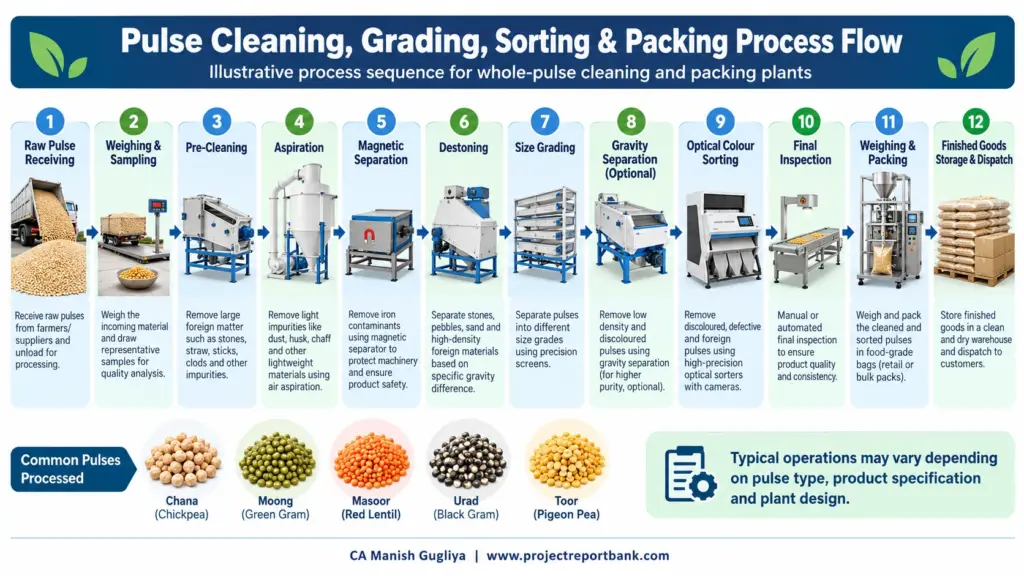
Raw Pulse Receiving → Weighing & Sampling → Raw Material Storage / Silos → Pre-Cleaning (Scalping) → Aspiration (Light Impurity Removal) → Magnetic Separation → Destoning → Size Grading → Gravity Separation (If Required) → Optical Colour Sorting → Final Quality Inspection → Automatic Weighing & Packing → Finished Goods Storage → Dispatch
- Not all plants will use every machine. The final configuration depends on raw material quality, targeted market, pulse variety, investment budget and the method of operation.
- Some compact plants combine multiple functions into multifunction machines (e.g., a classifier with built-in aspiration), while larger plants use separate, higher-capacity equipment for each stage.
- Pulses are sorted by size, color, and quality at different stages of this flow. Cleaning involves screening, aspiration, and destoning to remove contaminants.
- Process flow optimisation directly affects throughput, energy consumption and the achievable recovery percentage of saleable clean pulses.
Step-by-Step Pulse Cleaning, Grading, Sorting & Packing Process
Each step below covers objective, operating principle, typical machinery, input–output and quality checks. Examples like 5 TPH or 10 TPH are purely illustrative for understanding, not fixed industry benchmarks.
1. Raw Material Receiving and Inspection
Raw pulses arrive in trucks, tractors or bags from mandis, farmers, traders or import consignments. Each lot is weighed on a weighbridge or platform scale, and samples are drawn for checking moisture content, foreign matter percentage, insect infestation and size uniformity.
Moisture control is critical for preventing spoilage during storage and transport. High moisture lots may need sun drying or mechanical drying before further processing, and extremely poor-quality lots may be rejected or priced differently. Inspection results are recorded lot-wise to track recovery, process loss and supplier performance – information that feeds directly into financial analysis and procurement decisions.
2. Pre-Cleaning and Removal of Coarse Impurities
Pre-cleaning removes large foreign materials – pods, sticks, jute threads, big stones, clods and oversize impurities. Pulses are cleaned to remove dust and stones at this initial stage itself. A typical pre-cleaner or classifier uses sieves with calibrated perforations to separate oversize material, undersize fine powder and the main produce stream, usually through vibrating or rotary motion.
Common machinery includes rotary drum cleaners, vibro separators and scalper cleaners. Sieve perforations must match the pulse variety being processed. Quality-control checks include periodic sieve inspection for choking, hole damage and uniform feed distribution across the screen width.
3. Aspiration and Removal of Lightweight Material
Aspiration systems use controlled airflow to remove lighter impurities – husk, fine dust, dried leaves, light shrivelled grains and chaff. As grain falls through an aspiration column, an upward or cross-flow air current carries away low-density material to cyclones or dust collectors.
Aspiration can be a separate machine or built into the pre-cleaner. Fan speed and air volume must be adjusted carefully so that good pulses are not lost. Proper aspiration reduces dust accumulation in the plant, improving working conditions and reducing contamination risk across downstream equipment.
4. Magnetic Separation
Magnetic separation removes iron particles, rust, nails, broken machine parts and metallic filings that enter the material stream from handling and transport equipment. Typical equipment includes permanent magnetic plates, drum magnets or magnetic grills installed at strategic points – especially before sensitive machinery like colour sorters and weighers.
Magnets protect downstream machines and enhance food safety by preventing metal contamination in the final product. Routine magnet cleaning schedules and periodic magnet strength checks are important maintenance practices.
5. Destoning and Removal of Heavy Impurities
Destoners separate stones, glass pieces and heavy mud balls from pulses using the difference in specific gravity combined with vibration and airflow. A vibrating, slightly inclined deck with air passing through it causes lighter pulses to float and move upward, while heavier stones sink and move in the opposite direction.
Destoning is especially important for pulses sourced from stone-prone regions and is critical to avoid consumer complaints and safety hazards. Deck angle, vibration frequency, feed rate and air volume need to be tuned for each pulse type – overloading the destoner reduces its efficiency significantly.
6. Size Grading and Classification
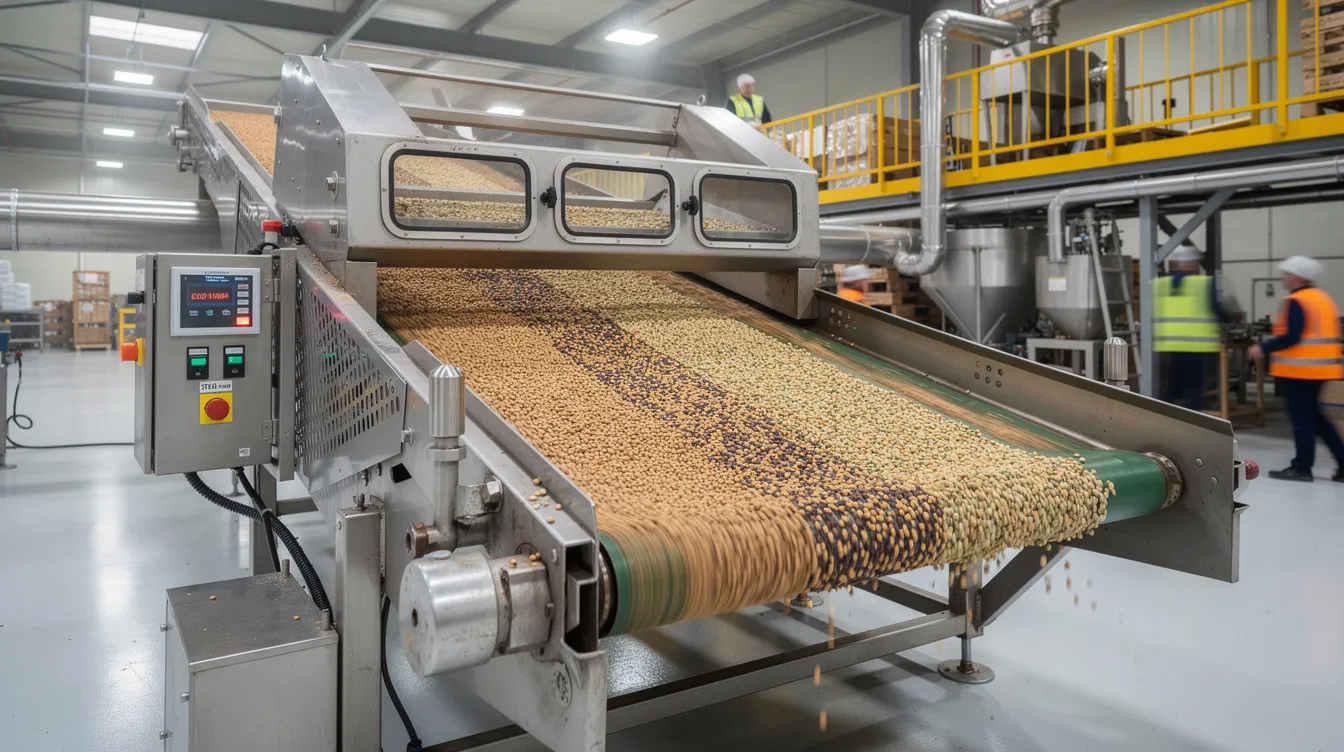
Size graders separate pulses into fractions like bold, medium and small. Pulses are graded into small, medium, and bold categories using rotary graders, multi-deck plansifters or vibro graders fitted with multiple sieves of different perforation sizes. Sorting and grading are based on size, color, and quality, with size grading being the primary dimensional separation step.
Standardized size fractions ensure consistent cooking times for pulses, which is valued by both retail consumers and institutional buyers. Grading ensures consistency across product batches and compliance with international trade and regulatory standards. Output fractions may be packed separately, blended in specific ratios or diverted to further processing depending on the business model – for instance, undersized grains may go to dal milling or flour production.
7. Gravity Separation (Where Applicable)
Gravity separators are optional machines that separate pulses based on small differences in density, removing immature grains, insect-damaged kernels and light shrivelled seeds from sound, heavy kernels. A vibrating, inclined, porous deck with airflow allows denser grains to stratify and move to one side, while lighter material migrates to the opposite side.
Gravity separation is typically used for higher-value lots, seed processing or export-grade pulses where quality premiums justify the extra investment. These machines require trained operators to set deck slope, feed rate, air volume and vibration for stable operation with minimal product loss.
8. Optical Colour Sorting
Modern processors use optical sorting for quality grading. Optical sorting technology uses cameras to detect and remove discolored or damaged grains, while high-speed pneumatic ejector valves eject defective seeds from the product stream. Color sorting is used to accept or reject pulses based on appearance – the machine scans and removes unsuitable grains including mouldy, spotted, black or foreign seeds.
Colour sorting is usually the final major processing step before packaging, especially for premium retail and export markets. Sorter performance depends on camera technology (RGB, NIR), number of chutes, software algorithms and compressed air quality. For detailed technical and commercial insights, see Optical Colour Sorter for Pulses: Technology, Capacity, Price & Selection.
Sorters require periodic calibration, cleaning of viewing windows and regular monitoring of reject percentage to avoid excessive product loss.
9. Final Inspection and Quality Control
Quality control is crucial for maintaining product specifications. Final quality control checks for foreign matter and compliance with safety standards are conducted through random sample testing. Quality checks cover moisture, foreign matter, and appearance against buyer specifications.
Many plants maintain a small in-house lab with moisture meters, weighing balances, sample dividers and inspection trays. Quality control ensures consistency in pulse processing when documented batch-wise, supporting traceability, complaint resolution and process improvement. Statistically significant sampling – lot-wise and shift-wise – is preferred over ad-hoc checks, especially in export-grade operations.
10. Automatic Weighing and Packaging
Clean, sorted pulses are conveyed to packing silos or hoppers and fed to automatic weighing and sealing systems. Pulses are packaged to protect against moisture and contamination, in consumer packs (500 g, 1 kg, 5 kg) and bulk bags (25 kg, 50 kg).
Common packaging machinery includes multi-head weighers with form-fill-seal machines, linear weighers and electronic bagging scales. Packaging material choices – laminated pouches, HDPE woven sacks, food-grade liners – affect shelf-life, branding opportunities and unit cost. Packaging lines should include metal detection or final quality checks where required by large retailers or export contracts.
11. Finished Goods Storage and Dispatch
Packed pulses are palletised or stacked with proper segregation by lot number, grade and production date, maintaining clean, dry and pest-controlled storage conditions. First-expiry-first-out (FEFO) or first-in-first-out (FIFO) inventory practices help minimise quality deterioration.
Dispatch operations – order picking, weighment, documentation and vehicle loading – must protect bags from moisture and physical damage. Faster rotation of finished goods inventory improves cash flows and reduces financing costs, directly affecting working capital efficiency.
Machinery Used in Pulse Cleaning, Grading, Sorting & Packing
The following table summarises key machinery typically found in Indian pulse cleaning plants:
| Machinery | Main Function | Selection Considerations |
|---|---|---|
| Pre-Cleaner / Scalper | Remove oversize and undersize impurities | Sieve size matched to pulse variety; capacity in TPH |
| Vibro Separator | Fine screening and classification | Screen layers; vibration frequency; throughput |
| Aspiration System | Remove lightweight dust, husk, chaff | Adjustable airflow; integration with pre-cleaner |
| Magnetic Separator | Remove ferrous metal contaminants | Magnet strength; placement before sensitive machines |
| Destoner | Separate stones and heavy impurities | Vacuum vs pressure type; deck size; air volume |
| Rotary Grader / Plansifter | Size grading into bold, medium, small | Sieve perforations; number of decks; multi-pulse use |
| Gravity Separator | Density-based separation of light/damaged kernels | Deck area; operator skill; export-grade applications |
| Optical Colour Sorter | Detect and eject discoloured or defective grains | Chute count; camera resolution; compressed air quality |
| Bucket Elevators | Vertical material conveying between stages | Capacity; gentle handling to minimise breakage |
| Belt / Chain Conveyors | Horizontal material transport | Length; speed; food-grade construction |
| Dust Collector / Cyclone | Capture airborne dust and fine powder | Filtration efficiency; maintenance access |
| Automatic Packing System | Weigh and seal consumer and bulk packs | Pack size range; speed; seal integrity |
Detailed capacity–cost data and technical specifications for each machine category are discussed in Pulse Cleaning, Grading & Sorting Machinery: Equipment List, Specifications & Cost.
Machinery selection must consider both current throughput and future expansion plans, while keeping project cost and DSCR viability in focus.
Pulse Cleaning and Grading Plant Capacity Planning
Rated capacity – say 5 TPH nameplate – differs from practical capacity after accounting for downtime, changeovers, maintenance and cleaning between pulse varieties.
Illustrative calculation: A 5 TPH line running 16 hours/day for 300 working days/year at 80% utilisation produces approximately 19,200 MT/year (5 × 16 × 300 × 0.80). This forms the basis for revenue projections in a DPR.
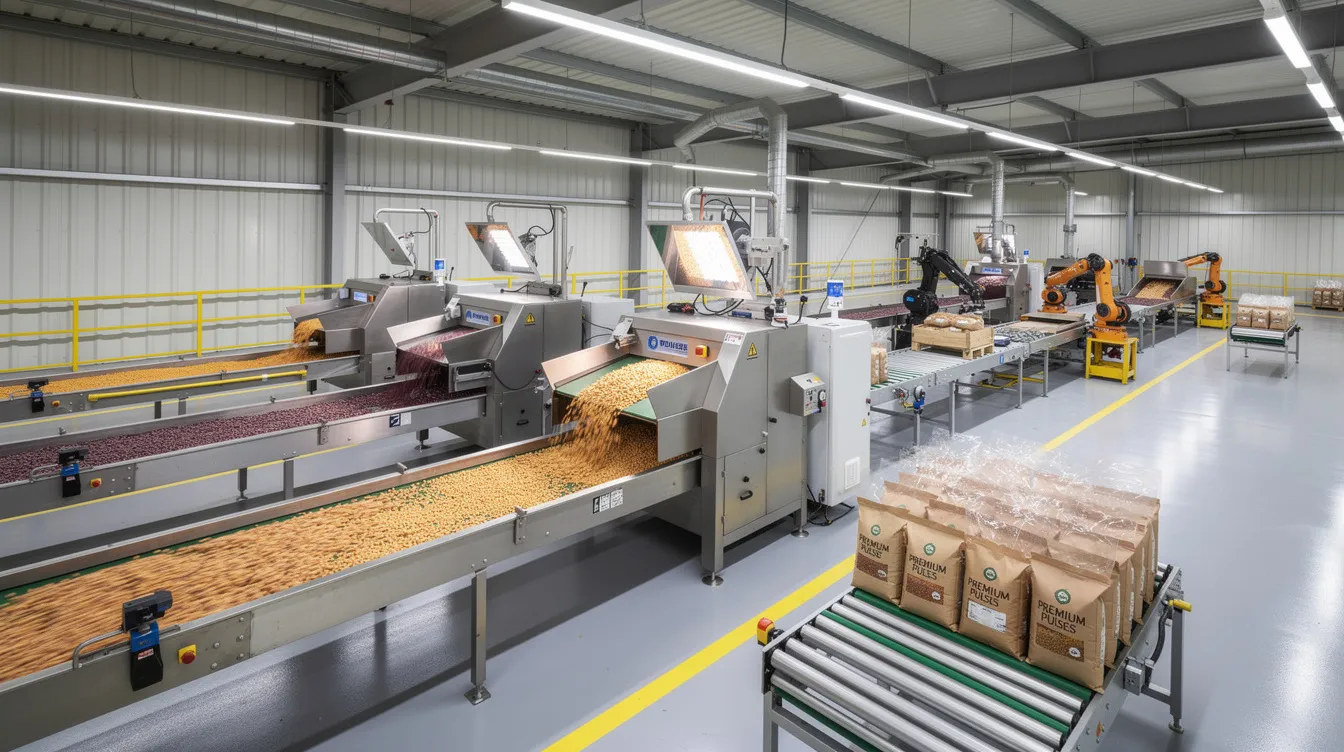
Equipment capacity balancing is critical. Pre-cleaners, destoners and graders often have higher throughput than colour sorters, which frequently become bottlenecks if undersized. Large pulse processing plants can exceed 1,500 metric tonnes daily, but even mid-scale operations must ensure no single machine constrains overall output.
Multi-pulse operation (chana in one shift, moong in another) requires realistic allowances for sieve changes and cleaning time. Planning for modular expansion – leaving space for additional colour sorter chutes or parallel grading lines – avoids costly retrofitting later. Entrepreneurs should align capacity with market demand, working capital strength and bank loan terms rather than relying solely on machinery brochures.
Material Balance, Recovery and Processing Losses
Understanding material balance and recovery is fundamental for profitability analysis, pricing decisions and bank-finance appraisal. The table below provides a purely illustrative mass balance for 1,000 kg of raw pulses:
| Stream | Illustrative % | Kg |
|---|---|---|
| Coarse foreign matter (pre-cleaning) | 3% | 30 |
| Light impurities (aspiration) | 2% | 20 |
| Stones and heavy impurities (destoning) | 1% | 10 |
| Undersize / broken grains (grading rejects) | 4% | 40 |
| Light / damaged kernels (gravity separation) | 2% | 20 |
| Discoloured / defective grains (colour sorting) | 1% | 10 |
| Saleable clean pulses | 87% | 870 |
All figures are hypothetical and will vary significantly with raw material quality, process configuration and operator skill. These should not be treated as guaranteed recovery rates. Minor weight variations also arise from moisture loss during drying or aeration.
Financiers and bankers examine realistic recovery assumptions and by-product disposal income while evaluating DPRs. Conservative estimates supported by actual trial data strengthen the credibility of financial projections.
Automatic vs Semi-Automatic Pulse Processing Lines
Automatic pulse cleaning and sorting plant lines feature mechanised feeding, conveying, weighing and packing – reducing labour dependence and improving batch-to-batch consistency. Semi-automatic lines rely more on manual handling for bag feeding, stitching and basic weighing.
| Parameter | Automatic Line | Semi-Automatic Line |
|---|---|---|
| Upfront Investment | Higher | Lower |
| Labour Requirement | Lower per tonne | Higher per tonne |
| Production Consistency | Better | Variable |
| Data Logging & Traceability | Usually built-in | Limited |
| Maintenance Complexity | Requires skilled technicians | Easier local repair |
| Suitability | Branded, retail, export | Local commodity, small scale |
The right choice depends on targeted scale, market segment, regional energy and labour costs, and the promoter’s financing capacity. Higher automation reduces certain operational risks but increases fixed costs and technical maintenance requirements.
Export-Grade Pulse Cleaning and Colour Sorting Process
Export buyers in the Middle East, Europe and other markets specify strict limits on foreign matter (typically 0.5–1%), defective grains (1–3%), moisture (≤12%) and zero live infestation. Typical export specifications, as quoted by Indian pulse exporters, require demonstrably tight tolerances across all quality parameters.
Export-grade processing requires tighter control at each stage: more precise destoning, gravity separation for immature or insect-damaged grains, and high-resolution colour sorting with multiple passes where necessary. HACCP and ISO 22000 are key quality certifications in processing that export-oriented plants frequently pursue, alongside FSSAI licensing and importing-country compliance.
Export packing involves bulk bags with inner liners, palletisation, fumigation, container stuffing protocols and batch identification for traceability. Documentation, shipment scheduling and quality dispute handling influence inventory levels and working capital needs. Detailed evaluation is covered in the Export-Grade Pulse Cleaning, Colour Sorting & Packing Plant Project Report.
Plant Layout, Material Handling and Utilities
Efficient plant layout reduces material handling, avoids cross-contamination and supports future expansion. A logical sequence places the raw material unloading area, pre-cleaning section, main cleaning and grading floor, colour sorting room, packing section and finished goods warehouse in a one-way flow with physical segregation.
Material handling options include bucket elevators, chain conveyors and screw conveyors, with gentle handling to minimise grain breakage. Dust extraction systems – cyclones and bag filters – control suspended dust, improving machine life and worker health.
Key utilities include electrical load estimation in kW for motors and colour sorters, DG backup where power supply is unstable, and compressed air requirements (pressure and dryness) for optical sorters. Hygienic design – smooth floors, washable surfaces, pest-control measures – is essential for food-grade plants supplying modern retail and export markets.
Key Factors Affecting Processing Efficiency and Operating Cost
Major cost heads include raw material procurement, power and fuel, labour, packaging materials, repairs, interest, depreciation and selling overheads. Raw material quality directly affects throughput and recovery – higher impurity levels mean more energy use, slower processing and lower saleable output per tonne.
Properly sized motors, modern energy-efficient machines and regular preventive maintenance reduce power consumption per tonne. High reject rates at colour sorters or graders indicate either poor upstream cleaning or incorrect settings. Labour productivity depends on clear SOPs, training and performance monitoring. In retail-focused plants, packaging material cost is a significant margin driver – optimising pouch structure and pack sizes improves contribution without compromising quality.
Business Models for Pulse Cleaning, Sorting and Packing Plants
Different business models affect plant design, capacity choice, brand investment and working capital requirements:
- Own-account processing and branded packing: Source raw material, process and sell under own brand through distributors, supermarkets and online channels. Higher margins but greater marketing and inventory investment.
- Job-work processing: Clean and sort pulses owned by traders or brand owners for a fixed processing charge per tonne. Lower working capital burden but limited upside. For a detailed analysis, see Pulse Cleaning, Grading & Packing Job-Work Business Model & Project Report.
- Trading with cleaning and grading: Buy raw pulses, upgrade through processing, sell as clean graded commodity – focusing on quick rotation and thin margins.
- Export-oriented processing: Higher quality requirements, foreign-currency receivables and logistics management, often with long-term buyer relationships.
- Integrated dal mill with pulse processing: Combining cleaning, destoning and colour sorting with dehusking and splitting lines creates multiple product streams (whole pulses, split dal, broken grains, flour) but requires higher investment and more complex project planning.
Financial Planning and Bank Finance Considerations
From a banker’s perspective, the technical process must translate into realistic financial projections. Main project cost components include land and site development, civil construction, plant and machinery (including all pulse processing equipment), electrical and utilities, pre-operative expenses and margin money for working capital.
Revenue projections are built from expected annual processed quantity (MT), average processing margin or job-work rate, by-product income and price assumptions for different grades. Core financial metrics – gross profit, net profit, break-even point, DSCR, IRR and payback period – each serve a specific purpose in evaluating loan repayment capacity and investment viability.
Sensitivity analysis assesses how changes in raw material prices, recovery percentages, oil and fuel costs, interest rates or capacity utilisation influence project viability. A professional DPR integrates detailed process-flow knowledge with robust financial modelling, ensuring assumptions are consistent with actual pulse processing operations and bank norms.
Common Mistakes in Pulse Cleaning and Sorting Plant Planning
Avoidable errors frequently observed in pulse processing projects across India include:
- Mismatched machine capacities: Installing a high-capacity pre-cleaner with an undersized colour sorter or packing line creates bottlenecks and underutilisation of major assets.
- Inadequate dust extraction: Poor aspiration planning leads to equipment fouling, fire risk, worker health issues and potential non-compliance with safety expectations.
- Wrong sieve sizes: Graders not aligned to the specific pulse varieties planned result in poor grading, customer complaints and frequent rework.
- Underestimated working capital: Branded and export models involve substantial inventory of raw pulses, finished goods and receivables relative to plant cost.
- Unrealistic capacity utilisation: Assuming 90–95% utilisation from year one without considering market development, seasonality and operational learning curve weakens the credibility of financial projections.
- Neglecting operator training: Gravity separators, colour sorters and destoners all require skilled operators – untrained staff increase reject rates and reduce the best value from expensive equipment.
Frequently Asked Questions
What is the difference between a pulse cleaning plant and a dal mill?
A pulse cleaning, grading, sorting and packing plant handles whole pulses – removing impurities, grading and packing. A dal mill additionally performs dehusking, splitting and sometimes polishing using dehulling machines and related milling technology. Machinery, investment level, energy consumption, nutrients retention and profitability structure differ, so DPRs must treat them as distinct project types.
Can one plant process multiple types of pulses on the same line?
Most modern plants are designed to handle multiple pulses – chana, moong, urad, masoor, peas and soybean – on the same line, but require changeover time for cleaning equipment, adjusting sieve sizes and tuning machine settings. Multi-pulse flexibility should be built into layout, machinery choices and capacity calculations during the development and project planning stage.
Do small plants also need an optical colour sorter?
While very small, purely local commodity-focused units may initially operate without a colour sorter, any company targeting premium, retail-branded or export markets needs optical sorting to meet acceptable standards of appearance. Entrepreneurs can start with job-work colour sorting at a third-party facility but should evaluate in-house sorters once throughput and brand scale justify the capital cost.
How long does it typically take to stabilise a new pulse processing plant?
Initial stabilisation typically takes a few months, during which operators fine-tune machine settings, establish SOPs, understand raw material behaviour and build reliable customer relationships. Capacity utilisation ramps up gradually, and prudent financial projections allow for lower utilisation in year one with phased growth thereafter.
What professional support is needed for setting up a pulse cleaning and packing unit?
Beyond machinery suppliers and civil contractors, entrepreneurs benefit from professional project-finance and DPR support covering process selection, capacity planning, project costing, financial projections and bank-loan documentation. Project Report Bank, led by CA Manish Gugliya, provides customised DPRs, CMA Data, financial modelling and feasibility analysis for pulse cleaning, grading, sorting and packing projects. Serious promoters can initiate a WhatsApp-based enquiry for personalised guidance.
Conclusion
A well-designed pulse cleaning, grading, sorting and packing process – from raw material receiving to final dispatch – helps achieve consistent quality, better recovery, lower unit processing cost and stronger market positioning. Each stage plays a crucial role and a vital role in determining whether the operation achieves its projected output and financial returns.
Process-flow decisions such as inclusion of gravity separators or advanced colour sorters, level of automation and layout design have direct implications for project cost, working capital, profitability and DSCR. These must be evaluated carefully during planning, not discovered after machinery orders are placed.
Entrepreneurs, MSMEs and investors considering a pulse processing plant should obtain a professional, bankable Detailed Project Report with complete financial projections, CMA Data and loan-proposal support before finalising machinery orders or approaching banks. Serious promoters are welcome to contact Project Report Bank – preferably via WhatsApp – for customised advisory on plant configuration, project economics, bank finance and investor-ready documentation.
CA Manish Gugliya, FCA, DISA (ICAI) Practising Chartered Accountant Industrial Project Reports | DPR | CMA Data | Financial Modelling | Project Finance Advisory Website: https://projectreportbank.com/