
Key Takeaways
- Rice milling is the industrial process that converts harvested paddy into marketable milled rice through sequential operations-cleaning, dehusking, whitening, polishing, grading, colour sorting and packaging-and the rice milling process flow chart directly determines head rice recovery, broken rice percentage and by-product generation.
- Modern rice mills use 6–8 machines in a continuous flow, achieving a milling recovery of 65–68%, whereas traditional milling results in a higher percentage of broken rice and lower overall yield.
- Process configuration must match target capacity, product mix (raw vs parboiled rice), automation level and market segment; every technical choice cascades into project cost, working capital, utility consumption and profitability.
- As a project finance and DPR consultant, I link technical parameters like plant capacity, rice recovery percentage and degree of automation directly with DSCR, working capital needs and overall project viability in every rice mill project report I prepare.
- This article provides a complete step-by-step view of the paddy to rice manufacturing process, including a simplified flow-diagram, machinery lists, indicative material balance and key financial implications for entrepreneurs and investors.
Introduction: Rice Milling as an Industrial & Financial Process
The rice milling process transforms rough paddy into polished rice by systematically removing the outer husk and bran layers while preserving maximum whole kernels. Rice milling removes husk and bran layers from paddy, and the goal is straightforward: maximise the amount of whole kernels while ensuring food safety. This is not just a mechanical exercise-rice milling extends shelf life by removing bran layers, increases market value by enhancing appearance, and produces edible white rice that cooks more evenly than unpolished rice.
Paddy, or unhusked rice (also called rough rice), consists of approximately 20% husk, 11% bran, and 69% starchy endosperm. Good milling aims to convert this raw paddy into high quality rice with minimum grain breakage, controlled moisture content and consistent quality across batches. Modern milling improves rice quality and reduces broken grains compared to older methods.
A modern rice milling process operates as a connected production line-from paddy reception and paddy cleaning through destoning, dehusking, paddy separation, whitening, rice polishing, grading, colour sorting and packaging. Modern rice mills process paddy in 15–20 minutes through this entire sequence. Traditional rice milling, by contrast, historically relied on manual tools like pestles and mortars or single-pass hullers with high breakage and inconsistent grain quality.
Process design, choice of modern machinery and rice mill plant layout directly influence project cost, working capital, energy consumption, labour requirements and recovery percentage. Entrepreneurs planning an integrated facility-combining parboiling, drying, storage and milling-should separately evaluate the total integrated rice mill plant setup cost in India before finalising their investment.
The sections ahead describe both the rice mill process flow chart and the complete rice mill production process step by step, covering what every DPR and bank appraisal must address.
Rice Milling Process Flow Chart & Overall Workflow
This section presents a textual rice milling process flow chart for a modern raw rice milling plant. The exact configuration varies by capacity and product, but the core sequence is standard across commercial rice mills.
Paddy Reception → Weighing → Sampling & Moisture Testing → Pre-Cleaning → Fine Cleaning → Destoning → Magnetic Separation → Dehusking (Husking) → Paddy Separation → Rice Whitening → Rice Polishing → Grading → Length Grading → Colour Sorting → Metal Detection → Weighing & Bagging → Finished Rice Storage
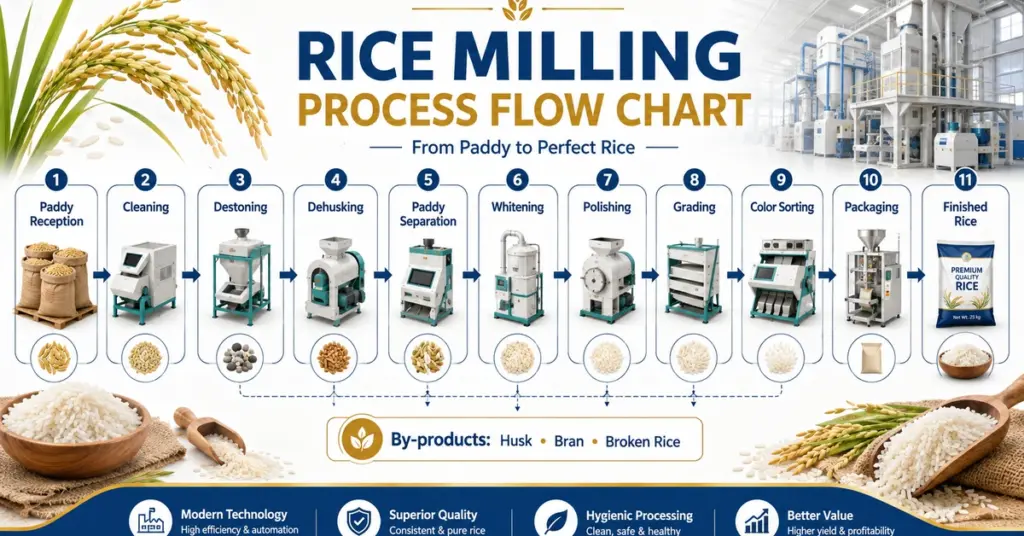
Key stages at a glance:
- Pre-cleaning removes large impurities such as straw, dust, stones and other impurities from the raw paddy
- Destoning separates stones and heavy particles based on density
- Dehusking removes husk to produce brown rice
- Paddy separation isolates unhusked grains from clean brown rice before whitening
- Whitening removes the bran layer to produce white rice
- Polishing smooths the grain surface for improved appearance
- Grading sorts rice by length to separate whole kernels from broken pieces
- Colour sorting ejects discoloured, chalky or damaged rice grains
- The rice processing plant process can include parallel lines for different varieties (basmati, non-basmati) and optional bypasses-some buyers may skip polishing for certain markets
- Main factors that modify the rice mill process diagram include plant capacity (TPH), raw rice versus parboiled rice milling, export quality requirements and degree of automation
A DPR or rice mill project report should always attach a customised paddy processing flow chart reflecting the actual configuration, number of passes and quality checkpoints.
Paddy Reception, Quality Testing & Storage
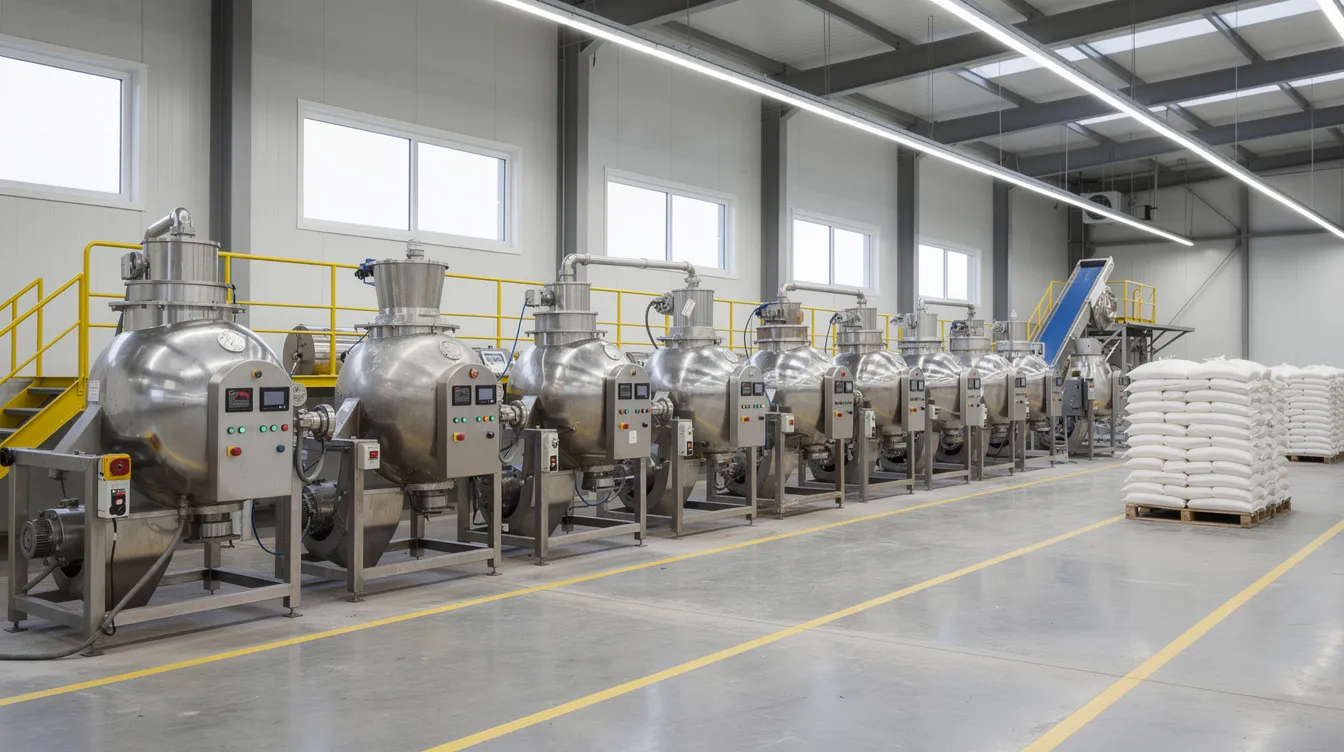
The rice production process in a rice mill begins at the factory gate. Trucks carrying paddy grains are weighed on a weighbridge, documented with batch details (season, variety, supplier, lot number) and sampled before unloading.
- Representative samples are drawn and tested for paddy moisture (acceptable range typically 12–14% for milling; exact values depend on variety and process), presence of immature grains, impurities and damaged kernels
- Moisture control is critical during drying to prevent kernel breakage; paddy moisture above 16% causes high broken rice rates during subsequent milling
- Storage options include traditional godowns (lower cost, limited aeration) and modern silos (better insect control, inventory management but higher investment)
- Prolonged storage at high moisture leads to fungal growth, discolouration, lower rice milling yield and increased broken rice-directly impacting revenue in financial projections
- Entrepreneurs should design covered storage for at least 30–60 days of paddy supply, reflecting land, building and working capital requirements clearly in the DPR
Pre-Cleaning, Cleaning, Destoning & Magnetic Separation
Effective front-end paddy cleaning protects rice milling equipment and is essential in any modern rice mill manufacturing process. Pre-cleaning removes impurities such as straw, dust, and stones from the paddy before it enters more sensitive machinery.
- Pre-cleaners, vibratory cleaners, scalpers and aspirators remove straw, chaff, oversized and undersized materials and light impurities
- Secondary cleaners and aspirators further remove small foreign matter and immature grains
- De-stoning separates heavier impurities like stones from the paddy based on density and air flow, protecting rubber roll huskers downstream
- Magnetic separators capture nails, wires and ferrous contaminants, improving food safety and reducing maintenance cost
- Poor paddy cleaning leads to higher machine wear, unscheduled downtime and extra operational expenses-factors that must be included in maintenance heads within project cost estimates
Dehusking (Husking), Paddy Separation & Brown Rice Handling
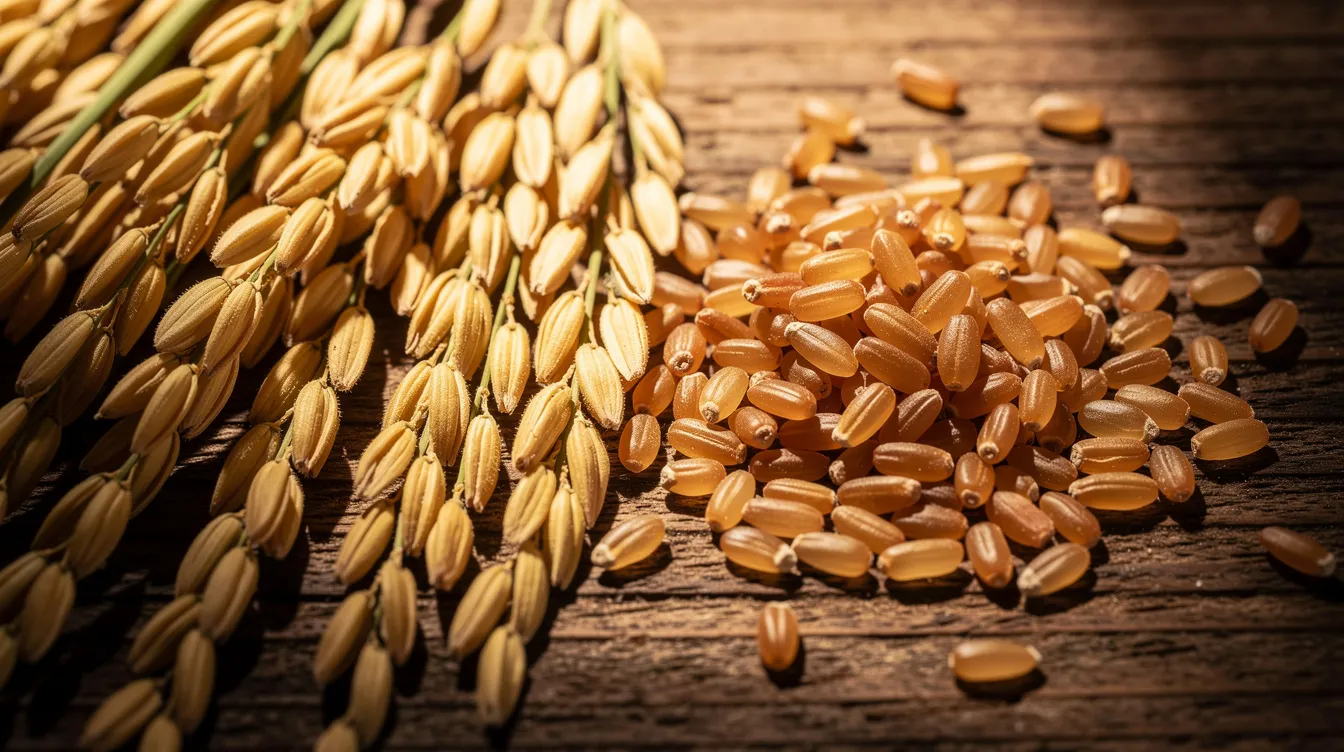
Dehusking is where the outer husk is removed from paddy to reveal brown rice. Correct control at this stage is vital for minimising broken rice and achieving good head rice recovery.
- Rubber roller huskers reduce grain breakage during milling by using calibrated roll speed difference and pressure; a husk aspirator separates husk from the grain mixture
- Outputs after husking include brown rice, unhusked paddy and husk; the rice husk is transported separately for use as boiler fuel or commercial sale
- A paddy separator divides the mixture into brown rice and residual unhusked grains; unhulled paddy passes back to the husker for re-processing, improving overall rice milling efficiency
- Brown rice retains the bran layer and germ; some plants divert a portion as a health-oriented product (producing brown rice for niche markets), which affects product mix and revenue assumptions
- Worn rubber rolls lead to increased broken rice during milling; timely replacement and monitoring of paddy moisture are key drivers of dehusking efficiency
- Grain damage occurs if machines are misaligned during milling, so operator skill matters significantly
Rice Whitening, Polishing, Grading, Length Grading & Colour Sorting
This section covers the transformation of brown rice into finished milled rice-the whitening process, rice polishing, grading, length grading and colour sorting in a modern rice milling production line.
- Rice whitening machines use friction to remove bran layers in 1–3 passes depending on variety and required whiteness; excessive pressure increases broken rice and reduces rice milling yield. Multi-stage milling reduces mechanical stress and improves whole-kernel recovery. This stage generates rice bran as a valuable by-product
- Polishing gently removes fine bran particles and enhances the visual appearance of rice through silky or mist polishing systems; the polishing machine smooths the grain surface, distinguishing it from whitening which primarily strips the bran layer
- Milled rice cooks more evenly than unpolished rice, which is one reason consumers and markets pay a premium for well-processed polished rice
- Rotary graders or plansifters separate whole grains, large brokens and small broken kernels; this broken rice separation process is crucial because different fractions command different selling prices
- A length grader or indented cylinder distinguishes head rice from shorter broken grains, particularly for basmati and long-grain export markets; higher head rice recovery translates directly to better revenue per tonne
- Colour sorting uses cameras and ejector valves to remove discoloured, chalky or damaged kernels and foreign particles; this step is often mandatory for export-quality and premium branded rice
- These quality-enhancing stages increase capital cost and energy use but enable higher realisation per tonne and stronger brand positioning; promoters should balance quality targets with market realities when finalising process configuration
Metal Detection, Rice Packaging Process & Finished Goods Storage
This is the final stage of the rice manufacturing process.
- Metal detectors (ferrous and non-ferrous) installed after colour sorting prevent contaminated product from reaching consumers and avoid export rejections
- Final quality checks include moisture content of the finished product, percentage of broken rice, foreign matter, whiteness and grain length
- The rice packaging process uses automatic weighers, form-fill-seal or bagging machines for 1 kg, 5 kg, 10 kg consumer packs and 25 kg or 50 kg bulk packs, with batch coding and brand labels
- Packaging prevents moisture re-absorption and pest infestation, protecting processed rice quality during distribution
- Finished rice is stored separately by grade and brand, using palletisation and FIFO practices; storage space must be factored into rice mill plant layout planning
Complete Rice Milling Process Step by Step (For Quick Reference)
The rice milling process step by step, summarised for quick reference:
- Paddy reception & weighing – incoming raw paddy is weighed and documented
- Sampling & moisture checking – representative samples tested for moisture, impurities and quality
- Pre-cleaning – paddy cleaning removes dust, stones, and foreign particles using vibratory cleaners and aspirators
- Fine cleaning & aspiration – secondary removal of small impurities and light materials
- Destoning & magnetic separation – stones removed by density; ferrous metals captured by magnets
- Dehusking – rubber rolls remove husk, producing a mix of brown rice and unhusked paddy
- Paddy separation – paddy separator routes unhusked grains back to the husker
- Rice whitening – whitening machines remove bran layers to produce white rice
- Polishing – polishing machine imparts surface smoothness and glossy appearance
- Grading & length separation – whole rice separated from broken grains by size and grain length
- Colour sorting – optical sorting machines eject defective or discoloured grains
- Metal detection – final food-safety check before packaging
- Weighing & packaging – automatic weighing, bagging, sealing and labelling
- Finished product storage – stored by grade under controlled conditions
For parboiled rice, the paddy to rice manufacturing process follows similar steps but is preceded by soaking, steaming and drying of paddy before entering the milling line.
Rice Mill Machinery at Each Stage of the Milling Process
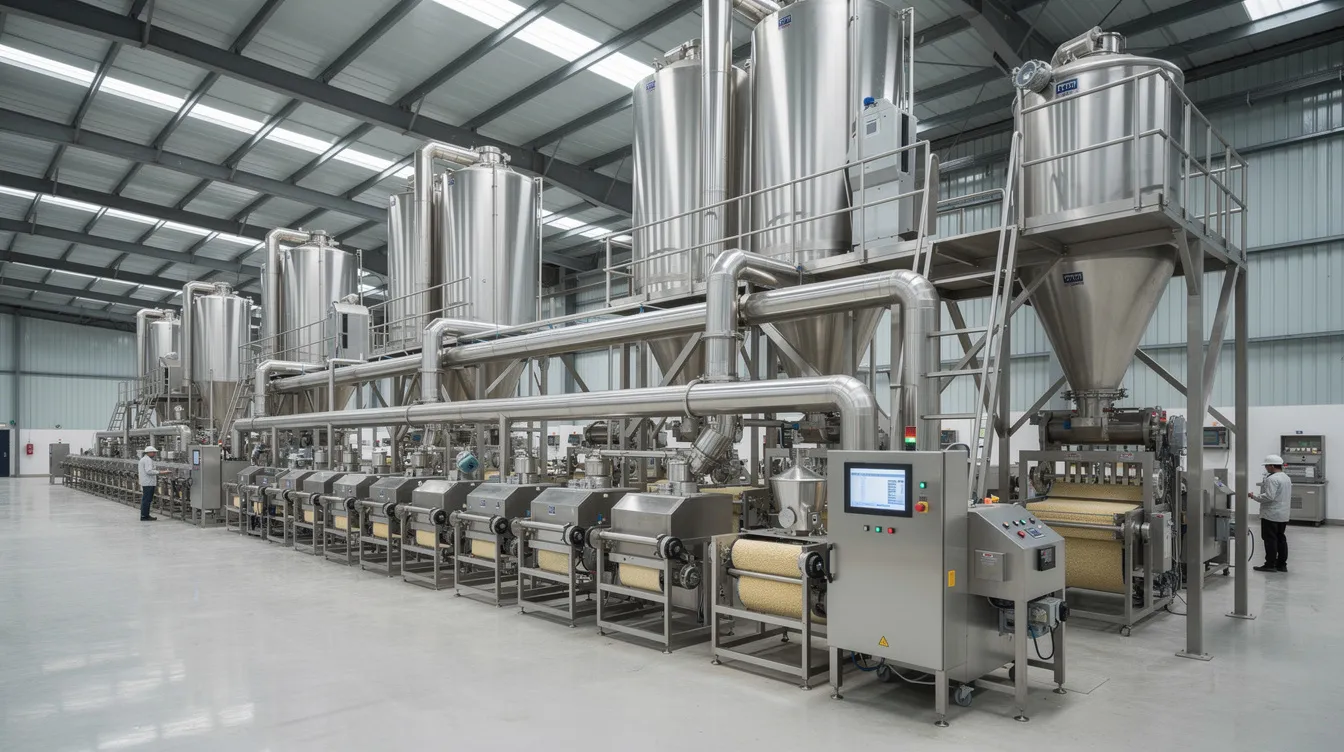
Modern rice mill process and machinery selection must be decided together. The rice mill production process dictates what rice processing machinery and rice milling equipment are required. Modern rice mills use 6–8 machines in sequence within a continuous flow.
| Processing Stage | Main Machinery | Main Function |
|---|---|---|
| Pre-cleaning | Pre-cleaner, scalper | Remove large impurities, straw |
| Cleaning | Paddy cleaner, aspirator | Remove fine foreign matter |
| Destoning | Destoner | Separate stones by density |
| Magnetic separation | Magnetic separator | Capture ferrous contaminants |
| Dehusking | Rubber roll husker, husk aspirator | Remove husk from paddy |
| Paddy separation | Paddy separator | Separate brown rice from unhusked rice |
| Whitening | Rice whitener (abrasive/friction) | Remove bran layer |
| Polishing | Rice polisher | Smooth grain surface |
| Grading | Rice grader, plansifter | Separate whole and broken kernels |
| Length grading | Length grader, indented cylinder | Separate by grain length |
| Colour sorting | Colour sorter (CCD/NIR) | Reject discoloured grains |
| Metal detection | Metal detector | Detect metal fragments |
| Packaging | Packing machine, weigher, sealer | Weigh, bag and seal finished rice |
| Material handling | Conveyors, bucket elevators | Move grain between stages |
| Dust control | Dust collection system | Capture airborne dust |
Configuration varies between automatic rice mill process, semi-automatic and integrated rice milling process setups. High-end colour sorters, PLC automation and sophisticated packing lines increase fixed investment but reduce labour and improve export competitiveness.
For detailed pricing across capacities and automation levels, refer to rice mill machinery and equipment cost. Actual machinery prices depend on capacity, brand, technology and packaging system chosen.
Rice Recovery Percentage, Material Balance & Head Rice Recovery
Understanding rice recovery percentage in milling and material balance is vital for realistic revenue projections and rice mill capacity calculation in a DPR. Proper milling can yield 65–72% of white rice from paddy, and a well-tuned rice mill achieves a recovery of 65–68%.
Illustrative Material Balance per 1,000 kg Paddy (Example Only)
| Output | Indicative Range |
|---|---|
| Milled rice (white rice) | 650–720 kg |
| Broken rice | 50–120 kg |
| Rice bran | 80–100 kg |
| Rice husk | ~200 kg |
| Process loss | 20–30 kg |
Actual figures depend on paddy variety, paddy moisture, plant technology, degree of polishing and operator skill.
- Head rice refers to whole or nearly whole kernels (≥ ¾ original length); commercial head rice recovery in modern mills typically ranges 50–60% of paddy weight
- Low milling recovery is below 63% and typically results from poor paddy quality, improper drying or outdated equipment
- Even a 1–2% improvement in head rice recovery on a 10 TPH plant can add more rice to annual saleable output, materially increasing turnover-but all assumptions must be clearly stated
- Over-optimistic rice milling yield assumptions in a DPR can inflate projected gross margins, EBITDA and DSCR, making a project report unrealistic and undermining bank appraisal credibility
Rice Mill By-Products: Husk, Bran and Broken Rice
By-products from rice mills are commercially important and must be modelled in every DPR. The main by products are rice husk, rice bran and broken rice.
| By-Product | Indicative % of Paddy | Common Uses |
|---|---|---|
| Rice husk | ~20% | Boiler fuel, biomass power, rice husk ash |
| Rice bran | 8–10% | Rice bran oil extraction, animal feed |
| Broken rice | 5–12% | Rice flour, food processing, brewing, animal feed |
- Husk is widely used as boiler fuel in parboiled units and for captive power; its utilisation directly affects fuel cost assumptions
- Rice bran quality (oil content, freshness) determines its sale price; the rice bran separation process occurs during whitening and polishing
- Broken rice serves food-processing applications (poha, idli/dosa mixes, rice flour) and supports project profitability even when head rice recovery is modest
- DPRs must include realistic by-product revenue and logistics assumptions rather than treating them as incidental income
Raw Rice Milling vs Parboiled Rice Milling Process
While the core paddy milling process is similar, parboiling involves soaking, steaming, and drying paddy before milling, improving yield and reducing breakage.
| Parameter | Raw Rice Milling Process | Parboiled Rice Milling Process |
|---|---|---|
| Pre-milling steps | Direct cleaning and milling | Cleaning → soaking → steaming → drying → milling |
| Head rice recovery | Typically 50–60% | Often 65–70% due to harder kernel |
| Broken rice | Higher (10–12%) | Lower (5–10%) |
| Energy consumption | Baseline | ~40% higher (study reference) |
| Additional equipment | None | Soaking tanks, boilers, dryers |
| Project cost | Lower CAPEX | Significantly higher CAPEX and OPEX |
Parboiling changes grain properties-harder kernel, different colour, better nutritional retention-but demands additional infrastructure including steam boilers, paddy dryers, effluent handling and extra storage. Approximately 50–60% of paddy in some Indian states undergoes parboiling. These differences must be modelled correctly in an integrated rice mill DPR.
Traditional Rice Mills vs Modern Automatic Rice Mills
Many entrepreneurs in India upgrade from traditional hullers to modern rice milling plants. Here is a balanced comparison:
| Parameter | Traditional Rice Mill | Modern Automatic Rice Mill |
|---|---|---|
| Automation | Minimal, manual handling | PLC controls, conveyors, sensors |
| Head rice recovery | Often below 30% | 50–60%+ |
| Broken rice | High (>20%) | Low (5–12%) |
| Grain quality | Inconsistent | Uniform quality across batches |
| Labour | High manual labour | Less labour per tonne |
| Sorting/grading | Limited or none | Multi-stage grading, colour sorting |
| Dust control | Poor | Integrated dust collection |
| Scalability | Limited | Designed for expansion |
| Capital investment | Low | Significantly higher |
| Export suitability | Generally unsuitable | Can meet export norms |
Traditional milling results in a higher percentage of broken rice-often exceeding 15%-and inconsistent quality. Modern rice mills using modern machinery deliver consistent quality, lower milling losses and better recovery. Promoters should assess local market, paddy availability and funding capacity before deciding on full automation versus phased modernisation.
Automation, Utilities & Plant Layout in Modern Rice Milling
Beyond machinery, automation level, utility planning and plant layout drive operating cost and future expansion potential.
- Automated systems in rice mills improve consistency and reduce errors through bucket elevators, screw conveyors, central control panels, PLC/SCADA systems and online moisture sensors
- Major utility requirements: electricity, water (especially for parboiled units), compressed air, steam/boilers, dust aspiration and backup power-each affects operating expenses and DPR utility cost estimates
- Good plant layout uses linear or vertical material flow, minimises cross-movement, maintains separate zones for raw paddy, in-process material and finished rice, and allows for future addition of a parboiling line
- Efficient layout reduces spillage, power consumption and improves safety and compliance with lender expectations
Rice Mill Capacity, Production Planning & Milling Efficiency Factors
Rice mill capacity is expressed in tonnes per hour (TPH), tonnes per day (TPD) and tonnes per annum (TPA). The basic formula:
Annual Production = Rated Capacity × Operating Hours/Day × Operating Days/Year × Capacity Utilisation %
Typical DPRs assume lower utilisation in the first year, ramping up in subsequent years. Key factors affecting rice milling efficiency include:
- Paddy moisture and variety; paddy moisture above 16% causes high broken rice
- Drying practices and storage conditions before milling
- Machine settings, condition of rubber rolls and whitening machines
- Number of milling passes and preventive maintenance schedule
- Operator training and daily monitoring of input-output ratios
- High broken rice exceeds 15% due to factors like worn rolls, improper moisture and poor machine calibration
Entrepreneurs should maintain performance records (input paddy, output rice, broken percentage, energy per tonne) to monitor actual results against DPR assumptions.
Quality Control & Process Losses in a Commercial Rice Mill
Systematic quality control ensures grain quality and minimises rice milling losses.
| Checkpoint | Parameters Checked |
|---|---|
| Incoming paddy | Moisture, impurities, damaged kernels |
| Post-cleaning | Foreign matter removal efficiency |
| Post-husking | Husking efficiency, unhusked grains |
| Post-whitening | Whiteness, bran residue, broken % |
| Post-sorting | Colour defects, foreign grains |
| Packed rice | Moisture, broken %, weight accuracy |
Common sources of loss include excessive brokens from wrong machine settings, husk carryover, over-whitening and inadequate maintenance. Practical measures: correct paddy moisture conditioning, timely replacement of worn rubber rolls, routine calibration of whiteners and graders, and periodic operator training. Reduced process losses mean more rice per tonne of paddy-directly improving profitability.
Financial & DPR Perspective on the Rice Milling Process
From a project finance viewpoint, the rice milling process flow chart is not just a technical diagram-it is the backbone for estimating fixed assets, working capital, revenues and DSCR.
A bankable rice mill DPR must include:
- Detailed rice mill process flow chart and plant capacity
- Complete machinery list with specifications
- Land, building and utility requirements
- Raw material sourcing plan and recovery assumptions
- Product mix (different grades, bran, husk, broken rice) with realistic pricing
- Projected P&L, balance sheet, cash flow, DSCR, break-even and sensitivity analysis
Process configuration choices-adding a colour sorter, length grader or parboiling unit-affect project cost, energy requirement, staffing and packaging, and must be reflected consistently across technical and financial sections. Promoters evaluating integrated plants should review the cost of setting up an integrated rice mill alongside the milling process design.
How Milling Efficiency Impacts Profitability & Project Viability
Small technical improvements in the rice mill production process can significantly impact margins at commercial scale. Consider a hypothetical 4 TPH plant operating 16 hours/day for 300 days:
- A 2% improvement in head rice recovery-shifting from 55% to 57%-on roughly 19,200 tonnes of annual paddy input means approximately 384 additional tonnes of head rice instead of lower-value broken rice; at even a modest price differential, this can add several lakhs to annual revenue
- Key drivers of project economics: head rice recovery, broken rice percentage, rice bran realisation, husk utilisation and capacity utilisation
- Sensitivity analysis in the DPR should test adverse scenarios-what if recovery drops 2–3%, paddy costs rise 10% or power tariffs increase
All assumptions above are illustrative. Actual results depend on project-specific conditions.
As a Chartered Accountant and DPR consultant, I help quantify these process–profitability linkages through structured financial projections and feasibility studies. No consultant can guarantee profits or loan sanction, but a well-prepared project report significantly strengthens your case.
Conclusion: Choosing the Right Rice Milling Process for Your Project
A well-designed rice milling process flow chart aligns technology choice, plant layout and automation with desired product quality, recovery, by-product utilisation and financial returns. The final product quality, selling price and therefore staple food market positioning all flow from process decisions made at the planning stage.
- Decisions on capacity, raw vs parboiled focus, colour sorting, packaging level and degree of integration must follow analysis of local paddy availability, market demand, financing options and risk profile
- CA Manish Gugliya can assist with rice mill project report preparation, project cost assessment, CMA data, bank finance planning, DSCR analysis and sensitivity studies tailored to your specific plant configuration
If you are a serious entrepreneur or investor planning a commercial or integrated rice milling plant in India, obtain a detailed, project-specific feasibility and financial assessment before committing substantial capital. A robust DPR is not a formality-it is your primary tool for informed decision-making and credible engagement with lenders.
Frequently Asked Questions (FAQs) about the Rice Milling Process
What is the rice milling process in simple terms?
The rice milling process is the sequence of industrial steps that converts harvested paddy (unhusked rice) into clean, polished, graded edible rice. It involves cleaning the paddy, removing stones, dehusking to produce brown rice, separating unhusked grains, whitening to remove the bran layer, polishing for a smooth finish, grading to separate whole rice from broken kernels, colour sorting to reject defective grains, and finally packaging. The entire process in modern mills takes about 15–20 minutes from paddy input to packed rice output.
How long does it take to set up a modern rice mill in India?
Typical timelines include 1–3 months for project planning and DPR preparation, 2–4 months for statutory approvals and finance tie-up, and 6–12 months for civil construction, machinery delivery, erection, commissioning and trial runs. Exact duration depends on plant size, technology, location and local approval processes. A 4–8 TPH automatic plant usually takes 8–14 months from project initiation to commercial production.
Which is more profitable: raw rice milling or parboiled rice milling?
Profitability depends on local paddy availability, market preference, selling prices, fuel and steam costs, and total investment. Parboiled rice mills often achieve better head rice recovery and lower breakage but require significantly higher capital and utility expenditure. Promoters should compare both options through a detailed DPR with sensitivity analysis rather than assuming one is universally better.
How often should key rice mill machines be serviced or replaced?
Rubber rolls on huskers may need replacement every few weeks to months depending on utilisation. Whitening machines require periodic emery or screen changes. All machines need daily lubrication and weekly inspection. Preventive maintenance is critical-neglecting it directly increases broken rice, reduces rice milling efficiency and raises operating costs. Manufacturer recommendations should be followed and adjusted based on actual wear patterns.
Do I need a Detailed Project Report (DPR) for a small rice mill?
Even for small-capacity rice mills, a basic DPR or feasibility study is advisable to estimate project cost, validate rice recovery assumptions, calculate working capital and assess loan repayment capacity. Banks in India typically require structured project information-including CMA data and financial projections-before sanctioning term loans or working capital limits. A well-prepared DPR protects both the entrepreneur and the lender.