If you are a small business owner or a first-time entrepreneur trying to decide between a Mudra loan and a traditional business loan, this guide will give you a clear, practical answer. As a Chartered Accountant with over 20 years of experience helping businesses secure finance, I have seen hundreds of entrepreneurs struggle with this exact decision. The confusion is understandable – both options provide financial assistance for business purposes, but they serve very different business needs.
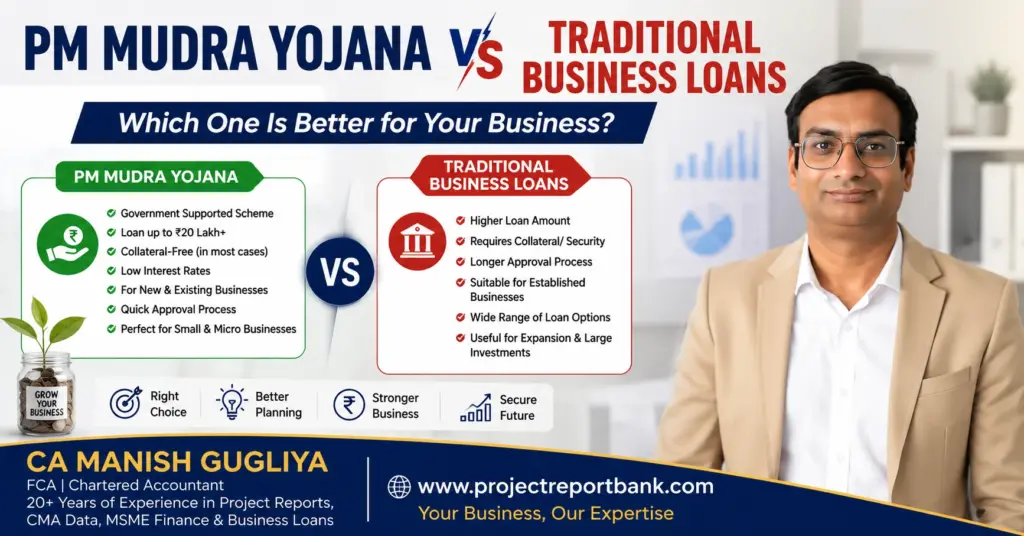
The single biggest difference is this: PM Mudra Yojana is a government backed initiative designed to support micro and small enterprises with collateral free loans up to ₹20 lakh, while traditional business loans offer substantially higher loan amounts but usually require collateral, stronger credit history, and extensive documentation.
The short answer: For most first-time entrepreneurs and micro businesses needing up to ₹10–20 lakh, PM Mudra Yojana is the better choice – it is collateral free, has simpler eligibility criteria, and offers faster approvals. If your business is established and you need larger capital (₹25 lakh to several crores) for expansion, purchasing equipment, or working capital, a traditional business loan will serve you better, provided you can meet the documentation and security requirements.
What is PM Mudra Yojana?
PM Mudra Yojana (Pradhan Mantri MUDRA Yojana – PMMY) was launched on 8 April 2015 by the Government of India. It is a government backed initiative created under the Micro Units Development and Refinance Agency (MUDRA) to provide collateral free institutional credit to micro enterprises in the non-farm sector.
The objectives of PM Mudra Yojana are straightforward – support business growth for small businesses, encourage income generation, and create employment opportunities across India.
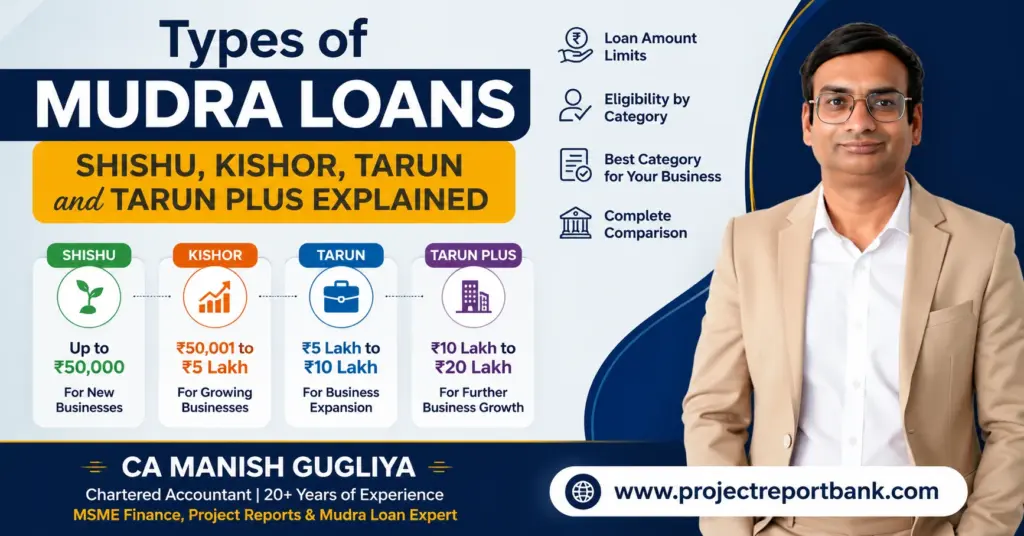
PM Mudra Yojana has a tiered loan structure based on business maturity levels. There are four loan categories:
- Shishu Loans – up to ₹50,000, designed for those just starting out
- Kishore Loans – above ₹50,000 up to ₹5 lakh, for businesses ready to grow
- Tarun – above ₹5 lakh up to ₹10 lakh, for established micro units needing larger funding
- Tarun Plus – above ₹10 lakh up to ₹20 lakh, introduced on 24 October 2024, available only to borrowers who have successfully repaid a previous Tarun loan
MUDRA loans are available through various financial institutions including banks and NBFCs. The participating lenders include Public Sector Banks, Private Sector Banks, Regional Rural Banks, small finance banks, NBFCs, MFIs, and NBFC-MFIs. You can learn more about the full key features of PM Mudra Yojana and how each loan category works in our complete beginner’s guide to PM Mudra Yojana.
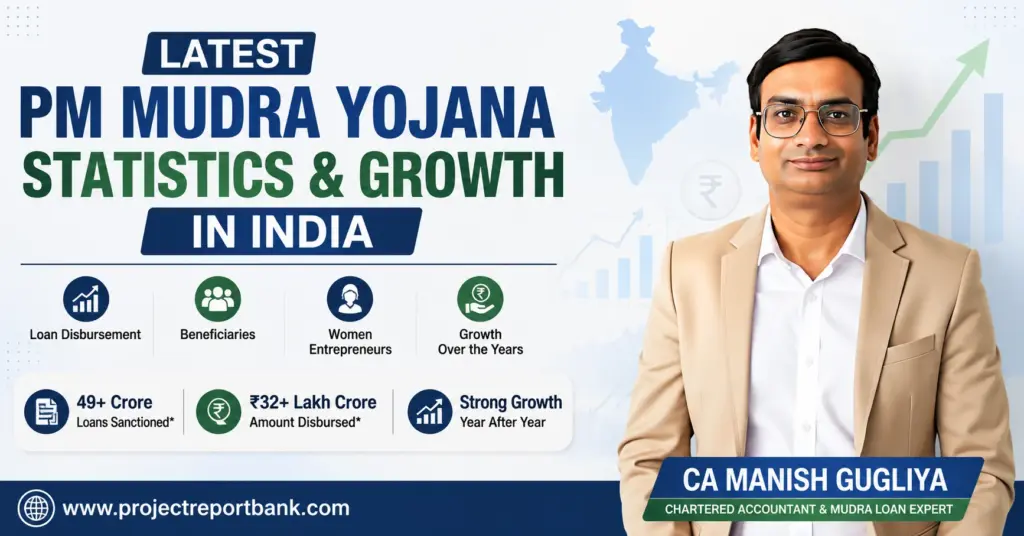
The scale of this mudra scheme is remarkable. As of 28 February 2025, more than 52.07 crore Mudra accounts have been sanctioned, with a total sanctioned amount of ₹33.19 lakh crore and ₹32.40 lakh crore disbursed.
Table of Contents
What is a Traditional Business Loan?
A traditional business loan refers to the conventional financing products offered by commercial banks, financial institutions, and NBFCs for business purposes. These are not specific government schemes – they are commercial lending products designed for businesses at various stages.
Traditional loans come in several forms:
- Term loans – for machinery purchase, expansion, or equipment purchases
- Working capital loans – for daily business operations, raw materials, and inventory
- Cash Credit (CC) – revolving credit facility linked to stock or receivables
- Overdraft (OD) facility – for short-term funding needs linked to a current account
- MSME loan products – specifically designed for micro, small, and medium enterprises
- NBFC business loans – offered by non-banking financial companies, often at higher interest rates
Traditional business loans suit established businesses needing larger amounts and longer tenures. They are used for expanding operations, purchasing equipment, entering new markets, debt consolidation, trade finance, and substantial funding requirements that exceed what the mudra scheme can offer.
PM Mudra Yojana vs Traditional Business Loans: How They Compare at a Glance
Here is a complete comparison table covering the key differences between PM Mudra Yojana and traditional business loans:
| Factor | PM Mudra Yojana | Traditional Business Loan |
|---|---|---|
| Purpose | Starting, expanding, or operating micro and small enterprises | Any legitimate business purpose including expansion, machinery, working capital |
| Loan Amount | ₹50,000 to ₹20 lakh (Tarun Plus) | Few lakhs to ₹1 crore or more; some banks offer up to ₹5 crore |
| Eligible Applicants | Indian citizens, 18–65 years, non-farm micro enterprises | Individuals, proprietorships, partnerships, companies, LLPs |
| New Business Eligibility | Yes – especially under Shishu and Kishore categories | Difficult – most lenders need 2–3 years of business history |
| Existing Business Eligibility | Yes | Yes |
| Collateral | Collateral free (including Tarun Plus with CGTMSE cover) | Usually required – property, machinery, fixed deposits |
| Guarantor | Generally not required | Often required for unsecured or larger amounts |
| Documentation | Minimal – KYC, business proof, quotations | Extensive – audited financials, ITR, GST, project reports, valuation reports |
| Interest Rate | ~7.5% to 18% p.a. depending on lender and category | ~8% to 17% or more; secured loans lower, NBFCs higher |
| Margin Money | Not required for Shishu/Kishore; 20% for Tarun Plus | Typically 15–25% depending on loan type |
| Processing Charges | Often lower or waived for Shishu/Kishore | Standard charges – processing, legal, valuation fees |
| Government Support | Full government backing, credit guarantee via CGTMSE/CGFMU | Limited – only if under specific MSME schemes |
| Repayment Tenure | Up to 5 years (60 months for term loans) | 1 to 15 years depending on type |
| EMI Flexibility | Standard EMI structure | More flexible repayment terms – moratorium, balloon payments possible |
| Approval Speed | Faster – days to 2 weeks for Shishu/Kishore | Slower – 15 to 45 working days or more |
| Credit Score Importance | Less critical, especially for Shishu/Kishore | Very important – typically 700+ CIBIL required |
| Project Report Requirement | Required for Tarun/Tarun Plus; minimal for smaller categories | Usually required for all term loans and larger amounts |
| Business Experience | Not mandatory for small loans | 2–3 years preferred |
| Risk to Borrower | Lower – no collateral at risk | Higher – collateral can be seized on default |
| Best Suited For | First-time entrepreneurs, micro units, home businesses | Established businesses needing substantial funding |
Headline takeaway: MUDRA loans provide access to credit for startups and entrepreneurs with lower barriers, while traditional loans offer higher loan amounts and flexible repayment terms for businesses that can meet stricter requirements.
Loan Amount and Categories
The loan amount you need is often the first filter in choosing between these two options. If your requirement is small, Mudra wins. If it is large, traditional loans are your only option.
Under PM Mudra Yojana, the maximum loan amount is structured across four categories. Shishu loans cover needs up to ₹50,000. Kishore loans go from above ₹50,000 to ₹5 lakh. Tarun loans range from above ₹5 lakh to ₹10 lakh. The Pradhan Mantri MUDRA Yojana provides collateral-free loans up to ₹20 lakh through the Tarun Plus category, but only for borrowers who have already availed and successfully repaid a Tarun loan.
MUDRA loans have a cap of ₹10 lakh for most borrowers who have not previously completed a Tarun loan cycle. MUDRA loans offer amounts up to ₹10 lakh for small businesses in the standard categories.
Traditional business loans often provide higher loan amounts. For instance, HDFC Bank offers business loans up to ₹1 crore under conventional products. Indian Bank’s IND DIGI MSME product provides up to ₹5 crores for eligible borrowers with non-presumptive tax ITR filings. When your business needs substantial funding – say ₹50 lakh for a manufacturing unit or ₹1 crore for a hotel expansion – traditional loans are the only viable path.
Winner: Traditional Business Loans – for businesses needing higher loan amounts beyond ₹20 lakh. However, if your requirement is within ₹10–20 lakh, Mudra’s collateral free structure makes it more accessible and practical for small business owners.
Eligibility and Documentation Requirements
Eligibility criteria directly affect whether you can actually get the loan. This is where Mudra has a clear advantage for newer businesses.
MUDRA loans require Indian citizenship to apply. Eligibility for MUDRA loans includes being aged 18 to 65 years. Applicants must have a viable business plan for MUDRA loans. MUDRA loans are available for micro and small enterprises only – specifically in non-farm sectors like manufacturing, trading, services, and agri-allied activities (dairy, poultry, beekeeping). MUDRA loans have simpler eligibility criteria than traditional loans.
MUDRA loans require identity and residence proof documents. For Shishu and Kishore categories, you typically need KYC documents (PAN, Aadhaar), business identity proof, address proof, and sometimes bank statements or vendor quotations. Financial statements are rarely required to be audited for smaller loan categories. For a detailed checklist, see our guide on documents required for Mudra Loan.
Traditional loans often require extensive documentation and operational history for approval. You will need identity proof and address proof of promoters, business registration (Udyam, GST), audited financial statements (usually 2–3 years), past income tax returns, bank statements for 6–12 months, project reports, CMA data, and sometimes valuation reports of collateral and certificates of incorporation. Traditional loans often require a more established business history – typically 2–3 years of operations.
Winner: PM Mudra Yojana – the eligibility criteria and documentation demands are significantly lighter, especially for Shishu and Kishore loans. The trade-off is that traditional loans accept a wider range of business structures (companies, LLPs) and offer higher amounts for those who meet the stricter requirements.
Collateral and Security Requirements
For many small business owners, collateral is the single biggest barrier to getting a loan. This is where the mudra scheme provides its most significant advantage.
MUDRA loans do not require collateral for approval. This applies across all four categories – Shishu, Kishore, Tarun, and Tarun Plus. Most MUDRA loans are unsecured and do not require collateral. For the Tarun Plus category, while no physical collateral is required, the loan must be covered under CGTMSE/CGFMU credit guarantee. The assets created from the loan (like machinery or equipment) are hypothecated to the bank, but no additional property or security is demanded.
Traditional business loans often require collateral for approval. Beyond certain limits, banks typically require collateral – this can include residential or commercial property, machinery, fixed deposits, inventory, or sometimes third-party guarantees. Additionally, margin money (promoter’s contribution of 15–25%) is often required. For example, even under Indian Bank’s Tarun Plus, the promoter’s margin is 20% on assets being financed.
Some traditional MSME loan products allow nil collateral if backed by CGTMSE guarantee, but this is not the default – it depends on the lender’s policies, loan amount, and borrower profile.
MUDRA loans are collateral-free, ensuring faster approvals and reducing the risk to borrowers. A first-time entrepreneur running a small salon or mobile repair shop simply does not have property to pledge. Collateral free MSME loans through the mudra scheme remove this barrier entirely.
Winner: PM Mudra Yojana – unambiguously. The collateral free nature of Mudra is its strongest feature. Traditional loans win only when the borrower has collateral and can use it to negotiate lower interest rates on larger amounts.
Interest Rates and Total Cost
Business loan interest rates directly impact your profitability and cash flow. Understanding the full cost – not just the headline rate – is essential.
MUDRA loans offer lower interest rates than traditional business loans in many cases, but interest rates for MUDRA loans depend on the lending bank. There is no uniform rate fixed by the government. Common ranges are approximately 7.5% to 18% p.a. depending on the institution, loan category, and borrower profile. For reference, Bank of Baroda offers Mudra rates between 8.40–11.10%, Canara Bank between 8.70–14%, and Union Bank between 9.75–11.00%. Indian Bank’s Tarun Plus carries approximately 10.00% p.a. (calculated as Repo + Prime Spread + Other Spread).
Traditional business loans may have more competitive interest rates for borrowers with strong collateral and credit history – secured term loans can start at around 8% p.a. However, unsecured business loans and NBFC rates tend to be higher, often 12–17% or more.
Processing fees for MUDRA loans are often lower or waived compared to traditional loans, especially for Shishu and Kishore categories. Traditional loans carry additional costs – processing charges (1–3%), valuation charges, legal fees, margin money requirements, insurance on assets, and sometimes foreclosure or pre-payment penalties.
When comparing, always calculate the effective cost including all charges, not just the stated interest rate.
Winner: It depends. MUDRA loans generally offer lower total cost for small amounts due to waived or reduced processing fees and no collateral-related expenses. Traditional loans may offer more competitive interest rates for secured, larger loans from borrowers with excellent credit profiles. The trade-off is clear – Mudra wins on accessibility and total cost for small businesses, while traditional loans can be cheaper per-rupee for established, creditworthy borrowers.
Approval Process and Speed
When you need funding urgently – whether for working capital, purchasing equipment, or seizing a business opportunity – approval speed matters.
MUDRA loans generally have a faster approval process. For Shishu and Kishore categories, processing can happen within a few days to two weeks when documentation is complete. MUDRA loans can be approved within a few days if documents are complete. The absence of collateral verification, legal checks on property, and complex financial analysis shortens the timeline considerably. MUDRA loans can be applied online or offline through any mudra approved bank or financial institution.
Tarun and Tarun Plus loans take somewhat longer because of higher amounts, DSCR assessment, verification of previous repayment records (for Tarun Plus), and CGTMSE coverage – but still faster than traditional secured loans.
Traditional business loans involve a more elaborate credit appraisal process. Banks require audited financials review, premises visits, title deed verification (for collateral), legal checks, and valuation reports. The application process for traditional loans typically takes 15 to 45 working days or longer depending on loan size and complexity. For reference, IndusInd Bank processes CGTMSE-backed loans under ₹25 lakh in approximately 14 working days, while amounts above that can take up to 45 working days.
Winner: PM Mudra Yojana – especially for smaller categories. The trade-off is that traditional loans, while slower, involve more thorough due diligence which can sometimes result in better-structured lending terms for larger amounts.
Government Support and Benefits
MUDRA loans are backed by the Government of India, which provides several key benefits that traditional loans simply do not offer.
The mudra scheme operates as a government backed initiative with built-in support: credit guarantee coverage through CGTMSE/CGFMU (reducing risk for lenders and eliminating collateral for borrowers), priority for vulnerable and underserved groups, and simplified access through a wide network of financial institutions. MUDRA provides special focus on women entrepreneurs and marginalized groups (SC/ST communities), making business financing more inclusive. For more on this, read about the benefits of Mudra loans for women entrepreneurs.
MUDRA loans provide access to credit for startups and entrepreneurs who would otherwise be shut out of the formal banking system. The scheme intentionally favours entry-level entrepreneurs, informal sector businesses, and those with lower financial thresholds – all to reduce barriers to formal finance. The MUDRA Card allows convenient digital withdrawals and repayments, adding operational flexibility.
Traditional business loans do not carry direct government support unless the enterprise qualifies under specific MSME schemes or CGTMSE guarantee programs. These require additional compliance and documentation. Government schemes like interest subvention are available but not universally applied.
Winner: PM Mudra Yojana – the government support, credit guarantee, and inclusive design give Mudra a distinct advantage. Traditional loans offer no comparable institutional backing for most small business owners.
PM Mudra Yojana vs Traditional Business Loans: Which Should You Choose?
Choose PM Mudra Yojana if:
- You are a first-time entrepreneur starting a new business
- Your business is a micro unit or small enterprise in the non-farm sector
- You need a loan amount up to ₹10 lakh (or up to ₹20 lakh if you qualify for Tarun Plus)
- You do not have collateral or property to pledge
- Your documentation is limited (no audited financials or multi-year ITR)
- You want a faster approval process with lower processing costs
- You are a woman entrepreneur or belong to a marginalized group seeking financial support
Choose a Traditional Business Loan if:
- Your business is established with 2–3 years of operations and proven revenue
- You need a higher loan amount – ₹25 lakh to ₹1 crore or more
- You have collateral (property, machinery, fixed deposits) available to pledge
- Your business requires expanding operations, large machinery, or factory setup
- You maintain audited financial statements, regular ITR filings, and strong credit history
- You need flexible repayment terms, moratorium periods, or longer tenures
- Your business is a medium enterprise or company/LLP structure needing substantial funding
A small business owner running a boutique or salon from home who needs ₹3 lakh would be well served by a Kishore Mudra loan. In contrast, a manufacturer needing ₹60 lakh for new machinery has no option but a traditional term loan or MSME loan. For home-based businesses, explore our guide on Mudra Loan for home business.
Practical Scenarios and Recommendations
Scenario 1: First-time grocery shop owner Ravi wants to open a grocery shop and needs ₹40,000 for initial inventory and a weighing machine. Recommendation: Shishu Mudra Loan. Collateral free, minimal documentation, quick disbursement. He does not need a traditional loan for this amount.
Scenario 2: Existing trader expanding inventory Sunita has been running a clothing store for 3 years. She needs ₹8 lakh for stock ahead of the festive season. Recommendation: Tarun Mudra Loan. She qualifies based on business stage, the amount is within Mudra limits, and she avoids pledging property. If she has strong financials, she could also compare a traditional MSME loan to negotiate a lower rate.
Scenario 3: Manufacturing unit needing equipment Arvind runs a packaging unit and needs ₹50 lakh for a new machine. Recommendation: Traditional Business Loan (term loan). This exceeds Mudra limits. He will need audited financials, a project report, CMA data, and likely collateral. The lower secured interest rate will benefit him over the loan tenure.
Scenario 4: Startup founder with a service idea Priya is 24, wants to launch a digital marketing agency from home, and needs ₹2 lakh for laptops and software. Recommendation: Kishore Mudra Loan. As a new entrepreneur with no business history, traditional banks will likely reject her loan application. Mudra’s simplified eligibility makes this feasible.
Scenario 5: Growing MSME seeking expansion capital A 5-year-old furniture manufacturing MSME needs ₹75 lakh for a new workshop and machinery. Recommendation: Traditional MSME term loan, secured against property or the assets being purchased. The business has the history, financials, and collateral to qualify. Using CGTMSE guarantee could reduce collateral requirements.
Scenario 6: Home-based entrepreneur Meena makes pickles and snacks at home and needs ₹1.5 lakh for a commercial mixer and packaging. Recommendation: Kishore Mudra Loan – ideal for home-based micro units. No collateral, minimal paperwork, and designed exactly for beneficiary micro unit businesses like hers.
Common Mistakes While Choosing Business Finance
From my 20+ years of practice, I have seen small business owners repeatedly make these costly mistakes:
- Borrowing more than required. Over-borrowing increases your EMI burden and strains cash flow. Estimate your actual requirement realistically.
- Ignoring repayment capacity. Before applying, calculate whether your business can generate enough monthly income to service the EMI. Banks assess this – you should too.
- Not comparing banks. Interest rates, processing charges, and service quality vary significantly between lenders. Always get quotes from at least 3–4 financial institutions.
- Poor documentation. Incomplete or inconsistent documents are the number one reason for delays and rejections. Prepare everything before submitting your loan application.
- Weak or missing project report. For Tarun, Tarun Plus, and all traditional loans, a professionally prepared project report with realistic projections makes a significant difference. Banks take your application more seriously.
- Ignoring hidden charges. Processing fees, documentation charges, insurance, valuation fees, and pre-payment penalties add up. Always ask for the complete cost breakdown.
- Choosing only on interest rate. A loan at 9% with high processing fees and strict pre-payment penalties can cost more than a loan at 10.5% with no additional charges. Evaluate the total cost of borrowing.
- Applying for the wrong product. Applying for a Mudra loan when your need exceeds ₹20 lakh wastes time and results in rejection. Match your business requirements to the right product.
Expert Advice from CA Manish Gugliya
As a practicing Chartered Accountant who has prepared thousands of project reports and CMA data statements for Mudra and MSME loans, here is my practical guidance:
When Mudra is the better choice: If you are starting a micro business, running a small enterprise, or a new entrepreneur without collateral, always explore Mudra first. MUDRA loans support micro and small enterprises effectively, and the government backing gives you a fair chance at formal credit even without an extensive business history.
When traditional loans make more sense: If your business has been operating for 3+ years, maintains proper books of accounts, files regular ITR, and needs capital above ₹20 lakh, a traditional business loan or MSME loan will provide the substantial funding and flexible repayment terms you need.
Always prepare a professional project report. Whether you apply for Mudra Tarun or a bank term loan, a well-prepared project report with projected profit and loss, cash flow statements, break-even analysis, and DSCR calculations dramatically improves your chances of approval. See our perfect project report guide for step-by-step help.
Evaluate total borrowing cost. Do not compare loans on interest rate alone. Calculate the effective cost including processing charges, guarantee fees, insurance, margin money, and any pre-payment penalties. This is the true cost of your loan.
Match the loan to your business goals. A tea stall does not need ₹10 lakh. A growing factory cannot survive on ₹2 lakh. Choose the right loan amount and product based on your actual business plan, repayment capacity, and growth stage. This discipline keeps your business forward on a sustainable path.
Renewal and repayment discipline matter. Under Mudra, successful repayment of a Tarun loan unlocks the higher Tarun Plus category (up to ₹20 lakh). Building a strong repayment track record opens doors for future, larger credit – whether through Mudra or traditional lending channels.
Frequently Asked Questions
Which is better – Mudra Loan or traditional business loan?
It depends on your business stage and needs. For first-time entrepreneurs and micro enterprises needing up to ₹10–20 lakh, Mudra is usually better due to its collateral free nature and simpler eligibility criteria. For established businesses needing larger amounts, traditional loans are more suitable.
Is a Mudra Loan cheaper than a traditional business loan?
MUDRA loans offer lower interest rates than traditional business loans in many cases. However, interest rates for MUDRA loans depend on the lending bank. Traditional business loans may have more competitive interest rates for secured loans from borrowers with strong credit profiles.
Can I hold both a Mudra Loan and a traditional business loan at the same time?
Yes. If the amounts and purposes differ and your existing obligations do not conflict, you can avail both. The bank will assess your cumulative exposure and repayment capacity before approving.
Which loan is easier to obtain?
Mudra loans are easier to obtain for eligible borrowers – especially under Shishu and Kishore categories. Minimal documentation, no collateral, and lower credit score requirements make the process simpler. Traditional loans require more documentation, business history, and often collateral.
Which loan requires collateral?
Traditional business loans often require collateral for approval – property, machinery, or fixed deposits. MUDRA loans do not require collateral for approval across all categories, including Tarun Plus.
Can startups apply for Mudra Loans?
Yes. MUDRA loans provide access to credit for startups and entrepreneurs. Shishu and Kishore categories are specifically designed for new entrepreneurs. Traditional loans are harder for startups to access because most lenders require 2–3 years of operational history.
Which loan is more suitable for women entrepreneurs?
MUDRA provides special focus on women entrepreneurs and marginalized groups, making it particularly suitable. Many banks also offer preferential rates for women borrowers under the Mudra scheme. Traditional loans do not typically offer gender-specific benefits.
Is a project report required for Mudra Loans?
For Shishu loans, a project report is generally not required. For Kishore, a brief business plan may be asked. For Tarun and Tarun Plus, a project report is usually required – especially for the term loan component. Traditional loans almost always require detailed project reports and CMA data.
Can I switch from a Mudra Loan to a traditional business loan later?
Yes. Many businesses start with Mudra and transition to traditional loans as they grow. Successfully repaying a Mudra loan builds your credit history and makes you eligible for larger, traditional business financing in the future.
Which loan is best for business expansion?
If the expansion requires less than ₹20 lakh and you qualify for Tarun Plus, Mudra can work. For larger expansion – ₹25 lakh to crores – a traditional business loan is necessary. You will need proper financials, a project report, and likely collateral.
What is the maximum loan amount under Mudra?
MUDRA loans offer amounts up to ₹10 lakh under the standard Tarun category. With the introduction of Tarun Plus on 24 October 2024, the maximum has been increased to ₹20 lakh for borrowers who have successfully repaid a previous Tarun loan.
Can I apply online for a Mudra Loan?
Yes. MUDRA loans can be applied online or offline through any participating bank, NBFC, or microfinance institution. Many banks now offer digital application processes.
What is the MUDRA Card?
The MUDRA Card allows convenient digital withdrawals and repayments. It functions like a debit card linked to your Mudra loan account, providing flexible access to working capital as needed.
Do I need GST registration for a Mudra Loan?
For Shishu and Kishore categories, GST registration may not be mandatory – though it helps. For Tarun and Tarun Plus, many banks now require Udyam registration and GST for formalisation and risk assessment. Traditional loans almost always require GST registration.
Which loan has a longer repayment tenure?
Traditional loans typically offer longer tenures – up to 10–15 years for secured term loans. Mudra term loans have a maximum repayment period of up to 60 months (5 years). If you need longer repayment horizons, traditional loans offer more flexibility.
Can a Mudra Loan be used for personal expenses?
No. MUDRA loans can be used for starting, expanding, or operating businesses in various sectors. They are strictly for business purposes – purchasing raw materials, equipment purchases, working capital, and other business needs. Personal expenses, home loan repayment, or mutual funds investments are not permitted.
Is a CIBIL score required for Mudra Loans?
Credit score is less critical for Shishu and Kishore categories. For Tarun and Tarun Plus, banks do check credit history, but the threshold is lower than traditional loans. Traditional loans typically require a CIBIL score of 700+ and a clean credit history.
Which banks offer Mudra Loans?
MUDRA loans are available through a wide network – all Public Sector Banks, major Private Sector Banks, Regional Rural Banks, small finance banks, NBFCs, and MFIs. You can approach any participating institution.
How much can I borrow under a traditional business loan?
Traditional business loans often provide higher loan amounts – from a few lakhs up to ₹1 crore or more depending on the lender and your business profile. Some digital MSME products offer up to ₹5 crores for qualifying businesses.
Conclusion
Choosing between PM Mudra Yojana and a traditional business loan is not about which product is universally better. It is about which one fits your business stage, financial needs, and repayment capacity.
PM Mudra Yojana is ideal for first-time entrepreneurs and micro businesses seeking affordable, government-supported, collateral free funding up to ₹20 lakh. It removes the biggest barriers – no collateral, simpler documentation, faster approval – making it the right choice for small business owners who are starting or running micro units.
Traditional business loans are more appropriate for established businesses needing larger capital, expansion funding, or specialized financing. If you have the financial history, collateral, and documentation to qualify, traditional loans provide the substantial funding and flexible terms to support business growth at scale.
Assess your actual business requirements carefully. Estimate your repayment capacity honestly. Compare offers from multiple lenders. And most importantly – prepare your documentation properly before applying.
If you need professional help with project reports, CMA data, Mudra Loan documentation, or guidance on choosing the right business financing option, feel free to reach out to CA Manish Gugliya at projectreportbank.com. With 20+ years of hands-on experience in MSME finance and business loan consultancy, I can help you move your business forward with the right financial support.
- PM Mudra Yojana Basics: Complete Guide to PMMY

- Latest Statistics and Growth of PM Mudra Yojana (PMMY) in India
- Common Myths About PM Mudra Yojana: Facts Every Business Owner Should Know
- PM Mudra Yojana vs Stand-Up India Scheme: Which Government Business Loan Is Right for You?

- PM Mudra Yojana vs MSME Loan: Which Is Better for Your Small Business in 2026?

- PM Mudra Yojana vs Traditional Business Loans: Which Is Better for Small Businesses?
- Types of Mudra Loans: Shishu, Kishor, Tarun and Tarun Plus Explained
- Key Features of PM Mudra Yojana Every Applicant Should Know

- Objectives of PM Mudra Yojana Explained