India’s edible oil production landscape presents a compelling case for integrated oilseed processing. Mustard and rapeseed are major oilseed crops known for high oil recovery rates and valuable protein-rich by-products, while groundnut oil commands premium positioning in western and southern Indian markets. Mustard oil is used extensively in cooking and pickling in Northern and Central India, and groundnut oil enjoys loyal consumer demand across Gujarat, Maharashtra and Tamil Nadu.
An integrated mustard rapeseed groundnut oil plant project report must address the distinct technical, procurement and financial realities of processing multiple oilseeds through shared infrastructure. Project feasibility studies are essential for evaluating potential investment in an oil extraction plant of this nature, because the interplay of seasonal raw materials, variable oil recovery rates and substantial working capital requirements makes this fundamentally different from a single-seed oil mill.
This guide examines the practical dimensions of setting up such a facility, from process technology and machinery requirements to project cost, means of finance, profitability and bankability.
Key Takeaways
This article provides a finance-focused perspective on planning an integrated mustard, rapeseed and groundnut oil extraction and refining plant in India. The discussion covers processing technology, project cost structures, financial projections and risk considerations relevant to industrial-scale investment decisions.
- Integrated edible oil plants processing mustard, rapeseed and groundnut require separate seed-preparation lines, careful scheduling and distinct oil recovery assumptions for each oilseed, unlike a simple single-seed oil mill.
- Raw materials account for 80–85% of operating expenses, making procurement strategy, seed quality and extraction efficiency central to project profitability.
- For a modern integrated oil mill and refinery processing 100–200 TPD, total capital investment can range from approximately ₹10–55 crore depending on capacity, process route and degree of integration.
- The global mustard oil market was valued at USD 20.07 billion in 2025, with market projections suggesting it could reach USD 26.34 billion by 2034, indicating sustained demand.
- Secondary revenue streams from high-protein oil cakes used in animal feed and cattle feed contribute meaningfully to gross margins and should be modelled carefully in the DPR.
- Financial indicators such as ROI, IRR and DSCR are critical for assessing project viability; promoters should base decisions on a customised Detailed Project Report with capacity-wise financial projections, CMA Data, sensitivity analysis and break-even assessment.
Introduction: Integrated Mustard Rapeseed Groundnut Oil Plant Project Report Perspective
India remains one of the world’s largest consumers of edible oils, yet imports a substantial share of its requirements. Within the domestic production basket, rapeseed-mustard contributes approximately 31% of oilseed production and groundnut around 27%, as per NITI Aayog’s 2024 strategy document on edible oil self-sufficiency. Among oils produced domestically, mustard oil alone accounts for roughly 45% of total output.
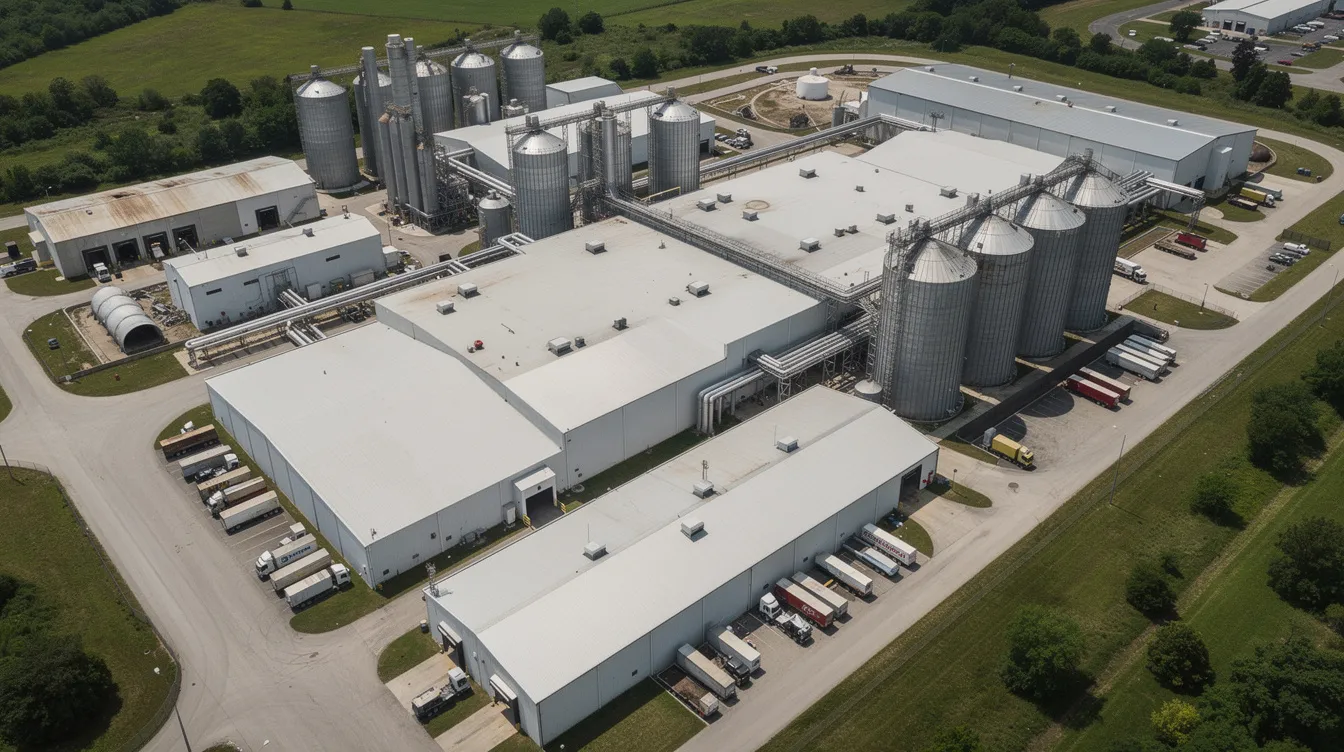
The concept of an integrated multi-oilseed processing plant involves crushing mustard, rapeseed and groundnut through partially shared infrastructure – common utilities, tank farms, packaging lines and potentially a single edible oil refinery – while maintaining separate seed-preparation sections. This model enables year-round plant utilisation by processing different seeds across their respective harvest seasons.
The opportunity extends across the value chain: oil extraction, oil processing, refining, branded packaged edible oils, bulk sales to food processors, and commercialisation of oil cake and de-oiled meal for animal feed. A project report for an edible oil processing plant of this type should cover technical, financial and operational aspects in integrated fashion.
This article is written from the perspective of CA Manish Gugliya (Project Report Bank), focusing on the financial analysis and bankability dimensions of integrated oil extraction projects rather than presenting a generic manufacturing overview.
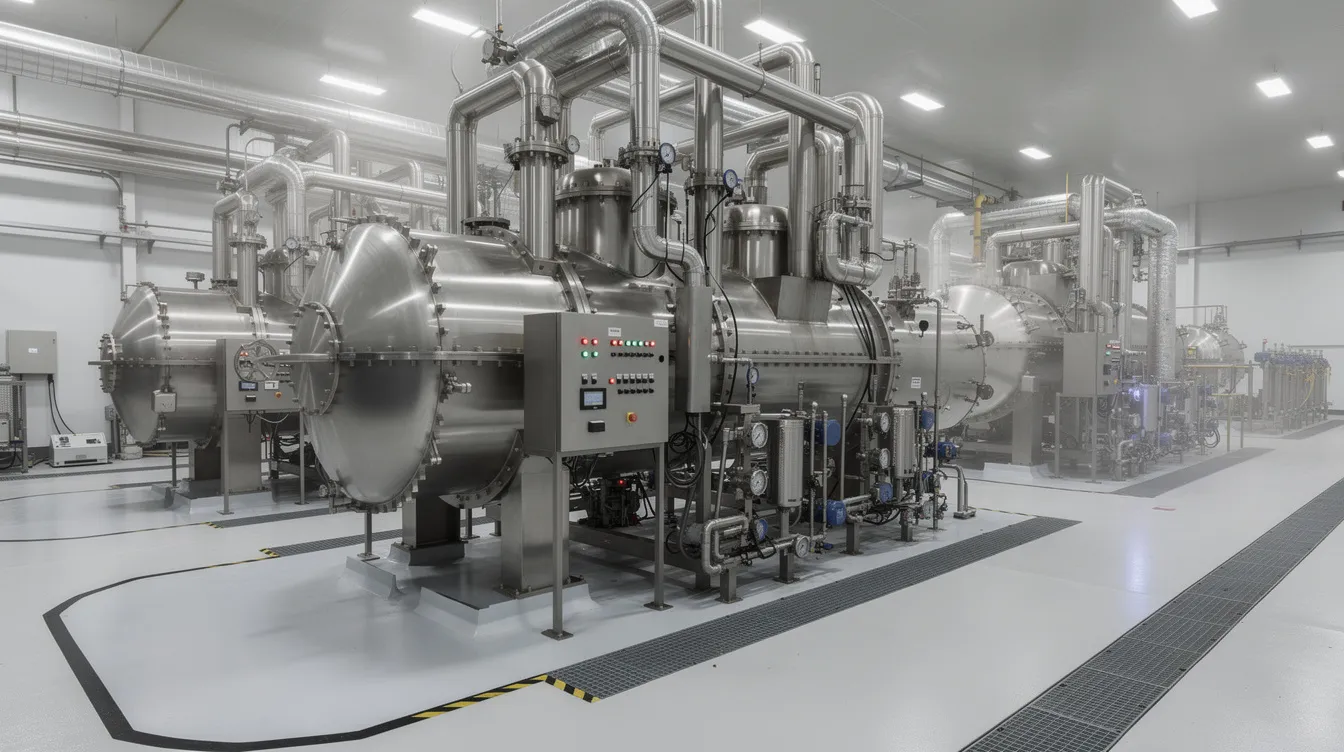
Understanding an Integrated Mustard, Rapeseed and Groundnut Oil Processing Plant
An integrated mustard, rapeseed and groundnut oil processing plant combines multiple oilseed crushing lines on a common site with shared utilities (steam, power, water, compressed air), storage infrastructure and, optionally, a common refinery producing refined edible oils. Oil extraction plants are often structured to pivot between different seed processing based on market needs and seasonal availability.
The typical configuration options include:
- Purely mechanical mustard oil processing plant and groundnut oil extraction via expellers
- Pre-pressing followed by solvent extraction for higher oil recovery from press cake
- Fully integrated oil extraction and edible oil refining facility with packaging
- Separate seed-preparation lines with shared boiler, power, refinery, tankage and packaging
Operations that can usually be shared include utilities, some material handling equipment, storage tanks, finished oil packaging lines (with proper cleaning and segregation), and laboratory and quality control infrastructure. For promoters evaluating large-scale multi-seed solvent extraction, the Industrial Solvent Extraction & Multi-Oilseed Processing Plant Project Report provides deeper technical context.
However, several operations require seed-specific handling: cleaning and grading setups differ between small mustard seeds and larger groundnut kernels; decortication and shelling equipment is needed exclusively for groundnut pods; separate bins prevent cross-contamination and manage allergen risks; and conditioning temperatures differ across oilseeds.
| Parameter | Mustard / Rapeseed | Groundnut |
|---|---|---|
| Oil content range | 36–42% | 45–50% (kernels) |
| Key seed preparation | Cleaning, conditioning, cooking | Shelling, grading, conditioning |
| Main processing route | Expeller; optional solvent extraction | Expeller; solvent extraction of cake |
| Principal by-products | Mustard oil cake, rapeseed meal | Groundnut cake, de-oiled meal, hulls |
| Key technical risks | Erucic acid, glucosinolates in meal | Aflatoxin contamination |
Market Opportunity and Industrial Investment Potential in India
The market is expected to reach USD 26.34 billion by 2034 for mustard oil globally, reflecting sustained consumption growth. Detailed market potential assessment helps in understanding demand for mustard and rapeseed oil across states like Rajasthan, Uttar Pradesh, Bihar, West Bengal and Haryana, where pungent mustard oil remains the preferred cooking medium. Groundnut oil enjoys premium positioning in Gujarat, Maharashtra and Tamil Nadu. Market analysis should identify target customers, distribution channels and competitors in the oil sector to build a realistic revenue model.
Demand segments include loose bulk mustard oil for regional traders, branded bottled oils for retail and e-commerce, bulk refined oil for food processors, bakeries and snack manufacturers, and export opportunities where FSSAI and Codex quality standards are met. Cold-pressed oils have grown in demand due to rising health consciousness, creating niche premium segments.
However, the competitive landscape includes large organised edible oil companies and cooperatives alongside fragmented unorganised oil mills, compounded by pressure from cheaper refined palm oil and imported sunflower and soybean oils. Integrated plants must compete on efficiency, oil quality and supply reliability rather than price alone. Strong consumption does not automatically guarantee profitability; margins are thin and cyclical, so a detailed feasibility report is necessary to test economic resilience under varying price scenarios.
Raw Material Procurement and Oilseed Selection
For mustard, rapeseed and groundnut oil projects, raw materials drive both the cost structure and technical feasibility. Seasonal procurement patterns affect the availability of mustard and rapeseed seeds, which are harvested between February and April in North India. Groundnut, primarily a kharif crop, has different harvest peaks. Efficient logistics and supply chain management are critical for successful operation of oil processing plants.
For mustard and rapeseed, procurement involves APMC mandis, farmer-producer organisations and aggregators. Quality parameters include moisture below 10%, oil content of 35–40%, and minimal foreign matter. The MSP for rapeseed-mustard for 2026–27 stands at ₹6,200 per quintal. High moisture increases storage losses and degrades oil quality.
For groundnut, a key decision involves buying pods versus purchasing kernels directly. Kernel outturn from pods is typically 65–70%. Aflatoxin risk demands regular laboratory testing, and high-aflatoxin batches may need to be rejected or diverted to non-edible uses. Quality control practices in oil processing include testing for moisture, oil content and free fatty acids at the procurement stage itself.
Long term contracts with FPOs or aggregators, digital commodity platforms for price discovery, and hedging strategies can smooth average raw material cost. The DPR should compute the effective “oil-in-seed” cost for each seed type and test at least three raw material price levels to understand sensitivity of contribution margins.
Mustard, Rapeseed and Groundnut Oil Extraction Process
While the overall oil extraction steps follow a similar sequence, certain operations vary significantly between mustard/rapeseed and groundnut. Mustard and rapeseed oil extraction plants typically utilise seed cleaning, grading and conditioning before mechanical expelling, while groundnut requires an additional shelling stage.
The extraction process for mustard and rapeseed typically involves mechanical expelling and filtration through these stages:
- Seed receiving and weighbridge operations
- Pre-cleaning using scalpers and aspirators
- De-stoning and fine cleaning
- Shelling and decortication (groundnut only)
- Conditioning using steam-jacketed kettles
- Flaking (particularly for pre-press solvent extraction routes)
- Mechanical expeller-based oil extraction using heavy-duty integrated oil press units
- Crude oil filtration, settling and clarification
- Press-cake handling, cooling and storage
- Optional solvent extraction of press cake for higher oil recovery
- Solvent recovery through evaporators and condensers
- Crude oil storage
Mustard oil is extracted using cold or hot pressing methods. Solvent extraction uses n-hexane to separate oil from seeds remaining in the press cake. Batch solvent extraction is suitable for small-scale oil plants, while continuous solvent extraction improves efficiency in oil recovery at industrial scale. For detailed technical specifications on the solvent extraction process, refer to the guide on Solvent Extraction Plant Process Flow and Technology.
The oil recovery rates for mustard, rapeseed and groundnut seeds vary based on seed type and processing methods. Expeller recovery for mustard is typically 33–37% of seed weight, while groundnut kernels yield 40–45% crude oil through expellers.
Not all mustard oil requires full refining. Many consumers prefer pungent, filtered mustard oil retaining natural aroma. Cold-pressed mustard oil targets premium health-conscious segments, while refined mustard or rapeseed oil suits blended edible oils. Groundnut oil is commonly refined to meet colour, flavour and shelf-life expectations in urban branded markets.
Illustrative process flow:
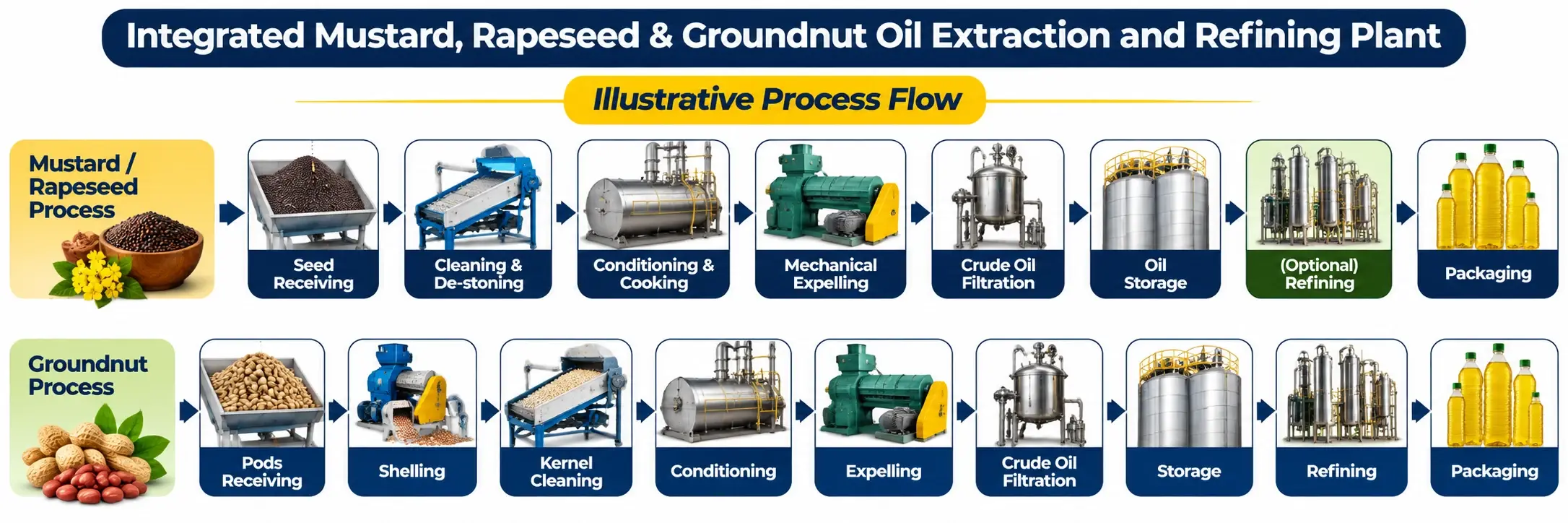
Mustard/Rapeseed: Seed Receiving → Cleaning & De-stoning → Conditioning & Cooking → Mechanical Expelling → Crude Oil Filtration → Storage → (Optional) Refining → Packaging
Groundnut: Pods Receiving → Shelling → Kernel Cleaning → Conditioning → Expelling → Crude Oil Filtration → Storage → Refining → Packaging
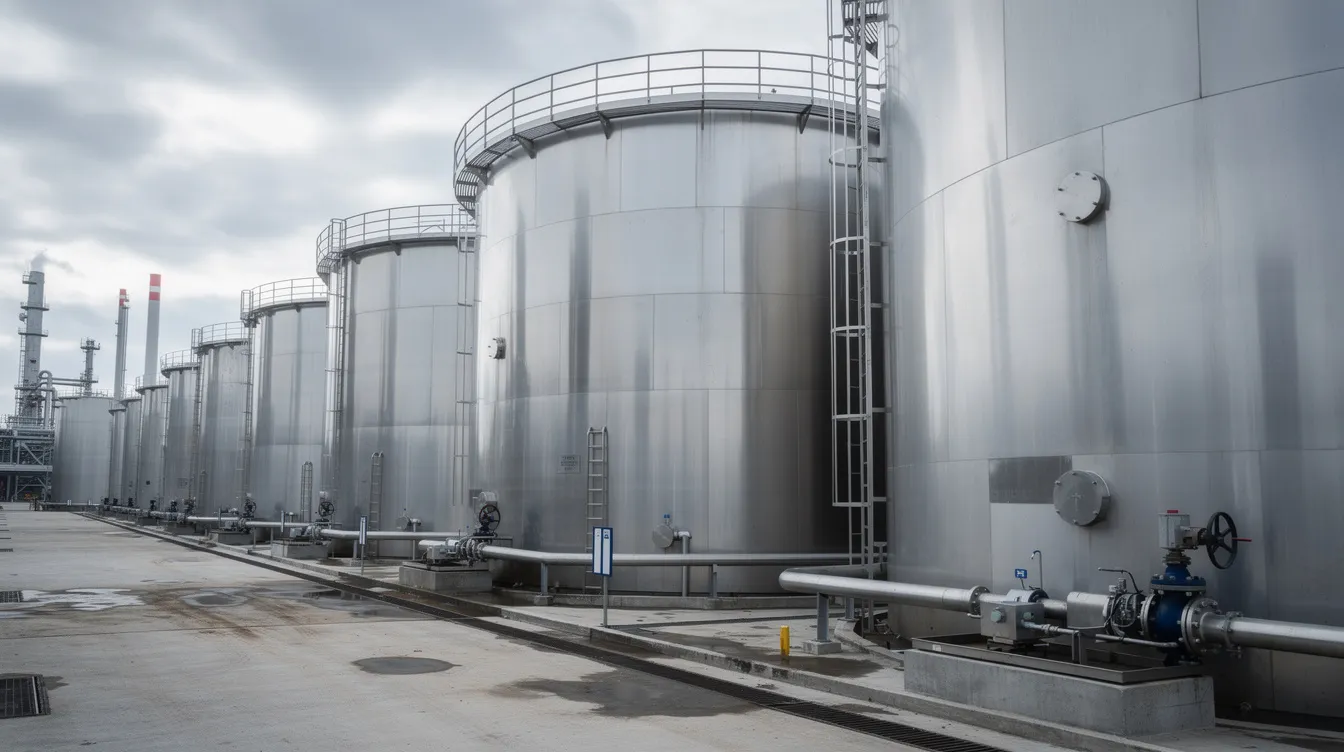
Edible Oil Refining Technology and Process Selection
Refining converts crude mustard oil, rapeseed oil and groundnut oil into stable edible oils with lighter colour and extended shelf life. The refining stages include degumming, neutralisation, bleaching, deodorisation and final filtration. The choice between Physical vs Chemical Refining of Edible Oils depends on crude oil characteristics, FFA levels and economic considerations.
Refining losses typically range from 3–8% depending on crude oil quality. High-FFA crude oil increases neutralisation losses significantly. The DPR must separately account for crude oil yield from seeds and refined oil yield after process losses.
| Business Model | Investment Intensity | Margin Structure | Typical Scale |
|---|---|---|---|
| Expeller with filtered oil | Low | Moderate, volatile | 10–50 TPD |
| Expeller + semi-refining | Medium | Improved margins | 30–100 TPD |
| Pre-press solvent + full refinery | High | Better recovery, stable | 100–500 TPD |
| Standalone refinery (bought-in crude) | Medium-high | Spread-based | 50–300 TPD |
For promoters considering higher-capacity centralised refining, the Large-Scale Edible Oil Refinery & Fractionation Plant Project Report offers additional reference.
Plant Capacity Planning and Production Configuration
In a mustard rapeseed groundnut oil plant project report, capacity must be expressed in terms of seed crushing capacity (TPD of each oilseed), refinery capacity (TPD of crude oil) and annual operating days. Plant capacity and production planning are influenced by raw material availability and market demand. Mustard oil processing plants can produce 20,000 MT annually at appropriate scale.
| Scenario | Seed Input (TPD) | Annual Input (300 days) | Oil Recovery (Mustard) | Oil Recovery (Groundnut) |
|---|---|---|---|---|
| 50 TPD | 30 M + 20 G | 15,000 MT | 34–37% | 38–42% |
| 100 TPD | 60 M + 40 G | 30,000 MT | 34–37% | 38–42% |
| 200 TPD | 120 M + 80 G | 60,000 MT | 34–37% | 38–42% |
Capacity utilisation should build gradually: 55% in the first year, 65–75% by years two and three, reaching 80–85% at steady state. Refinery capacity should match expected crude oil production, while planning for the possibility of selling some mustard oil as filtered product without full refining.
Plant and Machinery Requirements
High-quality machinery is essential for mustard oil production and efficient multi-seed processing. Machinery requirements span raw material preparation, extraction, refining, packaging and utilities. Equipment costs represent a significant portion of capital expenditure.
| Equipment Group | Function | Investment Category |
|---|---|---|
| Seed cleaners, graders, de-stoners | Raw material preparation | Major |
| Groundnut shellers/decorticators | Seed preparation | Medium |
| Expellers with cooking kettles | Oil extraction | Major |
| Filter presses, settling tanks | Crude oil clarification | Medium |
| Solvent extraction system | Enhanced oil recovery | Major |
| Degumming, neutralisation, bleaching units | Oil refining | Major |
| Deodoriser (batch/continuous) | Refining | Major |
| Filling, capping, labelling machines | Packaging | Medium |
| Boiler, thermic fluid heater | Utilities | Major |
| ETP, fire protection, laboratory | Compliance and quality | Supporting |
Selection criteria for EPC suppliers should include track record in edible oils, guarantees on oil recovery and throughput, commissioning responsibility, spares availability and compliance with safety standards. The guide on Edible Oil Refinery Machinery, Technology and EPC Selection covers refinery-equipment evaluation in greater depth.
Land, Building, Infrastructure and Utility Requirements
Plant layout must optimise workflow and safety. Infrastructure requirements for oil extraction include adequate storage, processing and administrative facilities. Illustrative land requirements range from 1.0–1.5 acres for a 50 TPD plant to 2–3 acres or more for 100–200 TPD with solvent extraction.
Key building components include raw material godowns, processing blocks, enclosed refinery sections, tank farms with bund walls, finished-goods warehouses, packaging halls and administrative buildings. Utilities encompass electrical connected load, steam for cooking and deodorisation, water treatment and effluent treatment. Compliance with local regulations is necessary for plant setup, including fire-fighting systems (particularly in solvent extraction areas classified as hazardous), lightning protection and explosion-proof equipment.
Integrated Oil Extraction and Refining Plant Project Cost
Capital expenditures in oil extraction projects include land development, machinery and operating expenses. All figures below are indicative and must be validated through specific machinery quotations and site assessments. Mustard oil processing plant setup costs include capital investments that vary substantially with configuration.
| Cost Head | 100 TPD Expeller + Refinery (₹ Lakh) | 200 TPD Pre-Press + SE + Refinery (₹ Lakh) |
|---|---|---|
| Land and site development | 80–150 | 150–300 |
| Civil construction | 200–400 | 400–800 |
| Seed preparation and handling | 50–100 | 100–200 |
| Expeller machinery | 150–300 | 300–500 |
| Solvent extraction (if included) | – | 400–800 |
| Refining plant | 150–300 | 300–600 |
| Packaging machinery | 30–60 | 60–120 |
| Storage, tanks, pipelines | 40–80 | 80–160 |
| Boiler, utilities, ETP | 80–150 | 150–300 |
| Pre-operative expenses, IDC, contingency | 100–200 | 200–400 |
| Working capital margin | 200–400 | 400–800 |
| Indicative Total Project Cost | ₹10–21 Crore | ₹25–50 Crore |
A 100 TPD expeller-only plant has a fundamentally different investment and risk profile compared to a 100 TPD integrated pre-press solvent extraction and refining facility. The Edible Oil Refinery Project Cost and Investment guide provides further refinery-specific cost structures.
Means of Finance and Capital Structure
Integrated projects generally involve sizeable capital outlay requiring balanced financing. Typical means of finance include promoter equity contribution (30–35% of total project cost), term loans from banks for fixed assets, and working capital limits (cash credit, WCDL).
| Source | Illustrative Share |
|---|---|
| Promoter contribution | 30–35% |
| Term loan | 55–60% |
| Working capital margin | 8–12% |
Lenders examine promoter net worth, debt-equity ratio, projected cash flows, DSCR and collateral security. Disbursement schedules should align with implementation stages to minimise interest during construction.
Production Economics and Operating Cost Analysis
A robust project report must include separate production economics for each oilseed. Raw materials account for 80–85% of operating expenses, making even small procurement cost differences material. Operating costs include utilities, labour and maintenance as additional cost components. The profitability of an oil extraction project relies on effective cost management and revenue generation strategies.
Illustrative material balance – Groundnut (per 1,000 kg kernels):
| Stage | Quantity |
|---|---|
| Kernel input | 1,000 kg |
| Cleaning losses (~2%) | 20 kg |
| Crude oil (expeller, ~42%) | 410 kg |
| Press cake | 550 kg |
| Refining losses (~5%) | 20 kg |
| Refined groundnut oil | ~390 kg |
Gross profit margins for mustard oil typically range between 15–25%, though these fluctuate with seed prices and selling rates. Small improvements in oil recovery of even 0.5–1 percentage point significantly enhance profitability at scale. The DPR should show best-case, base-case and stress-case margins. For refinery-specific profitability analytics, refer to the Edible Oil Refinery Feasibility Study and Profitability guide.
Working Capital Requirements
Even when machinery investment seems manageable, edible oil projects demand substantial working capital for stocking mustard seeds, rapeseed and groundnut and holding oil inventories. Working capital assessment should be focused on seasonal raw material inventories and operational needs, particularly during peak procurement months when heavy purchasing is necessary to lock in favourable prices.
For a 100 TPD plant (illustrative):
- Seed inventory (45 days): ₹3–5 crore depending on seed mix and prices
- Finished goods and crude oil (15 days): ₹1–2 crore
- Receivables (30 days): ₹1.5–3 crore
- Less creditors (15 days): ₹0.5–1 crore
- Net working capital requirement: ₹5–9 crore
Seasonal funding peaks require coordination between procurement planning and banking arrangements. Similar working capital assessment principles apply to integrated crusher-refinery projects, as detailed in Edible Oil Refinery Financial Projections, CMA Data and DSCR.
Financial Projections, CMA Data and Bank Finance
For a bankable mustard rapeseed groundnut oil plant project report, integrated financial projections and CMA Data are essential. A profit and loss analysis is crucial for projecting financial performance in oil processing projects over a 7–10-year horizon. Financial projections include ROI, profitability, and long-term sustainability metrics.
Core components of the financial model include projected P&L statements, balance sheets, cash flow statements, capacity-utilisation schedules with seed-wise throughput, oil-yield schedules, product-wise sales projections and detailed operating cost breakdowns. CMA Data preparation follows the standard Statement I to VI structure used in Indian banking, linking working capital assessment with drawing power calculations. First-year operational costs cover raw materials and utilities at reduced utilisation, while by the fifth year, operational costs are expected to increase significantly as the plant reaches steady-state throughput.
Sensitivity analysis must test scenarios with changes in seed prices, edible oil prices, capacity utilisation, recovery percentages and finance costs to observe impact on DSCR and payback period. Projections must be realistic, consistent with installed capacity and based on practical ramp-up timelines – typically 50–60% utilisation in the first year.
Financial Feasibility, Profitability and Investment Returns
This section translates processing assumptions into investment metrics. Contribution per tonne, fixed-cost coverage, EBITDA margin trends, project IRR, equity IRR and payback period should all be computed across base, optimistic and downside scenarios.
The distinction between accounting profit and cash flow is critical: depreciation is a non-cash expense, working capital movements consume cash, and adequate cash generation must be ensured in loan-repayment years even if accounting profits appear modest.
Risks to test include 10% raw material price increases, 5% edible oil price reductions, lower extraction recovery, reduced plant utilisation and higher energy costs. Lenders focus heavily on both average and minimum DSCR. Operating costs are primarily driven by raw material consumption, representing 80–85% of OpEx, which means even small adverse price movements can compress margins significantly.
For broader context on edible oil investment feasibility, the Integrated Soybean Crushing, Oil Extraction and Refining Plant DPR illustrates comparable financial-planning frameworks, though soybean projects differ technically.
Regulatory Approvals and Compliance Requirements
Edible oil plants must comply with multiple central and state regulations. Licensing and approvals from regulatory bodies like FSSAI are mandatory for food production facilities. Environmental compliance is necessary for oil extraction plants concerning waste and emissions management.
Key requirements include:
- FSSAI licence for edible oil manufacturing and packaging
- Factory licence under the Factories Act
- Consent to Establish and Consent to Operate from State Pollution Control Board
- Boiler and electrical safety approvals
- Fire NOC and safety compliance
- GST registration
- Legal metrology approvals for packaging declarations
FSSAI standards for mustard oil specify limits on refractive index, acid value, and require that solvent-extracted oil must be refined with hexane residue not exceeding 5.0 ppm as per FSSAI regulations. Groundnut oil must comply with aflatoxin limits under contaminant regulations. Solvent extraction plants require enhanced fire and explosion-protection systems due to flammable hexane handling.
Key Investment Risks and Mitigation
Mustard rapeseed groundnut oil projects involve commodity-price exposure, technical risks and compliance obligations that must be explicitly addressed in the project report.
| Risk | Likelihood | Mitigation |
|---|---|---|
| Oilseed price volatility | High | Diversified procurement, phased purchasing |
| Seasonal underutilisation | Medium | Multi-seed processing, contract arrangements |
| Lower extraction yields | Medium | Equipment maintenance, quality seed sourcing |
| Aflatoxin in groundnut | Medium | Pre-purchase testing, batch rejection protocols |
| Solvent fire hazards | Low | Hazardous-area design, safety training, insurance |
| Working capital shortages | Medium | Adequate CC limits, seasonal funding planning |
| Marketing risk from competition | High | Quality differentiation, branded products, market access diversification |
Proactive risk management through suitable contracts, insurance cover, conservative leverage and robust preventive-maintenance schedules enhances the project’s ability to navigate cyclical market conditions.
Preparing a Bankable Integrated Oilseed Processing Plant DPR
Many promoters underestimate the level of detail required for a bankable DPR. A comprehensive document should cover executive summary, promoter profile, market analysis, raw material availability study, detailed technical configuration, machinery costing with quotations, plant layout, capital cost estimates, means of finance, operating cost build-up, projected financial statements with CMA Data, DSCR and break-even analysis, investment return metrics and structured risk assessment.
The distinction between a generic project report and a customised, data-backed DPR is significant: the latter withstands lender scrutiny because it reflects project-specific capacity, location and raw material scenarios. Professional advisory services can assist in developing precise and investor-ready project documentation.
For cross-learning on other high-volume oilseed projects, promoters may consult the Cottonseed Oil Processing Plant Project Report and Rice Bran Oil Extraction and Refining Plant Project Report, while remembering that mustard, rapeseed and groundnut have distinct processing specificities.
How CA Manish Gugliya and Project Report Bank Can Assist
CA Manish Gugliya, FCA, DISA (ICAI) is a practising Chartered Accountant with over 20 years of professional experience in project finance, DPR preparation, CMA Data and financial modelling. Through ProjectReportBank.com, professional assistance is available for:
- Customised DPR preparation for integrated oil extraction and refining plants
- Project feasibility studies and investment cost assessment
- Financial projections, financial modelling and CMA Data preparation
- Bank term loan and working capital proposals
- Investor-ready project documentation
Technical configuration and engineering inputs must be validated with competent technology suppliers and process consultants. Financial and commercial structuring is where Project Report Bank adds value.
Serious promoters are invited to share their proposed project location, capacity in TPD, oilseed combination, technology preference, estimated investment budget and intended financing requirement. Please initiate your enquiry through the WhatsApp contact option available on ProjectReportBank.com.
Related Industrial Oil Processing Guides
- Industrial Solvent Extraction & Multi-Oilseed Processing Plant Project Report – for large-scale multi-seed solvent extraction
- Large-Scale Edible Oil Refinery & Fractionation Plant Project Report – for standalone refinery investment
- Corn Germ Oil Extraction Plant Project Report – for other industrial oil processing opportunities
The financial planning approaches, project cost structuring and bank finance frameworks in these guides are comparable to mustard, rapeseed and groundnut oil projects.
Frequently Asked Questions
What is the typical investment range for a mustard, rapeseed and groundnut oil extraction plant in India?
Investment varies significantly by capacity and configuration. A small expeller-based unit processing 20–30 TPD without a refinery may require ₹2–5 crore. A 50–100 TPD integrated plant with refinery and suitable infrastructure can require ₹10–21 crore. Larger 200–300 TPD plants with solvent extraction and full refining can exceed ₹25–50 crore. Individual site conditions, civil costs, chosen technology and level of automation change these ranges materially, so specific costing requires a customised project report.
Can one processing line handle mustard, rapeseed and groundnut seeds together?
While boilers, power systems, some conveyors and a common refinery can be shared, seed preparation steps differ. Groundnut requires shelling; mustard and rapeseed do not. Seed size, hardness and cleaning requirements vary. In practice, plants adopt partially separate preparation sections and carefully planned scheduling to avoid cross-contamination, particularly where allergen controls for groundnut are important.
Is it necessary to install a refinery along with a mustard and groundnut expeller plant?
It is not mandatory. Many oil mills operate successfully selling filtered mustard oil and crude groundnut oil to third-party refiners. However, an in-house refinery adds value, enables branded retail products and improves flexibility. Promoters should evaluate their target market, quality expectations, additional investment requirements and whether to start with expellers alone or integrate a refinery from inception.
How long does it usually take to implement an integrated oil extraction and refining plant?
Under organised project management, a medium-scale 50–100 TPD integrated plant can move from financial closure to commissioning in approximately 10–14 months. Timelines depend on land readiness, statutory approvals, machinery manufacturing and delivery schedules, and complexity of civil works. The DPR should include a realistic implementation schedule specific to each project.
How can I get a customised mustard rapeseed groundnut oil plant project report for bank loan purposes?
Promoters can approach Project Report Bank with basic project details including proposed location, capacity in TPD, seed mix, technology preference, available budget and financing requirement. Based on this, a proposal covering scope, timelines and professional fees for a customised DPR will be prepared. Communication can be initiated via the WhatsApp option or enquiry form on ProjectReportBank.com.
Conclusion
Integrated mustard, rapeseed and groundnut oil extraction and refining projects offer meaningful industrial opportunities in India, but require careful alignment of technology, capacity, procurement strategy and financial structure. Multi-seed processing demands thoughtful equipment choices and process scheduling. Oil recovery and by-product realisation from mustard oil cake, groundnut cake and de-oiled meal determine profitability as much as edible oil selling prices. Seasonal procurement and high working capital needs remain central to project finance planning.
Installed capacity alone does not establish profitability. Technical, commercial and financial assumptions must be tested through robust sensitivity analysis before capital commitments are made. A customised DPR and feasibility study help promoters make informed financing and investment decisions, distinguishing defensible projections from optimistic estimates.
For a professionally prepared mustard rapeseed groundnut oil plant project report tailored to your specific capacity, location and financing requirements, connect with CA Manish Gugliya through ProjectReportBank.com.