Key Takeaways
- A corn germ oil extraction and refining plant converts corn germ (a by product of maize wet- or dry-milling) into refined corn oil and germ meal; a customised, bankable Detailed Project Report is critical before committing ₹5 to ₹100+ crore of capital.
- Project viability depends on assured corn germ supply, realistic oil yield (based on germ source and technology), efficient refining, and prudent management of project cost, working capital and DSCR.
- Promoters must choose between expeller-only, pre-press plus solvent extraction, or full solvent extraction routes, each carrying different capital expenditure, energy consumption and profitability profiles.
- Bank finance appraisal for a corn oil processing plant revolves around CMA Data, 7 to 10 year financial projections, DSCR, break-even analysis and sensitivity to germ cost and refined corn oil selling price.
- Project Report Bank, led by CA Manish Gugliya, prepares customised DPRs, financial models and CMA Data for corn germ oil extraction and other edible oil projects.
Introduction – Corn Germ Oil Extraction & Refining Plant Investment Opportunity in India
Corn germ oil is an edible oil extracted from the germ portion of the maize kernel. Corn germ is a by product of maize processing; wet-milling operations (producing starch, corn syrup, gluten) and dry-milling operations (producing corn flour, grits, animal feed) both generate germ as a secondary output. The global corn oil market was valued at USD 6.9 billion in 2025 and is expected to reach USD 11.9 billion by 2034, exhibiting a CAGR of 6.20% from 2026 to 2034, primarily driven by rising demand for healthier edible oils.
India imports a significant amount of edible oil, indicating high domestic demand. Corn oil is increasingly preferred for its health benefits and low cholesterol, and is used in cooking, cosmetics, and pharmaceuticals. A corn germ oil processing plant converts this maize by product into refined edible corn oil and germ meal for animal feed. The business can operate as a standalone oil extraction plant or as a section within an integrated maize wet milling facility. Understanding the broader maize, corn, starch and derivatives processing value chain is essential for evaluating germ availability.
A Detailed Project Report outlines technical and financial aspects for corn germ oil extraction. From a project finance perspective, a professionally prepared corn germ oil extraction plant project report, with realistic assumptions on oil recovery, capacity utilisation, working capital cycles, DSCR and sensitivity analysis, is a prerequisite before seeking bank loans or investor funding. Project financials should estimate total capital investment and working capital requirements. Financial analysis should cover cash flow projections and loan repayment schedules. The project report should include a risk analysis to address potential project risks and mitigation strategies.
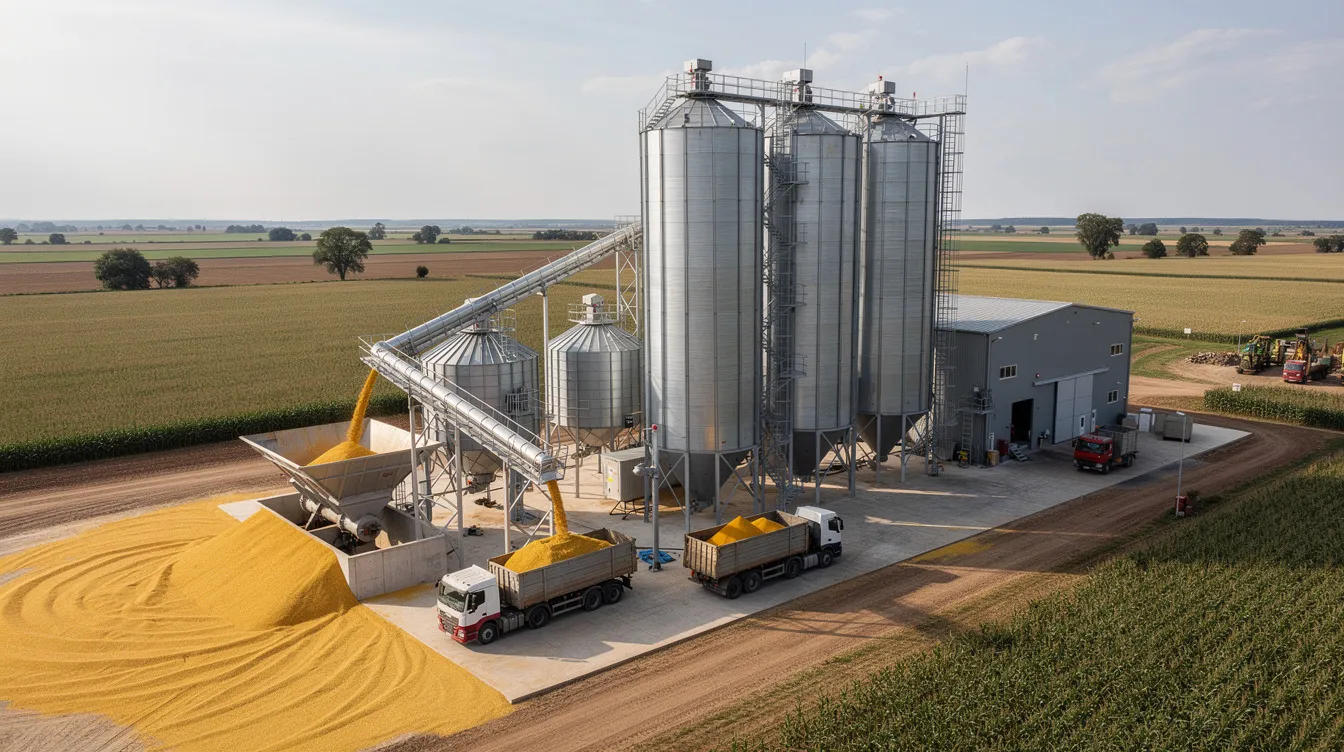
Corn Germ as Raw Material – Availability, Quality & Procurement Economics
A comprehensive project report must detail raw material specifications and procurement strategies. The oil content and physical characteristics of germ from different milling routes differ materially and must not be modelled with a single assumption. Corn germ accounts for 80-85% of operating expenses in production, making procurement economics the single most important variable in the DPR.
| Parameter | Wet-Milled Germ | Dry-Milled Germ |
|---|---|---|
| Oil Content (dry basis) | 40-50% | 15-25% |
| Moisture on Arrival | ~3% (dried) | 10-15% |
| Impurities / Fibre | Low; less bran carry-over | Higher; more endosperm |
| Storage Stability | Perishable; high lipid oxidation risk | More stable but free fatty acids rise if stored hot or moist |
| Typical Indian Sources | Starch plants (Karnataka, Maharashtra, AP) | Flour/grits mills (MP, Bihar, Rajasthan) |
Illustrative ranges only. Lab analysis required for each procurement source.
Procurement contracts should specify moisture, oil content, free fatty acids, impurity limits, sampling frequency (at minimum weekly) and price linkage to maize or oil markets. Supply chain risks include seasonal maize availability, dependence on one or two large suppliers, and competition from other oil extractors or feed manufacturers. For integrated maize wet-milling projects, internal transfer pricing for germ between divisions must be defined in the financial model.
Corn Germ Oil Extraction Process – Technology & Industrial Process Flow
The manufacturing process typically involves cleaning, conditioning, oil extraction, and refining. Corn germ oil extraction uses pressing and solvent methods. The production process begins with germ receiving, followed by preparation (cleaning, drying, flaking to rupture cell walls), then oil extraction, and separate handling of meal and crude oil.
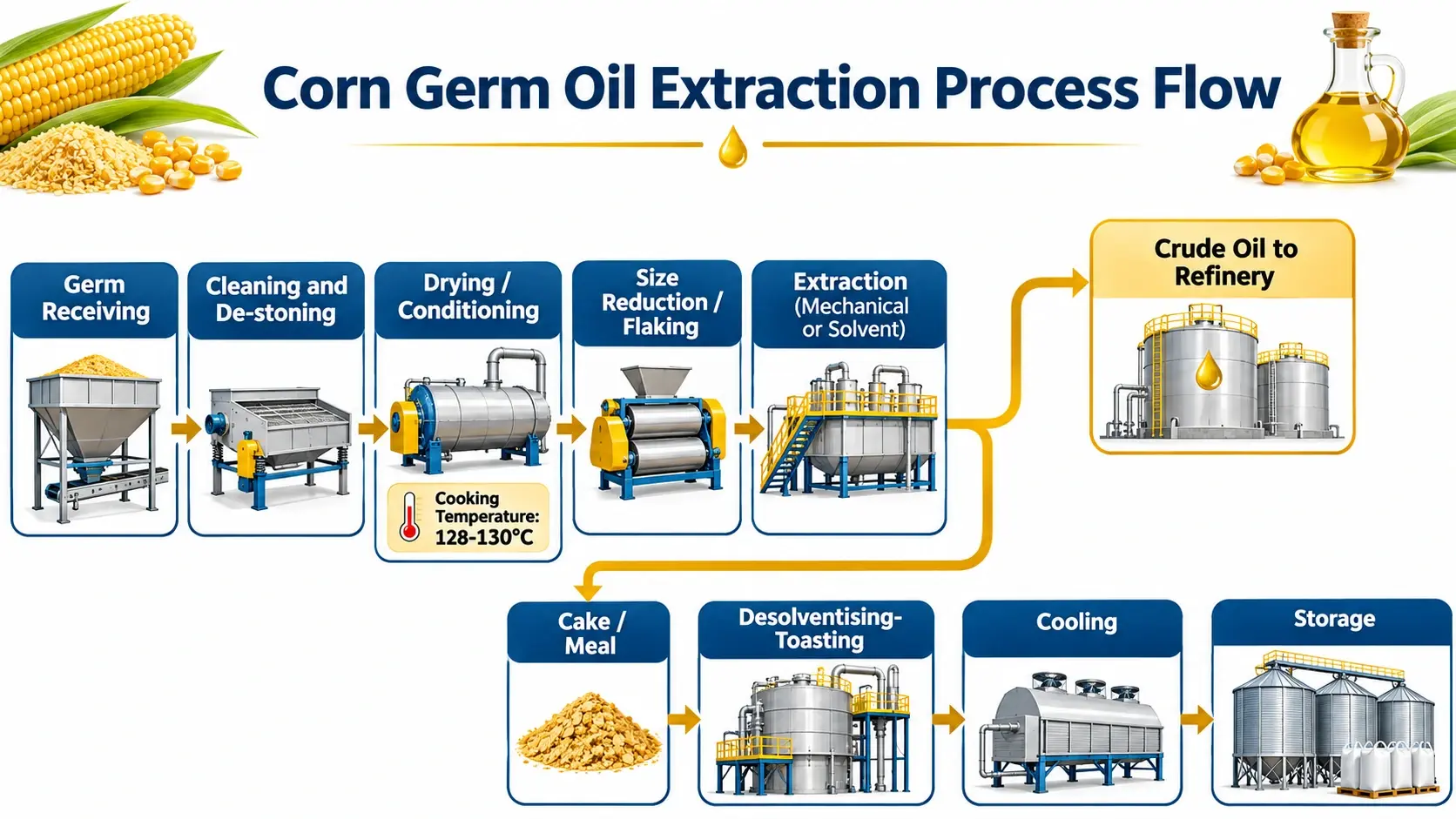
Process Flow: Germ Receiving → Cleaning and De-stoning → Drying/Conditioning (cooking temperature for corn germ is typically 128-130°C) → Size Reduction/Flaking → Extraction (Mechanical or Solvent) → Crude Oil to Refinery; Cake/Meal → Desolventising-Toasting → Cooling → Storage
| Parameter | Expeller Only | Solvent Extraction | Pre-press + Solvent |
|---|---|---|---|
| Capacity Range | Up to 30-50 TPD | 30-500 TPD | 60-500 TPD |
| Capital Expenditure | Lower | Higher | Moderate-High |
| Extraction Efficiency | 80-88% | 95-99% | 95-99% |
| Residual Oil in Meal | 8-15% | Less than 1% | Less than 1-2% |
| Safety Requirements | Standard | Explosion-proof, VOC controls | Explosion-proof, VOC controls |
| MSME Suitability | High | Moderate | Moderate |
Pre-pressing requires a pressure of at least 6.9 MPa. Corn germ oil extraction can achieve over 99% oil yield when using solvent extraction. Equipment manufacturing for solvent plants requires explosion-proof design and vapour recovery systems, adding to both capital expenditure and regulatory compliance costs. For detailed solvent extraction economics, promoters may refer to Project Report Bank’s article on industrial solvent extraction and multi-oilseed processing plant setup.
Corn Germ Oil Refining Process – From Crude Germ Oil to Refined Edible Corn Oil
Crude corn germ oil contains phospholipids, free fatty acids, colour bodies, waxes and volatiles. Corn germ oil refining removes 95% of phospholipids during degumming. The refining steps proceed as: degumming (water or acid) → neutralisation → bleaching with activated clay → winterisation/dewaxing → deodorisation under high vacuum → polishing filtration. Filtration is essential for producing clear and refined corn oil. Refined corn oil has a high smoke point of 232°C, making it suitable for cooking and food processing industry applications. The oil’s vitamin E content and linoleic acid profile contribute to its positioning among healthier edible oils.
Refining losses typically range from 5-7% of crude oil, depending on feedstock quality. Refining by-products (soapstock, spent earth, gums) may have modest scrap value. Promoters processing small volumes might consider toll refining at a large-scale edible oil refinery rather than investing in a captive refinery. While refining principles share common ground with rice bran oil extraction and cottonseed oil processing, corn germ presents distinct wax content and phospholipid profiles that require feedstock-specific process design.
Corn Germ Oil Extraction Plant Capacity Planning & Material Balance
Plant capacity should be defined in TPD of corn germ input, not maize grain or finished oil. A corn oil processing plant can produce 50 tons per day of germ throughput at larger scales. Corn oil manufacturing plants can produce 50,000 to 200,000 MT annually depending on configuration. A corn oil plant can yield 8-10 tons of refined oil daily from a 30-60 TPD germ input plant.
Illustrative Material Balance: 60 TPD Germ Input (Wet-Milled Germ, 40% Oil)
| Description | Value |
|---|---|
| Daily Germ Input | 60 MT |
| Oil Content (dry basis) | 40% → Potential oil = 24 MT |
| Extraction Efficiency (95%) | Crude oil = 22.8 MT |
| Press Cake / Meal Output | ~37.2 MT |
| Refining Loss (6%) | ~1.37 MT |
| Finished Refined Corn Oil | ~21.4 MT/day |
| Annual Germ Requirement (300 days) | 18,000 MT |
| Annual Refined Oil Output (80% utilisation) | ~5,136 MT |
Illustrative assumptions for DPR modelling. Actual values must be calibrated with lab data and vendor guarantees.
Formulas: Annual germ = TPD x operating days. Crude oil = germ x oil content x extraction efficiency. Refined oil = crude oil x (1 minus refining loss). Capacity utilisation typically starts at 60-70% in Year 1 and ramps to 80-90%.
Corn Germ Oil Extraction & Refinery Machinery Requirements
Machinery requirements include extraction, refining, and safety equipment for corn oil production. The setup cost includes machinery, land, and utility requirements as the primary capital expenditure components. Equipment should be sized according to the chosen process route and plant capacity.
Major equipment groups include: raw germ silos, vibratory cleaners and destoners, dryers and cooker-conditioners, flakers, expeller presses, solvent extractor with miscella distillation, desolventiser-toaster, crude oil tanks, degumming and neutralising vessels, bleaching units, deodoriser with vacuum systems, dewaxing chillers, heat exchangers, boilers, cooling towers, ETP, quality control laboratory and packaging lines. For a structured framework on evaluating vendors, see Project Report Bank’s article on edible oil refinery machinery, technology and EPC selection.
Domestic fabricators supply most mechanical equipment at competitive cost. Imported deodorisation or solvent recovery systems may be justified for larger plants but carry foreign-exchange risk and longer delivery timelines. Detailed machinery quotations serve as primary evidence for capital cost estimation in bank loan applications. Personnel training on equipment operation should be built into commissioning contracts.
Corn Germ Oil Extraction & Refining Plant Project Cost in India
Initial investment costs include machinery and facility construction. The total cost comprises fixed capital investment plus working capital margin. Below is an indicative capital cost framework.
Illustrative Project Cost: 60 TPD Corn Germ Extraction + Refining Plant
| Cost Head | Indicative Range (₹ Crore) |
|---|---|
| Land & Site Development | 1.0 – 2.5 |
| Factory Building & Civil Works | 2.0 – 4.0 |
| Germ Preparation Machinery | 0.5 – 1.5 |
| Extraction Plant (Pre-press + Solvent) | 3.0 – 6.0 |
| Refinery & Dewaxing | 2.0 – 4.0 |
| Boilers, Thermic Fluid & Utilities | 1.0 – 2.5 |
| Electricals & DG Set | 0.5 – 1.5 |
| Storage, Tanks & Material Handling | 0.5 – 1.5 |
| Lab, QC, ETP, Fire Systems | 0.5 – 1.0 |
| Pre-operative, IDC, Contingency | 1.5 – 3.0 |
| Total Fixed Capital Investment | 12.5 – 27.5 |
| Working Capital Margin | 3.0 – 6.0 |
| Total Project Cost | 15.5 – 33.5 |
Indicative only. Based on published benchmarks and general industry cost parameters. Not vendor quotations. For detailed methodology, see edible oil refinery project cost and investment.
For reference, a smaller 6 TPD corn germ oil plant has been estimated at approximately ₹5.58 crore total investment with ROI around 21%. An expeller-only configuration requires lower initial investment but delivers lower oil recovery and weaker long term sustainability of margins at scale. Operating costs increase due to inflation and market fluctuations, so expenditure projections should account for annual escalation.
Land, Building, Utilities & Infrastructure for Corn Oil Manufacturing Plant
Land requirements range from 1-2 acres for 30 TPD plants to 4-6 acres for 100 TPD facilities, influenced by factory layout, safety setback distances for solvent storage and expansion provisions. Power load typically ranges from 200 kW to 1 MW depending on capacity. Steam and thermic fluid requirements are substantial for cooking, extraction and deodorisation. Environmental management plans should cover air pollution, wastewater treatment, and solid waste management. Solvent storage areas require explosion-proof classified zones, fire hydrant systems and vapour detection. Proximity to maize germ sources directly reduces distribution costs and freight expenses.
Production Cost & Operating Economics of a Corn Germ Oil Plant
Operating costs driven by raw materials account for 80-85% of expenses in corn oil manufacturing. Variable costs dominate the cost structure.
Net Processing Contribution = (Refined corn oil sales revenue + Germ meal revenue) minus (Raw germ cost + Variable processing expenditure)
This contribution differs from EBITDA, which further deducts fixed overheads, and from net profit, which accounts for interest, depreciation and tax. Cost per kg of refined corn oil is calculated after allocating joint costs between oil and germ meal (by relative sales value or physical quantity) and applying by product credits.
Processing losses (handling, evaporation, refining) should be conservatively modelled. A serious promoter should test price and cost scenarios with plus or minus 5-10% swings in germ price and refined oil realisation to understand robustness of profit margins across market cycles.
Corn Germ Oil Refinery Profitability, ROI, IRR & Break-Even Analysis
Profitability analysis includes gross profit margin, net profit, and break-even analysis. Gross profit margins for corn oil range from 20-30%. Expected ROI for corn oil projects is 25-30% in retail channels, though bulk sales typically generate lower margins. Break-even for corn oil projects can be achieved in 2-3 years under base-case assumptions.
Key formulas: ROI = PAT divided by total project cost. IRR = discount rate where NPV equals zero. DSCR = (PAT + Depreciation + Interest on term loan) divided by (Principal repayment + Interest on term loan). Early-year underutilisation can depress DSCR below lender thresholds. For a broader framework on interpreting these metrics, see edible oil refinery feasibility, ROI, IRR and profitability. As a Chartered Accountant, I present these indicators with transparent assumptions and stated limitations rather than fixed profit guarantees.
Financial Projections, Working Capital, CMA Data & DSCR for Corn Germ Oil Projects
From a bank’s perspective, the bankability of a corn germ oil extraction plant project report is judged by the quality of 7 to 10 year financial projections, CMA Data and DSCR analysis. Required projected statements include P&L, Balance Sheet, Cash Flow, term-loan amortisation, depreciation chart and ratio analysis.
CMA Data captures working capital requirement in the format used by Indian banks. Most lenders look for minimum average DSCR of 1.3 to 1.5 over loan tenure. Working capital components include germ inventory (7-15 days), crude and refined oil stocks, germ meal, chemicals, receivables (30-60 days for institutional buyers) and creditor terms. Project Report Bank’s article on edible oil refinery financial projections, CMA Data and DSCR provides a broader framework adaptable to corn germ oil plants.
Bank Loan, Project Finance & Means of Finance
Typical means of finance: promoter equity 25-30%, term loan 50-70%, working capital credit as applicable. Banks appraise projects based on technical feasibility, financial metrics (DSCR, IRR, break-even), promoter profile and security coverage. Documentation required alongside the DPR includes KYC, net-worth statements, machinery quotations, land documents and evidence of raw material linkages. Term-loan repayment schedules must align with realistic ramp-up timelines. Technically sound projects may fail to obtain finance if working capital is underestimated or projections appear unrealistic.
Regulatory Approvals, Food Safety & Environmental Compliance
Statutory approvals and environmental compliance are crucial for project operations. Quality control is vital for ensuring the safety of corn germ oil for food applications. Key requirements include: FSSAI licence for edible oil manufacturing (with specifications per the FSSAI Compendium), GST registration, factory licence, State Pollution Control Board consents (CTE and CTO), fire safety NOC, boiler inspector approvals and pressure vessel certifications. Solvent extraction units face stricter environmental regulations due to VOC emissions. Product labelling must comply with FSSAI and Legal Metrology rules. Promoters must obtain project-specific legal advice for their state and capacity.
Corn Germ Oil Market Demand, Selling Prices & Revenue Opportunities
The corn oil market spans cooking oil, food processing, personal care and pharmaceutical applications. The mild taste and high smoke point of refined corn oil position it well against competing edible oils like sunflower, soybean and rice bran oil. Stable demand from the food industry and rising demand from health-conscious consumers support the market outlook. Revenue channels include bulk institutional sales, B2B supply to snack and bakery manufacturers, and branded retail. Germ meal sales to animal feed manufacturers provide meaningful by product revenue. Price trends should be modelled with conservative, base and optimistic scenarios rather than hard-coded forecasts. Net ex-factory realisation is lower than retail MRP after accounting for trade margins, freight and taxes. Key players in the international markets include Archer Daniels Midland Company and other multi-commodity processors. Government support for domestic edible oil production through import duty differentials can influence competitiveness. Some corn is also diverted to ethanol production, affecting germ supply dynamics.
Standalone Corn Germ Oil Plant vs Integrated Maize Wet-Milling Facility
| Parameter | Standalone Corn Germ Oil Plant | Integrated Maize Processing Plant |
|---|---|---|
| Raw Material Supply | External procurement; logistics risk | Captive germ; secure supply |
| Investment | Lower (oil section only) | Higher (multi-product complex) |
| Process Complexity | Moderate | Higher; multiple product lines |
| Procurement Dependency | High; supplier concentration risk | Low; internal sourcing |
| Working Capital | Moderate | Higher overall; diversified |
| Revenue Diversification | Limited to oil and meal | Starch, gluten, syrup, oil, meal |
| Risk Profile | Germ supply and price sensitive | Multi-product; lower concentration risk |
| Feasibility Evaluation | Standalone IRR | Incremental IRR of integration |
For an existing maize wet-milling unit, the financial question is incremental IRR of integrating germ oil extraction versus selling germ externally. Transfer pricing at fair value between divisions is essential for credible financial modelling.
Major Project Risks & Financial Sensitivity Analysis
Major risks include germ supply shortages, variability in oil content, refined oil and meal price volatility, extraction equipment underperformance, regulatory changes and commissioning delays. Financial risks include CAPEX overruns, slower ramp-up than projected, working capital shortfalls and interest rate increases.
Sensitivity Directions: Germ cost increase of 5-10% directly compresses contribution and DSCR. Refined corn oil price decrease of 5-10% reduces revenue proportionally. Oil recovery decrease of 1-2 percentage points raises effective production cost per kg. Capacity utilisation falling below planned levels increases fixed cost per unit. Practical mitigation includes multi-sourcing germ, quality contracts with lab testing, conservative machinery design margins, adequate insurance, phased expansion and maintaining reasonable debt-equity ratios. Sensitivity analysis actively informs capacity choice, technology route and capital structure.
Preparing a Bankable Corn Germ Oil Extraction Plant DPR
An investment-grade corn germ oil extraction plant project report integrates technical, market and financial analysis specific to the promoter’s situation. The executive summary of a DPR should include project name, location, and nature of business. Key steps: define the business model, confirm raw material sourcing, conduct technical feasibility, freeze plant capacity, obtain machinery and civil cost estimates, develop material and energy balance assumptions, prepare working capital assessment, build 7-10 year financial projections, calculate DSCR, IRR and break-even, and run sensitivity tests.
A generic downloadable report using outdated numbers cannot substitute for a professionally prepared DPR based on current vendor quotations, local tariffs, actual land cost and prevailing market conditions.
Why Engage Project Report Bank & CA Manish Gugliya for Corn Germ Oil Plant DPR & Financial Feasibility?
Project Report Bank is a Chartered Accountant-led advisory platform specialising in industrial DPRs, project finance advisory, CMA Data and financial modelling. CA Manish Gugliya, with more than 20 years of professional experience, provides customised DPR preparation, financial projections aligned with banker expectations, DSCR-based loan repayment planning and sensitivity analysis for new investors and established businesses.
Process design and performance guarantees must come from qualified engineers and plant suppliers. Financial modelling, bankability assessment and documentation are handled by Project Report Bank.
Serious entrepreneurs planning a corn germ oil plant project or related oil production line should visit www.projectreportbank.com and use the WhatsApp enquiry facility. Share your proposed project location, germ source, technology preference, capacity in TPD and approximate investment range to receive a tailored advisory proposal.
Frequently Asked Questions
What is a realistic starting capacity for a new corn germ oil extraction plant in India?
Many first-time promoters consider 30 to 60 TPD germ-input capacity as a practical starting range. Below 30 TPD, expeller-only configurations with low investment may be more viable. At 60 TPD and above, pre-press plus solvent extraction can justify the higher capital expenditure through improved production efficiency and lower residual oil content in meal. Final capacity should match assured germ availability within competitive logistics radius and the promoter’s business requirements and management bandwidth.
Can a corn germ oil plant process other oilseeds in the same facility?
Subject to appropriate design, some equipment such as the solvent extractor and refinery sections can be configured for multi-oilseed use. Each oilseed has specific preparation and refining requirements, so technical consultants must confirm feasibility before committing capital. The DPR should model economics separately for each feedstock scenario.
How long does implementation typically take?
Allow 2 to 3 months for DPR preparation, finance tie-up and regulatory approvals, followed by 6 to 9 months for civil construction, machinery erection and commissioning for mid-sized plants. Solvent extraction projects may require additional time for safety clearances and performance trials. Realistic implementation schedules must be built into financial projections and interest during construction calculations.
Is branded retail necessary for project viability?
A corn oil plant can operate viably with bulk or institutional sales in early years if acceptable margins and offtake arrangements are secured. Branded retail can enhance final product margins but requires marketing investment, working capital and distribution infrastructure. Many promoters phase in retail after stabilising bulk operations.
Can Project Report Bank assist with expansion of an existing corn oil processing plant?
Project Report Bank prepares expansion DPRs, evaluates incremental investment economics using historic performance data and revised market strategies, and supports refinancing or additional term loans. Such assignments review current plant bottlenecks and ensure incremental IRR and DSCR are acceptable to both promoters and lenders.
Conclusion – Evaluating Corn Germ Oil Extraction Plant Financial Viability
The financial viability of a corn germ oil extraction and refining plant in India depends on assured access to quality corn germ, appropriate extraction and refining technology, disciplined project cost management, realistic working capital planning and robust marketing arrangements for both oil and germ meal. Producing corn oil profitably requires that operating assumptions in the DPR reflect actual germ oil content, achievable recovery rates and market-aligned selling prices rather than aspirational targets.
A professionally prepared, customised corn germ oil extraction plant project report, covering detailed cost estimation, material balance, 7 to 10 year financial projections, CMA Data, DSCR and sensitivity analysis, is essential before finalising machinery orders or signing finance agreements. From a project finance perspective, I encourage promoters and new investors to treat the DPR as a decision-making tool, not a formality. Engage Project Report Bank at www.projectreportbank.com to objectively assess bankability, structure project finance and build a credible case for lenders and investors.
CA Manish Gugliya FCA, DISA (ICAI) More than 20 years of professional experience in project reports, financial projections, CMA Data, project finance and business advisory.