An eye hospital project report – commonly referred to as a DPR – is a structured document that presents the proposed hospital’s concept, infrastructure, medical equipment, project cost, means of finance, expected patient volumes, revenue, expenses, financial projections, working capital and loan repayment capacity in a format suitable for bank appraisal. This complete guide brings all these components together and directs you to nine specialised supporting guides for deeper analysis of each subject.
Key Takeaways
- An Eye Hospital Project Report (DPR) is a comprehensive document covering hospital concept, infrastructure, ophthalmology equipment, project cost, means of finance, revenue model, operating expenses, working capital, profitability analysis and loan repayment capacity – typically over a 5–7 year projection period.
- Banks and NBFCs use the DPR for term-loan appraisal in India, but submission of a report does not guarantee sanction. Financial feasibility, DSCR, collateral, credit history and promoter profile all influence the final decision.
- Every assumption must connect logically – capacity drives patient volume, patient volume drives revenue, revenue and expenses drive cash flow, and cash flow determines DSCR. Copy-paste figures from another hospital should be avoided.
- This hub article provides the complete overview, while nine detailed guides on ProjectReportBank cover project cost, equipment, means of finance, revenue model, financial projections, working capital, DSCR, bank finance and bank assessment individually.
- The guidance is written from the perspective of CA Manish Gugliya (ProjectReportBank), focusing on practical DPR preparation, financial analysis and bank appraisal in the Indian healthcare context.
Explore Eye Hospital DPR Guides
Explore our complete series on Eye Hospital project planning, financial analysis and bank finance.
Explore Hospital Project Report Guides
Explore our complete Hospital Project Report guides covering general hospitals, multi-speciality hospitals, cancer hospitals, diagnostic centres and eye hospitals.
What Is an Eye Hospital Project Report / DPR?
An Eye Hospital Project Report is a complete written presentation of a proposed eye hospital’s concept, infrastructure, ophthalmology equipment, staffing, project cost, funding structure, revenue model, operating expenses, profitability and loan repayment capacity. In India, this detailed project report is typically structured over a 5–7 year projection period and is the primary document submitted to banks for term-loan appraisal.
Unlike a brief eye hospital business plan that summarises the opportunity in broad strokes, a DPR is more granular and bank-focused. It includes structured financial statements, documented assumptions, a risk assessment section and sensitivity analysis that make it suitable for credit-committee review.
A proper Eye Hospital DPR combines three dimensions:
- Technical and clinical aspects – services offered, OT setup, diagnostics, hospital design, patient flow
- Operational aspects – workflow, staffing policies, infection control protocols, patient follow-up strategies
- Financial aspects – project cost, means of finance, cash flow, DSCR, break-even analysis
These must be tied together coherently. An eye hospital project report in India must be based on the specific site, capacity, equipment configuration and local market – not on generic templates or figures borrowed from a different hospital or city. This guide focuses on bankable DPR structure, while detailed cost numbers, ophthalmology equipment lists and projection formats are available in separate linked guides.
Why Is an Eye Hospital Project Report Required for a Bank Loan?
Banks, NBFCs and government-backed schemes insist on a structured Eye Hospital DPR for term-loan and project-finance proposals, particularly where the investment in medical equipment and infrastructure is substantial. A detailed project report is essential for hospital funding – banks require a DPR before approving loans for hospital projects because it answers every question a credit committee needs to evaluate.
The DPR should address:
- Who are the promoters and what is their ophthalmology or healthcare background?
- Where will the eye hospital be located – city, locality, catchment population, competing facilities?
- What services are proposed – OPD, cataract surgery, retina, glaucoma, LASIK, diagnostics, optical, pharmacy – and at what scale?
- What is the total project cost including land, building, interiors, equipment, pre operative expenses, working capital margin and contingencies?
- How much will be funded by promoter contribution versus bank term loan or equipment finance?
- What is the proposed working capital arrangement?
- How many patients and surgeries are projected, at what tariff, across how many years?
- What are the projected operational costs – salaries, consumables, power, rent, maintenance?
Lenders analyse whether projected income and cash flow are sufficient to service interest and principal while leaving reasonable margin for contingencies and future expansion. A DPR is also required for regulatory approvals in many contexts.
Even a very detailed Eye Hospital DPR for bank loan does not automatically guarantee approval. Final sanction depends on the lender’s internal credit policy, collateral, promoter credit history, overall banking relationship and risk appetite at the time of appraisal.
For a step-by-step view of the loan process, facility types and documentation, refer to the dedicated guide on Eye Hospital project finance and documentation.
What Should an Eye Hospital DPR Contain?
A bankable Eye Hospital detailed project report is usually 60–120 pages and follows a logical sequence from promoter background to financial feasibility. Here is a checklist-style overview of typical contents:
Promoter & Background:
- Executive Summary – 2–3 page snapshot of project concept, capacity, key services, total project cost, means of finance, projected turnover, profitability and DSCR
- Promoter Profile – qualifications, ophthalmology or healthcare experience, existing practice, financial strength and net worth
- Project Background – need for specialized care in the chosen location, service gaps, demographic and epidemiological factors
Location & Infrastructure:
- Location and Site Details – address, catchment area, accessibility, lease or freehold status, approximate built-up area and space requirements
- Hospital Capacity & Services – consultation rooms, OTs, day-care beds, inpatient beds, diagnostics and ancillary services such as optical and pharmacy
- Hospital Design & Infrastructure – floor-wise allocation, OT complex, sterilisation, patient flow, waiting areas and compliance with local building norms
Equipment & Human Resources:
- Medical & Ophthalmic Equipment Plan – major categories (slit lamps, phaco machines, microscopes, OCT, lasers) with high-level cost
- Human Resource Plan – key doctors, visiting consultants, optometrists, nursing and OT staff, technicians, administrative staff and estimated salary outlay
Financial Structure:
- Project Cost Estimate – detailed breakdown into land/building, interiors, equipment, furniture, IT, pre-operative expenses, deposits and margin for working capital
- Means of Finance – promoter contribution, term loan, equipment finance, other sources and overall debt-equity structure
- Revenue Model & Key Assumptions – OPD volumes, surgery volumes, diagnostic tests, optical/pharmacy sales, tariffs and capacity utilisation buildup over 5–7 years
- Operating Expenses – salaries, consumables, utilities, maintenance, marketing and other overheads
Feasibility & Risk:
- Working Capital Assessment – inventory levels, receivable cycles, cash/credit mix, proposed bank limits
- Financial Projections – projected Profit & Loss, Balance Sheet, Cash Flow, key ratios, break-even analysis and DSCR calculations
- Risk Analysis & Sensitivity – impact of lower patient volumes, delayed ramp-up, higher costs or interest-rate changes
- Implementation Schedule – timelines for premises readiness, equipment installation, staff onboarding and commissioning
- Supporting Documents – KYC, ITRs, quotations, layout plans, licences in process and existing financial statements
The rest of this article expands on these components at an overview level, with links to specialised guides for deeper treatment.
Promoter Profile and Professional Background
In healthcare lending, particularly for ophthalmology hospital projects, promoter profile often carries more weight than in many other MSME projects. Clinical quality and reputation directly influence patient volume and, by extension, financial success.
For an ophthalmologist-promoter, the DPR should cover:
- Degrees (e.g., MS Ophthalmology, DNB, FRCS), year of qualification and Indian registration details (NMC/state medical council)
- Clinical experience – years of practice, subspecialties (cataract, retina, cornea, glaucoma, refractive surgery), approximate annual surgeries handled
- Experience with similar setups – previous role in a corporate eye hospital, chain or independent practice
- Present practice, visiting-consultant positions and referral relationships that may support patient volumes at the new hospital
For non-medical or mixed promoter groups, relevant experience in healthcare management, hospital administration or business execution should be clearly separated from clinical responsibilities.
Financial strength matters equally – existing businesses, net-worth summary, banking and repayment history (without disclosing confidential data publicly). Role allocation among promoters (clinical head, operations head, finance) reassures banks that management responsibilities are clearly thought through.
Avoid overstating qualifications or claiming unrealistic patient following. Lenders may cross-check through existing financial statements and bank-account behaviour. A strong promoter profile improves lender comfort but does not override weak financial feasibility or an unviable location.
Eye Hospital Project Concept, Capacity and Services
The concept note in an Eye Hospital DPR should define exactly what kind of healthcare facility is being proposed – for example, a 10-bed day-care cataract centre in Jaipur, a 25-bed comprehensive ophthalmology hospital in Lucknow, or an ambulatory LASIK centre in Pune.
Positioning and Target Segment:
- Target patient segment – middle-income, insurance/TPA backed, corporate tie-ups, government schemes where applicable
- Positioning – value-for-money, mid-range, or premium eye care services, aligned with tariff assumptions in the revenue model
- Market analysis assesses local eye care needs and competitor analysis, identifying the competitive landscape and any significant gap in available services
Clinical Components:
- OPD & Refraction – number of consultation rooms, refraction lanes, average daily OPD capacity
- Diagnostics – OCT, fundus photography, visual fields, biometry, pachymetry, B-scan and basic diagnostic labs
- Operation Theatres – number and type (major OT for cataract and vitreoretinal work; minor OT/procedure room for injections, lasers, minor procedures)
- Surgical services – cataract removal through phacoemulsification, retina surgeries, squint correction, cornea, glaucoma (including minimally invasive glaucoma surgeries which are becoming more common), oculoplasty and vision correction procedures
- Eye hospitals must include outpatient, diagnostic, and surgical services to function as comprehensive care centres
Operational Model:
- Day-care and inpatient facilities – whether the project focuses on day-care surgeries only or includes inpatient beds for complex procedures and post-operative care
- Ancillary revenue streams – on-site optical outlet and pharmacy, with clarity on whether these are owned by the hospital entity or run through a related entity
- Eye hospitals are adopting hybrid models for community outreach, and tele-ophthalmology platforms are expanding service accessibility to underserved areas, addressing visual impairments in developing countries
The DPR should match capacity (OTs, chairs, diagnostic bays) with projected patient volumes, staffing numbers with hours of operation, and services offered with proposed equipment. A short narrative describing a typical day in the hospital’s operation – from patient arrival through registration, refraction, consultation, diagnostics, OT scheduling, and discharge – demonstrates that workflows have been practically thought through, ensuring patient safety and a good patient experience.
Eye Hospital Project Cost – Overview of Investment
Eye Hospital Project Cost in India can range from around ₹1–2 crore for a modest leased-premise day-care centre to ₹10–20 crore or more for a larger multi-OT, multi-specialty eye hospital with advanced equipment and in-house diagnostics. Actual numbers are entirely project-specific.
Eye hospitals typically require 600–1000 sq ft per bed, and construction costs for eye hospitals start from approximately ₹2,500 per sqft, varying substantially between Tier-I and Tier-III cities.
Major cost heads the DPR should summarise:
- Land – purchase cost or long-term lease deposit where applicable
- Building / Civil Works – new hospital construction or renovation, including structural changes, fire-safety compliance and exterior work
- Interiors & Furnishing – modular OT interiors, patient areas, consulting rooms, nursing stations, optical showroom, flooring and partitions
- Medical Equipment – diagnostic equipment, OT equipment, lasers, microscopes, sterilisation equipment, surgical instruments and other ophthalmic devices
- Furniture & Fixtures – OPD furniture, waiting-area seating, ward beds (if any), storage and OT furniture
- IT & Software – computers, networking, Hospital Information System (HIS), EMR, PACS, accounting software
- Electrical & HVAC – dedicated OT air conditioning, UPS, DG sets, electrical panels, lighting, cabling
- Pre-operative & Preliminary Expenses – architect and consultant fees, legal/compliance costs, project-report preparation, trial runs and staff training before launch
- Deposits & Contingencies – refundable deposits for electricity, water, rentals and a reasonable contingency margin (typically 5–10%) to manage cost overruns
The DPR must also embed margin for working capital within total project cost, where the bank requires part of the initial working capital to be funded as long-term margin.
For a line-by-line investment breakdown with example budgets and cost ranges, refer to the complete Eye Hospital project cost guide.
Eye Hospital Equipment Requirement and Cost
In an eye hospital, high-value ophthalmology equipment often represents 35–60% of the non-land project cost and strongly influences both service capability and revenue potential. High capital costs can affect acquiring and maintaining ophthalmic equipment, making this section of the DPR critical.
Major equipment categories the DPR should summarise:
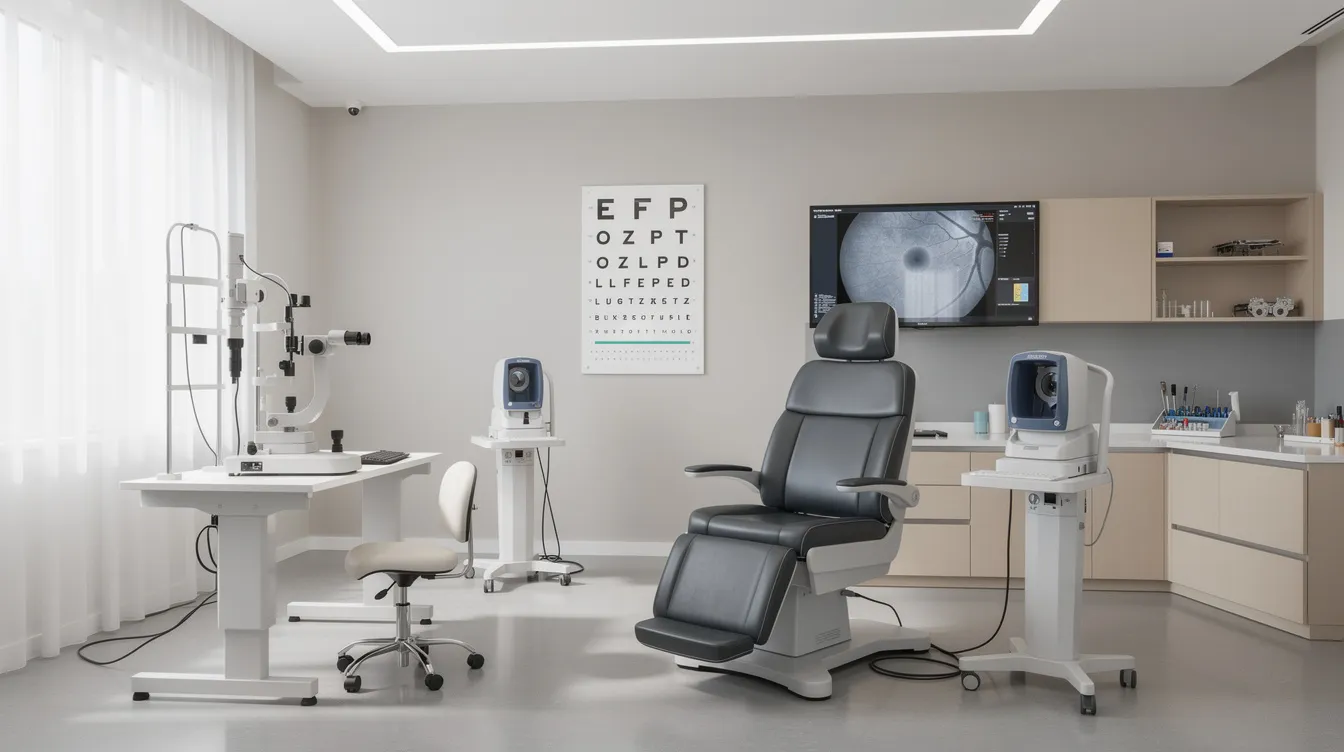
- Outpatient & Refraction – slit lamps, autorefractors, keratometers, trial lens sets, lensometers, visual-acuity charts
- Diagnostic Imaging – optical coherence tomography (OCT), fundus camera, FFA capability, visual field analysers, retinal imaging devices, pachymeter, specular microscope
- Operation Theatre – operating microscopes, phacoemulsification machines, vitrectomy machines, OT tables, ceiling lights, anaesthesia workstations; surgical theaters should be designed for optimal efficiency
- Lasers & Procedures – YAG laser, green laser, excimer or femtosecond laser (femtosecond lasers are used for cataract surgery advancements); technology requirements should specify essential medical devices like OCT and phaco machines
- Sterilisation & Support – autoclaves, ETO sterilisers, washer-disinfectors, instrument trolleys
- General Hospital Equipment – patient monitors, suction machines, crash cart, basic lab equipment
- IT & Connectivity – EMR terminals in OPD and OT, server hardware, backup and imaging storage
AI-powered diagnostic tools are emerging in eye hospitals, enhancing screening accuracy for conditions like diabetic retinopathy and glaucoma.
Equipment costs for reference: phaco machines range from approximately ₹18–80 lakh, LASIK excimer lasers from ₹65 lakh to ₹3 crore, and vitrectomy machines from ₹35 lakh to ₹1.6 crore depending on brand and configuration.
The DPR must ensure that planned surgeries and diagnostics in the revenue model match installed equipment and OT capacity. Over-equipping far beyond projected workload leads to unsustainable debt, while under-equipping while projecting high-end surgeries is an inconsistency lenders will notice.
For detailed brand-wise examples and typical equipment combinations, refer to the ophthalmology equipment required for an Eye Hospital guide.
Means of Finance for an Eye Hospital Project
In any Eye Hospital DPR, the total project cost must exactly equal the total means of finance. This matching is closely checked by bankers.
Components typically covered:
- Promoter Contribution – capital introduced from savings, internal accruals of existing practice, sale of non-core assets or unsecured loans from promoters/directors. Most banks prefer a debt-to-equity ratio of 70:30 for healthcare projects, meaning promoter contribution of at least 25–30% of project cost.
- Term Loan – medium to long-term bank loan covering building, interiors, equipment and other fixed assets, normally with repayment tenure of 5–10 years. Interest rates for well-structured healthcare projects currently range around 9.5–11%.
- Equipment Finance – specific loans or leases for major medical equipment, if structured separately from the main term loan
- Subsidy / Grant / Soft Loans – if any state or central government scheme or CSR-linked grant is genuinely applicable
- Working Capital Facilities – cash credit, overdraft against receivables; these are separate from term loans but part of the overall funding arrangement
- Unsecured Loans / Quasi Equity – clearly disclosed loans from relatives or shareholders that are subordinated to bank finance where permitted
Documenting the source of promoter contribution is essential because banks often ask for proof that equity is real and not fully borrowed.
Over-leveraging (very high dependence on term loan) can lead to DSCR problems, while too little debt may underutilise available banking support. A balanced structure is needed.
For detailed funding structures and lender expectations, refer to the guide on how to structure the means of finance for an Eye Hospital.
How to Prepare the Eye Hospital Revenue Model
Realistic revenue modelling is the most sensitive and scrutinised part of an Eye Hospital DPR. Revenue projections should be based on realistic assumptions – built from patient volumes and procedure mix, not assumed as flat annual growth rates.
Key revenue streams to identify separately:
- OPD consultation fees – number of new and follow-up patients per day, days of operation per month, average consultation fee
- Cataract surgeries – number per month by category (standard monofocal, premium IOL, complex cases) and average package revenue
- Other ophthalmic surgeries – retina, cornea, glaucoma, squint, oculoplasty, each with conservative volume and tariff assumptions
- Diagnostic tests – OCT, fundus photography, biometry, visual field tests with expected daily/weekly count
- Procedures & injections – intravitreal injections, laser procedures, minor OT work
- Optical store revenue – conversion rate from OPD to spectacle sales (including contact lenses), average bill size
- Pharmacy revenue – estimate based on percentage of surgical and OPD prescriptions
Modelling discipline:
- Use a ramp-up curve – 25–40% capacity utilisation in Year 1, gradually rising over 3–5 years rather than assuming near-maximum utilisation from day one
- The number of surgeries must be feasible given OT time, staffing and equipment
- Tariffs should match positioning, location and competition. Community outreach programs can improve access to eye care services and support long-term patient volume growth
- Growth rates should be moderate and defendable
The eye care market in India is estimated at ~₹19,000 crore for FY2025, with a projected CAGR of ~11.4%, indicating strong growth drivers – but individual hospital revenue depends on execution, not on industry trends alone.
For step-by-step revenue-modelling logic and line-wise templates, move to the realistic Eye Hospital revenue projections guide.

Operating Expenses of an Eye Hospital
Underestimating expenses is one of the most common reasons an otherwise promising Eye Hospital Project Report appears unrealistic to bankers. Staffing plans should include doctors, nurses, and administrative staff, and all recurring costs need detailed, category-wise costing.
Major recurring expenses:
- Medical & Professional – salaries of ophthalmologists on payroll, retainers for visiting consultants, optometrists, OT assistants, nursing staff
- Non-medical Staff – reception, billing, administration, housekeeping, security, managers and support services staff
- Consumables – lenses, disposables, surgical packs, medicines and diagnostic consumables used per surgery/visit
- Rent or Lease – market-appropriate rent with realistic escalation assumptions
- Utilities – electricity (particularly for OTs and air conditioning), water, internet, telephone
- Repairs & Maintenance – equipment AMC, building maintenance, OT fumigation and upkeep
- IT & Software – HIS licences, cloud storage, EMR, accounting software subscriptions
- Marketing & Outreach – digital marketing, local screening camps, CME programmes, corporate tie-ups
- Insurance & Compliance – professional indemnity, asset insurance, statutory fees
- Administrative Overheads – printing, stationery, bank charges, consultancy fees, statutory audit
- Depreciation & Interest – though accounting items, they affect reported profit and loan-eligibility analysis
Patient follow-up strategies are essential for ensuring compliance with post-operative care, and their cost should be budgeted. Biomedical waste management is required to maintain regulatory compliance in healthcare facilities. Infection control protocols are crucial for preventing complications in eye surgeries and carry their own recurring cost.
Operating costs are projected to increase significantly by the fifth year due to salary escalation, inflation and equipment maintenance cycles. Use market-based salary and cost benchmarks for the specific city rather than using arbitrary low numbers to inflate profitability. Quality frameworks should include indicators for surgical outcomes and customer satisfaction.
Eye Hospital Working Capital Requirement
Working capital is the capital required to run the day-to-day operations of the eye hospital – primarily inventory, receivables and minimum cash balance. Even a profitable hospital can face cash crunch without adequate working capital planning.
Key elements to quantify:
- Inventory of medicines & consumables – average stock in days for lenses, drugs, disposables and diagnostic consumables
- Optical & pharmacy stock – spectacle frames, lenses and medicines with realistic inventory cycles
- Receivables – credit period extended to corporates, insurance/TPA and institutional clients; typical settlement timelines
- Staff salaries – monthly salary outgo must be funded on time, even if collections are delayed
- Operating expenses – utilities and other recurring costs paid ahead of or on schedule
- Minimum cash & bank balance – buffer for day-to-day needs and unforeseen expenses
The DPR should estimate working capital requirement for a typical operating cycle and show how much will be funded through bank limits versus promoter margin. Banks may insist on a margin of 20–30% of assessed working capital funded from long-term sources, which should be built into the project cost.
Ignoring working capital or assuming “no working capital required because most patients pay cash” weakens the DPR, particularly where optical, pharmacy or institutional business is significant.
For detailed calculation methodology, refer to the working capital assessment for an Eye Hospital guide.
Financial Projections Required in an Eye Hospital DPR
Eye Hospital Financial Projections convert all assumptions about cost, finance, revenue and expenses into structured financial statements. Financial projections cover a period of five to seven years and form the core of every financial statement presented in the DPR.
Main statements to prepare:
- Projected Profit & Loss Account – year-wise revenue, expenses, depreciation, interest and profit before/after tax
- Projected Balance Sheet – assets (fixed assets at written-down value, current assets) and liabilities (term loans, working capital, equity) at each year end
- Projected Cash Flow Statement – operating, investing and financing cash flows, showing whether the hospital generates enough cash to meet obligations
Supporting schedules:
- Depreciation schedule – aligned with asset categories and applicable tax rules
- Interest calculations – based on opening and closing loan balances, using realistic interest rates
- Loan repayment schedule – instalment amounts, moratorium considerations and step-up structures where applicable
- Profitability indicators – EBITDA margin, net profit margin, return on capital employed
- Break-even analysis – at what revenue level or patient load the eye hospital covers its fixed and variable costs
Internal consistency is paramount. Revenues must map back to the revenue model. Expenses should be traceable to human resources, consumables and operations-planning sections. Interest and principal must reconcile with the means-of-finance section.
For detailed templates, example projection formats and stepwise methodology, see the guide on preparing financial projections for an Eye Hospital.
DSCR and Loan Repayment Capacity
The Debt Service Coverage Ratio measures how comfortably the projected cash profits of the eye hospital can cover its annual term-loan interest and principal obligations.
DSCR calculation elements:
- Numerator – cash accrual or funds available for debt service (profit after tax + depreciation + non-cash charges, sometimes adjusted for drawings/dividends as per lender practice)
- Denominator – total debt service for that year (interest on term loans + principal instalments due during the year)
A DSCR of 1.25 is generally acceptable for banks, though risk appetite, collateral coverage and promoter profile impact what a given lender finds acceptable. There is no single universally applicable “standard DSCR” for all banks and all times.
Key considerations:
- Year-wise DSCR may fluctuate, often being tighter in early years when instalments are high and operations are still ramping up
- Average DSCR across the projection period is typically used as an overall indicator of repayment comfort
- A project can be profitable on paper yet have poor DSCR because of heavy repayment obligations or slow cash conversion – this is why DSCR is critical in the Eye Hospital DPR for bank loan
- Lenders may stress-test DSCR by assuming slightly lower revenues or higher costs to check if the hospital can still repay comfortably
For numerical examples and stepwise DSCR computation, see the guide on assessing Eye Hospital loan repayment capacity.
How Banks Assess an Eye Hospital Project for Term Loan
Different banks and NBFCs may use different formats and checklists, but most look for the same fundamentals: credible promoters, realistic projections and adequate loan repayment capacity backed by security where applicable.
Typical appraisal dimensions:
- Promoter Assessment – qualifications, track record, credit bureau scores, history of existing loans and banking relationships
- Project Rationale – need for the eye hospital in the chosen location, gaps in services, potential referral base, the competitive edge the promoter brings
- Project Cost Reasonableness – whether quotations match market rates and whether any major item seems over- or under-stated; estimated costs should be internally consistent
- Means of Finance – sufficiency of promoter contribution, sanity of debt-equity structure and source of own funds
- Revenue Assumptions – plausibility of patient footfall, OPD and surgery volumes relative to capacity, competition and promoter brand strength
- Operating Costs – realistic salary structure, rent and consumables, with adequate provision for inflation
- Financial Ratios – DSCR, interest-coverage ratio, profitability margins and projected leverage
- Security & Collateral – primary security (hospital assets) and any additional collateral as per bank norms
- Existing Liabilities – whether promoters or group entities are already heavily leveraged
- Risk Factors – dependence on a single key surgeon, regulatory changes, technology obsolescence, environmental impact; and whether the DPR has acknowledged and mitigated these risks
Banks generally look for consistency between the story of the project and its financial numbers. A feasibility study that demonstrates clear vision on hospital functions, efficient operations and sustainable practices will have a competitive edge.
For a detailed view of the appraisal lens used by lenders, including common queries raised during credit committee discussions, read the guide on bank appraisal of an Eye Hospital project.
Documents Commonly Required Along With an Eye Hospital DPR
Each lender has its own checklist, but most eye hospital bank loan project reports in India are expected to be supported by standard KYC, financial and project documents.
Promoter- and entity-related:
- KYC – PAN, Aadhaar, photographs, address proof for all individual promoters and guarantors
- Constitution documents – partnership deed, LLP agreement, memorandum and articles of association, or proprietorship registration
- Professional documentation – medical registration certificates, postgraduate degree certificates of ophthalmologists
Financial documents:
- Income tax returns for last 2–3 years of promoters and existing business entities
- Audited/certified financial statements of existing practice or other businesses (P&L, Balance Sheet)
- Recent bank statements (usually 6–12 months) reflecting business activity and average balances
Project-related documentation:
- Property documents – ownership papers, title deeds, lease agreement drafts, sanctioned plan copies
- Quotations & proforma invoices – for building works, interiors and medical equipment
- Project cost & means of finance statement – signed by promoters or consultant, tallying with the DPR figures
Licences and approvals:
- A hospital needs multiple approvals before starting operations. Common approvals include operational licensing and safety compliance. Regulatory approvals vary based on location and hospital type.
- Essential registrations – clinical establishment registration, pollution clearance where needed, fire NOC status and any local municipal approvals in process
- Existing loan details – sanction letters and repayment schedules for current borrowings
This list is indicative. Borrowers should obtain the latest document checklist from their specific bank or financial institution before submitting the DPR.
Common Mistakes in an Eye Hospital Project Report
Many technically sound eye-care concepts face delays or rejections because the project report appears inconsistent or over-optimistic – not because the idea is inherently bad.
Frequent mistakes include:
- Overstated patient volumes – projecting unrealistically high OPD and surgery numbers in Year 1 without a clear brand, referral network or timeline for building visibility
- Ignoring ramp-up – assuming near-stable, high occupancy from day one instead of gradual build-up over 24–36 months
- Underestimating salaries – using salary levels that do not match the city or expecting senior ophthalmologists at below-market rates; some promoters reference salary structures from medical colleges which are not comparable to private health care
- Missing working capital – adding only fixed-asset costs without budgeting for 6–9 months of working capital margin
- Equipment–service mismatch – projecting advanced retinal or LASIK procedures without including necessary surgical equipment, OT configuration or surgical theaters in the cost
- Inconsistent means of finance – project cost and funding structure not matching, or promoter contribution being vaguely explained as “to be arranged”
- Incorrect loan repayment modelling – assuming unrealistically long moratoriums or very low instalments, leading to wrong DSCR calculations
- Copy-paste DPRs – using another hospital’s numbers or template without adapting to local pricing, capacity or promoter strengths; experienced credit officers identify this quickly during comprehensive analysis
- Ignoring risk discussion – presenting only best-case projections without showing sensitivity to lower revenues or higher costs; a proper detailed analysis of downside scenarios is essential
Quality assurance in DPR preparation means treating it as a planning tool first and as a loan document second. The most credible reports demonstrate quality standards throughout – every number has an explanation.

New Eye Hospital vs Expansion of Existing Eye Hospital
Lenders differentiate between greenfield (new) Eye Hospital projects and brownfield hospital expansion or modernisation of an existing practice.
New Hospital
- Projections rely heavily on market study – justified based on catchment population, competition and service gaps rather than past financials. An important factor is demonstrating unmet demand for eye health services.
- Emphasis on conservative Year-1 and Year-2 volumes with a clear marketing and outreach plan
- Higher execution risk – more emphasis on promoter’s experience, project management capacity and availability of equity
- Setting up a new hospital involves establishing efficient operations from scratch, including general surgery protocols if the hospital is a bed hospital with broader capabilities
Existing Hospital Expansion
- Historical OPD volumes, surgery numbers and revenue trends from past 3–4 years support assumptions
- Clear description of incremental capacity – additional OTs, diagnostic machines or beds and expected incremental patient load
- Historical profitability and repayment history improve lender comfort if reasonably strong
- Projections should be an evolution from historical performance, not a complete departure; bankers will compare post-expansion revenue ratios with historical ratios
For both new and expansion projects, DSCR and cash-flow analysis remain central to sanction decisions. The hospital planning approach differs, but the financial rigour expected in the DPR is identical.
Example Flow of an Eye Hospital DPR
This narrative roadmap shows how a well-prepared Eye Hospital DPR logically flows from concept to financial feasibility:
- Promoter & Concept – define who is setting up the hospital, where, and what services and capacity are planned
- Infrastructure & Equipment – decide number of operation theaters, diagnostic units, optical/pharmacy, and estimate corresponding capital cost
- Project Cost – prepare a detailed cost sheet covering building, interiors, ophthalmology equipment, IT, preliminary expenses and working capital margin
- Means of Finance – lay out promoter contribution, term loan, equipment finance and working capital limits, ensuring the total exactly equals the total project cost
- Revenue Model – derive OPD visits, surgeries and other income from capacity, promoter network and local demand, with clear tariffs and ramp-up
- Operating Expenses – estimate salaries, consumables, rent, utilities and other overheads based on realistic benchmarks and business requirements
- Financial Projections – convert revenue and cost assumptions into P&L, Balance Sheet and Cash Flow over 5–7 years
- Loan Repayment & DSCR – calculate year-wise and average DSCR, check if the term-loan structure is sustainable and refine assumptions where necessary
- Feasibility Summary – conclude on financial viability, sensitivity to downside scenarios and promoter’s ability to manage the project for future expansion
Changing a major assumption at any stage – such as reducing project cost or altering repayment tenor – must be flowed through the entire chain to keep the DPR internally consistent. This is what distinguishes an operational efficiency-focused DPR from a generic document.
Which Eye Hospital Guide Should You Read?
This hub article provides the big picture. Nine supporting guides on ProjectReportBank cover specific aspects in much deeper detail:
| If You Want to Understand | Recommended Guide |
|---|---|
| Total investment required | Eye Hospital Project Cost in India |
| Equipment requirement | Eye Hospital Equipment List & Cost |
| Promoter contribution and loan structure | Eye Hospital Project Cost & Means of Finance |
| How hospital income is projected | Eye Hospital Revenue Model |
| P&L, cash flow and balance sheet projections | Eye Hospital Financial Projections for DPR |
| Day-to-day funding requirement | Eye Hospital Working Capital Requirement |
| Ability to repay the bank loan | Eye Hospital DSCR & Loan Repayment Capacity |
| Loan documentation and project finance | Bank Loan for Eye Hospital |
| How lenders evaluate the proposal | How Banks Assess an Eye Hospital Project for Term Loan |
Bookmark this hub and use these linked guides as a complete toolkit for preparing an Eye Hospital DPR for bank loan.
How All Parts of an Eye Hospital DPR Are Connected
In a credible Eye Hospital DPR, no section stands alone. Infrastructure, equipment, capacity, revenue, expenses, working capital, borrowing and DSCR must all support one another logically.
Chain 1 – Revenue side:
- Hospital design & equipment → determines maximum patient handling and surgical capacity
- Capacity → sets upper limit on realistic patient volumes in the revenue model
- Patient volumes & tariffs → determine projected revenue by service line
Chain 2 – Profitability and repayment:
- Revenue & expense assumptions → produce operating profit and net profit
- Operating profit + depreciation → determine cash accrual available each year
- Cash accrual → is compared with term-loan instalments and interest to calculate DSCR
Chain 3 – Cost and finance:
- Infrastructure + equipment + working capital margin → together form total project cost
- Project cost → must be exactly matched by means of finance (equity + bank finance + other long-term sources)
- Loan amount & tenure → feed into interest and repayment, which in turn affect DSCR and cash flow
Practical implications:
- If the project reduces equipment to cut initial cost, then high-end revenue projections must also be reduced or justified differently
- If loan tenure is shortened, annual instalments increase and DSCR may fall, requiring either more equity or more conservative revenue assumptions
- Every number a banker challenges should connect logically to other parts of the project. This plays a crucial role in building lender confidence.
Test your DPR by asking: “If a banker challenges any one key assumption, can I logically explain how it connects to the rest of the project?”
Expert Note by CA Manish Gugliya
An Eye Hospital Detailed Project Report should not be prepared merely to satisfy a bank’s checklist. It should serve as the promoter’s own roadmap for implementing the project. Carefully linking project cost, equipment capacity, patient volumes, revenue rates, operating expenses, working capital needs and repayment obligations helps avoid financial stress after commissioning.
Overly optimistic projections may temporarily look good on paper but can lead to cash-flow pressure and difficulty meeting loan instalments in practice. Realistic, explainable assumptions – even if they show a slower ramp-up – usually build more confidence with lenders and make decision-making easier for promoters.
CA Manish Gugliya Chartered Accountant | ProjectReportBank
About CA Manish Gugliya
CA Manish Gugliya is a practising Chartered Accountant specialising in project reports, Detailed Project Reports (DPRs), CMA data, financial projections and working-capital assessments for Indian businesses, including healthcare and hospital projects. Through ProjectReportBank, he and his team assist entrepreneurs, doctors and healthcare promoters in structuring financially sound proposals for project finance and bank loans.
- Experience with analysing term-loan proposals from both borrower-preparation and lender-appraisal perspectives
- Focus on practical, implementable financial planning rather than theoretical templates
Frequently Asked Questions
What is an Eye Hospital Project Report in simple terms?
An Eye Hospital Project Report (or DPR) is a comprehensive written document that explains what kind of eye hospital is being set up, where it will operate, what services and equipment it will have, how much it will cost to establish, how that cost will be financed, how many patients are expected, what revenue and expenses are projected, and whether the hospital can comfortably repay the proposed bank loan. It is used both by the promoter for hospital planning and by banks for evaluating the loan proposal.
Is a DPR compulsory for every Eye Hospital bank loan in India?
For small equipment-only loans, some lenders may rely on shorter proposals. However, for establishing a new eye hospital or undertaking major expansion, most banks insist on a Detailed Project Report because of the investment size and risk profile. Specific documentation requirements differ across banks and schemes, so promoters should confirm the level of detail required with their chosen lender before finalising the DPR.
How much does it cost to start an Eye Hospital in India?
The total Eye Hospital Project Cost in India depends on city, size, whether land/building is purchased or leased, type and brand of ophthalmology equipment, and whether advanced specialities (retina, refractive surgery) are included. Rather than a single universal figure, promoters should prepare a component-wise estimate – a detailed breakdown tailored to their own project. Refer to the Eye Hospital Project Cost in India guide for structured cost ranges.
Can I use a generic template Eye Hospital DPR downloaded from the internet?
While templates can help in understanding structure, directly using a generic eye hospital project report PDF or another hospital’s figures without customising to your location, capacity, pricing and promoter profile is risky. Experienced credit officers regularly see multiple eye hospital proposals and can quickly identify copy-paste assumptions, which reduces credibility and can delay or harm the appraisal.
Who is best suited to prepare an Eye Hospital DPR?
There is no legal requirement that only one category of professional can prepare an eye hospital DPR. Effective reports typically involve collaboration between the ophthalmologist or promoter (who understands clinical scope and local demand for patient care), a financial professional such as a Chartered Accountant (who can structure project cost, means of finance, projections and DSCR), and where needed, architects or hospital planners for layout and infrastructure design. The most important factor is not the designation of the preparer but the quality, accuracy and internal consistency of the final report.
Explore More Hospital Project Report Guides
Continue exploring specialized Hospital DPR guides for project planning, financial projections and bank finance.