Setting up an eye hospital in India requires more than knowing the total investment. The real financing exercise begins when you determine where the money will come from, how much the promoter will invest, what a bank may reasonably fund, and whether projected cash flows support the proposed repayment. This article, written from the perspective of CA Manish Gugliya, focuses specifically on structuring the eye hospital means of finance – the funding side of the equation.
Key Takeaways
- This article focuses on how to fund an eye hospital project – promoter contribution, term loan, working capital – rather than detailing total project cost.
- In any eye hospital project, Total Project Cost must exactly equal Total Means of Finance. For example, a ₹8 crore project might be funded with ₹2.8 crore promoter equity, ₹4.2 crore term loan and ₹1 crore working capital facility.
- Lenders generally expect a reasonable promoter contribution and a balanced debt–equity structure based on repayment capacity, not on maximising the loan amount.
- Working capital for salaries, medicines and operations is as important as financing buildings and equipment, especially in the first 12–18 months.
- A well-prepared eye hospital project report with realistic financial projections increases bankability but never guarantees loan sanction.
Explore Eye Hospital DPR Guides
Explore our complete series on Eye Hospital project planning, financial analysis and bank finance.
Understanding Project Cost and Means of Finance
From a financing perspective, every eye hospital project has two sides: the use of funds (project cost) and the source of funds (means of finance).
Project Cost is the total investment required – covering land or building, interiors, ophthalmology equipment, diagnostic systems, OT setup, pre-operative expenses and initial working capital. Capital investment for eye hospitals includes both equipment and facility costs, and understanding each head in detail is the starting point.
Means of Finance is the combination of sources that will fund this cost – promoter capital, term loans, working capital limits, unsecured loans, equipment finance and other legitimate sources.
The basic equation is straightforward:
Total Project Cost = Total Means of Finance
This is a planning discipline, not merely an accounting formality. If the two sides do not match, the financing structure is incomplete and unlikely to pass bank appraisal.
Illustrative Example: An eye hospital in India with a total project cost of ₹10 crore might be funded with ₹3.5 crore promoter contribution, ₹5.5 crore term loan and ₹1 crore working capital facility. These numbers are purely illustrative and will vary by location, scale and lender policy. The detailed investment heads are covered in a separate cost article; this piece focuses on the eye hospital means of finance.
What Forms Part of an Eye Hospital Project Cost?
This section offers a compact recap so that funding decisions can be understood. For a line-item breakdown, refer to the dedicated cost guide.
Major cost components typically include:
- Land (if purchased) or long-term lease deposits
- Civil construction or leasehold improvements and interiors
- Modular OT construction and operation theatre equipment
- Ophthalmology equipment (phaco systems, operating microscopes, lasers)
- Diagnostic equipment (OCT, fundus camera, slit lamps, autorefractometers)
- Furniture and fixtures, electrical and air-conditioning installations
- IT hardware, EMR software and hospital information system
- Licenses, statutory fees and professional fees
- Pre-operative expenses (branding, staff training, pre-opening salaries)
- Refundable deposits (lease, electricity, TPA/insurance empanelment)
- Contingency provision (typically 5–10% of hard costs)
- Initial working capital (3–6 months of operating expenses)
Initial working capital is usually treated as part of project cost for financing, even though it is not a fixed asset. For a complete breakdown, refer to Eye Hospital Project Cost in India – Complete Investment Breakdown.
An accurate project-cost estimate is the first step before designing the funding structure and approaching lenders.
What Is Means of Finance for an Eye Hospital Project?
Means of finance is the combination of all sources that will fund 100% of the eye hospital project cost, including both long-term and short-term funds.
Common sources in India include:
- Promoter’s own capital – savings, investments, personal resources
- Partners’/shareholders’ equity – capital introduced by co-promoters or investors
- Term loan – for building construction, interiors and equipment
- Working capital limits – cash credit or overdraft from banks
- Unsecured loans – from promoters, directors or relatives (where acceptable to the lender)
- Equipment finance – separate lines or vendor tie-ups for specific machines
- Internal accruals – for expansion of an existing eye care practice
Eye hospitals utilize patient fees, government support, insurance, and donations as ongoing revenue sources that eventually sustain operations. Training and research grants can also provide institutional income. Nonprofit eye hospitals often provide care free or below cost to poorer patients, supported by philanthropy and donations that play a role in community-focused eye care. Government subsidies contribute to eye care infrastructure through public-private partnerships. Charitable care and non-profit assistance may offer reduced-cost options in certain projects.
Different lenders may treat unsecured loans differently – some accept documented, subordinated unsecured loans from promoters as quasi-equity, subject to conditions. Not every source will be suitable in every project; acceptability depends on lender policy, documentation quality and the promoter’s profile.
In practical project-report preparation, the means-of-finance table becomes a central summary for promoters, investors and bankers to evaluate how the eye hospital will be funded.
Promoter Contribution in an Eye Hospital Project
Promoter contribution is the portion of project cost funded through the promoter’s own funds and genuine equity – not borrowed in the background.
Why do banks expect this? It signals commitment, improves the debt–equity balance and cushions risk during the initial years when patient volumes are still stabilising. Patient revenue forms the core financial foundation in eye care, but it takes time to build.
Legitimate sources of promoter contribution include:
- Accumulated savings and sale of personal investments
- Internal accruals from an existing practice or clinic
- Capital introduced by partners or investors
- Documented unsecured loans that lenders agree to treat as quasi-equity
The importance of demonstrating the source through bank statements, income-tax returns and other documentation cannot be overstated – lenders may ask for this during appraisal.
Inadequate real promoter contribution can lead to higher leverage, stricter collateral requirements and weaker debt-servicing capacity. The acceptable promoter share varies by lender, project size, collateral available and risk profile, and should be discussed early during bank-loan planning.
Term Loan for Eye Hospital Setup
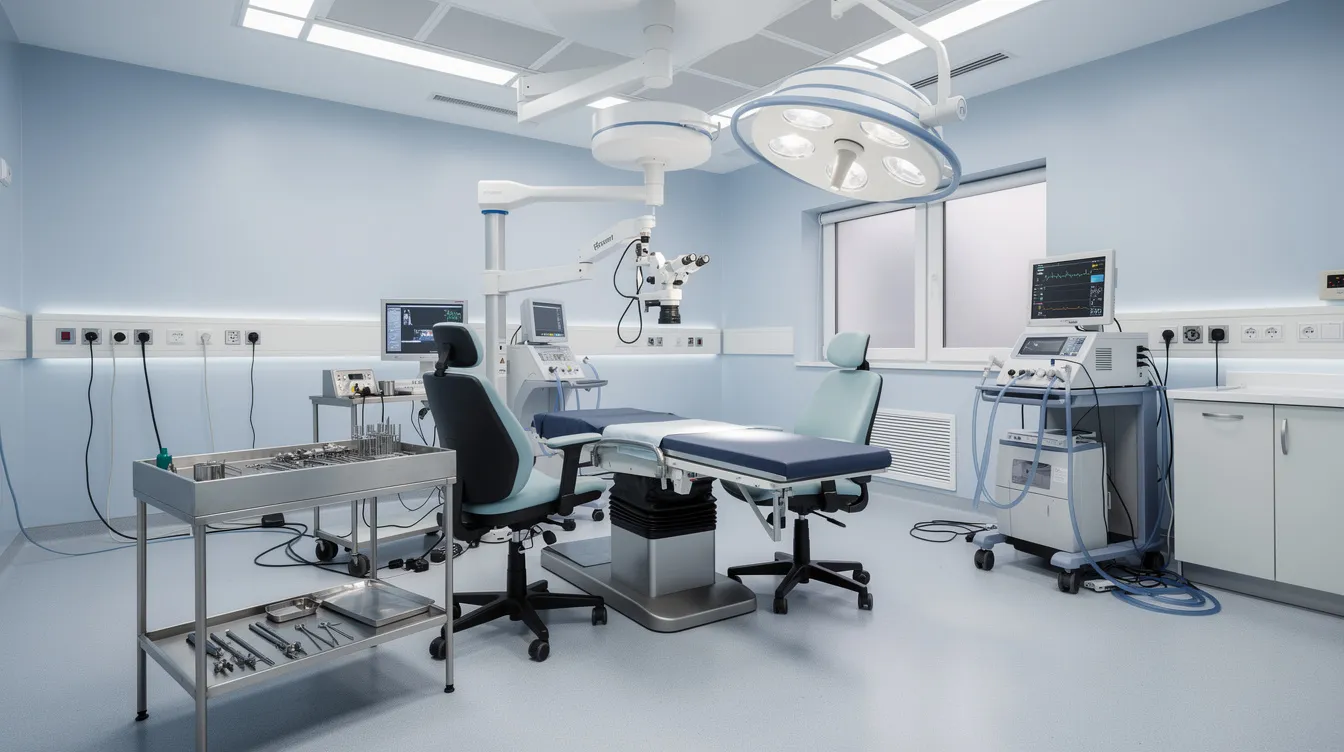
A term loan is typically used to finance long-term assets: civil construction, interiors, operation theatre infrastructure, ophthalmology and diagnostic equipment, furniture, electrical works and certain pre-operative expenses.
Key characteristics in practice:
- Tenure generally ranges from 5–10 years including moratorium, depending on asset mix and lender policy. IOB, for instance, allows up to 24 months moratorium for hospital construction and 12 months for equipment purchase.
- Moratorium is the initial period where only interest is paid, often aligned with construction plus ramp-up time before stable patient volumes are achieved.
- Margin requirement means the bank finances a percentage of eligible fixed assets – often 75–85% – with the balance funded by promoter contribution. Margins of 10–25% are common depending on asset type.
- Repayment should align with projected cash flows: lower instalments in initial years, gradually increasing where viable. Realistic revenue projections for consultation, diagnosis and cataract surgeries are essential.
Illustrative allocation: A ₹6 crore term loan might cover building works (₹3 crore), equipment (₹2 crore), interiors and other fixed assets (₹1 crore), with repayment structured so that projected DSCR remains comfortable throughout the tenure.
Working Capital Finance for an Eye Hospital
Even a well-equipped eye hospital with excellent vision correction facilities and high standards of care can struggle if it lacks sufficient working capital after launch.
Key working-capital needs include:
- Doctors’ and staff salaries
- Medicines, consumables, intraocular lenses, surgical disposables
- Utilities (electricity, water, internet), rent, administration
- Marketing and insurance premiums
- Credit given to corporate, insurance and TPA patients (receivables)
Operating costs in the first year include salaries, utilities, and taxes – all of which must be funded from day one. Effective supply chain management reduces costs in eye hospitals by optimising procurement of consumables and lenses.
The distinction is important: fixed-asset finance (term loan) covers building and equipment, while working-capital finance (cash credit, overdraft) covers day-to-day operations.
In practical project reports, initial working capital for the first 3–6 months is often included in project cost, while ongoing working capital may be arranged through a bank limit based on stock and receivables.
Using almost the entire sanctioned amount for construction and equipment, leaving negligible operational liquidity, is a common mistake. A small eye hospital may need ₹40–50 lakh for its initial 6 months of operations – this is indicative and varies by location and scale.
How to Structure the Means of Finance
This is the core exercise: combining promoter funds, term loans, working capital and other sources into a coherent, bankable eye hospital funding structure.
Step-wise approach:
- Finalise realistic total project cost
- Separate fixed assets from initial working capital
- Quantify genuine promoter contribution
- Estimate bank term loan requirement
- Quantify working capital requirements
- Consider unsecured or subordinated loans where acceptable
- Provide contingency
- Ensure Total Project Cost = Total Means of Finance
- Test repayment capacity using projections
- Refine the structure based on DSCR and risk assessment
A comprehensive feasibility study evaluates both capital and operational expenditures before arriving at the final structure.
Illustrative Means-of-Finance Table
| Source of Finance | Amount (₹ Crore) | % of Total Project Cost |
|---|---|---|
| Promoter Contribution (Equity) | 3.50 | 29% |
| Term Loan (Fixed Assets) | 7.00 | 58% |
| Working Capital Facility | 1.00 | 8% |
| Unsecured Loan (Subordinated) | 0.50 | 5% |
| Total Means of Finance | 12.00 | 100% |
Figures are purely illustrative.
During bank appraisal, lenders evaluate the nature of each source (own funds vs. borrowed) and internal consistency. Stress-testing against lower-than-planned patient volumes or delayed ramp-up may lead to adjusting debt size, increasing equity, or phasing equipment purchases.
The tone throughout should reflect actual experience of preparing eye hospital project reports and CMA Data for bank finance.
Debt–Equity Balance in an Eye Hospital Project
In simple terms, “equity” here means promoter contribution and share capital, while “debt” refers to term loans and other borrowings.
Excessive debt can cause strain through:
- Higher interest expense reducing profit
- Large EMI commitments during months when surgery volumes are still building
- Reduced financial flexibility for marketing or equipment upgrades
However, financing entirely from own funds may not be commercially optimal if it limits expansion or results in over-concentration of personal capital.
Factors influencing the appropriate debt–equity structure include project size (a ₹3 crore day-care unit versus a ₹25 crore tertiary eye hospital), promoter financial strength, quality of collateral, historical performance for expansions, and the lender’s internal policy.
DSCR (Debt Service Coverage Ratio) measures cash available for servicing debt versus annual principal and interest obligations. Lenders usually look for comfortable coverage – often 1.2× or above – over the entire repayment period.
There is no single ideal debt–equity ratio for all eye hospitals. The structure should be customised to risk, cash flows and long-term sustainability.
New Eye Hospital vs Expansion of Existing Eye Hospital
The means-of-finance structure for a greenfield eye hospital is often different from that of an expansion.
For a new hospital, lenders rely heavily on assumptions around patient footfall, surgery mix (cataract, LASIK, retina, glaucoma), pricing, payer mix and ramp-up period. Conservative projections are vital. Revenue diversification is a key component of sustainability for eye hospitals, and projections should reflect multiple income streams from the start.
For an existing hospital, banks may review past 3–5 years’ financials, turnover, profitability, banking conduct and historical cash accruals to assess additional borrowing capacity. Part of the means of finance may come from internal accruals and retained earnings. By the fifth year, operational costs are expected to increase significantly, which must be factored into expansion planning.
Eye hospitals benefit from economies of scale in patient care as they grow. Cross-subsidization allows paying patients to fund care for the underprivileged – a model used by several large eye hospitals in India and other countries.
Both new and expansion projects must ensure that project cost, means of finance and projected cash flows are consistent and realistically aligned.
Financing Medical and Ophthalmology Equipment
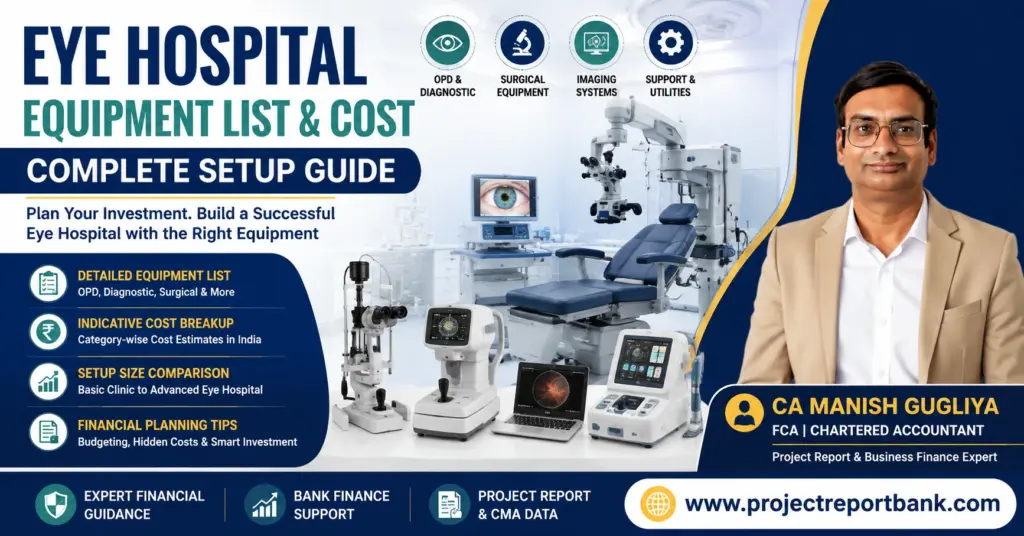
High-quality ophthalmology equipment for cataract, retina, refractive and diagnostic services often forms the largest component of eye hospital project funding decisions. Equipment costs account for the largest portion of capital expenditure in most eye hospital projects.
Major equipment categories include phacoemulsification systems, operating microscopes, OCT, fundus cameras, slit lamps, autorefractometers, visual field analysers, LASIK or SMILE platforms (if applicable), sterilisation units and OT tables with lights.
Equipment quotations from vendors – including GST, installation, training and warranty/AMC – directly affect both project cost and the amount of term loan or equipment finance required. Loan tenure should not exceed the economic life of the equipment; imported systems may carry higher cost but require careful utilisation planning.
Modern eye hospitals partner with financial providers for accessible procedures. Patients have access to various financing options for eye care services – including in-house payment plans that allow manageable monthly installments. LASIK surgery costs range from ₹40,000 to ₹1,20,000 per eye. Bajaj Finance offers zero or low-cost EMI options for LASIK, Fibe provides instant approvals for LASIK financing across India, and medical credit cards offer interest-free plans for LASIK surgery. Medical insurance often covers medically necessary treatments including certain eye procedures.
Separate equipment finance lines may sometimes be available with different terms, and should be compared with standard term-loan options. Maintenance contracts, consumables and future upgrade or replacement costs must be factored into projections so the hospital maintains high visual quality and competitive patient care in the long run.
Why Working Capital Should Not Be Ignored
Many eye hospital projects face cash stress not because the building or equipment is inadequate, but because working capital was underestimated.
Typical early-stage realities include slower-than-expected patient build-up, initial marketing efforts, time taken to get empanelled with TPAs and insurers, and payment lags from corporate clients – all of which require liquidity.
At least the first 6–12 months need a cushion so that salaries, rent and critical consumables are not compromised. Diverting short-term funds (like supplier credit or GST collections) to cover structural working-capital gaps is risky and should be avoided.
Optical and pharmacy sales are major ancillary revenue streams for eye hospitals and can ease working capital pressure once the hospital reaches a certain number of patients – but this takes time to reach meaningful volumes.
Consider a scenario: a promoter invests almost all funds in equipment, leaving only 1–2 months’ expenses in reserve. When patient volumes ramp up slower than projected, the hospital struggles to pay its team and maintain convenience for patients, undermining the very services it was built to deliver.
Repayment Capacity and Financial Projections
The sustainability of any eye hospital financing structure finally depends on repayment capacity, assessed through realistic financial projections.
Key projection elements include:
- Projected OPD and IPD patient numbers
- Average revenue per patient across consultation, diagnostics, treatment and surgery
- Operating expenses – staff cost, consumables, marketing, utilities, administrative overheads
- Projected profit and loss, balance sheet and cash-flow statements
- Yearly cash accrual (profit after tax plus depreciation) available for loan repayment
DSCR is checked across the projection period. Lenders generally prefer a comfortable margin above 1.0× – the exact standard varies by policy.
Increasing term-loan size purely to reduce promoter contribution can weaken DSCR and increase financial risk. Assumptions used in projections – growth rates, tariffs, capacity utilisation – should be clearly documented in the eye hospital project report so both promoter and lender can learn and understand the basis.
Common Mistakes While Structuring Eye Hospital Finance
Based on experience reviewing eye hospital project reports, common issues include:
- Underestimating total project cost, leading to cost overruns and unplanned borrowing
- Assuming the bank will fund nearly 100% of the project – lenders expect real equity
- Not planning promoter contribution documentation (bank statements, ITRs, source of funds)
- Ignoring or under-budgeting working capital, especially for the ramp-up period
- Relying on very optimistic surgery volumes – for instance, projecting full capacity from month one
- Purchasing excessive high-end equipment initially without realistic utilisation projections, when a phased approach would improve efficiency
- Omitting pre-operative expenses, statutory fees, deposits and contingency from project cost
- Mismatches between vendor quotations and cost figures in the report
- Inconsistencies between project cost, means of finance and financial projections
A careful evaluation – often with the help of a professional familiar with healthcare project finance – can rectify these issues before the proposal reaches the bank.
Role of an Eye Hospital Project Report in Bank Finance
A structured project report acts as the primary document summarising the eye hospital business plan, project cost and means of finance for lenders.
Key contents include:
- Promoter background and experience
- Project concept and services (cataract, LASIK, glaucoma, retina, myopia correction, diagnosis etc.)
- Detailed project cost and means-of-finance table
- Revenue assumptions and operating-cost assumptions
- Risk factors and mitigation
Financial statements typically attached: projected profit and loss, balance sheet, cash-flow statement, working-capital assessment, loan repayment schedule and key ratios such as DSCR and break-even point.
In practical project-report preparation, consistency between sections – narrative, numbers, assumptions – is critical. Lenders often cross-check figures across multiple pages.
A project report supports appraisal but does not guarantee sanction. Approval depends on promoter profile, collateral, credit history, lender policy and overall risk view.
[Internal link opportunity: project cost and means of finance guide]
Practical Example of Eye Hospital Means of Finance
Consider a simplified, hypothetical case for a mid-sized eye hospital in an Indian Tier-II city. The figures are purely illustrative and not a standard.
Total Project Cost: ₹12 Crore
| Cost Head | Amount (₹ Crore) |
|---|---|
| Building / Leasehold Works | 3.50 |
| Interiors and OT Setup | 1.80 |
| Ophthalmology & Diagnostic Equipment | 3.50 |
| Furniture, Electrical, IT | 1.20 |
| Pre-operative Expenses & Deposits | 0.80 |
| Initial Working Capital | 0.70 |
| Contingency (5%) | 0.50 |
| Total | 12.00 |
Means of Finance:
| Source | Amount (₹ Crore) | % Share |
|---|---|---|
| Promoter Contribution | 4.20 | 35% |
| Term Loan | 6.80 | 57% |
| Working Capital Facility | 1.00 | 8% |
| Total | 12.00 | 100% |
After building this structure, the promoter should assess whether projected cash flows support this debt. If DSCR is weak, options include raising more equity, reducing initial capex, selecting a phased approach to services, or improving revenue assumptions based on realistic factors.
Actual structures must be customised based on each hospital’s specific business model, risk appetite, affordability of debt, and lender feedback.

Expert Note
CA Manish Gugliya, Chartered Accountant | ProjectReportBank
An eye hospital’s means of finance should not be prepared mechanically just to make the project-cost table tally. Promoter contribution, term borrowing, working capital and repayment obligations must be structured together with realistic patient-volume, revenue and operating-cost assumptions. In my experience with healthcare project reports, projects with balanced funding structures and transparent assumptions tend to navigate bank appraisal more smoothly. Financial projections are estimates, not guarantees, and should be revisited periodically after the hospital starts operations. I encourage promoters to treat financing decisions as strategic choices that affect long-term sustainability – not just loan eligibility. Choose a structure that the hospital can maintain even when the result of initial months differs from the plan.
About CA Manish Gugliya
CA Manish Gugliya is a Chartered Accountant and project finance professional associated with ProjectReportBank.com, with a focus on project reports and financial planning for MSME and healthcare ventures in India.
- Professional expertise includes preparation of bankable project reports, CMA Data, working-capital assessment, financial projections and loan-application documentation for hospitals and clinics
- Specific experience with healthcare and eye hospital projects, including structuring funding for new units, expansions and equipment upgrades within lender policies
- This article is for educational purposes and does not constitute individual financial or legal advice; readers should consult their own advisors and bankers for project-specific decisions
- There is no claim of endorsement by any bank, NBFC or government authority; lending terms remain subject to each institution’s appraisal and policy framework
Frequently Asked Questions
The following questions address common queries about eye hospital means of finance that extend beyond the main article content.
What is the typical process to approach a bank for eye hospital project finance?
Start by preparing a detailed project cost and means-of-finance statement. Arrange necessary documents – KYC, income-tax returns, bank statements and property papers. Get a professional project report with financial projections prepared. Meet shortlisted lenders for initial discussions to speak about your requirements and understand their terms. Submit a formal application, after which the bank conducts its own appraisal before arriving at a sanction or decline. The option of approaching multiple lenders can help you compare terms.
Can I include my existing clinic assets as part of the eye hospital project finance plan?
In many cases, existing clinic equipment, deposits or furniture may be considered as part of promoter contribution or existing assets, but they are generally not financed again by a new lender. Correct disclosure in the project report helps lenders understand the full picture. Health insurance often covers medically necessary eye procedures, and companies offering medical financing credit cards designed for healthcare expenses can also assist patients with affordability – an important factor when projecting income from insured patients.
Is it possible to phase the eye hospital investment and finance it in stages?
Yes. Promoters sometimes start with core ophthalmology services and add advanced procedures (like LASIK suites or retina setups) in later phases, improving the efficiency of capital deployment. Financing can similarly be phased, subject to lender comfort, but each stage requires its own cost, means of finance and projected cash-flow detail. This approach can help manage risk during the improving ramp-up period.
How early should I start planning the means of finance for my eye hospital?
Financing discussions should ideally begin parallel to detailed project-costing and location finalisation – typically several months before construction or fit-out. This gives adequate time for bank terms, promoter contribution planning, and working-capital arrangements to be aligned before orders are placed. Any delay in this planning can cause availability issues later.
Can unsecured loans from relatives be treated as equity in an eye hospital project?
Some lenders may treat well-documented, interest-free unsecured loans from promoters or relatives as quasi-equity if subordinated to bank debt, but this treatment varies by bank. Traditional unsecured personal loans can also cover certain medical expenses in some cases. Flexible Spending Accounts can cover LASIK as a medical expense, and Health Savings Accounts allow tax-free payments for LASIK surgery – these are relevant considerations when understanding patient-side financing that supports hospital revenue. Proper documentation and transparent disclosure in the project report and loan application are essential for any unsecured loan to gain lender acceptance. The regulations and requirements differ across institutions.
Explore All Eye Hospital DPR Guides
Continue exploring our complete series on Eye Hospital project planning, financial projections, repayment capacity and bank finance.
- Eye Hospital Project Report / DPR for Bank Loan – Complete Guide

- Eye Hospital Term Loan Assessment: How Banks Evaluate Your Project in India
- Bank Loan for Eye Hospital – Project Finance & Documentation Guide
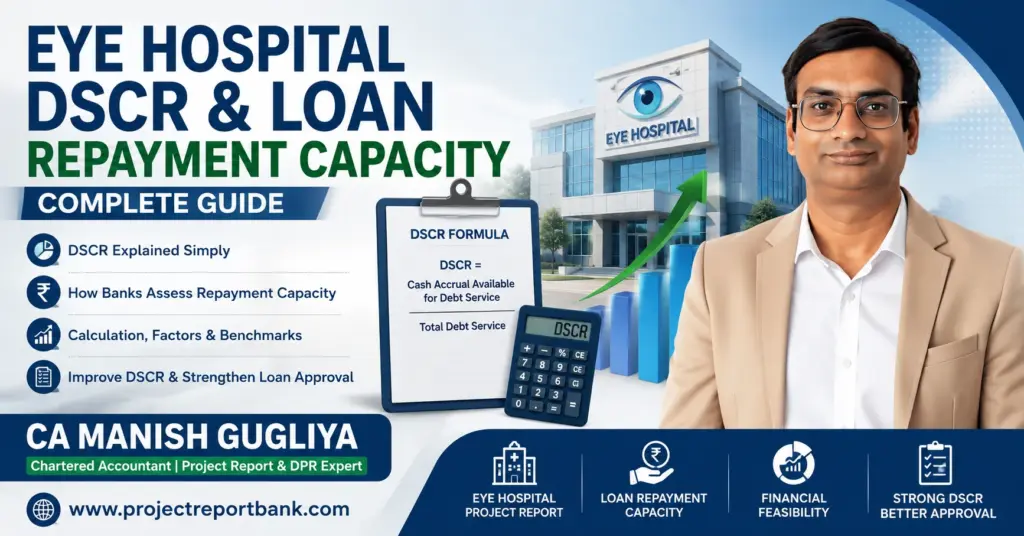
- Eye Hospital DSCR & Loan Repayment Capacity – Complete Guide
- Eye Hospital Working Capital Requirement – Assessment & Calculation (India-Focused Guide)
- Eye Hospital Financial Projections – How to Prepare Projections for DPR (India)
- Eye Hospital Revenue Model – How to Prepare Realistic Revenue Projections (Eye Hospital Project Report)
- Eye Hospital Project Cost & Means of Finance – How to Structure the Investment
- Eye Hospital Equipment List & Cost in India – Complete Setup Guide