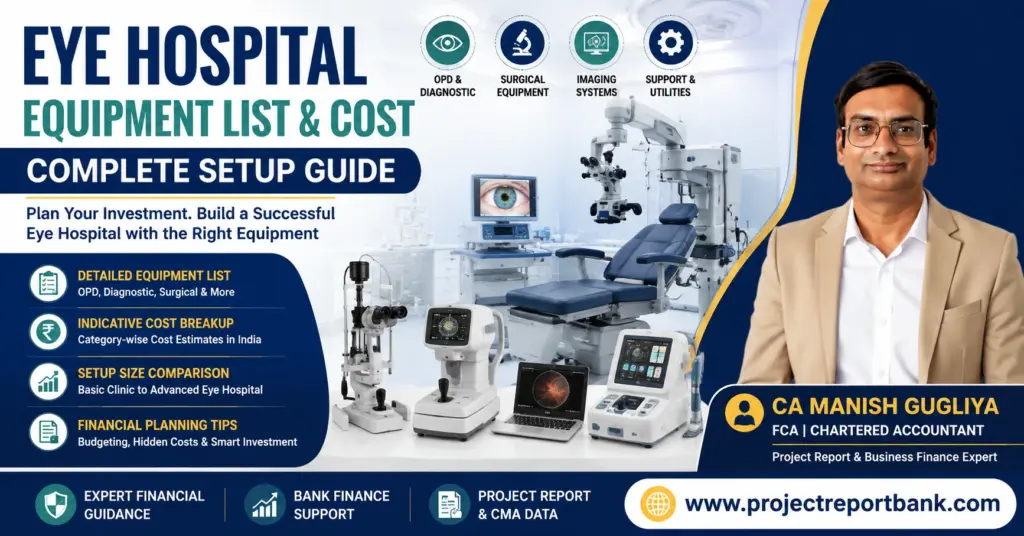
Planning an eye hospital in India requires a clear understanding of what equipment you need and how much it may cost. Whether you are an ophthalmologist opening your first clinic or a healthcare promoter preparing a Detailed Project Report for bank finance, this page provides a practical, category-wise eye hospital equipment list with indicative cost ranges to guide your investment decisions.
Key Takeaways
- This article covers the complete eye hospital equipment list across OPD, refraction, diagnostics, imaging, operation theatre, sterilisation and support categories, with indicative cost ranges for India (2024–2025 planning estimates, not supplier quotations).
- Equipment requirements vary significantly depending on whether you are setting up a basic eye clinic, a diagnostic centre, a cataract surgery hospital or a multi-specialty eye hospital offering retina, glaucoma, cornea and refractive services.
- All prices mentioned are approximate – actual costs depend on brand, Indian vs imported equipment, technology, accessories, taxes, installation and negotiation. Obtain fresh quotations before finalising any project cost.
- The article is written from the financial-planning perspective of CA Manish Gugliya (FCA), with experience in DPRs, CMA Data and project finance for healthcare units across India.
- You will also learn about hidden costs beyond purchase price, new vs refurbished equipment choices, and how to build an equipment budget that stands up in bankable project reports.
Explore Eye Hospital DPR Guides
Explore our complete series on Eye Hospital project planning, financial analysis and bank finance.
Eye Hospital Equipment List and Cost at a Glance
Before diving into details, here is a high-level snapshot of major equipment categories and their typical Indian cost ranges for planning purposes. Diagnostic devices are used to examine, diagnose, and treat vision conditions – the investment in each category depends on the scope of services your hospital will offer.
| Equipment Category | Typical Equipment | Indicative Cost Range (₹ lakh) | Main Purpose |
|---|---|---|---|
| OPD / Basic Examination | Slit lamp, ophthalmoscope, retinoscope, lensometer | 0.8–5 | Patient examination |
| Refraction | Auto refractometer, phoropter, trial set, digital vision chart | 2–10 | Vision assessment |
| Diagnostic (Basic) | Non-contact tonometer, pachymeter, B-scan, A-scan, visual field analyser | 5–30 | Ophthalmic diagnosis |
| Advanced Imaging | OCT (optical coherence tomography), fundus camera, specular microscope | 25–90+ | Retina, glaucoma, cornea imaging |
| Operation Theatre | Operating microscope, phaco system, vitrectomy (if needed), OT table/lights | 40–200+ | Eye surgery |
| Sterilisation (CSSD) | Autoclaves, ultrasonic cleaner, instrument trays | 5–25 | Infection control |
| Support / Furniture / IT / Power | UPS, generator, computers, HMIS, AC, furniture | 10–30% of total equipment cost | Hospital operations |
These are realistic planning ranges – costs vary by brand, import status, technology level, GST and supplier negotiation. Before performing security verification and other IT configurations, hospitals must also secure critical diagnostic and OT equipment with reliable power backup.
How Equipment Requirements Depend on the Type of Eye Hospital
There is no fixed universal eye hospital equipment list. What you need changes with the size of the facility, the types of services offered and the target patient population. Security verification of scope and feasibility at the planning stage avoids over-investment in under-utilised machinery. Promoters should first define the scope of clinical services – consultation only, cataract surgery, retina, glaucoma, LASIK, paediatric ophthalmology – before freezing equipment budgets.
Basic Eye Clinic
A single-doctor OPD setup focused on consultation, refraction and routine diagnosis with no operation theatre. Core equipment includes vision charts, trial lens sets, retinoscope, direct ophthalmoscope, a Slit Lamp (used to inspect the anterior structures of the eye), basic tonometer and lensometer. A Tonometer measures intraocular pressure to screen for glaucoma, making it valuable even at this level.
Indicative equipment cost: roughly ₹8–20 lakh, depending on new vs refurbished and brand choices. Such clinics typically refer patients to higher centres for OCT, retina procedures and cataract surgery.
Ophthalmology Diagnostic Centre
An advanced diagnostic facility serving multiple eye specialists, focused on imaging and testing rather than surgery. Key additions beyond a basic clinic include an upgraded slit lamp, non-contact tonometer, a Pachymeter (which measures corneal thickness to assess glaucoma risk), A-scan, B-scan, visual field analyser, corneal topographer and possibly a fundus camera and OCT.
Indicative diagnostic equipment budget: ₹40–150 lakh, depending on how many advanced imaging systems are included. These centres can become referral hubs for glaucoma, retina and anterior segment imaging if planned with adequate patient volume.
Eye Hospital with Cataract Surgery
A facility with OPD, diagnostics and at least one fully equipped eye operation theatre. Additional equipment groups include an ophthalmic operating microscope, Phacoemulsification Machine (used in modern cataract surgery), biometry instruments, OT table, lights, patient monitors and Sterilization Autoclaves that maintain sterile conditions for surgical instruments.
Broad equipment investment estimate: ₹80 lakh–₹3 crore, depending on whether equipment is basic/Indian or premium/imported and whether any retina or glaucoma lasers are added. A cataract-focused hospital must balance OT equipment quality with financial viability and bank repayment capacity.
Multi-Specialty Eye Hospital
A comprehensive centre providing cataract, vitreoretinal surgery, glaucoma, cornea, refractive surgery, paediatric ophthalmology and possibly LASIK/SMILE services. High-end OCT with anterior segment module, widefield fundus imaging, specular microscope, corneal topographer, Vitrectomy Systems (used for performing retinal surgeries), Excimer Laser (used in LASIK surgery to reshape the cornea) and multiple OT microscopes are typical. Ophthalmic Lasers are used for treating various retinal and glaucoma conditions, including peripheral iridotomy and diabetic retinopathy treatment.
Equipment budget: ₹3–10 crore or more. Such projects require detailed DPRs, strong financial projections and professional planning.
OPD and Basic Eye Examination Equipment
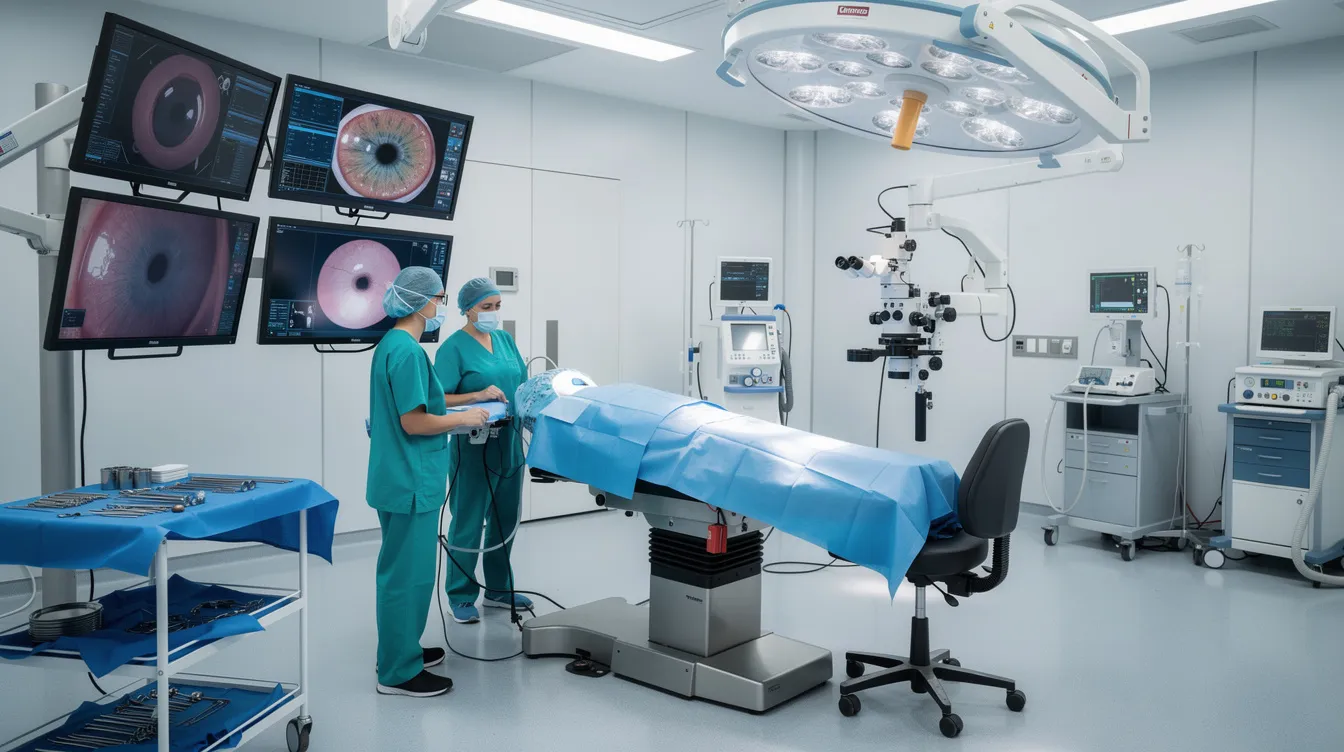
OPD equipment forms the backbone of patient examination and is required even in the smallest eye clinic. Manual tools like Retinoscopes and Lensometers assist in determining prescriptions. The slit lamp enables detailed examination of anterior segment structures including the cornea, lens and conjunctiva, while vision charts displayed on LED screens are replacing older Snellen boards.
Key items and indicative price bands:
- Slit lamp biomicroscope – ₹1.5–5 lakh (examine anterior structures of the eye)
- Retinoscope and ophthalmoscope – ₹0.15–0.80 lakh
- Trial lens set and trial frame – ₹0.30–1.5 lakh
- Basic tonometer (Schiotz/applanation) – ₹0.6–2 lakh
- Lensometer – ₹0.3–1 lakh
- LED vision chart, occluders, pinhole, torches – ₹0.15–0.50 lakh
Non-medical OPD essentials include a doctor’s chair, motorised ophthalmic chair-unit, instrument tables and a simple UPS. The waiting area should be comfortable and the layout should look clean and patient-friendly.
Refraction Equipment List and Cost
Accurate refraction is central to an eye clinic and directly affects the prescription of glasses. Investment levels range from manual trial sets to fully automated refraction lanes.
A Phoropter contains lenses for testing various refractive errors, while an Autorefractor automatically measures a person’s refractive error, speeding up the process. Equipment includes auto refracto-keratometer, digital vision chart, trial lens set, phoropter, lensometer, and pupilometer. Axis and power measurements must be precise for effective prescriptions.
| Setup Type | Key Equipment | Indicative Cost (₹ lakh) |
|---|---|---|
| Manual refraction lane | Trial lens + retinoscope + Snellen chart | 1–3 |
| Semi-automatic | Auto refractometer + digital chart + trial set | 3–8 |
| High-end automated | Auto refracto-keratometer + phoropter + digital chart | 8–20+ |
Eye clinics in competitive urban markets often prefer automated setups for efficiency, which can also influence revenue potential and time per patient.
Ophthalmology Diagnostic Equipment List
Diagnostic equipment goes beyond basic examination. It is used to assess conditions related to glaucoma, cataract, corneal disorders and retina pathology. Goldmann applanation tonometry is a key method to measure intraocular pressure. Ocular response analysers assess corneal biomechanical properties, providing additional data beyond standard IOP measurements. The Zeiss Humphrey’s Field Analyzer is the gold standard in Perimetry for visual field analysis.
| Equipment | Purpose | Indicative Cost (₹ lakh) | Usually Required For |
|---|---|---|---|
| Upgraded slit lamp | Detailed anterior segment exam | 2–5 | General ophthalmology |
| Applanation tonometer | IOP measurement | 0.6–2 | Glaucoma clinic |
| Non-contact tonometer | Quick IOP screening | 2–6 | All clinics |
| Pachymeter | Corneal thickness | 1–3 | Glaucoma risk assessment |
| A-scan ultrasound | IOL power calculation, various measurements | 2–5 | Cataract workup |
| B-scan / Ocular USG | Diagnosing retinal pathologies, posterior segment evaluation | 3–8 | Retina evaluation |
| Visual field analyser | Peripheral and central field testing | 1.5–18 | Glaucoma, neuro-ophthalmology |
| Indirect ophthalmoscope | Retina examination | 0.5–2 | Retina clinic |
| Gonioscope | Angle assessment | 0.1–0.5 | Glaucoma |
Ocular USG is used for diagnosing retinal pathologies, and A-scan biometry has been used since 1984-85 for IOL power calculation – Anjani Eye Hospital, for instance, has used A-scan biometry since 1984-85. The Appasamy Marvel Ocular USG was acquired in 2020 by various Indian centres, offering an effective Indian-made option.
Advanced Ophthalmology Diagnostic and Imaging Equipment
Not every new eye hospital needs these high-cost systems from Day 1. Optical Coherence Tomography (OCT) provides cross-section pictures of the retina, making it invaluable for retina and glaucoma diagnosis. The Zeiss Cirrus OCT Angioplex includes non-invasive OCT angiography, eliminating the need for dye injection in many cases. Fundus Cameras photograph the interior surface of the eye, and varieties range widely in price and capability.
Key equipment and planning cost bands:
- OCT (SD/SS) – ₹25–90 lakh (ESIC benchmarks place high-end OCT at ~₹90 lakh)
- Fundus camera – ₹1.5–24 lakh (portable to widefield). The Fundus on Phone captures 45° images without dilating drops, a cost-effective Indian innovation.
- Ultra-widefield imaging – ₹20–60+ lakh. The Optos Daytona, acquired by several Indian hospitals (e.g., December 2023 acquisitions), captures 200° retinal images in under ½ second.
- Corneal topographer/tomographer – ₹8–25 lakh
- Optical biometer – ₹15–40 lakh. The Zeiss IOL Master 700 uses low intensity laser beams for measurements, offering high precision for IOL power calculation.
- Specular microscope – ₹8–20 lakh (endothelial cell analysis for cornea evaluation)
Promoters should match such purchases with expected patient volume, specialist availability, potential revenue per test and access to project finance. Buying advanced imaging simply because competitors have it, without sufficient case load, leads to poor ROI.
Eye Operation Theatre Equipment List
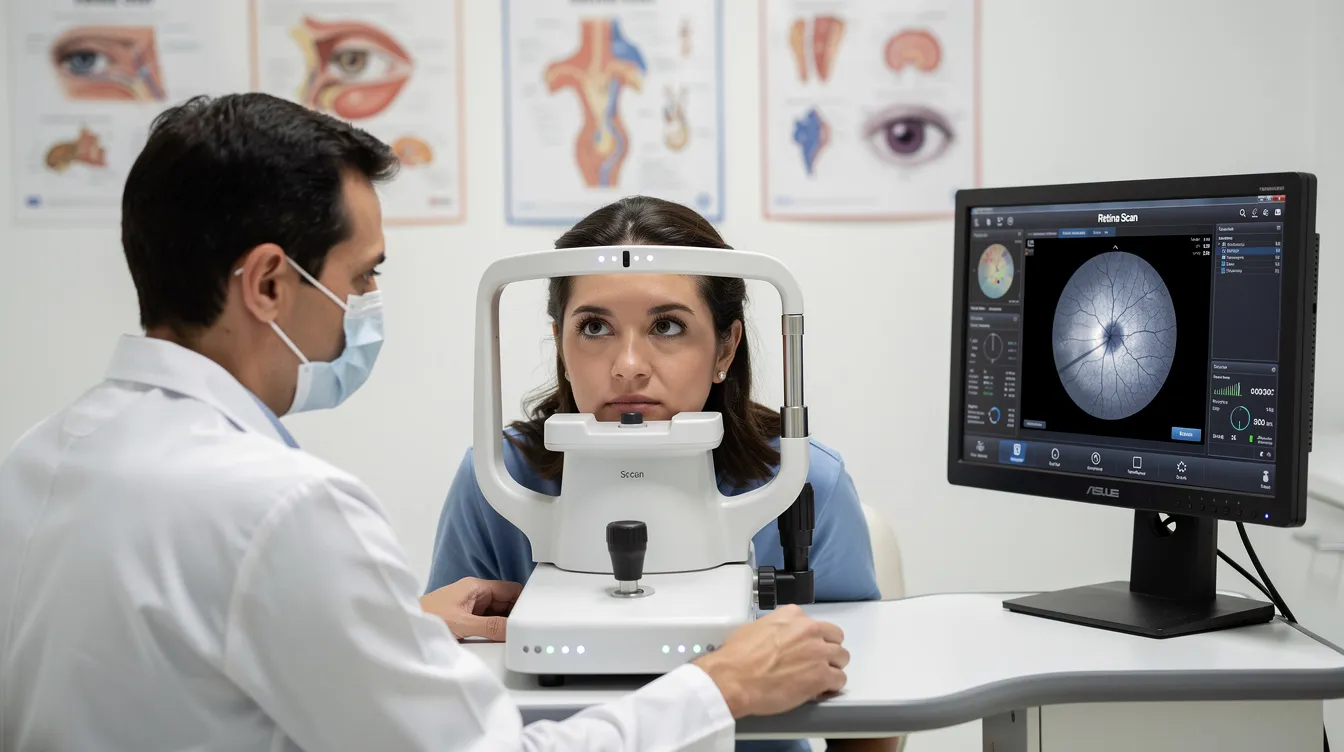
An ophthalmic OT must be planned for sterility, patient safety and smooth surgical workflow. Operating Microscopes provide magnification for delicate eye surgeries and are the single most important OT investment. The Alcon NGENUITY 3D Visualization System increases magnification by 48%, representing the cutting edge in visualisation technology.
Essential OT equipment for cataract surgery:
- Ophthalmic operating microscope (₹15–100+ lakh)
- Phacoemulsification machine (₹18–80 lakh)
- OT table, surgeon/assistant stools, OT light
- Instrument trolleys, mayo stands
- Multipara patient monitor, suction machine
- Cautery, basic resuscitation trolley
- Sterilisation Autoclaves and sterile storage
For advanced surgical services (vitreoretinal, glaucoma, cornea):
- Vitrectomy system (₹35 lakh–₹1.6 crore for premium)
- Posterior segment viewing systems, endolaser
- Special instrument sets, position-adjustable surgical chairs
- The Zeiss VISULAS Nd-YAG laser system treats Posterior Capsular Opacification – the Nd-YAG laser clears posterior capsular opacification after cataract surgery
OT support: Laminar airflow / HEPA filtration, dedicated AC, medical gas pipeline if needed, power backup/UPS solely for OT. A basic cataract OT may need around ₹40–120 lakh in equipment; adding vitrectomy and advanced microscopes raises this significantly.
Cataract Surgery Equipment List and Cost
Cataract surgery is the most common eye operation in India, making it the core service of many business plans. The Phacoemulsification Machine is used in modern cataract surgery – premium systems like the Alcon Centurion Vision System (added by facilities like Anjani Eye Hospital in 2016) offer advanced fluidics and control.
Dedicated cataract equipment includes:
- Modern phaco machine with various types of handpieces
- Operating microscope with good optics and red reflex
- A-scan or optical biometer for IOL power calculation
- Keratometer, surgical instrument sets (phaco, IOL insertion, emergency)
- Patient monitoring, anaesthesia support, autoclave
- Consumables: IOLs, phaco tips, blades, viscoelastics
Illustrative equipment budget for one cataract OT: roughly ₹60 lakh–₹2 crore depending on machine brands and diagnostic imaging inclusion. Details like date of purchase, warranty start and verification successful reports from suppliers should be documented carefully for warranty and financing records.
Sterilisation and Infection-Control Equipment
No eye hospital equipment list is complete without sterilisation planning. Cost-saving here is risky and can compromise patient safety. Sterilization Autoclaves maintain sterile conditions for surgical instruments – Bajaj Finserv data indicates hospital-grade autoclaves range from ₹70,000 to ₹10 lakh+ depending on size and technology.
Essential items: high-pressure steam autoclave, tabletop autoclave for small loads, ultrasonic cleaner for cleaning surgical instruments, ETO steriliser if required, instrument trays, sterile storage cabinets with lock systems, scrub sinks, biomedical waste bins and PPE supplies. These items collectively protect patients and staff from infection.
Typical CSSD equipment set: ₹5–25 lakh. Infection-control design should follow national guidelines; promoters must consult qualified healthcare planners.
Furniture, IT and Supporting Equipment
Non-medical items often cause budget overruns because they are underestimated during DPR preparation.
Furniture: Reception counters, waiting-area seating, doctor tables and chairs, OT stools, ward beds (if any), ophthalmic chair units and storage racks.
IT and electronics: Computers, printers, billing systems, hospital management software (check the vendor’s website at www for demos), networking, CCTV, biometric attendance, phone systems and access control. Modern hospital systems require performing security verification of logins and patient data access to protect sensitive health records. A robust security service helps prevent unauthorised access, while firewalls should block malicious bots from compromising the hospital’s website. System administrators may need to check logs including details like respond ray id when troubleshooting bot-related issues.
Support systems: UPS, inverters, diesel generator for power backup, air-conditioning, refrigerators for medicines and RO/UV water systems.
While individual items appear small, together they can form 10–25% of total equipment cost. Itemise them properly in your budget.
Eye Hospital Equipment Cost by Setup Size
These are broad illustrative ranges for Indian conditions. Actual costs vary by city, brand, technology and negotiation – treat these as planning benchmarks only. All figures below cover equipment only, excluding land, building, interiors and working capital.
Basic Eye Clinic
One consultation room, refraction area, minimal diagnostics, basic furniture and computer. Indicative equipment: ₹8–20 lakh. Entrepreneurs can start lean and add devices later.
Small Eye Hospital
OPD, refraction, limited diagnostics, single cataract OT. Includes phaco machine, OT microscope, basic sterilisation. Indicative equipment: ₹60 lakh–₹2 crore.
Medium Eye Hospital
Multiple OPD rooms, OCT or fundus camera, 1–2 OTs, in-patient beds. Better microscopes, advanced perimetry. Indicative equipment: ₹2–5 crore.
Advanced Eye Hospital
Retina OT with vitrectomy, high-end OCT and angiography, widefield imaging, LASIK platform, multiple OTs. Indicative equipment: ₹5–15 crore or more. Read the detailed planning considerations before committing to this level.
New vs Refurbished Ophthalmology Equipment
Many Indian promoters evaluate refurbished equipment to reduce initial investment, especially for high-cost devices like OCT and microscopes.
| Factor | New Equipment | Refurbished Equipment |
|---|---|---|
| Warranty | Full manufacturer warranty | Limited or third-party warranty |
| Software | Latest version included | May be outdated |
| Financing | Easier to finance | Some lenders cautious |
| Remaining life | Full useful life | Shorter, uncertain |
| Service support | Manufacturer network | May be limited |
| Cost | Higher upfront | 30–50% lower typically |
Banks and NBFCs generally prefer financing new equipment due to clearer valuation. Promoters should document serial numbers, purchase dates and verification successful reports after installation, whether equipment is new or refurbished. The financial saving from refurbished equipment must be evaluated against reliability and operational risk in order to make an effective decision.
Hidden Costs Beyond the Equipment Purchase Price
Quoting only the base equipment price leads to underestimation of project cost. Promoters must budget for:
- Taxes and logistics: GST, customs duty (imported items), transportation, transit insurance, on-site handling
- Installation: Electrical wiring, earthing, stabilisers, UPS, AC upgrade, special flooring, lead shielding for lasers
- Ongoing costs: Calibration, consumables, software licences, staff training, AMC/CMC, spare parts replacement
- Integration: EMR/HMIS software, networking, treatment protocol systems
Recommend keeping a 5–10% contingency margin on equipment budget in the DPR. These hidden elements can collectively add 15–30% to the base price of major machines.
How to Prepare an Eye Hospital Equipment Budget
A structured equipment schedule is essential for internal planning and for project reports submitted to banks. Prepare a spreadsheet with columns: Equipment, Specification, Quantity, Unit Cost, Total Cost, Supplier, GST, Installation Charges and Total Landed Cost.
Classify items into four groups:
- Essential equipment – must-have on Day 1
- Service-specific equipment – linked to particular clinics (glaucoma, retina)
- Advanced/optional equipment – can be deferred
- Future expansion items – planned for later phases
Obtain at least 2–3 quotations for each major machine. A careful process that verifies supplier credentials, checks the service network and validates warranty terms will help avoid future operational disruptions. Public procurement benchmarks (ESIC tender specifications and GeM data) serve as useful reference checks.
Equipment Cost and Eye Hospital Project Cost
Equipment is only one component of total eye hospital project cost. Other major cost heads include land, civil construction, interiors and modular OT, HVAC, electrical works, furniture, IT systems, pre-operative expenses, statutory fees, contingency and initial working capital.
Equipment cost feeds into total project cost, which determines promoter contribution and term-loan requirement. This chain ultimately affects depreciation, profitability projections and cash-flow-based repayment capacity. According to ICG Consulting, surgical equipment alone can account for 35–50% of total capital expenditure.
For a comprehensive view of all investment components beyond medical equipment, refer to the detailed eye hospital project cost in India – complete investment breakdown.
Eye Hospital Equipment Cost in a Project Report
In my experience preparing DPRs and CMA Data for healthcare projects, lenders examine the equipment schedule closely. They assess whether the proposed setup aligns with projected services, revenue and loan amount. An inflated or unrealistic equipment budget immediately raises red flags.
The logical chain that every lender evaluates:
Equipment Cost → Total Project Cost → Promoter Contribution → Term-Loan Requirement → Depreciation → Profit & Loss → Cash Flow → Debt-Servicing Capability
I advise attaching major quotations, equipment brochures and payment terms to the project report. Label all costs as estimates unless purchase is already committed. A professionally prepared report improves clarity and lender confidence – but it does not guarantee loan sanction. Approval still depends on bank policy, collateral, CIBIL score and overall project viability.
Example Eye Hospital Equipment Budget (Illustrative)
This simplified, hypothetical budget covers a small-to-medium Indian eye hospital with OPD, diagnostics and cataract OT. This is an illustration only – not a supplier quotation.
| Category | Illustrative Amount (₹ lakh) |
|---|---|
| OPD equipment | 8 |
| Refraction equipment | 10 |
| Diagnostic equipment | 25 |
| Imaging equipment (OCT + fundus camera) | 60 |
| OT equipment (microscope + phaco + accessories) | 90 |
| Sterilisation / CSSD | 12 |
| Furniture | 15 |
| IT & networking | 8 |
| Power backup (UPS + generator) | 10 |
| Miscellaneous & contingency | 12 |
| Total (Illustrative) | 250 |
Prepare a custom budget aligned to your specific location, brand choices and service mix, then validate it with supplier quotations. This kind of summary table is useful in DPR annexures for quick discussion with banks.
How to Control Eye Hospital Equipment Investment
Financial discipline in equipment selection can significantly improve project viability without compromising clinical quality.
- Define a clear initial service mix and separate must-have from nice-to-have items
- Phase purchases – start without OCT or widefield imaging if patient volume is low; add when demand justifies it
- Compare total landed cost (including GST, installation, AMC) rather than only base price
- Evaluate warranty terms, uptime guarantees, local service availability and training support
- Plan room layouts and electrical capacity for future scalability (e.g., space for OCT or vitrectomy system later)
- Keep 5–10% contingency to operate smoothly without financial strain
Common Mistakes While Estimating Eye Hospital Equipment Cost
Based on experience with multiple healthcare DPRs, here are errors to avoid:
- Copying another hospital’s list without matching it to your own proposed services and size
- Under-budgeting installation and civil work (electrical, AC, flooring, lead shielding)
- Ignoring accessories and consumables that add 10–30% to base equipment cost
- Forgetting power backup – a critical OT requirement
- Assuming old internet prices still apply; equipment costs change with GST, exchange rates and technology updates
- Not factoring AMC/CMC – annual maintenance can be 5–10% of equipment cost per year
- Over-investing in high-end machines with low expected utilisation, leaving inadequate working capital
- Using a single quotation without comparison across suppliers
Involve both clinicians and financial professionals when finalising equipment lists so medical needs and financial realities are balanced.
Expert Note
An eye hospital equipment budget should not be prepared merely by collecting machinery prices. Equipment selection must be driven by proposed clinical services, expected patient volume, location economics and financing capacity. Major equipment decisions impact long-term profitability, cash flows and loan repayment – they must be integrated into a detailed project-cost and means-of-finance plan. Document every major decision with quotations, assumptions and risk-mitigation measures. This note provides general guidance and is not a substitute for personalised professional or medical advice for a specific project.
– CA Manish Gugliya, FCA | Chartered Accountant | ProjectReportBank.com
About CA Manish Gugliya
CA Manish Gugliya is a Fellow Chartered Accountant (FCA) with experience in project reports, detailed project reports (DPRs), CMA Data, financial projections and bank-loan planning for MSME and healthcare projects in India. He has worked with eye hospitals, clinics and diagnostic centres to estimate project costs, prepare means-of-finance structures and assess business feasibility. This article aims to help entrepreneurs, doctors and investors understand how eye hospital equipment choices translate into investment requirements, bank proposals and long-term financial performance.
Frequently Asked Questions
Below are practical queries commonly raised about eye hospital equipment planning in India.
What is the minimum equipment required to start a basic eye clinic in India?
- A basic eye clinic needs a vision chart, trial lens set and frame, retinoscope, direct ophthalmoscope, slit lamp, basic tonometer, lensometer, basic furniture and a computer with printer.
- This setup may cost roughly ₹8–15 lakh depending on brands and new vs refurbished choices.
- Advanced diagnostics like OCT or fundus camera can be referred out initially and purchased later as patient volume grows.
Is OCT mandatory for starting an eye hospital?
- Optical coherence tomography is not legally mandatory to start a basic eye hospital, but it is extremely useful for retina and glaucoma services.
- Hospitals focused on cataract and routine OPD may defer OCT purchase until retina and glaucoma case load justifies the investment.
- Tie-ups with nearby diagnostic centres for OCT and anterior segment imaging can serve as an interim solution.
How much does a phaco machine cost in India?
- Mid-range Phacoemulsification Machines cost approximately ₹18–35 lakh, while premium imported brands (e.g., Alcon Centurion, J&J Veritas) can range from ₹45–80 lakh.
- ESIC procurement benchmarks estimate high-end phaco systems at approximately ₹80 lakh excluding CMC.
- Total cost including accessories, consumables and installation will be higher than the base machine price.
Can refurbished ophthalmology equipment be financed by banks?
- Some lenders may finance refurbished ophthalmology equipment, but many prefer new machines due to clearer valuation and warranty support.
- Borrowers should discuss this specifically with potential lenders and provide proper purchase invoices, supplier credentials and technical valuation reports.
- Policies vary across banks and NBFCs, so there is no universal rule.
Should supplier quotations be attached to the eye hospital project report?
- Major equipment items should be supported by at least 2–3 recent quotations attached as annexures to the DPR or project report.
- This helps lenders verify that the budget is realistic and supports the credibility of financial projections.
- Update quotations periodically if implementation is delayed, as medical equipment prices and GST rates can change over time.
Explore All Eye Hospital DPR Guides
Continue exploring our complete series on Eye Hospital project planning, financial projections, repayment capacity and bank finance.
- Eye Hospital Project Report / DPR for Bank Loan – Complete Guide
- Eye Hospital Term Loan Assessment: How Banks Evaluate Your Project in India
- Bank Loan for Eye Hospital – Project Finance & Documentation Guide

- Eye Hospital DSCR & Loan Repayment Capacity – Complete Guide
- Eye Hospital Working Capital Requirement – Assessment & Calculation (India-Focused Guide)