Key Takeaways
- Banks assess an eye hospital term loan not just on the doctor’s qualifications or collateral value, but on whether the project can generate sustainable cash flow to service debt over the full tenure. The focus is on promoter profile, realistic project cost, balanced means of finance, defensible revenue assumptions, adequate DSCR, and repayment capacity.
- A well-prepared eye hospital project report for bank loan must logically connect project cost, proposed eye care services, patient volumes, revenues, operating expenses, working capital needs, and loan servicing ability into a single coherent financial story.
- In India, ophthalmology equipment cost, working capital during the initial 12–18 months, and conservative ramp-up of cataract surgery volumes and OPD footfall are among the most scrutinised assumptions. Overstating any of these weakens the entire appraisal.
- Lenders require a minimum Debt Service Coverage Ratio typically greater than 1.25 in any individual year, with average DSCR often expected in the 1.50–2.00 range depending on bank policy and scheme. Financial projections should cover five to seven years for viability.
- This article explains the complete appraisal logic step by step, so that an ophthalmologist, healthcare entrepreneur, or investor can structure a bankable eye hospital project in 2026 and beyond.
Explore Eye Hospital DPR Guides
Explore our complete series on Eye Hospital project planning, financial analysis and bank finance.
Introduction: How a Bank Looks at an Eye Hospital Project
When an ophthalmologist or promoter approaches a bank for a term loan to set up or expand an eye hospital, the credit officer is not primarily evaluating the doctor’s surgical skill or counting the number of degrees on the wall. The core question behind every eye hospital term loan assessment is straightforward: can this project generate enough cash, consistently enough, to repay the loan along with interest while keeping the hospital operational?
In Indian bank appraisal practice, credit officers break a proposal into specific questions. Who is the promoter? What type of eye care facility is planned – a 15-bed day-care centre with OT, diagnostics, and optical shop, or a larger multi-specialty eye hospital? What is the total project cost? How will the investment be funded? Are projected revenues grounded in local patient demand? And can the hospital service its debt comfortably over 7–10 years? A Detailed Project Report (DPR) is essential for hospital funding because it connects clinical plans – OPD, cataract removal, retina services, diagnostics – with capital investment, operating model, and term-loan repayment structure.
Banks typically do not rely on generic templates. They expect project-specific numbers backed by supplier quotations, local market analysis, and internally consistent financial projections. The eye hospital industry in India is sizeable and growing – for perspective, over 170 Vasan Eye Care hospitals serve over 6 million patients annually, and Vasan Eye Care employs over 750 ophthalmologists and 7500 staff – yet each new project must prove its own commercial merit independently.
This article walks through each element of appraisal: promoter profile, project cost, equipment, means of finance, revenue model, operating expenses, working capital, DSCR, risk assessment, and more.

What Does Bank Appraisal of an Eye Hospital Project Mean?
Eye hospital project loan appraisal is the bank’s structured process of judging whether a proposed project is technically feasible, financially viable, and consistent with the borrower’s risk profile. It is not a single checklist item but an interconnected evaluation spanning multiple dimensions.
Appraisal usually covers: promoter assessment, technical feasibility (hospital design, equipment capacity, space requirements), project cost and financing mix, market potential and patient demand, projected income and expenses, profitability, cash generation, working capital needs, DSCR and repayment capacity, and security or collateral requirements. Market and operational assessments include evaluating competition and demand factors specific to the proposed location.
Requirements vary across public-sector banks, private banks, NBFCs, and dedicated schemes such as Baroda Arogyadham or Bank of Maharashtra’s doctor loan scheme. Norms for margin, DSCR, or tenure are not identical everywhere, so blanket assumptions about any single parameter should be avoided.
An eye hospital project report for bank loan is not merely a compliance formality. It is a working model from which the banker can independently test assumptions, perform sensitivity checks, and identify risks – including clinical utilisation risk (lower surgeries than planned), cost-escalation risk, regulatory delays, and slower-than-expected ramp-up of patient volumes.
1. Assessment of the Promoter and Ophthalmologist
In healthcare lending, banks first look at who is behind the project before analysing the numbers. This is especially true for single-specialty eye hospitals promoted by individual ophthalmologists, where doctor concentration risk is a significant consideration in hospital financing.
Lenders assess the professional qualifications and reputation of key medical directors – ophthalmology degrees (MS, DOMS, DO), fellowships in retina or cornea, years of clinical experience, prior association with recognised hospitals, and whether the doctor already runs a clinic or day-care centre. A strong borrower profile includes experienced management and a viable project plan, not just clinical credentials.
Banks also study managerial capability: experience managing human resources, procurement of medical equipment, dealing with TPAs and insurance, and governance systems including basic accounting, billing, and MIS. Financial profile checks include personal net worth, past and current borrowings, CIBIL or credit history, repayment track record, income-tax compliance, and the amount of personal investment proposed in the project.
Even a renowned surgeon with 15 years of experience can face appraisal issues if project cost is inflated, promoter contribution is thin, or revenue projections are unrealistic. Professional competence strengthens the proposal, but the project’s economics must independently make sense.
2. Eye Hospital Project Cost Assessment
Bank appraisal begins with validating whether the proposed project cost is complete, realistic, and backed by evidence – civil estimates, architect plans, and supplier quotations. Capital investment for eye hospitals includes equipment and facility costs, and both overestimation and underestimation create appraisal concerns.
Typical cost heads for a mid-size urban eye hospital in India include:
- Land or lease deposits
- Civil construction or interior renovation, including OT and clean-room works
- Ophthalmology and diagnostic equipment
- Furniture, fixtures, electrical, and plumbing
- IT systems and hospital information software
- Pre-operative expenses (consultant fees, initial marketing, staff training)
- Contingency (usually 5–10% of project cost)
- Initial working-capital margin
Equipment costs are a major part of capital expenditure for hospitals. Eye hospitals typically include outpatient rooms and surgical theaters, and estimated costs for each must be clearly itemised. Banks flag inflated costs (artificially high loan request) and underestimated costs (future overruns and funding gaps) with equal concern.
For a detailed investment breakdown, see the complete investment breakdown of eye hospital project cost in India.
3. Assessment of Ophthalmology Equipment and Equipment Cost
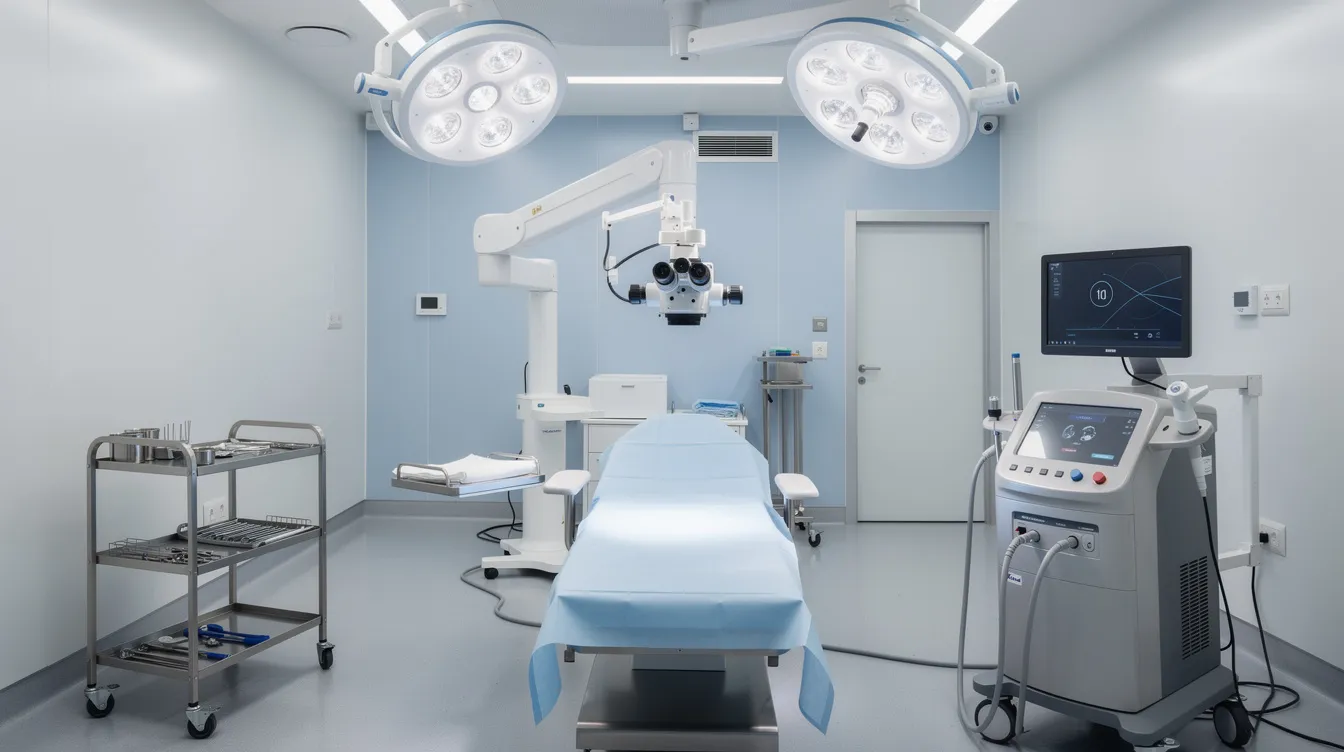
Ophthalmology equipment – phaco machines, operating microscopes, lasers, OCT, fundus cameras, slit lamps, auto-refractors – typically forms the largest single component of an eye hospital term loan. Lenders evaluate the cost and necessity of specialised ophthalmic equipment line item by line item.
A basic cataract-only setup requires a different equipment budget than a centre offering cataract, refractive, and retina services. Indicative benchmarks in 2026:
| Equipment | Approximate Cost Range |
|---|---|
| Slit lamp | ₹1–4 lakh |
| Auto-refractometer | ₹2–6 lakh |
| Optical biometer | ₹12–35 lakh |
| Phaco machine | ₹12 lakh – ₹1 crore+ |
| Femtosecond laser | ₹50 lakh – ₹1.5 crore+ |
| Operating microscope | ₹10–60 lakh |
Femtosecond lasers are improving cataract surgery outcomes in eye hospitals, and eye hospitals are adopting AI-powered diagnostic tools for early disease detection, but bankers apply a utilisation logic: if two high-end phaco machines and a femto laser are proposed, projections must show adequate surgery volume to justify such investment. Operating theatre utilisation rates are measured for efficient asset use. Idle high-value equipment weakens eye hospital financial feasibility.
Tele-ophthalmology platforms are enhancing service accessibility in eye care and may feature in newer DPRs, but banks will question whether technology investment aligns with projected revenue.
Explore a full eye hospital equipment list and cost – complete setup guide for detailed benchmarks.
4. Means of Finance and Promoter Contribution
In eye hospital project finance, banks carefully verify whether total project cost is fully tied up through a balanced mix of promoter contribution, term loan, and any other identified sources.
The basic identity is simple:
Total Project Cost = Promoter’s Own Funds + Term Loan + Other Identified Sources
Banks prefer a debt-to-equity ratio of 70:30 for healthcare projects, meaning the promoter is expected to bring roughly 25–35% of the project cost from own resources. For illustration, a ₹6 crore project might be funded through ₹1.8 crore promoter equity and ₹4.2 crore term loan – but these are illustrative figures, not universal rules.
Lenders judge whether the doctor or investor is bringing in a meaningful personal stake, supported by bank statements and capital-introduction proofs. The means of finance must also specify how working capital will be funded – through cash credit, overdraft, internal accruals, or as part of project cost. Mismatches between project cost and means of finance are a common red flag.
For funding-mix strategies, refer to how to structure the investment in an eye hospital project.
5. Location, Market Potential and Patient Demand
Even a perfect DPR on paper must be backed by genuine patient potential. Site selection criteria include proximity to residential areas and utilities, and banks expect the DPR to specify the catchment population, surrounding residential and commercial zones, distance from existing eye hospitals, and road or public-transport access.
Evaluation of local market demand considers demographics and aging populations – age profile drives cataract volume, diabetes prevalence drives retina demand, and corporate workforce density can support refractive surgery projections. Public-private partnerships are expanding eye care accessibility in underserved regions, which can create both opportunity and competition.
Banks scrutinise competition: existing ophthalmology clinics, chain eye hospitals (in 2011, Vasan was certified as the largest eye care provider, and Vasan Eye Care operates over 170 hospitals worldwide), government facilities, and how the new hospital differentiates through sub-specialties, technology, or pricing. If a small town proposes metro-level LASIK volumes from Year 1, the banker will view projections as aggressive and lacking credibility.
6. How Banks Examine the Eye Hospital Revenue Model
Lenders analyze revenue streams including outpatient consultations and surgical procedures. Principal revenue streams of an eye hospital include OPD consultation, cataract surgeries, other ophthalmic surgeries, diagnostics (OCT, biometry, fundus imaging), procedures (YAG laser, intravitreal injections), optical shop, and pharmacy where included. Eye hospitals often provide services like cataract and glaucoma treatment as their primary volume drivers.
In appraisal, revenue should be constructed from the ground up:
Patient Volume × Average Realisation = Revenue
For each service, projected patient counts per day or month multiplied by average realisation per service should produce monthly and annual income. The DPR should assume lower utilisation in Year 1 – for example, 30–40% of designed OT capacity – gradually increasing over 3–4 years rather than starting at full capacity.
A practical illustration: if cataract volume drops by 15%, both revenue and consumable costs change, and the bank mentally stress-tests these assumptions. Arbitrary annual growth rates without volume logic do not satisfy appraisal standards.
For detailed revenue-building methods, see the guide on eye hospital revenue model and realistic revenue projections.
7. Assessment of Operating Expenses and Profitability
Banks closely examine whether, after all operating expenses, the eye hospital generates sufficient operating surplus to cover interest, principal, and owner requirements. Operating costs in the first year include salaries, utilities, and taxes, and these grow as the hospital scales.
Major cost heads include:
- Salaries and professional fees (ophthalmologists, optometrists, nurses, technicians, admin)
- Consumables and lenses, medicines
- Utilities (power, water, internet)
- Rent (if premises are leased)
- Equipment AMC, repairs and maintenance
- Marketing, insurance, software, housekeeping
- Statutory compliances
Human resource planning should map staffing needs across all categories. Some expenses are semi-fixed (basic staff, minimum power, maintenance) while others are variable and linked to patient volumes (consumables per cataract surgery, lenses, diagnostic consumables). Projections should reflect this mix.
Operating profit or EBITDA, in simple terms, is income minus all operating expenses excluding interest and depreciation. Banks need this number to be positive and growing, because it feeds directly into debt servicing capacity. Understated expenses – especially unrealistically low salary budgets for 2026–2030 – are a common reason bankers discount DPR numbers or request revisions.
8. Financial Projections in the Eye Hospital DPR
Scrutiny of projected cash flows is essential for loan approval. Banks rely on integrated 5–7 year financial projections to understand how operations translate into profits, cash flows, and balance-sheet movements. Financial projections should cover five to seven years for viability.
A complete eye hospital DPR should contain:
- Projected Profit & Loss statement
- Projected Balance Sheet
- Projected Cash Flow statement
- Fixed-asset schedule and depreciation
- Term-loan amortisation schedule
- Working-capital assessment
- Key financial ratios
Internal consistency matters: if surgery volumes increase, projections must show higher consumables, more staff costs, and sometimes additional equipment or OT usage. Growth in credit patients must reflect in receivables and working capital. Banks analyze financial performance through historical profit and loss statements where an existing practice operates, and compare historical trends with forward projections. A financial statement that doesn’t reconcile across P&L, balance sheet, and cash flow raises immediate concerns.
For sample formats and modelling logic, refer to eye hospital financial projections for DPR preparation.
9. Working Capital Requirement of an Eye Hospital
A term loan only funds long-term assets. The eye hospital also needs working capital to run daily operations, especially during the first 12–18 months until cash flows stabilise.
Major working-capital elements include monthly salaries, consumables and medicines inventory, lenses and frames stock for optical, credit given to corporate and insurance patients (which creates receivables), utility bills, rent, and a minimum cash buffer. Customer satisfaction in eye care services depends on uninterrupted availability of quality consumables and support services, which requires adequate working capital.
A common mistake is preparing projections where all surplus cash is assumed available for loan repayment, ignoring the cash locked in stock and receivables. Working capital can be funded through cash credit limits, overdraft facilities, internal accruals, or inclusion of initial working-capital margin in project cost. The DPR should specify this clearly.
For detailed assessment methods, see the guide on eye hospital working capital requirement – assessment and calculation.
10. DSCR and Loan Repayment Capacity
Cash flow stability is crucial for loan servicing in healthcare financing, and the Debt Service Coverage Ratio is one of the most important factor in eye hospital term loan assessment. DSCR measures the relationship between cash generation and total debt servicing for each year.
In simple terms, for each projected year:
DSCR = Cash Accruals Available for Debt Service ÷ (Interest + Principal Due)
Cash accruals typically include operating profit after tax plus non-cash charges like depreciation. Banks look at both year-wise DSCR and average DSCR over the loan tenure. Under the Baroda Arogyadham scheme, for example, average DSCR of 1.75 is expected, with DSCR not falling below approximately 1.25 in any individual year.
If DSCR dips sharply – for instance, when heavy principal repayments start before the hospital stabilises patient volumes – banks may ask for higher promoter contribution, longer tenure, or revised projections. Sensitivity analysis matters: what happens if revenue falls by 10–15%? If DSCR drops below 1 in such scenarios, the proposal appears financially fragile.
For detailed ratio analysis and stress-testing, refer to eye hospital DSCR and loan repayment capacity – complete guide.
11. How the Proposed Term-Loan Repayment Schedule Is Evaluated
Even if DSCR appears acceptable on paper, banks review whether the repayment schedule matches the project’s gestation period and expected cash-flow pattern.
Typical stages include: implementation period (renovation, equipment installation, regulatory approvals), soft opening, gradual ramp-up of OPD and surgeries, and stabilisation. Many projects seek a short moratorium on principal during early months to allow revenue to build. Loans for hospital projects often have tenure up to 10–12 years, though this is not a rule.
An over-aggressive schedule with heavy repayments from Year 1 creates cash strain and lowers DSCR. A realistic schedule aligns principal repayments with growing operating surplus. Promoters should test their repayment structure through projections under slightly lower-than-expected revenue before facing bank scrutiny in the long run.
12. Existing Liabilities and Overall Financial Position
Banks evaluate the new eye hospital term loan in the broader context of the promoter’s existing borrowings and net worth, not in isolation.
Lenders typically review outstanding home loans, vehicle loans, education loans, unsecured business loans, credit-card dues, guarantees given for other businesses, and repayment track record on each account. The DPR or personal financial statement should clearly show promoters’ assets and liabilities to allow the banker to assess net worth.
If an ophthalmologist already operates a clinic, banks often ask for the last 2–3 years of financial performance – turnover, profit, bank statements – as evidence of business capability and cash-flow behaviour. High leverage or strained cash flows in existing operations can make banks more conservative, even if the new hospital’s economics otherwise appear sound.
13. Security, Collateral and Primary Assets
While cash-flow viability is central, many Indian banks also consider security when sanctioning an eye hospital loan. Valuation of collateral includes medical equipment and other hypothecated assets financed by the term loan.
Primary security typically comprises the assets financed – building, interiors, ophthalmology equipment, furniture – which are usually hypothecated or mortgaged and insured. Collateral security where required may include equitable mortgage of additional property or third-party guarantees. Requirements differ by lender, ticket size, and borrower profile. Blanket statements like “collateral is always mandatory” or “no collateral is needed” should be avoided – discuss expectations with your specific banker.
14. Statutory, Regulatory and Operational Readiness
Banks check whether the eye hospital appears reasonably prepared to comply with key regulatory and operational requirements. Verification of healthcare licenses and compliance with statutory standards is required, and regulatory approvals and licensing are mandatory before hospital operations can begin.
Relevant aspects in India include:
- Entity registration (proprietorship, partnership, LLP, company)
- Professional registration of doctors
- State clinical establishment registration
- Fire and safety clearances
- Compliance with biomedical waste management regulations
- Local municipal permissions
- Pharmacy licence and GST registration (if applicable)
- A hospital must comply with Bureau of Indian Standards for design where applicable
Banks take comfort when timelines for obtaining pending regulatory approvals are clearly mentioned in the implementation schedule. The environmental impact of waste disposal and the safety protocols of the facility are increasingly part of appraisal review. Applicability varies by state, city, and project scope.
15. What Banks Look for in an Eye Hospital Project Report (DPR)
A hospital Detailed Project Report is essential for funding and acts as the core reference document during appraisal. It must present a coherent story, not disconnected spreadsheets.
Essential DPR components include: promoter and organization profile, project background and objectives, detailed description of services (OPD, OT, diagnostics, optical, pharmacy), location and market analysis, project cost with supporting quotations, ophthalmology equipment list, means of finance, implementation schedule, revenue and cost assumptions, projected financial statements, working capital assessment, term-loan details, DSCR analysis, break-even analysis, and key risks.
Assumptions should be explicitly stated – for example, “cataract volume expected to increase from 50 surgeries per month in Year 1 to 120 in Year 4.” The purpose of the DPR is not to show maximum profit but to reflect a realistic and defendable business plan that can withstand stress-testing. A feasibility study prepared by someone familiar with healthcare project finance can help avoid structural errors, though it cannot guarantee sanction.
16. Common Red Flags in Eye Hospital Term Loan Appraisal
Many eye hospital loan proposals are delayed or declined not because the core idea is flawed, but because of specific red flags in the DPR and projections.
- Demand-side issues: Assuming very high OPD and surgery volumes in the first 6–12 months without marketing or referral plans, or projecting large LASIK volumes in areas where such demand is historically low, creates a significant gap between ambition and evidence.
- Financial red flags: Project cost inflated without supporting quotations, insufficient promoter contribution, overly optimistic revenue growth (e.g., 40–50% per year) without justification, or unrealistically low salary and consumable costs.
- Cash-flow concerns: Ignoring working capital needs, DSCR dropping sharply when large principal instalments start, or repayment schedules unrelated to operating cash generation.
- Consistency errors: Mismatch between equipment list and projected services, mismatch between bed/OT capacity and surgery volumes, or mathematical inconsistencies between P&L, balance sheet and cash-flow statements – all reduce banker confidence quickly.
17. How to Strengthen an Eye Hospital Term Loan Proposal
A strong eye hospital term-loan proposal results from thoughtful planning rather than last-minute adjustments to justify a particular loan amount.
- Base project cost on actual architect estimates and equipment quotations, include reasonable contingency, and keep documentation ready for each major cost head.
- Build a realistic revenue model: modest initial volumes, gradual ramp-up supported by specific outreach and referral strategies, and conservative pricing assumptions aligned with local market conditions.
- Estimate operating expenses and working capital separately using current salary benchmarks, power tariffs, and vendor terms instead of generic percentages.
- Before approaching banks, review projected DSCR, test slightly lower revenue or higher cost scenarios, and adjust project scope, repayment tenure, or promoter contribution to maintain comfortable repayment capacity.
- Maintain high standards of internal consistency across all projections – the quality of assumptions matters more than the size of projected profit.
Eye Hospital Bank Loan: Complete Finance and Documentation Guide
Understanding how banks assess your project is one part of the process. Equally important is knowing how to navigate the actual financing and documentation process – choosing the right bank or scheme, preparing the loan application, assembling KYC and financial documents, coordinating site visits, and managing post-sanction documentation.
For a step-by-step view, refer to the comprehensive guide on bank loan for eye hospital – project finance and documentation. A clear understanding of appraisal criteria, as covered in this article, makes it considerably easier to prepare documents and interact effectively with bank officials during the sanction process.
Example: How a Bank May Analyse an Eye Hospital Project
Consider a hypothetical day-care eye hospital in a Tier-II city in 2026. This is purely illustrative.
Project Basics (Illustrative):
| Parameter | Assumption |
|---|---|
| Total Project Cost | ₹5.00 crore |
| Promoter Contribution (30%) | ₹1.50 crore |
| Term Loan (70%) | ₹3.50 crore |
| Key Equipment Investment | ₹2.20 crore |
| OPD by Year 3 | 50 patients/day |
| Cataract Surgeries by Year 3 | 100/month |
| Loan Tenure | 8 years (incl. 6-month moratorium) |
Year 3 Financial Snapshot (Illustrative):
| Head | Amount (₹ Lakh) |
|---|---|
| OPD + Diagnostics Revenue | 90 |
| Surgical Revenue (Cataract + Other) | 210 |
| Optical + Pharmacy | 30 |
| Total Revenue | 330 |
| Total Operating Expenses | 210 |
| EBITDA | 120 |
| Depreciation | 30 |
| Interest on Term Loan | 28 |
| Profit Before Tax | 62 |
| Tax (approx.) | 16 |
| Net Profit | 46 |
| Cash Accrual (Net Profit + Depreciation) | 76 |
| Annual Debt Service (Interest + Principal) | 72 |
| DSCR | 1.06 |
Notice that even with reasonable-looking revenue, the DSCR in this scenario is barely above 1.0 – a level most banks would find uncomfortable. If surgical volume drops by 15%, cash accruals fall further and DSCR may slip below 1. This is exactly the type of financial analysis a banker performs. Adjusting tenure, reducing equipment scope, or increasing promoter equity could bring DSCR into an acceptable range.
Banker’s Perspective: The Five Questions Behind the Numbers
Every banker reading an eye hospital DPR is, consciously or not, answering five questions:
- Is the project cost reasonable and complete? No major items missing, no artificial inflation, supported by quotations.
- Is the promoter bringing adequate financial stake and showing good repayment discipline? Meaningful equity, clean credit history, willingness to share risk.
- Are patient volume and revenue assumptions realistic for this location and service mix? Consistent with catchment demographics, competition, and gradual ramp-up.
- After expenses and working capital, does the hospital generate enough cash? Not just paper profit, but actual cash after accounting for receivables, stock, and routine expenses.
- Can the term loan be serviced comfortably over the full tenure under reasonable stress? DSCR holds up even if revenue is 10–15% below plan.
If the answer to any one of these is weak, advanced equipment, impressive interiors, and strong clinical vision cannot compensate in the lender’s risk assessment. The progress of any eye hospital project through bank appraisal depends on aligning clinical ambition with financial discipline.
Expert Note
An eye hospital term-loan proposal should not be drafted by starting with a desired loan amount and then forcing projections to match. Project cost, means of finance, patient volumes, pricing, expenses, working capital, and repayment plan must be built logically and checked for internal consistency. A DPR constructed backwards – from a target loan to inflated revenue – rarely survives serious bank scrutiny. While professional preparation significantly improves clarity and credibility, no consultant or CA can guarantee loan approval. Final decisions rest with the lending institution based on its own policies and risk appetite.
Expert Note by CA Manish Gugliya, Chartered Accountant | ProjectReportBank
About CA Manish Gugliya
CA Manish Gugliya is a Chartered Accountant with professional experience in project reports and DPR preparation, CMA data, financial projections, project finance, bank-loan documentation, MSME finance, and financial feasibility assessment. Through ProjectReportBank, he has worked on linking project cost, means of finance, operating assumptions, working capital, DSCR, and repayment schedules into integrated financial models for hospitals and other capital-intensive ventures.
His practical approach involves tailoring DPRs and cash-flow models to the actual location, service mix, and promoter profile rather than using generic templates. This makes bank appraisal smoother and more transparent. His role is advisory and analytical – helping promoters understand lender expectations and prepare robust documentation – not to influence sanction decisions or bypass normal banking processes.
Frequently Asked Questions
How do banks assess an Eye Hospital project for a term loan?
Banks combine qualitative assessment – promoter background, clinical experience, market potential – with quantitative financial analysis covering project cost, means of finance, revenue projections, expenses, working capital, DSCR, and collateral. They typically review 5–7 years of projections before deciding whether the proposal fits their risk appetite. The process is integrated; no single factor in isolation determines the outcome.
Is a detailed project report mandatory for an Eye Hospital term loan?
For most new or expansion eye hospital projects involving significant capital expenditure in India, lenders insist on a structured DPR or feasibility study, even if smaller equipment-only loans sometimes proceed on simpler documentation. A robust project report almost always improves clarity and speeds up appraisal because it presents every aspect of the business plan – from project cost and market demand to DSCR – in a format bankers can independently evaluate.
Can a new ophthalmologist without long practice history get a bank loan for an eye hospital?
It is possible, but appraisal becomes more conservative. Banks place extra weight on qualifications, any existing clinical exposure, strength of co-promoters, promoter contribution, collateral support, and the conservativeness of projections. Each case is judged individually. A new entrant with strong equity, solid qualifications, and realistic projections can establish credibility, though expectations on margin money or collateral may be higher.
How much promoter contribution is typically expected in an eye hospital project?
Required equity or margin can vary by lender, scheme, and risk profile. Healthcare term loans in practice often expect meaningful promoter contribution – commonly in the 25–35% range for mid-size projects – but there is no single percentage guaranteed for all cases. Discuss expected margin with your banker early and plan for a reasonable personal stake to strengthen the proposal.
Does an eye hospital need working capital in addition to a term loan?
Almost all functioning eye hospitals need working capital for salaries, consumables, lenses, utilities, and credit patients, especially during the first 12–18 months. Ignoring this in the DPR can make cash-flow and DSCR appear stronger on paper than they will be in reality. Working capital should be separately estimated and funded – either through bank facilities, internal accruals, or a provision within project cost.
How is DSCR actually used during eye hospital loan appraisal?
Banks look at DSCR year-wise and on an average basis to judge repayment comfort. If DSCR falls close to or below 1 in several years, lenders may ask for higher promoter contribution, longer tenure, or revised projections. Each bank has its own internal benchmarks rather than a single public rule, though many healthcare loan schemes expect average DSCR in the 1.50–2.00 range.
Do banks finance only medical equipment or the full eye hospital setup?
Some lenders offer dedicated equipment-finance products focusing mainly on ophthalmology equipment, while larger term loans can fund interiors, civil works, IT systems, and other fixed assets as part of a full project. The structure depends on the loan product, ticket size, borrower profile, and the chosen bank’s guidelines. Discuss both options early to determine the right fit for your project.
Conclusion
Eye hospital term loan assessment is an integrated exercise. Banks do not view project cost, equipment, revenue, DSCR, or promoter contribution in isolation. Every component must support the same commercial story – and the story must be realistic.
The strongest eye hospital proposals use conservative assumptions, transparent costing, and internally consistent financial projections. They resist the temptation to inflate revenue or suppress costs merely to justify a larger loan amount. A project report that can withstand questions from a cautious banker, a co-investor, and the promoter’s own future self is the one that creates lasting value.
When approached with this discipline, eye hospital project finance becomes not just about securing loans to establish a new hospital, but about building a sustainable, patient-centric eye care institution that can honour its financial obligations in the long run – and deliver sight and vision to the society it serves.
Explore All Eye Hospital DPR Guides
Continue exploring our complete series on Eye Hospital project planning, financial projections, repayment capacity and bank finance.
- Eye Hospital Project Report / DPR for Bank Loan – Complete Guide

- Eye Hospital Term Loan Assessment: How Banks Evaluate Your Project in India
- Bank Loan for Eye Hospital – Project Finance & Documentation Guide
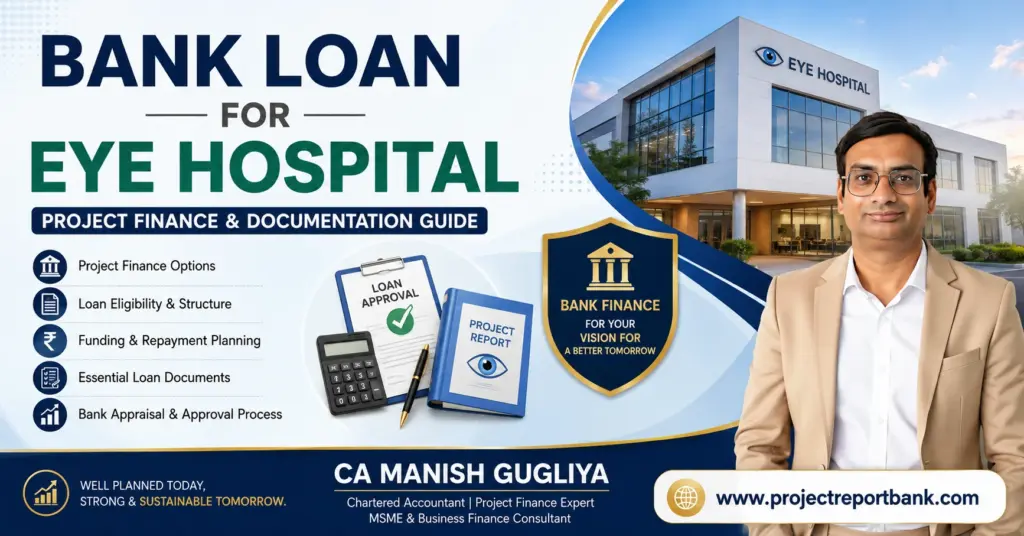
- Eye Hospital DSCR & Loan Repayment Capacity – Complete Guide
- Eye Hospital Working Capital Requirement – Assessment & Calculation (India-Focused Guide)
- Eye Hospital Financial Projections – How to Prepare Projections for DPR (India)
- Eye Hospital Revenue Model – How to Prepare Realistic Revenue Projections (Eye Hospital Project Report)
- Eye Hospital Project Cost & Means of Finance – How to Structure the Investment
- Eye Hospital Equipment List & Cost in India – Complete Setup Guide