Key Takeaways
Selecting edible oil refinery machinery is not merely a procurement exercise. It is a strategic decision that shapes refining yield, operating cost, product quality, and the financial viability of the entire project. For Indian promoters planning projects ranging from ₹5 crore to ₹100 crore and beyond, understanding machinery, process technology, and EPC contracting before committing capital is essential.
- Edible oil refinery plant machinery directly determines oil losses, steam and power consumption, maintenance expense, and compliance with FSSAI and BIS food safety norms. Even a 0.2–0.3% improvement in refining loss on a 100 TPD plant can materially increase annual EBITDA and shorten payback.
- The refining process involves multiple sequential stages – degumming, neutralisation, bleaching, deodorisation, dewaxing, and sometimes fractionation – each requiring specific equipment whose specifications must align with the crude oil type and production capacity.
- Physical refining and chemical refining serve different feedstocks and generate different waste streams, utility demands, and capital requirements. Choosing the wrong route without crude oil characterisation creates avoidable financial risk.
- Batch, semi-continuous, and continuous edible oil refinery plant configurations suit different scales and operating conditions. Continuous plants offer the lowest per-tonne costs at high utilisation but can underperform financially if capacity remains under-utilised.
- A professionally prepared Detailed Project Report (DPR) should precede final EPC selection, linking machinery choices to CAPEX, working capital, DSCR, IRR, and loan repayment capacity under realistic operating assumptions.
Introduction – Why Machinery and Technology Selection Matters
The choice of edible oil refinery machinery is one of the most consequential decisions an industrial promoter makes. It determines not only the initial capital investment but also refining yield, oil losses during degumming, neutralisation, bleaching, and deodorisation, utility consumption of steam and power, labour intensity, maintenance expense, downtime frequency, and the ability to meet Indian food safety standards under FSSAI and BIS.
Refinery plants can process capacities from 25 to 500 tons per day, and the capacity of edible oil refineries varies significantly depending on production methods and scale. Refinery machinery must be tailored to the specific type of oil and production capacity – a soybean oil refinery operates under different conditions than a palm oil refinery plant or a rice bran oil processing line.
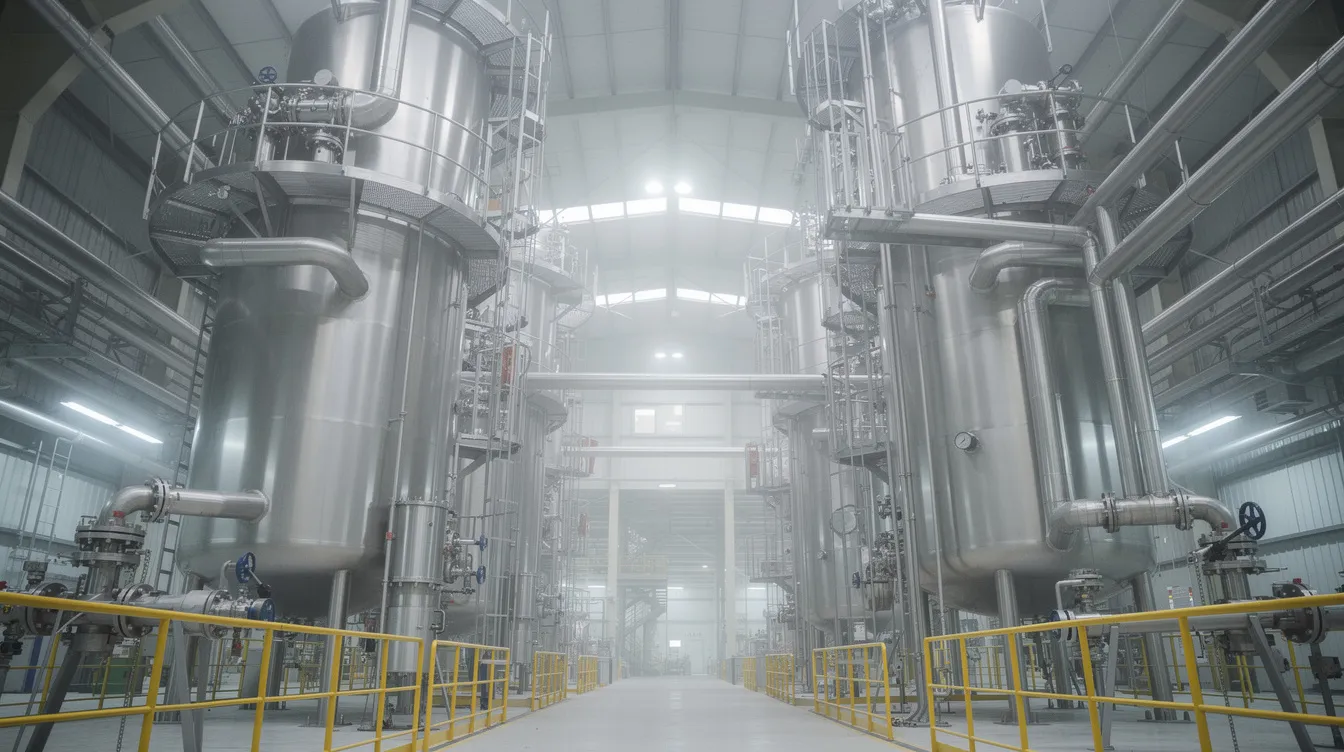
The lowest machinery quotation is rarely the lowest life-cycle cost. When oil losses, energy bills, spare parts, downtime, and operator skill requirements are factored into a 10–15 year financial model, a marginally cheaper equipment package may prove substantially more expensive in total. Supplier quotes often emphasise CAPEX alone, but operating cost per tonne – driven by machinery efficiency – can far outweigh initial savings over the project’s useful life.
As a Chartered Accountant-led project finance advisory, Project Report Bank evaluates edible oil refinery equipment not only on technical merit but also on its impact on project IRR, DSCR, break-even capacity utilisation, and loan repayment capacity. The financial model in a bankable DPR must reflect realistic oil loss percentages, utility tariffs, and capacity utilisation – not best-case supplier claims.
- Technology choice (physical refining vs chemical refining, batch vs continuous) directly affects the quality of the DPR, bank finance approval, and investor comfort.
- Supplier guarantees on oil loss, steam and power usage, yield, and finished oil quality are central to bankable project documentation.
- Equipment decisions interlock with CAPEX, working capital, depreciation, interest cost, and thus DSCR, IRR, and payback calculations.
- Machinery selection should follow from financial feasibility analysis, not precede it.
Understanding the Complete Edible Oil Refining Process
Edible oil refining typically consists of multiple stages including extraction, refining, and packaging. The core purpose is to convert crude oil – from soybean, sunflower, palm oil, rice bran, mustard, groundnut, cottonseed, coconut, or corn – into neutral, stable, clear, odourless edible oil meeting FSSAI and BIS standards. Common impurities in crude oil include free fatty acids and phospholipids, along with pigments, waxes, and volatile odour compounds. The refining process systematically removes these impurities to produce refined oil suitable for human consumption with an acceptable shelf life.
Major process steps:
- Crude oil reception and storage – Tanks, pre-filtration to remove particles and debris, initial heating to reduce viscosity. Crude oil purification involves filtering out impurities and suspended solids from extracted oil.
- Degumming – Degumming removes phospholipids and gums from crude oil. Phosphoric acid or water is used to hydrate hydratable phospholipids, which are then separated via centrifuge.
- Neutralisation (chemical refining only) – Chemical refining neutralizes free fatty acids using caustic soda to form soapstock, which is separated by centrifugal separators. The oil is then washed with hot water and dried.
- Bleaching – Bleaching removes color pigments and residual phosphatase from oil using bleaching earth (activated clay) and sometimes activated carbon, under vacuum and controlled temperature.
- Filtration – Vertical pressure leaf filters and polishing filters remove spent earth and fine particles from the oil.
- Deodorisation – Deodorization removes undesirable odors and flavors from oil through high-temperature steam distillation. Deodorization occurs at temperatures of 240°–260°C under vacuum. In physical refining, the deodoriser also strips fatty acids.
- Dewaxing / Winterisation – Required for oils with high wax content. Winterization cools oil to crystallize waxes that might cloud the oil at lower temperatures. Dewaxing improves clarity and stability of oils at low temperatures.
- Fractionation – For oils like palm, to separate olein and stearin fractions using crystallisers and filters.
- Finished oil storage and transfer – Final filtration, cooling, storage under controlled conditions.
- Packaging – Bottling, filling, labelling where included in project scope.
Text-based process flow diagram:
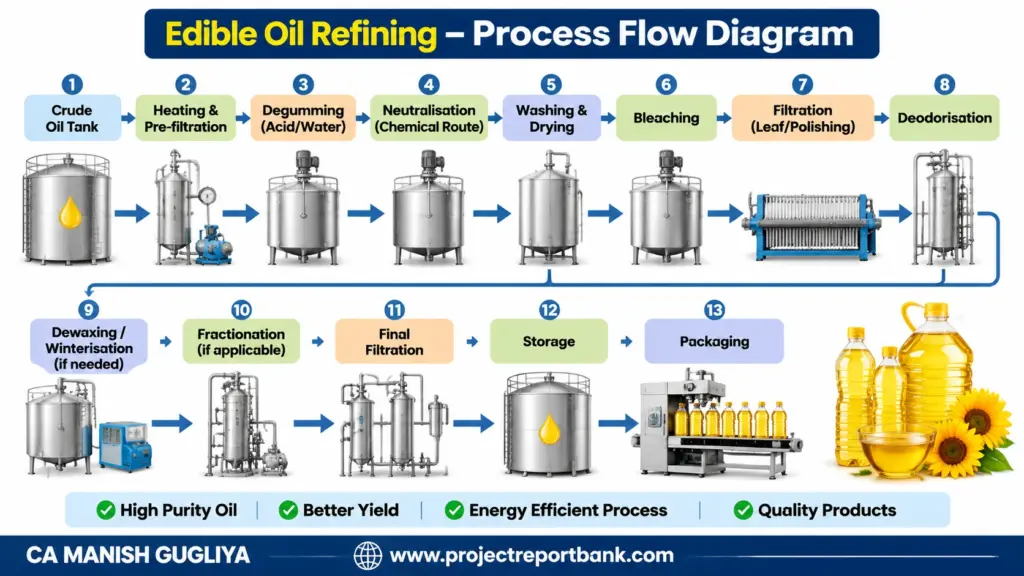
Crude Oil Tank → Heating & Pre-filtration → Degumming (Acid/Water) → Neutralisation (Chemical Route) → Washing & Drying → Bleaching → Filtration (Leaf/Polishing) → Deodorisation → Dewaxing/Winterisation (if needed) → Fractionation (if applicable) → Final Filtration → Storage → PackagingThe exact sequence differs for physical refining versus chemical refining. For physical refining, neutralisation is omitted and free fatty acids are removed in the deodoriser. High-FFA oils such as palm and rice bran often favour physical refining, while soft oils like soybean and sunflower with higher phospholipid content may require chemical refining with more intensive degumming. Edible oil refining plants process oils like soybean and palm, and the process design must account for feedstock-specific characteristics.
A process engineer must define detailed parameters – temperatures, residence times, vacuum levels, steam rates – but promoters need conceptual clarity to evaluate machinery quotations and assess oil refinery EPC proposals effectively.
Complete Edible Oil Refinery Machinery and Equipment List
Common machinery in edible oil refining includes degumming tanks, centrifuges, and deodorizers, but a complete edible oil refinery plant machinery list extends well beyond core process vessels. Vegetable oil refinery equipment costs approximately Rs 1,50,00,000 per unit for basic configurations, while edible oil refinery plants cost approximately Rs 2,00,00,000 each at entry-level capacities. The table below covers primary process equipment and essential supporting systems.
| Machinery / Equipment | Function | Key Selection Considerations | Financial / Operational Implications |
|---|---|---|---|
| Crude oil storage tanks and unloading pumps | Store incoming crude oil; ensure continuous supply to the process | Tank material (carbon steel vs stainless), heating jacket, insulation, capacity matching throughput and buffer needs, pump sizing | Inadequate storage leads to oxidation and higher FFA; insufficient buffer causes production downtime |
| Buffer and day tanks | Maintain process continuity; allow feedstock changeover | Sizing for retention time; material; heat tracing; cleaning provisions | Enables flexibility; reduces start-stop losses; affects working capital tied to oil inventory |
| Degumming vessels and acid/water dosing systems | Remove gums and phospholipids using phosphoric acid or water | Type (batch/continuous), residence time, mixing intensity, centrifuge efficiency, dosing accuracy | Incomplete degumming increases bleaching load and oil loss; raises chemical costs |
| Neutraliser and centrifugal separator | Remove free fatty acids via caustic reaction (chemical refining) | Caustic dosing accuracy, mixing quality, separator efficiency, soapstock handling | Loss of oil as soapstock; caustic and wash water costs; effluent treatment burden |
| Washing and drying systems | Remove residual soap; dry oil to prevent hydrolysis | Water temperature and quality; washer type; vacuum dryer capacity | Water and effluent cost; risk of foaming if moisture remains |
| Bleaching vessel and bleaching earth handling | Adsorb pigments, trace metals, oxidation products | Earth dosage and type; vacuum vessel design; agitator quality; filter compatibility | Bleaching earth cost and disposal; oil retained in spent earth is a direct yield loss |
| Vertical pressure leaf filters and polishing filters | Remove spent earth and fine particles from oil | Filtration area; cake handling; automatic vs manual cleaning; media durability | Oil loss in filter cake; downtime for cleaning; maintenance cost of filter media |
| Deodorisation column with plate heat exchanger and heat recovery | Strip odours and volatile fatty acids; recover process heat | Design temperature and vacuum level; structured packing vs tray internals; steam-to-oil ratio; heat integration with incoming crude | Steam and power consumption; product quality (odour, colour); capital higher for energy-efficient designs |
| Vacuum system and condensers | Maintain deep vacuum in bleaching and deodorisation | Capacity at design load; back-pressure; materials of construction; condensate recovery | High power/steam cost; poor vacuum increases oil degradation; reliability critical for continuous operation |
| Deodoriser vent scrubber and distillate recovery | Treat vapours; recover useful fatty acid distillate | Efficiency; environmental compliance; distillate value recovery | Regulatory risk if emissions uncontrolled; good recovery improves margin from by-products |
| Dewaxing/winterisation equipment (crystallisers, chillers, filters) | Remove waxes for cold-climate clarity | Cooling capacity; crystalliser design; seed handling; filtration of wax crystals | Required for sunflower, rice bran, corn oils; adds capital and utility cost |
| Fractionation equipment | Separate olein and stearin fractions (primarily for palm) | Cooling profile control; filter and seed capacity; stearin handling | Opens markets for different product grades; adds 10–15% to CAPEX |
| Steam boiler / thermic fluid heater / vacuum heater | Provide process heat for various stages | Fuel type; efficiency; emissions compliance; capacity margin | Fuel cost is a major ongoing expense; effective heat recovery reduces steam requirement |
| Cooling tower and chilled water plant | Provide cooling for condensers, dewaxing, fractionation | Cooling load matching ambient conditions; water treatment; chiller sizing | Power and water consumption; tropical heat in India can strain capacity seasonally |
| PLC/SCADA, field instrumentation, electrical panels | Automation, safety, and process control | Sensor accuracy; recipe control for different crude oils; data logging; spare parts availability | Higher CAPEX but lower labour, fewer errors, better consistency; supports bankable performance documentation |
| Finished oil storage tanks and loading bays | Store refined oil; dispatch to packaging or bulk sales | Material; capacity matching output and sales buffer; inert gas blanketing | Storage buffer reduces risk of market delays; oxidation prevention essential |
| Effluent treatment plant (ETP), spent earth and soapstock handling | Treat process water; handle by-products | Local environmental rules; peak load capacity; by-product recovery potential | Non-compliance risks fines or shutdown; good ETP may attract government incentives |
| QC laboratory equipment | Ensure finished oil meets FFA, peroxide, colour, and other specifications | Analysers (GC, spectrophotometer, moisture); sample throughput; calibration | Poor quality control leads to market rejects and brand damage |
Items such as degumming, bleaching, filtration, deodorisation, and basic utilities are standard for almost all edible oil refineries. Dewaxing is conditional – required for sunflower, corn, and rice bran oil. Fractionation is primarily needed for palm oil. Advanced automation is more suitable for continuous edible oil refinery plant operations at medium to large scale.
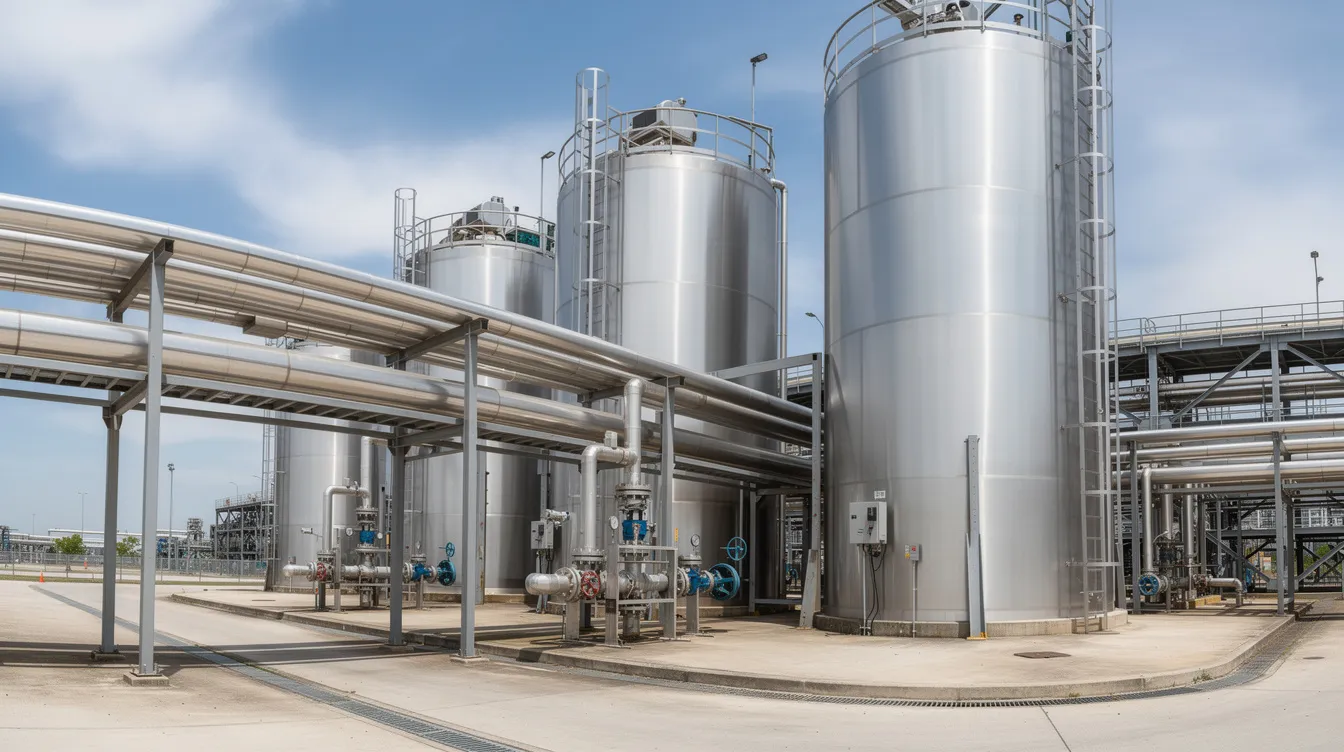
Physical Refining vs Chemical Refining Technology
Physical refining removes free fatty acids as vapours in the deodoriser after pretreatment (degumming and bleaching), avoiding the caustic neutralisation step entirely. The chemical refining process neutralises fatty acids using caustic soda, generating soapstock and requiring wash water and drying before bleaching and deodorisation.
| Parameter | Chemical Refining | Physical Refining |
|---|---|---|
| FFA removal method | Caustic neutralisation | Steam stripping in deodoriser |
| Suitable feedstocks | Soybean, sunflower, cottonseed with variable phospholipids | Palm oil, palm kernel, coconut, high-FFA rice bran oil |
| Waste streams | Soapstock; wash water; saponification loss | Fatty acid distillate; no soapstock |
| Refining losses | Higher due to saponification and washing | Generally lower FFA-related loss |
| Chemical consumption | Caustic soda, wash water, bleaching earth | Bleaching earth; no caustic |
| Energy profile | Heating for neutralisation, washing, drying plus deodorisation | Higher deodoriser heat and vacuum demand |
| CAPEX implications | Additional neutralisers, washers, driers; larger ETP | More robust deodoriser, vacuum system, and heat recovery |
| Environmental impact | Chemical effluent; soapstock disposal | Lower chemical effluent; tight control of stripping emissions needed |
Physical refining is often preferred for high-FFA oils like palm oil because it avoids the large volumes of caustic and effluent that chemical refining would generate. Chemical refining can be more suitable for certain soft oils with high phospholipid levels where crude quality is variable and degumming alone cannot adequately prepare the oil for deodorisation.
No single edible oil refining route suits every crude oil. Crude oil analysis – FFA, phosphatides, metals, colour, wax content – and sometimes pilot tests are required before locking the refining process in contracts. Even a 0.2–0.3% difference in refining loss on a 100 TPD capacity plant can translate to 60–90 tonnes of additional refined oil annually, materially impacting EBITDA, IRR, and payback period. These differences must be captured in the DPR financial model with appropriate sensitivity analysis.
Batch vs Semi-Continuous vs Continuous Refining Plants
The three main edible oil refinery plant configurations – batch, semi-continuous, and continuous – must align with capacity, product mix, feedstock consistency, and financing capability. Plants can have capacities ranging from 25 to 500 tons per day, and the optimal configuration depends on where a project falls within this range.
| Feature | Batch | Semi-Continuous | Continuous |
|---|---|---|---|
| Typical capacity range | 5–50 TPD | 50–200 TPD | 200–500+ TPD |
| Automation level | Lower; manual operations | Moderate; mix of manual and automated | High; PLC/SCADA with recipe control |
| Flexibility for multiple oils | High; easy changeover | Good; changeover requires some downtime | Less flexible unless specifically designed |
| Utility consumption per tonne | Higher; heat loss between batches | Lower than batch | Lowest; steady-state heat integration |
| Oil loss control | More variable; operator-dependent | Better | Best; consistent operations reduce losses |
| Capital intensity per TPD | Lower total CAPEX | Intermediate | Highest upfront; lowest unit cost at scale |
Continuous deodorizing plants cost about Rs 1,00,00,000 each at basic configurations, while the total cost of a continuous refinery plant is substantially higher when all process sections are included.
Guidance by capacity:
- 50 TPD – Batch or semi-continuous is typically suitable; lower CAPEX but model oil loss and utility costs per tonne carefully.
- 100 TPD – Semi-continuous or continuous if feedstock supply is consistent; continuous may justify higher investment when utilisation exceeds 75–80%.
- 200 TPD – Continuous configuration is generally appropriate; requires robust boilers, vacuum systems, and automation.
- 500 TPD – Continuous and highly automated; strong EPC contractor essential; high CAPEX spread over a large production base.
These are illustrative scenarios. Final choice depends on actual supplier designs, quotations, and feedstock conditions. Promoters should not assume that continuous plants are always superior. At under-utilised loads – say 50–60% capacity – a heavily automated continuous refinery can have poor financial performance due to fixed overheads. This must be quantified in feasibility and DSCR analysis before committing to any configuration.
Oil-Specific Technology and Machinery Requirements
Edible oil refinery machinery design must reflect the chemistry of each crude oil – FFA level, phosphatide content, wax presence, colour intensity, and minor components such as tocopherols and oryzanol.
Soybean and sunflower oil:
- Typically moderate FFA (0.5–1.5%) but may carry high phospholipids and pigments. Strong degumming – possibly enzymatic – is required. Chemical refining is common, though physical refining is possible with careful pretreatment.
- For sunflower oil, dewaxing may be needed to ensure clarity in cold weather. Dewaxing plants for sunflower oil are priced at Rs 2,00,00,000 at basic configurations.
Rice bran oil:
- Often has significantly higher FFA – sometimes 15–60% depending on post-harvest handling. Contains oryzanol (a valuable nutraceutical) and waxes.
- Physical refining with strong pretreatment is often preferred. Dewaxing plants improve clarity and stability of vegetable oils like rice bran, which tends to develop haze at low temperatures. Distillate recovery and valorisation of oryzanol can add meaningful by-product revenue.
Palm oil:
- Crude palm oil typically has FFA of 3–5%. Physical refining is standard. The deodoriser must operate at high temperature under deep vacuum, and the deodorisation section must be designed to control formation of process contaminants such as 3-MCPDE and glycidyl esters.
- Fractionation is usually required to produce palm olein (liquid at ambient temperature) and palm stearin, using crystallisers and membrane or plate filters. Palm oil refinery plants are priced around Rs 1,10,00,000 per unit for basic fractionation-equipped configurations.
Multi-feedstock refineries:
- Processing various types of oil (soybean, sunflower, palm, rice bran, groundnut, cottonseed, corn, coconut) requires flexible tankage, dedicated pipelines, cleaning systems, adjustable control logic, and possibly separate dewaxing or fractionation lines.
- The product slate – which oils and grades will be produced – must be clearly defined in the DPR before finalising machinery specifications. Versatility increases CAPEX and complexity but enables better market flexibility and stronger sales channels.
Utilities, Automation and Supporting Infrastructure
Utilities – steam, thermic fluid, electricity, water, cooling, vacuum, and compressed air – often form a substantial share of operating costs in an edible oil refinery. Medium-sized continuous plants typically consume 150–250 kg of steam per tonne of oil processed in deodorisation alone, according to World Bank technical benchmarks. Cooling water requirements can be 70–100 m³ per tonne. These utility loads must be dimensioned alongside process equipment and accurately estimated for financial modelling. Integrated heating and cooling systems reduce operational costs when heat recovery is properly engineered.
Key utility systems:
- Steam boiler or thermic fluid heater, fuel storage, and condensate recovery
- Cooling tower and chilled water system sized for tropical ambient conditions
- Vacuum system – steam ejectors or mechanical vacuum pumps – for bleaching and deodorisation vessels
- Instrument air compressors and dryers for control valve operation
- Power distribution including transformers, MCCs, and DG sets for backup
- Water treatment for boiler feed, process water, and effluent
Automation systems ensure consistent oil quality and reduced labor costs. PLC/SCADA systems with field instruments for temperature, pressure, level, flow, and vacuum enable recipe control for different crude oils, data logging for performance documentation, and interlocks for safety. Higher automation increases upfront CAPEX but reduces human error and supports consistent quality in the finished product.
Infrastructure must include proper plant layout, fire protection systems, nitrogen blanketing where appropriate for oxidation-sensitive oil, safe storage for crude and refined edible oil, soapstock and spent earth storage areas, and an effluent treatment plant for wash water and condensate. Accurate estimation of utility loads and tariffs is essential – underestimating steam, power, or fuel requirements can significantly distort EBITDA and project viability calculations. For a broader discussion of utility planning in food processing, the dairy plant utilities guide illustrates similar principles applied to a different industry.
EPC, Turnkey and Equipment-Only Procurement Models
The edible oil refinery market uses several commercial models, and the terms “turnkey” and “EPC” are sometimes used loosely by suppliers. Turnkey solutions are available for small to large-scale refineries, with turnkey refining plants ranging from 25 TPD to 500 TPD capacity, but what is included in each offer varies considerably.
- Equipment-only supply – Supplier provides process machinery; promoter arranges engineering, civil, piping, electrical, and installation separately. Offers more control and potentially lower cost but carries high integration and interface risk.
- Equipment plus erection supervision – Supplier assists with installation guidance. Some risk transfer, but the promoter remains responsible for civil works, utilities, and other packages.
- Turnkey plant supply – Supplier delivers end-to-end equipment, installation, and commissioning. Scope must be precisely defined – does it include utilities, structural steel, insulation, cabling, control room, laboratory, fire protection, ETP?
- Full EPC contract – Detailed engineering, procurement, construction, commissioning, and performance guarantee under a single contract. Greater upfront cost but better schedule certainty and performance accountability. Banks generally prefer this model.
- Multiple-package procurement – Separate contracts for process machinery, boiler, electrical, civil work. Can offer cost advantage or access to specialist suppliers but creates coordination burden and interface risk.
From a project finance perspective, clearer allocation of risk and performance responsibility in the EPC or turnkey agreement supports more confident bank appraisal and reduces implementation surprises. DPR and tender documents should explicitly define inclusions and exclusions to avoid scope gaps.
How to Evaluate Edible Oil Refinery EPC Contractors
Evaluating edible oil refinery EPC contractors goes beyond comparing ex-works machinery prices. It requires structured assessment of technical capability, execution track record, and commercial terms. Globally, firms like Alfa Laval – which holds over 3,700 patents for refining technology – represent the scale of innovation in this industry. In India, several established edible oil refinery machinery manufacturers serve various types of projects, and promoters must evaluate each leading manufacturer on merit rather than reputation alone.
Key evaluation parameters:
- Number and scale of completed edible oil refineries, especially in India, with verifiable reference projects
- Experience with the specific feedstocks the promoter plans to process (palm, soybean, rice bran, multi-feed)
- In-house process engineering capability with proven refining process technology
- Manufacturing standards, materials of construction (appropriate stainless steel grades), welding quality, and food-grade finishes
- Written performance guarantees: refining capacity, finished edible oil quality (FFA, peroxide, colour), oil losses, steam and power consumption, cold test for dewaxed oils, and uptime metrics – all tied to clearly defined test conditions
Illustrative weighted evaluation matrix:
| Criteria | Weight |
|---|---|
| Technical capability and experience | 25% |
| Guarantees (yield, loss, utilities) | 20% |
| References and feedstock alignment | 15% |
| Automation and QC standards | 10% |
| Schedule and execution reliability | 10% |
| Commercial terms and payment milestones | 10% |
| After sales service and spare parts | 10% |
Promoters should score multiple EPC and equipment-only bidders on this matrix to make an objective comparison. The delivery time, availability of local service teams, and long-term spare parts support deserve particular attention alongside headline prices.
Critical Technical and Commercial Clauses in EPC Contracts
Even strong edible oil refinery machinery and equipment suppliers require carefully drafted contracts to protect the project’s technical and financial objectives.
Technical clauses should cover:
- Detailed process flow diagrams (PFDs) and piping and instrumentation diagrams (P&IDs)
- Equipment data sheets with design basis: maximum FFA, moisture, phospholipids, colour in crude feed; specified utility conditions (steam pressure, vacuum level, cooling water temperature)
- Battery limits clearly defining what is included – process equipment, utilities, civil, labs, ETP, fire protection
- Materials of construction, surface finishes, and safety features
- Specifications for specially designed nozzles, structured packing in the deodoriser, pump sizing, and other critical components
Performance testing provisions:
- Agreed test runs (e.g., 72-hour continuous run), feedstock specifications, analytical methods
- Acceptance criteria for capacity, refining loss, FFA, colour, odour, and wax content where relevant
Commercial protections:
- Liquidated damages for delay
- Remedies for failure to meet guaranteed performance figures
- Warranty period and scope; training obligations; spare parts lists
- Change order procedures and scope creep management
- Dispute resolution mechanisms
These contract provisions should be reviewed jointly by legal counsel, the promoter’s project finance adviser, and independent technical experts before signing with any edible oil refinery EPC contractor.
Machinery Selection and Its Impact on Project Financial Feasibility
Machinery selection directly shapes total project cost, working capital requirement, refining margin, operating cost per tonne, break-even capacity utilisation, DSCR, and project IRR. Higher-efficiency edible oil refinery machinery – with better heat recovery, improved vacuum systems, and advanced automation – can reduce steam, fuel, and power costs. Small percentage reductions in oil losses can substantially increase annual EBITDA.
Consider two hypothetical refinery setups:
- Setup A – Lower CAPEX, but oil loss is 5.5% and steam consumption is higher. Annual operating cost per tonne is elevated.
- Setup B – Higher CAPEX by 15–20%, but oil loss is 5.0% and energy recovery is better. On 100,000 tonnes annual throughput, the 0.5% yield improvement delivers approximately 500 additional tonnes of refined oil per year.
At a selling price of ₹1,00,000 per tonne, the yield improvement alone generates ₹5 crore additional annual revenue – often more than enough to justify the higher initial investment when modelled over the project life. DPR financial modelling should quantify these trade-offs clearly. For a detailed breakdown of project cost, financing structure, and integrated cost estimates, the article on edible oil refinery project cost and capital investment provides a complementary analysis.
Banks and investors examine DSCR, payback, and sensitivity analysis. Promoters should not freeze machinery or EPC contracts before confirming that the selected technology keeps the project comfortably bankable under realistic operating assumptions – including reduced utilisation scenarios of 60% or lower.
Integration with Oilseed Crushing and Solvent Extraction Plants
Many Indian projects plan integrated oilseed crushing, solvent extraction, and downstream edible oil refining. Oilseed preparation involves cleaning, dehulling, and flaking to maximize oil yield before the oil flows through extraction and into the refinery. Edible oil extraction methods include mechanical pressing and chemical solvent extraction, each producing crude oil of somewhat different quality.
Integration changes crude oil logistics, quality control, and storage requirements compared to stand-alone refineries. Key considerations include:
- Synchronising capacities of crushing, extraction, and refining sections
- Managing intermediate crude oil storage so that oil is fed to the refinery at consistent quality
- Handling by-products: de-oiled cake, soapstock, fatty acid distillate, and spent earth
- Sizing utilities to serve all sections – boiler, cooling, power, water, ETP
For integrated soybean projects, the integrated soybean crushing, oil extraction and refining plant DPR addresses coordinated project planning. Multi-oilseed operations have their own configuration challenges – the industrial solvent extraction and multi-oilseed processing plant DPR can help promoters evaluate whether integrated or stand-alone refining is more economical for their raw materials and market.
Integration can improve margins and reduce logistics cost but increases project complexity, CAPEX, and coordination risk. All of these factors should be captured explicitly in project feasibility and financing plans.
Capital Expenditure Planning Before Machinery Procurement
Before signing any edible oil refinery plant machinery purchase orders, promoters should prepare a comprehensive CAPEX plan covering process equipment, utilities, civil and structural work, electricals, instrumentation, pre-operative expenses, and contingencies.
Major capital cost heads typically include:
- Land and land development
- Building and civil structures (foundations, floors, bunds, control room)
- Process and utility machinery (the core refining equipment discussed above)
- Erection and installation, piping and insulation
- Control and automation systems (PLC/SCADA, instrumentation)
- Laboratory and QC equipment
- Storage tanks (crude, refined, chemicals)
- ETP, fire safety, and environmental compliance systems
- Pre-operative expenses and initial spares
A structured capital expenditure plan feeds directly into a bankable DPR, loan proposal, and CMA data, ensuring that debt–equity ratios, term loans, and promoter contribution are aligned with realistic project cost estimates. Changes in scope – for example, deciding to add dewaxing or fractionation for a cooking oil refinery plant serving multiple markets – can materially increase CAPEX and should be evaluated upfront with sensitivity analysis rather than added during construction. For detailed guidance on CAPEX structuring, refer to the article on capital expenditure planning for manufacturing projects.
Major Machinery Selection Mistakes and Project Risks
Many edible oil refinery projects underperform not because of insufficient market demand but due to early-stage machinery and technology decisions that were not properly evaluated from a financial and risk perspective.
Common mistakes include:
- Choosing a refining process unsuited to actual crude oil quality – for example, selecting physical refining for high-phospholipid soybean without adequate degumming
- Underestimating utility requirements, leading to undersized boilers or vacuum systems that cannot maintain required operating conditions
- Buying incomplete packages without critical auxiliaries (mixers, condensers, ETP, lab equipment)
- Assuming optimistic capacity utilisation in Year 1 without commercial justification
- Inadequate provisions for effluent treatment and other impurities handling, ignoring local environmental and safety norms
- Relying on unverified supplier performance claims without checking reference plants
Financial consequences:
- Higher oil losses and frequent breakdowns inflate per-tonne production cost
- Higher power and steam bills compress margins
- Delayed commissioning causes cost overruns and deferred revenue
- Stressed DSCR can lead to repayment pressure and possible loan restructuring
These risks apply broadly to manufacturing projects. The article on manufacturing project risks – raw material, capacity utilisation and sales provides a broader risk framework that is equally relevant to oil refinery projects.
Mitigation measures:
- Independent technical review of supplier proposals before placement
- Realistic sensitivity analysis in the DPR covering worst-case crude quality, utilisation, and pricing
- Phased capacity expansion where demand justification is uncertain
- Robust contingency provisions in both budget and implementation schedule
Why a Detailed Project Report Should Precede Final EPC Selection
A professionally prepared DPR is the bridge between engineering possibilities and financial realities for any edible oil refinery project.
What a DPR for an edible oil refinery should cover:
- Technology route comparison (physical vs chemical refining)
- Capacity options and plant configuration (batch vs continuous)
- Preliminary layout and production capacity planning
- Project cost estimates including all CAPEX heads
- Means of finance – debt, equity, subsidy if applicable
- Projected profit and loss, cash flow, and balance sheet
- DSCR analysis and loan repayment schedule
- Sensitivity analysis on crude oil price, refining margin, and capacity utilisation
The DPR helps promoters negotiate better with EPC contractors and edible oil refinery machinery manufacturers in India by clearly defining required performance, scope boundaries, and acceptable commercial terms. The DPR and financial consultant focuses on viability, capital structuring, and risk analysis; the process engineer and EPC contractor focus on detailed process design and guarantees; banks and investors rely on both sets of documentation.
Promoters should treat the DPR as a decision document, not a post-facto formality for banks. Machinery selection should follow from the DPR’s conclusions rather than preceding them.
Practical EPC Selection Checklist for Industrial Promoters
Carry this checklist into vendor meetings, quotation evaluation, and feasibility reviews for your edible oil refinery project:
- How many edible oil refineries of similar capacity have you commissioned in India? Provide verifiable references.
- What crude oil quality range (FFA, phospholipids, moisture, metals) has your equipment processed successfully?
- What are your guaranteed oil losses at specified crude quality? How is the guarantee tested?
- What steam and power consumption per tonne do you guarantee?
- Is your offer for equipment only, turnkey, or full EPC? What exactly is excluded?
- Are utilities (boiler, cooling tower, vacuum, compressed air) included in your scope?
- What level of automation is included? Is PLC/SCADA with data logging standard or extra?
- What materials of construction are used for process-contact surfaces?
- What is the source and grade of major equipment items (pumps, centrifuges, heat exchangers, plate heat exchanger units)?
- What erection, commissioning, and performance testing support is included?
- What training is provided to the promoter’s operating team?
- What is the warranty duration and coverage? Are performance guarantees linked to remedies?
- Do you have local service teams in India for after sales service and spare parts supply?
- What is the realistic delivery time from order confirmation to mechanical completion?
- What is your payment milestone schedule, and can it be aligned with bank disbursement stages?
- Can the refinery handle multiple feedstocks? What modifications are needed to remove impurities from different oils?
- How do you handle scope changes and change orders contractually?
- Provide a standard document set: PFD, preliminary P&IDs, utility consumption list, critical spares list, and performance guarantee schedule.
Promoters should request these documents from each bidder and compare them systematically. Maintain a structured evaluation sheet based on the weighted matrix discussed earlier, capturing both qualitative impressions and quantitative scoring. Reconcile EPC cash-flow schedules and payment milestones with project finance draw-downs and equity infusion plans prepared in the DPR.

Planning an Edible Oil Refinery Project? Obtain a Professional DPR and Financial Feasibility Assessment
Project Report Bank is a Chartered Accountant-led professional advisory practice specialising in Detailed Project Reports, financial feasibility studies, and project finance documentation for industrial projects across India – including edible oil refinery, cooking oil refinery plant, and integrated oilseed processing projects of various types and scales.
Core services relevant to edible oil refineries:
- Customised Detailed Project Reports with realistic assumptions and defensible projections
- Project cost assessment linking machinery investment to total CAPEX
- Technology and capacity evaluation support from a financial and bankability lens
- Financial projections including revenue, costs, profitability, and cash flow
- IRR, DSCR, break-even, and sensitivity analysis
- CMA data preparation for bank term-loan proposals
- Investor-ready DPRs with financial models tailored for equity investors
Project Report Bank does not manufacture edible oil refinery machinery or act as an EPC contractor. The practice works alongside technical specialists to ensure that technology decisions are financially sound and bankable – helping promoters reduce losses in project planning and make informed investment decisions.
Serious promoters planning a large-scale edible oil refinery project or integrated oil processing venture are welcome to contact Project Report Bank through the website or WhatsApp for an initial professional discussion.
Frequently Asked Questions
What basic machinery is needed to start a small edible oil refinery in India?
At minimum, a small edible oil refinery requires crude oil storage tanks, a degumming vessel with dosing equipment, a bleaching vessel with bleaching earth handling, pressure leaf filters, a deodoriser, a vacuum system, a steam boiler, basic cooling, and a QC laboratory. The exact configuration depends on the type of oil being processed, production capacity, and target product specifications. Edible oil refinery plants cost approximately Rs 2,00,00,000 at entry-level capacities, though final cost depends on medium or large-scale design choices.
Can one edible oil refinery process different crude oils such as soybean, sunflower, and palm oil?
Multi-feedstock refining is possible if the plant is designed for it, with suitable separate storage tanks, cleaning procedures, flexible process controls, and – in some cases – dedicated dewaxing or fractionation sections. However, changing between oils requires adjustments to temperature, chemical dosing, vacuum levels, and bleaching earth usage. The plant’s process design and automation must accommodate these variations, and production planning must account for changeover time.
How long does it typically take to commission an edible oil refinery after machinery delivery?
The timeline depends on plant size, EPC scope, and site readiness. Typical stages include civil completion, equipment erection, piping and electrical installation, cold commissioning (checking connections without oil), hot trials with actual crude oil, and formal performance testing. For a medium-capacity continuous plant, the period from equipment delivery to stable commercial production may span several months, influenced significantly by civil work completion and utility readiness.
Do Indian banks require a DPR for financing an edible oil refinery plant?
For most term-loan proposals above micro-scale MSME projects, banks expect a structured DPR covering project cost, means of finance, projected financial statements, DSCR analysis, sensitivity analysis, and details of the selected edible oil refinery equipment and EPC contracts. The DPR demonstrates that the project is technically feasible and financially viable, supporting the bank’s credit appraisal process.
How can promoters estimate working capital needs for an edible oil refinery?
Working capital depends on crude oil inventory holding (which can be substantial given commodity price volatility), finished goods stock, receivable cycles, and day-to-day operating expenses including chemicals, fuel, and labour. The mixture of these factors – particularly the gap between raw materials purchase and sales realisation – determines the operating cycle. Working capital should be quantified in the financial model alongside term-loan planning, with sensitivity for changes in inventory holding and receivable periods.
Conclusion
Edible oil refinery machinery selection is a strategic investment decision that intertwines technology compatibility, operating efficiency, product quality, regulatory compliance, and project finance viability. The process is not simply about sourcing the cheapest equipment – it is about identifying the combination of machinery, refining technology, and EPC arrangement that delivers the best long-term financial outcome under realistic operating conditions.
Promoters should avoid treating machinery procurement as a price-driven purchase. Instead, they should combine technical due diligence, detailed EPC contract review, and rigorous DPR-based financial analysis. The refining process, whether physical or chemical, batch or continuous, must be validated against actual crude oil characteristics, market requirements, and the promoter’s capacity to manage operational complexity.
Engaging qualified process engineers, experienced edible oil refinery EPC contractors, and professional financial advisers together at the planning stage – rather than sequentially – optimises outcomes and reduces implementation risk. Well-planned edible oil refinery projects, based on appropriate technology and sound financial structuring, are well-positioned to compete effectively in India’s growing vegetable oils market over the long term.
About the Author
CA Manish Gugliya, FCA, DISA (ICAI), is a practising Chartered Accountant with more than 20 years of professional experience in project finance, DPR preparation, and industrial feasibility analysis. Through ProjectReportBank.com, he advises entrepreneurs, MSMEs, and industrial promoters on project cost assessment, capital structuring, DSCR and IRR analysis, CMA data preparation, and bank/investor documentation for manufacturing and processing projects.
His focus is on aligning technical project concepts – such as edible oil refinery plant design and machinery selection – with realistic financial projections and bankability, helping promoters take informed investment decisions.