Key Takeaways
- For a typical 30 to 75 room 3 star hotel in India, FF&E (furniture, fixtures and equipment) often ranges around 12 to 20% of total project cost, depending on positioning and facilities. This is indicative and varies by location.
- Room-wise and department-wise equipment planning across guest rooms, kitchen, laundry, housekeeping, IT and fire safety produces more reliable budgets than using a single percentage of project cost.
- Hotel furniture cost per room in a 3 star category can vary broadly from around ₹1.75 lakh to ₹3.00 lakh per key in 2026 India, depending on room size, design standard and departmental facilities included.
- Bankable DPRs and 3 star hotel project reports should include itemized FF&E and OS&E estimates supported by budgetary vendor quotations, not a lump-sum figure.
- Furniture costs typically account for 30 to 40% of total FF&E budget; the rest goes to kitchen equipment, IT systems, safety infrastructure, laundry and engineering assets.
Explore 3-Star Hotel Project Report Guides
Explore our complete 3-Star Hotel Project Report and DPR guides covering setup cost, equipment, project cost, revenue, financial projections, occupancy, feasibility, project finance and bank loan assessment.
Introduction: Why 3-Star Hotel Equipment Planning Matters
Most promoters entering the hotel business in India spend months evaluating land, architectural plans and construction contractors. Equipment, furniture, kitchen machinery, laundry systems and technology receive far less attention during early project planning. This gap shows up later as cost overruns, last-minute compromises or funding shortfalls. A standard 3 star hotel provides a comfortable experience with a focus on cleanliness, and delivering that experience requires the right equipment across every department.
A practical 3 star hotel equipment list is not just a procurement checklist. It is a financial planning tool. Hotel equipment includes kitchen, room and service tools, and each item carries a cost that feeds into your project report, depreciation schedule, working capital estimate and bank loan proposal. From a project finance perspective, equipment and FF&E form a major part of hotel CAPEX and directly affect guest experience, operational efficiency and the lender’s assessment of project viability.
The final FF&E requirement depends on number of rooms, room categories, facilities (restaurant, banquet, meeting rooms), service level and where the property sits within the 3 star spectrum. Indian classification for 3 star hotels specifies a minimum room size of 130 sq ft, and accessibility standards must be met for guests with disabilities. This article covers India-specific, 2026-oriented cost ranges. All hotel furniture cost and equipment prices mentioned are indicative ranges only, varying by city, vendor, specification and GST.
What Is FF&E in a 3-Star Hotel?
FF&E stands for Furniture, Fixtures and Equipment. In practice, it covers every movable item a hotel uses in operations that is not part of the building’s civil structure. Think beds, wardrobes, desks, restaurant chairs, commercial kitchen ranges, laundry machines, reception counters, TVs, CCTV cameras and EPABX systems. These items are physically movable even though they may stay in one place for years.
Concrete examples in a 3 star hotel include mattresses, bedside tables, lighting fixtures, minibars, electronic safes, lobby sofas, dining tables, cooking ranges, deep freezers, exhaust hoods, dishwashers, vacuum cleaners, washing machines, office desks, servers and fire alarm panels.
FF&E is usually classified under fixed assets within hotel CAPEX alongside civil work, MEP and interior finishes. Because these assets are movable, they follow distinct replacement and refurbishment cycles. In my experience preparing DPRs for 3 star hotel projects, FF&E is ideally listed department-wise rather than treated as a single line item. This avoids underestimation and gives banks a clear audit trail for the investment.
FF&E vs OS&E: Definition and Comparison
FF&E and OS&E are related but distinct categories in hotel project planning. Understanding the difference matters because they are budgeted, procured and accounted for differently.
FF&E covers long-term, higher-value movable assets with a multi-year useful life: beds, wardrobes, kitchen ranges, boilers, AC units, reception counters. OS&E covers day-to-day operating supplies and smaller equipment: linen, towels, crockery, cutlery, glassware, cleaning tools, guest room accessories and minor utensils. 3 star hotels should supply a set of clean bath towels and hand towels for each guest; that inventory falls squarely under OS&E.
| Particular | FF&E | OS&E |
|---|---|---|
| Nature | Movable capital assets | Consumable / short-life supplies |
| Typical useful life | 5 to 15 years | 6 months to 3 years |
| Examples | Beds, kitchen ranges, TVs, wardrobes | Linen, crockery, cutlery, cleaning tools |
| Capital / operational treatment | Usually capitalized as fixed assets | Often treated as pre-opening inventory or operating expense |
| Budgeting approach | One-time project cost with periodic replacement | Pre-opening stock plus ongoing replenishment |
Actual accounting treatment (capitalization vs expense) can depend on entity policy, applicable accounting standards and tax rules. Avoid rigid assumptions without consulting your accountant.
Complete 3-Star Hotel Equipment & FF&E Categories
Before drilling into each department, here is the high-level map of what a complete 3 star hotel equipment list covers.
| Department / Area | Major Equipment / FF&E |
|---|---|
| Guest Rooms | Beds, wardrobes, desks, TVs, safes, AC units |
| Bathrooms | Sanitaryware, geysers, mirrors, exhaust fans |
| Reception & Lobby | Reception counter, sofas, computers, key-card system |
| Restaurant | Dining tables, chairs, buffet counters, POS terminals |
| Commercial Kitchen | Ranges, ovens, freezers, exhaust hoods, dishwashers |
| Housekeeping | Trolleys, vacuum cleaners, floor machines |
| Laundry | Washing machines, dryers, steam press, ironing tables |
| Administration | Office desks, chairs, printers, storage cabinets |
| IT & Communication | PMS, Wi-Fi, EPABX, servers, networking |
| Security | CCTV cameras, NVR, access control |
| Fire Safety | Alarm panels, detectors, extinguishers, signage |
| Electrical / Power Backup | DG sets, UPS, panels, distribution boards |
| HVAC | Split/VRF AC, ventilation, hot-water systems |
| Maintenance / Engineering | Tool kits, workbenches, ladders |
| Staff Areas | Lockers, staff dining furniture |
| Banquet / Conference | Banquet chairs, tables, AV equipment, stage |
This departmental map is useful both for procurement planning and for preparing the fixed assets schedule in a 3 star hotel DPR or CMA data submitted to banks. Smaller 30-room properties may omit banquet facilities, while 75-room hotels typically need more extensive FF&E per area.
Guest Room Furniture & Equipment List (Per Room)
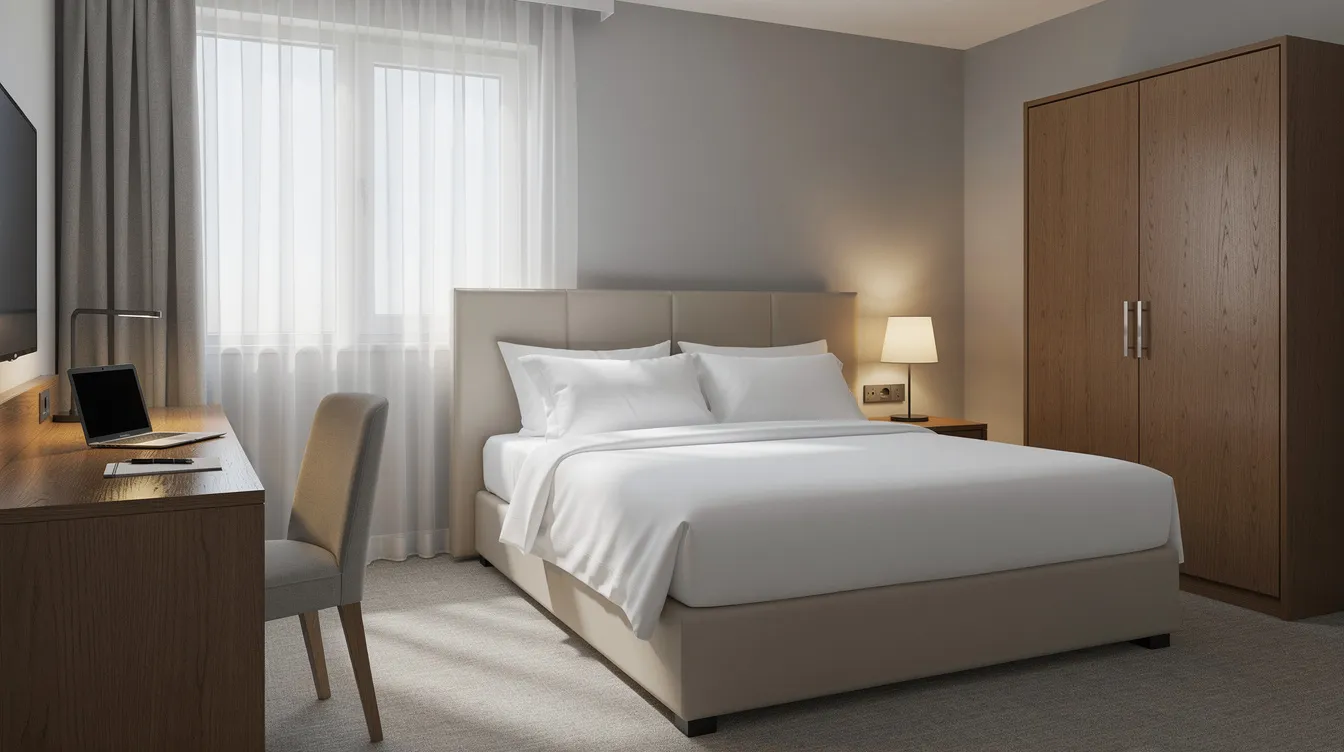
Hotel room furniture and in-room equipment form the largest single FF&E block. A standard 3 star room inventory must include a comfortable bed and fresh linens. High-quality mattresses enhance guest comfort and satisfaction, making the mattress one of the most important selections. Proper lighting, including bedside reading lamps, is expected in guest rooms. 3 star hotels typically provide climate control with individually controlled air conditioning. Safety deposit boxes in guest rooms are common for securing valuables. 3 star hotels should include a mini-refrigerator or facilities for storing food and beverages. Minibars and hairdryers are essential in guest rooms at this category.
Globally, 3 star hotel room furniture costs roughly $2,500 to $4,000, while luxury hotel room furniture can exceed $15,000. In Indian rupee terms for 2026, here is a representative per-room breakdown:
| Item | Qty/Room | Indicative Cost (₹, 2026) | Essential / Optional | Remarks |
|---|---|---|---|---|
| Bed frame + headboard (queen/king) | 1 | ₹20,000–₹35,000 | Essential | Laminated or upholstered headboard |
| Mattress (8–10 inch, hotel grade) | 1 | ₹8,000–₹15,000 | Essential | Spring or foam-spring, fire-retardant cover |
| Bedside tables | 2 | ₹7,000–₹18,000 | Essential | Matching finish, USB provision optional |
| Wardrobe (2-door) | 1 | ₹12,000–₹24,000 | Essential | Hangers, mirror, soft-close hardware |
| Study desk + chair | 1 set | ₹8,000–₹20,000 | Essential | Power and cable management |
| Luggage rack | 1 | ₹3,500–₹10,000 | Essential | Upholstered top optional |
| TV + wall bracket (40–50 inch LED) | 1 | ₹15,000–₹28,000 | Essential | Brand vs local options |
| Electronic safe | 1 | ₹5,000–₹12,000 | Essential | Wall or shelf mounted |
| Mini-refrigerator | 1 | ₹6,000–₹12,000 | Essential | 30–50 litre capacity |
| Electric kettle | 1 | ₹800–₹2,000 | Essential | With tray and supplies |
| Curtains (sheer + blackout) | 1 set | ₹5,000–₹12,000 | Essential | Custom-size, fire-retardant fabric |
| Lighting fixtures + reading lamps | 1 set | ₹5,000–₹12,000 | Essential | LED downlights + bedside lamps |
| Mirror (full-length) | 1 | ₹2,000–₹5,000 | Essential | Wall-mounted |
| Occasional chair or sofa | 1 | ₹5,000–₹15,000 | Optional | Depends on room size |
| Artwork / décor | 1–2 pcs | ₹2,000–₹6,000 | Optional | Framed prints or wall décor |
| Telephone | 1 | ₹1,500–₹4,000 | Essential | A reliable communication system including a direct-dial telephone is standard |
Ranges are per-key averages for a typical 3 star hotel in Tier-2 and Tier-3 Indian cities, generally exclusive of GST and may exclude logistics and installation. Guest room FF&E cost per key, combining furniture and in-room equipment, broadly falls in the ₹90,000 to ₹1,40,000 range for many 3 star projects. Actual quotes are necessary before finalizing any budget.
Bathroom Fixtures & Guest-Room Accessories
A 3 star hotel typically includes a private en-suite bathroom. Essential fixtures in 3 star hotel bathrooms include a toilet and shower or bathtub. A 3 star hotel requires reliable, continuous hot and cold water supply, which means geysers or central hot-water systems must be planned.
Bathrooms combine civil and plumbing works (tiles, concealed piping, basic plumbing) with movable fixtures and accessories. This distinction matters for DPR classification. Items like framed mirrors, wall-mounted hair dryers, accessory sets, exhaust fans and geysers can often be captured in the FF&E schedule.
| Bathroom FF&E / Accessory | Indicative Cost (₹) | Treatment |
|---|---|---|
| Sanitaryware set (WC, basin, fittings) | ₹8,000–₹18,000 | Usually civil/interior |
| Shower enclosure or curtain rod | ₹3,000–₹12,000 | Fixture |
| Vanity mirror (framed) | ₹2,000–₹5,000 | FF&E |
| Hair dryer (wall-mounted) | ₹1,500–₹3,500 | FF&E |
| Towel racks and accessory set | ₹2,000–₹5,000 | FF&E |
| Exhaust fan | ₹800–₹2,000 | FF&E |
| Geyser / water heater | ₹4,000–₹10,000 | FF&E or MEP |
In professional project reports, bathroom CAPEX is often split between civil/interior cost heads and FF&E to reflect the true nature of spending. Banks appreciate this clarity.
Reception & Lobby Furniture and Equipment
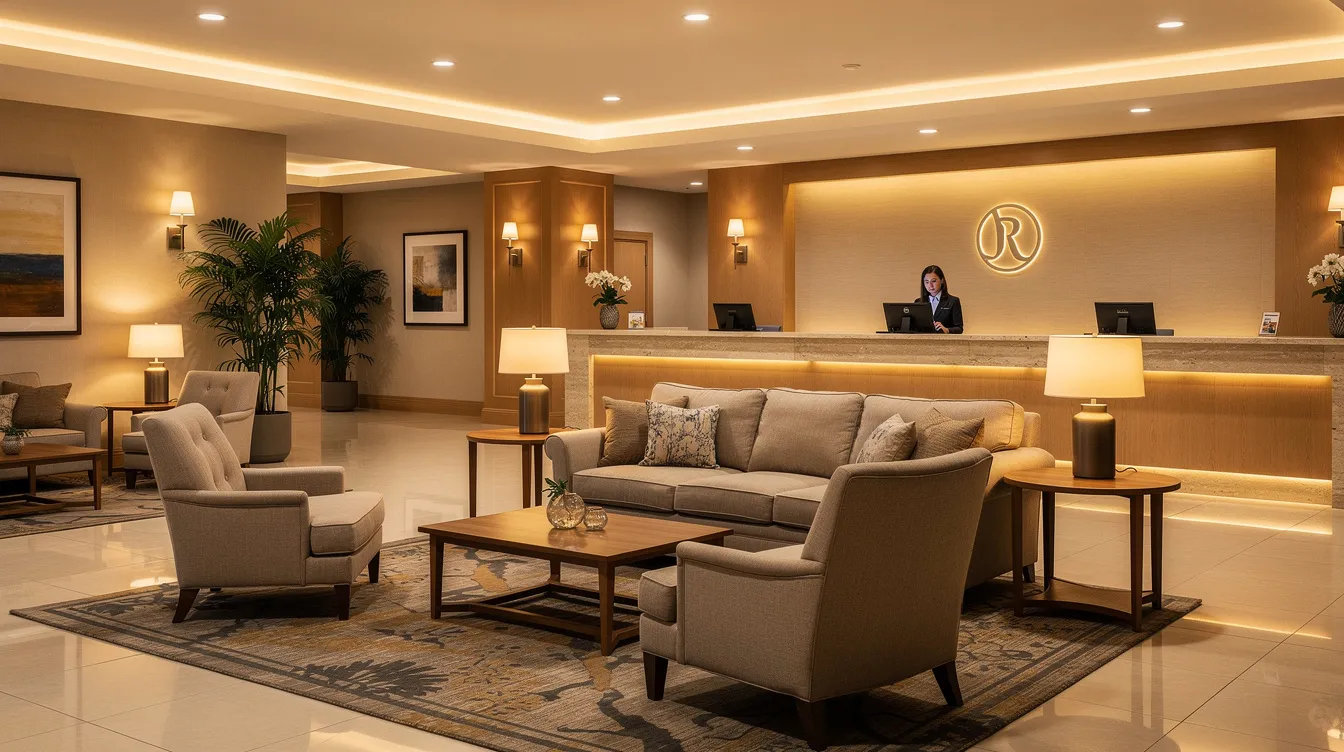
Lobby and reception areas influence first impressions, especially for walk-in and corporate guests. A 3 star hotel often has a 24-hour front desk service, so the reception setup must support round-the-clock operations. Public area furniture packages can range from $25,000 to $150,000 depending on scale and finish.
Essential reception furniture includes a reception counter, back-office storage, guest seating sofas and armchairs, centre tables, luggage trolleys and brochure stands. Key equipment covers desktop computers, monitors, printers, landline/EPABX handsets, key-card encoders, POS/PMS terminals, cash drawers and CCTV display monitors.
Representative cost ranges: reception counter ₹80,000 to ₹1,50,000; 3-seater sofa ₹18,000 to ₹35,000; luggage trolley ₹15,000 to ₹30,000; reception computer setup ₹35,000 to ₹55,000 each. A small 30-room hotel may spend ₹6 to ₹10 lakh on lobby and reception FF&E, while a 75-room property may go up to ₹15 to ₹25 lakh, depending on design ambitions.
Restaurant Furniture & Front-of-House Equipment
Restaurant furniture and equipment depend on seating capacity and positioning. A 40-cover breakfast-only outlet requires a fraction of what a 60-cover all-day dining restaurant needs. 3 star hotels may have on-site dining facilities such as restaurants serving breakfast and other meals.
Typical restaurant furniture includes dining tables (2-seater and 4-seater), dining chairs, banquette seating, buffet counters, sideboards and service stations. Front-of-house equipment covers POS terminals, credit card machines, bar counter equipment for licensed hotels (underbar refrigerators, glass washers), crockery storage racks and hot/cold bain-marie for buffet service.
Restaurant furniture and front-of-house equipment might broadly range from ₹8 lakh to ₹18 lakh for a 40 to 60 cover restaurant in a 3 star Indian hotel in 2026, exclusive of GST. OS&E like plates, cutlery, buffet chafing dishes and table linen are treated separately under OS&E.
Commercial Kitchen Equipment List with Cost
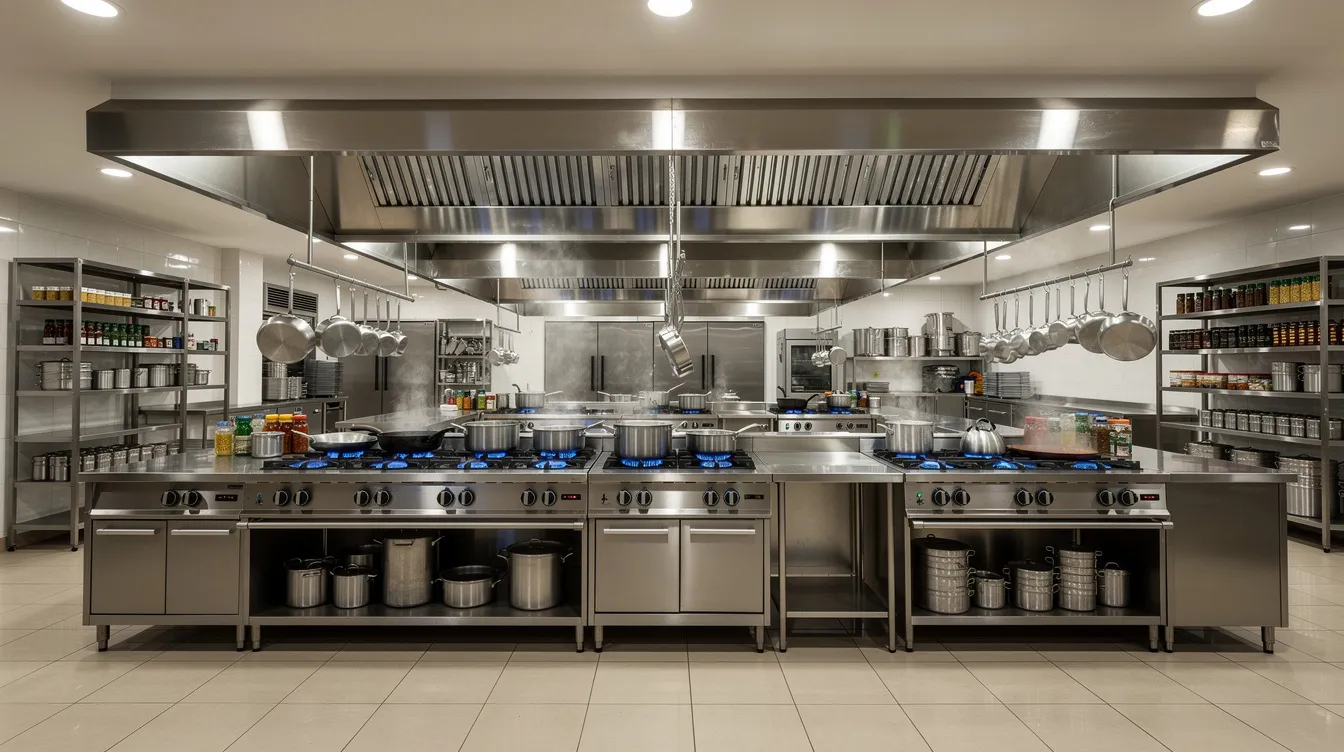
Proper kitchen equipment planning is crucial for hotel operations. Kitchen equipment must handle peak meal service demands efficiently, and sizing should be based on peak covers (meals per hour) and menu complexity, not just number of rooms. Commercial kitchen equipment should use SS 304 stainless steel or above for durability and hygiene compliance.
Main categories for a 3 star hotel kitchen: cooking ranges (gas or induction), Indian/Chinese ranges, ovens, grills, fryers, tandoor, combi ovens, refrigerators, deep freezers, cold rooms for larger hotels, preparation and work tables, sinks, exhaust hoods with ducting, dishwashers, food preparation machines (mixers, slicers, grinders), bain-marie and hot cases, water purification systems, storage racks, and small equipment starter kits including cutting boards and utensils.
| Kitchen Equipment | Typical Purpose | Indicative Cost (₹, 2026) | Remarks |
|---|---|---|---|
| 4-burner range with oven | Main cooking | ₹55,000–₹1,20,000 | Gas or electric |
| Tandoor | Indian bread/kebabs | ₹25,000–₹60,000 | Gas-fired, common in Indian hotels |
| Combi oven (6-tray) | Multi-mode cooking | ₹1,80,000–₹5,50,000 | Optional for basic 3 star |
| Double-door vertical chiller | Cold storage | ₹45,000–₹90,000 | SS body |
| Deep freezer (300–500 L) | Frozen storage | ₹25,000–₹55,000 | Chest or upright |
| Walk-in cold room | Bulk cold storage | ₹2,50,000–₹6,50,000 | For 75+ room hotels |
| Exhaust hood + ducting (per line) | Smoke/heat extraction | ₹8,000–₹18,000 per running ft | Includes fire suppression for hood |
| Hood-type dishwasher | Warewashing | ₹1,50,000–₹3,50,000 | Commercial dishwashers can use up to 40% less water and power |
| Planetary mixer (20 L) | Food preparation | ₹35,000–₹75,000 | Bakery and bulk production |
| Work tables (per running metre) | Prep surface | ₹6,000–₹12,000 | SS 304 top |
| Bain-marie (4-pan) | Hot holding | ₹15,000–₹35,000 | For food service and buffet |
| Water purifier (commercial) | Safe drinking water | ₹25,000–₹60,000 | RO + UV |
| Fryer (double tank) | Deep frying | ₹18,000–₹40,000 | Gas or electric |
| Griller / salamander | Grilling/finishing | ₹15,000–₹35,000 | Counter-top |
| Storage racks (per unit) | Dry/cold storage | ₹5,000–₹12,000 | SS or chrome-plated |
Kitchen CAPEX for a standard 3 star hotel with one all-day dining restaurant often falls in the broad range of ₹18 lakh to ₹45 lakh. Larger properties with banquets and specialty outlets may exceed this. Smart ovens can reduce energy use by adjusting heat in real time, and smart ovens can adjust heat in real time to prevent cooking errors. Energy-efficient kitchen equipment can reduce operational costs; high-quality equipment can reduce energy costs by up to 30%. The total cost of ownership matters more than just purchase price: promoters should factor in energy efficiency, maintenance, spares and after-sales service.
Housekeeping Equipment & Laundry Options
Housekeeping and laundry equipment ensure room turnaround efficiency and linen quality, which directly affects guest reviews and staff productivity. Daily housekeeping service is standard in 3 star hotels.
Key housekeeping equipment includes housekeeping trolleys (one per floor), vacuum cleaners (commercial grade), wet and dry vacuum machines, single-disc floor scrubbers, mopping systems, step-stools, housekeeping store racks and basic cleaning tools (brushes, squeegees, buckets).
For laundry, promoters face a choice: in-house laundry vs outsourced laundry. In-house laundry means higher initial CAPEX but lower per-piece cost and more operational control. Outsourced laundry reduces initial investment but creates ongoing operating expense and dependency on vendor quality and turnaround.
For in-house laundry, typical equipment includes industrial washing machines (15 to 25 kg), dryers, hydro extractors, steam press or steam iron, flatwork ironer for sheets in larger hotels, laundry tables, racks and trolleys. Indicative CAPEX ranges from about ₹8 lakh to ₹25 lakh depending on capacity and brand. Automated laundry systems can cut costs by nearly 40% over manual processes. In DPRs, the laundry model should be clearly stated; banks often ask whether laundry CAPEX is included or whether services will be outsourced, as this changes both fixed asset and operating cost assumptions.
Linen, Crockery and Other OS&E Requirements
OS&E is often budgeted separately from FF&E but still forms part of overall project cost and pre-operative expenditure in a 3 star hotel project report.
Key linen items: bed sheets, pillow covers, duvet covers, duvets or quilts, mattress protectors, blankets (where required by climate), bath towels, hand towels, face towels, bath mats, restaurant table linen (tablecloths, napkins) and staff uniforms.
Key F&B OS&E: crockery (plates, bowls, platters), cutlery (forks, spoons, knives), glassware (water glasses, wine glasses, beer mugs), serving dishes, chafing dishes, tongs, ladles, bar accessories, and basic kitchen utensils too small for the main kitchen equipment list.
Many 3 star properties maintain 3 par levels of linen (rooms in use, in laundry, in store), though exact par levels vary by operating philosophy and laundry turnaround. OS&E budget can roughly range from ₹25,000 to ₹60,000 per room in many 3 star projects. Although OS&E items are individually small, they collectively require substantial upfront funding and should be explicitly shown in the DPR and term-loan application rather than hidden under “miscellaneous.”
Hotel IT, Technology, Fire Safety & Security Equipment
Modern 3 star hotels require a baseline of IT, connectivity and safety equipment. High-speed Wi-Fi access is typically complimentary in 3 star hotels, and corporate guests and OTAs evaluate connectivity before booking.
IT and technology equipment: Property Management System (PMS) software and hardware, POS systems for F&B, desktop computers, printers, Wi-Fi routers and access points on each floor, network switches, servers or cloud subscriptions, telephone/EPABX system, key-card lock systems, billing and accounting software, and backup and storage devices.
3 star hotels must comply with safety regulations, including fire safety systems. Fire safety and security equipment: fire extinguishers, smoke detectors, fire alarm panel, manual call points, sprinkler heads (where applicable), emergency exit signage, emergency lights, public address system, CCTV cameras, Network Video Recorder (NVR), access control for critical rooms, and metal detectors for some properties.
IT and communication hardware for a 30 to 75 room 3 star hotel may range around ₹6 lakh to ₹20 lakh. Fire safety and security systems can range from ₹10 lakh to ₹35 lakh depending on local statutory requirements and building configuration. Fire and life-safety design must follow applicable Indian building codes, local fire department norms and consultant advice. No generic article can replace a project-specific fire-safety design.
Electrical, Power Backup, HVAC & Engineering Equipment
Large mechanical and electrical systems (transformers, main panels, DG sets, central HVAC chillers) are sometimes treated in separate MEP budgets but still form part of the hotel’s fixed asset structure and must be coordinated with FF&E planning.
Electrical and power backup: LT panels, distribution boards, cabling, diesel generator sets sized for essential loads, automatic changeover panels, UPS for IT and critical loads, electric meters and sub-meters.
HVAC and hot-water systems: split AC or VRV/VRF systems, air handling units, ventilation fans, exhaust systems, hot-water boilers or heat pumps or solar systems, water pumps, STP and RO plants where part of the project, and engineering department tools (workbenches, ladders, small power tools).
While many of these items may be budgeted under “MEP” rather than FF&E in a DPR, they remain fixed assets and will appear in the project cost and depreciation schedule. Classification should be consistent within the report. Promoters should obtain engineering consultant BOQs and budgetary quotes for major MEP equipment rather than relying only on per-room thumb rules, especially for properties above 50 rooms.
Banquet / Conference Equipment: If Applicable
Not every 3 star hotel in India has large banquet facilities, but where they exist, banquet and conference equipment can materially increase total FF&E cost while also adding a revenue stream from MICE and social events.
Key banquet and conference furniture and equipment: stackable banquet chairs, banquet tables (round and rectangular), buffet counters, podium, stage platforms and risers, skirting and backdrops, audio system (speakers, mixer, microphones), projectors or LED screens, motorised or manual projector screens, and basic lighting control equipment.
A modest 150 to 200 pax banquet hall in a 3 star hotel might require around ₹15 lakh to ₹40 lakh for dedicated banquet FF&E and AV, depending on specifications. In DPRs, banquet FF&E should be clearly separated so lenders and promoters can see how much of project revenue is expected from MICE and banquet business versus room revenue. Additional OS&E (table linen, buffet displayware, décor) sits under the OS&E budget even if used mainly in banquets.
Indicative FF&E and Equipment Cost per Room (Per Key)
Many investors ask for a single “per key” FF&E number. A range is more realistic due to variation in design and facilities. This section provides a planning framework, not a quotation.
| Positioning | Guest Room FF&E per Key (₹) | Total Hotel FF&E + Equipment per Key (₹) | Description |
|---|---|---|---|
| Economy 3 star | ₹0.90–₹1.20 lakh | ₹1.75–₹2.40 lakh | Basic domestic furniture, limited F&B, no banquet |
| Standard 3 star | ₹1.10–₹1.40 lakh | ₹2.20–₹2.80 lakh | Mid-range finishes, one restaurant, small meeting room |
| Upper 3 star | ₹1.30–₹1.80 lakh | ₹2.60–₹3.50 lakh | Better finishes, full restaurant, banquet, in-house laundry |
“Guest room FF&E per key” covers the bed, furniture and in-room equipment. “Total FF&E per key” adds the proportionate share of kitchen, restaurant, lobby, IT, safety, engineering, banquet and OS&E spread across all rooms. These figures assume a typical mid-market 3 star hotel in a Tier-2 city in 2026, with one all-day dining outlet, no large spa and a moderate banquet or meeting room. Metro locations and high-end finishes can push numbers above the upper end.
All figures are exclusive of GST and may not include design fees, logistics or installation. Final budgets must be based on vendor quotations.
Indicative FF&E & Equipment Cost for 30, 50 and 75 Room 3-Star Hotels
This scenario-based view assumes a single all-day dining restaurant, standard kitchen, basic banquet or meeting room, and standard 2026 pricing. All assumptions are illustrative.
| Particular | 30 Rooms (₹ lakh) | 50 Rooms (₹ lakh) | 75 Rooms (₹ lakh) |
|---|---|---|---|
| Guest Room Furniture | 25–35 | 40–55 | 55–75 |
| Guest Room Equipment (TV, safe, AC, kettle, fridge) | 15–22 | 22–35 | 32–50 |
| Lobby & Reception | 6–10 | 8–15 | 12–20 |
| Restaurant (FOH furniture & equipment) | 6–12 | 8–16 | 10–18 |
| Kitchen | 18–30 | 25–40 | 35–55 |
| Housekeeping | 3–5 | 4–7 | 5–10 |
| Laundry (in-house) | 8–15 | 10–18 | 12–22 |
| IT & Technology | 6–10 | 8–14 | 10–18 |
| Safety & Security | 8–15 | 10–20 | 14–28 |
| Administration & Back Office | 2–4 | 3–5 | 4–7 |
| Other FF&E & Engineering | 4–8 | 6–12 | 8–16 |
| Contingency (8–12%) | 8–15 | 12–20 | 16–28 |
| Indicative Total | ₹1.09–₹1.81 Cr | ₹1.56–₹2.57 Cr | ₹2.13–₹3.47 Cr |
Key assumptions: standard 3 star positioning, Tier-2 or Tier-3 city procurement, mid-range Indian brands for most equipment, exclusion of land and civil works, figures in 2026 rupees, exclusive of GST and financing costs.
Equipment and FF&E represent only one component of the total investment. Promoters evaluating the complete project, including construction, interiors and pre-operative expenses, may also refer to our detailed guide on 3-Star Hotel Setup Cost in India, 30, 50 & 75 Room Hotels. During DPR preparation, such scenario tables are refined with itemized BOQs and updated vendor budgetary quotations before being shared with banks.
What Determines the FF&E Cost of a 3-Star Hotel?
Minor design decisions can cumulatively affect total CAPEX by several lakhs in a 30 to 75 room project. The right supplier and the right equipment choices matter as much as the scale of the property.
Key determinants:
- Number of rooms and room size (a 200 sq ft room needs more furniture than a 130 sq ft room)
- Hotel positioning (economy vs upper 3 star)
- Quality of hotel furniture materials (engineered wood vs solid wood, fabric grades)
- Imported vs domestic equipment
- Restaurant and banquet capacity
- Laundry model (in-house vs outsourced)
- Central HVAC vs split AC systems
- Technology intensity (keyless entry, advanced PMS, CCTV coverage)
- Compliance requirements (fire, accessibility, environmental)
- Location-specific logistics, labour and market conditions
Custom furniture can cost 20 to 40% more than standard options, but may improve brand identity and guest perception if aligned with the property’s market potential. Logistics, freight and installation can add 8 to 15% to the purchase price of kitchen and HVAC equipment, and must be budgeted explicitly.
In CA-level financial projections, sensitivity analysis on FF&E cost per key can reveal how small percentage changes in CAPEX offset into DSCR and equity requirement.
New vs Refurbished Equipment: Pros, Cons & Cautions
Some promoters consider refurbished or used hotel equipment to reduce initial project cost. This approach carries both financial and operational risks.
Equipment where refurbished purchases may be relatively less risky if carefully vetted: simple storage racks, some office furniture and selected non-critical items. Equipment where new investment is usually better: fire safety systems, elevators, heavy-duty kitchen ranges, high-speed laundry machines and critical electrical gear.
Risks of refurbished core equipment: shorter remaining useful life, higher breakdown incidence, lack of warranty, difficulty obtaining spares, and possible non-compliance with updated safety or energy norms. Investing in durable furniture reduces replacement costs within 2 to 3 years, making the upfront spend worthwhile. Banks may look more favourably at projects with new equipment in critical areas, as this supports more reliable operations and more predictable maintenance expenditure in financial projections.
Cost saving must never compromise statutory compliance or guest safety. Lifecycle cost and business risk should be weighed more heavily than narrow purchase-price differences.
How FF&E Is Included in a 3-Star Hotel Project Report / DPR
In my experience preparing project reports, promoters should avoid treating FF&E as a residual estimate. A room-wise and department-wise assessment generally produces a more realistic project cost. DPRs and bankable project reports should present FF&E as an item-wise or department-wise schedule aligned with the overall project design.
Typical DPR structure for FF&E:
- Separate schedules for guest room FF&E, public area furniture, kitchen equipment, laundry and housekeeping, IT and communication systems, safety and security equipment, and OS&E/initial inventory
- Each schedule with quantity, estimated rate and amount columns
- Estimates ideally supported by budgetary vendor quotations (email quotes, proforma invoices) documenting basic price, GST, freight and installation
These schedules link to overall project cost, means of finance and fixed asset block in projected balance sheets. They also drive depreciation in projected profit and loss statements. An explicit 5 to 10% contingency on FF&E is often prudent in projections to accommodate specification changes, exchange-rate variations for imported items and last-minute additions. Turnkey solutions from established vendors minimize coordination risks and ensure consistent quality across departments.
Equipment Cost, Means of Finance, Depreciation & DSCR Impact
Equipment and FF&E costs influence not only total project investment but also borrowing level, interest outgo, depreciation and DSCR, which banks analyse closely.
- FF&E may be financed through promoter’s equity or internal accruals, term loans, and occasionally through separate equipment finance loans or vendor credit. Eligibility and margin requirements depend on lender policies and sanction terms.
- Capitalized equipment attracts depreciation in projected financial statements, reducing accounting profit in early years but not directly affecting cash flow. Banks look at DSCR (cash-flow based) rather than only accounting profit.
- The chain works both ways: higher FF&E cost raises term loan, raises EMI, and can lower DSCR if revenues are unchanged. But under-investment can depress room rates, occupancy and F&B revenue, harming DSCR from the revenue side.
The objective is appropriate investment, not minimal investment. Professional DPR preparation should balance FF&E quality, guest expectations and financial ratios in a realistic way.
Common Mistakes in 3-Star Hotel Equipment & Furniture Budgeting
Many first-time hotel owners in India underestimate FF&E and OS&E requirements, leading to cost overruns, shortfalls in bank finance or quality compromises just before opening.
- Using one lump-sum “furniture and equipment” figure without room-wise detail (leads to inaccurate project cost)
- Ignoring OS&E like linen, crockery and smallwares (creates working capital shortfall at opening)
- Underestimating hotel kitchen equipment cost (forces quality downgrade or last-minute equity infusion)
- Forgetting freight, installation and statutory clearances (8 to 15% surprise addition)
- Not budgeting IT systems, PMS software and networking (operational delays post-opening)
- Ignoring fire and safety compliance costs (regulatory delays, higher insurance premiums)
- Misjudging laundry needs (either overspending on unused capacity or running short)
- Over-investing in luxury décor that does not add revenue for a 3 star segment
- Not planning for replacement cycles (cash-flow shock in year 3 to 5)
- Preparing DPR estimates without vendor validation (weakens credibility with lenders)
In my experience, lenders view detailed, validated equipment budgets more favourably than rounded-off assumptions. This shows promoter preparedness.
How to Reduce Hotel Equipment Cost Without Compromising Quality
The goal is optimisation, not cutting corners. Smart early decisions can keep FF&E cost within realistic limits while preserving guest satisfaction and operational efficiency.
- Standardise room layouts and furniture modules to benefit from bulk production and manufacturing discounts (15 to 20% savings at scale)
- Use durable mid-range materials (good laminates with sturdy carcasses) instead of the cheapest options that need replacement within 2 years
- Compare multiple vendors and negotiate packages including installation and basic spares
- Prioritise energy efficient kitchen and laundry equipment to reduce operating cost over the equipment’s life
- Evaluate outsourcing of laundry or specialised services in smaller projects to cut initial CAPEX
- Phase non-essential décor or advanced technology for a later upgrade after operations stabilise
- Insist on lifecycle cost evaluation rather than only lowest purchase price
- Use Indian commercial kitchen and furniture manufacturers with proven hospitality experience; this often provides a good balance between cost, quality and service
Clearly differentiate “must-have” vs “nice-to-have” equipment in internal lists, so that if budget pressures arise, core operations are not impaired. Involving both operations and finance perspectives during the specification stage leads to more sustainable FF&E choices.
Vendor Quotation Checklist & Procurement Timing
Reliable FF&E budgeting for a 3 star hotel requires structured vendor quotations. These should start as “budgetary quotes” during DPR preparation and move to final negotiated quotes closer to procurement.
Every equipment or furniture quotation should contain:
- Make, model and brand
- Capacity and detailed technical specifications
- Quantity required
- Basic purchase price
- GST rate and amount
- Freight and insurance charges
- Installation and commissioning charges
- Required civil and electrical provisions
- Warranty terms and duration
- Optional AMC cost
- Delivery period and payment terms
- After-sales service coverage and location
- Validity of quotation
Promoters should avoid placing large non-refundable orders before project finance is tied up, but should still collect enough quotes to support realistic DPR estimates for banks. Attaching a few key budgetary quotations (kitchen, laundry, IT, fire safety) to the DPR annexures can improve transparency during bank appraisal.
Procurement planning must be aligned with the construction schedule so that equipment arrives only when the site is ready for safe storage and installation, avoiding damage, storage costs and money locked in idle inventory.
FAQs: 3-Star Hotel Equipment, Furniture & FF&E in India
What is the typical lead time to procure hotel equipment and furniture?
Most standard items (beds, basic kitchen equipment, wardrobes) carry 4 to 8 week lead times from Indian contract furniture suppliers. Custom furniture, imported equipment or large HVAC units can take 10 to 16 weeks. Plan procurement backwards from your target opening date with at least 2 to 3 months buffer for delays in delivery or site readiness.
Can a small 30-room 3-star hotel start with a very simple kitchen?
Yes. Some 30-room hotels, especially in business districts with limited F&B focus, can start with a compact kitchen offering breakfast and limited room service. However, the kitchen must still meet hygiene and fire-safety norms. Under-sizing the kitchen can restrict future revenue from F&B sales and small banquets, so the feasibility study and positioning should guide this decision.
How often should FF&E be refurbished or replaced in a 3-star hotel?
Soft furnishings and OS&E (linen, upholstery, crockery) may need partial replacement every 3 to 5 years. Major FF&E like beds, wardrobes and kitchen ranges may have 7 to 10 year horizons. Actual cycles depend on build quality, occupancy, maintenance and brand standards. Project cash-flow projections should include periodic refurbishment reserves.
Do banks insist on new equipment, or can used equipment be financed?
Many banks are more comfortable funding new equipment with proper invoices, warranties and collateral value. Financing used equipment is possible but more complex and may be discounted in valuation. Promoters should confirm lender policies in advance and document any second-hand purchases carefully.
Are furniture and equipment costs always included in a hotel project report for bank loans?
A properly prepared 3 star hotel project report or DPR should always include detailed furniture, fixtures, equipment and OS&E costs. Some informal proposals omit or understate them. Including these costs gives banks a clearer picture of real project cost and reduces the risk of later cost overruns or funding gaps.
Conclusion & Author Note
A reliable 3 star hotel equipment list and FF&E budget must be prepared room-wise, department-wise and capacity-wise. Using a random lump-sum percentage of project cost is neither accurate for the promoter nor convincing for the lender. Every item, from the bed frame to the kitchen exhaust hood, carries a cost that feeds into the property’s total CAPEX, depreciation schedule, working capital and cash-flow projections.
Equipment and furniture choices influence initial investment, borrowing requirement, operational efficiency, guest experience, maintenance costs, revenue potential, profitability and ultimately loan repayment capacity (DSCR). The spend on FF&E is not where promoters should cut costs arbitrarily; it is where they should invest wisely based on their market, their guests and their business plan.
Promoters, investors and consultants who need assistance in preparing a 3 star hotel project report, DPR, CMA data, financial projections or bank-finance proposal can seek professional support through ProjectReportBank.com.
About the Author: CA Manish Gugliya is a Chartered Accountant with professional experience in project report and DPR preparation, CMA data, financial projections, project finance, bank-loan proposals and MSME advisory. This guide covers practical planning considerations and indicative cost ranges for 2026 India. All figures must be validated with updated vendor quotations and professional advice before making investment or financing decisions.
Explore More 3-Star Hotel Project Report Guides
Continue exploring our 3-Star Hotel DPR guides covering setup cost, equipment, project cost, revenue, financial projections, occupancy, feasibility, project finance and bank loan assessment.