If you are a first-time entrepreneur, shopkeeper, small manufacturer, or service provider in India trying to get a business loan, you have probably heard two terms used interchangeably – “Mudra Loan” and “MSME Loan.” Many borrowers walk into a bank assuming these are the same product. They are not. Choosing the wrong one can mean smaller funding than you need, unnecessary paperwork, or even a rejected application.
This complete comparison breaks down PM Mudra Yojana and MSME loans on every factor that matters – loan amount, collateral, interest rates, eligibility criteria, documentation, and processing time – so you can pick the right financing option for your specific business needs.
The short answer: PM Mudra Yojana (PMMY) is a government backed initiative offering collateral-free loans up to ₹20 lakh specifically for non-corporate and non-farm micro enterprises. MSME loans are a broader category of business financing products from banks and NBFCs that can range from ₹50,000 to several crores, covering micro, small, and medium enterprises with a wider spectrum of financial products. Mudra Loan is actually one subset of MSME financing – not a separate system. If your funding requirement is under ₹20 lakh and you want simplified, unsecured credit, Mudra is likely your best path. If you need higher amounts, specialized loan products, or expansion financing, a standard MSME loan is the practical choice.
What is PM Mudra Yojana?
Pradhan Mantri Mudra Yojana – where MUDRA stands for Micro Units Development and Refinance Agency – is a flagship government scheme launched on April 8, 2015. Its primary objective is to provide financial assistance to small businesses, street vendors, women entrepreneurs, and first-time entrepreneurs who typically struggle to get credit from commercial banks.
PMMY is designed for non-corporate and non-farm micro enterprises. The refinance agency behind it (MUDRA, under SIDBI) does not lend directly. Instead, it provides refinance support to banks, small finance banks, NBFCs, and MFIs that disburse the actual loans to the beneficiary micro unit.
The scheme has four categories of loans:
- Shishu loans offer up to ₹50,000 for startups – ideal for a street food vendor, a small tailoring unit, or a mobile repair shop just getting started.
- Kishore loans range from ₹50,000 to ₹5 lakh for growth – suitable for a growing salon, a small dairy unit, or a trader expanding inventory.
- Tarun loans provide ₹5 lakh to ₹10 lakh for established businesses – think a small manufacturer buying machinery or a restaurant upgrading its kitchen.
- Tarun Plus loans range from ₹10 lakh to ₹20 lakh for expanded businesses – introduced in Budget 2024-25, available to borrowers who have successfully repaid a Tarun loan.
Key benefits: Loans under PM Mudra Yojana are collateral-free, require minimal documentation for smaller categories, and PM Mudra Yojana provides fast loan approvals due to the unsecured nature of the credit. The scheme is backed by the Credit Guarantee Fund for Micro Units (CGFMU) operated by NCGTC, which covers lender risk.
The scale of the mudra scheme is massive. By March 2026, cumulative disbursements under PMMY reached ₹9.02 lakh crore under Shishu, ₹6.22 lakh crore under Kishore, and ₹1.09 lakh crore under Tarun – a clear sign that the scheme genuinely serves millions of small businesses across India.
For a deeper understanding of the scheme’s purpose, read our guide on the objectives of PM Mudra Yojana.
Table of Contents
What is an MSME Loan?
An MSME loan is a much broader term. It refers to any business loan product designed for businesses classified as Micro, Small, or Medium Enterprises under the Udyam Registration system. These loans come from public sector banks, private banks, small finance banks, NBFCs, SIDBI, and other lending institutions.
MSME loans include a wide variety of financial products:
- Working capital loans – to manage daily cash flow, inventory, and operational expenses
- Term loans – for purchasing assets, setting up a new unit, or one-time investments
- Machinery and equipment loans – specifically for equipment purchases and manufacturing upgrades
- Expansion financing – for businesses entering new markets, adding locations, or scaling production
- Overdraft and cash credit facilities – revolving credit lines linked to business turnover
MSME loans can range from ₹50,000 to several crores depending on the lender, the business classification (micro, small, or medium enterprises), and the borrower’s financial profile. Under the CGTMSE guarantee scheme, collateral-free credit facilities have been available up to ₹5 crore – and this cap was raised to ₹10 crore effective from 1 April 2025.
Here is the important distinction: Mudra Loan is one financing option within the broader MSME loan ecosystem. It is a specific scheme with defined limits and rules. MSME loans, on the other hand, encompass dozens of products and government schemes designed to support business growth at every stage – from a micro unit needing ₹1 lakh in working capital to a medium enterprise seeking ₹50 crore for a new manufacturing plant.
MSME loans cater to micro, small, and medium businesses requiring higher limits. They offer a broader spectrum of financial products including specialized financing that Mudra simply does not cover.
PM Mudra Yojana vs MSME Loan: How They Compare at a Glance
| Factor | PM Mudra Yojana | MSME Loan |
|---|---|---|
| Best for | Startups, micro units, first-time entrepreneurs, women entrepreneurs | Established businesses, growing SMEs, manufacturers needing scale |
| Loan Amount | Up to ₹20 lakh (across Shishu, Kishore, Tarun, Tarun Plus) | ₹50,000 to several crores |
| Collateral | No collateral required | Varies – collateral-free up to ₹20 lakh (RBI mandate from April 2026); may require security for larger amounts |
| Interest Rates | Set by lender; no single fixed rate; typically competitive for small amounts | 8% to 18% p.a. depending on lender, security, and borrower profile |
| Processing Time | Faster – simpler verification for smaller amounts | Longer – detailed evaluation for larger loans (15 to 45 days typical) |
| Government Support | CGFMU guarantee, government-backed scheme | CGTMSE guarantee available; various specific schemes |
| Documentation | Minimal for Shishu/Kishore; basic KYC and business proof | Extensive – audited financials, project reports, CMA data, GST returns |
| Business Stage | New and existing micro/small units | Existing businesses with financial track record preferred |
| Eligible Businesses | Non-farm, non-corporate small enterprises | Manufacturing, services, trading – micro, small, and medium |
Key takeaway: PM Mudra Yojana is a focused, government-backed product for small-ticket, collateral-free financing. MSME loans are the broader financing universe with higher limits and more product variety, but they come with more documentation and scrutiny.
Loan Amount and Flexibility
This is often the deciding factor. PM Mudra loans offer up to ₹20 lakh for businesses – and that ceiling is firm. Even the newest Tarun Plus category, designed for borrowers who have successfully repaid a Tarun loan, caps at ₹20 lakh. For a small kirana store needing ₹3 lakh for stock or a beautician setting up a salon with ₹8 lakh, this works perfectly.
But if you are a manufacturer who needs ₹30 lakh for a new CNC machine, or a restaurant chain expanding to a second location with a ₹75 lakh requirement, the Mudra ceiling simply will not work. Traditional MSME loans may be more appropriate for businesses needing greater amounts than ₹20 lakh. MSME loans can scale up to several crores, making them the practical choice for significant capital investment.
Consider these real-world scenarios:
- A woman starting a home-based pickle business needs ₹40,000 → Mudra Shishu is ideal
- A trader expanding stock for a new market needs ₹4 lakh → Mudra Kishore fits
- A flour mill owner wants ₹18 lakh for new equipment and has repaid a Tarun loan → Mudra Tarun Plus works
- A garment manufacturing unit needs ₹50 lakh for expansion → Only an MSME loan can provide this
Winner: MSME Loan – for sheer flexibility and scalability. However, if your needs are under ₹20 lakh, Mudra’s structured categories make the application process simpler and more predictable.
Collateral and Security Requirements
This is where Mudra loans have a clear edge for small borrowers. No collateral is required for MUDRA loans – period. Whether you borrow ₹30,000 under Shishu or ₹20 lakh under Tarun Plus, the loan remains unsecured. The CGFMU (Credit Guarantee Fund for Micro Units) covers the lender’s risk, which is why banks can offer these collateral free MSME loans under the Mudra umbrella without demanding property or assets as security.
For standard MSME loans, collateral requirements vary based on loan size. Under RBI’s Master Directions (updated February 2026), banks are mandated not to accept collateral for MSME loans up to ₹20 lakh – applicable to loans sanctioned or renewed after 1 April 2026. Banks are further advised to extend collateral-free loans up to ₹25 lakh for MSE units with strong financial positions. Beyond these limits, lenders typically require property mortgage, fixed deposits, or other security.
MSME loans can also provide collateral-free financing through the CGTMSE scheme, where guarantee coverage has been enhanced from ₹5 crore to ₹10 crore effective from 1 April 2025. Micro units get the highest guarantee coverage at 85% for smaller loans.
However, having a guarantee does not mean automatic approval. Banks still evaluate your business plan, repayment capacity, credit history, and financial statements before sanctioning the loan.
Winner: PM Mudra Yojana – for guaranteed collateral-free lending regardless of loan size within the scheme. MSME loans are catching up with RBI’s expanded collateral-free mandates, but larger MSME loans still commonly require security.
Interest Rates and Government Support
Let me be direct: there is no single fixed interest rate for either Mudra loans or MSME loans. This is one of the biggest areas of confusion I see among borrowers.
Interest rates for PMMY loans vary based on lender policies and borrower profiles. The Mudra scheme does not prescribe a uniform rate. Each bank, NBFC, or MFI sets its own rate based on RBI guidelines, cost of funds, and the borrower’s risk profile. Because these are small, unsecured loans, the effective interest rate can sometimes be higher than a well-secured MSME term loan of a larger amount.
For MSME loans, the interest rate range in 2026 broadly falls between 8% and 18% per annum. Secured loans from public sector banks can be on the lower end – and notably, as of March 2026, approximately 64.2% of total bank advances carry interest rates below 9%, reflecting the impact of recent RBI repo rate cuts. Unsecured MSME loans from NBFCs, however, can climb to 15-18%.
Factors that affect your interest rate for both options:
- Your credit score and repayment history
- Whether the loan is secured or unsecured
- Your business experience and cash flow stability
- The lending institution’s internal policies
- Loan tenure and repayment capacity
Both loan types benefit from government support – Mudra through CGFMU and government financial support for the refinance agency, and MSME loans through CGTMSE, interest subvention schemes, and other specific schemes from state and central governments.
Winner: Tie – it depends on your profile. A well-established business with good credit and collateral will likely get a lower interest rate on a standard MSME loan. A first-time entrepreneur without assets will find Mudra more accessible, even if the rate is slightly higher.
Documentation and Processing
PM Mudra loans are processed quickly due to being unsecured and small in ticket size. For Shishu loans especially, the documents required are minimal:
- Identity proof (Aadhaar, PAN)
- Address proof
- Passport-size photos
- Basic business proof (shop license, Udyam Registration if available)
- Bank statements (3-6 months)
For Kishore and Tarun, you may need a simple project report and quotations for machinery or equipment.
MSME loans involve rigorous documentation including audited financial statements. For loans above ₹10-20 lakh, banks typically ask for:
- Detailed project report and CMA data
- Audited financial statements (2-3 years)
- GST returns
- Udyam Registration certificate
- Bank statements (6-12 months)
- Quotations for machinery/equipment
- Property documents (if collateral is required)
- Business plan with revenue projections
Processing timelines reflect this difference. Mudra loans – especially Shishu and Kishore – can be sanctioned within days to a couple of weeks. MSME loans for larger amounts typically take 15 to 45 days due to detailed appraisal, site visits, collateral evaluation, and internal credit committee reviews.
For guidance on what documents you need for a Mudra loan, we have a detailed checklist.
Winner: PM Mudra Yojana – significantly simpler and faster for small business financing needs. If speed matters and your requirement is under ₹20 lakh, Mudra’s streamlined application process is hard to beat.
Eligibility Criteria Comparison
Eligibility is another area where Mudra and MSME loans differ meaningfully.
PM Mudra Yojana eligibility:
- Applicants must be aged between 18 to 65 years
- Eligible businesses include small non-farm enterprises – manufacturing, trading, services, activities allied to agriculture (dairy, poultry, beekeeping)
- Agricultural businesses are not eligible for MUDRA loans (direct cultivation is excluded)
- Non-corporate entities: individuals, proprietorships, partnerships, self-help groups
- Both new and existing businesses can apply
- PMMY supports new and first-time entrepreneurs more effectively than traditional MSME loans
- PMMY targets specific underserved groups with preferential terms – including women entrepreneurs, SC/ST entrepreneurs, and rural micro units
For detailed eligibility rules, see our PM Mudra Loan eligibility guide.
MSME Loan eligibility:
- Business must be registered under Udyam Registration (MSME classification based on investment and turnover)
- Covers micro, small, and medium enterprises across all sectors
- Financial track record is important – lenders evaluate credit history, turnover, profitability
- Both new and existing businesses can qualify, though established businesses with audited financials have an advantage
- MSME loans are suitable for established businesses seeking significant capital investment
Key difference for startups: If you are starting a new business with limited financial history, Mudra is far more accessible. Eligible borrowers under MSME loan schemes generally need a demonstrated track record, though some banks do offer startup-focused MSME products.
Winner: PM Mudra Yojana – for accessibility, especially for new entrepreneurs, women entrepreneurs, and businesses without established financial records. MSME loans win on breadth of coverage for medium enterprises and larger established businesses.
PM Mudra Yojana vs MSME Loan: Which Should You Choose?
Choose PM Mudra Yojana if:
- You are starting a small business and need funding up to ₹20 lakh
- You are a first-time entrepreneur without collateral or extensive financial records
- You need quick disbursement with minimal paperwork
- You qualify for government schemes targeting micro units, women entrepreneurs, or underserved communities
- Your business is a non-farm, non-corporate micro enterprise
Choose an MSME Loan if:
- Your business is established and needs capital above ₹20 lakh
- You can provide collateral or have a strong credit profile for better interest rates
- You need specialized loan products – equipment purchases, project finance, overdraft, or cash credit facilities
- You are planning major expansion, entering new markets, or scaling production significantly
- Your business falls under the small or medium enterprise category with higher turnover
Decision Matrix: Which Loan for Which Business?
| Business Scenario | Recommended Option | Why |
|---|---|---|
| New grocery shop needing ₹2 lakh stock | Mudra Kishore | Small amount, quick approval, no collateral |
| Boutique owner expanding to ₹4 lakh inventory | Mudra Kishore | Fits the loan amount band, simple process |
| Mobile repair shop startup needing ₹40,000 | Mudra Shishu | Perfect fit – Shishu loans offer up to ₹50,000 for startups |
| Small flour mill buying machinery worth ₹8 lakh | Mudra Tarun | Right band, collateral-free, straightforward |
| Manufacturing unit needing ₹50 lakh for CNC machines | MSME Loan | Exceeds Mudra ceiling; needs term loan with project evaluation |
| Restaurant chain expanding to second location (₹75 lakh) | MSME Loan | Large amount, project finance, possibly secured |
| IT services company needing ₹30 lakh working capital | MSME Loan | Working capital facility beyond Mudra limits |
| Woman starting a home catering business (₹45,000) | Mudra Shishu | Government support, fast processing, no security needed |
| Workshop owner wanting ₹18 lakh (has repaid Tarun) | Mudra Tarun Plus | Designed exactly for this scenario |
| Medium enterprise needing ₹2 crore for plant expansion | MSME Loan under CGTMSE | Only MSME loans cover this scale |
If your funding need falls right at the ₹15-20 lakh range, compare both options from your bank. You may find that a standard MSME loan offers a lower interest rate if you have a strong credit profile and Udyam Registration, while Mudra Tarun Plus offers simpler processing.
Advantages of PM Mudra Yojana
Here are the key benefits of the Pradhan Mantri Mudra Yojana:
- No collateral required – You do not need to pledge property, gold loan security, fixed deposits, or any assets. The CGFMU guarantee covers the lender’s risk.
- Government-backed scheme – Financial support comes through a structured government framework, giving both lenders and borrowers confidence.
- Simplified documentation – Especially for Shishu and Kishore categories, the paperwork is minimal. Basic KYC, business proof, and a simple application are often enough.
- Fast processing – Because amounts are smaller and loans are unsecured, verification and approval happen faster.
- Inclusive by design – PMMY is specifically structured to support micro units, women entrepreneurs, SC/ST entrepreneurs, and first-generation business owners who typically cannot access formal credit.
- Structured progression – The Shishu → Kishore → Tarun → Tarun Plus pathway lets you build credit history and access larger amounts over time.
- Wide availability – You can apply online or offline through commercial banks, small finance banks, NBFCs, MFIs, and regional rural banks across India.
The CGFMU guarantee practically means that even if you are a first-time borrower with no credit history, banks have a safety net that encourages them to lend. This is a significant advantage over standard business loan products.
Advantages of MSME Loans
MSME loans support a wider range of business types and financial needs. Their advantages include:
- Higher loan amounts – From lakhs to several crores, MSME loans can fund large-scale expansion, major equipment purchases, and significant working capital requirements.
- Flexible product variety – Choose from term loans, cash credit, overdraft, bill discounting, machinery financing, and project funding. Each product is designed for a specific financial need.
- Potentially lower interest rates – For businesses with strong financials, good credit scores, and collateral, secured MSME loans from public sector banks can offer rates well below 9% p.a.
- CGTMSE guarantee coverage – With enhanced coverage up to ₹10 crore, eligible borrowers can access substantial collateral-free credit.
- Customized solutions – Banks offer tailored loan structures including moratorium periods, bullet repayments, and step-up EMIs based on projected cash flow.
- Relationship banking – Regular MSME borrowers build long-term relationships with banks, making future funding easier, faster, and cheaper.
- Insurance and add-ons – Many MSME loan products come bundled with credit insurance, mutual funds advisory, and other financial services.
For businesses at a stage where they need to expand aggressively – enter new markets, hire significantly, or invest in large infrastructure – MSME loans are the realistic path to push your business forward.
Common Myths About Mudra Loan vs MSME Loan
Myth 1: Mudra Loan and MSME Loan are exactly the same
Fact: They are not identical. Mudra Loan is one specific government scheme under the MSME financing umbrella. MSME loans include Mudra as well as dozens of other products – term loans, working capital, equipment financing, CGTMSE-backed credit, and more. Understanding the key features of PM Mudra Yojana makes this distinction clear.
Myth 2: Mudra Loan is interest-free
Fact: Interest rates for PMMY loans vary based on lender policies and borrower profiles. The government does not provide interest-free money. Each lending institution charges interest based on RBI norms, their cost of funds, and your risk profile. Some state government schemes may offer interest subvention, but the base loan always carries interest.
Myth 3: MSME registration guarantees loan approval
Fact: Udyam Registration proves your business classification – it does not guarantee approval. Banks still evaluate your repayment capacity, business viability, credit score, financial statements, and project report before sanctioning any MSME loan. The CGTMSE guarantee reduces the lender’s risk but does not eliminate the credit evaluation process.
Myth 4: Only startups can get Mudra Loans
Fact: Both new and existing businesses can availed Mudra loans. Existing micro units with operational businesses regularly apply for Kishore and Tarun loans for expansion, working capital, or equipment upgrades. The Tarun Plus category is specifically designed for borrowers who have already repaid a Tarun loan.
Myth 5: Every MSME automatically gets a government subsidy
Fact: Government subsidies are available only under specific schemes (like PMEGP, CGTMSE fee waivers, or state-level programs). A standard MSME loan from a bank does not automatically come with a subsidy. You need to apply under the relevant scheme and meet its criteria.
Common Mistakes Borrowers Make
In my 20+ years of practice helping businesses secure funding, I have seen these mistakes repeatedly:
- Applying for the wrong loan type – A business needing ₹40 lakh applies for Mudra and gets rejected, wasting months. Or a micro unit needing ₹3 lakh gets overwhelmed by MSME term loan documentation when Mudra Kishore would have been approved in days.
- Poor project report preparation – Many borrowers submit generic or poorly prepared project reports. Banks use your project report to assess viability. A weak report directly hurts your approval chances – whether for Mudra or MSME loan.
- Inadequate documentation – Missing GST returns, incomplete bank statements, or outdated financial statements cause delays and rejections. Prepare all documents required before approaching the bank.
- Choosing an inappropriate loan amount – Asking for too much raises red flags; asking for too little means you will need additional funding mid-project. Base your loan amount on a realistic business plan with proper cost estimates and quotations.
- Not comparing offers from different banks and NBFCs – Interest rates, processing fees, and terms vary significantly between lenders. Always compare at least 3-4 options before committing.
- Misunderstanding collateral rules – Some borrowers assume all MSME loans require property mortgage, so they never apply. Others assume Mudra means guaranteed approval without any evaluation. Neither is true.
- Ignoring credit score – Even for Mudra loans, lenders check your credit history. Clean up outstanding dues, settle old disputes, and maintain a healthy credit profile before applying.
Expert Advice from CA Manish Gugliya
As a Chartered Accountant with over 20 years of experience preparing project reports, CMA data, and helping MSMEs secure finance, here is my practical guidance:
1. Match the loan to your actual need, not your ambition. If you need ₹6 lakh for a small workshop, apply for Mudra Tarun. Do not try to get ₹50 lakh “just in case.” Banks evaluate your repayment capacity against the requested amount. An unrealistic ask leads to rejection.
2. Prepare a bank-ready project report – always. Even for Mudra Kishore and Tarun loans, a proper project report significantly improves your chances. Include realistic revenue projections, cost breakdowns, and clear repayment schedules. For larger MSME loans, CMA data (Credit Monitoring Arrangement) is essential. Learn how to create a perfect project report for your loan application.
3. Get your Udyam Registration done before applying. While it may not be strictly mandatory for Shishu loans, Udyam Registration strengthens your application for any business loan. It is free, takes minutes online, and proves your MSME classification.
4. Build a banking relationship early. Open a current account, maintain regular transactions, and keep your banking history clean. Banks lend more confidently to borrowers they know. This matters whether you are applying for a ₹50,000 Mudra loan or a ₹5 crore MSME term loan.
5. Do not shy away from the application process. I have seen many eligible borrowers – especially women entrepreneurs and rural business owners – who never apply because they think the process is too complex. For Mudra Shishu and Kishore, the process is genuinely simple. Walk into your nearest bank or apply online, carry your basic documents, and start the conversation.
6. Plan for growth from day one. If you start with Mudra Shishu, plan your finances so you can graduate to Kishore, then Tarun, then Tarun Plus. Eventually, as your business grows, you can transition to larger MSME loan products. Think of Mudra as your first step in building a credit relationship that will support business growth for years to come.
Frequently Asked Questions
Is Mudra Loan different from MSME Loan?
Yes. Mudra Loan is a specific government scheme (Pradhan Mantri Mudra Yojana PMMY) offering collateral-free loans up to ₹20 lakh for non-farm micro enterprises. MSME Loan is a broader category that includes Mudra and many other financing products from banks and NBFCs. For a detailed breakdown, see our MSME Mudra Loan guide.
Can I apply for both Mudra Loan and MSME Loan simultaneously?
Not for the same purpose from the same bank. However, you can have a Mudra loan for working capital and a separate MSME term loan for machinery from different banks, provided your repayment capacity supports both obligations.
What happens if my business outgrows the Mudra Loan limit?
This is actually the intended progression. Once your business grows beyond ₹20 lakh in funding needs, you transition to standard MSME loan products. Your successful Mudra repayment history strengthens your MSME loan application significantly.
Do I need Udyam Registration for both types of loans?
For MSME loans, Udyam Registration is effectively mandatory. For Mudra loans – especially Shishu – it is not always required, but having it strengthens your application and is increasingly expected by lenders.
Which option is better for women entrepreneurs?
For initial funding needs up to ₹20 lakh, PM Mudra Yojana is often better because PMMY targets specific underserved groups with preferential terms, including women entrepreneurs. Several banks also offer reduced interest rates for women under Mudra. For larger amounts, MSME loans with CGTMSE guarantee (which offers higher coverage for micro units) are available.
Can existing businesses apply for Mudra Loans?
Absolutely. Mudra loans are not limited to startups. Existing micro enterprises can apply for Kishore, Tarun, or Tarun Plus categories based on their funding needs and repayment history.
What are the typical interest rates for both loan types?
There is no single fixed rate. Mudra loan rates depend on the lender and your profile. MSME loan rates in 2026 broadly range from 8% to 18% p.a. Secured MSME loans from public sector banks can be below 9%, while unsecured NBFC loans may go higher.
How long does approval take for each option?
Mudra loans (Shishu and Kishore) can be sanctioned within a few days to two weeks. Larger MSME loans typically take 15 to 45 days due to detailed documentation review and credit evaluation.
Can I use Mudra Loan for purchasing machinery?
Yes. Mudra Tarun and Tarun Plus categories can be used for equipment purchases, machinery, and asset acquisition for your business – as long as the total amount stays within the category limit.
What is CGTMSE and how does it help?
CGTMSE (Credit Guarantee Fund Trust for Micro and Small Enterprises) provides guarantee coverage to lenders who give collateral-free loans to MSEs. With enhanced coverage up to ₹10 crore (effective April 2025), it enables eligible borrowers to access larger loans without pledging property. Guarantee cover ranges from 50% to 85% depending on loan size and borrower category.
Do banks prefer one type of loan over another?
Banks generally process Mudra loans because the government guarantee reduces their risk. For larger amounts, banks prefer MSME loans backed by CGTMSE or secured by collateral. Your relationship with the bank and your financial profile matter more than the loan type itself.
Can I switch from Mudra to MSME loan later?
You do not “switch” – you graduate. Repay your Mudra loan successfully, build your credit and business track record, and then apply for a standard MSME loan when your financial needs grow beyond ₹20 lakh.
Which loan is better for manufacturing businesses?
It depends on scale. A small manufacturing unit needing up to ₹10-20 lakh for initial setup or machinery can use Mudra. A manufacturing business requiring ₹50 lakh or more for plant expansion, large machinery, or project financing needs an MSME loan. Compare this with our detailed PM Mudra Yojana vs traditional business loans analysis.
Are there any hidden charges in either option?
Legitimate lenders do not have “hidden” charges, but both loan types may include processing fees (0.5% to 2% of the loan amount is common), documentation charges, and insurance premiums. Always ask for a complete fee schedule before signing.
What documents are most important for quick approval?
For Mudra: Aadhaar, PAN, business proof, and bank statements. For MSME loans: audited financial statements, project report with CMA data, GST returns, Udyam Registration, and quotations. In both cases, having clean, complete documentation is the single biggest factor in fast approval.
Conclusion
The key differences between PM Mudra Yojana and MSME loans come down to scale, simplicity, and purpose.
PM Mudra Yojana is the right choice when you need collateral-free financing up to ₹20 lakh, want a simplified process, and are a micro enterprise – whether new or existing. The Pradhan Mantri Mudra Yojana is specifically engineered to support micro and small enterprises that might otherwise be shut out of formal banking credit.
MSME loans are the right choice when your business has matured, your funding needs exceed ₹20 lakh, and you require specialized financial products – machinery loans, large working capital facilities, project finance, or expansion funding.
Do not choose based on assumptions or what someone else used. Choose based on your actual business needs: the amount you need, the documentation you can provide, the collateral you have (or do not have), and the urgency of your requirement.
Both options exist to support small businesses across India. Understanding which one fits your situation today – and planning for how your financing needs will evolve tomorrow – is the most important financial decision you will make as an entrepreneur.
If you are unsure, consult with a banking professional or a Chartered Accountant who understands MSME finance. A 30-minute consultation can save you months of wasted effort on the wrong application.
- PM Mudra Yojana Basics: Complete Guide to PMMY

- Latest Statistics and Growth of PM Mudra Yojana (PMMY) in India
- Common Myths About PM Mudra Yojana: Facts Every Business Owner Should Know
- PM Mudra Yojana vs Stand-Up India Scheme: Which Government Business Loan Is Right for You?

- PM Mudra Yojana vs MSME Loan: Which Is Better for Your Small Business in 2026?
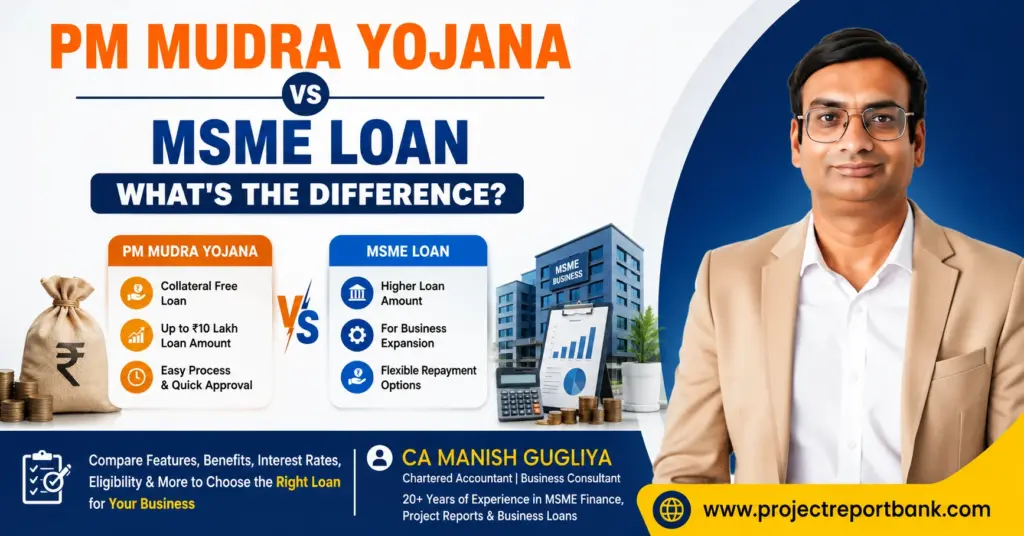
- PM Mudra Yojana vs Traditional Business Loans: Which Is Better for Small Businesses?
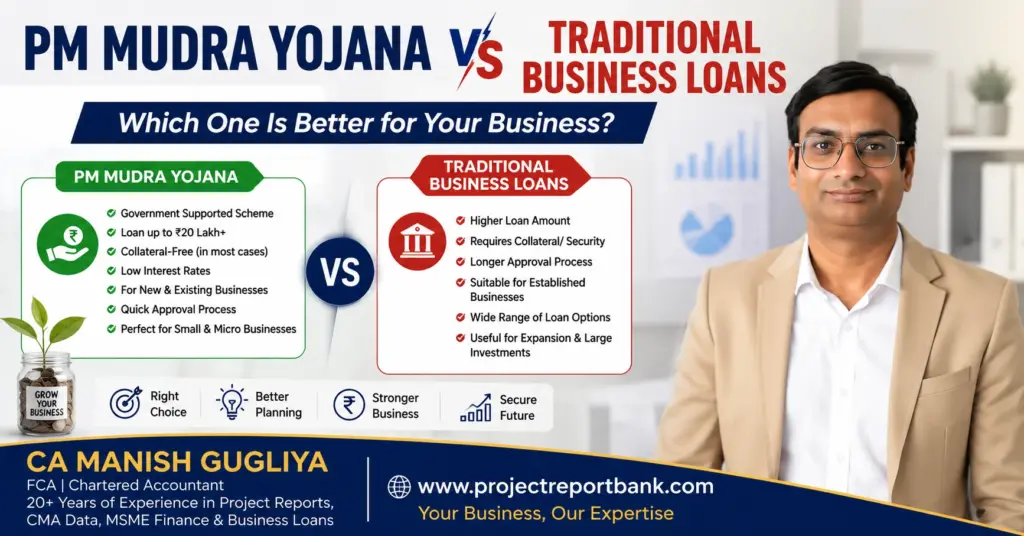
- Types of Mudra Loans: Shishu, Kishor, Tarun and Tarun Plus Explained
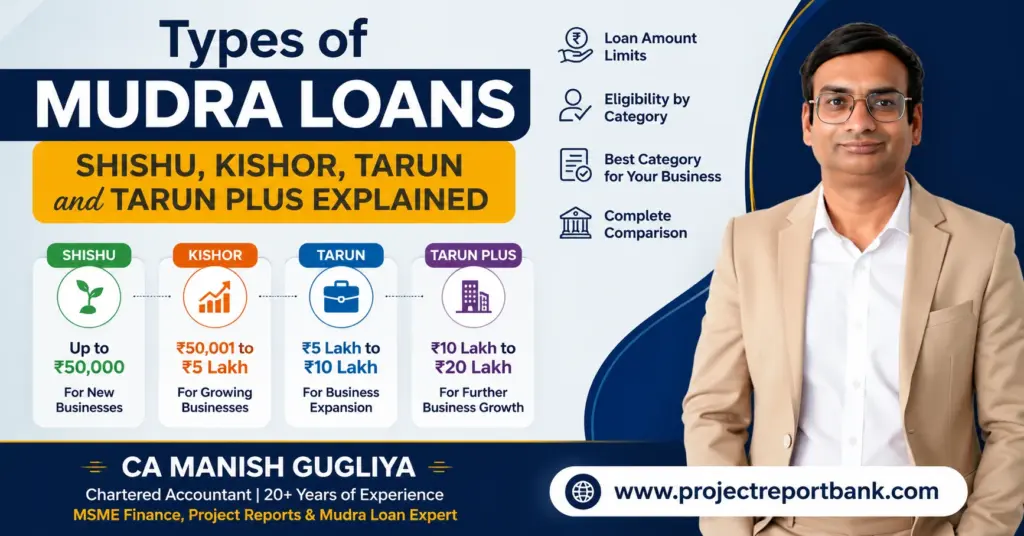
- Key Features of PM Mudra Yojana Every Applicant Should Know
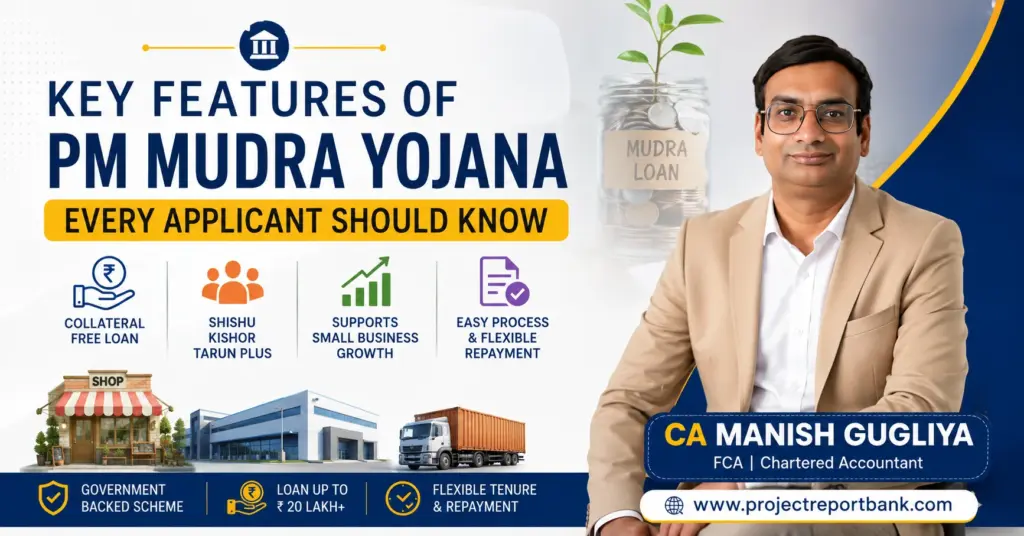
- Objectives of PM Mudra Yojana Explained