
Key Takeaways
The industrial ghee manufacturing plant setup cost in India depends on capacity, raw material route, automation level, packaging configuration, utilities and location. There is no single universal number.
- Small industrial ghee plants (1-2 TPD finished ghee) typically require total project investment in the range of ₹1-3 crore including land, building, machinery, utilities and working capital. Mid-scale plants (5-10 TPD) generally need ₹3-10 crore or more, while large integrated facilities (20+ TPD) can run into several tens of crores depending on scope.
- Total ghee manufacturing plant project cost = land and site development + building and civil works + plant and machinery + utilities and electricals + packaging infrastructure + laboratory + installation and commissioning + pre-operative expenses + contingency + margin for working capital.
- Ghee plant capital investment changes with capacity (1, 5, 10, 20 TPD), raw material route (cream, butter, integrated milk), and automation level (semi-automatic vs fully automatic). Two plants of identical capacity can differ by crores based on these choices.
- Cost estimates should always be based on a capacity-specific detailed project report (DPR), current vendor quotations and realistic civil, utility and working capital calculations rather than generic online figures.
Introduction: Industrial Ghee Manufacturing Plant Setup Cost in India
Packaged ghee is among the fastest-growing segments in India’s food processing industry. The global ghee market was valued at USD 58.99 billion in 2025, and domestic demand continues to expand with rising disposable incomes, growing awareness of nutritional benefits, population growth and the spread of organized retail and e commerce platforms. Indian households remain the largest consumers of this traditional dairy product, and export demand for clarified butter from international markets adds another layer of opportunity.
This growing demand is pulling investment away from small scale manual operations and toward industrial ghee manufacturing plants that can deliver consistent quality, regulatory compliance and competitive packaging. For promoters evaluating this space, the first question is straightforward: how much does it cost?
The answer is not a single number. Industrial ghee manufacturing plant setup cost in India varies based on:
- Production capacity (1 TPD to 20+ TPD of finished ghee)
- Raw material route (purchasing butter vs cream separation vs integrated milk processing)
- Automation level (semi-automatic vs fully automatic PLC/SCADA systems)
- Packaging formats (pouches, jars, tins, bulk)
- Utilities (boiler capacity, power load, water treatment, refrigeration)
- Land and building costs (which differ by state and industrial zone)
- Quality control infrastructure and environmental compliance
- Working capital tied up in butter/cream inventory and receivables
This article covers each of these cost drivers in detail. As a practising Chartered Accountant specializing in DPR preparation, project finance and industrial project costing at ProjectReportBank.com, I have structured this guide to help promoters, dairy companies, MSMEs and investors plan realistic project costs for commercial ghee production plants.
What Is an Industrial Ghee Manufacturing Plant?
An industrial ghee manufacturing plant is a food processing facility engineered for continuous or large-batch ghee production at capacities typically ranging from 1 to 20+ tonnes per day of finished ghee. These plants use stainless steel equipment, controlled heating and cooling systems, CIP (clean-in-place) protocols, in-process quality checks and mechanized packaging lines to produce ghee that meets FSSAI norms and buyer specifications for both domestic and international markets.
This is distinct from household or cottage-level ghee making. Industrial plants feature automated butter melting, ghee clarifiers, filtration systems, steam-jacketed kettles, bulk storage tanks, multiple packaging lines and finished goods warehousing. FSSAI licensing is mandatory for dairy and milk product manufacturing in India, and industrial operations must also comply with pollution control, fire safety and food safety regulations.
A standalone ghee manufacturing unit receives butter or cream as input and converts it to ghee. An integrated dairy processing plant, by contrast, handles milk reception, chilling, cream separation, butter production and ghee manufacturing under one complex. The integrated route adds upstream equipment cost but offers better margin control. Both models require meaningful capital investment, which is the focus of this article.
Industrial Ghee Manufacturing Process and Its Impact on Plant Cost
The basic manufacturing process in an industrial ghee plant follows this sequence: receiving cream or butter, melting and heating, moisture removal through controlled heating, clarification (separating milk solids from fat), filtration, cooling or granulation, packaging and finished goods storage. Ghee kettles must maintain temperatures between 105-120°C during the clarification stage, and storage tanks should be insulated and maintain 15-25°C temperatures for finished product stability.
A plant operating on the butter route buys or produces butter and then clarifies it into ghee. This requires butter melting vats, storage tanks, clarifiers and filtration units, but avoids the need for milk reception, chilling, cream separation and pasteurization equipment. The cream route or integrated milk-to-ghee approach adds separators, pasteurizers, cream storage and possibly butter churning equipment, raising both machinery scope and building requirements.
Process choices that directly affect ghee plant cost estimation include:
- Number of process stages (single-stage batch vs multi-stage continuous)
- Level of automation and temperature control
- Type of filtration and granulation systems
- CIP system capacity and design
- Whether refrigeration is needed for raw material or finished product storage
- Number and speed of packaging lines
Major Components of Industrial Ghee Plant Setup Cost
Ghee manufacturing plant setup costs include land and infrastructure, building, plant and machinery, utilities, electricals, laboratory, installation, pre-operative expenses, contingency and working capital. Each component should be quantified in the DPR with supporting civil estimates, vendor quotations and realistic implementation timelines.
Equipment costs represent a significant portion of capital expenditure, but ignoring land, civil works, utilities and working capital leads to under-estimation. The sections below cover each head individually.
Land and Site Development
Ghee plant land requirement depends on whether the unit is standalone or part of a larger dairy complex. A small 1-2 TPD standalone plant may fit in a compact industrial plot of 0.25-0.5 acre. A 5-10 TPD unit with warehousing and utilities needs a larger plot. Integrated facilities at 20+ TPD may require multi-acre land parcels.
Key land elements include an industrially zoned plot, approach road for tanker movement, loading and unloading bays, truck parking, green belt and provision for future expansion or additional product lines. Land cost varies sharply by state and micro-location; in many project reports, land is shown separately from machinery quotations to allow comparison across locations.
Site development (internal roads, boundary wall, drainage, levelling, rainwater management) forms a noticeable portion of overall project cost and should not be overlooked. Dairy processing plants are subject to local municipal approvals and fire safety clearances, which influence plot layout and setbacks. Some promoters use existing industrial sheds or dairy land to reduce initial capital investment, which should still be valued properly for bank appraisal.
Factory Building and Civil Construction
Civil construction for a ghee manufacturing plant must meet food-grade standards: RCC or structural steel buildings with acid-resistant floors, hygienic wall finishes, proper drainage, ventilation and segregation of clean and utility areas.
Principal building sections include:
- Raw material receiving area (butter, cream or liquid milk)
- Processing hall for ghee manufacturing
- Packaging hall
- Finished goods warehouse (ambient or cold storage)
- Utilities block (boiler room, DG room, compressor area)
- Laboratory
- Administrative offices and staff amenities
Building cost is influenced by clear height for equipment installation, floor load design for tanks and boilers, column spacing and provision for future capacity expansion. In a detailed project report, civil cost is typically estimated on a per-square-metre rate adjusted for region, with separate provisions for foundations, mezzanine floors, drainage pits and pipeline trenches.
Plant and Machinery for Ghee Manufacturing
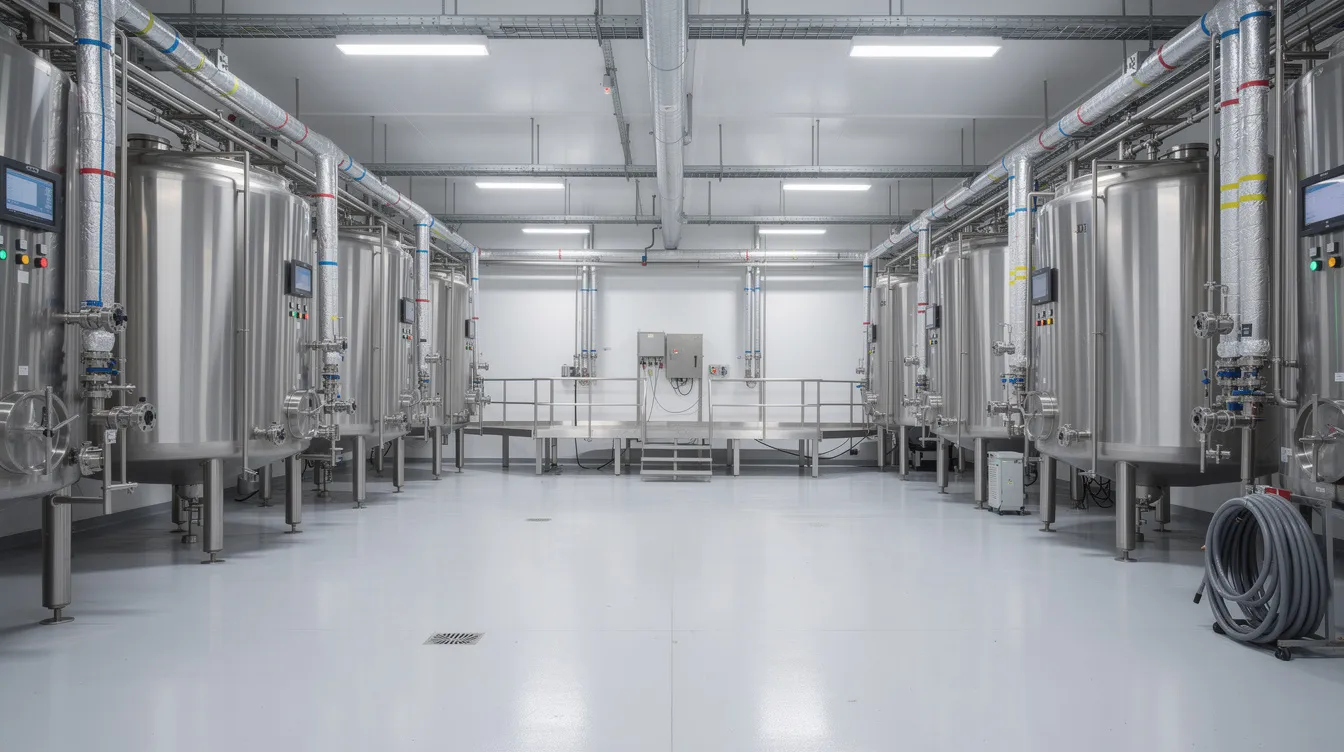
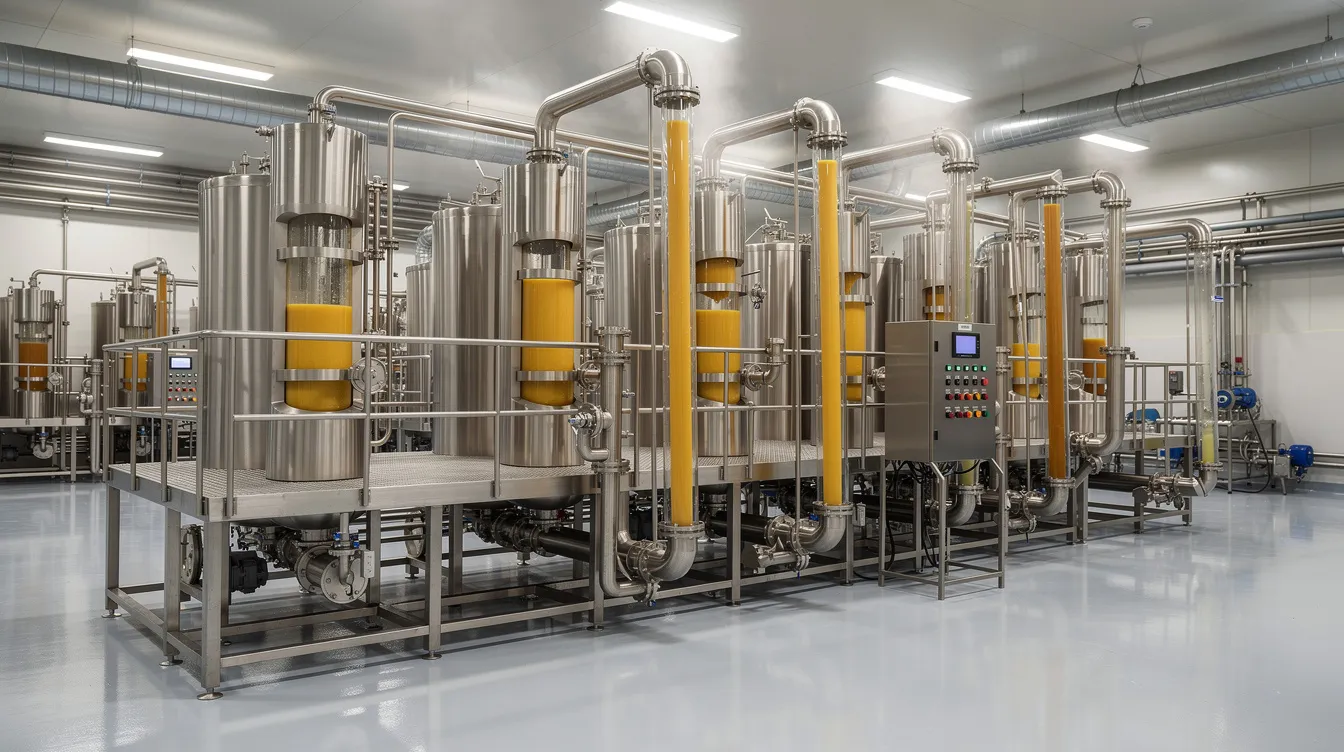
Core industrial ghee processing machinery includes butter melting tanks, cream storage tanks, ghee kettles or boilers, steam-jacketed vessels, ghee clarifiers, filtration units (filter press or cartridge filters), pumps, pipelines, CIP systems, ghee storage tanks and cooling or granulation systems. Ghee production requires cream separators and butter churners when operating on the cream or milk route. Filtration units are essential for achieving clear ghee quality and removing fine residual solids.
Machinery scope differs based on route: a butter-to-ghee finishing unit needs fewer upstream items than an integrated plant with milk reception, separation and pasteurization sections.
A common mistake I see in cost estimation is confusing basic ex-works machinery price with fully installed cost. The installed cost includes interconnecting pipelines, valves, insulation, support structures, automation panels, instrumentation, freight and GST. This can add 15-30% over the basic machine price, depending on plant complexity.
Material of construction (SS304 vs SS316), level of PLC/SCADA automation, energy-efficient motors and heat recovery systems also influence pricing and long-term operating expenses. Obtaining multiple detailed quotations with clear scope of supply is essential for realistic plant and machinery budgeting in the ghee manufacturing plant DPR.
Packaging Machinery and Infrastructure
Packaging configuration is a major determinant of industrial ghee plant cost. Different SKUs require different filling and sealing technologies, speeds and change-parts. Common packaging formats include:
- Retail pouches (200 ml, 500 ml, 1 litre)
- PET/HDPE jars
- Tin containers (retail and institutional)
- Institutional packs (5-15 kg tins or HDPE containers)
- Bulk drums for B2B supply
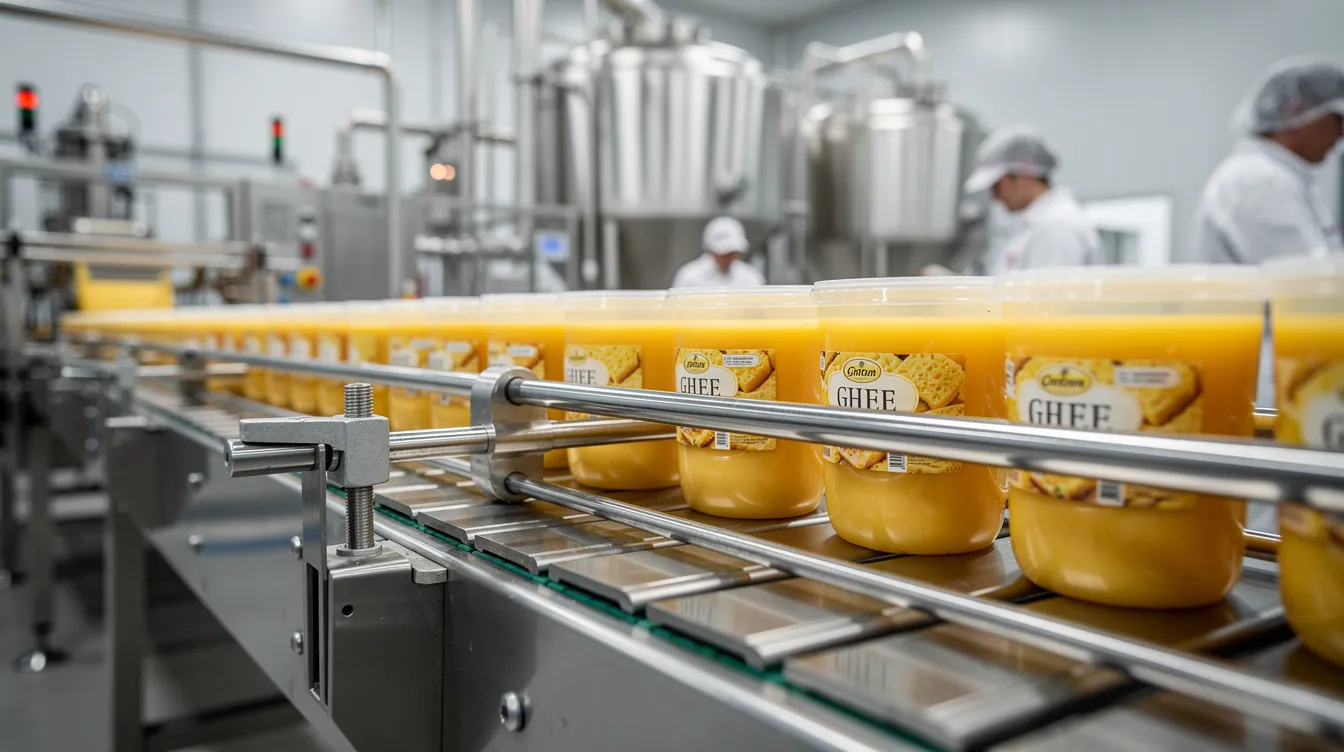
Typical ghee packaging machinery includes pouch filling and sealing machines, bottle/jar fillers, capping or seaming machines, induction sealers, labeling machines, inkjet or laser batch coders, conveyors and secondary packaging systems. Automated packaging machines enhance efficiency in ghee production and are necessary for high-throughput retail operations. Food-grade antioxidants extend ghee’s shelf life and influence packaging material selection for longer distribution channels.
Ghee packaging machine cost increases with higher speed (packs per hour), multi-SKU flexibility, automatic weight control and integration with conveyors. The DPR must align target product mix and volumes with packaging line capacities to avoid under-sized or over-sized investment.
Utilities, Electrical Installation and Quality Control
Steam, power and water are the principal utilities impacting ghee plant cost estimation and long-term operating expenses. Dairy processing entails energy requirements for refrigeration and boiler operations that scale with plant throughput.
Key utility systems include:
- Boiler and steam distribution for kettles, CIP and hot water
- Electrical substation, LT panels, MCC and DG backup
- Water supply and treatment (softening, RO if required)
- Compressed air for pneumatic instruments and packaging
- Refrigeration (especially for plants integrated with other dairy lines)
- Effluent handling where applicable
Environmental compliance is necessary for ghee manufacturing due to effluent generation. Pollution control clearances are mandatory for ghee manufacturing plants. Electrical installation (cabling, panels, lighting, earthing, control wiring) is often excluded from basic machinery quotations but can be a noticeable share of total infrastructure cost.
Quality control is critical in ghee production to ensure product safety and standards adherence. A basic in-house laboratory requires equipment for fat and moisture analysis, FFA and peroxide tests, and sample storage. Quality management systems must comply with food safety regulations. Export-oriented facilities need HACCP and ISO 22000 certifications, which require more advanced QA infrastructure.
Installation, Pre-Operative Expenses, Contingency and Working Capital Margin
Installation, erection and commissioning costs cover freight, unloading, positioning, structural supports, interconnecting pipelines, steam and water lines, insulation, cabling, instrumentation, testing and trial production. In my experience with DPR preparation, these costs often form 8-15% of plant and machinery value in realistic cost estimations.
Typical pre-operative expenses include:
- DPR and consultancy fees
- Architectural and engineering design
- Statutory approvals and licenses (FSSAI manufacturing license, pollution control board consent, factory licence)
- Interest during construction period
- Staff recruitment and training before commercial production
- Initial marketing and branding
Ghee production requires compliance with food safety, health and environmental regulations. Pollution control clearances are mandatory. These licensing and regulatory compliance costs, including periodic renewals and inspections, should be factored into both pre-operative and recurring budgets.
A contingency provision (commonly 5-10% of total fixed assets) is included in professional project reports to cover unexpected scope changes during implementation. Working capital margin represents the promoter’s contribution towards inventory (butter, cream, packaging materials), finished goods, receivables and minimum cash. Working capital covers recurring expenses like raw materials and labor. In bank-oriented project reports, working capital margin is presented separately from term-loan-funded fixed capital, but both together constitute total project cost.
Capacity-Wise Ghee Manufacturing Plant Cost in India
Capacity (TPD of finished ghee) is the first filter for planning industrial ghee manufacturing business investment. Production capacity should be aligned with market demand and financial viability to ensure profitability. The initial capital investment for a small ghee manufacturing plant can range based on various factors, and the investment for a mid-scale ghee plant varies by production capacity and automation level.
| Plant Capacity | Typical Configuration | Automation Level | Major Cost Drivers | Indicative Investment Considerations |
|---|---|---|---|---|
| 1-2 TPD | Standalone butter-to-ghee | Semi-automatic | Machinery, basic packaging, moderate utilities | Suitable for regional brands; total project cost typically a few crores including land, building and working capital |
| 5 TPD | Standalone or attached to dairy | Semi to automatic | Machinery, 1-2 packaging lines, boiler, lab | Mid-scale investment; common upgrade path for cooperatives and regional processors |
| 10 TPD | Standalone or integrated | Automatic | Multiple packaging lines, larger utilities, warehouse, QA | State-level or multi-state brands; higher automation and packaging investment |
| 20+ TPD | Integrated dairy complex | Fully automatic PLC/SCADA | Integrated upstream, multiple high-speed lines, advanced lab, large ETP, extensive logistics | Large organized dairy companies or export-focused operations; total project cost can reach several tens of crores |
Any rupee figures in this article are broad planning ranges based on industry experience, not vendor quotations. Two 10 TPD plants can differ by crores: one with basic tin packaging vs another with multiple high-speed lines for pouches, jars and tins. Capacity-wise costing should always be refined through a feasibility study and detailed quotations, particularly when applying for a ghee plant bank loan.
5 TPD Ghee Manufacturing Plant Cost
A 5 TPD ghee manufacturing plant is a common size for regional dairy brands and cooperative unions upgrading from manual or small scale ghee production. Setting up a medium-scale industrial ghee manufacturing plant typically requires an initial capital investment that covers machinery, building, utilities and working capital.
A typical 5 TPD configuration includes butter reception and storage, 1-2 butter melting tanks, ghee kettles or boilers, a clarifier, filtration system, small CIP system, limited ghee storage tanks and 1-2 packaging lines (pouches and tins/jars). Industry data suggests that machinery packages for 500 kg to 5-ton capacity plants can cost around ₹70 lakh for semi-automatic SS equipment, excluding full infrastructure.
At this scale, working capital for butter or cream inventory and receivables can be material relative to fixed assets. For planning purposes, total project cost for a 5 TPD plant typically falls in the ₹1-3 crore range depending on location, packaging and automation, as indicated by industry project reports.
10 TPD Ghee Manufacturing Plant Cost
A 10 TPD ghee plant typically serves state-level or multi-state markets and justifies higher automation in material handling, process control and packaging. Representative machinery includes multiple butter melting tanks, a continuous ghee clarifier, higher-capacity storage tanks, automatic CIP and at least two to three packaging lines running in parallel.
Cost escalators at 10 TPD include a larger processing building, more sophisticated utilities (higher-capacity boiler, larger electrical connection, robust DG set), bigger warehouses and an expanded laboratory. Such plants often run multiple shifts, which influences design of staff amenities, utilities redundancy and maintenance planning.
For planning purposes, a 10 TPD plant may require ₹3-5 crore or more in total project cost, rising further with integrated upstream processing or extensive retail packaging. Promoters at this scale should also budget for branding and distribution support, aligning these with capital investments to ensure realistic payback and ghee plant ROI.
20 TPD and Large-Scale Industrial Ghee Plant Cost
Plants at 20 TPD and above typically form part of large integrated dairy or fat-processing complexes supplying national brands, institutional buyers and export markets. Features include integrated milk reception and cream or butter production, continuous ghee production lines, fully automatic PLC/SCADA systems, extensive bulk storage, nitrogen blanketing for oxidation control, multiple high-speed packaging lines and automated material handling.
At this scale, utility systems (high-pressure boilers, chillers, large compressors, ETP, fire-safety systems) and extensive warehouses add substantially to fixed capital. A reference point: a 50,000 LPD dairy processing unit (multi-product, including ghee) was estimated at approximately ₹17.25 crore total capital investment, with plant and machinery at ₹6.35 crore and monthly working capital at ₹5 crore. Scaling to 1 lakh LPD or adding advanced packaging and additional product lines pushes total cost to ₹35 crore and beyond.
Large plants usually invest in sophisticated QA laboratories, R&D facilities for product development (organic ghee, A2 ghee, fortified variants) and cold-chain infrastructure. Detailed feasibility study and phased execution planning are especially important at this scale.
Ghee Manufacturing Plant Machinery Cost and Selection
Plant and machinery is usually the single largest component of fixed capital in ghee manufacturing plant project cost.
| Equipment | Function | Capacity Consideration | Cost Impact |
|---|---|---|---|
| Butter melting tank | Melts butter for ghee processing | 500-2,000 kg batch | Medium |
| Ghee boiler/kettle | Controlled heating and moisture removal | Matched to TPD output | High |
| Ghee clarifier | Separates milk solids from ghee | Batch or continuous; continuous costs more | High |
| Filtration unit | Removes fine solids for clear ghee | Cartridge or filter press | Medium |
| CIP system | Clean-in-place for hygiene compliance | Scales with number of process vessels | Medium |
| Storage tanks | Holds finished ghee before packaging | Insulated; sized for inventory policy | Medium |
| Packaging line | Fills, seals, labels, codes finished packs | Speed and SKU count drive cost | High |
| Cream separator | Separates cream from milk (integrated route) | LPH capacity | Medium-High |
| Boiler | Generates steam for heating and CIP | Fuel type and pressure rating | High |
Quotes should be compared on complete scope of supply, including auxiliary equipment, installation, warranty, training and after-sales service. In DPR preparation and CMA data, machinery cost should include realistic GST, freight, insurance and installation to avoid under-estimating total investment.
Automatic vs Semi-Automatic Ghee Plant Cost
Semi-automatic plants carry lower upfront capital investment but require more labour, manual valve operation, basic control panels and simpler packaging machines. Product variability tends to be higher. These setups suit lower capacities or locations where labour is readily available.
Fully automatic plants use PLC-controlled processes, automated valves and pumps, automatic CIP, in-line monitoring of temperature and flow, servo-controlled fillers, integrated conveyors and coding systems. The CAPEX difference can be 20-50% or more depending on automation scope.
Automatic ghee manufacturing plant cost per litre may be lower over time when considering reduced wastage, better fat recovery, lower labour cost per unit and higher capacity utilization. The choice between semi-automatic and automatic should be based on capacity, target market, labour costs, quality requirements and long-term growth plans rather than initial CAPEX alone.
Raw Material Route and Its Impact on Investment
One of the biggest structural decisions in ghee manufacturing business planning is whether to operate as a butter-to-ghee finishing plant, a cream-based unit or a full milk-to-ghee integrated dairy processing plant.
Ghee requires high-quality milk or cream as primary raw material. Milk must contain a minimum of 3.5% fat content for viable cream separation. Butter must have at least 80% milk fat content for ghee production. Cultured butter enhances flavor development in ghee and is preferred for certain product segments, adding a fermentation step.
Butter-route plants purchase butter externally, reducing the need for milk collection, chilling, separation and butter manufacturing equipment. Cream-route or integrated plants handle the full supply chain from raw milk intake, raising fixed capital but providing better control over raw material quality and margins. Standalone ghee finishing units require robust butter or cream procurement contracts. This route decision should be evaluated through a feasibility study comparing incremental investment vs margin improvement, using sensitivity scenarios on milk and butter prices.
Packaging Format and Its Impact on Ghee Plant Cost
Packaging is both a marketing decision and a technical investment driver. Adding multiple packaging formats increases machine cost due to extra filling heads, change-parts, seaming or capping systems and associated conveyors. High-speed retail packaging lines contribute to industrial ghee plant cost but are necessary for plants targeting large FMCG distribution channels or export volumes.
In my project advisory work, I generally recommend that promoters prioritize 1-2 core SKUs at launch and phase additional packaging lines later to avoid over-capitalizing the project at start-up. Smooth texture and rich nutty taste are key selling points, but these are achieved through process control, not packaging spend.
Land and Building Requirement Planning
Rather than quoting a single universal land-area figure, planners should derive ghee plant land requirement from a block layout covering production, raw material and finished goods storage, utilities, circulation space, administration and expansion areas. Vertical construction (mezzanines) can reduce footprint but increases structural cost. Low-rise layouts need more land but lower structural complexity.
Regulatory norms related to fire safety, setbacks, parking, water storage and effluent handling affect building and land planning. Land and building requirements should be frozen only after a preliminary plant layout and process flow diagram are available, typically prepared jointly with the machinery supplier and project consultant.
Utility Requirement and Cost for Ghee Plants
Steam, power and water are the principal utilities impacting both CAPEX and operating cost. The capacity of boilers, electrical connections, water treatment and compressed air systems scales with plant throughput and degree of automation. Utility buildings, equipment and pipelines are part of fixed capital and must be budgeted separately from process machinery.
During feasibility study, promoters should evaluate different fuel options (PNG, biomass briquettes, diesel) and energy-efficiency measures. These choices influence both CAPEX and long-term operating costs and can materially affect ghee manufacturing plant profitability.
Working Capital Requirement for a Ghee Manufacturing Plant
Working capital is the finance required to keep day-to-day operations running: to buy butter, cream or milk fat, packaging material, pay wages and utilities, hold inventory and offer credit to customers.
The working capital cycle follows this sequence: procurement of raw materials (often on advance or short credit), processing and packaging, finished goods storage (especially before festive demand peaks), dispatch to distribution channels and collection of receivables. Conceptually:
Working Capital ≈ Raw Material Inventory + Packaging Inventory + WIP + Finished Goods + Receivables + Minimum Cash – Creditors
Procurement volatility of milk fat prices can impact ghee production margins and working capital needs. Maintaining buffer stock during low-price periods improves margins but ties up more capital. For a 50,000 LPD dairy unit, one month’s working capital was estimated at approximately ₹5 crore on a total project cost of ₹17.25 crore. In bank-linked DPRs and CMA data, working capital assessment is critical for sanction of cash-credit or overdraft limits.
Total Project Cost Structure of a Ghee Manufacturing Plant
The standard total project cost structure for a ghee manufacturing plant includes:
- Land and site development
- Building and civil works
- Plant and machinery
- Utilities and electricals
- Laboratory and miscellaneous fixed assets
- Installation and commissioning
- Preliminary and pre-operative expenses
- Contingency
- Margin for working capital
Each head should be supported by detailed back-up workings. Many online references to “ghee manufacturing plant cost in India” refer only to plant and machinery and sometimes exclude land, building and working capital, leading to under-estimation of actual total capital investment. When presenting project cost to banks or investors, promoters should clearly distinguish fixed capital (term-loan component) from working capital (cash-credit component). For integrated dairy projects, the ghee section may be one cost centre among several, which can be referenced to related resources like the Integrated Dairy Processing Plant Project Report on ProjectReportBank.com.
Means of Finance for a Ghee Manufacturing Project
Means of finance refers to the mix of promoter’s contribution (equity, internal accruals) and external finance (term loan, working capital limits) used to fund total project cost. A typical structure involves promoter equity funding a portion of fixed capital, with the balance through a term loan, plus sanctioned working capital limits from banks.
Eligibility for specific MSME or dairy-sector schemes, subsidies or interest subvention must be checked against current government notifications and should not be assumed automatically. Lenders assess project viability based on projected profitability, cash flow and DSCR, in addition to collateral and promoter background. While professional advisors help structure means of finance and documentation, loan sanction remains the prerogative of the financing institution.
Factors That Can Increase Ghee Plant Setup Cost
- Imported or premium-brand machinery with advanced instrumentation
- High automation (PLC/SCADA) and continuous processing systems
- Multiple packaging lines and SKUs from day one
- High-capacity utilities, advanced laboratory facilities, cold-chain integration
- Land in prime industrial or urban locations
- Stringent environmental compliance or ETP/ZLD requirements
- Extensive warehousing, office blocks and fire-safety systems
- Designing for aggressive future expansion (oversized utilities, extra foundations)
- Regulatory compliance costs including license renewals and inspections
Factors That Can Reduce Initial Capital Investment Sensibly
Cost reduction should never compromise food safety, hygiene or statutory compliance. Practical strategies include:
- Starting at an optimal capacity (e.g., 5 TPD with provision to scale to 10 TPD)
- Using existing dairy land, buildings or utilities
- Focusing on 1-2 high-volume core SKUs initially
- Sizing machinery to realistic demand projections rather than peak aspirational capacity
- Shared utilities within an integrated dairy (common boiler, refrigeration, ETP) with proper cost allocation
- Selecting domestic machinery suppliers where acceptable quality is available
- Phased packaging-line additions as volumes and brand visibility grow
Ghee Plant Setup Cost vs Operating Cost
CAPEX is the one-time investment in land, building, plant and machinery, utilities and pre-operative expenses. OPEX is the ongoing cost of running the plant.
Key OPEX items for a ghee manufacturing unit include butter, cream or milk fat, packaging material, fuel for boilers, electricity, labour, maintenance and repairs, QC and testing, insurance, transportation and marketing. Operating costs for ghee production are primarily driven by raw materials, which account for 85-90% of OpEx. First-year operational costs also include utilities and maintenance expenses that stabilize over subsequent years.
A plant with lower CAPEX but high energy consumption or wastage can be more expensive to operate than a slightly higher-cost automatic plant with better fat recovery. Life-cycle cost analysis (CAPEX + discounted OPEX over a reasonable horizon) is a better decision tool than comparing setup cost alone. In DPR and financial projections, CAPEX assumptions must be matched with realistic OPEX assumptions to derive credible DSCR and ROI figures.
Profitability of an Industrial Ghee Manufacturing Plant
Profitability depends on the margin between ghee selling price and net landed cost of raw materials, adjusted for process losses, packaging, utilities, labour and overheads. Ghee manufacturing gross profit margins typically range between 20-30%, but this varies between commodity bulk ghee and premium or organic segments.
Critical profit drivers include raw material procurement strategy, fat yield, capacity utilization, product and packaging mix, brand positioning, distribution efficiency and energy management. Market research into distribution channels and pricing across domestic and international markets is essential before committing investment. Sensitivity analysis should test the impact of changes in raw material prices, selling price and capacity utilization on overall profitability. Detailed profitability modelling is better addressed in a dedicated DPR, while this article focuses on investment and setup cost.
Break-Even, ROI and Financial Feasibility Metrics
Break-even point is the level of annual ghee sales at which total revenue equals total costs. Break-even for ghee manufacturing typically ranges from 2 to 4 years depending on capacity utilization, raw material costs and selling prices. Financial projections for ghee projects include ROI and profitability assessments alongside IRR and DSCR calculations. Lenders focus on DSCR and repayment capacity; investors look closely at IRR and payback period.
Realistic financial feasibility requires integrating project cost, means of finance, operating assumptions and market outlook into projected P&L, cash flow and balance sheet statements for at least 5-7 years. Sensitivity analysis (for example, ±10% changes in raw material or selling price) tests how robust the project is under different scenarios. In practice, many ghee plant proposals are revised after initial feasibility study to align capacity and investment with acceptable break-even and ROI thresholds.
Bank Loan, DPR and CMA Data for a Ghee Manufacturing Plant
Industrial ghee plants seeking term loan and working capital limits from banks need a comprehensive ghee manufacturing plant project report. A detailed project report is vital for establishing the financial and operational strategy of a ghee plant.
A good DPR includes:
- Promoter profile and industry trends in the ghee manufacturing sector
- Plant capacity, location, manufacturing process description
- Machinery list with vendor quotations
- Detailed project cost and means of finance
- Implementation schedule
- Projected financial statements (P&L, balance sheet, cash flow)
- DSCR, break-even analysis, key risk factors
Banks also typically require CMA data formats with projected balance sheet, fund flow and working capital assessment aligned with DPR assumptions. Copy-paste generic project reports without location-specific costing and updated assumptions may not be acceptable for serious project appraisal. Promoters planning comprehensive dairy investments can also explore related resources such as Milk Powder Plant Setup Cost in India and Cheese Manufacturing Plant Setup Cost in India for comparative investment understanding.
How CA Manish Gugliya and ProjectReportBank.com Can Assist
Based on my experience in preparing DPRs, CMA data and financial projections for dairy and other industrial projects, I offer structured project-planning support for ghee manufacturing plants through ProjectReportBank.com.
Key services include:
- Detailed project cost estimation for ghee manufacturing plants (capacity-wise)
- Preparation of bank-ready ghee plant DPRs with realistic financial analysis
- Working capital assessment and business plan structuring
- DSCR, break-even analysis, ROI and IRR calculations
- Sensitivity analysis across raw material price, selling price and capacity utilization scenarios
- CMA data preparation and term-loan/working-capital documentation support
This support covers financial and project-planning advisory. It does not constitute a guarantee of loan sanction; final lending decisions rest with the bank based on their independent appraisal. Promoters evaluating related dairy investments can also explore resources on UHT Milk Processing Plant Setup Cost in India and Industrial Ice Cream Plant Setup Cost in India.
Conclusion: Estimating Industrial Ghee Manufacturing Plant Setup Cost in India
Industrial ghee manufacturing plant setup cost in India is a function of plant capacity, raw material route, plant layout, automation level, packaging mix, utilities, land and building, and working capital requirements. No single figure applies to every project.
Promoters should avoid relying only on headline machinery prices. A complete cost structure must include land, civil works, utilities, laboratory, installation, pre-operative expenses, contingency and working capital to reflect actual investment.
A properly prepared DPR integrates technical capacity, project cost, means of finance, working capital, projected revenue, profitability, cash flow and DSCR into a coherent feasibility picture. This is what separates a bankable project from a rough estimate.
If you are planning to set up or expand an industrial ghee plant, ProjectReportBank.com and CA Manish Gugliya can help you convert your concept into a financially viable, bank-ready industrial project through structured project planning and financial advisory.
Frequently Asked Questions (FAQ)
The questions below address common doubts entrepreneurs have when first exploring ghee manufacturing plant cost and investment planning in India.
How much does it cost to set up an industrial ghee manufacturing plant in India?
Costs vary with capacity, location and configuration. Small 1-2 TPD units may require a few crores including land and working capital. Plants at 5-10 TPD typically need ₹3-10 crore depending on automation and packaging. Integrated 20+ TPD facilities can run into several tens of crores. Accurate costing requires a capacity-specific DPR with current vendor quotations, civil estimates and realistic working capital calculations.
Does ghee manufacturing plant cost include land and working capital?
Many online figures refer only to machinery. A complete ghee manufacturing plant project cost must add land and site development, building, utilities, electricals, laboratory, installation, pre-operative expenses, contingency and margin for working capital. Without these components, the total cost is materially under-estimated.
How much land is required for an industrial ghee plant?
Land requirement depends on capacity and layout. A small standalone 1-2 TPD plant may fit in a compact industrial plot. A 5-10 TPD plant with warehousing and utilities requires a larger area. Integrated 20+ TPD dairy complexes with upstream milk processing may need multi-acre parcels. The exact area should be derived from a block layout after process flow and building design are finalized.
Is an industrial ghee manufacturing plant profitable?
Ghee manufacturing gross profit margins typically range between 20-30%. Profitability depends on raw material procurement cost, capacity utilization, product mix, brand positioning, distribution efficiency and energy costs. Market growth in the ghee market, both domestic and export, supports investment opportunities, but profit margins should not be assumed from generic online claims. A project-specific financial analysis with sensitivity testing is the right approach.
What is included in a ghee manufacturing plant project report?
A comprehensive project report for a ghee manufacturing plant includes promoter background, market overview, plant capacity and location, manufacturing process description, machinery list with quotations, detailed project cost, means of finance, implementation schedule, projected financial statements (P&L, balance sheet, cash flow), DSCR, break-even analysis, technology requirements and key risk factors. This document forms the basis for bank appraisal, investor evaluation and the promoter’s own decision-making.