Setting up an industrial ice cream manufacturing plant in India is not a fixed-price purchase. The total cost depends on installed capacity, automation level, product mix, refrigeration infrastructure, packaging formats, land location, and seasonal working capital needs. This article provides a structured, assumption-backed investment framework for promoters planning plants in the 10,000 to 50,000+ litres per day range.
Key Takeaways
- A medium industrial ice cream manufacturing plant of 10,000–20,000 LPD typically requires approximately ₹25–₹60 crore in total funding (including working capital margin), depending on automation, refrigeration scope, and land cost.
- Machinery, refrigeration, hardening tunnels, and frozen cold storage together usually form 55–70% of the fixed capital investment, while land and building can range from 10–35% depending on location.
- Banks appraise projects on the complete project cost – fixed assets plus pre-operative expenses, interest during construction (IDC), and margin money for working capital – not just machinery quotations.
- Ice cream is a highly seasonal product. Plant capacity must be designed for peak-season demand (summer volumes can be 3–4× winter), and a Detailed Project Report (DPR) based on realistic utilisation ramp-up is essential before seeking finance.
- Capital investment includes machinery, land, and construction costs, but the total funding requirement also covers utilities, compliance, distribution infrastructure, and substantial working capital for raw materials and inventory.
Industrial Ice Cream Plant Setup Cost in India – Quick Investment Overview
There is no single standard answer to the question of industrial ice cream plant setup cost in India. The investment depends on whether you are setting up a 10,000 LPD regional facility or a 50,000+ LPD plant targeting national distribution. As an indicative framework based on 2024–25 conditions:
- A 10,000 LPD automated plant with hardening and frozen storage may require roughly ₹15–₹25 crore in fixed capital (excluding high-cost metro land), with total funding in the range of ₹25–₹45 crore.
- A 20,000–25,000 LPD facility with multiple packaging lines and robust cold chain infrastructure can range from ₹30–₹50 crore in fixed capital, with total funding of ₹50–₹90 crore.
- Plants at 50,000 LPD or above, with high automation and multiple SKU lines, may need ₹80–₹150+ crore depending on scope, and total project funding well above ₹100 crore.
All figures assume a greenfield, automated ice cream manufacturing plant with hardening tunnels and frozen storage – not a small parlour, manual unit, or commercial kitchen. Total project costs scale with production capacity, with even mid-range setups often requiring ₹8 crore to ₹12 crore or more for core processing alone. The global ice cream market was valued at USD 78.57 billion in 2025 and is expected to reach USD 102.38 billion by 2034, which underscores why large scale industrial production capacity in India is attracting serious investment.
The major drivers that can double or halve the investment include: capacity in litres per day, number of operating shifts, automation level, packaging formats, refrigeration system design, cold chain scope, and whether the plant is standalone or part of an integrated dairy facility.
Indicative Cost Framework by Capacity and Automation
The following table provides an indicative comparison across four capacity scenarios. These are planning-level estimates, not vendor quotations.
| Parameter | 10,000 LPD | 20,000–25,000 LPD | 50,000 LPD | >50,000 LPD |
|---|---|---|---|---|
| Operating Shifts | Single (8–10 hrs) | 1.5–2 shifts | 2 shifts (16 hrs) | 2–3 shifts / multi-location |
| Automation Level | Semi to fully automatic | Fully automatic | Fully automatic, PLC/SCADA | High automation, robotics |
| Packaging Lines | 1–2 | 2–4 | 4–6+ | Multiple, high-speed |
| Fixed Capital (excl. land) | ₹15–₹25 crore | ₹30–₹55 crore | ₹80–₹140 crore | ₹150–₹250+ crore |
| Working Capital Margin | ₹3–₹6 crore | ₹5–₹10 crore | ₹12–₹25 crore | ₹20+ crore |
| Total Estimated Funding | ₹25–₹45 crore | ₹50–₹90 crore | ₹100–₹180 crore | ₹180–₹300+ crore |
| Capacity Utilisation (Yr 1→3) | 50–70% → 85% | 55–70% → 85–90% | 50–65% → 85% | Varies by market rollout |
These numbers can vary sharply with imported high-speed lines, high-cost urban land, advanced extrusion plants for novelties, and a large refrigerated fleet. Ice cream plant equipment costs can vary widely based on automation level and desired production capacity.
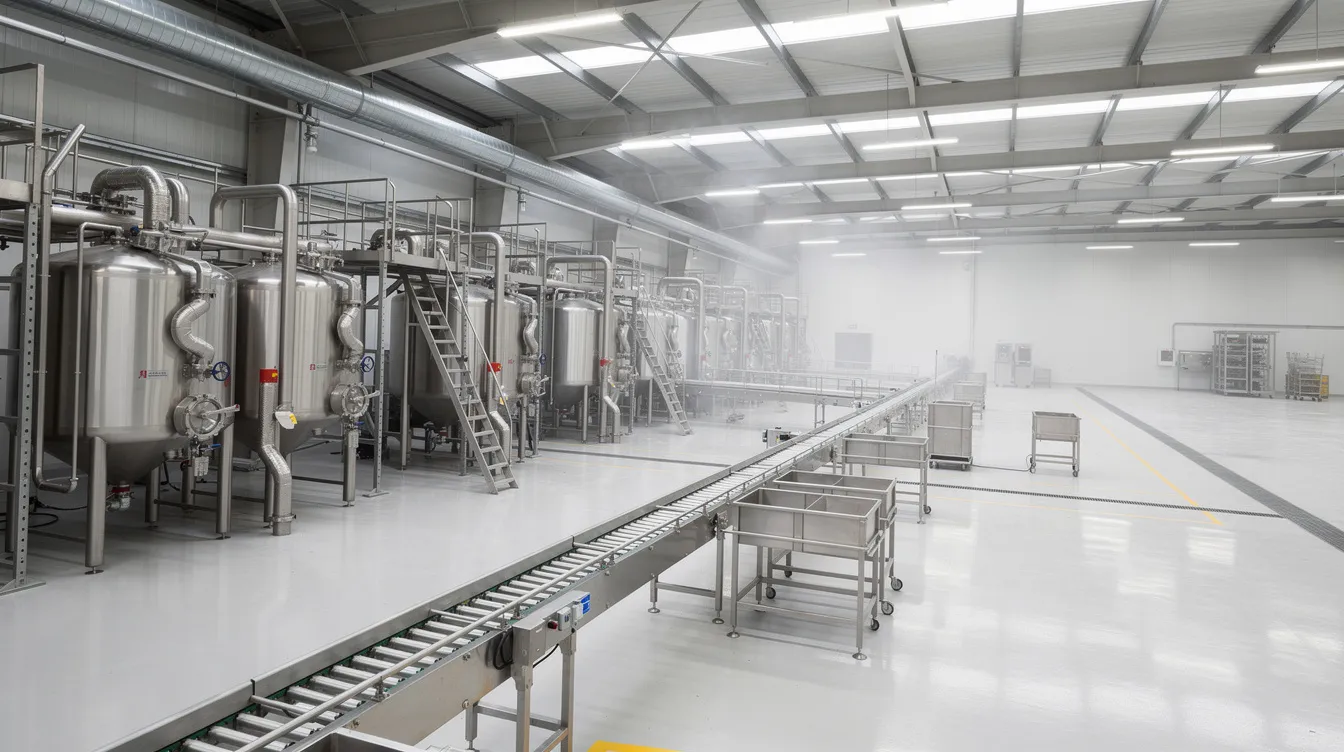
Key Factors Affecting Industrial Ice Cream Manufacturing Plant Cost
There is no single ice cream factory setup cost in India. The total cost is the result of several design and commercial choices made during project planning.
The main cost drivers include:
- Production capacity (LPD/LPH) and number of shifts
- Product mix: cups, cones, sticks, bars, tubs, party packs, kulfi, frozen desserts, novelties
- Automation level: semi-automatic vs fully automatic ice cream plant machinery
- Packaging configuration: number and speed of filling lines
- Refrigeration technology, hardening tunnel capacity, and cold storage scale
- Land location and building standards (food-grade, insulated, hygienic)
- Whether the facility is standalone or integrated with a dairy plant
A Detailed Project Report (industrial ice cream plant DPR) quantifies each of these factors and converts them into an itemised project budget. Banks and investors closely examine how these assumptions are documented before sanctioning a term loan or equity infusion.
Production Capacity, Seasonality and Plant Sizing
Design capacity must be based on peak-season demand, not annual average sales. Summer ice cream volumes in India can be 3–4 times winter volumes. A plant designed only for average throughput will lose sales in peak months, while one designed only for peak will suffer low capacity utilisation the rest of the year.
The relationship between installed capacity, hourly throughput, and shifts matters. For example, a 20,000 LPD plant running 16 hours per day during peak season needs an ice cream mix processing capacity of roughly 1,500–1,800 litres per hour, plus buffer for breakdowns and CIP cleaning cycles.
A phased capacity expansion strategy often makes financial sense: start with 20,000 LPD and design the building, utilities, and refrigeration to accommodate a second continuous freezer and additional filling lines to reach 40,000 LPD later. Oversizing the ice cream manufacturing unit inflates initial capital investment and drags down capacity utilisation, while undersizing creates lost revenue during summer – both affecting break even timelines.
Product Mix, SKUs and Impact on Investment
Cups, cones, sticks, bars, family packs, bulk packs, kulfi, frozen desserts, and coated novelties each need different equipment. A plant making only tubs and party packs has a lower automatic ice cream plant cost than a facility producing sticks, bars, and chocolate-coated novelties on multiple lines.
Premium ice cream (higher fat, inclusions, ripples, chocolate coating) increases the need for ingredient preparation tanks, fruit-feeding and dosing systems, and more complex quality control. The product range directly affects changeover requirements – additional flavors need separate hoppers, flavour tanks, CIP loops, and inevitable downtime between SKUs.
As a practical example, adding an extrusion line for chocobars and novelties can increase overall fixed capital by 20–35% compared to a basic cup and tub plant of the same LPD. Contract manufacturing can be a strategic option for launching a new ice cream brand with reduced initial capital needs, especially for novelty SKUs that require specialised equipment. Leading manufacturers in the space often run separate lines for high-volume products to minimise changeover losses.
Automation Level and Ice Cream Production Line Cost
The difference between semi-automatic and fully automatic ice cream manufacturing is significant. Semi-automatic plants rely on manual handling for filling, packing, and cartoning. Fully automatic lines integrate conveyors, robotic pick-and-place, automatic cartoning, and PLC/SCADA controls.
Fully automatic ice cream plant machinery can raise initial machinery cost by 25–60%, but reduces labor costs, wastage, and quality variations. Beyond 20,000–25,000 LPD, full automation is usually preferred by both promoters and banks.
Consider lifecycle cost, not just purchase price. Automation may increase CapEx by, say, ₹8–₹15 crore on a large plant but save ₹2–₹4 crore annually in operating expenses through reduced labour, rework, breakage, and product recall risk. Banks often view higher automation favourably when justified by capacity, as it supports a stronger DSCR. The ice cream making process benefits significantly from consistency that automation provides, particularly in maintaining creamy texture across batches.
Packaging Configuration and Ice Cream Plant Capacity Planning
Packaging is often the bottleneck in an ice cream factory, not the pasteuriser or continuous freezer. Main packaging machines include:
- Cup fillers and lidding machines
- Cone filling and wrapping lines
- Stick and bar production lines (moulded or extruded)
- Extrusion and chocolate enrobing systems
- Flow-wrap machines for novelties
- Tub fillers for family and bulk packs
- Carton packing, coding, and labelling systems
Each additional format – cones, sticks, multipacks – requires separate machines and conveyors, significantly increasing the ice cream factory machinery cost. High-speed imported lines (European) increase the ice cream production line cost in India but may be justified for 50,000+ LPD plants where ice cream brands target national distribution. Line speed (cups per minute, sticks per hour) directly determines how many filling lines are needed for a given plant capacity.
Refrigeration, Hardening and Cold-Storage Cost
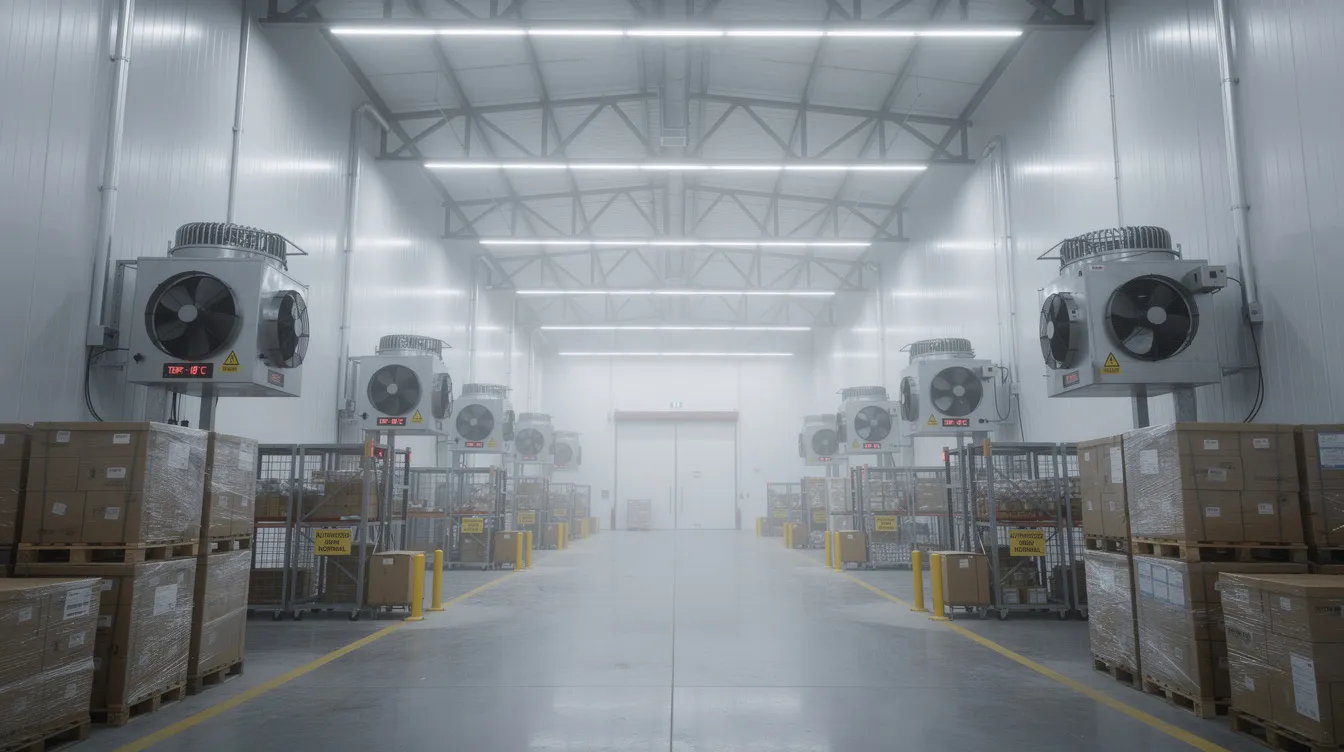
Refrigeration and cold chain typically account for 25–40% of fixed capital investment in a large-scale ice cream production plant. Management of distribution logistics is critical to the overall financial success of an ice cream business, and it starts with getting the cold chain right inside the factory.
Major components include:
- Central refrigeration plant (ammonia or freon-based systems)
- Glycol and chilled-water circuits
- Blast hardening tunnels (core temperature −25°C to −30°C)
- Frozen cold rooms with insulated PUF panels
- Brine tank systems for certain moulded-product lines
- Refrigerated loading bays
- Temperature monitoring and alarm systems
Inadequate hardening capacity leads to soft cores, product deformation, and reduced throughput – effectively capping the real ice cream plant capacity even if the processing line is larger. High-capacity cold-chain infrastructure is essential for maintaining product quality in ice cream distribution.
Indicative cost ranges: refrigeration infrastructure is critical for ice cream production, with costs potentially ranging from ₹2 crore to ₹10 crore for medium setups. For a 20,000 LPD plant, hardening and frozen storage might require ₹8–₹15 crore, while a 50,000 LPD plant could need ₹25–₹40 crore, excluding refrigerated vehicles. Adding 10–30 reefer vans for distribution can add ₹3–₹10 crore or more, depending on whether you own the fleet or use third-party logistics.
Detailed Ice Cream Manufacturing Plant Project Cost Breakdown
The following table illustrates indicative cost heads and their share for a reference case of a 20,000–25,000 LPD fully automatic ice cream manufacturing plant. All figures are planning estimates.
| Cost Head | Indicative Range (₹ Crore) | % of Project Cost |
|---|---|---|
| Land and site development | 2–15 (highly variable) | 3–15% |
| Factory building and civil works | 8–18 | 10–18% |
| Ice cream processing machinery | 15–30 | 20–30% |
| Filling and packaging lines | 10–20 | 12–20% |
| Refrigeration plant, hardening tunnels, cold rooms | 10–22 | 15–25% |
| Raw-material and ingredient storage | 1–3 | 1–3% |
| QC laboratory | 0.5–1.5 | 0.5–1.5% |
| Utilities (electrical, boiler, water, CIP, ETP, compressor, DG) | 5–12 | 6–12% |
| Office, furniture, material handling | 1–2 | 1–2% |
| Installation and commissioning | 2–4 | 2–4% |
| Technical consultancy and engineering | 1–2 | 1–2% |
| Preliminary and pre-operative expenses | 2–5 | 2–5% |
| Interest during construction (IDC) | 2–6 | 2–6% |
| Contingency | 2–5 | 2–5% |
| Margin money for working capital | 5–10 | 5–10% |
| Total estimated funding requirement | ₹50–₹90 crore | 100% |
It is essential to distinguish between:
- Fixed capital investment: tangible assets (land, building, plant, machinery, utilities)
- Project cost: fixed capital + pre-operative expenses + IDC + contingency + margin for working capital
- Working-capital requirement: the ongoing fund need for inventory, receivables, and operating expenses (financed separately via cash credit / WCDL)
A concise illustration: if core machinery costs ₹40 crore, the total project cost typically reaches ₹70–₹90 crore once building, refrigeration, utilities, IDC, and working capital margin are added. Initial budget allocations for an industrial ice cream plant should include provisions for utilities and compliance costs from the outset.
Land, Building and Factory Infrastructure Cost
Land costs vary significantly based on location, influencing overall project budgeting for ice cream plants. Prices range from less than ₹50 lakh per acre in certain industrial zones to ₹10+ crore per acre near metros. Project reports should always present land and building cost separately.
A mid-to-large industrial setup typically requires 10 to 15 Kathas of land, or roughly 1.5–4 acres for a standalone ice cream plant with adequate space for future expansion. An ice cream plant layout should incorporate these functional zones:
- Raw milk receiving and milk cream storage
- Mix preparation, pasteurisation, and homogenisation
- Ageing rooms and continuous ice cream freezer bay
- Filling and packing hall
- Hardening tunnels and frozen storage
- Dispatch docks and refrigerated loading area
- Utility block, QC lab, admin block, employee amenities
Options include buying land outright, taking a long-term industrial lease (e.g., 30-year MIDC lease), or using an existing dairy-processing facility. Each changes the initial outlay and the bank’s security structure.
Civil works for setting up an ice cream plant can cost between ₹20 lakh to ₹50 lakh for smaller setups, scaling to ₹8–₹18 crore for 20,000+ LPD plants. Food-grade factory construction (including epoxy flooring, drainage, PUF insulation, hygienic ceilings) generally costs ₹1,500–₹3,000 per sq ft, and building typically accounts for 15–25% of total project cost excluding land.
Ice Cream Plant Machinery and Production-Line Cost
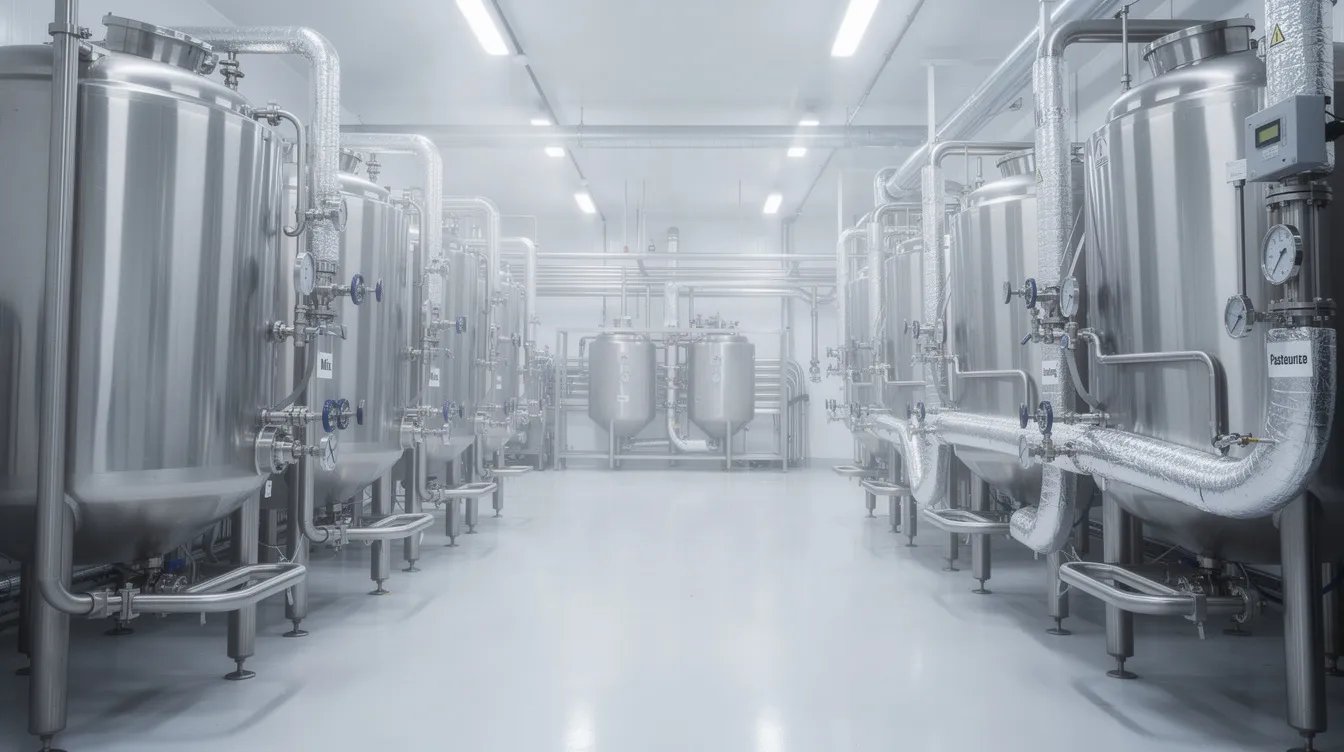
Ice cream manufacturing equipment price is the largest controllable portion of CapEx and requires careful specification. Ice cream plants are built using food-grade SS304 stainless steel for all product-contact surfaces, with SS316 used where corrosion resistance is critical.
Core process equipment includes:
- Milk reception and storage tanks
- Ingredient preparation and ice cream mix tanks
- Pasteurisers and homogenisers (essential equipment for any ice cream manufacturing process)
- Ageing vats
- Continuous freezer (the heart of the ice cream making plant)
- Batch freezer for specialty products or soft serve applications
- Fruit feeders and ingredient dosing systems
- CIP system, pumps, pipelines, and valves
Downstream machinery covers cup and cone filling machines, tub fillers, stick and bar lines, extrusion and chocolate coating systems, wrapping and cartoning machines, metal detectors, and coding systems.
Different equipment exists across a wide range of scales. For reference, ice cream plants can range from 100 to 1000 L/hr capacity in processing throughput. A 500 LPH ice cream candy plant has a capacity of 500 L/hr and costs approximately ₹15 lakh. The automatic turnkey ice cream plant operates at 100 L/hr capacity and is fully automatic. The 200 L/hr ice cream plant is designed for medium-scale production. Estimated costs for machinery and equipment generally range from ₹15 lakh to ₹60 lakh for smaller-scale setups.
For industrial-scale plants, processing equipment alone scales as follows: 5,000 LPD roughly ₹1.5–₹2.5 crore; 10,000 LPD roughly ₹3.5–₹6 crore. For a 20,000–25,000 LPD automatic plant, processing, filling, and CIP equipment together may cost ₹30–₹55 crore, while a 50,000 LPD multi-line plant may reach ₹70–₹120 crore depending on product mix and whether lines are Indian or imported. Commercial ice cream machine specifications, packaging machines speeds, and the number of filling lines drive these costs significantly.
Utilities, Electricals and Supporting Infrastructure
Utility costs are often underestimated but are critical for ice cream plant reliability. The 200 L/hr ice cream plant requires a 20 kW power supply – industrial plants at 20,000+ LPD need connected loads of 500 kW to 2,000+ kW depending on refrigeration design.
Key utility infrastructure includes:
- HT/LT electrical panels, transformer, cabling
- DG sets for backup power (essential given refrigeration dependency)
- Steam boilers or hot-water generators for pasteurisation and CIP
- Water supply and water-treatment plant
- Compressed-air system
- Effluent treatment plant
- Fire-fighting and safety systems
Design must consider peak load in summer – simultaneous running of continuous freezers, hardening tunnels, cold rooms, and all packaging lines – not just average consumption. Electricity bills can account for significant ongoing costs due to refrigeration operations running round the clock for cold storage, even outside production hours.
Utility CapEx typically ranges from 8–15% of total plant investment. Promoters considering a combined dairy–ice cream–milk powder facility may find it useful to review resources such as a Milk Powder Plant Setup Cost in India for understanding shared utility economics.
Licences, Registrations and Compliance Costs
Mandatory licenses for ice cream manufacturing in India include FSSAI registration (central licence for turnover above ₹12 crore) and pollution control approvals from the State Pollution Control Board. Other generally applicable registrations include:
- Company or LLP registration, PAN, TAN
- GST registration
- Factory licence under the Factories Act
- Fire NOC and local municipal approvals
- Legal metrology compliance for pre-packaged ice creams (weight and volume declarations)
- Trademark registration for brand names and logo
- Labour registrations (EPF, ESIC)
- Food safety standards compliance documentation
Exact approvals vary by state, capacity, effluent discharge method, fuel type, and building specifications. Regulatory and compliance costs are typically ₹25–₹75 lakh for medium projects (excluding major environmental mitigation), but delays in approvals can extend interest during construction and inflate IDC.
Preliminary, Pre-operative and Often Overlooked Costs
Many project budgets understate soft costs, leading to funding gaps during implementation. Commonly overlooked items include:
- Detailed Project Report and financial modelling
- Technical consultancy, plant engineering, and architectural design
- Loan processing and documentation charges
- Travel and vendor inspection expenses
- Trial production and product development runs
- Packaging design and printing cylinder charges
- Recruitment, staff training, and initial production losses
- Marketing launch, trade schemes, and distributor security deposits
- Power-connection deposits and project insurance
- Interest during construction
These pre-operative expenses typically add 5–12% to total project cost. For a ₹80–₹100 crore project, this translates to ₹4–₹12 crore – a material amount that, if ignored, creates a real funding shortfall. A prudent contingency of 5–10% should be built into the budget for cost escalation, forex movement on imported equipment, and design changes. Initial operating costs can be significant, covering raw materials and utilities even during the commissioning phase.
Working Capital Requirement for an Ice Cream Factory
Working capital is separate from fixed assets and must cover inventory, receivables, and operating expenses – especially during peak season when raw materials purchases, finished-goods inventory, and distribution credit all spike simultaneously.
Major working-capital components include:
- Raw materials: milk, milk cream, milk powder, sugar, vegetable fat, stabilisers, emulsifiers, flavors, fruit preparations, chocolate, and coatings
- Packaging materials: cups, cones, sticks, wrappers, cartons, corrugated boxes
- Finished-goods frozen inventory
- Distributor and modern-trade credit (typically 30–60 days)
- Electricity and refrigeration bills, wages, repairs, and marketing spends
Raw materials account for 60–70% of total operating expenses in ice cream manufacturing. Ice cream production typically requires substantial working capital for raw materials, electricity, and distribution costs. The initial working capital provision for a small ice cream plant is typically around ₹10 lakh to ₹25 lakh, but for industrial-scale operations, the numbers are far larger.
Banks often finance 70–80% of the working-capital requirement via cash credit or WCDL, with the balance margin brought in by promoters as part of the project’s total funding requirement. For a 20,000–25,000 LPD plant, peak working capital may be ₹12–₹20 crore, with margin money of ₹4–₹7 crore built into the project cost.
Capacity Utilisation, Cost per Litre and Break-Even Analysis
Fixed cost per litre depends heavily on how quickly the plant ramps up utilisation. Ice cream plant gross profit margins typically range between 40–50%, but these are achievable only at reasonable capacity utilisation.
A simple benchmarking formula:
Capital cost per litre of installed daily capacity = Relevant plant investment ÷ Installed litres per day
For example, ₹80 crore invested for 20,000 LPD gives a capital cost of ₹4,000 per litre of daily capacity, while ₹110 crore for 30,000 LPD gives approximately ₹3,667 per litre – demonstrating the scale advantage of larger plants.
Break even for ice cream manufacturing typically ranges from 3 to 5 years. The break-even volume is the point at which depreciation, interest, fixed salaries, insurance, and refrigeration overheads are fully recovered across litres sold. Realistic projections should assume a ramp-up curve: 50–60% utilisation in Year 1, 70–80% in Year 2, and 85–90% from Year 3, rather than full capacity from day one.
Means of Finance and Bank Loan for Ice Cream Manufacturing Plant
An industrial ice cream plant investment is usually financed through a combination of:
- Promoter’s equity contribution: 25–35% of project cost
- Bank term loan: 60–70% of eligible fixed assets
- Separate working-capital limits: cash credit, WCDL, LC/BG
- Equipment finance or leasing, where applicable
Subsidies under central or state food-processing schemes can reduce the effective promoter contribution. Starting a business under the PMFME scheme can provide credit-linked subsidies for food processing units. State policies, such as UP’s food processing policy offering 35% subsidy on machinery and 50% on cold storage infrastructure, may also apply. However, subsidies must be treated carefully in the means-of-finance statement and should never be assumed until formally approved.
Banks evaluating an industrial ice cream plant DPR look for realistic cost estimates, capacity justification, market analysis, profitability projections, DSCR above 1.5×, sensitivity analysis, and the promoter’s track record. No consultant or article can guarantee loan sanction – approvals depend entirely on the bank’s credit appraisal.
Cost Optimisation Without Compromising Plant Quality
The objective is to optimise the total cost of the ice cream manufacturing plant, not to cut corners on food safety or reliability. Practical strategies include:
- Phase capacity expansion: start with core production and add lines as target markets develop
- Prioritise core SKUs (cups, tubs, family packs) at launch; add novelties and coated products later
- Design the building and utilities for modular expansion from the beginning
- Separate must-have machinery from future-phase equipment
- Evaluate lifecycle cost (purchase price + energy + maintenance + spares over 10–15 years), especially for refrigeration systems, continuous freezers, and hardening tunnels
- Negotiate comprehensive installation, training, spare parts, and warranty terms with suppliers – delivery time and after-sales support matter as much as price minimum order quantity
- Compare complete offers from multiple suppliers rather than lowest equipment price alone
Savings should never come at the expense of insulation quality, hardening capacity, food-contact stainless steel grade, CIP systems, or basic hygiene and food safety standards. An interested request for callback explore quotation options from at least three different equipment manufacturers before finalising.
Importance of a Detailed Project Report (DPR) for Ice Cream Plants
A robust DPR is central to serious industrial ice cream plant planning and bank finance. As a practising Chartered Accountant working with food-processing and dairy projects, I have observed that projects backed by professionally prepared DPRs move faster through bank appraisal and face fewer implementation surprises.
A comprehensive ice cream manufacturing plant project report should cover:
- Optimum ice cream plant capacity planning based on market analysis
- Product mix strategy and production scheduling
- Detailed project cost with itemised quotations
- Means-of-finance plan and promoter contribution structure
- Revenue projections, operating-expense estimates, and working-capital assessment
- Profitability, break-even analysis, IRR, NPV, DSCR, payback period, and cash-flow profile
- Sensitivity analysis on milk prices, power tariffs, capacity utilisation, and selling prices
All projections are based on transparent assumptions and are not a guarantee of performance. The proposed project parameters must reflect the promoter’s specific situation.
Promoters considering a combined dairy–ice cream facility may also benefit from reviewing an Integrated Dairy Processing Plant Project Report, a UHT Milk Processing Plant Setup Cost in India, or a Whey Processing and Dairy Ingredients Plant Project Report for understanding integration opportunities.
Conclusion and Professional Advisory Call to Action
The cost of setting up an industrial ice cream plant in India is a composite of processing machinery, packaging lines, refrigeration and cold-chain infrastructure, land and building, utilities, regulatory compliance, preliminary and pre-operative expenses, and substantial seasonal working capital. There is no single number that applies to every project. A realistic budget must reflect specific capacity, location, product mix, automation level, packaging formats, and distribution strategy. The indicative figures in this article are starting points for planning – not substitutes for a detailed, project-specific assessment.
Initial capital investment for a mid-scale industrial ice cream manufacturing facility typically ranges from ₹50 lakh to ₹1.5 crore for the smallest commercial setups, while setting up an industrial ice cream plant in India at scale requires an estimated investment of several crores depending on scope. Setup cost for an ice cream plant starts at Rs 8,00,000 for the most basic configurations, and a mini ice cream plant costs around Rs 17,00,000, but these are far removed from the industrial scale discussed in this article.
Serious promoters, dairy companies, and investors planning an industrial ice cream manufacturing plant are invited to engage CA Manish Gugliya for a customised DPR, project-cost assessment, financial projections, CMA Data preparation, ice cream plant feasibility study, and bank-finance documentation. Each project report is prepared based on actual vendor quotations, site conditions, proposed financing structure, and the promoter’s profile – with focus on bankability and practical implementation.
Frequently Asked Questions
The following answers provide indicative planning ranges based on 2024–25 conditions. Actual figures will vary with time, technology, location, and project-specific choices.
How much does an industrial ice cream plant cost in India for 20,000 litres per day?
A 20,000 LPD automatic ice cream manufacturing plant producing cups, tubs, and basic novelties, including refrigeration and cold storage, may broadly require ₹50–₹90 crore in total project cost, excluding very high land prices in metros. Within this, machinery could account for roughly ₹30–₹55 crore, building and utilities around ₹12–₹20 crore, and the balance towards pre-operative expenses, IDC, and margin for working capital. Adding high-speed imported lines, an extensive distribution fleet, or a complex product range can push costs higher. Additional information and price quotes from multiple vendors are essential before finalising.
What is the minimum investment for a commercially viable automatic ice cream plant?
For a serious regional ice cream brand with industrial automation, the practical lower end is typically around 10,000 LPD, which may need roughly ₹25–₹45 crore in total funding depending on land, product mix, and scope. Smaller plants below 5,000 LPD can be set up for less – estimated costs for machinery and equipment generally range from ₹15 lakh to ₹60 lakh at that scale – but they fall closer to semi-industrial or MSME space and may not support distribution across multiple states. Promoters should balance ambition with financial capacity and consider phased expansion.
Is land generally included when people quote “ice cream factory setup cost”?
Many vendor-level quotations and online figures for ice cream plant cost cover only machinery, installation, and sometimes utilities – not land and building. A proper project-report-based ice cream factory setup cost in India should show land, building, plant and machinery, utilities, pre-operative expenses, IDC, and working-capital margin separately. Always ask whether land, GST, and interest during construction have been included in any lump-sum number you encounter.
How much does cold storage and hardening add to the project cost?
For medium and large industrial plants, hardening tunnels, frozen storage, refrigeration plant, and insulated structures together may account for roughly 25–40% of total fixed capital investment (excluding land). In a ₹60 crore fixed-capital project, refrigeration and frozen storage might easily amount to ₹15–₹22 crore depending on technology and redundancy. Cutting corners on hardening or cold storage usually results in product loss and effective capacity loss, which is more expensive than the initial saving. A mixture of proper design and adequate space allocation is essential.
Why is a DPR essential before applying for a bank loan for an ice cream plant?
Banks do not fund projects based on machinery quotations alone. They require a complete industrial ice cream plant DPR covering technical details, itemised cost, financial projections, break-even analysis, DSCR, and risk sensitivity. A professionally prepared DPR helps avoid under-budgeting, supports faster bank appraisal, and gives promoters a realistic picture of funding requirements and repayment capacity. The DPR also serves as a working document during implementation – guiding procurement, sequencing, and expenditure monitoring throughout the main steps of the project.