
Securing a bank loan for an ice cream manufacturing plant in India is a structured process that demands far more than enthusiasm and a business idea. With India’s ice cream market projected to reach ₹30,000 crore in 2024 and growing at 13–15% annually, lenders are increasingly receptive to well-prepared proposals-but they apply rigorous credit assessment before releasing a single rupee. In this article, I discuss how banks evaluate an industrial ice cream plant for term-loan finance, how DSCR is calculated, what promoters must bring to the table, and how a professionally prepared DPR can strengthen your proposal.
Key Takeaways
- An ice cream plant bank loan for an industrial-scale ice cream manufacturing unit depends on a bankable detailed project report, realistic financial projections, adequate DSCR, promoter contribution and sufficient security coverage.
- Ice cream plant DSCR and ice cream plant term loan assessment are central to how lenders decide the eligible term-loan amount, repayment period and moratorium structure.
- Ice cream manufacturing project finance is typically structured as a term loan for fixed assets plus separate working-capital limits, supported by detailed CMA data for the ice cream plant loan application.
- In practice, banks rarely fund 100% of ice cream factory project cost and finance; promoters must plan a clear equity contribution and maintain an acceptable debt-equity ratio for an ice cream manufacturing project.
- Professional support from a practising Chartered Accountant-such as CA Manish Gugliya at ProjectReportBank.com-for a bankable DPR, DSCR calculation and financial modelling significantly improves the quality of a bank loan for ice cream manufacturing plant proposal, though it does not guarantee sanction.
Understanding Bank Finance for an Industrial Ice Cream Plant
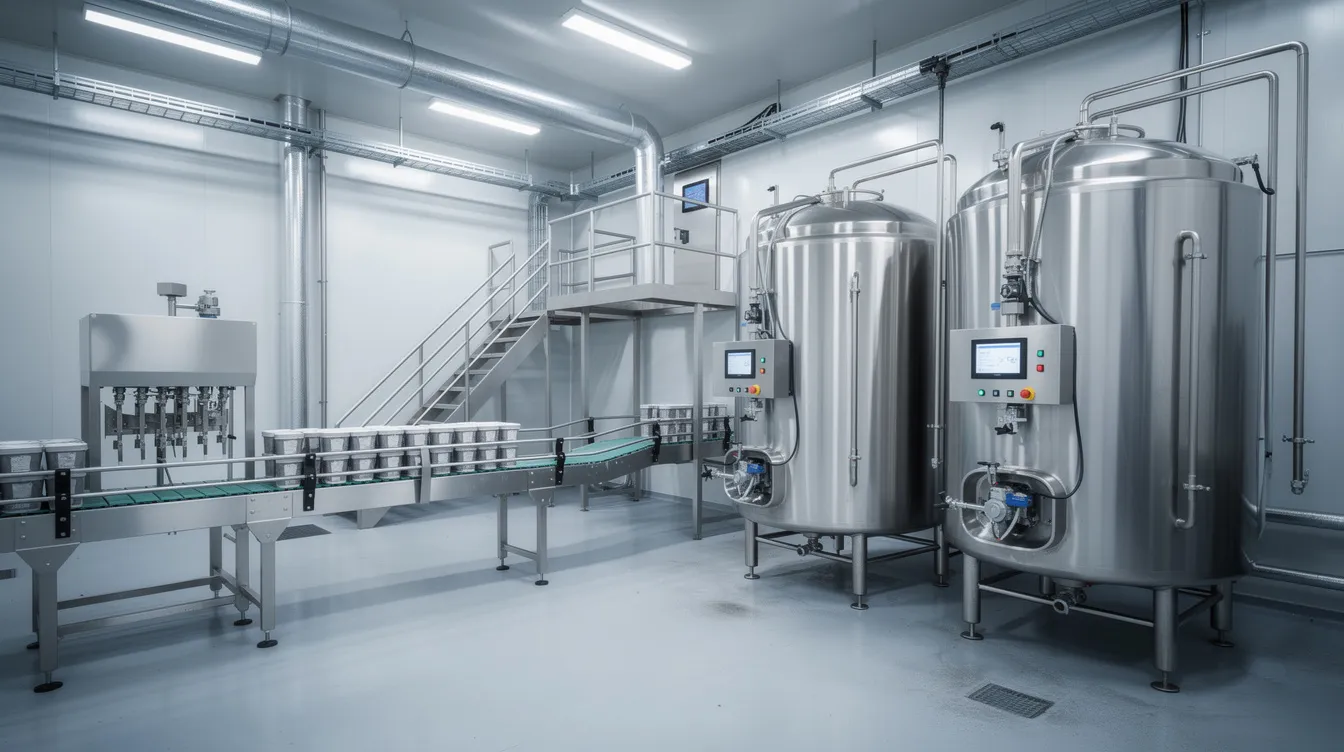
An industrial ice cream manufacturing unit producing 20,000–40,000 litres per day is a capital-intensive project. The investment covers automated processing machinery, continuous freezers, refrigeration infrastructure, cold rooms, hardening tunnels, utilities, insulated factory buildings and cold chain distribution facilities. For context, a plant of 20,000–25,000 LPD with multiple packaging lines may require total project funding of ₹50–₹90 crore, depending on automation and land cost. The global ice cream market was valued at USD 78.57 billion in 2025 and is expected to reach USD 102.38 billion by 2034, underscoring the scale of opportunity.
Banks in India split ice cream plant project finance into distinct components:
- Term loan for fixed assets: processing machinery, building, refrigeration, utilities
- Working-capital facilities: cash credit, WCDL, BG/LC for imports or large orders
- Promoter’s contribution: equity, unsecured loans from promoters or group entities
- Non-fund-based facilities: where required for machinery imports or transport
Sanctioning working capital and a term loan involves separate but interconnected appraisals. The bank evaluates overall ice cream plant loan repayment capacity including the impact of working-capital interest on cash flows. Key credit concepts include project finance appraisal, debt-equity ratio, DSCR, interest coverage ratio, collateral security and primary security-each examined against the specific risk profile of an ice cream manufacturing unit in India.
Why an Ice Cream Plant Requires a Bankable DPR
An ice cream plant project report for bank loan-the DPR-is the core document on which bankers base their technical and financial appraisal. A project report includes a detailed business plan covering every aspect from promoter credentials to repayment capacity.
A bankable DPR for an industrial ice cream manufacturing plant must cover:
- Promoter profile: management experience, particularly in dairy, FMCG or cold chain operations
- Business constitution and shareholding pattern
- Proposed capacity in litres/day or MT/year and product mix (cups, cones, family packs, novelty bars, bulk tubs-including flavours like vanilla, chocolate and mango)
- Manufacturing process: from milk reception through pasteurisation, homogenisation, ageing, continuous freezing, filling, packaging, hardening and frozen storage, aligned with the industrial ice cream manufacturing process and production line
- Physical infrastructure: land, building, plant layout, utilities, power load, DG sets, ice cream cold storage and hardening tunnel requirements, quality-control lab and ETP/STP
- Financial components: total project cost, means of finance, financial projections, projected P&L, balance sheet, cash-flow statement, DSCR and loan repayment schedule, break-even analysis and sensitivity analysis
- Regulatory and licensing requirements: FSSAI, factory licence, pollution control, fire safety
The report must cover raw material costs and financial projections in an internally consistent manner. Capacity utilisation, sales volume, raw materials consumption, power cost, cold-storage space, staffing and loan repayments must mathematically tie together. Different lenders may use different formats, but the underlying data-particularly DSCR calculation for the ice cream plant-must remain logical and defensible.
Components of Ice Cream Plant Project Cost Eligible for a Term Loan
During bank appraisal of an ice cream manufacturing project, not every rupee of expenditure qualifies for term-loan funding. Eligibility follows each bank’s policy and applicable regulatory guidelines.
Typical fixed-asset heads considered eligible:
- Land and site development (often capped at 10% of project cost per NABARD norms)
- Factory building and civil works, including insulated processing halls and PUF panels
- Ice cream processing machinery: pasteurisers, homogenisers, ageing vats, continuous freezers (ice cream manufacturing requires a pasteuriser and homogeniser as essential equipment)
- Automatic filling, wrapping and cartoning lines
- Refrigeration systems, cold rooms and hardening tunnels (cold storage units must maintain temperatures of −20°C)
- Batch freezer units (costing ₹5–10 lakh for 500–1,000 litres/day capacity)
- Utilities: boiler, water treatment, air compressor, DG sets
- Lab and quality inspection equipment, material handling, office furniture
- Pre-operative expenses, contingencies and margin money for working capital (where permitted by bank policy)
Items that may receive partial or no term-loan funding include land cost beyond bank limits, second-hand machinery, related-party purchases, already incurred expenditure and cost overruns. For example, in a proposed project costing ₹35 crore, ₹5 crore of land and pre-operative costs already spent might be excluded, reducing the eligible cost base to ₹30 crore-directly affecting ice cream plant term loan assessment.
Means of Finance and Promoter Contribution
The ice cream plant project cost and means of finance must balance clearly, showing how the project will be funded. Banks typically require 15% to 25% promoter contribution for project costs, though for larger industrial projects, 25–35% is common.
Promoter contribution includes equity capital, share premium and unsecured loans from promoters or group entities (subject to subordination). Banks examine documentary evidence-bank statements, ITRs, net-worth statements-to verify the source and availability of funds.
Indicative Means of Finance (Illustrative Only)
| Component | Amount (₹ Crore) | % of Project Cost |
|---|---|---|
| Total Project Cost | 30.00 | 100% |
| Promoter’s Equity | 9.00 | 30% |
| Unsecured Promoter Loans | 1.00 | 3% |
| Term Loan | 20.00 | 67% |
All figures are indicative and will vary by project size, lender policy and promoter profile.
This structure yields a debt-equity ratio of approximately 2:1, which many commercial banks find acceptable for food processing. Promoters should not assume 100% financing; most banks require upfront equity infusion before major term-loan disbursement.
Government subsidies and capital subsidies can serve as a supplementary funding source. PMFME provides a credit-linked capital subsidy of 35% for eligible plant and machinery. PMEGP offers a margin money subsidy of 15% to 35% for new manufacturing units-specifically 25–35% subsidy for ice cream projects. NABARD supports dairy-linked projects with lower interest rates. However, subsidy receipt is contingent and time-lagged; banks rarely treat it as primary margin at the sanction stage. Equipment leasing may also be explored as an alternative financing option for specific machinery components.
How Banks Assess an Ice Cream Plant Term Loan
Ice cream plant term loan assessment involves multiple layers of credit assessment covering promoters, technology, market, financial viability and security.
Promoter Assessment: Banks evaluate the promoter’s experience in dairy, FMCG or frozen dessert operations, financial strength, net worth, credit history (CIBIL/CRIF), existing borrowings and demonstrated capacity to infuse required equity. A team with prior ice cream manufacturing or distribution exposure strengthens the proposal significantly.
Technical Assessment: Lenders examine installed capacity, technology choice (continuous vs batch), vendor credibility, alignment with automatic ice cream plant machinery and equipment cost benchmarks, refrigeration load, plant layout, machinery requirements, utilities sizing and the implementation schedule with clear milestones. Plant size must be justified by market demand.
Market Assessment: This covers demand for ice cream in the target geography, competition from established ice cream brands and ice cream manufacturers, distribution network (dealers, modern trade, HoReCa, quick commerce platforms), and seasonal demand patterns. Lenders often refer to ice cream plant revenue model, distribution network and seasonality analysis. Health-focused ice cream-including low sugar and premium variants-commands 2–4× the price of standard varieties, which can support stronger revenue assumptions if backed by market evidence. India produces over 20 crore tonnes of milk annually, ensuring easy access to key raw materials for dairy farmers and ice cream producers alike.
Financial Assessment: Banks focus on projected turnover, operating margins, ice cream plant profitability and break-even analysis, debt-equity ratio, DSCR, interest coverage ratio, working-capital cycle and sensitivity to changes in raw material costs and power prices. Market factors like competition, distribution networks, and seasonal demand directly affect loan approvals.
Security and Documentation: Primary security includes hypothecation of plant and machinery and a charge on fixed assets financed. Collateral requirement for an ice cream plant loan may include mortgage of immovable property, third-party guarantees or additional securities. Food manufacturing loans often require compliance with food safety regulations. Requirements vary by bank and scheme and must not be assumed identical across lenders.
Term Loan Assessment for an Ice Cream Plant – Practical Illustration
Banks do not simply fund total project cost. They calculate the eligible term loan by applying margin norms, asset-eligibility criteria and projected loan repayment capacity. Establishing a clear repayment plan is crucial in a loan application.
Here is an indicative illustration:
- Total project cost: ₹40 crore
- Ineligible items (land already owned, pre-operative expenses incurred): ₹5 crore
- Eligible project cost: ₹35 crore
- Required promoter margin (30%): ₹12 crore (including equity + unsecured loans)
- Maximum conceptual term loan: ₹23 crore
- Resulting debt-equity ratio: approximately 1.9:1
- Indicative repayment: 8 years with 1-year moratorium
Even if asset coverage justifies ₹23 crore, the bank may cap the sanction lower-say ₹20 crore-if DSCR, average cash accruals or stress-case projections do not comfortably support higher repayment. Banks evaluate manufacturing loans primarily on project viability, not just asset value.
What Is DSCR in an Ice Cream Plant Project?
DSCR-Debt Service Coverage Ratio-measures whether your project generates enough cash to pay both interest and principal on the term loan each year. In simple terms:
DSCR = Cash Available for Debt Service ÷ Total Debt-Service Obligation
Cash available for debt service typically includes profit after tax plus non-cash expenses (depreciation, amortisation), with term-loan interest added back where the bank’s format requires it.
Total debt service includes interest on the project term loan plus principal repayment due during the year.
Banks examine both annual (year-wise) DSCR and average DSCR over the projection period. A project with a strong average but a weak Year 2 DSCR raises a red flag. Many lenders expect DSCR must be greater than 1.5 for loan approval, though the exact threshold varies-Central Bank of India’s food processing scheme, for instance, requires an average DSCR of at least 1.25. There is no single mandatory minimum DSCR required for an ice cream factory loan that applies universally across all banks.
DSCR Calculation for an Ice Cream Plant – Numerical Example
The following illustrative DSCR table assumes a ₹20 crore term loan at 10.5% interest, repayable over 8 years with a 1-year moratorium. Capacity utilisation ramps from 55% in Year 1 to 85% by Year 4.
| Parameter (₹ Crore) | Year 1 | Year 2 | Year 3 | Year 4 | Year 5 |
|---|---|---|---|---|---|
| Profit After Tax | 0.80 | 1.60 | 2.50 | 3.20 | 3.50 |
| Depreciation | 2.20 | 2.00 | 1.85 | 1.70 | 1.60 |
| Term Loan Interest | 2.10 | 1.95 | 1.72 | 1.48 | 1.22 |
| Cash Available for Debt Service | 5.10 | 5.55 | 6.07 | 6.38 | 6.32 |
| Principal Repayment | 0.00 | 2.86 | 2.86 | 2.86 | 2.86 |
| Total Debt Service | 2.10 | 4.81 | 4.58 | 4.34 | 4.08 |
| Annual DSCR | 2.43 | 1.15 | 1.33 | 1.47 | 1.55 |
All figures are indicative. Tax, working-capital and seasonality assumptions are conservative for illustration.
Notice how Year 1 DSCR appears high because no principal is due (moratorium). Year 2 shows the tightest ratio as heavy instalments begin while revenue is still ramping up. The average DSCR across five years is approximately 1.53, which looks comfortable-but a lender will scrutinise Year 2 carefully. If Year 2 DSCR dips below 1.0, the bank may restructure the repayment schedule or reduce the sanctioned amount.

Average DSCR, Year-Wise DSCR and Seasonality Impact
Average DSCR is calculated as the sum of cash available for debt service across all projection years divided by the sum of total debt service across those years. Year-wise DSCR focuses on each individual year’s repayment safety. Banks insist that even the lowest DSCR year must remain within their comfort range-not just the average.
The ice cream market exhibits strong seasonality. Sales peak in summer and dip sharply during monsoon and winter. This creates uneven monthly cash flows. Even when annual DSCR appears satisfactory, a quarterly instalment falling due in September (off-season) may strain liquidity if customers have delayed payments and finished-goods revenue has slowed.
Where the lender permits, repayment scheduling should be aligned with cash-flow patterns-lighter instalments during the off-season, heavier amounts aligned to peak-season collections. Stress factors that compress DSCR in specific periods include slower-than-expected distributor ramp-up, power outages affecting ice cream production, higher marketing spends in the first 2–3 years, and delayed collection from institutional buyers using direct supply arrangements.
Working Capital Assessment for an Ice Cream Factory
Industrial ice cream plant finance always involves separate working-capital assessment because the business is inventory, cold-storage and receivables intensive. Raw materials account for 60–70% of operating expenses, with milk, cream and sugar being the dominant cost drivers.
Key current assets include raw materials (milk, cream, skimmed milk powder, sugar, stabilisers, emulsifiers, flavours), packaging materials (cones, cups, laminates, corrugated boxes), in-process stock, finished goods inventory and cold-storage stock held for peak season. Current liabilities include supplier credit from dairy farmers and milk cooperatives, packaging vendor payments, utilities and wages outstanding.
Banks assess the net working-capital gap using traditional methods (MPBF), turnover method for MSME units, or cash-budget method for highly seasonal ice cream manufacturing projects. Promoters must avoid misusing working-capital limits for fixed-asset payments or term-loan instalments-such diversion weakens liquidity and can result in the account being classified as irregular. For a detailed understanding of how projected current assets and liabilities link to cash-credit limits and DSCR, refer to ice cream plant financial projections and working capital requirement.
Key Financial Ratios Examined by Banks
Term-loan eligibility for an ice cream factory and overall creditworthiness are not judged on DSCR alone. Banks review multiple financial ratios:
| Ratio | What It Measures | Typical Comfort Range* |
|---|---|---|
| Debt-Equity Ratio | Overall leverage | ≤ 2.5:1 |
| DSCR | Loan repayment capacity | ≥ 1.25 average |
| Interest Coverage Ratio | Ability to meet interest expense | ≥ 1.50 |
| Current Ratio | Short-term liquidity | ≥ 1.10 |
| Operating Profit Margin | Profitability from operations | Varies by product mix |
Ranges are indicative; each bank applies its own internal benchmarks.
Gross profit margins for ice cream plants typically range between 40–50%, but net margins can be compressed by power, packaging, cold chain and depreciation. Operating costs are driven by raw materials, especially milk cream at 60–70%. Efficiency metrics such as inventory holding period, receivable period and working-capital turnover are closely watched-finished-goods inventory before summer must be carefully planned and financed.
Repayment Period, Moratorium and Loan Repayment Schedule
Structuring the loan repayment schedule for an ice cream plant is as important as the sanctioned amount. Banks consider construction time (typically 9–15 months for a large plant), trial production, commercial-operation date and staged capacity ramp-up over 3–4 years.
A moratorium generally postpones principal repayment, but interest remains payable during this period. Under schemes like IOB Krishi Vriddhi Plus, term loans extend up to 10 years including moratorium of up to 36 months. Too short a repayment period creates heavy instalments and weak DSCR; unnecessarily long tenure increases total interest outgo.
An indicative structure: 1-year moratorium followed by 7 years of quarterly principal repayment, with interest serviced from Month 1. This feeds directly into the DSCR calculation and shapes the bank’s appraisal of the ice cream manufacturing project.
Financial Projections, CMA Data and Sensitivity Analysis
Credible financial projections and CMA data for an ice cream plant loan are central to both term-loan and working-capital assessment. Projections must cover at least 7–10 years for a large industrial plant, including projected P&L, balance sheet, cash-flow statement, term-loan amortisation, depreciation schedule and tax estimation.
CMA data components include analysis of existing business performance (if applicable), current assets and liabilities, projected working-capital requirement, fund flows and key ratios aligned with DPR projections. All assumptions-capacity utilisation ramp-up, selling prices, raw material costs, manpower, marketing spends and distribution costs-must be explicitly stated and defensible.
Sensitivity Analysis – Indicative Impact on DSCR
| Scenario | Utilisation | Average DSCR |
|---|---|---|
| Base Case | 75% by Year 3 | 1.53 |
| Adverse: Utilisation −15% | 60% by Year 3 | 1.18 |
| Adverse: Milk cost +10% | 75% by Year 3 | 1.31 |
In my professional experience, stress-testing projections under at least base, optimistic and adverse scenarios is essential before presenting the proposal. I assist promoters by preparing, reviewing and stress-testing these projections to make the ice cream plant bank loan proposal more robust-though this does not guarantee loan approval.
Common Weaknesses in Ice Cream Plant Loan Proposals
Many otherwise promising ice cream factory project loan applications face delays due to avoidable gaps:
- Inadequate promoter contribution or unclear source of equity funds
- Over-ambitious sales projections assuming full capacity in Year 1
- Underestimating cold chain infrastructure and refrigeration investment cost
- Weak DSCR in Years 2–3 when large instalments begin
- Unrealistic repayment schedule mismatched with seasonal cash flows
- Excessive reliance on speculative government subsidies as primary funding
- Missing land titles, unverified machinery quotations or absent implementation schedule
- Inconsistent figures between DPR, CMA data and application forms
An early review by a professional adviser can identify and correct many of these weaknesses before the proposal reaches lenders. A feasibility report that addresses these gaps upfront saves months of back-and-forth.
Improving the Bankability of an Ice Cream Plant Project
To strengthen ice cream plant loan eligibility:
- Select a realistic plant capacity based on a market study-not aspiration alone
- Define a clear product mix aligned to target customers (impulse vs take-home vs bulk for small business owners and institutional buyers)
- Obtain comparable vendor quotations for machinery and refrigeration, with warranties and site-support details
- Clearly establish sources of promoter contribution and ensure the equity infusion schedule matches project cash-flow needs
- Build adequate provisions for pre-operative expenses, interest during construction and contingencies
- Use conservative selling prices and operating margin assumptions, especially in initial years
- Pre-test DSCR and debt-equity ratio under stress scenarios and restructure the repayment plan or project scope before submitting the final application
- Document the distribution and cold chain strategy with evidence of distributor interest or sign-up commitments
Documents Generally Required for an Ice Cream Plant Bank Loan
Actual requirements differ across lenders, project sizes and business constitutions. The following is a structured but non-exhaustive checklist:
Promoter and Entity Documents: KYC (PAN, Aadhaar, address proof), constitution documents (Partnership Deed, LLP Agreement, MOA/AOA, GST registration), last 3–5 years income-tax returns and audited financial statements, bank statements, net-worth statements and details of existing loans. Banks require various documentation including financial statements and identity proofs as standard practice.
Project Documents: Detailed ice cream plant project report for bank loan, land ownership or lease documents, approved building plans, machinery quotations with technical specifications, plant layout, implementation schedule, raw-material sourcing details and the website or registered office address of key vendors.
Regulatory Documents: FSSAI licence, factory and labour registrations, pollution-control clearances, fire-safety NOC and municipal permissions (requirements vary by state).
Financial Documents: CMA data, projected financial statements, collateral-property documents, valuation reports and insurance proposals.
Role of a Professional DPR, Financial Model and Advisory Support
Serious industrial ice cream plant promoters benefit significantly from a professionally prepared, bankable DPR and integrated financial model. As a practising Chartered Accountant, I assist promoters with organising project assumptions, preparing project-cost and means-of-finance statements, developing financial projections and DSCR schedules, structuring working-capital assessment, CMA data preparation, break-even and sensitivity analysis, and aligning the DPR with bank norms for industrial ice cream plant project finance in India.
This support improves clarity, consistency and credibility of the proposal but does not constitute certification of projections or a guarantee of sanction. Final approval rests solely with the lending institution, subject to its own credit risk analysis and policies.
Practical Action Plan for Ice Cream Plant Project Promoters
- Define capacity and product portfolio based on realistic market analysis
- Select a suitable site and assess utility requirements (power, water, refrigeration)
- Obtain machinery and refrigeration quotations from credible vendors
- Estimate full project cost including civil works, cold chain, contingencies and pre-operative expenses
- Decide promoter contribution and explore all financing options (equity, unsecured loans, bank finance)
- Draft preliminary DPR assumptions and validate with market data
- Prepare detailed financial projections and working-capital assessment
- Calculate DSCR, test repayment capacity and perform sensitivity analysis
- Finalise the DPR, CMA data and complete required documentation
- Approach suitable commercial banks or financial institutions with the complete proposal
- Allow time for technical clarifications and modifications during bank appraisal
- Seek early professional input to optimise DSCR, debt-equity ratio and repayment structure before the first lender interaction

Frequently Asked Questions (FAQs)
The following questions address common doubts on ice cream plant loan eligibility, DSCR and term-loan assessment not fully covered above.
How can I get a bank loan for an ice cream manufacturing plant?
Securing a bank loan for an ice cream manufacturing plant requires a clear financial roadmap: a professionally prepared DPR with realistic projections, adequate promoter contribution, complete documentation and a project that demonstrates commercial viability. Approach commercial banks, NABARD-refinanced institutions or apply under government-backed schemes that can significantly lower interest rates and secure subsidies. A small ice cream plant requires about ₹25 lakh to start, while industrial-scale projects may need ₹25–₹90 crore depending on capacity. SC/ST and women entrepreneurs can access ₹10 lakh to ₹1 crore loans under specific government schemes.
Does a strong DSCR guarantee bank-loan approval?
No. A strong DSCR is necessary but not sufficient. Banks also evaluate promoter credentials, credit history, technical feasibility, market viability, security coverage and compliance with food safety regulations. A good DSCR improves the probability of favourable appraisal but does not override other deficiencies in the proposal.
Can working capital be included within the ice cream plant project loan?
Some lenders permit margin money for working capital as a component of the term-loan project cost, while others insist it be funded entirely by promoters. A working capital loan for an ice cream factory is typically sanctioned as a separate cash-credit or WCDL facility. CGTMSE provides collateral-free loans up to ₹2 crore for MSMEs, and Mudra Loan provides up to ₹10 lakh without collateral for smaller units. Policies differ by lender and scheme.
What is the appropriate repayment period for an ice cream plant term loan?
Repayment periods typically range from 7 to 10 years including a moratorium of 12–24 months, aligned with the useful life of processing and refrigeration assets. Under certain schemes, tenure can extend to 15 years. The ideal structure balances manageable instalments (supporting adequate DSCR) against total interest cost over the loan’s life. A small ice cream plant can earn ₹50,000–₹1,00,000 monthly, while larger plants generate substantially higher revenue to support longer-tenure repayment.
Who can prepare an ice cream plant project report for bank finance?
A practising Chartered Accountant with expertise in project finance, DPR preparation and CMA data can prepare a bankable DPR tailored to lender requirements. CA Manish Gugliya at ProjectReportBank.com assists promoters across India with DPR preparation, DSCR calculation, financial projections, working-capital assessment, sensitivity analysis and investment-grade documentation for industrial ice cream manufacturing projects. Professional preparation supports the appraisal process but does not guarantee disbursement-the final decision remains with the lending institution.
Planning an industrial ice cream manufacturing project? If you are a serious entrepreneur, established dairy business or investor preparing for institutional bank finance, connect with CA Manish Gugliya through ProjectReportBank.com for professional assistance with your bank finance DPR, DSCR and repayment analysis, CMA data preparation, working-capital assessment, break-even and sensitivity analysis, and investor-ready documentation. Every project is unique-and so should be its financial model.