Key Takeaways
- An edible oil refinery by-products processing plant converts soapstock, fatty acid distillates and other refinery residues into saleable acid oil and industrial fatty acids, recovering value that would otherwise be lost or disposed of at cost.
- Soapstock, acid oil and PFAD (Palm Fatty Acid Distillate) are distinct materials. Each requires its own process design, equipment specification and financial assumptions in a project report.
- Project cost, operating economics and financial feasibility depend on plant capacity, feedstock quality, chemical consumption, recovery yields and downstream market conditions; no universal formula applies.
- A bankable Detailed Project Report (DPR) with realistic CMA Data, DSCR analysis and sensitivity testing is the foundation for both investment decisions and bank finance proposals.
- Project Report Bank, led by CA Manish Gugliya (FCA, DISA, ICAI), prepares customised DPRs, financial models and feasibility studies for soapstock processing, acid oil manufacturing and fatty acid recovery plants across India.
Introduction: Industrial Value Addition from Edible Oil Refinery By-Products
An edible oil refinery generates valuable by-products during oil processing. Whether the feedstock is soybean oil, sunflower oil, palm oil, rapeseed oil or rice bran, the edible oil refining process produces soapstock, gums, fatty acid distillates and spent bleaching earth alongside the final product. Proper treatment and valorization of by-products are essential for economic viability of the refinery as a whole.
A dedicated edible oil refinery by-products processing plant recovers acid oil and fatty acids from these streams, reducing effluent load while creating additional revenue. Indian refineries processing 50 to 500 TPD of crude oil generate proportional volumes of soapstock and distillates that can support 10 to 100 TPD recovery facilities, either integrated within the refinery or as standalone operations sourcing from multiple plants.
Before committing capital, promoters should invest in a bankable DPR covering technology selection, material balance, project cost, financial projections and risk analysis. For promoters already operating or planning refineries, the Large-Scale Edible Oil Refinery Project Report & DPR provides the broader context into which a by-products unit fits.
What Are Edible Oil Refinery By-Products?
Oil refining involves sequential steps: degumming removes phospholipids and gums from crude oil; neutralization removes free fatty acids from the oil using caustic soda; bleaching uses bleaching earth to remove pigments and contaminants; and deodorization removes odor compounds using steam distillation at 240 to 260 degrees Celsius. Each step produces a distinct side stream. The Edible Oil Refinery Process Flow article maps where each by-product arises.
Chemical refining forms aqueous soap from free fatty acids during neutralization, generating soapstock. Physical refining reduces chemical usage and wastewater generation but produces fatty acid distillates during deodorization instead. The processing technology, yields and economics differ accordingly; the comparison at Physical vs Chemical Refining of Edible Oils covers these distinctions.
Key by-product streams:
| Stream | Origin | Composition | Processing Route | Main Applications |
|---|---|---|---|---|
| Soapstock | Chemical neutralization | Sodium soaps, neutral oil, water (50-70% moisture), phospholipids | Acidulation with mineral acid | Acid oil production |
| Acid oil | Acidulation of soapstock | Free fatty acids (60-85%), residual neutral oil, impurities | Direct sale or further distillation | Soap, detergent, oleochemical feed |
| Fatty acid distillate / PFAD | Physical refining / deodorization | High FFA content, tocopherols, sterols | Vacuum distillation, fractionation | Oleochemicals, surfactants |
| Gums / phospholipids | Degumming | Phospholipids, polar lipids | Drying, purification | Lecithin production |
| Spent bleaching earth | Bleaching | Activated clay with adsorbed oil, pigments | Oil recovery, disposal | Recovered oil, brick/cement filler |
Deodorizer distillate is produced during the deodorization stage under vacuum steam, and high-value substances like tocopherols and phytosterols can be extracted from it. Fatty acid distillates are generated during physical refining or deodorization processes. Lecithin is a key commercial emulsifier derived from gum processing; for that distinct value-add path, see the Soy Lecithin Extraction Plant Project Report. Spent bleaching earth is generated during the bleaching stage using activated clay, and recoverable oil can be extracted from spent bleaching earth using solvent or mechanical methods. Waxes are produced during the winterization or dewaxing of specific oils such as sunflower and rice bran oil. Wastewater generated during oil refining contains high levels of oil and organic loads, requiring treatment before discharge.
Soapstock Processing and Acid Oil Manufacturing Technology
Soapstock processing is the most common entry-level by-products value-add project for Indian edible oil refineries. Acid oil is generated from soapstock during the acidulation process, converting sodium soaps back into free fatty acids.
Process flow:
Soapstock Receiving → Sampling and Quality Testing → Feed Conditioning → Controlled Acidulation (sulphuric acid) → Heating to 90-95°C with agitation → Phase Separation (gravity settlers or centrifuges) → Acid Oil Recovery → Water Washing (optional) → Product Quality Testing → Storage and Dispatch
Feedstock assessment drives economics: moisture content, total fatty matter, neutral oil and phospholipid levels all affect yield. Research on sunflower soapstock showed that acidulation at 90-95°C for approximately 40 minutes achieved a fatty acid yield of around 79%, with product total fat content reaching 97%. In contrast, soybean soapstock under milder conditions yielded approximately 45% acid oil, illustrating why no single recovery percentage applies universally.
Chemical consumption benchmarks indicate sulphuric acid dosage in the range of 10 to 14% relative to soapstock, with exact requirements depending on soap content. The aqueous effluent contains sulphates, sodium salts and high BOD/COD, requiring neutralization and biological treatment. Acid fume scrubbing, corrosion-resistant materials in reactors and pumps, bund walls around acid storage, and appropriate PPE are non-negotiable safety requirements.
Fatty Acid Recovery, Distillation and Purification
Fatty acid recovery projects go beyond simple acidulation. They target purified or fractionated fatty acids from PFAD, deodorizer distillates from rice bran or soybean oil, or upgraded acid oil streams. Vacuum systems are essential for effective deodorization and distillation processes at this level.
Core technology routes include vacuum distillation with packed or plate columns, thin-film evaporators, and steam stripping. Pre-treatment steps such as drying, filtration and de-metallisation precede distillation. The capital intensity per TPD is several times higher than basic acidulation, but distilled fatty acids command a price premium in oleochemical markets.
For context on PFAD generation from palm oil physical refining, the Crude Palm Oil Refining Process and Refining Economics article covers production volumes and economics. A fatty acid recovery plant project report must specify the targeted product slate and achievable purity to avoid overestimating revenues.
Plant Capacity Planning: Standalone vs Integrated Recovery Facilities
Capacity planning is among the key factors influencing both technology selection and financial feasibility. Capacity should always be defined on the basis of feedstock input (TPD of soapstock or distillate), not nameplate machine rating alone.
- 10-25 TPD units suit single small or medium refineries, or cluster-based standalone operations.
- 50-100 TPD plants align with large integrated refineries or multi-source standalone hubs.
Soapstock constitutes approximately 6% by volume of crude oil processed during chemical refining. A refinery processing 200 TPD crude oil generates roughly 12 TPD soapstock, which can support a small acidulation unit. Standalone plants sourcing from multiple refineries must account for transportation, buffer storage and quality variability, plus longer working capital cycles.
Project planning should incorporate a realistic capacity utilisation ramp-up (60-70% in year 1, increasing to 90%+ by year 3-4) and model at least two capacity scenarios to test sensitivity of IRR and DSCR to plant size.
Plant and Machinery Requirements
Machinery selection depends on whether the project covers soapstock acidulation only, acid oil upgrading, or full fatty acid distillation. Turnkey projects simplify coordination and improve reliability, while the automation level influences the overall investment.
Equipment categories:
| Category | Key Items |
|---|---|
| Feed handling | Receiving tanks, unloading pumps, metering systems |
| Conditioning | Heating coils, agitators, conditioning tanks |
| Acidulation | Reactors with acid dosing, temperature control |
| Heating | Steam boilers, thermic fluid heaters, heat exchangers |
| Separation | Gravity settlers, decanters, centrifuges |
| Distillation (if applicable) | Vacuum columns, condensers, vacuum pumps/ejectors |
| Product handling | Filtration, storage tanks with venting |
| Quality control | FFA, moisture, impurity and colour testing instruments |
| Effluent treatment | Neutralization tanks, oil-water separators, sludge handling |
| Safety & control | Acid fume scrubbers, automated control systems, PPE stations |
Degumming reactors remove phospholipids and gums from crude oil in integrated refinery setups. Neutralization systems eliminate free fatty acids from oil. Bleaching filters use bleaching earth to adsorb impurities. Deodorization towers remove odor compounds using steam distillation. These are upstream refinery equipment; the by-product plant connects downstream.
Material of construction for acid-service components requires stainless steel or acid-resistant linings. Vendor quotations, technical guarantees and utility consumption norms should form part of any Edible Oil Refinery Machinery, Technology & EPC Selection process.
Land, Building, Utilities and Infrastructure
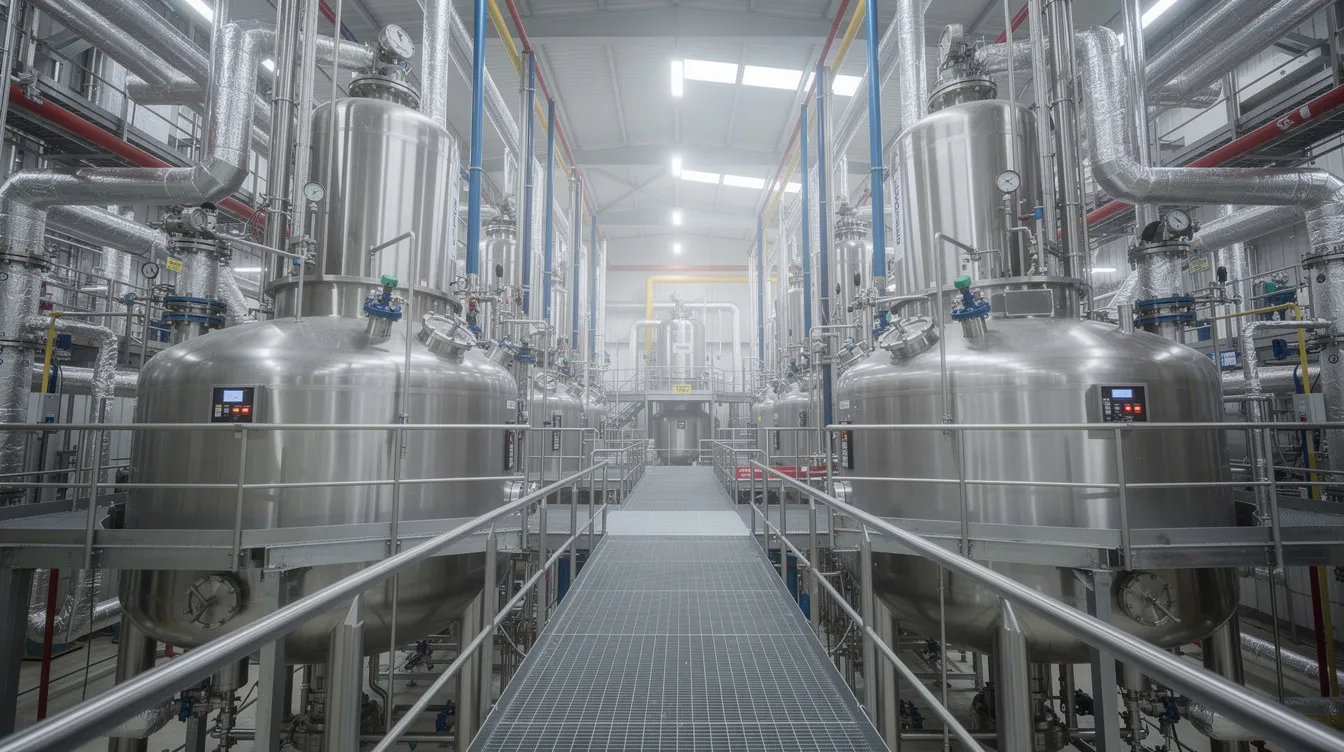
Small to medium by-product processing plants in India typically require 0.5 to 2 acres, depending on tank farm size and integration level. Main built-up components include the process building, tank farm, utility block (boiler, cooling tower, electrical room), laboratory, control room, ETP area and sludge handling zone.
Heat recovery systems improve energy efficiency in refineries and should be considered in utility design. Key utilities include steam (for heating to 90-95°C), electrical power for motors and instrumentation, process and cooling water, and compressed air for valve actuation. Acid-proof flooring, bund walls around acid and oil storage, and fire protection systems for flammable liquids are essential infrastructure. Plants attached to existing refineries can share certain utilities, altering both plant layout and project cost; the Edible Oil Refinery Utility Requirements article covers shared utility planning.
Edible Oil Refinery By-Products Processing Plant Project Cost in India
Edible oil refinery costs depend on plant capacity and oil type processed. Investment costs depend on capacity and technology used, ranging from basic soapstock acidulation to full fatty acid distillation.
Cost heads in a structured DPR:
- Land and site development
- Civil construction and structural works
- Plant and machinery (including taxes and transport)
- Erection, installation and commissioning
- Utilities (boiler, cooling, electrical)
- ETP and pollution control
- Laboratory and safety equipment
- Pre-operative and preliminary expenses
- Contingencies and escalation
- Interest During Construction (IDC)
- Working capital margin
A 35 TPD acid oil plant’s core equipment was listed at approximately ₹35 lakh by a Gujarat-based vendor. Total project cost (including civil works, utilities, ETP, tanks and installation) typically runs 3 to 5 times the equipment cost. Integrated installations within an existing edible oil refinery share land and utilities, reducing incremental cost. For broader refinery-level investment analysis, see Edible Oil Refinery Project Cost & Investment.
Raw Materials, Production Yield and Recovery Economics
Primary raw materials include soapstock from chemical refining of vegetable oils (soybean, sunflower, mustard, palm oil, cottonseed and others), deodorizer distillates from physical refining, and externally sourced acid oil for upgrading. Cottonseed contains 15% to 25% oil by weight. Mechanical screw oil pressing is a common extraction method at the oil mill stage, while solvent extraction can yield higher oil recovery than pressing; degumming removes phospholipids from crude oil during refining before it reaches the refinery where soapstock is generated. Deodorization removes odor compounds using steam distillation.
Illustrative material balance (soapstock acidulation):
- Input: 25 MT/day soapstock (assume ~70% moisture, ~20% soaps)
- Output: ~10-15 MT/day acid oil (yield varies 45-79% depending on feedstock)
- Effluent: aqueous phase with dissolved salts, residual acids
- Chemicals: sulphuric acid (~10-14% of soapstock), wash water, neutralising agents
A change of 10-15% in feedstock fatty acid content can shift acid oil output and daily revenue by a comparable proportion. Procurement pricing is typically linked to fat content relative to prevailing acid oil or refined oil prices. Long-term pricing mechanisms or indexation clauses reduce margin erosion.
Operating Cost, Revenue and Profitability
Operating costs are primarily driven by raw material consumption. Raw materials account for 85 to 90% of total operating expenses in oil and by-product manufacturing operations. Other cost heads include chemicals, utilities, manpower, maintenance, environmental compliance, insurance and administration. Operational costs must be tracked closely because the margin between feedstock purchase price and acid oil selling price is often narrow.
Revenue sources include sale of acid oil to soap and detergent manufacturers, sale of distilled fatty acids to oleochemical users, and possible recovery from spent earth or minor by-products.
Key formulas for project planning:
- Annual Production = Installed Capacity (TPD) x Operating Days x Capacity Utilisation x Saleable Recovery Factor
- Annual Revenue = Sum of (Product Quantity x Net Selling Price)
- EBITDA = Total Revenue minus Operating Expenditure (before depreciation, interest and tax)
Gross profit margins for edible oil plants range from 10 to 15%, and by-product processing margins fall in a similar band depending on scale and operational efficiency. Per-tonne contribution margin (selling price minus variable cost) is the clearest indicator of sensitivity to feedstock and product price movements. For integrated evaluation, the Edible Oil Refinery Feasibility Study & Profitability framework applies.
Financial Projections, CMA Data, DSCR and Bank Finance
Financial projections assess capital investment and operating costs against projected revenues to determine whether the project can service its debt and deliver returns. In my experience preparing DPRs for edible oil and oleochemical projects, lenders evaluate by-product processing proposals on the same rigour as any manufacturing term loan.
A bankable DPR includes: project cost and means of finance; projected profit and loss (7-10 years); projected balance sheet; cash flow statements; term loan repayment schedule; depreciation schedule; working capital assessment with holding norms; year-wise and average DSCR; break-even analysis; project IRR and equity IRR; NPV and payback period; and sensitivity analysis testing changes in soapstock price, acid oil price, chemical cost and operating days.
CMA Data summarises historical and projected financials in the format banks use for credit appraisal. Specific vulnerabilities of by-product processing projects include feedstock concentration risk, FFA-based product price volatility linked to primary edible oil market movements, and possible environmental compliance cost increases. The analytical approach at Edible Oil Refinery Financial Projections, CMA Data & DSCR applies equally to by-product recovery DPRs.
Market Demand and Commercial Applications
The edible oil market in India was 25.33 million tons in 2025, supporting a substantial downstream demand for acid oil and fatty acid products. Primary buyers include soap and detergent companies, oleochemical plants producing surfactants and intermediates, and certain industrial users. Regional clusters in Gujarat, Maharashtra, Andhra Pradesh and Tamil Nadu offer stronger business ecosystems with concentrated refinery and oleochemical capacity.
Acid oil and technical fatty acids are non-edible products. They should not be assumed fit for food or animal-feed applications without specific regulatory clearance. Some fractions may qualify for biodiesel feedstock under ISCC certification requirements, subject to traceability and quality compliance. Export demand for distilled fatty acids exists but promoters should validate trade dynamics and quality norms before including export revenue in financial projections.
Regulatory Approvals, Environmental Compliance and Risk Management
Indian by-product processing plants require State Pollution Control Board Consent to Establish (CTE) and Consent to Operate (CTO), factory licence under the Factories Act, fire NOC for flammable oil and acid storage, GST registration and building plan approvals. The Acid Oil (Quality Control) Order, 2022, amended with effect from 24 October 2024, regulates acid oil quality standards under BIS.
Environmental compliance includes on-site ETP for acid wastewater, safe handling and disposal of sludge under applicable hazardous waste rules, and stack emission controls for boilers.
Risk and mitigation framework:
| Risk | Mitigation |
|---|---|
| Feedstock supply variability | Multi-supplier agreements, buffer storage, quality testing |
| Yield underperformance | Conservative base-case assumptions, pilot trials, pre-treatment |
| Chemical price fluctuation | Supply contracts, escalation clauses, inventory management |
| Environmental non-compliance | ETP designed above minimum norms, early SPCB engagement |
| Product price volatility | Offtake agreements, customer diversification |
| Technology underperformance | Vendor performance guarantees, corrosion-resistant materials |
| Delayed statutory approvals | Early application, dedicated compliance budget |
| Working capital stress | Conservative utilisation ramp, contingency funding |
Physical refining reduces chemical usage and wastewater generation compared to chemical refining, which is relevant when choosing the upstream refining route that determines by-product profiles.
Financial Feasibility: Is a Soapstock and Fatty Acid Recovery Plant Profitable?
Profitability depends on consistent access to high-fat soapstock or distillate at a reasonable differential to market prices, strong downstream demand within economical transport radius, and efficient plant design that can optimize chemical and utility consumption.
Adverse scenarios include feedstock price spikes without matching product price increases, lower-than-expected yields from poor quality feedstock, and higher effluent treatment costs. Integrated units in large refineries enjoy captive feedstock and shared utilities, translating into better margins. Standalone units bear higher procurement and marketing risk but access multiple supply sources.
A comprehensive feasibility study should model base, optimistic and conservative scenarios for capacity utilisation, feedstock cost and selling price. DSCR-based assessment under each scenario, plus an IRR range rather than a single-point estimate, provides the foundation for an informed investment decision. While many Indian projects in this domain can achieve profitability and long term success, promoters should not rely on generic rules; a customised acid oil manufacturing plant project report or fatty acid recovery plant project report is the minimum standard before commitment.
How to Prepare a Bankable Detailed Project Report
A bankable DPR combines process technology description, plant capacity and layout, raw material availability assessment, product profile with quality specifications, machinery list with vendor quotations, project implementation schedule, project cost with all heads, means of finance, 7 to 10 year financial projections, IRR, NPV, DSCR, sensitivity analysis, regulatory compliance summary and risk mitigation.
A customised DPR uses project-specific feedstock, location, technology and financing assumptions. It reflects actual vendor quotations and realistic timelines, addressing bank queries and credit norms more effectively than generic downloadable reports. Engineers, promoters and financial advisors should collaborate to ensure that technical assumptions feed correctly into financial models.
Professional DPR and Project Finance Advisory
CA Manish Gugliya, FCA, DISA (ICAI) brings over 20 years of experience in industrial DPRs, project finance advisory and CMA Data preparation, with specific expertise in edible oil and agro-processing projects through Project Report Bank.
Services for soapstock processing, acid oil manufacturing and fatty acid recovery projects include customised DPRs tailored to capacity and technology, bank finance project reports, financial modelling with profitability and DSCR analysis, and feasibility studies covering sensitivity to many factors including feedstock price and yield. Clients planning investments typically from ₹1 crore upwards can reach out via the website’s WhatsApp contact facility with details on proposed capacity, location, estimated budget, existing refinery linkage and funding requirement. All work focuses on professional analysis and documentation; there is no assurance of loan sanction, subsidy approval or guaranteed returns.

Frequently Asked Questions
What is an edible oil refinery by-products processing plant?
It is a dedicated facility that processes soapstock, fatty acid distillates, gums and similar side streams from edible oil refineries into value-added products like acid oil and industrial fatty acids. Such plants may be attached to a single refinery or designed as standalone units sourcing feedstock from multiple refineries. The main objectives are value addition, reduction of effluent load, improved safety in waste handling and better overall refinery profitability.
How is acid oil manufactured from soapstock?
Soapstock is treated with mineral acid (typically sulphuric acid) in a process called acidulation. The acid splits sodium soaps into free fatty acids. The mixture is heated to 90-95°C with agitation, then allowed to settle or centrifuged to separate the acid oil phase from the aqueous phase. Conditions like acid dosage, temperature and reaction time must be optimised to balance oil yield, quality and chemical cost. The process generates acidic effluent requiring neutralisation and treatment before discharge.
What is the difference between soapstock, acid oil and PFAD?
Soapstock is a by-product of chemical refining, consisting of sodium soaps, neutral oil, water and impurities. Acid oil results from treating soapstock with acid to liberate free fatty acids; it is a non-edible fatty material used in soap and industrial applications. PFAD is obtained from palm oil physical refining and deodorization, containing a higher concentration of free fatty acids with fewer impurities; it is used as oleochemical feedstock and, where compliant, as a biodiesel feedstock.
How much does a soapstock acidulation plant cost in India?
Soapstock acidulation plant cost in India depends on capacity (10 to 50 TPD), automation level, ETP requirements, integration with an existing refinery and supplier selection. Core equipment for a 35 TPD unit has been listed at approximately ₹35 lakh by Indian vendors, but total project cost including tanks, utilities, civil works, ETP and working capital is typically 3 to 5 times the equipment cost. Each promoter must obtain vendor-specific quotations and prepare a customised project report to determine the accurate investment required for their specific business requirements.
Can banks finance an acid oil manufacturing plant?
Indian banks and financial institutions do finance technically and financially feasible by-products processing plants under term loan and working capital facilities. Banks evaluate promoter experience, DPR quality, realistic financial projections, DSCR under conservative scenarios, collateral and environmental compliance. A professionally prepared DPR with CMA Data and transparent assumptions improves the quality of the loan proposal. Actual sanction decisions rest with the lender and depend on their own appraisal and credit norms.