
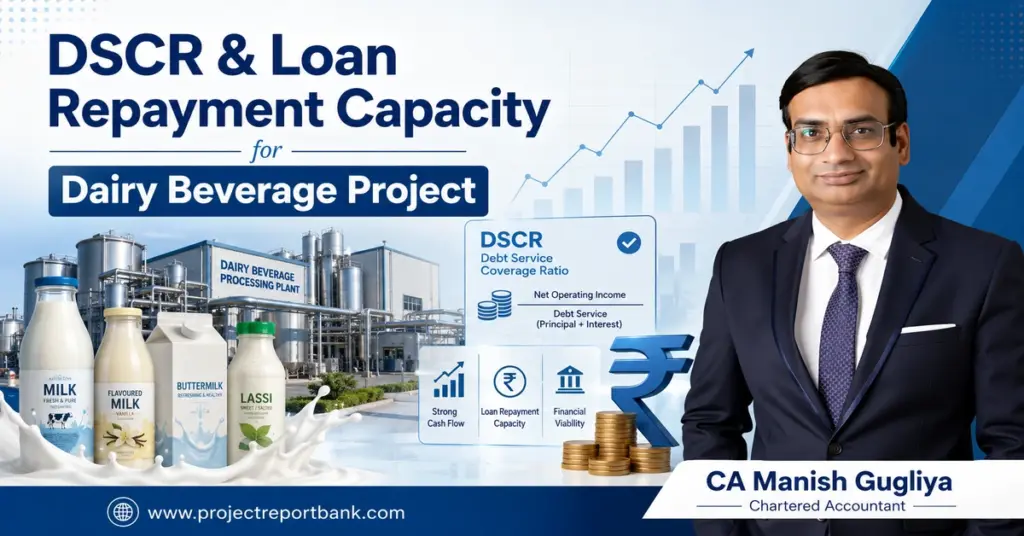
A dairy beverage plant may report accounting profit in its projected P&L and still miss term-loan instalments. The reason: profit on paper is not the same as cash in the bank. The Debt Service Coverage Ratio (DSCR) evaluates whether a dairy beverage project generates enough cash flow to pay its debt obligations, covering both interest and principal. This article explains how dairy beverage project DSCR is analysed, what drives it, where it breaks down, and how to structure projections that banks can appraise with confidence.
Key Takeaways
- Dairy beverage project DSCR measures whether projected cash accruals from the plant are adequate to service term-loan interest and principal on schedule.
- A dairy beverage project can be profitable on paper yet struggle with loan repayment if cash is locked in working capital, milk and packaging costs rise, or capacity utilisation is delayed.
- Banks examine year-wise DSCR, average DSCR, repayment structure, capacity ramp-up and working capital while assessing dairy beverage plant bank loan DSCR.
- Realistic financial projections, correct cash accrual calculation and appropriate term-loan structuring are critical for strong dairy beverage plant loan repayment capacity.
- This article is written by CA Manish Gugliya for promoters, bankers and consultants dealing with dairy beverage plant project finance.
Why DSCR Matters More Than Profit in a Dairy Beverage Project
Profitability alone does not determine whether a bank will finance a dairy beverage manufacturing plant. Lenders focus on dairy beverage project DSCR and actual cash flow available for term-loan servicing.
A dairy beverage plant can show accounting profit but still miss EMIs if cash accrual is weak. This happens when raw milk procurement prices spike mid-season, packaging material costs increase, or distributors delay payments beyond agreed credit terms. Capacity utilisation lagging at 40% in Year 1 instead of planned 60% lowers EBITDA and weakens DSCR in initial years. Aggressive repayment schedules with heavy instalments starting immediately after commissioning create repayment stress even in otherwise viable projects.
DSCR is one of the key ratios used by banks during dairy beverage project bank appraisal to judge whether projected cash generation will comfortably meet interest plus principal obligations.
What Is DSCR in a Dairy Beverage Project?
DSCR measures a project’s ability to cover its annual debt service from cash flows. It compares cash available for debt service with total debt service for a given year.
DSCR = Cash Available for Debt Service ÷ Total Debt Service
The exact computation format may vary between banks and appraisal models. Calculating DSCR involves assessing Cash Flow Available for Debt Service (CFADS) and debt service obligations.
Cash Available for Debt Service is generally derived from projected P&L: Profit After Tax + Depreciation ± other non-cash adjustments. Some bank formats add back interest on term loan to the numerator.
Total Debt Service includes scheduled term-loan principal instalments plus interest on the same term loan, and may also include servicing of other long-term borrowing.
Promoters should not rely on a single formula found online; they must align their DSCR presentation with their lender’s specific format while keeping the underlying logic consistent.
Why DSCR Is Important for Dairy Beverage Plant Bank Finance
Lenders check dairy beverage plant bank loan DSCR to judge adequacy of cash flows, repayment comfort and suitability of proposed repayment tenure and moratorium. Banks evaluate DSCR along with overall project risk, promoter contribution, security, government scheme benefits and industry conditions before sanctioning bank finance for a dairy beverage project.
Dairy-specific risks that affect DSCR include seasonal milk price variation, dependence on local milk collection networks from milk unions and cooperatives, cold chain expenses, high packaging cost (PET, glass, aseptic), and marketing and distribution spends. The perishable nature of flavoured milk, lassi and buttermilk creates expiry and return risk, which can compress margins and reduce dairy beverage project loan repayment capacity if not controlled.
DSCR helps lenders decide on term-loan quantum, moratorium length, instalment pattern (monthly or quarterly) and need for additional working capital limits.
How Cash Accruals Are Calculated for a Dairy Beverage Project
DSCR for a dairy beverage plant is driven by cash, not book profit. Revenue, EBITDA, Profit Before Tax, Profit After Tax and Cash Profit each represent different measures of financial performance. Here is a simplified framework:
| Step | Item |
|---|---|
| 1 | Revenue from milk sales and beverage sales |
| 2 | Less: Operating expenses (milk procurement, ingredients, packaging, utilities, salaries) |
| 3 | = EBITDA |
| 4 | Less: Depreciation |
| 5 | = EBIT |
| 6 | Less: Interest on term loan and working capital |
| 7 | = Profit Before Tax |
| 8 | Less: Tax |
| 9 | = Profit After Tax |
| 10 | Add back: Depreciation (non-cash charge) |
| 11 | = Indicative Cash Accrual |
Operating expenses must accurately reflect milk procurement costs and energy consumption in the dairy beverage sector. Banks may adjust further for non-cash provisions, extraordinary items and working capital changes while finalising dairy beverage project cash accruals for DSCR analysis.
Dairy Beverage Project Loan Repayment Capacity
Dairy beverage project loan repayment capacity is influenced by revenue, margins, fixed costs, working capital and tax outflows.
- Revenue generation: Realistic assumptions on product mix (flavoured milk, lassi, buttermilk, shakes), selling prices, volumes per SKU and channels (retail, institutional, HoReCa) are essential. Factors affecting revenue in dairy beverage projects include product mix, capacity utilisation and selling price.
- Contribution margin: Milk cost per litre, cream/skim adjustments, sugar, flavours, stabilisers, packaging and conversion costs determine gross margin for each beverage line.
- Capacity utilisation ramp-up: Should be staggered (50-60% in Year 1, gradually increasing) instead of assuming 100% from day one merely to improve projected DSCR.
- Working capital impact: Cash blocked in raw milk inventory, packaging stock, chilled finished goods and credit given to distributors reduces cash available for term loan servicing.
- Operating expenses: Salaries, power (including refrigeration load), steam and boiler fuel, water, CIP chemicals, maintenance, transport, marketing and administration must all be covered in projections.
- Tax and statutory dues: Income tax, GST cash outflows and compliance costs must be factored before arriving at final cash available for debt servicing.
Term Loan Repayment Structure for a Dairy Beverage Plant
DSCR is closely linked to how the term loan is structured. Dairy farm loans can range from ₹50,001 to ₹20 Lakh for smaller dairy farming operations, while larger dairy beverage manufacturing projects require substantially higher loan amounts tied to project cost.
Repayment tenures for dairy loans typically range from 1 to 7 years, and NABARD-linked dairy farming project loans have repayment tenures of 3 to 7 years. Flexible repayment options are available based on milk sales income, which is relevant for projects where revenue builds gradually. Kisan Credit Card loans can offer interest rates as low as 4%, though term loans for dairy beverage plants typically carry rates between 8% and 15% per year depending on borrower profile and bank policy.
The moratorium period should cover construction, installation, trial runs and initial market development. Too short a moratorium leads to low Year 1 DSCR; too long a moratorium increases interest cost. Instalment frequency (monthly vs quarterly) and structured or step-up instalments should be considered for projects where capacity utilisation ramps up gradually. The repayment schedule should be aligned with the projected cash accrual pattern.
Illustrative DSCR Calculation for a Dairy Beverage Project
All numbers below are purely illustrative and should not be treated as standard performance benchmarks for any bank finance for dairy beverage project.
Assume a dairy beverage plant with Year 3 cash accrual of ₹3.00 crore, term-loan interest of ₹0.80 crore and principal repayment of ₹1.20 crore:
DSCR = ₹3.00 crore ÷ (₹0.80 + ₹1.20) = ₹3.00 ÷ ₹2.00 = 1.50
This indicates a 50% cushion above scheduled debt service. The same project in Year 1 might show cash accrual of only ₹1.60 crore against total debt service of ₹1.50 crore, resulting in a DSCR of approximately 1.07, which offers limited repayment buffer.
Lenders look at year-wise DSCR as well as average DSCR over the loan tenure and may ask for restructuring of the repayment pattern if early-year DSCR appears too weak.
Average DSCR vs Year-Wise DSCR
Average DSCR is computed over the full projection period; year-wise DSCR focuses on each individual year’s ability to service debt. A project may show an average DSCR of 1.6 over seven years while Year 1 and Year 2 DSCR fall below 1.2 due to low initial capacity utilisation and market development expenses.
Banks study both because strong later-year DSCR does not compensate for inadequate coverage in the first few years when cash flows are uncertain. Promoters should verify that each year, especially initial years post-commissioning, shows reasonably comfortable dairy beverage project loan repayment capacity. In practice, lenders may fine-tune moratorium length, instalment amounts or tenure if early-year DSCR is particularly weak.
What Is a Good DSCR for a Dairy Beverage Project?
There is no single DSCR level that guarantees sanction for every dairy beverage plant bank loan. A typical DSCR for dairy beverage projects is between 1.25 and 1.50, based on common appraisal conventions. The NDDB working capital loan scheme for cooperatives and FPOs specifies DSCR of 1.25 or above.
What is considered comfortable depends on perceived project risk, stability of milk procurement, product mix, promoter track record, collateral, loan tenure and overall financial position. Promoters should discuss expected DSCR norms directly with their bank or financial consultant. Dairy beverage project DSCR must be seen alongside profitability, break-even, working capital, security coverage and overall creditworthiness.
Factors That Can Reduce DSCR in a Dairy Beverage Plant
Even well-designed projections can see DSCR fall if assumptions move adversely. Dairy beverage projects face fluctuating raw milk prices due to market volatility; a rise of even ₹2-3 per litre in procurement cost can reduce contribution margin for low-priced beverages like buttermilk and lassi. Given its capital-intensive nature, the dairy beverage sector’s operational metrics must account for volatile agricultural inputs.
Packaging cost escalation (PET bottles, glass, aseptic cartons, caps) is heavily commodity-linked. Lower capacity utilisation, where the plant runs at 50% instead of planned 75%, means fixed costs (salaries, utilities, depreciation) remain similar while EBITDA shrinks. Competitive pressure may reduce net realisation per litre. Interest rate increases raise debt service obligations and can lower DSCR. Delays in commercial production cause months of interest during construction with no revenue. High working capital blockage from longer credit to distributors and larger cold storage inventory weakens free cash for term loan servicing. Milk supply and consumer demand for dairy drinks can be seasonal, adding another layer of variability.
DSCR and Capacity Utilisation in Dairy Beverage Manufacturing
DSCR is very sensitive to how quickly a dairy beverage plant reaches stabilised capacity. Initial years of a dairy beverage project usually operate below full capacity due to ramp-up periods. A realistic ramp-up pattern for a mid-scale plant might be 50-60% utilisation in Year 1, 70-80% in Year 2 and 85-90% by Year 3.
Production planning must align with milk availability, product shelf-life, refrigeration capacity and market demand. Higher utilisation spreads fixed costs over more units, improving EBITDA margin and boosting dairy beverage plant cash flow for loan repayment. Banks examine capacity assumptions in the DPR, checking consistency with machinery capacity, number of shifts and market penetration strategy. Promoters should explore detailed guidance on dairy beverage plant capacity planning and product mix to align technical and financial assumptions.
DSCR and Product Mix in Dairy Beverage Manufacturing
Not all dairy beverages carry the same margin, shelf life or credit cycle. Higher-value products like protein beverages and functional dairy drinks may have better gross margins but higher marketing and R&D costs. Mass-market items like flavoured milk and lassi offer thinner margins per unit but higher volumes.
Aseptic long-life beverages reduce cold chain dependence but require higher initial machinery investment and packaging cost, affecting both project cost and DSCR profile. DPR and DSCR analysis should specify contribution margins and expected credit periods by major product category rather than relying on a single blended average.
DSCR and Working Capital Requirement
Many dairy beverage projects are profitable on paper but face repayment pressure because too much money is locked in inventories and receivables. The raw milk procurement cycle involves daily purchases against weekly or fortnightly payments, often through milk unions or cooperative arrangements. Buffer stock of ingredients, packaging materials and chilled finished goods ties up working capital. Distributor and institutional credit periods for modern trade, hotels and caterers can further delay cash realisation, weakening dairy beverage plant debt repayment ability.
Promoters should review detailed guidance on dairy beverage plant working capital requirement when preparing their business plan. Utilisation of cash credit or working capital limits affects interest cost and indirectly influences yearly DSCR.
DSCR and Financial Projections in a Dairy Beverage DPR
DSCR should be an outcome of an integrated DPR model, not a number calculated in isolation. DSCR computations for dairy projects often require careful cash flow modeling across consistent 5-7 year projections of Profit & Loss, Cash Flow Statement and Balance Sheet incorporating depreciation, interest, tax and working capital movements.
The term-loan amortisation schedule should be built into projections so that dairy beverage project term loan assessment reflects actual repayment obligations each year. Accurate revenue projections, cost assumptions and capital expenditure feed into dairy beverage plant financial projections for DPR and hence DSCR accuracy. Financial statements must be internally consistent for the income projection and DSCR to hold credibility.
DSCR, Profitability and Break-Even Analysis
Profitability, break-even and DSCR each answer different questions: profit tells how much surplus exists, break-even tells at what volume the plant stops losing money, and DSCR tells whether the project can repay debt on time. A plant can cross its accounting break-even yet still have tight DSCR if debt level is high, repayments are front-loaded or working capital remains heavily utilised.
A detailed dairy beverage plant profitability and break-even analysis supports DSCR evaluation by establishing the minimum viable operating threshold. While promoters often focus on net profit margin, lenders scan cash accrual trends and DSCR more closely for project finance decisions.
Project Cost and Means of Finance Affect DSCR
A dairy beverage project involves capital expenditure for facilities producing milk-based drinks, and how this investment is financed directly shapes DSCR. Key project cost components include land development, buildings, processing and packaging machinery, utilities (boilers, chilling, refrigeration), civil works, pre-operative expenses and contingency provisions. A dairy beverage project requires significant investments in processing machinery and cold-chain logistics.
Means of finance typically include promoter equity (around 25-35%), term loan (60-65%) and working capital margin. A higher debt component in a dairy beverage project’s capital structure increases debt service obligations and can reduce DSCR. Increasing term-loan quantum simply to reduce promoter contribution can raise annual debt service to uncomfortable levels. A detailed breakdown is available in the discussion on dairy beverage plant project cost and means of finance.
Revenue Model and Its Impact on Repayment Capacity
The revenue model determines both margins and cash cycle, influencing dairy beverage project loan repayment analysis. Channels include general trade distributors, modern retail, HoReCa, institutional catering, private label contracts and direct distribution. Each carries different gross margin, credit period and logistics cost.
Trade margins, schemes, free stock and promotional allowances must be backed out from invoice price to derive true net realisation per unit. Channels with higher margins may involve higher marketing costs, while institutional sales may offer lower margins but greater volume stability. The revenue model and market strategy for dairy beverages explains these dynamics in detail.
Machinery Investment and Debt Servicing
Choice of machinery and automation level directly affects project cost, depreciation and required loan size, thereby shaping DSCR outcomes. Dairy processing machinery requires regular maintenance to meet food safety guidelines, and this maintenance cost along with depreciation must be accounted for in DSCR calculations. Power consumption, technical manpower and expected equipment life feed into the DPR’s operating expense and depreciation assumptions.
Machinery selection should be balanced to meet medium-term demand without over-investment that leads to under-utilisation and weak early-year DSCR. Detailed cost references are available in the guide on dairy beverage plant machinery and equipment cost.
Manufacturing Process and Operating Cash Flow
The technical manufacturing process creates the pattern of operating costs that shapes cash flows and DSCR. Key steps include raw milk reception and chilling, standardisation, homogenisation and heat treatment, blending with ingredients, filling, packaging and cold storage. Process losses from cream separation, spillage, product returns and batch rejections must be realistically factored into material consumption assumptions.
Regulatory compliance is essential for food safety in dairy processing before products can be distributed commercially; FSSAI licensing, pollution control and effluent treatment add both cost and time. Process choices (UHT vs pasteurised chilled products) affect utility loads, shelf life and working capital cycle. The dairy beverage manufacturing process and production line resource covers these technical details.
Initial Investment and Plant Setup Cost
Realistic estimation of initial investment is the foundation for any dairy beverage project DSCR study. For a 10,000 LPD flavoured milk plant, project cost excluding land typically falls in the ₹3-6 crore range; for a 20,000 LPD plant with moderate automation, approximately ₹10-12 crore including basic working capital. Promoters should factor in statutory approvals, FSSAI compliance, effluent treatment and initial branding expenses. Detailed cost heads for various scales are covered in the resource on dairy-based beverage manufacturing plant setup cost in India.
Cold Chain and Its Effect on Cash Flows
Chilled dairy beverages need a reliable cold chain with both capital cost (cold rooms, chillers, reefer vehicles) and recurring cost (electricity, maintenance, diesel). Investing in adequate cold storage reduces product spoilage and returns but increases fixed costs, influencing DSCR especially in low-utilisation years. Poor cold chain management leads to high product expiries, write-offs and brand damage, quickly eroding dairy beverage plant loan repayment capacity. Detailed guidance on financial impact is available in the discussion on cold storage and cold chain requirements for dairy beverages.
DSCR Sensitivity Analysis for Dairy Beverage Projects
Sensitivity analysis tests how DSCR behaves if key assumptions change. Scenarios to model include lower sales volume, slower market acceptance, milk procurement price increases, packaging cost escalation and utility tariff hikes. Financial sensitivities such as higher interest rates, change in repayment tenure or rescheduling of moratorium alter annual debt service amounts. Changes in receivable period, inventory days and payable terms to farmers affect working capital and therefore DSCR indirectly.
Promoters should prepare at least three scenarios (base case, conservative case, adverse case) in the DPR to understand the robustness of dairy beverage project debt servicing capacity.
Common Mistakes While Calculating DSCR
- Using accounting profit (PAT) instead of cash accrual (PAT + depreciation) while computing DSCR, thereby understating cash coverage.
- Forgetting to include principal instalments or using only interest in total debt service, which artificially inflates DSCR.
- Inconsistent interest treatment: adding back interest in cash accrual but not including full interest in total debt service.
- Unrealistic capacity utilisation and selling price assumptions used merely to improve DSCR.
- Under-estimating raw milk, packaging, logistics or marketing costs.
- Focusing only on average DSCR while ignoring weak individual years.
- Manual tweaking of numbers to achieve a target DSCR reduces credibility during bank appraisal.
How Banks Assess Dairy Beverage Project Repayment Capacity
Dairy beverage project DSCR is one part of a broader credit appraisal. Financial institutions evaluate promoter background, technical feasibility, raw material availability, market potential, competition, and regulatory environment. Financial parameters include project cost, means of finance, profitability projections, working capital assessment, DSCR, break-even analysis, security cover and sensitivity analysis results.
Lenders often require compliance with DSCR covenants during financing agreements for dairy projects. They review borrower’s existing banking conduct; a CIBIL score of 650 or above is preferred for loans. Indian citizenship and residency are required for loan applicants. Minimum age for dairy farm loan applicants is usually 18 or 21, and applicants typically need 6 months to 2 years of dairy farming experience.
For smaller dairy farming operations, dairy farm loans can fund purchasing cows or buffaloes, with loan amounts under MUDRA ranging from ₹50,001 to ₹5 Lakh and the maximum loan under MUDRA’s Tarun Plus being ₹20 Lakh. No collateral is required for MUDRA’s Shishu and Kishore tiers. Some dairy farm loans are available without collateral requirements. Commercial banks, national bank linkages and RBI priority sector lending guidelines shape eligibility criteria and interest subvention under various government schemes supporting rural development, animal husbandry, agriculture, fisheries and poultry activities alongside dairy farming.
Acceptable DSCR enhances comfort but does not by itself guarantee sanction; overall risk assessment, collateral, bank statements review, address proof verification, KYC documents, required documents and policy alignment determine the final decision. The dairy farm loan online application process at many commercial banks now allows borrowers to initiate the process digitally, though physical verification of land, animals, equipment such as milking machines, cattle feed arrangements, shed construction and assets created remains part of the appraisal.
Role of DPR in Assessing DSCR and Loan Repayment
A well-prepared Detailed Project Report acts as the primary document through which banks understand a dairy beverage project. The logical flow within a DPR runs from technical assumptions to capacity and product mix, then to sales projections, operating costs, profitability, cash accruals, debt servicing, and finally DSCR and repayment schedule.
If any link in this chain is weak or inconsistent, the DSCR calculation loses reliability even if mathematically correct. The DPR should transparently disclose key assumptions, provide clear workings and reconcile DSCR numbers with projected P&L and cash flow statements. Professional DPR preparation helps ensure a bankable structure and coherent plan for companies seeking funds and government support through various schemes implemented for dairy processing and technology adoption.
How CA Manish Gugliya Can Assist with Dairy Beverage Project DSCR and DPR
I have been involved in DPR preparation, CMA data, financial projections and project finance advisory for manufacturing and MSME projects, including dairy beverage plants. Services I can assist with include:
- Detailed Project Report preparation and project cost estimation
- Structuring means of finance and evaluating loan size and repayment terms
- Financial projections, cash flow projections and DSCR analysis
- Term-loan repayment schedules and break-even analysis
- Working capital assessment and CMA Data preparation
- MSME loan documentation and project feasibility analysis for bank finance
Projections and DSCR assessments are prepared based on assumptions and information shared by the promoter. They are analytical tools and not certification or guarantee of future performance. Promoters and consultants can reach out through www.projectreportbank.com for professional assistance.
Conclusion
The central question for any dairy beverage plant is not whether it will be profitable, but whether it will generate sufficient, timely cash accruals to meet interest and principal obligations over the loan tenure. Realistic project cost, balanced means of finance, achievable capacity utilisation, sound product mix, disciplined working capital management and a properly structured repayment schedule together determine dairy beverage project DSCR.
Promoters should treat DSCR as a planning and risk-management tool, using it to test financial robustness under various scenarios rather than as a cosmetic number for loan applications. Entrepreneurs and existing dairy businesses planning a dairy beverage manufacturing plant can seek professional support from CA Manish Gugliya via ProjectReportBank.com for DPR preparation, financial projections, DSCR analysis and bank-oriented term-loan structuring.
FAQs on DSCR and Loan Repayment Capacity for Dairy Beverage Projects
What is DSCR in a dairy beverage project and why is it important?
DSCR (Debt Service Coverage Ratio) measures cash available for servicing term-loan interest and principal compared to total annual debt service. Banks use it to gauge whether the plant’s projected cash generation is adequate for timely repayment. A project with DSCR below 1.0 cannot cover its debt obligations from operating cash flows; most lenders expect a reasonable cushion above 1.0.
How do I calculate DSCR for my dairy beverage plant in practice?
Prepare projected P&L and cash flow statements. Compute cash accrual by adding depreciation (and other non-cash items) back to Profit After Tax. Determine annual interest plus principal instalments from the term-loan amortisation schedule. Divide cash available for debt service by total debt service for each project year. Confirm the format with your lender, as banks may prescribe specific adjustments.
Why can a profitable dairy beverage plant still face repayment problems?
High working capital blockage in inventories and receivables, unexpected increases in milk or packaging costs, lower-than-planned capacity utilisation, and aggressive repayment schedules can all create cash shortages despite reported accounting profits. The business activity may generate income on an accrual basis while actual cash collection lags behind.
Does a higher DSCR guarantee that the bank will sanction my term loan?
A strong DSCR improves comfort but does not guarantee approval. Banks also evaluate promoter profile, security and collateral, project feasibility, market risk, existing liabilities and compliance history. Lenders check multiple parameters across the borrower’s documents, approved credit policies and broader lending environment before taking a credit decision.
Should I focus on average DSCR or year-wise DSCR when planning my loan?
Both matter. Year-wise DSCR identifies specific years, especially initial years after commissioning, where coverage might be weak. A strong average can mask one or two years where repayment capacity is inadequate. The repayment structure should ideally be aligned with projected year-wise cash flows so that no single year faces undue strain. Essential cookies of good DPR practice include testing each year individually rather than relying on averages alone.