
Key Takeaways
- A dairy beverage bottling plant is not just a bottle filling machine – it is an integrated system linking processed product, hygienic liquid filling, packaging material selection, cold chain and project finance.
- Packaging choice (PET, glass, cup, pouch, carton) directly influences production capacity, machine capacity, filling technology, automation grade, milk bottling plant cost, working capital and long term operational performance.
- There is no single “best packaging for dairy beverages.” PET vs glass vs cup vs pouch must be evaluated against product type (flavored milk, milkshake, protein drink), shelf-life target, distribution radius and brand positioning.
- Promoters should integrate packaging system decisions into the Detailed Project Report (DPR), bank finance planning, DSCR assessment and overall dairy-based beverage manufacturing plant setup cost in India.
- Serious entrepreneurs should obtain a structured dairy beverage bottling plant DPR from a professional consultant before committing to any filling line or dairy beverage packaging equipment purchase.
What Is a Dairy Beverage Bottling Plant?
A dairy beverage bottling plant is a complete industrial system converting processed flavored milk, milkshake, chocolate milk and protein drinks into market-ready PET, glass, cup or pouch packs. The primary goals of such a facility include product safety and extended shelf life. Beverage bottling plants handle various beverage types efficiently, and the layout should minimize cross-contamination and ensure a smooth workflow from reception to dispatch.
The typical industrial sequence runs as follows: processed beverage in balance tank → buffer/storage tank → product transfer through sanitary pipelines → container preparation (bottle blowing or receiving) → bottle rinsing or sterilization → dairy beverage filling machine → capping or sealing → batch coding → labeling → bottle inspection → secondary packaging (shrink wrapping, carton packing, crates) → cold storage → refrigerated or ambient dispatch. A typical dairy beverage process includes steps from raw milk reception to cold storage and distribution.
A modern dairy bottling line integrates CIP system, stainless steel product-contact surfaces, automation controls (semi automatic or fully automatic), and online quality checks to ensure hygienic filling and consistent production capacity. Line design differs for cold-fill vs ESL vs aseptic dairy beverage packaging systems, and packaging decisions must align with upstream processing as explained in the dairy beverage manufacturing process and production line.
Packaging Options Available for Dairy Beverages
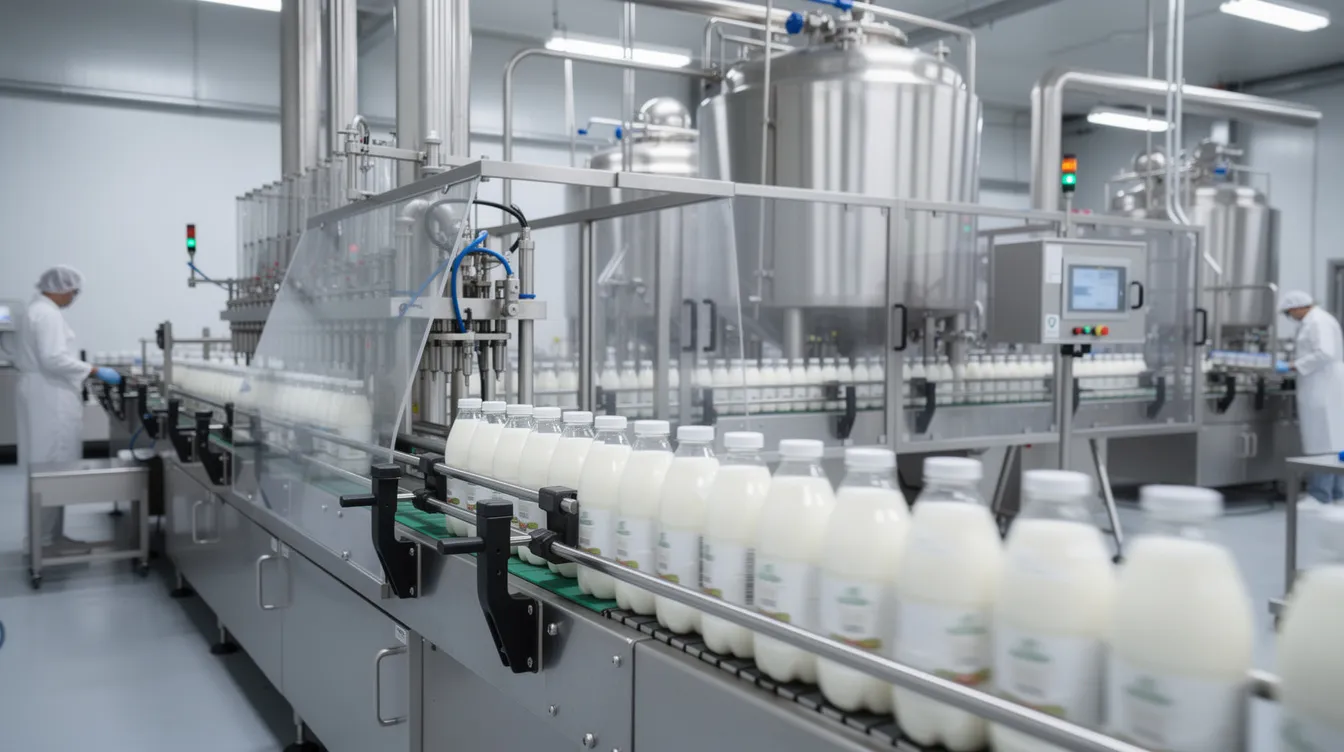
Packaging options must be derived from beverage formulation, homogenization and heat treatment, desired shelf life, cold chain capability, logistics model and target consumer segment. Packaging material choices can impact product shelf life and distribution strategy significantly.
- PET bottles – widely used for flavored milk and milkshake PET bottle filling machine lines
- Glass bottles – premium and traditional markets
- HDPE bottles – standard milk bottling plant formats
- PP / thermoformed cups – lassi, yoghurt drinks, small RTD portions
- Flexible pouches – standard milk, some value-added beverages
- Stand-up pouches – niche flavored milk or protein drink SKUs
- Cartons / aseptic packs – long-shelf-life distribution without continuous cold chain
Each format has implications on machine types (bottle filling machine vs milk pouch packaging machine vs automatic cup filling sealing machine), automation grade, and dairy packaging machinery cost in India.
PET Bottle Packaging for Dairy Beverages
PET bottle packaging is a popular choice for flavored milk, cold coffee, milkshake and RTD dairy drinks in India. Automatic milk filling machines can handle 50 to 300ml containers, and PET systems offer lightweight containers, design flexibility, transparency for product visibility, good branding area with sleeve labeling machine applications, multiple closure options including induction sealing, and easy integration into automatic dairy beverage filling line automation. Beverage bottling plants use food-grade materials for safety standards across all PET applications.
Limitations include sensitivity to high temperatures (narrow window unless specially designed), light and oxygen transmission challenges for chocolate milk, storage condition sensitivity, and evolving recycling and EPR regulations in India. PET milk bottling plant promoters must decide between in-house PET bottle blowing machine vs buying ready-made bottles – this decision strongly affects dairy packaging line investment and working capital for preforms.
Machinery Required for PET Bottling
A complete PET bottling line requires: PET bottle blowing machine (if produced in-house), bottle unscrambler, air conveyor system, PET bottle rinsing filling capping machine, optional sterilization (chemical or UV) for ultra-clean filling, gravity or volumetric liquid filling machine, automatic capping machine, labeling machine or sleeve labeling machine, inkjet coding machine for batch coding, inspection conveyor, shrink wrapping machine, and carton packing. These plants are designed for high-speed operations and product safety.
The trade-off between buying ready bottles vs installing in-house blowing is significant: higher initial dairy beverage plant machinery and equipment cost but lower long-term packaging cost per bottle. Automation grade should match scale – up to 1,500–2,000 bottles/hour suits semi automatic modules; above that, fully automatic lines provide better filling accuracy and efficiency.
Glass Bottle Packaging for Dairy Beverages
Milk bottling in glass bottles is regaining interest in India for premium segments, café chains and traditional brands. Benefits include premium appearance, excellent barrier against oxygen and light (advantageous for chocolate milk), rigidity for high filling accuracy, and suitability for returnable systems. Glass bottle filling machines ensure drip-free filling of milk.
Challenges include higher weight leading to greater freight and handling cost, breakage risk during transport, requirement of bottle washing lines for returnables (adding water, caustic and energy use), and higher secondary packaging investment. Lenders evaluating glass bottle projects scrutinize working capital tied up in reusable bottle inventory and crates.
Machinery for Glass Bottle Filling
A glass bottle dairy beverage filling line includes: automatic bottle washer (for returnables), bottle inspection system, rinser, glass bottle milk filling machine with hygienic stainless steel valves, crown corker or ROPP capper, sealing integrity check, labeling station, coding system, and crate or carton packing station. Returnable glass adds complexity – bottle segregation, crate handling conveyors, and deposit record-keeping. According to TERI’s LCA study, returnable glass bottles with five reuse cycles show 70–75% reduction in global warming potential versus single-use glass.
PET vs Glass Bottles for Dairy Beverages
PET vs glass milk packaging is one of the most frequent queries in dairy beverage projects. The correct answer depends on product type, target consumer, distribution distance, sustainability positioning and project size.
| Parameter | PET Bottle | Glass Bottle | Cup | Pouch |
|---|---|---|---|---|
| Packaging cost per unit | Lower | Higher (single-use) | Medium | Lowest |
| Machinery requirement | Moderate | Higher (washers) | Moderate | Lower |
| Product visibility | High | High | Limited | Low |
| Weight | Light | Heavy | Light | Very light |
| Breakage risk | Negligible | Significant | Low | Leakage risk |
| Logistics cost | Lower | Higher | Medium | Lowest |
| Branding opportunity | Strong (sleeves) | Premium image | Moderate | Limited |
| Filling speed | High | Moderate | Medium | High |
| Secondary packaging | Shrink wrap/carton | Crates/cartons | Trays | Crates |
| Typical suitability | Mass RTD, flavored milk | Premium, café | Single-serve | Price-sensitive |
Working capital differs: PET plants tie up capital in preforms, bottles and caps, while glass plants also lock capital in crates and reusable bottle inventory with damage and pilferage assumptions built into DPR projections.
Cup Filling and Sealing Systems
Cup-based dairy beverage container packaging suits lassi, chaas, yoghurt drinks and small-portion flavored milk in 100–200 ml PP or thermoformed cups. Lines typically use preformed cups fed automatically, followed by volumetric liquid filling, foil placement, heat sealing, optional snap-on lids, date coding and secondary packaging. They ensure hygienic handling and precise filling of liquids. Cup systems often work well as an add-on line in a multi-product plant.
Pouch Packaging for Dairy Beverages
Standard milk pouch applications differ from value-added dairy drink pouches. Automatic four head milk filling machines can fill 3000 pouches per hour, making pouch packaging system for milk beverages a high-throughput, cost-effective option. Key equipment includes automatic milk pouch packing machine, milk pouch filling and sealing machine, and liquid milk pouch filling machine for higher viscosity products.
Advantages include very low packaging material cost, compact logistics and simple automatic liquid dairy packaging line configurations. Limitations include weaker shelf display, lower perceived premium value, potential leakage issues, and handling challenges versus rigid bottles. DPRs must capture film cost volatility, reel MOQs and film storage requirements in working capital assessment.
Aseptic Packaging vs Refrigerated Packaging
Refrigerated dairy beverage filling requires cold chain from plant to consumer with shorter shelf life. ESL processing uses higher heat treatment – HTST pasteurization heats milk to at least 72°C for 15 seconds to ensure safety, while ESL typically reaches 120–135°C for 1–4 seconds. Pasteurization is a critical step to destroy harmful microorganisms in dairy products. Homogenization prevents cream from rising to the top of milk by breaking down fat globules before thermal processing. Aseptic filling occurs in a sterile environment to maintain product integrity, allowing ambient storage for several months.
Shelf life depends on the complete system: formulation, heat treatment, microbiological control, packaging barrier, hygienic filling design and storage temperature. Dairy beverage plants utilize various technologies for filtration, standardization, and thermal processing. For most start-up flavored milk plants, refrigerated distribution using PET, glass or cups is more realistic, while large RTD projects may evaluate aseptic systems like Amul’s GEA blow-fill PET line achieving 30,000–36,000 bottles per hour.
Filling Technologies and Major Machinery
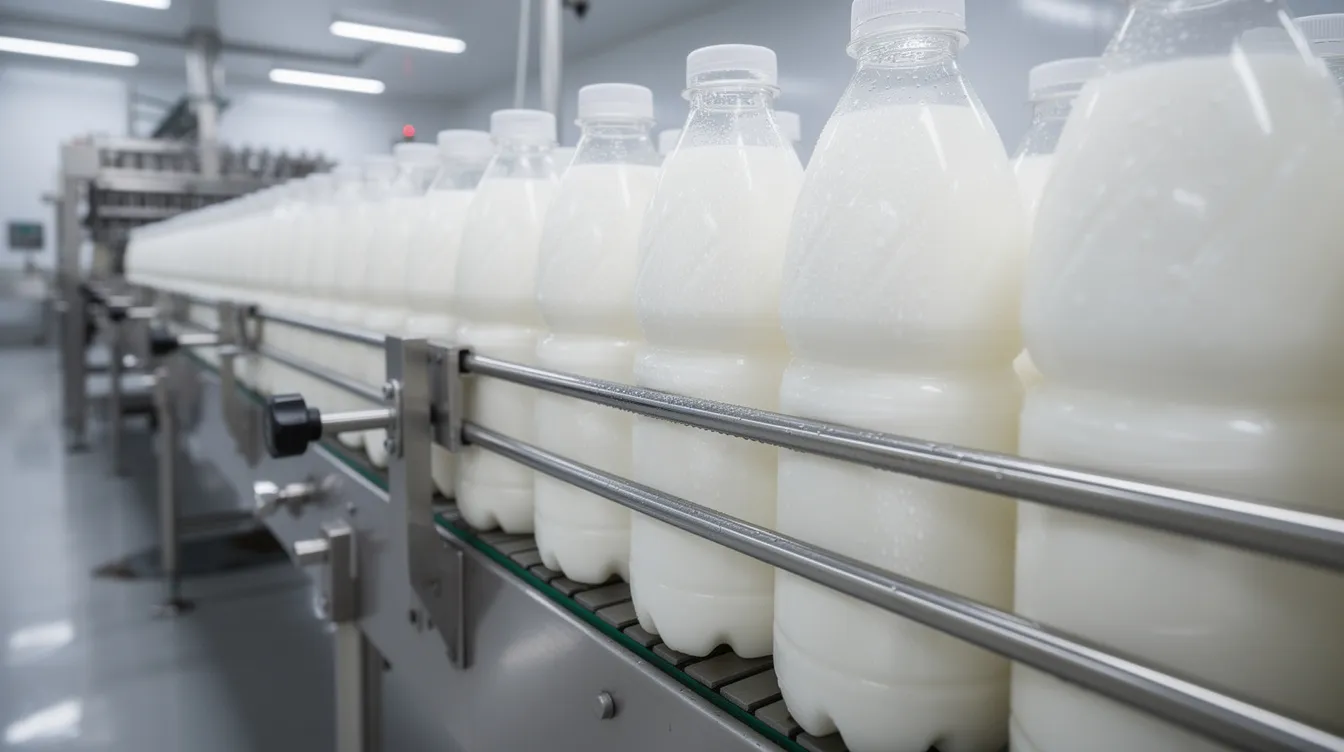
Selecting the right filling machine depends on beverage viscosity, particulates, filling temperature and microbiological risk. Common technologies include gravity filling (free-flowing flavored milk), volumetric filling (thicker milkshakes), flow-meter filling (flexible multi-product lines) and piston filling (viscous or pulpy dairy beverages). Flavored milk filling machines operate at 30 BPM as a typical benchmark. Milk filling machines can be semi-automatic or fully automatic depending on scale. Beverage bottling plants support both small and large-scale production needs.
| Machine | Function | Main Selection Parameter |
|---|---|---|
| Bottle blowing machine | Converts PET preforms to bottles | Bottle sizes, production capacity |
| Bottle unscrambler | Orients loose bottles for line feeding | Speed, different bottle sizes |
| Rinser/sterilizer | Cleans containers before filling | Hygiene level, filling type |
| Filling machine | Doses product into containers | Viscosity, filling capacity, accuracy |
| Capping machine | Applies and secures closures | Closure type, speed |
| Labeling machine | Applies labels or sleeves | Label type, bottle shape |
| Coding machine | Prints batch/date codes | Legibility, speed |
| Shrink wrapper | Bundles bottles for transport | Pack configuration |
| CIP system | Automates cleaning without disassembly | Line complexity, product mix |
Automatic vs Semi-Automatic Bottling Plant
The choice between semi automatic and fully automatic configurations affects project cost, production capacity, manpower and payback. Semi automatic lines suit lower volumes (up to 1,000–1,500 bottles/hour) with flexible product experiments but are more labour-intensive. Fully automatic lines with integrated bottle washing filling capping machine monoblocks suit plants targeting 3,000–12,000+ bottles/hour with better filling accuracy. Utilizing automation in dairy processing can enhance efficiency and product traceability. DPRs should include scenario analysis comparing both approaches for long term operational performance.
Capacity Planning, Pack Sizes and Material Cost
Production capacity planning must be expressed as bottles per hour and matched across filler, capper, labeler and shrink wrapper – the slowest machine defines practical line output. Raw milk is tested for quality, temperature, and antibiotic residues upon arrival, and upstream processing capacity must feed the bottling line without bottlenecks.
Packaging size (180 ml to 1 litre) affects bottle moulds, label design, SKU complexity and production scheduling. Mould cost for PET and tooling for glass should be separate line items in project cost. Avoid excessive SKU proliferation at startup – plan a core mix covering 70–80% of expected demand.
In many dairy beverage projects, packaging material cost per litre can equal or exceed the cost of raw milk, sugar and flavour combined. Promoters should calculate packaging cost both per litre and per retail unit, include loss factors (wastage, misprints, breakage), and stress-test with ±10–15% sensitivity on PET or film prices.
Dairy Beverage Bottling Plant Cost in India
There is no universal number for milk bottling plant setup cost. Dairy plants require significant energy and water for operations, influencing design and equipment choices. Utilities such as chilled water, steam, and compressed air are critical to dairy bottling operations.
Major cost heads include:
- Land and civil construction
- Processing equipment (tanks, mixers, pasteurizers)
- Filling and packaging machinery
- Utilities (boiler, chiller, compressor, DG set)
- CIP system, laboratory, cold storage
- Electrical installation, project engineering
- Pre-operative expenses and initial working capital
For reference, an integrated dairy plant of 1,00,000 LPD capacity costs approximately ₹35–60 crore excluding land, while Amul’s aseptic PET expansion of 1 million bottles/day required approximately ₹200 crore. A basic automatic filler-labeler unit of 5,000–6,000 BPH may cost around ₹7–8 lakh, though complete bottling halls with all modules run into multiple crores. These figures are indicative and depend on capacity, automation, supplier and location. Explore detailed breakdowns in our guide on dairy-based beverage manufacturing plant setup cost in India.
Working Capital and Profitability
Packaging format has a direct and often underestimated impact on working capital requirements. PET systems require preforms, caps and labels. Glass systems additionally lock capital in reusable bottles and crates. Pouch systems need printed films in larger MOQs. The lowest packaging cost per unit does not automatically deliver the highest profitability – contribution per litre and market positioning matter more.
Premium packaging (glass or high-quality PET with sleeve labels) can support higher MRP and gross margin for products like those covered in a protein and functional dairy beverages manufacturing plant project report, while pouches may be necessary for mass-market price points.
Packaging by Product Type
| Product | Possible Formats | Key Considerations |
|---|---|---|
| Flavored milk | PET, glass, pouch, cup | PET dominates mass-market; glass for premium brands |
| Chocolate milk | PET (UV-sleeve), glass, carton | Light/oxygen barrier critical for cocoa solids |
| Milkshake | PET (wide-neck), cup | Volumetric/piston fillers for viscosity |
| Protein beverage | PET (200–330 ml), glass | Premium positioning, nutrient protection |
| RTD dairy drink | PET, cup, pouch, carton | Distribution model drives format selection |
For product-specific guidance, refer to the flavoured milk manufacturing plant project report, milkshake manufacturing plant project report, or ready-to-drink dairy beverages manufacturing plant project report.
Food Safety, QC and Hygiene
All dairy beverage packaging systems must comply with food-contact material regulations. Smooth, non-porous surfaces in facilities help prevent bacterial contamination in dairy plants. Dairy beverages must often comply with strict food safety standards like the FDA Pasteurized Milk Ordinance. Regulatory compliance is essential in dairy bottling for maintaining food safety standards. CIP systems automate the sanitation of dairy processing equipment without disassembly.
Quality control in dairy plants includes checks for fill levels, capping integrity, and labeling accuracy. Additional QC parameters cover cap torque, seal integrity, leakage tests, microbiological sampling and shelf-life testing with retained control samples.
Sustainability and Packaging Selection Framework
Recyclable PET, reusable glass, lightweight pouches and recycled-content materials all have trade-offs depending on local collection infrastructure. Consider full life-cycle impact, local waste management and consumer perception rather than relying on material claims alone.
To select the right system, work through: product formulation → processing method → required shelf life → storage temperature → target market → selling price → distribution distance → pack size → plant capacity → investment budget → packaging material availability → automation level → working capital → brand positioning → future scalability. Model at least two alternative configurations in your DPR before final commitment.
DPR Perspective – CA Manish Gugliya
In my experience preparing and analysing dairy beverage bottling plant DPRs for bank finance and investors, packaging is never a purely technical decision. A robust DPR should quantify planned plant capacity in litres per hour and bottles per hour, product mix, packaging mix, detailed machinery list with quotations, total project cost and means of finance.
Financial projections must integrate packaging assumptions – material cost per unit, wastage, working-capital cycles, selling prices for different SKUs, operating cost, profitability, break-even analysis and DSCR over the loan tenure. Banks scrutinize whether automation grade and machine capacity align with projected sales and promoter experience. Treat packaging selection as a core part of project economics and seek professional help for DPR, CMA data and financial structuring before approaching lenders.
Common Mistakes While Planning a Dairy Bottling Line
- Finalizing filler specifications before locking product formulation and bottle type
- Ignoring preform/bottle procurement lead times and MOQs
- Mismatching filler capacity with labeler or shrink wrapper speed
- Installing too many SKUs causing frequent changeovers and lower line efficiency
- Insufficient cold storage space and inadequate CIP capacity
- Cramped bottling hall leaving no room for future expansion
- Focusing only on machinery purchase price without evaluating lifecycle cost, warranty, spare parts and impact on operating margin
Frequently Asked Questions
What is the minimum practical capacity for a new dairy beverage bottling plant?
While very small semi automatic lines of a few hundred litres per day are technically possible, commercial viability and bank finance typically become realistic when daily output reaches several thousand bottles. Minimum capacity depends on local market size, product mix, MRP and margin. Promoters should undertake a structured demand assessment as part of a professionally prepared DPR before finalizing machine capacity.
Can one plant handle both PET and glass bottles for dairy beverages?
Technically yes, if line design allows for appropriate conveyors, rinsing, filling and capping solutions for both formats. However, this increases machinery cost and complexity. Either separate lines or carefully designed change-parts are needed. Banks will examine whether the additional investment is economically justified through realistic sales projections for each format.
How long does it typically take to commission a dairy beverage bottling line?
Under Indian conditions, typical timelines from finalizing machinery orders to commercial production range from 6 to 12 months, depending on civil works readiness, supplier lead times, import content and regulatory approvals. Key stages include design, civil and utility work, machine manufacturing and dispatch, installation, commissioning, trial runs, product stability testing and market launch. Include realistic timelines and contingency in the DPR to avoid underestimating interest during construction.
How do packaging choices influence bankability of a dairy beverage project?
Banks assess whether selected packaging systems align with target market, pricing and distribution. An over-engineered aseptic line for a small local chilled market may raise concerns about demand risk. Lenders look for coherent linkage between project cost, operating cost including packaging, projected sales, working capital, profitability and DSCR. Packaging assumptions should be clearly justified in the DPR with vendor quotations and sensitivity analysis on material prices to build confidence with term-loan appraising officers.
What approvals are needed for dairy beverage packaging machinery in India?
The overall dairy beverage plant must meet FSSAI registration or licensing requirements, local pollution-control norms, factory and boiler regulations, and electrical safety standards. Packaging materials must comply with food-contact regulations and relevant BIS/ISO standards. Some institutional customers may require additional certifications such as HACCP, ISO 22000 or FSSC 22000. Consult local regulatory experts and keep machine material certificates and test reports ready for inspections.