
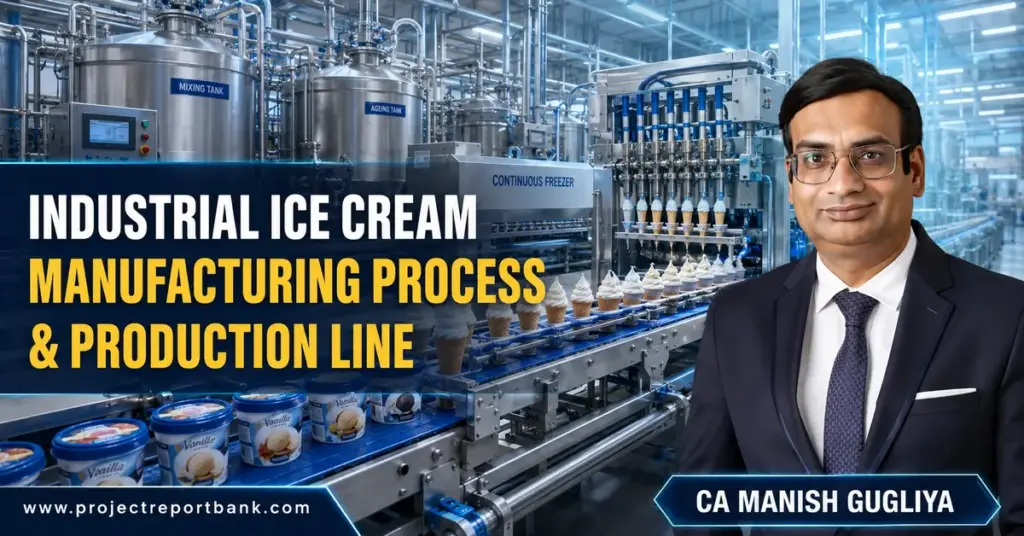
Key Takeaways
- An industrial ice cream production line is a fully integrated system covering mix preparation, pasteurisation, homogenisation, ageing, continuous freezing, filling, hardening, frozen storage and dispatch – not just a single machine.
- Plant profitability in India depends on correctly sizing and balancing every stage of the line (pasteuriser, aging tanks, continuous freezers, hardening tunnels, cold store, packaging), not only on the headline capacity of one machine.
- Different product formats (cups, cones, sticks, tubs, extruded novelties) require different forming, filling and packaging equipment, even when they share the same ice cream mix and continuous freezing section.
- Food safety, CIP cleaning, FSSAI-compliant processing and uninterrupted cold-chain management are central design requirements for any industrial ice cream processing plant.
- From a DPR and project-finance perspective, production-line choices – batch vs continuous, manual vs automatic, hardening technology, utilities, refrigeration – directly affect project cost, operating margins, working capital and bankability.
Introduction: Why Process Engineering Matters in Industrial Ice Cream Plants
Modern ice cream in India is produced in fully engineered, hygienic industrial plants – not small parlours. The industrial ice cream manufacturing process is a coordinated sequence: raw milk and cream handling, ice cream mix standardisation, heat treatment and homogenisation, controlled ageing, dynamic continuous freezing with air incorporation, forming and filling, rapid hardening, frozen storage and cold-chain dispatch. Industrial manufacturing of ice cream combines dairy science, thermodynamics and fluid mechanics into a single production system.
In Indian conditions – strong seasonality, high ambient temperatures and power variability – the design of the ice cream production line and refrigeration system is critical for both quality and financial viability. This article, written from the professional perspective of CA Manish Gugliya with over 20 years of experience advising on DPRs and project finance for industrial food and dairy plants, is aimed at entrepreneurs, dairy companies and investors planning medium- to large-scale industrial ice cream processing plants in India.
What Is an Industrial Ice Cream Production Line?
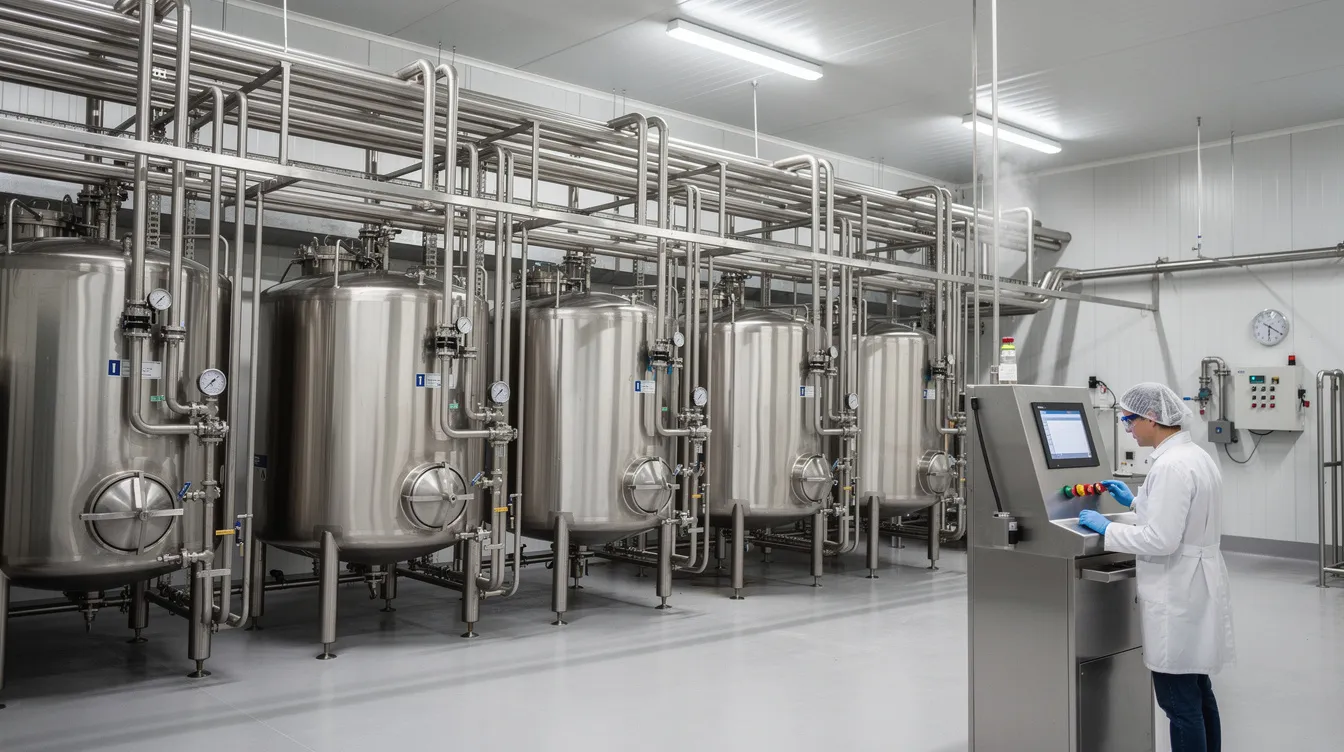
An industrial ice cream production line is a continuous or semi-continuous, integrated system of industrial ice cream equipment that takes ice cream ingredients from reception through to packed, hardened ice cream ready for dispatch. Industrial ice cream manufacturing utilises continuous systems for cost-effective production and efficiency, achieving high throughput and strict quality control through automation.
This contrasts sharply with small-batch or parlour production – where a batch freezer, manual filling and limited volumes dominate – or artisan kitchen production focused on craft rather than throughput. An industrial line links mix preparation, pasteurisation, homogenisation, ageing, continuous freezers, fruit feeders, filling and extrusion lines, hardening tunnels, cold storage and material-handling systems into one coordinated process. PLC/SCADA controls, sensors and recipe management maintain consistent overrun, fill weights, temperatures and traceability across large daily volumes.
Such a line is normally designed for specific hourly capacities (for example, 500–2,000 litres of mix per hour) and must be balanced so that no single stage becomes a chronic bottleneck.
Industrial Ice Cream Manufacturing Process Flow Chart
Raw-material reception → Ingredient weighing and standardisation → Ingredient mixing and blending → Mix filtration → Pasteurisation → Homogenisation → Cooling → Ageing → Continuous freezing and air incorporation → Flavour and inclusion addition → Filling, moulding or extrusion → Primary packaging → Hardening → Secondary packaging → Frozen storage → Dispatch
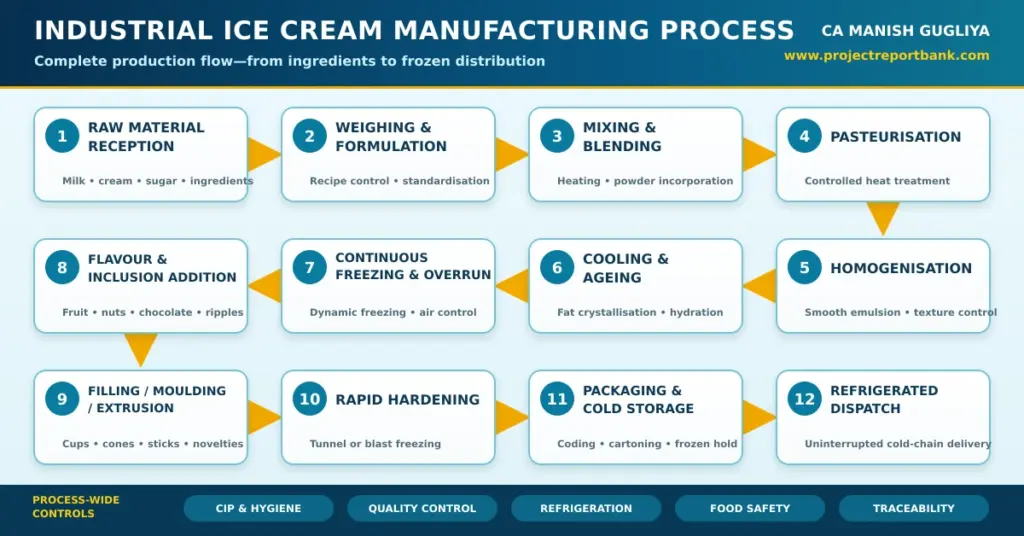
This is the typical ice cream manufacturing process flow chart used in industrial ice cream processing plants. The typical industrial process involves multiple stages including mixing, pasteurization, homogenization and freezing. The exact sequence may change depending on product type, packaging format, plant capacity, degree of automation and whether dairy or non-dairy mixes are used. In a fully automatic ice cream production line, most of these stages are linked by automated conveyors, pipeline transfers and synchronised controls rather than manual handling. Flavoring and coloring may be added to the ice cream mix just before freezing.
Raw-Material Reception and Storage
Bulk milk and cream arrive in insulated tankers, undergo QC testing and are pumped into chilled storage silos. Skimmed milk powder, sugar, glucose syrup and stabiliser–emulsifier blends are stored in dry, humidity-controlled rooms. Raw ingredients for ice cream include milk, cream, sugar, milk solids, stabilizers and emulsifiers – and ingredient selection is crucial for ice cream quality.
Key ice cream ingredients handled at this stage include whole milk, cream, skim milk powder, milk powder, sugar, corn syrup, permitted vegetable fat, stabilisers (such as guar gum), emulsifiers, flavours, colours, fruit preparations, chocolate, nuts and other inclusions. Segregated storage for allergens (nuts, soy, egg), proper labelling, batch identification and FIFO inventory control are essential for food safety and traceability. Typical infrastructure includes chilled raw-milk and cream tanks, insulated sugar and fat storage, dry-ingredient racks, and cold rooms for fruit preparations. There must be clear separation between raw-material areas and pasteurised product zones.
Ice Cream Mix Formulation and Standardisation
Ice cream mix formulation balances fat, milk solids-not-fat, sugar, total solids, water, stabilisers, emulsifiers and flavours to achieve the desired texture, sweetness, melting behaviour and cost target. Ice cream typically contains 10–16% milk fat, and under FSSAI composition standards, full-fat ice cream requires minimum 10% milk fat and 36% total solids. Standard ice cream also requires at least 1.6 pounds of food solids per gallon. Stabilizers and emulsifiers are essential for ice cream texture – they control body, melt resistance and air-cell stability.
Industrial plants in India may run multiple formulations: standard economy, premium, sugar-reduced and non-dairy variants. Ingredient preparation ensures accurate formulation of the ice cream mix before production. Mix standardisation involves calculating proportions of milk, cream, skim milk powder, sugar and fat so that legal standards and brand claims are met. Formulation software or ERP-linked recipe management minimises weighing errors and ensures consistency.
Ingredient Mixing and Blending
Water, milk and cream are pumped into a jacketed stainless-steel mixing tank. Dry ingredients – sugar, milk powder, stabiliser and emulsifier blends – are incorporated using powder induction or high-shear mixing to avoid lumps. The controlled sequence dissolves sugars and milk solids first, then adds stabiliser–emulsifier blends at appropriate temperatures for correct hydration.
Proper continuous agitation, heating and circulation through filters ensure a smooth, homogeneous mixture prior to heat treatment. Transfer pumps, balance tanks and inline filters feed the pasteuriser with a continuous supply of liquid ingredients matched to downstream capacity.
Pasteurisation and Homogenisation of the Ice Cream Mix
Both stages are critical for food safety, product stability and texture in any commercial ice cream manufacturing process. Indian plants must comply with FSSAI and applicable dairy-processing norms.
Ice Cream Mix Pasteurisation Process
Proper pasteurization eliminates pathogenic microorganisms. Pasteurisation also hydrates stabilisers, dissolves sugars and milk solids, and improves ice cream mix structure and creaminess. Pasteurization heats the mix to 83–85 °C in many industrial systems.
Two main systems are used:
- A batch pasteuriser (jacketed tank with agitation) holds the mix at 68.3°C for 30 minutes – suitable for lower capacities or multiple small recipes.
- High-Temperature Short-Time (HTST) pasteurisation heats the hot mix to 79.4°C for 25 seconds using a plate heat exchanger for higher throughput.
Temperature recording, holding-time control and automatic diversion valves form part of the plant’s HACCP critical control points. Actual settings must follow validated processes, equipment design and regulatory approvals.
Ice Cream Homogenisation Process
A high-pressure homogeniser reduces fat globules to a much smaller, more uniform size – typically 2 to 10 microns – improving emulsion stability and texture. The homogenization process uses high pressure to achieve a stable emulsion in ice cream, with homogenization pressure ranging from 172 to 200 bar. Homogenization typically occurs at 63°C to 77°C.
One-stage homogenisation primarily reduces globule size, while two-stage homogenisation breaks up fat-globule clusters for improved stability. Homogenisation is usually performed on the hot mix, immediately after or during pasteurisation. Inadequate homogenisation causes fat separation, poor whipping and inconsistent overrun. Homogenization prevents fat separation during aging and freezing – it effectively prevents fat separation throughout downstream processing.
Cooling and Ageing of the Ice Cream Mix
Immediately after pasteurisation and homogenisation, the mix is rapidly cooled through the plate heat exchanger and transferred to insulated aging tanks at chilled temperatures. Aging typically lasts 3 to 12 hours at 5°C. During aging, stabilizers hydrate and milk fat crystallizes. Aging improves viscosity and structure of the ice cream mix and is essential for achieving a smooth texture in ice cream. Ice cream mix is typically aged for 3 to 12 hours.
Aging tanks are equipped with slow-speed agitators and external cooling jackets, and must be designed for easy CIP cleaning. Total ageing-tank volume must support peak continuous freezer demand over the intended number of shifts, or the ageing stage will restrict daily output.
Continuous Freezing, Overrun Control and Inclusion Addition
This stage is the heart of the industrial ice cream manufacturing process. The chilled mix enters a continuous freezer, is rapidly cooled on refrigerated barrel surfaces while being scraped and whipped – a process called dynamic freezing that incorporates air into the ice cream mixture, enhancing its texture. Freezing occurs between -3°C and -6°C during production. The aged ice cream mix is quickly frozen to enhance the ice cream’s structure and texture.
Overrun refers to the amount of air incorporated into ice cream, affecting its texture and volume – it is called overrun because it measures the percentage increase in volume over the original mix. Continuous freezing incorporates air, increasing overrun by 80–100%. This air incorporation directly affects density, yield, mouthfeel and cost per litre. The freezing process affects the quality, palatability and yield of ice cream.
Illustrative example: A continuous freezer rated at 1,000 LPH mix with 80% overrun yields approximately 1,800 litres per hour of finished product (1,000 × 1.80). If filling machines only handle 1,200 L/h, the freezer is under-utilised.
Overrun control methods include controlled air valves, flow meters, back-pressure control and regular sampling of unit weights. Solid inclusions like chocolate chips and fruit can be added to semi-frozen ice cream before packaging – a fruit feeder, nut feeder or ripple pump is typically mounted downstream of the continuous freezer to gently add inclusions, ensuring they are evenly distributed without damage.
Continuous Freezers and Fruit/Nut Feeders
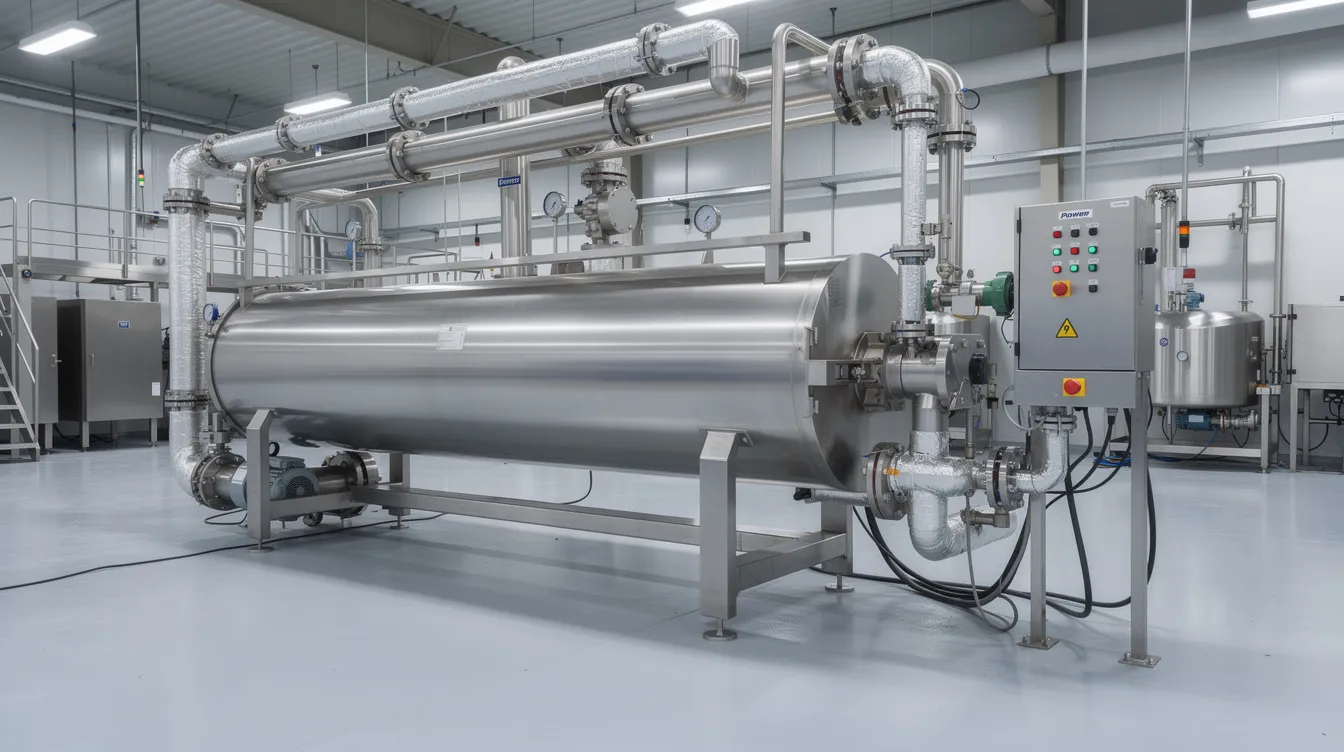
Continuous freezers are high-capacity machines designed for continuous freezing, equipped with refrigeration, scraper blades and controls for viscosity and overrun. Indian manufacturers offer units from 100 to 2,000 LPH capacity. Each freezer’s rated capacity must be coordinated with ageing-tank volume, ingredient feeders and filling-line speeds. Frequent flavour changeovers require CIP or semi-CIP systems and careful allergen control between nut and non-nut products. According to ASHRAE reference data, a continuous freezer processing 1,000 L/h of a typical mix requires approximately 31.3 kW of refrigeration capacity.
Product-Specific Forming, Filling and Packaging Lines
After continuous freezing, the semi-frozen ice cream goes to different forming or filling systems depending on the final product. All formats may share the same upstream mix and continuous freezers but require different dedicated downstream equipment and packaging materials.
| Product Format | Main Equipment | Packaging | Automation Level | Key Consideration |
|---|---|---|---|---|
| Cups and tubs | Volumetric/weight filler | Paper/plastic cups, lids | Medium to high | Fill-weight accuracy |
| Cones | Cone dispenser, filler, wrapper | Waffle cones, sleeves | High | Cone breakage, moisture |
| Sticks/moulded | Moulding and filling system | Wrappers, flow-pack | High | Mould design, coating control |
| Extruded bars | Extrusion line, cutter | Flow-wrap | Very high | Synchronisation, speed |
| Sandwiches/novelties | Assembly line, slab depositor | Flow-wrap, cartons | Very high | Multi-component alignment |
Cups and Tubs
Cup and tub filling machines receive ice cream from continuous freezers and perform volumetric or weight-based dosing into cups or family packs. Operations include de-stacking, filling, lidding, heat sealing, coding and discharge to hardening. Ice cream is packaged in single-service containers for retail. Packaging protects ice cream from contamination and moisture loss, and must allow for easy opening and reclosure.
Cones
Dry waffle cones are de-stacked, optionally pre-coated internally with chocolate, filled with ice cream, topped and closed with a lid or wrapper. Cone breakage, chocolate-coating set time and protection from moisture migration are key concerns.
Sticks and Moulded Products
Stick lines use moulding and filling systems: liquid mix is dosed into cold moulds, pre-frozen, sticks are inserted, then moulds are further frozen. Demoulding uses warm brine or air, followed by optional chocolate or compound coating, nut sprinkling and high-speed wrapping. These lines can be capital-intensive but deliver very high throughput.
Extruded Ice Cream Products
Ice cream extrusion lines continuously extrude semi-frozen ice cream onto a conveyor, where it is cut into bars or shapes, combined with sticks, biscuits or coatings. Extruded novelties require high automation and accurate synchronisation and often need more sophisticated industrial ice cream manufacturing technology.
Ice Cream Sandwiches and Novelty Products
Sandwich lines deposit ice cream slabs between biscuits or wafers, followed by cutting, wrapping and cartoning. Multi-packs of ice cream are commonly packaged in polythene bags. Novelty lines increase product differentiation but complicate scheduling, allergen control and cleaning.

Hardening Process: From Semi-Frozen to Stable Product
Immediately after filling, ice cream must be rapidly frozen to create small ice crystals for a smooth texture. Ice cream is rapidly frozen in hardening tunnels to stabilise its microstructure. Rapid hardening occurs at -30°C to -40°C. Ice cream hardening occurs at temperatures of -18°C or lower for the final product, while hardened ice cream is stored at -20°C to -40°C during the hardening process. Hardening time typically lasts about 12 hours for optimal results.
Slow hardening promotes large ice crystal formation, affecting texture – rapid hardening prevents large ice crystals from forming. Industrial solutions include blast freezers, spiral hardening tunnels and in-line hardeners linked to stick or extrusion lines. Inadequate hardening capacity is one of the most frequent bottlenecks in growing factories, even when continuous freezers and filling lines have been upgraded. Bulk ice cream is often packaged in fiberboard cartons before entering hardening.
Secondary Packaging, Frozen Storage and Dispatch
After primary packaging, individual units are collated into cartons, case-packed and palletised for transfer to frozen storage. Metal detection, checkweighing and coding provide final quality and food safety assurance. Cold storage maintains ice cream at sub-zero temperatures to preserve its quality during distribution. Cold-chain management continues through refrigerated vehicles and distributor cold rooms – temperature fluctuations during transit cause heat shock, recrystallisation and texture damage to the final product. Maintaining the shelf life of the finished product depends on an unbroken cold chain from factory to retail.
Machinery Required for an Industrial Ice Cream Production Line
| Process Stage | Principal Machinery | Purpose | Key Selection Factor |
|---|---|---|---|
| Raw-material storage | Milk silos, cream tanks, dry stores | Temperature-controlled storage | Capacity, insulation, CIP |
| Mixing | Powder induction system, blending tank | Dissolve and blend ice cream ingredients | High-shear capability, heating |
| Filtration | Inline filters | Remove undissolved particles | Mesh size, cleanability |
| Pasteurisation | Batch pasteuriser or HTST system | Heat treatment for food safety | Throughput, HACCP controls |
| Homogenisation | High-pressure homogeniser | Reduce fat globules, stabilise emulsion | Pressure range, flow rate |
| Cooling | Plate heat exchanger | Rapid cooling post-pasteurisation | Thermal efficiency |
| Ageing | Insulated aging tanks | Fat crystallisation, hydration | Volume, agitation, CIP |
| Freezing | Continuous freezer | Freeze mix, incorporate air | LPH capacity, overrun control |
| Inclusions | Fruit feeder, ripple pump | Add nuts, chocolate, sauces | Dosing accuracy, gentle handling |
| Filling | Cup, cone, tub, stick-mould fillers | Form and fill product | Format, speed, weight control |
| Hardening | Hardening tunnel, blast freezer | Rapid freezing to stabilise product | Temperature, residence time |
| Packaging | Wrapping, cartoning machines | Primary and secondary packing | Speed, format flexibility |
| Cleaning | CIP system | Hygienic cleaning of all equipment | Chemical compatibility, automation |
| Refrigeration | Compressors, condensers, evaporators | Central cooling for full line | Total kW load, redundancy |
| Cold storage | Insulated rooms, racking | Frozen storage before dispatch | Volume, temperature control |
For detailed guidance on how to estimate and compare automatic ice cream plant machinery and equipment cost, entrepreneurs should obtain multiple supplier quotations aligned with their specific capacity and product-format requirements.
Batch, Semi-Automatic and Fully Automatic Production Lines
| Parameter | Batch System | Semi-Automatic | Fully Automatic |
|---|---|---|---|
| Suitable scale | Small to medium | Medium | Medium to large |
| Capital investment | Lower | Moderate | Higher |
| Labour requirement | High | Moderate | Lower |
| Process consistency | Variable | Good | Excellent |
| Flexibility | High (frequent changeovers) | Moderate | Lower |
| Traceability | Manual records | Partial digital | Integrated PLC/SCADA |
| Expansion potential | Limited | Moderate | High |
| Typical limitation | Throughput ceiling | Packaging bottleneck | High initial CAPEX |
Maximum automation is not automatically the best choice. The correct system depends on capacity, product mix, packaging complexity, market demand and available capital. A batch system may still use industrial ice cream equipment such as a batch pasteuriser and batch freezer, but is more suited to high product variety with frequent changes.
Production Capacity and Line Balancing
Capacity may be expressed in litres of mix per hour, litres of finished ice cream per hour, pieces per hour or tonnes per day – none of these alone gives the full picture without considering density, overrun, pack size and operating efficiency.
Line balancing means matching capacities of pasteurisation, ageing, continuous freezing, inclusion feeding, filling, hardening and frozen storage. Ice cream production line capacity in litres per hour is meaningful only when every downstream stage can handle the output. Typical design decisions include providing extra ageing capacity for peak-season production or adding a second filler before adding another freezer. Realistic capacity planning directly affects DPR projections and lender confidence. Industrial ice cream production achieves high throughput and strict quality control through automation – but only when the line is properly balanced.
Product Mix and Changeover Planning
Many Indian ice cream production plants manufacture multiple product types – small impulse packs, cones, family packs, bulk tubs for catering, sticks and sandwiches – from the same base mix or variants. Grouping similar flavours and pack sizes reduces cleaning and format changeover time. The impact of changeovers on productivity includes time for allergen cleaning, mould changes, packaging-material changeovers and labelling adjustments. Additional cold-store SKUs and packaging stock increase working capital but may be justified by higher margins on uniform ice cream products.
Utilities, Refrigeration and Cold-Chain Requirements
Key utilities for an industrial ice cream plant include:
- Electrical power and backup (DG sets)
- Refrigeration plant (the single most critical utility, serving mix cooling, continuous freezers, hardening tunnels and frozen storage)
- Chilled water, process water, hot water and steam
- Compressed air (dry, oil-free for pneumatic valves and fillers)
- CIP chemicals, drainage and effluent treatment
Refrigeration is a core production utility – not merely a cold-storage requirement. Peak refrigeration load during simultaneous freezing and hardening must be planned against Indian power tariffs and ambient conditions. Energy-efficient systems and adequate insulation standards are essential for long-term operating efficiency. The complete solutions for utilities must be sized during DPR preparation, not retrofitted after commissioning.
CIP Cleaning Systems and Hygienic Plant Design
CIP (cleaning-in-place) systems clean tanks, pipelines, pasteurisers, homogenisers and continuous freezers without disassembly. Key elements of hygienic design include smooth stainless-steel surfaces, proper slopes and drainability, avoidance of dead legs in piping, separation between raw and pasteurised zones, and controlled personnel movement. Allergen segregation strategies – dedicated lines for nut products or validated cleaning protocols – are critical when producing multiple SKUs. Effective CIP reduces microbial risks, supports HACCP implementation and improves food-safety audit performance.
Quality Control, Food Safety and Regulatory Compliance
Ice cream production involves quality control measures to monitor critical parameters during manufacturing. Key checks include:
- Raw-material inspection and mix composition (fat, solids, sugar)
- Pasteurisation parameter verification and homogenisation performance
- Ageing conditions, viscosity and overrun measurement
- Fill weights, core temperatures, microbiological testing
- Packaging-seal integrity, sensory evaluation and shelf-life studies
Indian regulatory requirements include FSSAI standards for ice cream and frozen desserts, GMP, and HACCP-oriented food safety management systems. Robust food-safety systems are especially important when the plant handles allergens. Process quality control supports brand reputation, modern-trade access and lender confidence.
Automation, Sensors and Production Monitoring
PLC and SCADA systems automate and monitor pasteurisation temperatures, homogeniser pressures, flow rates, freezer performance, overrun, filling weights and hardening tunnel temperatures. Digital recipe management and batch tracking maintain consistency and traceability. Automation reduces human error, improves yield and supports predictive maintenance – but the automation level should be selected considering operator skill availability and service support in the Indian context.
Plant Layout and Material Flow
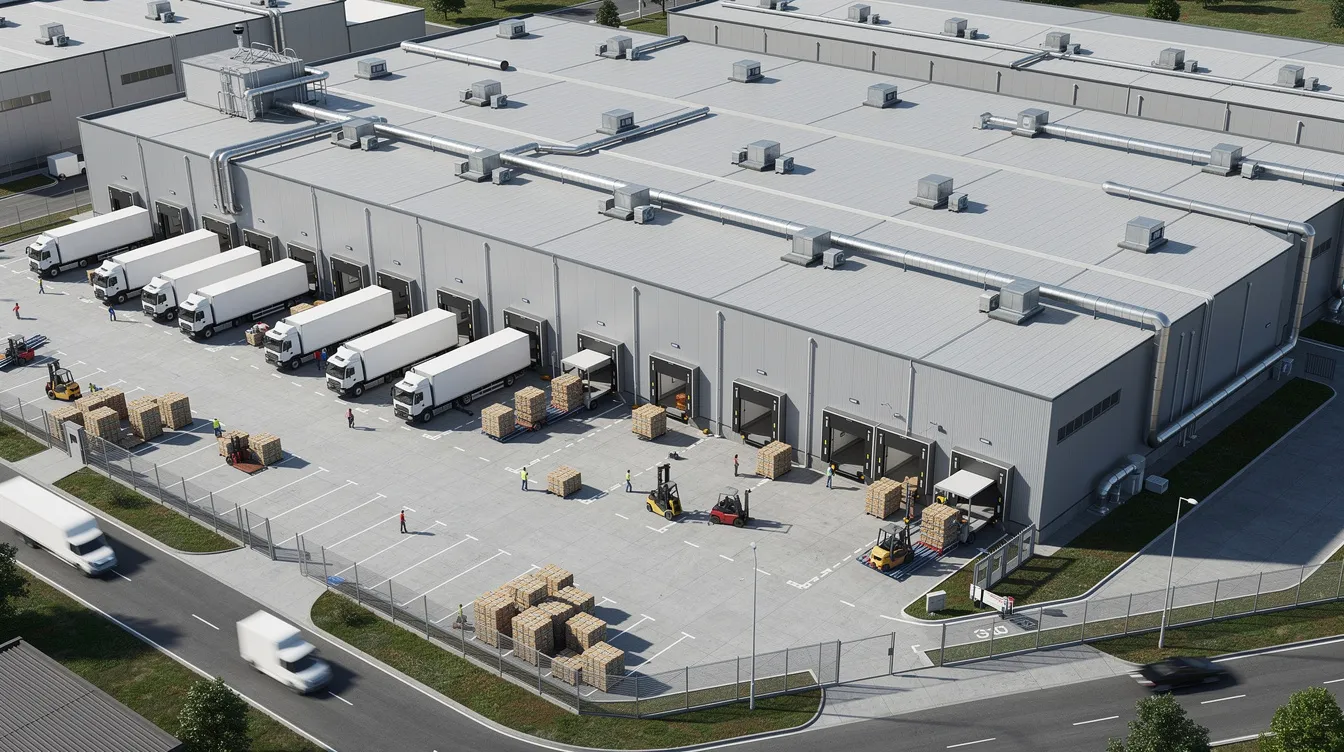
A logical, hygienic layout separates raw-material reception, dry-ingredient stores, mix-processing room, ageing section, freezing and filling area, hardening zone, packaging area, cold store, utility block, laboratory and staff amenities. One-way product flow from raw to finished goods with minimal cross-traffic and proper hygienic zoning is essential.
For detailed guidance on infrastructure planning, building specifications and overall project-cost estimation, refer to our resource on industrial ice cream plant setup cost in India. Common layout mistakes include crossing paths for raw milk products and finished products, and insufficient ceiling heights for hardening tunnels.
Yield Losses, Waste Management and Effluent
Common loss points include product left in pipelines during changeovers, start-up and shutdown losses, overfill and underfill corrections, rejects from packaging defects, and product lost during power failures. Good design – shorter product lines, product recovery systems, better overrun and weight control – reduces losses. Wastewater from CIP, floor washing and condensate requires effluent-treatment plants meeting local discharge standards. Accurate measurement of losses is vital for realistic DPR assumptions and margin calculations.
Common Production Bottlenecks and How to Avoid Them
| Bottleneck | Preventive Measure |
|---|---|
| Insufficient ageing capacity | Size aging tanks for peak-season demand plus buffer |
| Freezer–filler mismatch | Match filler speed to freezer output before purchasing |
| Limited hardening capacity | Invest in adequate hardening tunnel or spiral freezer from the outset |
| Undersized cold store | Plan cold-store volume for peak inventory including freezing time buffers |
| Frequent changeovers | Group similar flavours and formats, optimise scheduling |
| Poor CIP design | Eliminate dead legs, automate cleaning cycles |
| Manual material movement | Use conveyors and pallet systems for packaging lines |
| Inadequate maintenance | Implement preventive-maintenance schedules for all ice cream processing equipment |
Identifying potential bottlenecks early in project design allows more accurate capacity planning and better long-term returns.
Factors Affecting Production-Line Cost and Investment
Main cost drivers include installed capacity (litres per hour), number and type of filling or moulding lines, level of automation, imported versus Indian-manufactured machinery, refrigeration and hardening technology, CIP sophistication and cold-storage scale. Building and infrastructure – civil works, insulation, floors, utilities, effluent treatment – can account for a large share of total project cost.
There is no single standard figure for complete ice cream production line cost. Reliable estimates require actual supplier quotations, layout drawings and utility assumptions. Entrepreneurs should consult specialists and use detailed financial models when planning capital expenditure for a turnkey ice cream manufacturing plant.
Financial and DPR Perspective by CA Manish Gugliya
As a practising Chartered Accountant and DPR specialist, I view the industrial ice cream manufacturing process primarily through its impact on project viability. Choices such as batch versus continuous systems, level of automation, number of product formats and size of cold storage directly affect fixed capital investment, capacity utilisation, labour cost, energy cost and working-capital requirements.
A bankable DPR must reconcile technical capacity – litres of mix per hour, shifts per day, operating days per year – with realistic sales forecasts, seasonal demand, distribution reach and pricing assumptions. Lenders assess contribution margins, breakeven volume, DSCR (debt service coverage ratio), payback period and sensitivity to changes in raw-material prices or power tariffs. While I can structure assumptions and prepare robust financial projections, no consultant can guarantee profitability or loan approval – outcomes depend on execution, market conditions and management capability.
Production-Line Planning Checklist for Promoters
- Target markets, geographies and distribution channels
- Product mix, pack sizes and family packs strategy
- Daily and hourly capacity, number of shifts, peak-season plan
- Process technology choice (batch, semi-automatic or fully automatic)
- Machinery quotations from multiple ice cream production line suppliers
- Utility loads: power, refrigeration, water, steam, compressed air
- Hardening tunnel sizing and cold-storage capacity
- Factory layout with hygienic zoning and expansion provision
- Manpower plan including dairy technologists and refrigeration engineers
- Food-safety systems (FSSAI, GMP, HACCP)
- Packaging sourcing, logistics and cold-chain tie-ups
- Working capital for raw materials, packaging and finished-goods inventory
- Comprehensive DPR and financial projections before approaching banks or investors
Frequently Asked Questions
What is the minimum practical capacity for an industrial ice cream processing plant in India?
Most bankable industrial projects start from a few hundred litres of mix per hour upwards, operating multiple shifts in peak season. Very small lines are typically treated as micro or semi-industrial units. The right capacity depends on target markets, distribution reach, brand strength and access to raw materials and cold-chain infrastructure.
How long does it take to commission an industrial ice cream production line?
End-to-end timelines typically include several months for civil construction and utilities, followed by a machinery installation and commissioning phase. Exact durations depend on equipment sourcing (domestic vs imported) and project complexity. Planning regulatory approvals, power connections and cold-chain tie-ups in parallel can shorten the time to commercial production.
Can one set of mix preparation equipment feed multiple filling lines?
A central mix-preparation and ageing section can feed several continuous freezers and filling or extrusion lines, provided capacities are correctly matched and there is enough buffer in aging tanks and refrigeration. This approach improves investment efficiency but requires more careful scheduling and CIP planning to avoid cross-contamination.
What skills and manpower are required to run an automatic ice cream production line?
Beyond general factory workers, plants need dairy technologists, refrigeration engineers, electricians, mechanics, quality-control staff and supervisors trained in hygiene, HACCP and ice cream equipment operation. Higher automation shifts skill requirements towards operators who can manage PLC/SCADA systems and interpret process data.
How should an entrepreneur begin preparing a DPR for an ice cream factory?
Start with clear decisions on target markets, capacity, product range, location and cold-chain strategy. Obtain preliminary machinery and utility quotations to build a realistic cost framework. Financial modelling should factor in seasonality, price competition, input-cost volatility and debt-servicing obligations. Working with an experienced ice cream manufacturing plant consultant or DPR specialist helps align technical and financial assumptions into a credible industrial ice cream plant project report.
Conclusion and Professional Call to Action
A successful industrial ice cream manufacturing process in India depends on integrated decisions about process technology, line balancing, refrigeration, utilities, automation, hygiene, product mix, working capital and market access. Simply buying machines is not enough – the ice cream production plant must be engineered and financed as a coherent system from raw-material reception to frozen dispatch.
Serious entrepreneurs, dairy companies and investors planning an industrial ice cream processing plant are invited to contact CA Manish Gugliya through www.projectreportbank.com for assistance with industrial ice cream plant project reports, detailed project reports, financial projections, CMA data preparation, project feasibility analysis and bank-finance proposals. With the right combination of sound process engineering and robust financial planning, an industrial ice cream production line can become a resilient, scalable business in the Indian frozen-dessert market.