Preparing eye hospital financial projections for a Detailed Project Report is one of the most technically demanding parts of any hospital finance proposal. This article walks through the entire process-from project cost and means of finance to revenue, expenses, profit, cash flow, loan repayment and DSCR-so that promoters, ophthalmologists and consultants can build projections that are realistic, internally consistent and useful for both bank appraisal and operational planning.
Key Takeaways
This article provides a step-by-step method to prepare eye hospital financial projections for a DPR in India, based on practical project-finance experience.
- Realistic projections start from project cost, hospital capacity and service mix-OPD consultations, surgeries, diagnostics, optical shop and pharmacy-not from a predetermined profit target.
- A complete financial model must connect the entire chain: project cost → means of finance → revenue streams → operating expenses → depreciation and interest → profit → cash flow → loan repayment schedule → DSCR → projected balance sheet.
- Lenders typically scrutinise revenue assumptions, working capital adequacy, DSCR profiles and internal consistency across all projected statements.
- Financial projections forecast revenues, expenses, cash flows and profitability for eye hospitals over several years, helping assess financial viability before committing capital.
- This article is written from the professional experience of CA Manish Gugliya for ProjectReportBank.com, focused on Indian hospital finance and bank loan context.
Explore Eye Hospital DPR Guides
Explore our complete series on Eye Hospital project planning, financial analysis and bank finance.
What Are Financial Projections in an Eye Hospital DPR?
Financial projections in an eye hospital DPR are forward-looking estimates-usually covering 5 to 10 years-that convert expected operational volumes into a complete financial picture. They translate patient flow assumptions (daily OPD visits, number of cataract surgery and other eye surgeries, diagnostic tests, optical sales) into projected revenues, then account for all costs to produce profit, cash flows and a projected balance sheet.
Key components of financial projections include income statements, cash flow statements and balance sheets. For an eye hospital DPR specifically, you also need a term-loan repayment schedule, break-even analysis and DSCR calculations.
These projections are built from operational assumptions. For example, consider a 25-bed eye hospital in a tier-2 city with 2 modular surgical theaters and 3 full-time ophthalmologists. Year 1 OPD might be estimated at 60 patients per day × 300 working days = 18,000 visits. Surgeries follow from a conversion rate applied to OPD. Diagnostics and optical shop revenue are modelled similarly.
Projections are structured estimates, not certainties. They must be built on defendable assumptions that help banks and promoters evaluate eye hospital financial feasibility. Even small shifts matter:
- A 10% increase in average cataract surgery package realisation can lift overall revenue by 5–8%.
- A 15% drop in OPD footfall cascades through surgery conversion, diagnostics and optical sales.
- Changing payor mix from cash to insurance alters working capital and receivable cycles significantly.
Why Are Financial Projections Important for an Eye Hospital Project?
The DPR’s financial section is often the primary quantitative basis on which lenders evaluate a hospital proposal. Financial projections for eye care facilities should analyse patient volume capacity and diverse revenue streams to determine whether the project can sustain itself.
Key purposes include:
- Estimating commercial viability and return on investment
- Determining total funding requirement, including capital cost and initial working capital
- Assessing cash flow projection and debt-service ability
- Understanding when the hospital reaches break-even at both operating and cash levels
- Planning working capital, especially where insurance receivables are involved
- Supporting discussions with lenders for securing funding
Projections also help promoters decide when to hire additional consultants, when to add a new OT or diagnostic modality, and how aggressively to invest in marketing and eye camps. Common challenges include securing funding and regulatory compliance-projections help address both by demonstrating financial sustainability.
A common issue I notice is promoters “back-solving” a target profit and then adjusting volumes or rates to match, instead of starting from realistic patient volumes and pricing strategy. This produces numbers that do not withstand lender scrutiny.
Start with the Eye Hospital Project Cost
No credible financial projection can be built unless the total project cost is first worked out in detail. Project cost drives depreciation, interest expense, loan repayment and the minimum revenue needed to sustain the hospital. Capital expenditure budgets detail investments in medical technology and equipment, and these must be captured comprehensively.
Eye hospitals require specialized infrastructure for efficient operations. An eye hospital typically includes outpatient consultation rooms and surgical theaters. Building an eye hospital typically requires 600 to 1000 sq ft per bed, and construction costs typically start from ₹2,500 per sqft. A mid-sized eye hospital may require ₹5–10 crores to build.
Major project cost heads include:
- Land and building (purchase or long-term lease), civil work and interiors for OPD, OT, diagnostic and ward areas
- Ophthalmology and OT equipment-microscopes, phaco machines, vitrectomy systems, lasers
- Diagnostic equipment-optical coherence tomography, fundus camera, visual fields, biometry, topography
- Furniture, fixtures, CSSD, recovery beds, waiting areas, air conditioning
- IT hardware and hospital software (HMS, EMR, PACS)
- Electricals, HVAC, power backup, medical gases
- Statutory and pre-operative expenses-regulatory approvals, architect fees, branding, initial staff training
- Contingencies and initial working capital margin
For typical cost ranges across metro, tier-2 and tier-3 cities, readers may refer to the detailed guide on Eye Hospital Project Cost in India. The total project cost sheet must ultimately reconcile with the fixed-asset block in the projected balance sheet.
Estimate the Means of Finance
Means of finance refers to the structure by which the total project cost will be funded. In India, this typically includes:
- Promoter’s equity contribution (cash introduced, or value of land/building already owned)
- Bank or NBFC term loan for building and equipment
- Unsecured loans from promoters or relatives, where actually proposed
- Subsidies or credit-linked schemes where applicable
The financing structure directly influences interest expense in the P&L, loan repayment projection, DSCR profile, and the promoter’s return on capital. A higher debt load increases pressure on revenue and cash flow; too little promoter equity weakens the proposal.
For typical debt–equity norms and structuring options relevant to hospital projects, the detailed resource on Eye Hospital Project Cost & Means of Finance covers this in depth. When preparing hospital financial projections in India, term-loan repayment schedules must be consistent with proposed moratorium and tenure, and these flows must tie into the cash flow statement and closing loan balances. Capital expenditure in eye care facilities involves high initial technology investments and ongoing staffing expenses, so the financing structure must accommodate both.
Prepare Realistic Eye Hospital Revenue Projections
Revenue projections must be built bottom-up from capacity and service-wise volumes-this is the heart of a sound revenue model. Revenue streams in eye care include outpatient consultations, surgical procedures and diagnostic services.
Typical revenue streams requiring separate assumptions:
- OPD consultation fees (new and review visits)
- Cataract surgeries, segregated by package tiers
- Other ophthalmic surgeries-retina, glaucoma, cornea, squint, oculoplasty; hospitals often also provide emergency eye care and corneal transplant services
- Diagnostic tests and investigations, including retinal imaging
- Laser therapies-YAG, PRP, LASIK, SMILE where applicable
- Optical shop income (frames, lenses, contact lenses)
- Pharmacy revenue where applicable
- Corporate/institutional billing and eye camp conversions
Revenue varies by service type including comprehensive eye exams, optical sales and laser procedures. High-margin surgical procedures in eye care include cataract surgery, LASIK and vitreoretinal surgeries. Vision correction procedures like LASIK can command ₹35,000–1,50,000 per case depending on technology.
The formula-based approach works as follows: yearly OPD volume = average daily OPD × working days. Surgery volume derives from OPD conversion rates. Projected revenue = procedure count × average realisation per case. Patient volume estimates should consider new and returning patients, seasonal fluctuations and local demographics.
Capacity utilisation should ramp up gradually-perhaps 35–40% of OT capacity in Year 1, 55–60% in Year 2, stabilising around 70–75% by Year 4–5. Eye hospitals are increasingly focusing on affordable care models, and public-private partnerships are expanding eye care access in rural areas, which can influence projected volumes. Profitability is influenced by payer mix including government schemes, commercial insurance and cash-paying patient segments.
A dedicated article on Eye Hospital Revenue Model and Realistic Revenue Projections covers this in depth. Eye hospitals are also adopting advanced technologies like AI diagnostics, which may create new revenue and efficiency opportunities.
Link Equipment Investment with Revenue Capacity
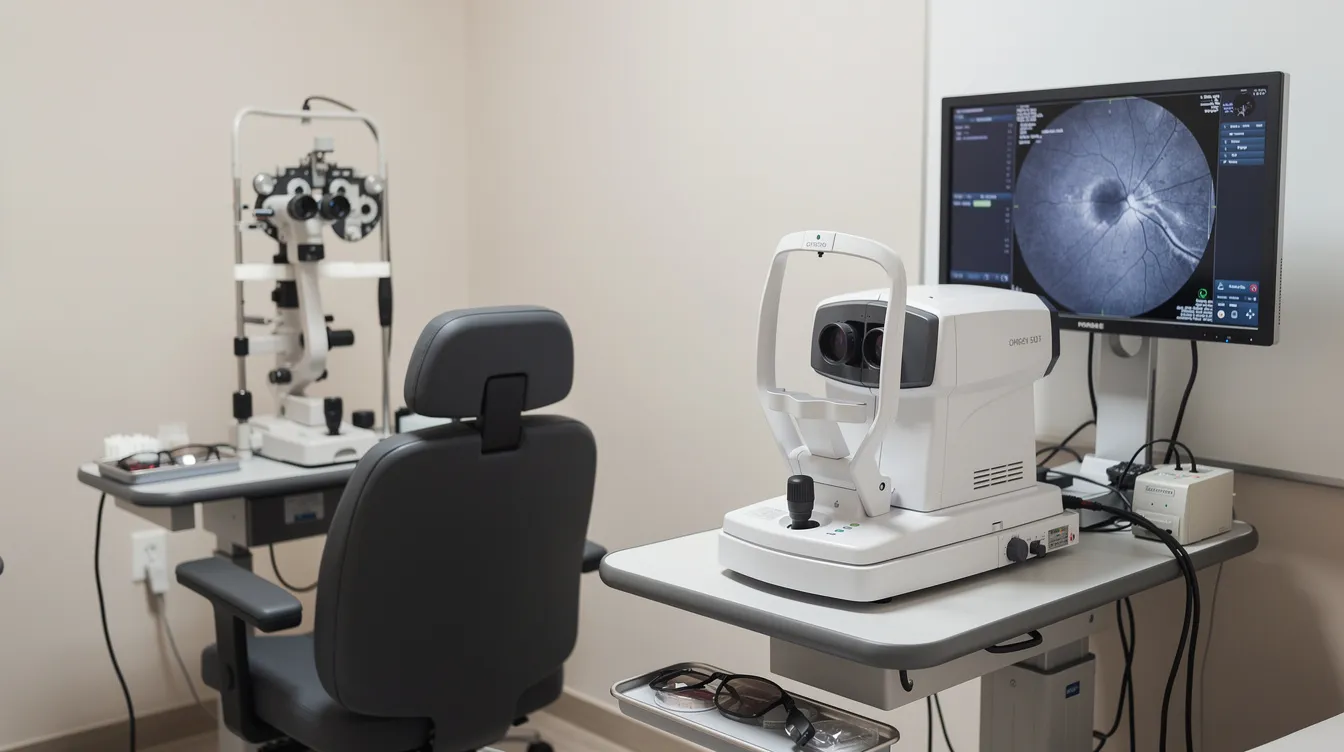
An eye hospital financial model must ensure that the procedures driving revenue are actually possible with the planned equipment and OT setup. Eye care facilities must budget for significant equipment and technology investments, and these must match projected service volumes.
Key consistency checks:
- Cataract surgery projections versus number of phaco machines, OTs and operating hours per day
- Retina and vitreoretinal procedure volumes versus availability of vitrectomy machine, lasers and trained surgeon
- LASIK or refractive revenue should not be projected unless excimer or femtosecond laser and pre-operative diagnostics are included in the project cost
- OCT-based diagnostics should not appear in revenue unless the equipment is budgeted
A simple capacity calculation: 2 OTs × 4 surgeries per OT per day × 250 working days = 2,000 surgeries at 100% utilisation. At a realistic 60% utilisation, that is approximately 1,200 surgeries per year. If projections assume 2,500 surgeries without adequate OTs or staff, they will be questioned.
For reference, promoters can review the typical Eye Hospital Equipment List & Cost and align procedure assumptions with installed equipment capacity. In my experience, bank appraisers often question DPRs where high-end procedure revenue is projected but the necessary surgical equipment is missing from the project report.
How to Project Operating Expenses
Expense projections must be as detailed and realistic as revenue assumptions. Key expense categories for eye hospitals include personnel costs, medical consumables and facility overhead. Staffing and provider productivity should align with patient volume rather than being fixed at arbitrary levels.
Major cost heads include:
- Doctors’ remuneration (full-time ophthalmologists, visiting consultants, anaesthetists); recruiting skilled ophthalmologists is a persistent challenge that affects both cost and capacity
- Salaries and wages-optometrists, nurses, OT technicians, counsellors, housekeeping, admin (human resources is a significant cost centre)
- Consumables and surgical materials-IOLs, disposables, OT packs, injections
- Medicines for IPD and day care
- Utilities-electricity, water, diesel for generators
- Rent or lease charges; repairs and maintenance including equipment AMC
- Marketing and community outreach-advertising, eye camps
- IT and software subscriptions; professional fees; insurance
- Regulatory and compliance costs must be factored into financial projections for eye care facilities
Understanding the cost structure is essential. Fixed costs include base staff salaries, rent and basic utilities. Variable costs include consumables linked to surgical services and diagnostic volumes. Semi-variable costs include marketing and staff incentives. This distinction matters directly for break-even analysis.
Expenses should be escalated annually-5–8% for salaries, potentially higher for imported consumables. Operating costs are projected to increase significantly by year five as the hospital scales. Understating salaries and consumables to show very high profit margins is a common mistake that undermines the business model.
Prepare the Projected Profit & Loss Statement
An income statement shows projected revenues minus total expenses to indicate net profit or loss. The projected P&L follows this structure:
- Revenue by service heads (OPD, surgeries, diagnostics, optical, pharmacy)
- Less: Operating expenses (consumables, manpower, overheads)
- Equals: EBITDA
- Less: Depreciation
- Less: Interest on term loan and working capital
- Equals: Profit Before Tax
- Less: Tax provision
- Equals: Profit After Tax
Profitability must be analysed over the full projection horizon. Eye hospitals providing comprehensive eye care services often require 1–2 years to reach stable utilisation and margins. High EBITDA does not automatically mean strong cash flow if loan repayments are heavy-the projected profit and loss must be read together with cash flow and loan schedules.
Depreciation in Eye Hospital Financial Projections
Eye hospitals are asset-heavy-phaco machines, lasers, microscopes, diagnostic imaging equipment and interiors all carry significant capital cost. Depreciation has a meaningful impact on reported profit, though it does not directly affect cash flow.
Depreciation should be calculated by asset class: building or civil works, medical equipment, furniture and fixtures, computers and software. For DPR purposes, reasonable rates consistent with Indian accounting and tax norms are applied. Depreciation reduces taxable profit each year, and accumulated depreciation reduces the net block of fixed assets in the projected balance sheet. Banks examine whether depreciation calculations are logical and consistent with the project cost schedule.
Interest and Loan Repayment Projections
The term-loan repayment schedule is among the most scrutinised parts of eye hospital DPR financials. Key assumptions to specify:
- Loan amount and drawdown timing
- Interest rate (healthcare term loans in India currently range around 10–12% depending on bank and borrower profile)
- Moratorium period during construction and initial months
- Total repayment tenure (typically 7–10 years for hospital projects; Indian Bank’s Ind Health Care scheme allows up to 120 months for hospital construction)
- Repayment method-equated instalments versus structured repayments
Each year’s schedule must show opening loan balance, principal repaid, interest charged and closing balance. These figures must exactly match the interest line in the P&L and term-loan movement in the balance sheet. A common projection error: showing moratorium in the schedule but incorrectly charging or omitting interest in the P&L and cash-flow statements.
Prepare the Projected Cash Flow Statement
A cash flow statement tracks the actual movement of cash into and out of a facility. An eye hospital can show accounting profit yet struggle with cash due to loan repayments, inventory build-up or delayed insurance payments.
Main components:
- Cash from operations (EBITDA minus tax minus working-capital changes)
- Cash used for capital expenditure
- Cash from financing (loans drawn, promoter capital)
- Cash used for financing (principal repayment, interest)
Working capital and cash flow projections are critical especially in the early months of operation. If annual cash accrual (PAT + depreciation) is ₹1.20 crore and debt service is ₹90 lakh, the project has cushion. If reversed, cash stress is likely. Lenders look at cumulative cash position across the repayment period.
Prepare the Projected Balance Sheet
A balance sheet provides a snapshot of a hospital’s assets, liabilities and equity at a point in time. A complete eye hospital financial projection format must include projected balance sheets to ensure all assumptions tie together.
Asset side: Gross fixed assets per project cost, accumulated depreciation and net block, inventories, receivables (from insurance, TPAs, corporate clients), cash and bank balances.
Liabilities and equity: Share capital or proprietor’s capital, reserves from accumulated PAT, term loan outstanding each year, working-capital borrowings, trade creditors and statutory liabilities.
Reconciliation is essential: closing term loan must equal the loan schedule closing balance, fixed-asset additions must match project cost, and accumulated PAT must flow into reserves. Bankers check that total assets equal total liabilities plus equity each year with no unexplained balancing figures.
Working Capital Projections for an Eye Hospital
Working capital covers day-to-day funding of stock, receivables and cash buffers. Components to estimate:
- Inventory of surgical consumables, lenses and medicines (15–20 days)
- Optical and pharmacy stock
- Receivables-30–45 days for insurance and corporate clients versus immediate for cash-paying patient walk-ins
- Credit period from suppliers (typically 30 days)
- Minimum cash balances and salary timing differences
In many smaller Indian eye hospitals with predominantly cash patients, working-capital needs are modest. But once insurance and corporate billing increase and diagnostic labs and optical shop operations scale, working-capital facilities become critical. Any proposed working-capital limits must be reflected in the balance sheet, interest cost in P&L and cash outflows in the statement.
Break-Even Analysis
Break-even analysis helps determine the volume of services required to cover fixed costs. Facilities should track both fixed and variable costs to determine break-even points.
- Fixed costs per year: salaries, rent, basic utilities, core admin
- Variable cost percentage: consumables, some marketing
- Contribution margin = revenue minus variable costs
- Break-even revenue = fixed costs ÷ contribution margin %
For example: if annual fixed costs are ₹2.4 crore and contribution margin is 50%, break-even revenue is approximately ₹4.8 crore. This translates to a specific daily OPD and surgery workload, giving promoters a clear minimum sustainable target. Expressing break-even as capacity utilisation (say 45–50% of OT capacity) helps promoters understand whether early-year projections realistically cross this threshold.
DSCR and Repayment Capacity
DSCR (Debt Service Coverage Ratio) measures cash available for debt servicing relative to total debt obligations (interest plus principal). The conceptual formula: DSCR = cash accrual ÷ (interest + principal repayment) for a given year.
In eye hospital DPR financials, we present year-wise DSCR and average DSCR over the loan tenure. Bank of Baroda’s Arogyadham scheme, for instance, requires average DSCR of 1.75 and minimum 1.25 in any year. However, acceptable DSCR levels vary between banks and schemes-avoid assuming one universal standard.
Sensitivity analysis enhances the reliability of financial projections by testing scenarios with lower volumes or higher interest rates. Lenders consider not only average DSCR but also minimum DSCR to understand weak periods during ramp-up years.
Key Financial Ratios to Review
Beyond P&L and DSCR, several ratios help assess financial health and financial analysis of the projected eye care hospital:
| Ratio | What It Indicates |
|---|---|
| Operating Profit Margin (EBITDA ÷ Revenue) | Core operational efficiency of hospital functions |
| Net Profit Margin (PAT ÷ Revenue) | Overall profitability after finance costs and tax |
| Debt–Equity Ratio | Leverage and promoter commitment |
| Current Ratio | Working-capital comfort and short-term liquidity |
| Break-even Margin of Safety | Revenue cushion above break-even |
| IRR / Payback Period | Return indicators for the project |
These ratios should be reviewed across multiple years. A specialty eye hospital in a metro may have different margin patterns compared to a smaller centre addressing visual impairments in a semi-urban area. Ratios that appear “too perfect” without supporting assumptions attract additional lender questions. The Indian hospital industry broadly expects operating profit margins of 22–24%, though smaller specialty hospitals may differ.
How Many Years Should Eye Hospital Financial Projections Cover?
Financial projections typically cover a specific future period of 3 to 5 years at minimum, though for hospital projects with 7–10 year term loans, projections often extend to 7–10 years. There is no single statutory rule-some banks accept projections covering the loan tenure while others may ask for additional outer years.
We generally align projection years with expected loan tenure when preparing eye hospital project reports for bank loan purposes. Beyond 10 years, assumptions become speculative, so focus should remain on the realistic planning and repayment period.
Example of Eye Hospital Financial Projections (Illustrative)
Illustrative figures only-actual projections depend on project size, location, service mix, pricing, capacity, financing and operating assumptions.
Assumptions: 25-bed eye hospital, 2 OTs, 3 full-time ophthalmologists in a tier-2 city. Project cost approximately ₹7 crore. Promoter equity 30%, term loan 70% at 11% interest, 8-year repayment with 6-month moratorium. Ramp-up from 35% utilisation in Year 1 to 70% by Year 5.
| Indicator (₹ in Lakhs) | Year 1 | Year 2 | Year 3 | Year 4 | Year 5 |
|---|---|---|---|---|---|
| Capacity Utilisation % | 35% | 52% | 63% | 70% | 72% |
| Total Revenue | 380 | 540 | 680 | 790 | 860 |
| Operating Expenses | 290 | 380 | 460 | 520 | 570 |
| EBITDA | 90 | 160 | 220 | 270 | 290 |
| Depreciation | 55 | 55 | 52 | 50 | 48 |
| Interest | 52 | 48 | 42 | 36 | 30 |
| Profit Before Tax | (17) | 57 | 126 | 184 | 212 |
| Cash Accrual (PAT + Dep.) | 38 | 97 | 152 | 196 | 216 |
| Total Debt Service | 114 | 110 | 104 | 98 | 92 |
| DSCR | 0.33 | 0.88 | 1.46 | 2.00 | 2.35 |
Note: Year 1 DSCR is low, reflecting ramp-up. In practice, moratorium and promoter margin money would cover early shortfalls. Average DSCR across tenure should meet lender thresholds. Aravind Eye Care System performed over 500,000 surgeries in 2021–2022 with remarkable operational efficiency. Aravind’s surgeons are six times more productive than the industry standard-their assembly line model allows surgeons to perform over 2,000 surgeries yearly. Aravind’s dual-hospital system subsidizes free services for 50% of patients. While few hospitals replicate that scale, the principle of efficient operations and high throughput improves financial sustainability at any size.

Common Mistakes in Eye Hospital Financial Projections
In my experience reviewing numerous eye hospital DPR financials, several recurring mistakes reduce credibility:
- Projecting immediate high OPD and surgery volumes from month one without accounting for brand building-patient experience and referral networks take time
- Assuming near 100% utilisation of OTs and equipment; clinical and operational constraints always limit this
- Overestimating cataract removal and premium surgery volumes relative to local demographics; not every market supports high volumes of premium procedures for high quality eye care
- Using consultation and package rates far above local benchmarks without market analysis or justification
- Projecting diagnostic and procedure income without budgeting corresponding equipment-if OCT is not procured, OCT revenue cannot be earned
- Understating salaries and consumables to inflate profit margins; this undermines cost containment credibility
- Not providing for working capital or underestimating insurance receivable cycles
- Inconsistent depreciation and interest calculations across statements; loan repayment schedules that do not reconcile with term-loan outstanding
- Aggressive annual revenue growth (30–40%) without operational justification
In one project report I reviewed, the promoter assumed 3,000 cataract surgeries in Year 1 with only one phaco machine and one OT scheduled for 3 hours daily. Realistic capacity was closer to 1,200 surgeries. After corrections, the loan amount and margins changed substantially. In another, optical shop revenue was projected high though neither inventory nor sourcing was budgeted-the assumed margin was invalid. These are not theoretical risks; they are patterns I encounter regularly.
How to Make Eye Hospital Financial Projections More Realistic
Realistic projections are built from ground realities-population catchment, competition, doctor availability and affordability. Detailed analysis of local conditions is essential. Key factors include:
- Base OPD and surgery assumptions on local prevalence data and existing utilisation of healthcare needs in the area
- Factor in doctor schedules-support services and specialist availability directly limit throughput
- Allow gradual ramp-up with explicit assumptions for marketing, eye camps and referral tie-ups
- Align equipment selection with the service mix projected; an eye hospital involves significant coordination between clinical capacity and financial planning
- Apply locally benchmarked tariffs and expected payor mix; pricing strategy must reflect what patients and insurers actually pay
- Build staff costs using current market salaries; address customer satisfaction and patient safety through adequate staffing
- Internal consistency is non-negotiable: changing surgery volumes must adjust consumables, staffing, OT utilisation and sometimes additional capex
Professional assistance from people experienced in hospital DPRs and economic analysis can help avoid blind spots. Promoters should compare projections with actual performance post-launch-this is a management tool, not merely a bank requirement. Sustainable practices in financial planning support long-term well being of both the institution and the communities it serves.
Financial Projections for a New Eye Hospital vs Expansion Project
For a new (greenfield) eye hospital, all assumptions rely on feasibility study inputs-demographic studies, market analysis, conservative ramp-up and higher initial marketing and eye camp expenses. There is more uncertainty in payor mix and referral patterns, and hospital design decisions are still being finalised.
For an expansion of an existing eye care hospital, historical OPD, surgery and revenue trends provide a reliable base. Existing doctor productivity, actual conversion rates from camps and established operational costs allow more accurate projections. Economies of scale may reduce costs-existing admin, utilities and procurement systems can absorb incremental patient care load.
For expansion DPRs, ignoring historical financial statements and using entirely arbitrary numbers is a red flag for lenders. Projections should be anchored to past performance plus realistic incremental capacity. Revenue generated historically serves as the foundation for expansion projections.
How Banks May Review Eye Hospital Financial Projections
Different banks have their own appraisal norms, but common aspects they typically consider include:
- Reasonableness of project cost against market quotations; eye hospitals must comply with regulatory approvals for operation
- Adequacy of promoter contribution (often 20–30%)
- Realism of revenue assumptions, especially in early years; whether quality standards in patient care are addressed
- Operating margins and whether key areas of expense are adequately provided
- Projected cash accrual and DSCR trend across the loan tenure
- Working-capital requirement and whether sufficient facilities or promoter funds are planned
- Overall consistency between P&L, cash flow, balance sheet and term-loan schedule
- Promoter profile, experience and existing financial obligations
Well-structured, internally consistent eye hospital DPR financials can make discussions with bank officials smoother, even though they do not guarantee sanction. Some lenders also conduct sensitivity analysis and compare projections with industry benchmarks. Every eye hospital project is evaluated on its individual merits; these observations reflect common patterns rather than universal rules.
Financial Projections Should Tell One Consistent Financial Story
Every number in the eye hospital financial model should logically connect to other numbers. The DPR must read as one coherent financial story. Key consistency links:
- Project cost ties to fixed assets and depreciation
- Equipment list ties to procedure capacity and revenue projections
- Staffing plan ties to salary costs and daily throughput-increase productivity only if staff and infrastructure support it
- Means of finance ties to interest, repayment and DSCR
- Working-capital assumptions tie to inventory, receivables and short-term borrowing
- P&L profit plus depreciation ties to cash flow; cash flow ties to term-loan balances in the balance sheet
“Financial projections should not be prepared by starting with the profit a promoter wants to show. They should start with operational assumptions that can be reasonably explained. Profitability and repayment capacity should emerge from those assumptions.”
- CA Manish Gugliya, Chartered Accountant | ProjectReportBank
Lenders take more comfort when the DPR’s narrative, technical details and financials align. Projections are a living planning document-revisit them periodically, not just for bank compliance. Clear vision in planning leads to better outcomes in execution. The goal is not needless blindness to risks but early detection of potential issues through robust financial planning.

About CA Manish Gugliya
CA Manish Gugliya is a Chartered Accountant with extensive experience in preparing and reviewing project reports, Detailed Project Reports (DPRs), CMA data and financial projections for MSMEs, hospitals and healthcare projects across India. His expertise includes evaluation of hospital project cost structures, structuring means of finance, developing realistic financial planning models, assessing DSCR and repayment capacity, and advising on bank finance proposals.
He has worked with doctors, ophthalmologists, hospital promoters and healthcare entrepreneurs, helping them translate clinical plans into robust financial models. Through ProjectReportBank.com, he and his team assist clients in preparing customised eye hospital project reports for bank loans, with a focus on internal consistency, practical assumptions and compliance with typical lender expectations.
Frequently Asked Questions
The following FAQs address common queries from doctors and first-time hospital promoters. Specific project situations and bank policies can differ; readers should seek tailored professional advice for their projects.
What are financial projections in an Eye Hospital DPR?
Financial projections are structured estimates of future revenues, expenses, profits, cash flows and balance sheet positions of the proposed eye hospital over several years. They are built from assumptions about patient volumes, pricing, capacity, project cost and financing, and help assess viability, repayment capacity and overall financial feasibility before committing capital. They are key elements of any bankable DPR.
How do you project revenue for an eye hospital?
Revenue is projected by estimating realistic daily and annual volumes for each service category-OPD, cataract, retina, diagnostics, optical, pharmacy-and multiplying by expected average realisation per service. A ramp-up pattern is applied over initial years. Assumptions must align with equipment installed, number of doctors, working days, local market pricing and the hospital’s specialized care offerings for comprehensive eye care services and high quality care.
How many years of financial projections are required for an Eye Hospital Project Report?
Typical DPRs for hospitals in India cover 5–10 years, often matching or slightly exceeding the proposed term-loan tenure. The Indian eye-care services market is valued at approximately ₹19,000 crore in FY2025 with an expected CAGR of 11.4%, providing a supportive long-term outlook. Exact requirements can vary by lender and project size, so borrowers should confirm with their bank or consultant.
What financial statements should be included in an Eye Hospital DPR?
Standard inclusions are: projected profit and loss statement, projected cash flow statement, projected balance sheet, detailed term-loan repayment schedule, break-even analysis, DSCR workings, and supporting schedules for project cost, means of finance and major assumptions. Some banks may also require ratio analysis and sensitivity scenarios relevant to eye health services in developing countries.
Can I finalise projections before locking equipment cost and list?
While initial drafts can be prepared with indicative budgets, final eye hospital DPR financials should not be frozen until the equipment list, broad specifications and realistic cost estimates are reasonably finalised. Otherwise, revenue and depreciation assumptions may not match actual capacity and capex-particularly for corneal blindness treatment capabilities, private rooms planning, or environmental impact considerations-weakening the credibility of the project report with lenders.
Explore All Eye Hospital DPR Guides
Continue exploring our complete series on Eye Hospital project planning, financial projections, repayment capacity and bank finance.
- Eye Hospital Project Report / DPR for Bank Loan – Complete Guide

- Eye Hospital Term Loan Assessment: How Banks Evaluate Your Project in India
- Bank Loan for Eye Hospital – Project Finance & Documentation Guide

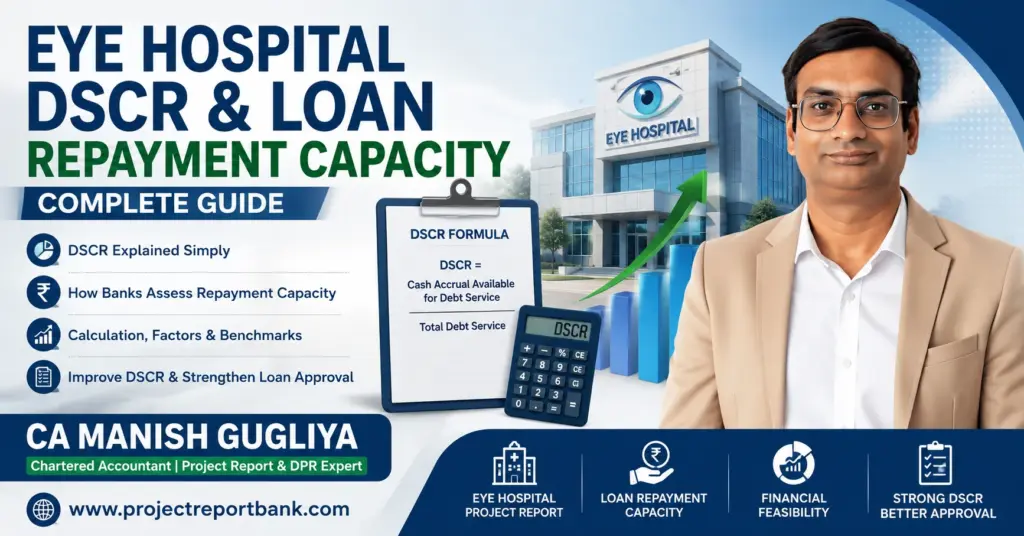
- Eye Hospital DSCR & Loan Repayment Capacity – Complete Guide
- Eye Hospital Working Capital Requirement – Assessment & Calculation (India-Focused Guide)
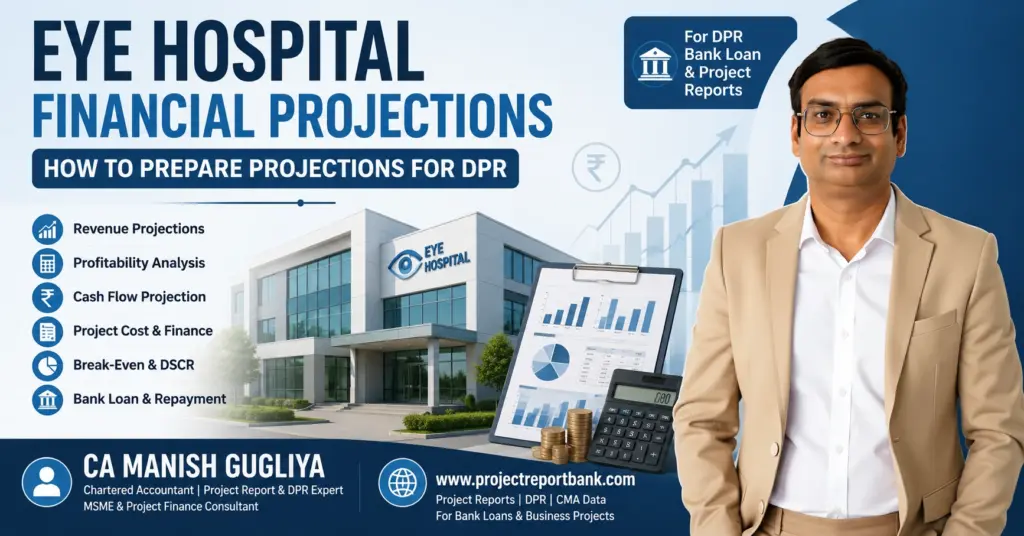
- Eye Hospital Financial Projections – How to Prepare Projections for DPR (India)
- Eye Hospital Revenue Model – How to Prepare Realistic Revenue Projections (Eye Hospital Project Report)
- Eye Hospital Project Cost & Means of Finance – How to Structure the Investment
- Eye Hospital Equipment List & Cost in India – Complete Setup Guide