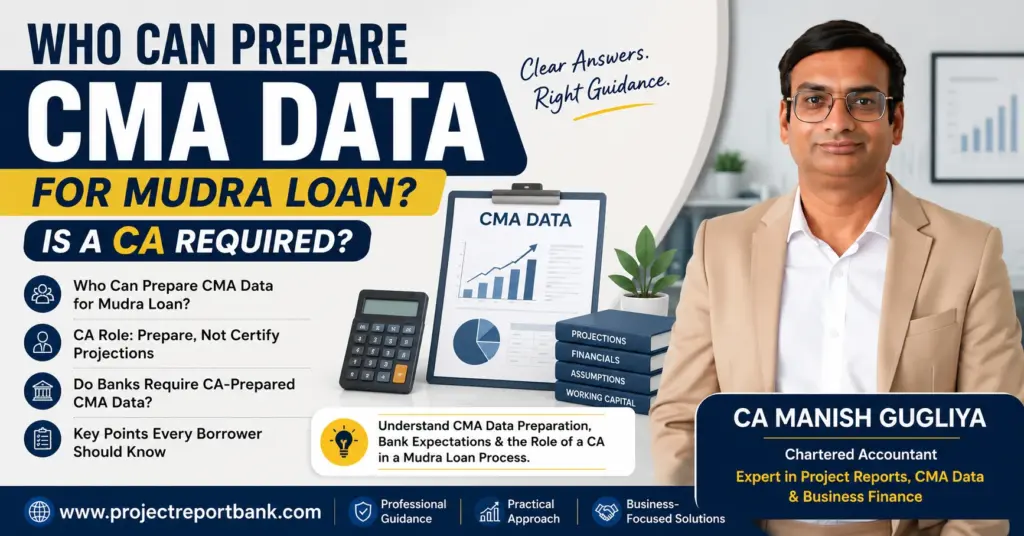
If you are applying for a Mudra loan and your bank has asked for CMA Data, one of the first questions that comes to mind is whether you need a Chartered Accountant to prepare it or whether you can do it yourself. The short answer is that CMA Data for a Mudra loan can be prepared by the borrower, an accountant, a CA, or a financial consultant. But the longer answer involves understanding what banks actually expect and where professional help genuinely makes a difference.
Key Takeaways
- CMA Data for a Mudra loan can be prepared by the borrower, an accountant, a Chartered Accountant, or a financial consultant, depending on the bank’s comfort level and the complexity of the proposal.
- No RBI rule states that CMA Data for every Mudra loan must be prepared or signed by a CA. However, individual banks may still ask for CA-prepared or CA-supported financial projections in practice, particularly for higher loan amounts.
- A CA can professionally prepare CMA Data and projected financial statements, but this preparation must not be treated as a “guarantee” or “certification” of future turnover or profits.
- The quality, consistency, and reasonableness of assumptions in the operating statement, balance sheet projections, and working capital assessment matter far more than whose name appears on the CMA report.
- Always confirm exact documentation requirements-including whether CA-prepared CMA Data is needed-with your specific bank branch before finalising the Mudra loan file.
Direct Answer: Who Can Prepare CMA Data for a Mudra Loan?
CMA Data for a Mudra loan may be prepared by the entrepreneur, an in-house accountant, an external financial consultant, or a Chartered Accountant, subject to the bank accepting the format and content. A CMA statement does not have to be exclusively prepared by a Chartered Accountant for Mudra loans.
In many small Mudra loans (for example, under the Shishu or Kishor categories), banks rely mainly on a concise project report and basic financial projections rather than a full CMA data format. Some branches, however, prefer a structured CMA statement even for smaller business loan amounts. Projections for smaller Mudra loans may require less complex documents than full CMA packages.
There is no uniform rule across all Indian banks that “only a CA can prepare CMA Data for Mudra loan.” That said, some lenders or branches may insist on CA-prepared figures for comfort, especially where projected turnover and working capital limits are significant. The lending bank decides the required financial statements and documents for loan proposals.
From my professional experience, CMA data preparation often helps organise assumptions, future projections, and working capital calculations into a structured format. But professional preparation does not automatically result in loan approval. The sections below explain what “preparing CMA Data” really involves and how CA preparation differs from the commonly misunderstood idea of “certification” of projections.

What Does “Preparing CMA Data” Actually Mean?
Preparing CMA Data for a Mudra loan means building a complete financial picture of the business-past performance, current financial position, and future projections-in a structured CMA data format that banks can analyse. CMA Data includes historical and projected financial performance, and CMA data focuses on financial data and projections that the bank needs to assess creditworthiness.
Key components typically covered in CMA preparation include:
- CMA operating statement (projected profit and loss)
- Projected balance sheet for 3–5 years
- Cash flow statement or fund flow statement overview
- Current assets and current liabilities comparison
- Working capital assessment and calculation of maximum permissible bank finance (MPBF) where relevant
- Key financial ratios including debt service coverage ratio, interest coverage ratio, and debt equity ratio
CMA Data requires 2–3 years of historical financial statements and CMA reports must include projected financials for 3–5 years. Preparation involves understanding the proposed business activity, gathering historical data (if the unit already exists), establishing realistic assumptions on sales, purchases, and expense patterns, and translating them into year-wise future projections.
Good CMA preparation requires checking internal consistency: the projected balance sheet must tally, the operating statement must link with the working capital cycle, and financial ratios should reflect the sector’s practical realities rather than arbitrary numbers. CMA reports follow a specific RBI-prescribed format, and CMA data must align with banking norms and standard RBI formats for acceptance.
If you are completely new to the concept, understanding what CMA Data means for a Mudra Loan will help you grasp basic definitions before finalising your own statements.
Who Can Prepare CMA Data for a Mudra Loan?
Banks mainly care about clarity, consistency, and reasonableness of the CMA, not solely about the designation of the person who prepares it. In practice, CMA Data for a Mudra loan is often prepared by one of four groups: the borrower, an internal or external accountant, a Chartered Accountant, or a specialised loan consultant or project report professional.
Whichever option is chosen, the underlying commercial logic and assumptions must originate from the entrepreneur. The preparer can only structure and translate these into financial terms.

Can the Borrower Prepare CMA Data?
A financially aware entrepreneur with basic accounting knowledge and comfort with spreadsheets may technically prepare CMA Data, especially for a small Mudra loan where the projections are relatively simple. Business owners can prepare their own CMA data using standard templates or online platforms, and CMA data can be prepared without a licensed professional’s signature under Indian banking norms.
Self-preparation requires the borrower to understand how to prepare a realistic operating statement, estimate working capital needs, and ensure that the projected balance sheet, profit and loss, and cash flow are all interlinked and mathematically correct.
However, self-preparation of CMA data may result in errors that stall loan applications. Avoid stretching or manufacturing figures just to achieve attractive ratios or a higher loan amount-bankers regularly test projections against sector norms and existing capacity.
Some banks might still ask self-prepared CMA Data to be countersigned or reviewed by a professional. Confirm acceptance with your branch before relying solely on self-prepared statements.
Can an Accountant Prepare CMA Data?
There is an important difference between basic bookkeeping and structured financial projection. Many accountants are skilled in preparing past financials, audited financial statements, and GST returns, but CMA Data needs an additional understanding of banking ratios, working capital cycles, and loan appraisal logic.
An experienced accountant who regularly deals with bank loans can competently prepare CMA Data, provided they understand MPBF concepts, operating statement linkages, and how maximum permissible bank finance is derived for working capital loans.
The quality of an accountant-prepared CMA depends on the individual’s exposure to banking documentation. Not every accountant will automatically produce bank ready CMA reports without guidance. For complex or larger Mudra proposals, an accountant and a CA may even work together-the accountant assembling historical data and the CA focusing on projections, ratio analysis, and review.
Can a Chartered Accountant Prepare CMA Data?
Chartered accountants routinely prepare CMA Data for business loan proposals, including Mudra loans, especially where the bank expects a detailed financial report with ratio analysis. CMA Reports are prepared by Chartered Accountants or financial consultants, and chartered accountants are widely preferred for preparing CMA data due to their credibility.
A CA can help in areas such as:
- Interpreting past financial statements and audited financials
- Designing realistic turnover and margin assumptions
- Preparing future projections (projected financial statements over 3–5 years)
- Balancing project cost and means of finance
- Conducting working capital assessment
- Reviewing overall internal consistency of the CMA report
When CMA Data and projected statements are prepared by a CA, it should be described as “prepared by a Chartered Accountant” or “prepared with professional assistance”-not as a certification or guarantee of the future numbers.
For instance, a CA can prepare projections showing expected turnover growth over the next three years based on capacity and market assumptions, but this does not mean the CA certifies or guarantees that those turnovers will definitely be achieved. The projections remain estimates based on financial information and assumptions provided by the applicant.
Can a Financial Consultant or CMA Specialist Prepare CMA Data?
Many MSME owners use specialised project report consultants or CMA Data professionals who focus exclusively on bank loan documentation and know various banks’ preferred formats. Financial consultants regularly prepare CMA data that aligns with banking formats and ratios.
Such consultants, when experienced, can be effective in translating the entrepreneur’s commercial plan into a structured CMA data format, complete with future projections, fund flow analysis, and MPBF workings where needed.
Designation alone (consultant, coach, advisor) is not sufficient. The preparer must have a sound understanding of banking norms, financial statements, and how bankers appraise working capital finance and term loan proposals. Ask any consultant specifically how they will build assumptions and check internal consistency, rather than only providing a template filled with arbitrary numbers.
Table of Contents
Is a Chartered Accountant Mandatory for CMA Data?
There is no single nationwide rule making a CA compulsory for preparing CMA Data for every Mudra loan. Requirements may vary by bank, loan size, and the nature of the business. CMA Data is required for loans above INR 2 crore under standard banking norms, but Mudra loans are well below this threshold, so the documentation expectations are typically lighter.
Borrowers should differentiate between:
- Whether the bank requires CMA Data at all
- Whether the bank wants projections in a specific CMA data format
- Whether the bank insists those projections be prepared or supported by a CA
- Whether the bank expects any separate declaration on other financial documents
Some banks and branches are comfortable with well-structured self-prepared CMA Data for small Mudra limits, especially in Shishu or Kishor loans. Others may ask for CA-prepared data once amounts and complexity increase. If the loan amount is ₹5 lakh or more, having a CA prepare the CMA is generally worthwhile-using a Chartered Accountant can significantly improve CMA approval rates for higher-tier Mudra loans.
In my practice, many Mudra applicants come to me only after the branch has verbally requested CA-prepared projections. This remains a bank-specific practice rather than a uniform legal requirement. I recommend that borrowers confirm the exact expectation with their bank-ideally via email or written communication-before finalising who will prepare their CMA statements.
Does CMA Data Require a CA Signature?
A CA signature on CMA Data is not automatically required for all Mudra loans. Some branches accept unsigned CMA printouts or spreadsheets, while others prefer the name and membership number of the CA who prepared the figures. CMA data can be prepared without a licensed professional’s signature under Indian banking norms.
Where a CA’s signature appears on a CMA report, it usually indicates that the CA has prepared or assisted in preparing the financial projections based on information and assumptions provided by the applicant-not that the CA is certifying the future results.
Each bank has its own internal checklist. In some cases, a branch may ask the applicant to attach a separate CA certificate for past financial figures or capital introduced, while viewing the CMA projections themselves as “management estimates.”
If your bank explicitly asks for CA-signed CMA Data, request clarity on what exactly must bear the signature-projected financials, historical figures, or both-to avoid unnecessary rework.
Can a CA Certify CMA Data or Financial Projections?
This is one of the most commonly misunderstood areas among borrowers. The distinction lies between historical financial information (past audited figures, actual bank statements, existing loans) and projected or prospective information (future sales, profits, cash flow, working capital requirements).
A CA can audit and express an opinion on past financial statements under established standards. But prospective projections inherently depend on assumptions about the future and therefore cannot be “certified” or guaranteed in the same way. CMA reports can include past financials, projections, and key ratio analyses to demonstrate repayment ability-but the projected data portion remains an estimate.
When describing CMA Data prepared with professional assistance, use phrases like “prepared by a CA” or “based on assumptions provided by management.” Avoid language implying guaranteed future turnover or profits.
Example: A trader with past turnover of ₹30 lakh expects to reach ₹45 lakh after adding new product lines and increasing stock. A CA can structure these expectations into a projection for the operating statement and balance sheet. However, whether the business actually achieves ₹45 lakh depends on market conditions and execution, not on the CA’s preparation.
Bankers themselves treat CMA projections as management estimates. They review the logic and reasonableness-not as figures guaranteed by the CA.
CA-Prepared CMA Data vs Self-Prepared CMA Data
Understanding the practical differences between self-prepared and professionally prepared CMA Data can help you decide the right approach for your Mudra loan proposal.
| Basis | Self-Prepared CMA Data | CA/Professionally Prepared CMA Data |
|---|---|---|
| Preparation | Applicant directly | CA or financial consultant |
| Financial knowledge required | Higher burden on applicant | Professional assistance available |
| Assumption development | Entirely applicant’s responsibility | Professionally structured with applicant inputs |
| Working capital calculations | Applicant prepares MPBF, credit limits | Professional handles complex computations |
| Ratio analysis | Applicant must understand DSCR, debt equity ratio | Professional analyses and cross-checks |
| Internal consistency | Applicant checks linkage across statements | Professional review during preparation |
| Future results guaranteed? | No | No-preparation is not certification |
| Bank acceptance | Depends on lender requirements | Depends on lender requirements |
Both CMA and project reports are often required for loan applications. Neither self-prepared nor CA-prepared CMA Data should be treated as a certification of future results; both are projections for appraisal, not guarantees of profitability or bank loan approval.
When Should You Consider Getting CMA Data Prepared by a CA?
Many micro enterprises may manage simple projections themselves. But there are specific situations where CA-prepared CMA Data becomes particularly beneficial:
- You are not comfortable with balance sheet and profit and loss linkages
- Multiple banking facilities or higher Mudra limits (Tarun or Tarun Plus) are involved
- Working capital calculations and MPBF estimations are complex
- The proposal includes both term loans and working capital components
- Your business has audited financial statements that need to be converted into coherent future projections
If you have previously faced bank queries on inconsistencies-like a mismatch between project cost in a Mudra Loan project report, means of finance, and projected operating statement-engaging a professional to restructure your CMA Data can significantly reduce back-and-forth.
What Information Does a CA Need to Prepare CMA Data?
Before approaching a CA or professional, keep these documents and details ready:
- Constitution documents (proprietorship declaration, partnership deed, incorporation certificate)
- Nature of business, products, or services
- Existing financial statements for the last 2–3 years (audited financials preferred)
- Latest provisional figures if the financial year is not yet closed
- Income tax returns and relevant GST information
- Last 6–12 months bank statements
- Existing loan and limit sanction letters
- Proposed loan amount under Mudra (term loan vs working capital split)
- Quotations or estimates for machinery or equipment
- Expected monthly or annual sales and gross margin
- Operating expenses, wage bills, rent, and utilities
- Likely debtor and creditor periods, inventory holding pattern
- Loan repayment schedules and assumptions (tenor, EMI structure)
The more specific and realistic the entrepreneur’s inputs, the more meaningful and defensible the final CMA Data-regardless of whether it is prepared by a CA or any other professional.
How CMA Data Connects With the Mudra Loan Project Report
Banks usually look at the Mudra loan project report and CMA Data together. The narrative in the project report and the numbers in the CMA should tell the same story. A project report includes business background and market analysis, while a CMA report focuses on financial data and projections. Both are often required for loan applications.
Understanding what a Mudra Loan project report contains helps you see how the non-financial sections complement CMA Data. Project reports are necessary for new businesses seeking loans.
Key reconciliation points:
- The project cost should reconcile with fixed asset additions and term-loan drawdown reflected in CMA projections and the projected balance sheet
- The means of finance in a Mudra Loan project report-promoter contribution versus bank loan-must be consistent across both the narrative report and CMA Data
- Sales and revenue projections for a Mudra Loan project report should match the CMA operating statement figures
- The working capital requirement for a Mudra Loan project report for stock and receivables must match the drawn working capital limits shown in CMA
Common Mistakes While Getting CMA Data Prepared
From reviewing dozens of CMA files, here are the most frequent mistakes I observe:
- Unrealistic jumps in sales without corresponding increase in capacity, marketing plan, or technical feasibility support
- Copying projections from another business without adjusting for different margins or working capital cycles
- Ignoring existing loans or overdue amounts while calculating debt obligations and repayment capacity
- Inconsistent project cost between CMA and the detailed project report
- Incorrect or missing means of finance break-up
- Operating statements that do not match the projected balance sheet or fund flow statement
- Understating debtor and inventory levels to improve ratios, which appears inconsistent with industry norms during credit analysis
- Capacity-related projections that do not align with actual plant and equipment proposed-ensure your numbers match machinery and equipment details in a Mudra Loan project report
- CMA reports require a debt service coverage ratio above 1.25; a DSCR below this threshold often triggers rejection
- Assuming CA-prepared CMA Data automatically guarantees quick bank loan approval-the bank still independently assesses financial viability and policy fit
Is Professional CMA Preparation Worth It for a Mudra Loan?
For very small and straightforward Mudra proposals, simple projections embedded in the project report may be sufficient. Professional CMA preparation may be optional if the bank is satisfied with a basic financial report.
Advantages of professional preparation include improved structuring of assumptions, accurate working capital and MPBF calculations, cleaner ratio analysis, and fewer avoidable queries. CMA Data assesses a company’s financial health and creditworthiness for loans, and banks use CMA Data to evaluate repayment capacity. A well-prepared accurate CMA report helps in determining loan eligibility by presenting clear projected data.
Professional CMA preparation does not guarantee approval, faster sanction, or a particular interest rate. It improves clarity and reduces technical mistakes. Each entrepreneur should weigh the time, complexity, and risk of error in self-preparation against the cost of engaging a professional, keeping in mind the bank’s stated expectations for their specific Mudra loan.

Practical Example: How a CA Helps Turn Assumptions into CMA Data
Consider a small manufacturing unit in 2026 seeking a Mudra Tarun loan of ₹10 lakh-₹6 lakh for machinery and ₹4 lakh for working capital.
The entrepreneur explains: monthly production capacity of 5,000 units at ₹25 per unit selling price, raw material cost of ₹12 per unit, 30-day credit to customers, 15-day credit from suppliers, and 20-day inventory holding. Monthly overheads (rent, wages, power) total ₹40,000.
The CA organises these inputs into:
- Project cost: ₹6 lakh machinery + ₹1.5 lakh promoter margin for working capital = ₹7.5 lakh total project cost
- Means of finance: ₹1.5 lakh promoter contribution + ₹6 lakh term loan + ₹4 lakh working capital limit
- Operating statement: Year 1 projected sales of ₹15 lakh, COGS ₹7.2 lakh, overheads ₹4.8 lakh, net profit before tax approximately ₹3 lakh
- Working capital: Debtors (~₹1.25 lakh), inventory (~₹1 lakh), creditors (~₹0.6 lakh). CMA Data helps in determining working capital limits through these calculations
- DSCR: Calculated at approximately 1.8, comfortably above the 1.25 threshold that banks prefer
- Projected balance sheet and fund flow reflecting asset additions, loan repayments, and business growth over 3–5 years
Even though this CMA Data and these future projections are prepared professionally, the CA does not and cannot guarantee that the actual turnover or profit in 2027–2029 will exactly match the projected figures. They remain estimates based on current financial information and past performance patterns.
Expert View: CA Manish Gugliya’s Perspective
In my professional experience across preparing CMA Data for Mudra and other MSME loans with different banks, I have observed that banks primarily look for reasonableness of assumptions, linkage between project cost, means of finance, and the operating statement, and a practical working capital structure-rather than simply checking whether a CA’s name appears on the CMA file.
Professionally prepared CMA Data often reduces queries and clarifications at the branch level. But it cannot replace the bank’s own credit appraisal or its internal policy decisions on sanction, security, and margins. The bank’s financial analysis goes beyond the CMA alone.
The key is not just “who” prepares CMA Data. What matters is whether the data reflects the real business model and is backed by logic that the applicant can confidently explain across the table to the banker. Financial stability and financial viability of the proposal must come through in every number.
Frequently Asked Questions
These questions address common doubts that Mudra loan applicants face regarding CMA data for bank loan proposals.
Can I submit a Mudra loan application without CMA Data if my banker has not asked for it?
If your bank’s checklist for a small Mudra ticket only mentions a basic project report and KYC financial documents, you can generally proceed without a full CMA statement. However, the bank might request additional financial projections during appraisal. Clarify with your loan officer whether a standard CMA data format is needed for your specific loan amount and business type.
If my CMA Data is self-prepared, will banks automatically reject it?
Banks do not automatically reject CMA Data just because it is self-prepared. They mainly review whether the financial information is complete, consistent, and realistic relative to the business and its past financial performance. Some branches may still prefer professional preparation for comfort, so be ready either to explain your own workings or to engage a CA if the bank explicitly asks.
Do banks prefer CMA Data in a standard Excel template or printed format?
Most banks work with an internal Excel or system-based CMA data format. Some branches share an Excel template and expect applicants or their consultants to fill it. Request the bank’s preferred format at the start, and provide both a soft copy and a signed printout if required, instead of relying on a generic CMA sheet downloaded from the internet. The goal is to produce a report for bank use in a format they can process.
Is it necessary to revise CMA Data every year after getting a Mudra loan?
CMA Data must be updated annually for loan renewals, especially where the facility includes working capital loans or cash credit limits that need periodic renewal. Pure term loans may not need annual CMA submission. CMA Data must be submitted annually for loan renewals where working capital limits are involved. Confirm at sanction stage whether your bank expects updated historical data and revised projections each year.
Does well-prepared CMA Data guarantee Mudra loan approval?
No format or professional label can guarantee loan approval. Sanction decisions depend on borrower profile, existing obligations, banking history, security, and the bank’s policies. What well-prepared CMA Data can realistically do is present the company’s financial health clearly, reduce avoidable queries, and help the banker understand how the proposed business can reasonably service the Mudra loan based on its repayment capacity and projected financial statements.
Conclusion
CMA Data for a Mudra loan can be prepared by the borrower, an accountant, a CA, or a specialised consultant, depending on the complexity of the proposal and the bank’s documentation expectations. CMA Reports are required for loans above INR 2 crore under standard banking norms, but for Mudra-level amounts, requirements are generally lighter and more flexible.
A Chartered Accountant can add significant value in structuring projections, working capital calculations, ratio analysis, and internal consistency. But neither law nor RBI circulars state that every Mudra loan’s CMA Data must be CA-prepared or CA-signed. This remains a bank-level or branch-level practice.
Professional preparation of projections should not be interpreted as certification or guarantee of future performance. Projections remain assumptions-based estimates prepared for bank appraisal using historical financial data and reasonable forward-looking assumptions.
From my professional perspective, focus on realistic assumptions, clear linkage between your project report and CMA Data, and early communication with your bank about required formats and signatures. Prepare an accurate CMA report that tells a coherent story about your business-that is what ultimately matters for loan eligibility and a smooth appraisal process.
- CMA Data for Mudra Loan: Complete Guide

- CMA Data for Mudra Loan Online – Can It Really Be Prepared from Anywhere?
- How to Make Realistic Assumptions in CMA Data for Mudra Loan
- How Many Years of Projections Are Required in CMA Data?
- Information Required for CMA Data for Mudra Loan – Practical Guide by CA Manish Gugliya
- Who Can Prepare CMA Data for Mudra Loan? Is a CA Required?
- Is CMA Data Required for Mudra Loan? When Banks May Ask for It
- What Is CMA Data for Mudra Loan? Complete Beginner Guide