Setting up a fully automatic instant noodles manufacturing plant in India is a capital-intensive industrial project that demands rigorous technical planning, realistic financial analysis, and a professionally prepared detailed project report before any machinery orders or bank commitments are finalised. The instant noodles market in India is growing at 10-12% annually, and the global noodles market reached USD 60.33 billion in 2025, but market growth alone does not guarantee project success. A manufacturing plant project report must evaluate production capacity, the instant noodles manufacturing process, raw material costs, packaging requirements, operating cost structure, distribution economics, and bankable financial projections specific to the promoter’s proposed plant setup.
Key Takeaways
This article serves as a DPR-style guide for medium-to-large fully automatic instant noodles and cup noodles manufacturing plants in India. It is not intended for micro food processing units or small manual setups.
- Fried noodles, non-fried instant noodles, and cup noodles each require different line configurations, packaging machinery, and capital investments. The product mix decision drives machinery selection, project cost, and working capital requirements.
- A customised detailed project report is essential before finalising machinery purchases, bank term loans, or investor commitments for an instant noodles manufacturing plant.
- The article covers instant noodles industry trends, the fully automatic instant noodles manufacturing process and cup noodles process flow, automatic instant noodles production line machinery, plant layout, setup cost methodology, raw materials, working capital, financial projections, and project economics.
- All financial examples are illustrative. Project Report Bank, led by CA Manish Gugliya, prepares project-specific DPRs, CMA Data, and feasibility studies for bankable instant noodles and cup noodles projects.
Project Overview and Key Investment Highlights
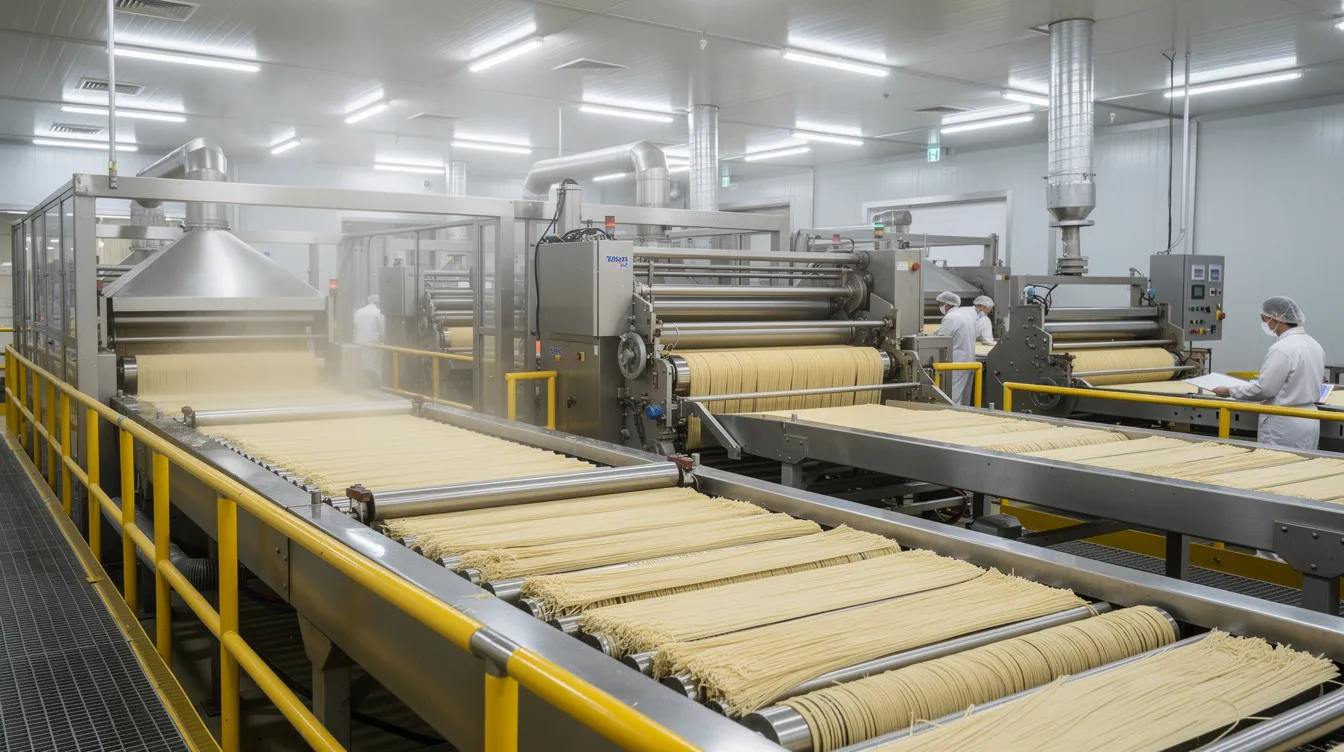
The following snapshot summarises the key factors and investment components for a fully automatic instant noodles manufacturing plant with an integrated cup noodles line, aimed at promoters, bankers, and investors evaluating this manufacturing plant project.
| Parameter | Illustrative Details |
|---|---|
| Project Type | Instant noodles manufacturing plant with cup noodles downstream line |
| Key Products | Fried pouch noodles, non-fried noodles, cup noodles, seasoning sachets |
| Main Raw Materials | Wheat flour (maida), palm oil or sunflower oil, starches, spices, laminates, PP/paper cups |
| Indicative Capacities | 3 TPD, 5 TPD, 10 TPD+ finished product (scenario-based) |
| Technology | Continuous automatic line; optional non-fried hot-air dryer |
| Automation Level | PLC-based controls, automatic dosing, integrated packaging |
| Plant Infrastructure | 2–6 acres (capacity-dependent), hygienic food-grade building, utilities block |
| Principal Machinery | Compound sheeter, slitter, steamer, fryer/dryer, pillow-pack machines, cup filling-sealing, checkweighers, metal detectors |
| Utility Requirements | 500 kW–2 MW electric load, boiler/steam generation, compressed air, water treatment, effluent handling |
| Packaging Formats | Laminated pouches, cups with foil/film lids, cartons |
| Financing Options | Promoter equity, bank term loan, working capital limits, government schemes for food processing |
Key investment components include land and building, fully automatic instant noodles production line machinery, cup noodles downstream packaging line, utilities, pre-operative expenses, and margin for working capital. The capacity and cost indications above are illustrative scenarios that must be refined in a customised instant noodles project report based on actual quotations, site conditions, and market analysis.
Instant Noodles and Cup Noodles Manufacturing Industry in India
The instant noodles industry is a major segment within the broader convenience foods market. Globally, 123.1 billion servings of instant noodles were consumed in 2024, with China and Hong Kong alone accounting for 43.8 billion servings. The global instant noodles market was valued at USD 60.33 billion in 2025 and is expected to reach USD 87.37 billion by 2034, growing at a CAGR of 4.2% from 2026 to 2034. India’s instant noodles market, valued at approximately ₹8,000 crores, is growing at 10-12% annually, driven by:
- Urbanisation, nuclear families, and a growing working population seeking ready-to-cook and ready-to-eat formats
- Expanding distribution through general trade (kirana stores), modern retail, quick-commerce, and e-commerce platforms
- Institutional and HoReCa demand from canteens, hostels, and QSR chains
Industry trends include premiumisation with exotic flavours (including instant ramen and Korean-style variants), healthier noodle alternatives such as non-fried, baked, and fortified options, and regional masala adaptations. Market segmentation is evolving, with cup noodles and bowl formats growing faster than traditional pouches. Market analysis involves studying competitor brands and product differentiation strategies, recognising that leading manufacturers hold significant brand equity and distribution reach.
Private-label and contract manufacturing present investment opportunities for new entrants, though margins may be tighter. Export opportunities exist for South Asia, Gulf, and African markets, but require additional labelling, quality, and Halal compliance where relevant. Promoters must not assume guaranteed offtake; realistic sales ramp-up and marketing spends must be incorporated into the noodles manufacturing plant project DPR.
Technologies for Extruded Breakfast Cereals Manufacturing Plant Project Report and Integrated Multi-Product Extruded Snacks Manufacturing Plant Project Report differ from noodles manufacturing, so machinery is not interchangeable even if target consumers overlap.
Types of Products Manufactured by an Automatic Noodles Plant
Product mix decisions directly influence line design, automatic instant noodles production line machinery, raw material requirements, packing material cost, and working capital:
- Fried instant noodles in pillow pouches – the dominant format, using oil frying for moisture removal and characteristic texture
- Non-fried or hot-air-dried instant noodles – positioned as healthier noodle alternatives, requiring different drying equipment and separate process validation
- Cup noodles and bowl noodles – instant noodles packaged in laminated pouches or cups, requiring cup feeding, seasoning dosing, and sealing machinery; higher price points but elevated packaging cost share
- Masala and seasoning sachet noodles – requiring additional seasoning blending and sachet-filling machines, with sachet cost significantly affecting unit economics
- Premium and specialty variants – multigrain, millet-blend, vegetable, and chef-inspired flavours for modern retail and export, impacting raw material sourcing and pricing strategy
- Private-label and contract-manufactured noodles – providing base volumes for new plants but with tighter pricing and quality specifications
Millet-based formulations require separate development; refer to Millet Noodles, Pasta & Vermicelli Manufacturing Plant Project Report for that technically distinct investment option.
Fully Automatic Instant Noodles Manufacturing Process (Pouch Pack Line)
The manufacturing process for a fried instant noodles line involves continuous, integrated unit operations from flour intake to finished pack dispatch. The manufacturing process should be detailed with a flow diagram illustrating production steps in every instant noodles manufacturing unit DPR. The primary process flow is:
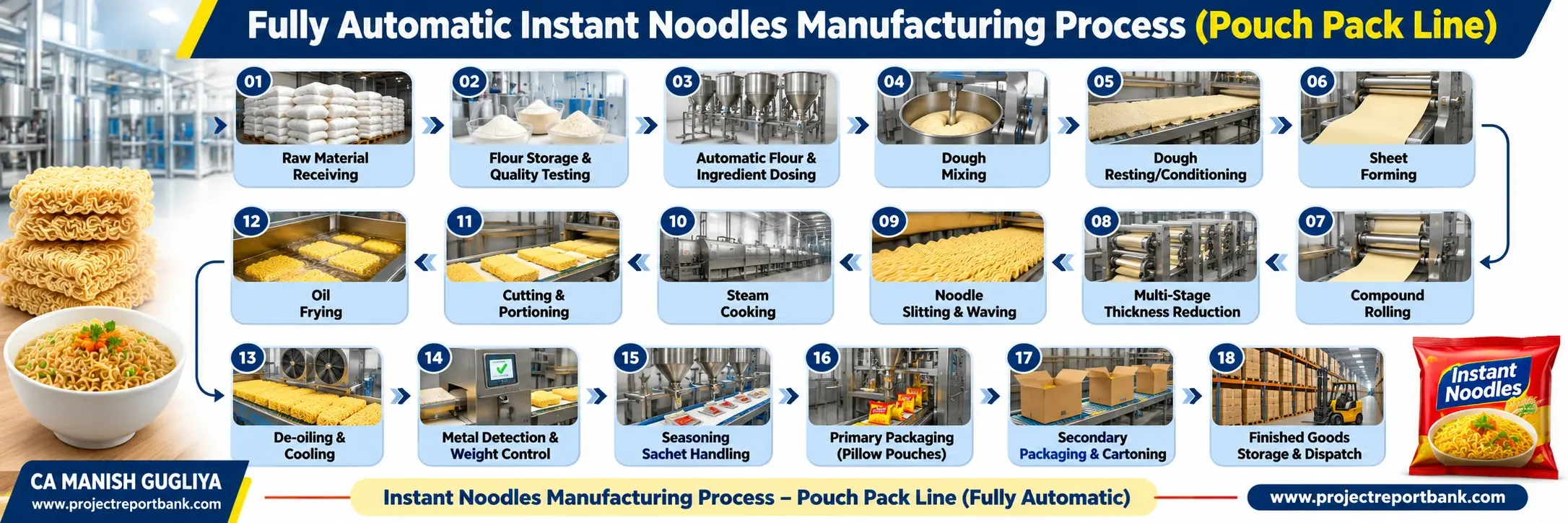
Raw Material Receiving → Flour Storage & Quality Testing → Automatic Flour & Ingredient Dosing → Dough Mixing → Dough Resting/Conditioning → Sheet Forming → Compound Rolling → Multi-Stage Thickness Reduction → Noodle Slitting & Waving → Steam Cooking → Cutting & Portioning → Oil Frying → De-oiling & Cooling → Metal Detection & Weight Control → Seasoning Sachet Handling → Primary Packaging (Pillow Pouches) → Secondary Packaging & Cartoning → Finished Goods Storage → Dispatch
The various unit operations involved include:
- Flour dosing and mixing – controlled water absorption and gluten development using wheat flour with 8.5–12.5% protein content; alkaline agents like sodium carbonate are used for texture
- Dough resting – hydration and elasticity development before sheeting
- Compound rolling and thickness reduction – achieving uniform dough sheets for consistent noodle quality
- Slitting and waving – creating the characteristic wavy noodle texture
- Steam cooking – starch gelatinisation for partial cooking; critical for downstream frying or drying
- Portion cutting and folding – forming individual noodle blocks
- Oil frying – instant noodles require refined palm oil or sunflower oil for frying, reducing moisture to 2–5% and increasing shelf stability; frying oil turnover and filtration must be rigorously controlled
- Cooling and product stabilisation – temperature reduction before packaging to prevent condensation
Quality control at each stage is crucial: in-process checks for moisture, fat content, block weight, metal detection, packaging integrity, and shelf-life testing linked to HACCP/food safety plans. Facilities for quality control should include testing for raw materials and finished products.
A non-fried instant noodles manufacturing process replaces the fryer with a hot-air dryer, targeting 8–12% moisture. This requires different residence times, air temperatures, and separate process validation for texture, rehydration, and safety.
Fully Automatic Cup Noodles Manufacturing Process
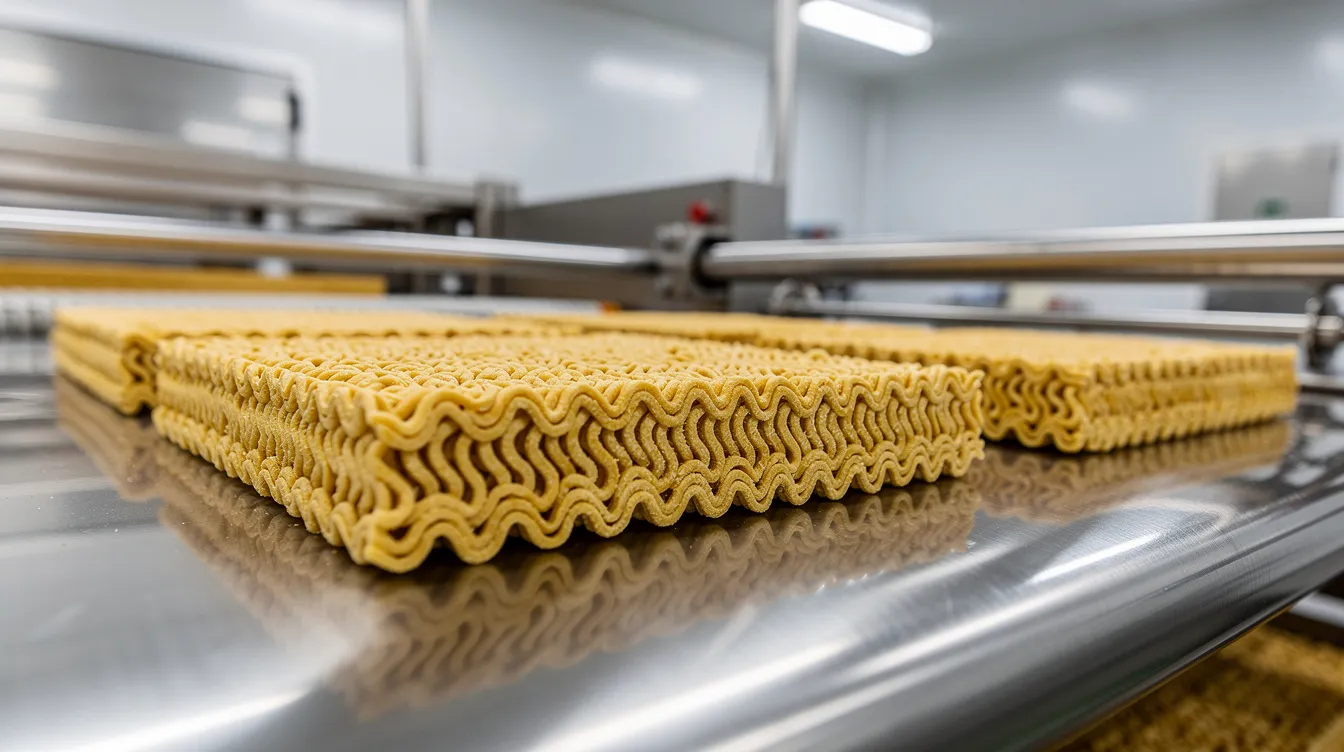
Cup noodles production uses a common upstream instant noodles manufacturing process to produce noodle cakes, then diverts them to a dedicated cup-filling and sealing section. The detailed process flow for the cup noodles line:
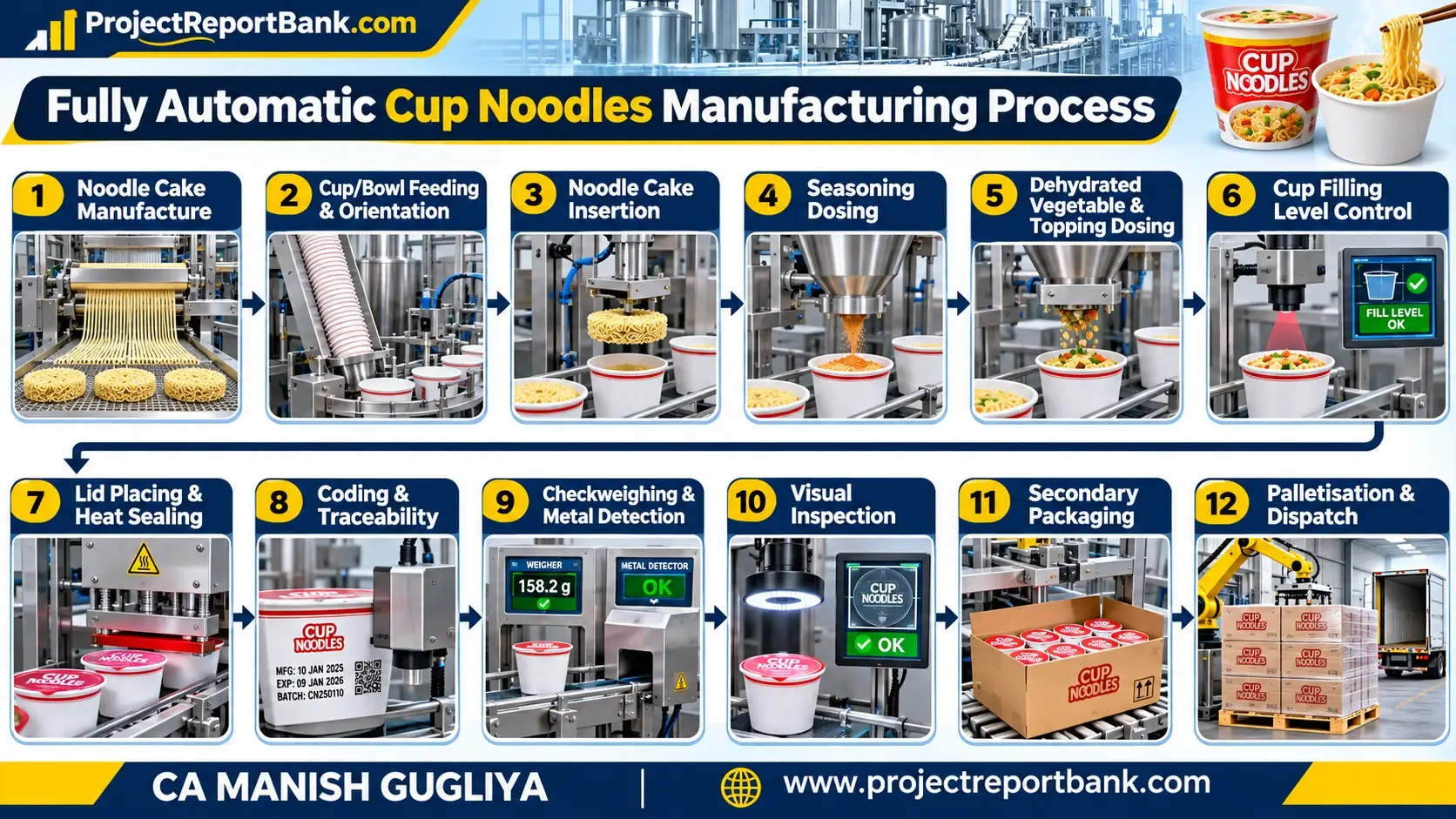
Noodle Cake Manufacture → Cup/Bowl Feeding & Orientation → Noodle Cake Insertion → Seasoning Dosing → Dehydrated Vegetable & Topping Dosing → Cup Filling Level Control → Lid Placing & Heat Sealing → Coding & Traceability → Checkweighing & Metal Detection → Visual Inspection → Secondary Packaging → Palletisation & Dispatch
Key steps include automatic denesting and conveying of cups, synchronised noodle cake feeding, multi-head dispensers for seasonings and vegetables, and sealing temperature settings ensuring hot-water resistance and seal integrity. Food-contact suitability of cups (PP, PS, paper with barrier coatings) must comply with FSSAI and Legal Metrology rules.
Additional quality assurance considerations specific to cup noodles include control of particle dust, allergen cross-contact management in multi-flavour lines, and periodic seal-strength testing. The noodles manufacturing plant project report must clarify whether the plant will run pouch instant noodles only, cup noodles only, or an integrated model sharing upstream capacity with separate downstream packaging sections. Per-serving economics and packaging cost dynamics are also relevant to products like Cup Poha Manufacturing, Packaging & Business Model.
Automatic Instant Noodles Production Line Machinery
Plant and machinery requirements should be specified based on production capacity needs. Below is an overview of major machinery categories:
| Machinery | Function | Key Selection Criteria |
|---|---|---|
| Flour silos & pneumatic conveying | Storage and dust-free transfer | Capacity, food-grade construction |
| Automatic dosing & weighing | Precise ingredient proportioning | Accuracy, PLC integration |
| Industrial dough mixer | Uniform dough preparation | Batch size, mixing speed, CIP capability |
| Compound sheeter & multi-stage rollers | Sheet forming and thickness reduction | Roll width, pressure uniformity |
| Slitting & waving machines | Noodle strand formation | Strand count, wave pitch |
| Continuous steamer | Starch gelatinisation | Steam capacity, belt speed |
| Continuous fryer with oil filtration | Moisture removal via frying | Oil volume, temperature control, heat exchangers |
| Hot-air dryer (non-fried) | Drying without oil | Airflow zones, temperature uniformity |
| Cooling conveyor | Product stabilisation | Length, ambient/forced air |
| Seasoning sachet machines | Sachet fill-seal | Speed (sachets/min), dosing accuracy |
| VFFS pouch packing | Primary pouch packaging | Packs/min, seal quality |
| Cup filling & sealing | Cup noodles assembly | Cups/min, seal integrity |
| Checkweighers & metal detectors | Inline quality checks | Sensitivity, rejection mechanism |
| Cartoners & case packers | Secondary packaging | Speed, format flexibility |
| Boiler, compressor, water treatment | Utilities | Capacity matched to process demand |
| Laboratory instruments | Quality control testing | Moisture, fat, microbiological analysis |
Promoters should compare indigenous versus imported machinery based on total cost of ownership, local technical support, compliance with Indian safety standards, and integration capability. Project Report Bank’s DPRs include preliminary machinery lists with estimated capital costs, but promoters must validate with current quotations from at least 2–3 reputable manufacturers.
Production Capacity Planning for Industrial Noodles Plants
Capacity planning must be aligned to realistic market demand, distribution rollout, and working capital capacity. A noodles manufacturing plant typically requires 50,000 to 200,000 MT capacity across the industry, though individual plant sizes vary widely. The production capacity ranges from 50,000 to 200,000 MT annually at industry level.
| Scenario | Approx. Output/Hour | Annual Output (300 days, 2 shifts) | DPR Use |
|---|---|---|---|
| 3 TPD | ~125 kg/hr | ~900 MT/year | Small-medium plant |
| 5 TPD | ~200 kg/hr | ~1,500 MT/year | Medium plant |
| 10 TPD+ | ~400 kg/hr | ~3,000 MT/year | Large plant |
Translating rated machine capacity into annual saleable output requires accounting for shift operations, planned operating days (typically 300), maintenance downtime, product changeover, quality rejections, and yield losses. Capacity utilisation ramp-up typically starts at 50–60% in year one, moving toward 80–85% by years four to five. Over-optimistic utilisation assumptions can distort DSCR and IRR calculations. Downstream cup filling and sealing speed can become a bottleneck even when upstream capacity is available, and must be verified in technical layouts. Human resource requirements also scale with capacity, from approximately 50 to 200 staff for larger installations.
Land, Building, Plant Layout and Infrastructure
Hygienic zoning, linear product flow, and allowance for future expansion are central principles for an instant noodles manufacturing unit. Plant layout should reflect separate areas for production, packaging, and storage. Key functional areas include:
- Raw material storage area and flour warehouse, packaging material store
- Dough preparation, sheeting, rolling, steaming, and frying/drying sections
- Cooling and inspection zone, seasoning preparation room
- Pouch packing hall, cup filling and sealing section
- Finished goods warehouse, utilities block (boilers, compressor, DG)
- Quality-control laboratory, staff facilities, administration, and dispatch yard
Unidirectional movement from raw material receipt to finished goods dispatch reduces cross-contamination risk. Infrastructure costs include food-grade flooring, controlled ventilation, lighting, drainage, water treatment, and fire safety systems. Site development, boundary walls, and transportation requirements for inbound raw materials and outbound finished goods must also be planned. Land and infrastructure costs are essential for plant setup and vary significantly by location. Regulatory and certification considerations-FSSAI guidelines, HACCP/ISO 22000, and state Pollution Control Board norms-impact building design from the DPR stage.
Instant Noodles Manufacturing Plant Setup Cost and Capital Investment
Setting up a noodles plant requires significant capital investment. Rather than guessing a single figure, promoters should use a structured capital expenditure framework. The project cost should be broken down into categories like machinery and infrastructure. A bankable instant noodles project report from Project Report Bank breaks costs into defined heads:
| Cost Component | Remarks |
|---|---|
| Land & site development | Location-specific; lease or purchase |
| Factory building & civil works | Hygienic food-grade construction |
| Noodle processing line machinery | Largest single cost head |
| Fryer or dryer systems | Technology-dependent |
| Cup filling, sealing & dosing equipment | If cup noodles line is included |
| Pouch packaging machinery | VFFS, cartoners |
| Utilities (boiler, compressor, DG, water) | Matched to capacity |
| Electrical installation | Transformers, panels, wiring |
| Laboratory & QC equipment | Mandatory for quality assurance |
| Installation & commissioning | Supplier-assisted |
| Pre-operative expenses | Interest during construction, consultancy, approvals |
| Contingencies | Typically 5–10% of hard costs |
| Margin money for working capital | For bank cash-credit limits |
Initial investment for a small semi-automatic noodles unit ranges from ₹15 lakh to ₹75 lakh, but a fully automatic industrial instant noodles plant with cup noodles capability requires substantially higher capital costs, potentially ₹3 crore to ₹80 crore depending on capacity, automation level, and infrastructure. Eligible project cost for bank finance typically excludes land in some lending norms. Due to rapid changes in machinery prices and building materials, the DPR must use current quotations rather than outdated figures.
Raw Materials, Production Cost and Operating Expenses
Operating costs for noodles manufacturing are driven by raw materials, particularly wheat flour and edible oil. Raw material consumption forms the bulk of variable costs. Wheat flour accounts for 65-75% of operating expenses in many configurations. The operating cost for the first year is projected to be significant relative to revenue due to lower capacity utilisation.
| Cost Component | Approx. % of Ex-Factory Sales (Illustrative) |
|---|---|
| Wheat flour/maida | 35–45% |
| Edible oil (palm oil for fried noodles) | 10–20% |
| Seasonings, vegetables & additives | 5–10% |
| Packaging materials | 10–15% (higher for cup noodles) |
| Utilities & labour | 8–12% |
| Selling, distribution & freight | 8–12% |
Key utility requirements include steam and fuel consumption, electrical power, process water, and maintenance consumables. The operating cost structure differs between fried noodles (higher oil cost, lower drying energy) and non-fried lines (no oil but higher drying energy). Price trends in wheat flour and palm oil directly affect profit margins. Understanding cost per kg of noodles, cost per block, and cost per retail cup is essential-cup noodles show much higher packaging cost share despite their higher selling price.
Cup Noodles vs Pouch Noodles – Investment and Profitability Comparison
Many promoters assume cup noodles are automatically more profitable due to higher MRP. In reality, capital costs, packing cost, freight, and shelf-space dynamics can offset the higher selling price. Instant noodles manufacturing gross margins typically range from 25-45%, but the split varies significantly by format:
| Parameter | Pouch Noodles | Cup Noodles |
|---|---|---|
| Machinery investment | Lower | Higher (cup feeding, dosing, sealing) |
| Packaging cost per serving | Lower | Significantly higher |
| Throughput (packs/min) | Higher | Lower |
| Selling price band | Mass market | Premium |
| Logistics volume per ₹1L sales | Lower | Higher (bulky packaging) |
| Gross contribution potential | Moderate | Higher per unit, but offset by costs |
| Transit damage risk | Lower | Higher |
| Competition intensity | Very high | Moderate but growing |
Gross profit margins for instant noodles range from 25-35% at the manufacturing level, but cup noodles’ higher packaging and logistics costs can narrow net margins. A customised financial analysis within the DPR is needed for each promoter to decide optimal product mix. The comparison of cup-based convenience food economics is also discussed, in a different process context, in the Cup Poha Manufacturing, Packaging & Business Model.
Working Capital Requirements
Instant noodles and cup noodles businesses are working-capital intensive. A working capital assessment is needed to determine funds required for daily operations. Major current-asset components include:
- Raw material stock (maida, oil, seasonings) – typically 15–20 days of consumption
- Packing material inventory (laminates, cups, cartons)
- Work-in-progress and finished goods stock to service distributor orders
- Trade receivables from distributors, modern trade, and export buyers
Current liabilities partially offset requirements through supplier credit for raw and packing materials. The working capital cycle (inventory days plus receivable days minus payable days) determines cash-credit limit needs. Project Report Bank prepares month-wise working capital assessments for the first operating year and annual assessments thereafter, feeding into CMA Data for banks and helping estimate drawing power against stocks and receivables. Fixed and variable costs must both be considered in the assessment.
Instant Noodles Manufacturing Plant Financial Projections and Feasibility Analysis
A DPR is essential for securing bank loans or investment funding. Serious promoters and bankers expect a 7–10 year financial model for an instant noodles manufacturing plant DPR. Financial projections should cover projected profit and loss statements for several years, including:
- Year-wise capacity utilisation and product-wise production volumes
- Revenue by product and packaging category, income and expenditure projections
- Cost of goods sold, gross profit, EBITDA, depreciation, interest, profit before and after tax
- Projected balance sheet, cash flow statements and profitability analysis
- Debt repayment schedule, working capital assessment
Financial analyses should include metrics such as ROI and NPV for investment decisions. Key ratio analyses include Debt Service Coverage Ratio (an important indicator for loan repayment capacity analysis), break-even point analysis (which helps determine the minimum operating level to avoid losses), Internal Rate of Return, net present value, payback period, and sensitivity analysis on selling price, raw material costs, capacity utilisation, and price volatility. Financial projections include capital investment, operating costs, and expected ROI, but Project Report Bank does not insert arbitrary figures-projections are built on transparent, project-specific assumptions. Project feasibility studies assess the commercial viability of investment opportunities.
For large instant noodles and cup noodles capital investments combining bank term loans and equity funding, promoters may benefit from How to Get Investors & Raise Equity Funding in India.
Bank Loan DPR, CMA Data and Project Finance
A bankable detailed project report and CMA Data preparation are needed for bank loan proposals and financial assessments for a fully automatic instant noodles manufacturing plant. The DPR should include a clear executive summary providing a snapshot of the entire project, promoter profile, detailed technical description of the instant noodles manufacturing process, machinery list with estimated costs, implementation schedule, project cost and means of finance (promoter contribution, term loan, subsidies), projected financial statements, and risk analysis. The DPR should outline financial projections and project viability analysis. Detailed project reports typically include market analysis and demand potential, along with the instant noodles business plan and business requirements.
CMA Data elements include operating statement, fund-flow statement, working capital assessment, maximum permissible bank finance calculation, and ratio analysis. Banks examine promoter equity commitment, security, DSCR over loan tenure, and sensitivity of profitability to raw material price changes. Government schemes can provide financial assistance for food processing projects. Different lenders have varying norms, so DPR and CMA Data are tailored to specific lender formats. Investor-ready documentation is critical for raising funds through equity investment alongside debt. Financial modeling includes creating cash flow statements aligned with the proposed instant noodles manufacturing unit’s projections.
Regulatory Approvals and Food Safety Compliance
Statutory approvals are required for legally operating a food manufacturing plant. Compliance with local regulations for food safety is necessary for the manufacturing process. Regulatory compliance includes obtaining licenses such as FSSAI for food safety, along with:
- FSSAI central licence (for larger capacities/turnover), adherence to applicable instant noodles standards
- Factory and boiler licences, state Pollution Control Board consent, fire NOC
- GST registration, Shops & Establishment or Factories Act registration
- Food safety management systems: HACCP, ISO 22000, or FSSC 22000 as demanded by buyers
- Legal Metrology compliance: net quantity, MRP, batch/expiry dates, FSSAI logo, nutritional information, veg/non-veg declaration
- Plastic Waste Management Rules and Extended Producer Responsibility for plastic packaging, especially relevant for cup noodles
- Monitoring and discarding degraded frying oil, microbiological testing, shelf-life validation, and traceability systems for recall readiness
Industrial Noodles Manufacturing Project Risks and Feasibility Challenges
Even with a growing instant noodles industry, not every project succeeds. Risk analysis and mitigation strategies must be included in project planning. Major risk factors include:
- Over-investment relative to realistic market demand and low capacity utilisation
- Incorrect machinery specifications or supplier selection
- Raw material price volatility-wheat flour and edible oil prices can fluctuate 10–20%, directly impacting profit margins
- Food safety incidents or quality failures damaging brand trust
- High cup packaging costs eroding net margins despite premium MRP
- Intense price competition, promotion costs, and slow brand development
- Working capital shortages and delayed receivables creating DSCR stress
A sensitivity analysis framework should compare base-case projections with scenarios of 10% lower selling price, 10% higher flour/oil cost, 10–15 percentage-point lower capacity utilisation, and longer receivable days, assessing impact on EBITDA margin and DSCR. Practical mitigation strategies include phased capacity expansion, cautious launch geography, combination of own brand and private-label contracts, raw material procurement policies, preventive maintenance, and maintaining adequate working-capital buffers.
Similar financial risk analysis applies to other industrial food-processing projects such as Industrial Corn Flakes & Multigrain Flakes Manufacturing Plant Project Report.
Why a Professional DPR Is Essential Before Investing
In over two decades of project finance and DPR work, I have observed that detailed, realistic planning significantly improves the chances of bank approval and sustainable operations for instant noodles manufacturing plants. Professional advisory services are critical for entrepreneurs lacking in-house expertise in financial modelling, project feasibility, and bank documentation. Customer profiles for our advisory services include SMEs, manufacturers, and project promoters across India.
Key benefits of commissioning a customised DPR for a fully automatic instant noodles and cup noodles project include accurate estimation of project cost, careful selection of capacity and automation level, clear comparison of pouch versus cup product mix, robust financial projections and DSCR analysis, and early identification of working-capital gaps. Project Report Bank’s DPRs integrate machinery quotations, location-specific cost factors, realistic sales roll-out assumptions, and project-specific sensitivity analysis. Detailed education content is provided covering project planning and industry specifics. A professionally structured DPR and CMA Data set reduces back-and-forth with banks, helps answer queries confidently, and provides a roadmap for monitoring performance post-commissioning.
CA Manish Gugliya, FCA, DISA (ICAI) Practising Chartered Accountant | Industrial DPR & Project Finance Consultant www.projectreportbank.com
To discuss a customised instant noodles or cup noodles manufacturing plant project report, share your proposed plant location, production capacity, product mix, machinery quotations, estimated investment, and financing requirements through ProjectReportBank.com. WhatsApp is the preferred initial contact channel for serious project enquiries.
Frequently Asked Questions
What lead time should I budget for setting up a fully automatic instant noodles and cup noodles plant?
Typical timelines include 1–2 months for detailed planning and DPR preparation, 2–4 months for land finalisation and regulatory groundwork, 4–6 months for civil construction and utilities, and 4–6 months parallelly for ordering and receiving automatic instant noodles production line machinery. Installation, trial runs, and FSSAI licensing may take another 1–2 months. In practice, an integrated instant noodles manufacturing unit may take 10–14 months from project conception to commercial production, depending on site readiness, machinery origin, and speed of regulatory approvals.
Can one instant noodles plant serve both my own brand and private-label contracts?
Technically, the same fully automatic instant noodles manufacturing process and packing lines can serve both own-brand and private-label pouch or cup noodles, subject to appropriate scheduling, allergen control, and packaging changeovers. The DPR should separately model pricing, credit terms, and marketing spends for own brand versus private-label volumes, as private-label contracts may offer lower margins but provide more stable base orders for capacity utilisation and debt servicing.
Is it advisable to start with a non-fried instant noodles line instead of a fried line?
Non-fried instant noodles require different drying technology and product development. While they appeal to health-conscious consumers, the market is still evolving and carries higher price expectations. Many promoters initially install a fried instant noodles line-the dominant format-and evaluate adding a non-fried dryer section later. Such phased investment strategy should be assessed within the DPR based on target markets and brand positioning.
Can I integrate other convenience-food products with an instant noodles plant?
Some promoters consider adding complementary products such as extruded snacks or breakfast cereals, but these use entirely different core technologies and equipment. Such diversification should be evaluated in a separate or expanded DPR to ensure capital, utilities, and management bandwidth are adequate, and that each line remains financially viable on its own merits.
How often should financial projections for an operating noodles plant be updated?
Once the instant noodles manufacturing plant is operational, promoters should update detailed financial projections at least annually, or earlier if there are significant changes in raw material prices, selling prices, capacity utilisation, or financing terms. Project Report Bank can assist existing units with revised CMA Data, refinancing proposals, or expansion DPRs based on updated performance and market conditions.