Key Takeaways
- A medium-to-large industrial rolled oats processing plant in India typically requires a total project investment starting from approximately ₹5–₹7 crore for a 20 TPD line and can scale to ₹25–₹40 crore or more for a 100 TPD facility, depending on automation, building standards and utility systems.
- An industrial rolled oats processing plant project report and an instant oats processing plant project report must cover market feasibility, raw oat procurement strategy (domestic plus imports), technical process design, capital costs, working capital assessment and bankable financial projections including DSCR, IRR and break-even analysis.
- Rolled oats, quick oats and instant oats can often be produced on an integrated automatic line with product-specific adjustments in steam conditioning, flake thickness and additional drying, but machinery requirements, capital costs and utility requirements need careful engineering and financial planning.
- Project Report Bank, led by CA Manish Gugliya, FCA, DISA (ICAI), prepares customised DPRs, CMA data and financial models for oat processing plants in the 20, 50 and 100 TPD range with detailed DSCR, IRR and break-even analysis for both bank finance and equity investors.
- This article is an educational industrial-investment guide; final investment decisions should rely on project-specific engineering data, vendor quotations and tailored financial feasibility studies.
Introduction – Industrial Rolled Oats Processing Plant Project Report
Industrial rolled oats and instant oats have become key products in India’s health-food and breakfast-cereal segment. Health consciousness drives rolled oats market growth, and the demand for convenience foods boosts rolled oats consumption across retail brands, private labels and institutional buyers. Since around 2020, the acceleration in consumer adoption has created a meaningful opportunity for domestic processing at industrial scale.
Modern oat processing transforms raw oat grain into oat groats, rolled oats, quick oats and instant oats using integrated cleaning, dehulling, kilning, steam conditioning and flaking lines designed for 20–100 TPD and larger industrial capacities. Detailed project planning requires a thorough understanding of production capacity, cost assessment and financial viability before committing capital.
An industrial rolled oats processing plant project report is the comprehensive document covering technical configuration, plant setup, machinery sizing, project cost, working capital, profitability, DSCR and risk assessment. A detailed project report format for an industrial rolled oats processing plant follows a structured framework that integrates engineering inputs with financial analysis. A project report for industrial rolled oats processing is used for securing bank financing and government subsidies.
Project Report Bank, led by CA Manish Gugliya, FCA, DISA (ICAI), is a Chartered Accountant-led advisory specialising in customised DPRs, financial modelling, CMA data and project-finance advisory for food and grain-processing plants across India. This article is aimed at serious investors and promoters planning medium-to-large plants with investments of ₹5 crore and above. All financial figures presented are illustrative and must be refined for each specific site and project configuration.
Market Opportunity for Rolled Oats and Instant Oats in India
Urbanisation, busy lifestyles and rising health awareness have expanded demand for rolled oats, instant oats and oat-based breakfast products in India. Market potential analysis includes local, national and export trends for healthy breakfast cereals. The market analysis assesses the demand-supply gap for healthy breakfast cereals and oat-based ingredients.
As of 2025, the India oats market was valued at approximately USD 506.5 million, with forecasts indicating growth to about USD 606.4 million by 2034. The total size of the volume market was around 71,000 metric tonnes in 2023. The instant oatmeal segment has shown particularly strong momentum, with value growth estimated at 14–17% CAGR.
Consumer-facing segments include retail packaged oats under national and regional brands, private-label packs for modern trade, and online D2C health brands focusing on clean-label and whole-grain claims. On the B2B side, bulk industrial oat flakes are supplied to breakfast cereal manufacturers, bakeries, biscuit producers, snack makers and diet-food kitchens. These industry trends point towards a structural shift in both retail and ingredient demand.
Raw material sourcing is a critical consideration. Most Indian oat acreage is dedicated to fodder, with limited domestic cultivation of milling-grade oats for human consumption. India’s raw oat imports increased five-fold over a decade, and the country imports around 200,000 tonnes annually of raw oats. Australia is the main supplier of raw oats to India. Rolled oats are taxed at 30% import duty from Australia, which affects the landed cost and the competitive positioning of domestically processed oats.
Competition is significant. In the branded segment, Saffola holds approximately 45% value share and Quaker around 30%, making them the key players. A new entrant can position itself as a B2B ingredient supplier, private-label specialist or adopt a mixed own-brand plus B2B strategy. Distribution channels include wholesalers, modern retail, e-commerce marketplaces, institutional tenders and long-term supply contracts.
Key risk factors in this market include price volatility of raw oats, currency risks for imports, brand-level price wars and consumer sensitivity to the quality and consistency of rolled oats. Region price analysis impact and segment market breakup should be studied carefully before finalising the revenue model.
Industrial Oats Processing Plant – Product Portfolio and Applications
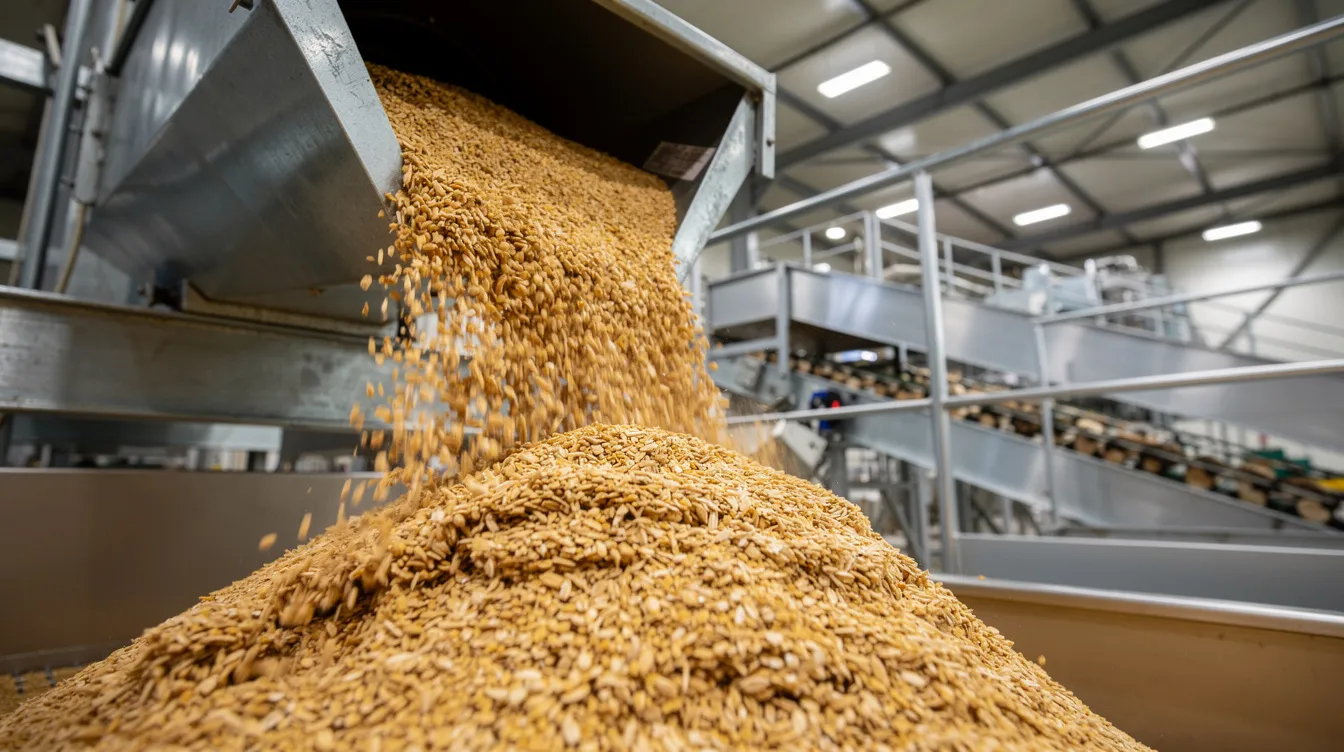
A modern industrial oats processing plant can produce several distinct products from oat groats on the same core line, with adjustments in cutting, flake thickness and thermal treatment. The final product range determines machinery requirements and revenue potential.
| Product Type | Process Highlights | Typical Flake Thickness | Main Applications | Target Markets |
|---|---|---|---|---|
| Regular Rolled Oats | Whole groats, moderate steaming, standard rolling gap | 0.51–0.76 mm | Traditional porridge, baking | Retail, institutional |
| Thick Rolled Oats | Whole groats, lighter steaming, wider rolling gap | 0.76–1.0 mm | Granola, muesli, texture-rich applications | Retail, bakery |
| Quick-Cooking Oats | Cut groats, higher steaming, thinner rolling | 0.36–0.46 mm | Fast-cooking porridge, smoothie bowls | Retail, convenience |
| Instant Oats | Finely cut groats, intensive conditioning, thin flaking, extra drying | ≤0.36 mm | Hot-water reconstitution, sachets, oatmeal | Retail, HORECA, private label |
| Steel-Cut / Groat Products | Cut groats, minimal or no flaking | N/A (cut pieces) | Niche whole-grain cooking | Health food, premium retail |
| Industrial Oat Flakes | Customised flake size per buyer specification | Variable | Cereal blends, snack bars, bakery ingredients | B2B, food manufacturers |
Adjacent but secondary products include oat flour, oat bran and oat hulls. The popularity of oat flour is rising due to gluten-free trends and clean-label demand, making it a useful value-adding by-product. Hulls can be used as biomass fuel or animal feed. These should be considered as by-product revenue rather than the primary scope.
For promoters evaluating other breakfast cereal investments, the Industrial Corn Flakes & Multigrain Flakes Manufacturing Plant Project Report and Ready-to-Eat Millet Breakfast Cereals Manufacturing Plant Project Report cover alternative processing technologies.
Plant Capacity Planning for Industrial Oats Processing (20, 50 and 100 TPD)
Realistic capacity planning is critical for matching plant size to raw oat availability, off-take commitments, promoter capital and bankable financials. Capacity is usually expressed based on raw oat intake per day at standard operating hours of 16–20 hours across 2–3 shifts.
Key planning parameters include annual operating days (typically 300–330), the distinction between raw oat input versus finished rolled oats output, and typical groat recovery assumptions. Oat groats yield 68 to 72% of the kernel weight after dehulling, with the hull constituting about 28–32% of raw grain weight. Additional process losses during cleaning, kiln drying and flaking further reduce the finished-product output.
| Parameter | 20 TPD Plant | 50 TPD Plant | 100 TPD Plant |
|---|---|---|---|
| Raw Oat Input (tonnes/day) | 20 | 50 | 100 |
| Indicative Finished Output Range (tonnes/day) | 12–14 | 30–35 | 60–70 |
| Typical Working Shifts | 2 | 2–3 | 3 |
| Annual Operating Days | 300–320 | 300–330 | 310–330 |
| Steam & Power Requirement | Moderate | Medium-High | High |
| Indicative Project Cost Range (₹ crore) | 5–10 | 12–22 | 25–40+ |
Production bottlenecks typically occur at the dehulling stage, kiln throughput, steam-conditioning and flaking sections or the dryer and packing-line speed, all of which must be line-balanced in DPR-level design. Capacity-utilisation ramp-up is usually planned at 50–60% in year 1, 70–80% in year 2 and stabilising thereafter, which directly impacts bank-finance appraisals and DSCR calculations.
Actual yields and utilities depend on raw material quality, specific machinery, target moisture and product mix, so exact capacity and balance-of-plant sizing must be engineered on a project-specific basis. Similar capacity-planning principles apply across grain-processing projects, as discussed in the Integrated Rice Milling & Processing Plant Project Report.
Raw Materials and Procurement Requirements for Oats Processing
The primary raw material is milling-grade raw oats with uniform variety, adequate test weight (minimum 46 kg per hectolitre per FSSAI standards), moisture typically below 12–14% and low foreign matter. Oat groats are the primary raw material for downstream oat processing after dehulling and cleaning. FSSAI allows oats to have up to 14% moisture content.
Key raw material requirements include imported milling oats (primarily from Australia or Europe), any available domestic supplies, food-grade steam, process water and food-safe processing aids. Oats must meet FSSAI standards: 14% moisture, 1% foreign matter. India’s raw oat imports rose five-fold in a decade, reflecting limited domestic milling-grade availability. Various feedstocks should be evaluated for quality consistency before finalising contracts.
Packaging requirements include multilayer laminated pouches, bulk paper or poly bags, BOPP labels, master cartons and palletisation materials. Barrier properties for aroma and moisture control are important for shelf life performance.
Inventory and procurement strategy should address seasonal import planning, hedging against price volatility, establishing contracts with overseas suppliers, quality certifications and adherence to FSSAI specifications. Storage requires temperature and humidity control, pest management, FIFO and batch-wise traceability. Segregation of raw oats, hulls, groats and finished products is essential. For reference on raw-material planning approaches in grain processing, see Paddy Procurement & Raw Material Planning for Rice Mill.
Raw-material price risk directly impacts gross margin. A small percentage change in raw oat price can significantly affect contribution margins in a commodity-like product, making price trends monitoring and supply agreements critical.
Rolled Oats and Instant Oats Manufacturing Process
The manufacturing process involves an integrated flow from raw oat reception to packed finished rolled or instant oats, with food safety, yield optimisation and consistency at the core. The various unit operations involved are outlined below.
Process Flow:
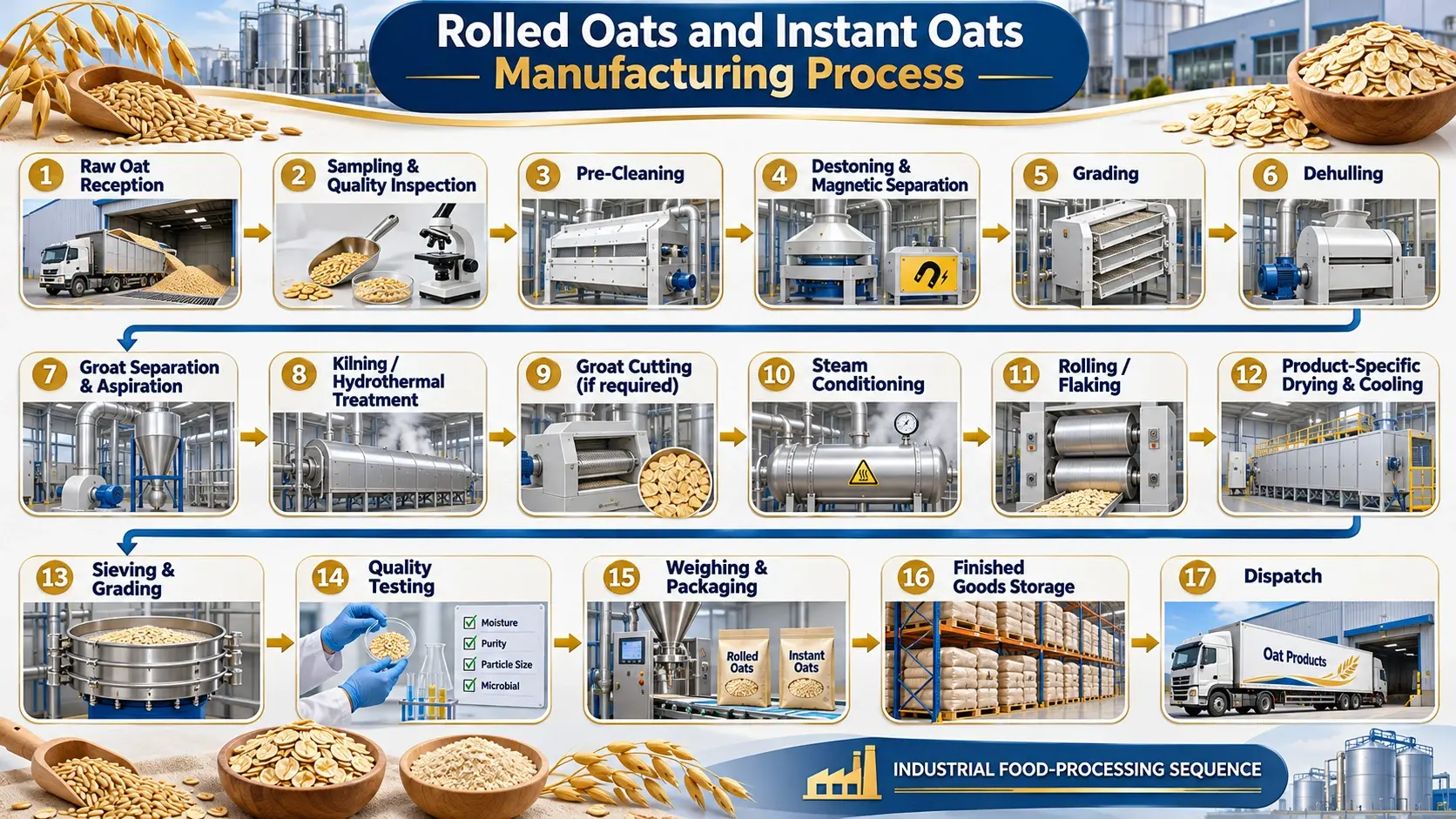
Raw Oat Reception → Sampling & Quality Inspection → Pre-Cleaning → Destoning & Magnetic Separation → Grading → Dehulling → Groat Separation & Aspiration → Kilning / Hydrothermal Treatment → Groat Cutting (if required) → Steam Conditioning → Rolling / Flaking → Product-Specific Drying & Cooling → Sieving & Grading → Quality Testing → Weighing & Packaging → Finished Goods Storage → Dispatch
Each major step serves a specific purpose. Pre-cleaning removes impurities. Destoning eliminates stone and dense-particle contamination. Magnetic separation ensures metal safety. Grading provides size uniformity for efficient dehulling. A dehuller and kiln are essential for oats processing – the dehuller removes the inedible hull, while kilning inactivates lipase enzymes and stabilises flavour, extending shelf life significantly.
Rolled oats are flattened to 0.51 to 0.76 mm thickness using flaking roller mills. Flaking requires a flaking roller mill for rolled oats, and the rolling gap determines the product type. Live steam is used for conditioning groats before flaking, raising moisture by approximately 3–5% before rolling, after which the product is dried back to about 10–12% moisture for storage stability.
Oat processing requires automated systems for improved yields and consistency. Moisture management throughout the process is critical – inline moisture measurement ensures uniform product quality. Food-safety controls include metal detection, sieving, dust management, allergen and cross-contamination controls, HACCP planning and in-house lab testing.
By-product handling covers oat hulls for biomass fuel or animal feed, screening fines for possible use in flour or bran blends, and the importance of establishing buyers for hulls to avoid waste buildup on site.
Rolled Oats vs Instant Oats – Process and Technology Differences
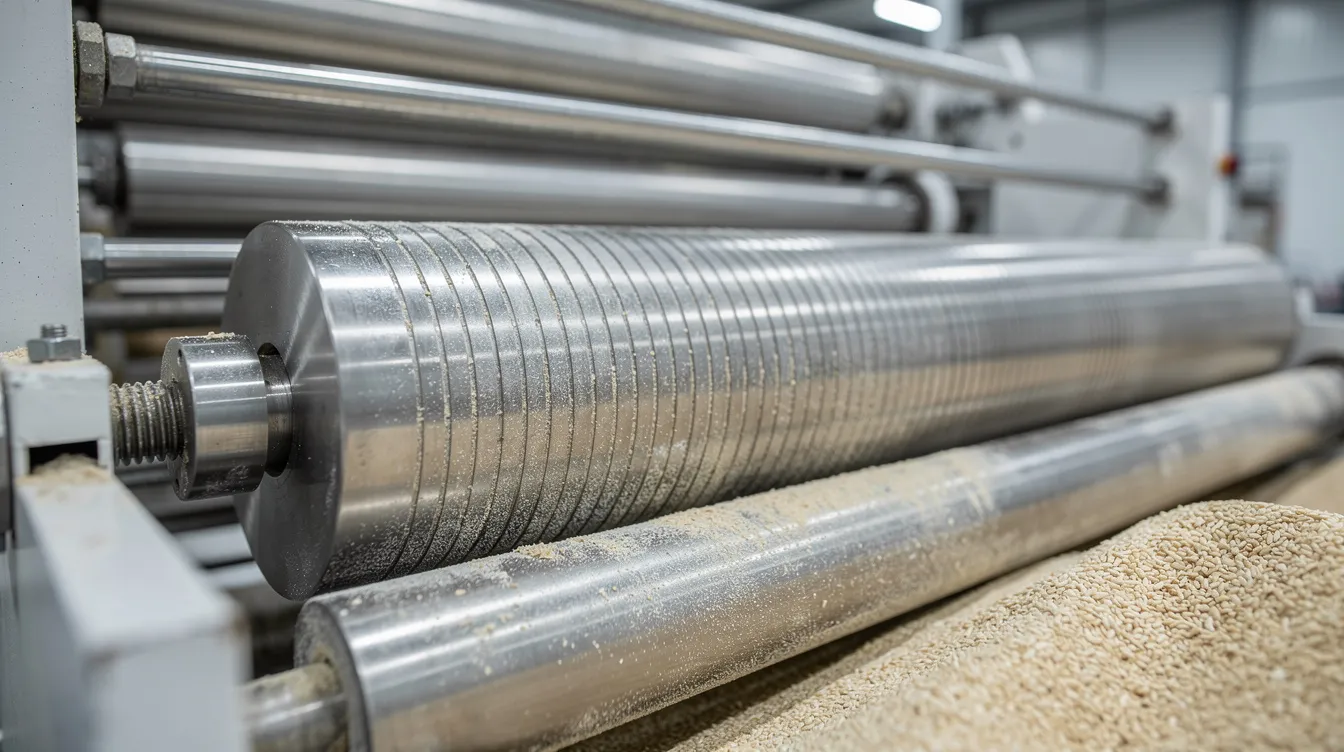
Both products share the same core front-end processes (cleaning, dehulling, kilning) and diverge mainly in groat cutting, steam-conditioning intensity, flake thickness and final drying conditions. The product overview and unit operations for each variant differ as follows:
Regular rolled oats involve whole or coarsely cut groats, moderate steaming and a thicker rolling gap, resulting in longer cooking times but a more intact texture. Quick oats and instant oats use more finely cut groats, thinner flaking and, in the case of instant oats, more extensive hydrothermal treatment to deliver very short preparation times with hot water or milk. Importantly, not all instant oats require extrusion – many are flake-based instant oats produced through intensive steaming and thin rolling.
| Feature | Regular Rolled Oats | Quick Oats | Instant Oats |
|---|---|---|---|
| Groat Size | Whole or coarse cut | Medium cut | Fine cut |
| Steaming Level | Moderate | Higher | Intensive |
| Flake Thickness | 0.51–0.76 mm | 0.36–0.46 mm | ≤0.36 mm |
| Typical Cooking Time | 5–15 minutes | 3–5 minutes | 1–2 minutes (hot water) |
| Primary End-Use | Porridge, baking, granola | Quick porridge, smoothies | Instant oatmeal, sachets, HORECA |
Industrial Oats Processing Plant Machinery and Equipment
An industrial oats processing plant uses a combination of grain-handling machinery, cleaning and dehulling systems, hydrothermal equipment, flaking and drying lines, automatic packing and process automation. Rolled oats manufacturing requires specific machinery like dehullers and kilns at its core.
| Equipment Group | Function | Capacity Selection Basis | Sourcing |
|---|---|---|---|
| Raw Grain Intake & Conveying | Receiving, elevating, distributing raw oats | Tonnes/hour linked to TPD | Indian / Either |
| Pre-Cleaners | Removing coarse impurities, dust | Matched to intake capacity | Indian / Either |
| Destoner & Magnetic Separator | Stone and metal removal | Matched to cleaning flow | Indian / Either |
| Grading Equipment | Size-based separation for uniform dehulling | Feed rate kg/hr | Indian / Either |
| Oat Dehuller | Hull removal from raw oat grain | 500–1,500+ kg/hr per unit | Indian / Imported |
| Hull Separators & Aspiration | Hull-groat separation, hull recovery | Matched to dehuller output | Indian / Either |
| Kiln / Hydrothermal Unit | Enzyme inactivation, flavour stabilisation | Tonnes/hr, steam pressure | Imported / Either |
| Groat Cutters | Sizing groats for quick/instant oats | Throughput matched to flaker | Indian / Either |
| Steam Conditioner | Moisture and temperature conditioning pre-flaking | Matched to flaker capacity | Imported / Either |
| Flaking Roller Mill | Rolling conditioned groats into flakes | 500–2,000+ kg/hr | Imported / Either |
| Dryer & Cooler | Moisture reduction and temperature normalisation | Matched to flaker output | Indian / Either |
| Sieving & Plansifter | Grading finished flakes, removing fines | Product flow rate | Indian / Either |
| Automatic Packing | Weighing, filling, sealing retail and bulk packs | Packs/min by format | Indian / Either |
| Steam Boiler | Steam generation for conditioning, kilning | Kg steam/hr, fuel type | Indian |
| Dust Collection | Cyclones, bag filters, ducting | Air volume, dust load | Indian |
| QC Lab Equipment | Moisture, protein, microbial testing | As per testing schedule | Either |
| PLC/SCADA | Process automation, data logging | Plant-wide integration | Imported / Either |
An industrial oats processing plant machinery configuration for a diversified rolled-and-instant-oats portfolio requires additional thermal treatment and drying capability compared to a line producing only regular rolled oats. For an understanding of machinery and equipment selection approaches in cereal and flour processing, similar principles of capacity matching and food-safety design apply.
Land, Building, Plant Layout and Infrastructure Planning
Site selection should prioritise proximity to ports or major transport hubs for imported raw oats, access to target markets, reliable power and water supply, and compliance with local industrial zoning regulations. Land and infrastructure requirements are crucial for the setup of an industrial rolled oats plant.
Indicative land requirements scale with capacity: a 20 TPD plant may require a relatively compact industrial plot, while 50 and 100 TPD plants need progressively larger areas covering factory building, raw-material warehouse, hull and by-product storage, finished-goods warehouse, utility block, administrative areas and circulation space. The land required should also account for future expansion of flaking or kilning capacity.
Plant layout significantly influences operational efficiency in oats manufacturing. Layout principles include linear process flow from raw oat intake to packing, segregation of dusty or raw areas from clean packaging areas, separate zones for hull handling and clear inbound/outbound logistics routes. Hygienic design considerations include washable surfaces, adequate ventilation and controlled access zones for food safety audits.
Infrastructure costs cover loading and unloading bays, weighbridge if justified by scale, internal roads, fire hydrant system, drainage and security. Final building dimensions and structural design must be developed by qualified architects and engineers in coordination with the selected machinery layout. For practical insights on plant layout and utility planning in food-processing projects, see the Instant Poha Plant Capacity, Land, Layout & Utilities Guide.
Utilities and Technical Infrastructure
Utilities such as power, steam, water, compressed air and ventilation significantly influence both capital investments and operating costs for an oats processing plant. Utility requirements must be carefully estimated.
Electrical requirements are driven by dehullers, aspiration fans, bucket elevators, flakers, dryers, packing machines and automation systems. Larger plants need dedicated HT connections and appropriate transformer capacity. Steam requirements depend on boiler sizing based on kiln, hydrothermal treatment and steam-conditioning loads. Consistent steam pressure and quality are essential for uniform flake texture and product stability.
Water requirements include boiler feed, cooling-tower makeup if used, cleaning and sanitation. Compressed air serves pneumatic conveying, actuators, valves and packing machines, requiring dry, oil-free air in food-contact zones. Dust-extraction and ventilation through cyclone separators and bag filters protect worker health, reduce explosion risk and support compliance with industrial safety norms.
Actual utility consumption figures and equipment sizing should be confirmed through vendor quotes and process engineering. These numbers feed directly into the DPR’s operating-cost and DSCR analysis.
Rolled Oats Manufacturing Plant Cost and Capital Investment
Total project cost for a rolled and instant oats processing plant comprises fixed capital (land, building, machinery, utilities, pre-operative expenses) plus margin for working capital. Capital expenditure includes machinery, utilities and land costs. The project report must include a breakdown of project costs covering fixed capital and working capital.
| Cost Component | Description |
|---|---|
| Land & Site Development | Acquisition, levelling, boundary, approach roads |
| Civil Works | Factory building, warehouses, utility block, admin |
| Primary Processing Machinery | Cleaning, dehulling, grading equipment |
| Hydrothermal & Flaking Equipment | Kiln, steam conditioner, flaking roller mills |
| Dryers & Coolers | Product drying and cooling systems |
| Packing & Material Handling | Automatic packing, conveyors, palletisers |
| Electricals | HT/LT panels, transformers, wiring, lighting |
| Boiler & Utilities | Steam boiler, compressed air, water treatment |
| Automation / Instrumentation | PLC/SCADA, sensors, control panels |
| QC Lab | Moisture analysers, protein testers, micro lab |
| Erection & Commissioning | Installation, trial runs, start-up costs |
| Engineering & Consultancy | Design, project management, advisory fees |
| Pre-Operative Expenses | Interest during construction, training, preliminary |
| Contingencies | Typically 5–10% of fixed capital |
| Margin for Working Capital | Promoter’s portion of initial working capital |
Capital expenditure analysis includes fixed and variable costs. The rolled oats manufacturing plant cost varies significantly based on automation level, imported versus Indian machinery, building standards and location. For a 20 TPD plant, indicative total project cost may range from ₹5–₹10 crore. A 50 TPD plant may require ₹12–₹22 crore, while a 100 TPD plant could range from ₹25–₹40 crore or higher. These are illustrative ranges and must be validated through vendor quotations and site-specific estimates.
Taxes, import duties, freight, insurance and start-up losses during trial runs must be planned within total project cost in a professional DPR.
Working Capital Requirements
Working capital finances day-to-day operations: raw oats inventory, packaging stocks, processing costs and receivables. It is usually supported by bank cash-credit limits alongside promoter margin.
Major working-capital components include raw oat stocks (often imported and held in bulk), packaging materials, work-in-progress, finished-goods inventory, trade receivables and minimal cash floats. Offsetting current liabilities include supplier credit periods, transporter credit and statutory dues cycles.
| Working Capital Component | Basis of Estimation |
|---|---|
| Raw Oat Inventory | Days of consumption × daily cost |
| Packaging Materials | Days of stock × daily consumption cost |
| Work-in-Progress | Processing cycle days × daily cost of production |
| Finished Goods | Holding days × daily COGS |
| Trade Receivables | Debtor days × daily sales |
| Less: Trade Creditors | Creditor days × daily purchases |
| Net Working Capital Required | Sum of above components |
Costs raw material requirements, costs packaging requirements and costs transportation requirements all contribute to the working-capital cycle. CMA data preparation and bank appraisal are essential for sanctioning cash-credit limits. Conservative assumptions in the DPR can prevent cash-flow stress during initial ramp-up years. For more on working-capital structuring, see Working Capital for Puffed Rice Plant.
Production Cost and Operating Economics
The main cost heads in operating an industrial oats plant are raw oats, steam and fuel, electricity, labour, repairs and maintenance, packaging, factory overheads and logistics. Operating expenses cover labor, maintenance and raw materials.
Raw-oat cost structure includes landed cost at plant, unloading and handling, cleaning losses, hull removal and groat yield. Groats yield 68 to 72% of the oat kernel weight, meaning that the raw-material cost per kg of finished product is significantly higher than the per-kg cost of raw oats. Energy costs involve boiler fuel consumption for steaming, electrical consumption for motors and drives, and compressed air.
| Cost Head | Approximate Share of Total Production Cost |
|---|---|
| Raw Oats (landed) | 55–70% |
| Steam / Fuel | 5–10% |
| Electricity | 3–6% |
| Direct Labour | 4–8% |
| Packaging | 4–8% |
| Repairs & Maintenance | 1–3% |
| Factory Overheads & QC | 2–4% |
| Selling & Distribution | 3–6% |
Operating expenditure projections are crucial for financial modeling. Costs human resource requirements include production supervisors, machine operators, maintenance crew, quality staff, material handlers, packers and administrative staff along with statutory benefits. Costs utility requirements and costs involved in routine compliance add to factory overheads.
The distinction between cost of production, cost of sales and net selling realisation matters for contribution and profitability analysis. Variable costs (raw oats, packaging, utilities, variable labour) must be separated from fixed operating expenses for meaningful break-even calculations.
Revenue Model, Sales Realisation and Profitability
Revenue in an oats processing plant comes from a combination of B2B bulk flakes, private-label packing and own-brand retail packs, along with by-product sales of hulls and fines. Income projections depend on market demand and pricing strategies.
Key revenue channels include long-term supply contracts to cereal manufacturers, private-label manufacturing for supermarkets, own-brand sales through distributors and e-commerce, and institutional supply. The pricing mechanism should benchmark against imported and domestic brands while accounting for raw-oat cost, conversion cost, marketing spend and desired contribution margin.
Profitability is highly sensitive to raw-oat procurement cost, yield, selling prices and utilisation rates. Contribution per kg is calculated as selling price minus variable costs, and this feeds into plant-level EBITDA at different capacity-utilisation levels. Profit projections and expenditure projections must account for the ramp-up period in the initial years. Revenue from various channels should be modelled separately to reflect different margins.
Financial Projections, DSCR, IRR and Break-Even Analysis
Any serious industrial rolled oats processing plant project report must include 7–10 year financial projections covering profit and loss account, balance sheet and cash flows. Financial projections must include analysis of capital and operating expenditures over 5 to 10 years.
Key elements include sales volume and value by product category, cost of raw oats and other direct costs, gross margin, operating expenses, EBITDA, interest, depreciation, profit after tax and cash accrual. Profit and loss accounts provide insights into financial health across the projection period.
DSCR measures cash accruals versus term-loan principal and interest. Banks typically expect minimum average and year-wise DSCR thresholds for project approval. Expected ROI and net present value are key financial metrics. Net present value analysis is crucial for project viability assessment. Expected ROI for rolled oats processing can vary significantly based on capacity utilisation, raw-material costs and product-mix decisions.
Break-even point analysis is essential to determine the required capacity utilization for profitability. Early years may show under-utilisation but remain acceptable if the ramp-up plan and cash-flow coverage are adequate. Sensitivity analysis assesses project risk and financial viability by testing variables such as raw-oat cost, selling price, plant utilisation, fuel cost and interest rate.
| Financial Metric | Description | Illustrative Basis |
|---|---|---|
| Total Project Cost | Fixed capital + margin for working capital | As per project-specific estimates |
| Term Loan | Typically 65–75% of project cost | Bank norms, promoter capacity |
| Promoter Equity | 25–35% of project cost | Actual promoter funds |
| Utilisation Ramp-Up | Year 1: 50–60%, Year 2: 70–80%, stabilising | Market off-take, production readiness |
| EBITDA Margin Range | 12–22% indicative | Product mix, utilisation dependent |
| Break-Even Utilisation | 35–55% indicative | Fixed-variable cost structure |
| Average DSCR | 1.5–2.5x indicative | Cash accrual vs debt service |
| Project IRR | 15–25%+ indicative | All project assumptions |
These are illustrative ranges. Actual numbers must be derived from project-specific assumptions and must not be treated as guarantees. The executive summary of a DPR includes project snapshot and key financial highlights covering these metrics.
Bank Loan, Project Finance and Investor Readiness
Medium-to-large oats processing plants are usually financed through a mix of promoter equity and bank term loans, along with working-capital facilities such as cash credit. Project funding and means of finance planning are central to implementation.
Typical capital structure considerations include promoter contribution percentage, term-loan tenure, moratorium period, interest-rate range and collateral expectations from Indian banks. The bank-appraisal process requires a bankable project report, CMA data, detailed financial projections, machinery quotations and promoter background documentation.
Requirements for equity investors differ, emphasising market positioning, scalability, governance, exit options and detailed IRR or valuation discussions, often requiring an investor-ready DPR and pitch deck. Transparent documentation and a realistic project-implementation schedule improve the chances of timely financial closure. For comparable project-finance structuring, see Bank Loan & Project Finance for Puffed Rice Plant.
Licences, Regulatory Approvals and Food Safety Compliance
The regulatory environment for an oats processing plant in India involves multiple food, factory and taxation regulations. Key regulatory procedures include obtaining an FSSAI licence for food manufacturing, GST registration, incorporation of the business entity and local factory licences. Key certifications required for supplying to multinational buyers may include ISO 22000 or FSSC 22000. Key certifications and approvals should be verified during DPR preparation.
Factory and labour compliances include registration under relevant state factories acts, adherence to health and safety norms and wages regulations. Environmental compliance requires consent from the State Pollution Control Board where applicable, especially for boilers and dust emissions. Oats processing is generally categorised under the Orange category if boiler capacity or wastewater thresholds apply.
FSSAI labelling requirements cover ingredient listing, nutritional information (including vitamins and minerals declarations), allergen declarations, best-before dates and storage conditions. Specific approvals can change over time and vary by state, so promoters should verify current requirements during pre-implementation stages.
Major Risks in Industrial Oats Processing Plants
Although oats processing is a relatively mature technology, commercial success depends on managing several risk factors across raw material, market, operational and financial dimensions.
| Risk Category | Key Risks | Mitigation Strategies |
|---|---|---|
| Raw Material | Import dependence, price volatility, currency risk, quality variability | Long-term contracts, hedging, supplier diversification |
| Market & Competition | Brand pricing pressure, new entrants, private-label margin compression | Product differentiation, B2B focus, volume contracts |
| Operational | Sub-optimal machinery, unbalanced line, maintenance issues, skill gaps | Careful vendor selection, preventive maintenance, training |
| Financial | Low utilisation in early years, tight working capital, DSCR stress | Conservative projections, adequate promoter margin, phased ramp-up |
| Food Safety & Quality | Contamination, off-flavour, shelf life failures, product returns | HACCP, GMP, quality systems, in-process testing |
Practical mitigation requires long-term raw-oat procurement arrangements, robust market mapping, careful engineering design and vendor selection, quality systems, conservative financial planning and periodic review of business assumptions.
How to Evaluate the Feasibility of an Industrial Oats Processing Plant
Feasibility evaluation combines technical, market, financial, regulatory and risk perspectives rather than focusing only on headline project cost or basic margin estimates. The rolled oats and instant oats plant feasibility must be assessed systematically.
Technical feasibility checks include confirming availability and reliability of selected machinery, evaluating process configurations, validating utility requirements and assessing local infrastructure. Market feasibility involves demand assessment, competition mapping, pricing analysis and identification of potential B2B and private-label customers in the coming years.
Raw-material feasibility requires assessing long-term availability and pricing of imported oats, exploring domestic sourcing and understanding logistics from port to plant. Economic and financial feasibility covers project economics, preliminary cost estimates, working-capital projections, revenue scenarios, DSCR, IRR analysis and sensitivity tests.
A practical checklist for promoters includes clarity on plant capacity and product portfolio, confirmed machinery concept, indicative raw-oat sourcing plan, at least preliminary buyer interest and access to equity and collateral for bank finance. Generic project profiles or rough cost-per-TPD approximations are not substitutes for a customised techno-economic feasibility study.
Importance of a Detailed Project Report for an Oats Processing Plant
The DPR is the central planning and appraisal document integrating market study, technical design, project cost, financial analysis, risk assessment and implementation strategy. Essential DPR sections include executive summary, promoter profile, industry and market analysis, technical description and process flow, capacity planning, plant layout, capital-cost estimates, working-capital assessment, projected financial statements, risk analysis and conclusions.
A robust DPR supports discussions with banks by providing the basis for term-loan appraisal, DSCR evaluation and sanction of working-capital limits. It also clarifies capacity, performance guarantees and delivery schedules for machinery suppliers, reducing the risk of scope gaps and cost escalation. For larger plants targeting export or multinational clients, the DPR should also consider quality-certification roadmap, traceability and scalability options.
DPR assumptions should be periodically revisited during implementation as vendor quotes firm up and market realities evolve. This makes the DPR a living decision-making document rather than a static submission.
Professional DPR and Financial Feasibility Services by Project Report Bank
Project Report Bank, led by CA Manish Gugliya, FCA, DISA (ICAI), provides specialised professional advisory for industrial and agro-processing projects across India, backed by more than 20 years of professional experience in project reports, financial projections, CMA data, project finance and business advisory.
Core services relevant to oats processing plants include customised detailed project reports, techno-economic feasibility studies, financial modelling and projections, CMA data preparation for bank loans, DSCR and loan-repayment analysis, working-capital assessment, means-of-finance planning and investor-ready documentation. The approach integrates engineering inputs from machinery suppliers with financial models, ensuring that capacity, utility loads, yields and staffing levels in the DPR are technically realistic.
Services cover both bank-finance DPRs and investor-ready DPRs, along with support for pitch decks and investor discussions for larger oats processing investment opportunities.
Serious promoters planning 20–100 TPD oats processing projects are invited to initiate a discussion via WhatsApp or the ProjectReportBank.com enquiry form. Please share your proposed location, planned capacity, estimated project budget, current stage of planning and intended financing structure (bank loan, equity or both) to enable a focused preliminary consultation.
Frequently Asked Questions
The following questions address common queries from promoters evaluating industrial rolled oats and instant oats processing plants.
What is the typical investment required for a 20–50 TPD industrial rolled oats plant in India?
For a 20 TPD automatic plant with cleaning, dehulling, kilning, flaking, drying and packing, total project cost including civil works and margin for working capital commonly falls in the range of ₹5–₹10 crore. A 50 TPD facility can move into the ₹12–₹22 crore range depending on automation level, imported equipment content and building standards. These are indicative figures and must be validated through a customised DPR with actual vendor quotations and site-specific estimates. The time required for financial closure and implementation planning should also be factored.
Can one plant produce rolled oats, quick oats and instant oats together?
A well-designed plant often uses the same front-end and flaking line, with process adjustments in groat cutting size, steam-conditioning parameters, flake thickness and drying profiles. Some incremental equipment may be needed to switch between regular rolled oats, quick-cooking oats and certain instant-oats formats. The feasibility and cost of such flexibility must be analysed during the machinery layout and DPR preparation phase, as it affects both capital cost and utility sizing.
How long does it usually take to commission an industrial oats processing plant?
After financial closure and final machinery ordering, typical implementation timelines for a new 20–50 TPD plant range from about 9 to 15 months, covering civil construction, utilities, machinery installation, trial runs and stabilisation. Duration depends heavily on supplier lead times, site readiness and the complexity of imported equipment procurement. Regional breakup of construction timelines may also vary.
Are oats processing projects eligible for government incentives in India?
Depending on the state and scheme period, oats processing units may qualify under broader food-processing, agro-processing or MSME incentive frameworks, including capital subsidies, interest subventions or electricity-duty concessions. Promoters should verify current central and state policies and incorporate only confirmed incentives into the DPR after official verification.
What are the key success factors for an industrial oats processing plant?
Key success factors include securing reliable and cost-effective raw oat supply, selecting well-matched machinery for the intended product mix, achieving planned capacity utilisation within the first two to three years, maintaining consistent product quality and shelf life, building stable B2B or private-label customer relationships and managing working capital prudently. Health benefits of oats and growing consumer awareness support demand, but operational and financial discipline ultimately determine project viability.
Conclusion
Industrial rolled oats and instant oats plants represent a structurally growing opportunity in India’s health-food and breakfast-cereal ecosystem. However, success depends on disciplined raw-oat procurement, reliable processing technology, efficient utilities and strong market linkages. The grain processing industry rewards plants that combine scale with operational consistency.
A rigorous industrial rolled oats processing plant project report or instant oats processing plant project report, backed by realistic capacity planning, accurate project-costing, detailed operating-economics and robust DSCR and IRR analysis, is essential before committing capital. The financial model should withstand scrutiny from both bankers and investors.
Serious entrepreneurs, MSMEs and large food manufacturers considering 20–100 TPD oats projects are encouraged to engage Project Report Bank for customised DPR preparation, feasibility studies, financial modelling and bank-finance advisory tailored to their specific location, capacity and business model. Share your proposed project details via WhatsApp or through www.projectreportbank.com to initiate a structured feasibility and project-report engagement.