
Key Takeaways
- Pulse cleaning and grading processing cost for a mid-sized plant in India typically falls in the range of ₹0.90–₹1.40 per kg (₹900–₹1,400 per MT), depending on capacity utilisation, power tariff, labour cost and machinery configuration. This excludes raw pulse purchase cost.
- Cleaning and grading is a commercially distinct operation from dal milling, with different recovery logic, lower capital investment and a different risk profile. Recovery in cleaning and grading refers only to removal of foreign matter and off-grade pulses, not dehusking or splitting yield.
- Major cost heads include power and electricity, direct labour and supervision, machinery maintenance, consumables, handling, packaging and finance cost. Actual processing cost per kg depends heavily on throughput and capacity utilisation.
- Higher recovery percentage and better plant utilisation directly improve EBITDA, ROI and DSCR for any pulse cleaning and grading plant or seed processing plant project.
- Project Report Bank can prepare customised DPR, financial projections and CMA Data for pulse cleaning and grading projects tailored to your specific assumptions and bank requirements.
Understanding Pulse Cleaning and Grading Economics
In my experience preparing Detailed Project Reports for agro-processing ventures, one of the most common areas of confusion is the distinction between a dedicated seed cleaning grading plant and a dal mill. Many promoters approach me with combined assumptions that mix cleaning recovery with dehusking and splitting recovery. These are fundamentally different operations with different economics.
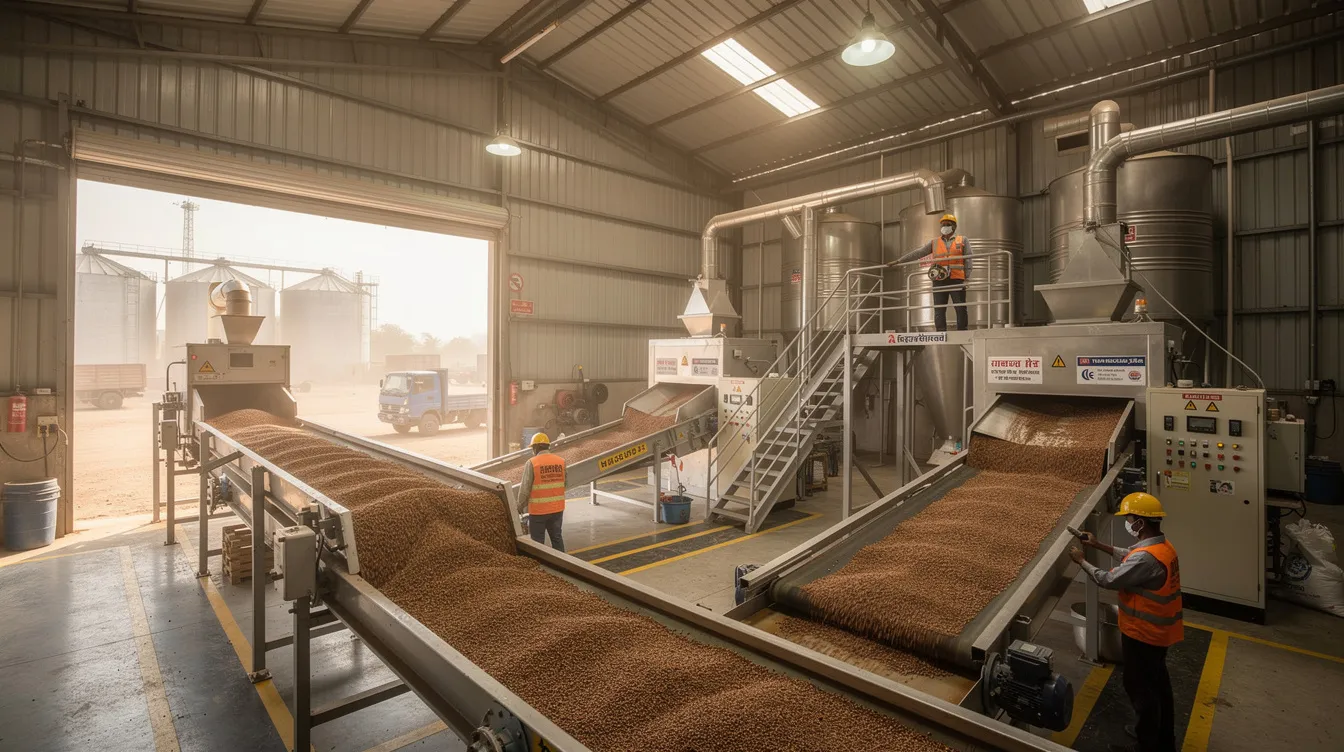
Cleaning and grading pulses involves removing foreign matter and sorting by size or quality. The process typically includes pre-cleaning to remove coarse impurities, destoning for stones and heavy matter, aspiration to separate light impurities and light particles using air and a blower system, size grading through screens and sieves, optical colour sorting for discoloured or defective kernels, and finally packing. Grading machines separate produce by size, shape, and weight, and the grading process uses sieves and airflow systems for sorting. Dust collectors capture fine dust during aspiration. Each stage adds value, and grading machines improve market value by delivering clean, graded produce that meets buyer specifications and quality standards.
The key economic drivers include input quality and impurity level, required output specifications based on customer demand, moisture content, installed capacity in TPH, operating hours per day, capacity utilisation, power tariff, labour cost and local handling charges. Efficient cleaning and grading, combined with optical sorting and consistent sizing, improves product quality and market value, enabling access to premium domestic and export buyers. Pulse processing typically includes pre-cleaning, grading, and sorting stages, and different processing methods vary in cost efficiency based on their technology and complexity. For a detailed understanding of how material flows through each rejection point, refer to the Pulse Cleaning, Grading, Sorting & Packing Process Flow.
Pulse Cleaning and Grading Processing Cost Per MT and Per Kg
Processing cost in this context means the total expenditure from in-gate to out-gate, excluding raw pulse purchase cost, expressed as ₹/MT and ₹/kg. This separation is important because in a job-work model, the processor does not own the raw material, while in an own-trading model, raw material cost dominates total expenditure.
Variable operating costs include power and electricity, direct labour, consumables, loading and unloading, and packing material for cleaned output. Fixed operating costs include salaried staff, rent, insurance, basic administration and minimum maintenance. Fixed costs continue even when the processing facility is not in operation.
Power consumption is a critical cost factor in pulse processing industries. Continuous-flow cleaning lines require substantial electrical power for various systems including motors, blowers, elevators and optical sorters. Energy consumption can range from 30–80 kWh per MT depending on impurity load, machine efficiency and idle time. At industrial tariffs of ₹8–₹10 per kWh, this translates to ₹240–₹800 per MT. Plants require a reliable pulses electricity connection, typically a three phase material supply rated at 100–150 HP or more for medium-capacity installations. Energy and utilities are significant ongoing costs in pulse processing.
Labour and supervision costs depend on region and shift pattern. Skilled labor is necessary for equipment calibration and monitoring in pulse processing. For a 4 TPH plant running a single shift, 8–10 workers plus 2 supervisors may be required, costing approximately ₹80–₹150 per MT. Manual processing has low initial costs but high ongoing labor expenses, while automated processes lower labor costs while requiring higher initial investments.
Machinery maintenance for the cleaning machine, seed grader, elevators and pulse grading machine is typically estimated at 1–2% of machinery cost annually. Maintenance costs include replacing worn screens and other key components. The complexity of machinery impacts both initial investment and operational expenses. For current Pulse Cleaning, Grading & Sorting Machinery Cost benchmarks, indicative prices include: a pulse cleaning machine at ₹2,10,000, an automatic pulses and grain pre-cleaner machine at ₹3,25,000, a rajma cleaning machine at ₹2,90,000, a pulses fine grading machine at ₹4,60,000, and a multipurpose grain cleaning and grading plant at ₹4,35,000. Readers can view complete details and latest price capacity information on our machinery cost page.
Packaging costs vary significantly based on packaging types and market requirements. The choice of packaging impacts the final cost of processed pulses. Bulk sack packing may cost ₹50–₹80 per MT while retail or branded packaging can be substantially higher.
Automation in processing lines shifts capital and operational expenses significantly. Here is an illustrative cost table for a 4 TPH grading plant running 8 hours per day, 26 days per month:
| Cost Head | Basis | ₹/MT | ₹/kg |
|---|---|---|---|
| Power and electricity | 60 kWh/MT × ₹9.50 | 570 | 0.57 |
| Direct labour and supervision | 10 staff per shift | 120 | 0.12 |
| Maintenance and spares | ~1.5% of machinery cost | 50 | 0.05 |
| Consumables and screening | Filters, air jets | 40 | 0.04 |
| Handling and loading | Material movement | 30 | 0.03 |
| Packing (bulk sacks) | Basic packing | 80 | 0.08 |
| Overheads (admin, rent, insurance) | Fixed cost apportioned | 90 | 0.09 |
| Depreciation and interest | Term-loan machinery basis | 150 | 0.15 |
| Total accounting cost | – | 1,130 | 1.13 |
| Cash operating cost (excl. depreciation and interest) | – | 930 | 0.93 |
For a smaller 1 MT per hour plant at 70% capacity utilisation, cash operating cost may rise to approximately ₹1.10–₹1.20 per kg because fixed costs are spread over fewer tonnes. Different scales of operation influence per-ton processing costs in pulse processing, and larger commercial processing plants benefit from economies of scale. Higher processing volumes can reduce costs per ton through better equipment utilization.
Pulse Cleaning Recovery Percentage and Yield Calculation
Product recovery rates significantly impact the effective processing cost. In a pulse cleaning and grading context, recovery refers to the proportion of marketable cleaned whole pulses obtained from raw input, after removal of all foreign matter, off-grade grains and processing rejects.
Marketable Recovery (%) = Marketable Cleaned Pulse Output ÷ Raw Pulse Input × 100
Here is a practical material-balance example for 1,000 kg of raw chana or toor received at a cleaning and grading plant:
| Output Stream | kg | % of Input |
|---|---|---|
| Coarse foreign matter (pre-cleaner) | 30 | 3.0% |
| Light impurities and dust (aspiration) | 20 | 2.0% |
| Stones and heavy matter (destoner) | 10 | 1.0% |
| Broken and undersized grains (grading) | 40 | 4.0% |
| Damaged kernels | 20 | 2.0% |
| Colour rejects (optical sorter) | 10 | 1.0% |
| Marketable cleaned pulses | 870 | 87.0% |
| Total | 1,000 | 100% |
This example reconciles perfectly. In practice, small moisture-related weight differences of 1–1.5% may occur if pulses are received at 13–14% moisture and dried to 11–12% for storage or export. Commercial contracts typically account for moisture adjustments separately.
Variation in recovery depends on initial impurity level, moisture, machine settings including screen size, air flow and feed rate from the feeding hopper, grading machine configuration and optical sorter stringency. Processing costs depend on the quality and condition of incoming pulses. This is fundamentally different from dal milling recovery, which involves dehusking and splitting and typically yields only 65–78% dal from cleaned input.
Pulse Cleaning and Grading Wastage Analysis
Not all wastage is equal. The distinction between recoverable by-products and non-recoverable waste is financially important.
Recoverable rejects include broken pulses, undersized grains, discoloured kernels and off-grade lots that can be sold as cattle feed, poultry feed or lower-grade food material. Non-recoverable wastage includes fine dust, soil, stones, weed seeds and very light particles removed through blow and aspiration, which have negligible value.
The level of pulse cleanliness directly affects the required cleaning effort. Raw pulses from farmer-direct or FPO collections typically carry 8–12% foreign matter, while mandi arrivals may already be partially cleaned with 4–6% impurities. Higher impurity levels in pulses lead to increased cleaning expenses. High initial contamination in pulses increases processing time and energy consumption.
Moisture-related weight changes deserve careful attention. If 1,000 kg of pulses received at 13.5% moisture is dried to 12%, the weight reduces by approximately 17 kg (1.7%). At a sale price of ₹60 per kg, this represents ₹1,020 of apparent loss per MT. However, drier pulses command better quality and often fetch premium prices that more than compensate for weight reduction. This must be properly accounted for in financial projections.
Best practices to minimise genuine wastage include proper screen selection in the cleaning machine, regular calibration of the seed grader, optimised air settings for separation of dust and light impurities, and careful tuning of optical sorter reject thresholds. Regular maintenance is needed to ensure efficient operation of processing machines.
Pulse-Wise Processing Cost and Recovery Considerations
Pulse cleaning and grading processing cost per MT normally stays in a similar range for a given plant, but effective cost and recovery per MT vary due to impurity level, grain hardness, size distribution and cleaning difficulty. Grading machines process pulses like chana, moong, and masoor, and pulse grading machines can process dal and pulses like chana and moong. Pulses grading machines can achieve high grading quality for dal across various types of pulses and food grains.
| Pulse | Typical Impurity Issues | Cleaning Complexity | Key Equipment | Relative Wastage |
|---|---|---|---|---|
| Chana | Stones, soil clods, discoloured | Low–Medium | Pre-cleaner, destoner, optical sorter | Lower |
| Toor | Foreign pulses, stones, fibre | Medium | Destoner, seed grader, gravity separator | Moderate |
| Moong | Dust, powder, splits | Medium–High | Fine screens, aspiration, optical sorter | Higher |
| Urad | Dust, broken germs, coat damage | Medium–High | Fine screens, colour sorter | Higher |
| Masoor | Tiny stones, weed seeds, off-colours | Medium | Destoner, seed grader, optical sorter | Moderate |
Multi Commodity Cleaning & Grading Machines handle various crops, including grains like wheat and rice, and machines can process oilseeds, spices, and nuts alongside grains and pulses. Some grading machines operate with interchangeable sieves for different crops, and grading machines can clean and grade multiple crops with minor adjustments. Multi Commodity Cleaning and Grading Plants handle various crops including other food grains, making the equipment versatile enough to improve annual capacity utilisation across seasons and meet diverse customer and client demand. A plant from a leading manufacturer with robust construction and durability can handle seeds, grains, wheat, rice, spices and crops of various origin with consistent reliability and performance. Pulses grading machines can process up to 4 tons per hour. Key features of modern machines include efficiency in separation and removal of impurities, suitable range of screen options, and consistent output for producers seeking best quality material and quality material for market supply.

Pulse Cleaning and Grading Plant Profitability Models
Model A: Own Purchase and Sale
In this model, the processor buys raw pulses from mandi or directly from farmers and producers, processes them through cleaning and grading, and sells cleaned pulses and by-products. Margin per MT is the difference between sale realisation and the sum of raw material cost plus processing cost plus inventory carrying cost.
Illustrative monthly profitability (Model A) – 2 TPH plant, 8 hrs/day, 26 days/month, 65% utilisation:
| Item | Value |
|---|---|
| Monthly throughput | ~270 MT |
| Raw pulse purchase cost (₹55/kg avg.) | ₹1,48,50,000 |
| Processing cost (₹1,100/MT) | ₹2,97,000 |
| Recovery: 87% cleaned pulses (235 MT) @ ₹59/kg | ₹1,38,65,000 |
| By-product sale: 13% rejects (35 MT) @ ₹20/kg | ₹7,00,000 |
| Gross margin before overheads | Approx. ₹-4,82,000 to positive |
The margin is thin and highly sensitive to the spread between raw and cleaned pulse prices. Price risk and inventory risk are substantial. For a comprehensive economic model, refer to the Integrated Multi-Pulse Cleaning, Grading & Packing Plant Project Report.
Model B: Job-Work Processing
In the Pulse Cleaning, Grading & Packing Job-Work Business Model, the plant charges clients per MT for cleaning, grading, sorting and packing. The processor does not bear raw material or price risk.
Illustrative monthly profitability (Model B) – 5 TPH plant, 65% utilisation:
| Item | Value |
|---|---|
| Monthly throughput | ~675 MT |
| Job-work charge @ ₹1,800/MT | ₹12,15,000 |
| Variable cost @ ₹650/MT | ₹4,38,750 |
| Contribution | ₹7,76,250 |
| Fixed costs (salaries, rent, admin) | ₹3,50,000 |
| EBITDA | ₹4,26,250 |
| Depreciation + interest | ₹1,80,000 |
| Profit before tax | ₹2,46,250 |
Job-work carries lower per-MT margin but significantly less risk. Volume risk and customer concentration risk become the primary concerns, which banks evaluate differently from price risk in own-trading. The installation of suitable equipment with adequate capacity is essential for both models.
Capacity Utilisation and Its Effect on Processing Cost
A 4 TPH pulse cleaning grading plant running 8 hours per day for 26 days per month has an installed monthly capacity of approximately 832 MT. In practice, utilisation is often 50–75% due to seasonal arrivals, maintenance downtime, power disruptions and raw material availability.
| Utilisation | Monthly Throughput (MT) | Fixed Cost/MT (₹) | Variable Cost/MT (₹) | Total Cost/MT (₹) |
|---|---|---|---|---|
| 50% | 416 | 360 | 700 | 1,060 |
| 65% | 541 | 277 | 700 | 977 |
| 75% | 624 | 240 | 700 | 940 |
| 90% | 749 | 200 | 700 | 900 |
(Assumes fixed monthly cost of ₹1,50,000 and variable cost of ₹700/MT.)
The impact is clear. At 50% utilisation, processing cost per kg rises to ₹1.06 compared to ₹0.90 at 90% utilisation. Plant layout, material handling, elevators, conveyors and capacity planning are crucial for achieving targeted throughput. For infrastructure details, see Pulse Cleaning & Packing Plant Capacity and Layout Requirements. Any realistic Detailed Project Report must model multiple utilisation scenarios and perform sensitivity analysis on processing cost per kg and EBITDA margin.
Break-Even Analysis, EBITDA and ROI
In a job-work model with contribution of ₹1,150 per MT and fixed monthly cost of ₹3,50,000:
- Break-even throughput = ₹3,50,000 ÷ ₹1,150 = approximately 304 MT per month
- At 675 MT per month, EBITDA = ₹4,26,250, giving an EBITDA margin of approximately 35% on revenue
- After depreciation and interest, profit before tax = ₹2,46,250
Accounting profit differs from operating cash flow because depreciation is a non-cash charge while loan principal repayment is a cash outflow not reflected in profit. DSCR must be evaluated by comparing cash available for debt service against actual annual repayment obligations.
Overall ROI depends on total project cost including land, building, the grading plant and pulse grading machine, optical sorter, working capital margin and pre-operative expenses. For a Pulse Cleaning, Grading & Packing Plant Setup Cost of ₹2 crore, annual post-tax earnings of ₹20–₹25 lakh would indicate a simple payback period of 8–10 years. IRR and NPV calculations in a DPR provide a more sophisticated evaluation.
Strategies to Improve Recovery and Profitability
Small improvements in recovery percentage, power efficiency and utilisation can materially improve EBITDA and ROI for any pulse cleaning grading plant or multi-commodity seed cleaning grading plant.
- Better procurement: Buying cleaner lots with lower foreign matter reduces cleaning effort and improves recovery. The origin and condition of incoming material matters significantly.
- Pre-cleaning and destoning: Using a pre-cleaner and destoner ahead of the main seed grader reduces load on downstream machines and improves throughput.
- Screen calibration and air flow: Careful selection of screens and calibration of aspiration air flow, feed rate and blow pressure minimises unnecessary rejection of good grains.
- Optical colour sorting: Advanced optical sorting can improve product quality but adds substantial costs. For export and premium markets, the improved realisation often justifies the investment. For details on cost and technology, see Optical Colour Sorter for Pulses – Technology, Capacity and Price.
- Preventive maintenance: Regular maintenance of the cleaning machine, elevators, grading machine and conveyor systems minimises breakdowns. A supplier with good after-sales support ensures consistent performance and durability of equipment.
- By-product monetisation: Selling brokens, undergrades and cattle-feed mix through contract-based arrangements can add 1–2% to effective realisation and improve pulse cleaning and grading profitability.
- Batch-wise monitoring: Comparing actual recovery versus expected recovery for each lot helps identify issues quickly and refine machine settings or procurement strategy to deliver produce of the best quality material standard.
Project Feasibility, DPR and Bank Finance for Pulse Cleaning & Grading Plants
From my experience as a practising Chartered Accountant, a professionally prepared Detailed Project Report helps promoters evaluate commercial and financial feasibility before committing capital. A bankable DPR for a seed processing plant or pulse cleaning grading plant covers market study, technical configuration and machinery list, capacity planning, project cost, means of finance and working capital assessment.
Financial projections normally include sales volumes and prices for cleaned pulses and by-products, pulse processing cost per kg, overheads, manpower cost, interest and depreciation, along with profitability, DSCR, break-even analysis, ROI and sensitivity analysis for utilisation, prices and interest rates. CMA Data preparation, cash-flow statements and term-loan repayment schedules help banks evaluate working capital needs and loan repayment capacity. All projections are estimates based on reasonable assumptions, not guarantees of future performance.
For related project planning resources, the Integrated Multi-Pulse Cleaning, Grading & Packing Plant Project Report provides a comprehensive framework. For dal milling ventures specifically, promoters may also refer to the Dal Mill Project Report for comparison.
Frequently Asked Questions on Pulse Cleaning & Grading Economics
The following questions address the most common queries from promoters evaluating pulse cleaning and grading projects. For project-specific estimates, customised analysis is always recommended.
What is the pulse cleaning and grading processing cost per kg in India?
For a mid-sized plant (4–6 TPH) operating at 65–75% capacity utilisation, processing cost typically ranges from ₹0.90 to ₹1.40 per kg, excluding raw pulse purchase cost. This includes power, labour, maintenance, consumables, handling, overheads and finance charges. Actual cost depends on plant scale, utilisation and local tariff rates.
How is pulse cleaning recovery percentage calculated?
Marketable Recovery (%) = Marketable Cleaned Pulse Output ÷ Raw Pulse Input × 100. For reasonably clean mandi arrivals, cleaning and grading recovery is typically 85–90%. This must not be confused with dal milling recovery, which involves dehusking and splitting and yields significantly lower percentages.
What causes wastage during pulse cleaning and grading?
Wastage comes from removal of stones, dust, foreign matter, weed seeds, broken grains, damaged kernels and colour rejects. Moisture-related weight loss of 1–1.5% may also occur during drying. Higher impurity levels in raw pulses lead to higher wastage and increased cleaning expenses.
Is a pulse cleaning and grading plant profitable as a standalone project?
Profitability depends on business model, capacity utilisation, processing cost control and market conditions. A job-work model can generate EBITDA margins of 25–35% at good utilisation. An own-trading model carries higher margin potential but also greater price and inventory risk. Both models require careful financial evaluation.
How does optical sorting influence recovery and profitability?
Optical sorting improves output quality by removing discoloured and defective kernels, enabling access to premium markets. However, it increases rejection by 1–2% and adds capital and AMC costs. The benefit depends on the price premium achievable for optically sorted output versus the marginal cost and wastage.
What is the difference between cleaning recovery and dal milling recovery?
Cleaning and grading recovery refers only to removal of foreign matter and off-grade whole pulses, typically yielding 85–90% marketable output. Dal milling recovery involves dehusking, splitting and polishing, typically yielding 65–78% dal from cleaned input. These are separate operations with different economics.
What is the minimum viable capacity for a commercial pulse cleaning plant?
A 1–2 TPH plant is the minimum practical capacity for commercial operations. However, higher throughput (4 TPH and above) significantly improves per-MT cost economics. Pulses grading machines can process up to 4 tons per hour, making this a suitable benchmark for most MSME-scale projects.
Is a job-work pulse cleaning plant profitable?
At stable utilisation of 60–65% or above and processing charges of ₹1,500–₹2,000 per MT, job-work plants can achieve reasonable profitability. The key risk is volume dependency and customer concentration rather than raw material price volatility.
What financial information is required for a pulse cleaning plant DPR?
A bankable DPR requires project cost estimates, means of finance, capacity and utilisation assumptions, revenue projections, detailed operating cost build-up, working capital assessment, profitability projections, cash flow statements, DSCR analysis, break-even analysis, sensitivity analysis and CMA Data for bank submission.
For customised project-specific cost and recovery estimates, professional advisory from an experienced consultant is recommended over generic assumptions.
Need a Bankable DPR or Financial Feasibility Study for Your Pulse Cleaning & Grading Plant?
I assist entrepreneurs, FPO operators and industrial investors with professionally prepared project reports, CMA Data, financial projections, feasibility studies and bank finance proposal preparation for pulse cleaning and grading projects. Every assignment is customised to your specific capacity, machinery configuration, location, market assumptions and financing requirements. Project Report Bank is a professional advisory platform, not a template seller.
CA Manish Gugliya FCA, DISA (ICAI) More than 20 years of professional experience
Website: www.projectreportbank.com
For enquiries, please contact via WhatsApp as the preferred method. All projections are prepared as estimates based on stated assumptions and do not constitute guarantees of future performance or loan sanction.