This article provides a structured, investment-oriented overview of setting up a roasted chana and sattu manufacturing plant in India. It is written from the professional advisory perspective of Project Report Bank, led by CA Manish Gugliya, FCA, DISA (ICAI).
Key Takeaways
- This guide covers the industry overview, manufacturing process, machinery, project cost, working capital, feasibility study and bank finance aspects of a roasted chana sattu manufacturing project report.
- Project Report Bank prepares customised detailed project report (DPR), CMA Data, financial projections and feasibility studies for roasted chana, sattu and value-added pulse manufacturing plants across India.
- The article focuses on raw materials (mainly gram and other pulses), manufacturing plant setup, investment opportunities and practical project planning relevant to the FY 2026–27 context.
- All numerical figures presented here are illustrative. Exact capacity, cost, DSCR, IRR and ROI require a project-specific professional DPR based on real quotations and location-specific data.
- Initial capital investment for a roasted chana sattu venture may range from approximately ₹15 to ₹50 lakhs depending on scale, automation and product mix.
Introduction to Roasted Chana & Sattu Manufacturing Project Report
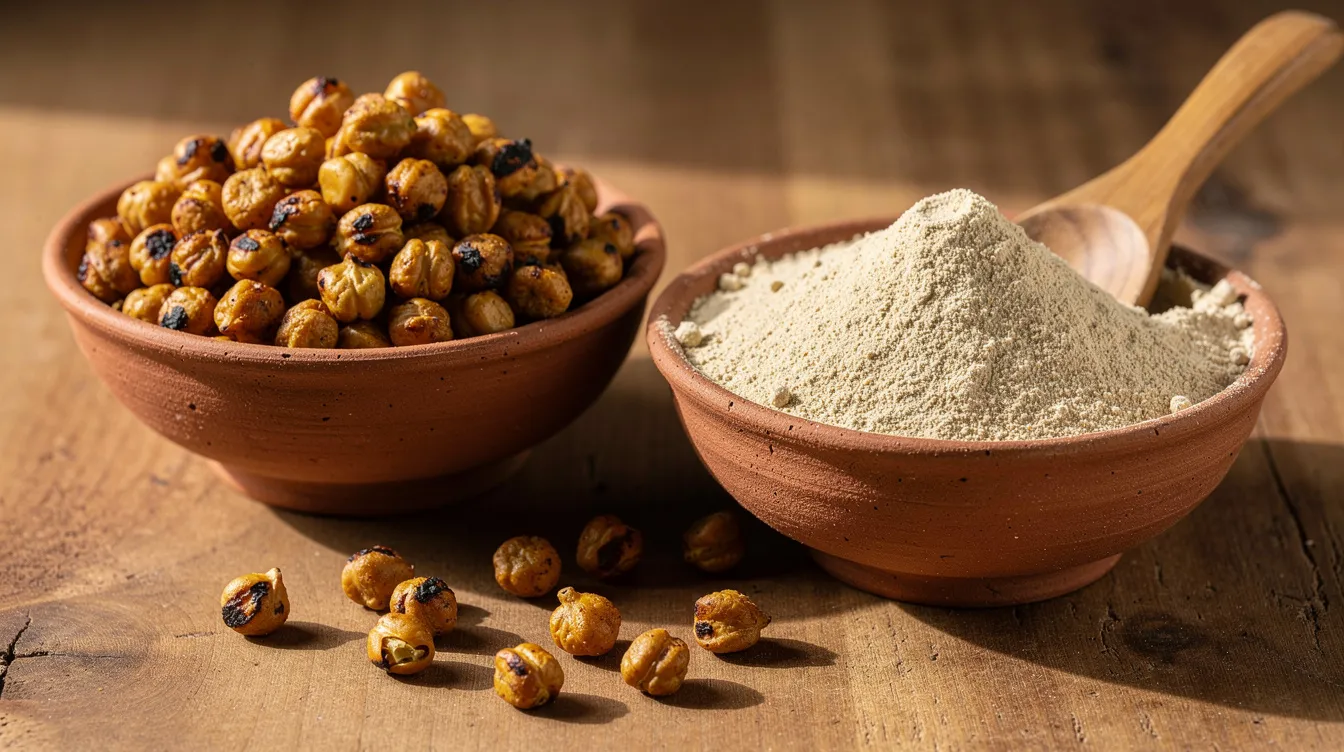
Roasted chana and sattu are among the most widely consumed traditional food products across Bihar, Jharkhand, Uttar Pradesh, West Bengal, Rajasthan and other parts of India. Sattu is prepared generally from fried gram after milling and sieving – a nourishing flour often called India’s original superfood. The basic raw material for sattu is gram. Roasted chana, in turn, serves as a popular dry food and a healthy food snack alternative to fried options.
A roasted chana sattu manufacturing project report typically contains technical specifications (process, machinery, capacity), financial projections (profit and loss, cash flow, balance sheet), market research and risk analysis. This article is an educational project-planning guide, not a ready-made bankable DPR. Project Report Bank prepares customised reports for specific capacities and locations, covering everything from a 250 kg/hr semi-automatic unit to a 1 TPH integrated plant.
Industry Overview & Market Potential for Roasted Chana and Sattu
India is among the world’s largest pulse producers, and the demand for roasted chana and sattu continues to grow steadily. Current demand for sattu is rising as a traditional high-protein health drink, with sattu demand increasing by 8–10% annually. There is a large gap between sattu demand and supply, which presents a good scope for new investment. Sattu is popular among all classes of society – from farmers energised during blazing summers in the eastern region to fitness enthusiasts in urban centres.
Key industry trends include:
- A shift from unorganised small mills to organised, branded packaged products in modern trade and e-commerce channels.
- Rising interest in plant protein, low-GI foods and ready-to-mix sattu drink blends as real food alternatives.
- Growing institutional demand from canteens, hostel kitchens, food-service units and nutrition brands.
- The broader food processing industry is expanding rapidly, with the roasted chickpea market sized at approximately ₹19,552 crore in FY 2026.
A market research-backed roasted chana sattu manufacturing project report helps validate demand, competition, pricing and scalability before any new entrepreneur commits capital.
Products, Variants & Value-Added Pulse-Based Portfolio
Modern sattu manufacturing units seldom rely on a single product. They typically operate as value-added pulse-processing plants for better utilisation and margins. Products that can be part of the portfolio include:
- Plain roasted chana (with skin or without skin) – a direct food snack.
- Traditional gram-based sattu, which is roasted chana flour ground to a fine powder.
- Multi-grain sattu blending chana with barley, wheat and millets.
- Masala sattu mixes – ready-to-drink blends with spices, salt, sugar or jaggery.
- Roasted pulse snacks such as masala chana, coated chana and flavoured pulses.
- By-products like husk usable as cattle feed or a cheap low-cost ingredient.
Sattu can be packaged in sizes from 500 grams to 100 kilograms, including retail pouches and polythene lined gunny bags or lined gunny bags for bulk supply. The product has a shelf life of about six months at room temperature when moisture control is maintained properly. A broader portfolio reduces risk and improves average realisation per kg.
For related pulse-processing opportunities, see our guide on the dedicated Value-Added Pulse Snacks & Integrated Food Processing Plant Project Report.
Business Models for Roasted Chana & Sattu Manufacturing
The DPR must clearly define the proposed business model because it affects plant capacity, machinery, quality systems and working capital requirements. Potential models include:
- Own brand manufacturing: full in-house production, packaging and marketing under a proprietary brand.
- Third-party processing: providing roasting, grinding and packaging services as job-work.
- Integrated plant: combining common roasting and cleaning lines for multiple SKUs across sattu, roasted chana and pulse snacks.
- Contract manufacturing for regional and national FMCG brands.
- B2B bulk supply to bakeries, restaurants, sweet makers and nutrition brands.
Each model influences certification requirements, minimum viable capacity and marketing investment differently. An Integrated Roasted Chana Sattu Pulse Processing Plant Project Report allows better evaluation of economies of scale and cross-product profitability.
Raw Materials, Inputs & Quality Parameters
Raw materials and quality control significantly influence yield, taste, shelf life and brand acceptance. Key inputs for a roasted chana sattu manufacturing plant include:
| Input Category | Examples |
|---|---|
| Primary grain | Whole gram/chana (desi or kabuli) |
| Diversification grains | Moong, masoor, barley, wheat, millets, oats |
| Flavouring | Spices, salt, sugar, jaggery for masala variants |
| Packaging material | Food-grade laminated pouches, PET jars, bulk HDPE bags, labels |
| Utilities | Electricity, LPG/PNG for roasters, water, compressed air |
| Labor | Skilled and semi-skilled workers for roasting, grinding and packing |
Quality of raw material – specifically uniformity and grading – impacts the final product significantly. The DPR should define raw material quality specifications including moisture percentage, foreign matter limits and broken-grain tolerances. Moisture control is crucial in packaging to prevent clumping and rancidity in roasted chana. Storage should follow dry, ventilated conditions with FIFO systems.
Seasonal price variation analysis and procurement strategy (direct from farmers, mandis or traders) should form part of the feasibility study. For related grain-processing projects, our Besan Mill Project Report covers complementary gram-based manufacturing.
Manufacturing Process Flow: Roasted Chana & Sattu
The production workflow includes cleaning, soaking (where applicable), roasting, de-husking, milling, sieving and packaging. Here is the process in an age old way refined for modern production:
Roasted Chana Process:
- Raw gram receiving, weighing and sampling
- Cleaning, destoning and grading
- Roasting in batch or continuous roasters (temperature and time controlled)
- Cooling and tempering
- Optional removal of husk/skin
- Flavouring and mixing in a seasoning drum for masala variants
- Weighing and packaging
Sattu Manufacturing Process:
- Roasted gram is fed to a grinder or hammer mill
- Ground material is sieved slowly to specified mesh size
- Coarse particles are recirculated for re-grinding
- Blending with other milled grains or spices for multigrain or masala sattu
- Quality check (moisture, microbiological, particle size)
- Packing in retail pouches and bulk bags
How sattu differs from simple roasted chana is primarily the grinding and sieving stage that converts the roasted grain into a quality and economic product. Process losses of around 25% during roasting and grinding are typical and must be accounted for in the DPR.
Plant & Machinery for Roasted Chana Sattu Manufacturing
Machinery selection depends on capacity, degree of automation and product mix. The project must detail machinery specifications necessary for producing roasted chana sattu. Core machinery required includes a dry fryer, grinder, and packing machine at minimum.
| Equipment | Indicative Price Range (₹) | Function |
|---|---|---|
| Grain Cleaner & Destoner | 40,000 – 1,20,000 | Removing stones, dust, foreign matter |
| Roaster (Batch/Continuous) | 1,00,000 – 4,00,000 | Roasting at controlled temperature |
| Pulveriser / Hammer Mill | 70,000 – 3,00,000 | Grinding roasted gram to powder |
| Vibro Sifter | 50,000 – 2,00,000 | Particle size separation |
| Ribbon Blender | 80,000 – 2,50,000 | Mixing multigrain or masala blends |
| Packaging FFS Machine | 1,20,000 – 3,50,000 | Automatic/semi-auto pouch filling |
| Batch Coding Machine | 10,000 – 35,000 | Date and batch identification |
For a small-to-medium MSME-scale plant, plant and machinery cost may be approximately ₹11.45 lakh for basic equipment. An automatic roasted chana plant with integrated controls, continuous roasters and automatic feeding changes both capital cost and labor requirement substantially. Vendor quotations and layout-confirmed machinery lists are essential attachments of a bankable project report.
For detailed machinery guidance, see the Fully Automatic Roasted Chana Plant: Machinery, Capacity & Project Planning Guide.
Land, Building & Manufacturing Plant Layout
A well-planned plant layout reduces material handling, cross-contamination risk and operational bottlenecks. A covered shed of approximately 1,000 to 2,000 sq. ft. is usually required for small-to-medium scale units. Larger capacities need proportionally more land, and location in a food park or industrial area can reduce infrastructure expenses.
Built-up area should include:
- Raw material godown and finished-goods warehouse
- Production block for cleaning, roasting, grinding and packing
- Quality-control lab
- Utility block (transformer, DG set, compressor room)
- Office and staff amenities
The layout must follow a linear flow from raw material intake to dispatch with hygienic zoning. Compliance with FSSAI, fire-safety and building norms is essential. The DPR should contain a schematic factory layout and civil-construction cost estimate.
For cost breakdowns, see the Roasted Chana & Sattu Manufacturing Plant Setup Cost & Investment in India.
Project Cost, Capital Investment & Means of Finance
Capital investment for a roasted chana sattu manufacturing plant generally includes land, site development, building, plant and machinery, utilities, pre-operative expenses and margin for working capital. For a reference small-scale sattu plant, total capital investment is approximately ₹35.56 lakh. Initial capital investment for a roasted chana sattu venture can range from ₹15 to ₹50 lakhs depending on scale and automation.
Cost heads in the project report include:
- Land and site development
- Civil construction and building
- Plant and machinery including erection
- Utilities and electrical installations
- Furniture, lab equipment and office assets
- Pre-operative expenses (consultancy, interest during construction, trial-run expenses)
- Contingencies
Means of finance are typically structured as promoter contribution (equity), term loan from a bank, and where applicable, subsidy components under government and MSME schemes. The DPR provides the total project cost, debt–equity ratio and proposed repayment terms, all subject to bank appraisal.
Working Capital, Operating Costs & Production Economics
Many food-processing projects face stress not due to plant cost but due to inadequate working capital planning. Working capital required for one month in a representative sattu unit is approximately ₹21.25 lakh, covering raw material, work-in-progress, finished goods and receivables.
Major operating cost components include:
- Raw material and packing material consumption at realistic yield norms
- Direct labor and supervisory wages
- Power, fuel and utilities (roaster fuel cost is significant)
- Repairs, maintenance and low maintenance consumables
- Selling and distribution expenses
- Administrative overhead and interest expenses
The report should calculate cost of production per kg, break-even sales volume and sensitivity of profitability to raw material price changes. Project Report Bank prepares CMA Data and bank-compliant working-capital assessments aligned with banking norms for such manufacturing units.
Financial Projections, Profitability & Ratios
Financial projections in a roasted chana sattu manufacturing project report generally span 7–10 years. Profitability statements should include projected profit and loss, cash flow statements, and balance sheets along with a term-loan repayment schedule.
Key financial indicators to be analysed:
- Break-even point – for this type of sattu plant, the break-even point is approximately 39%. Typically, break-even point occurs at 40% to 50% capacity utilisation in sattu production.
- The expected rate of return is approximately 57% for a well-utilised plant, while return on investment (ROI) for roasted chana sattu is typically between 25% and 30% under moderate assumptions.
- DSCR (year-wise and average), IRR, payback period and margin of safety.
All figures vary depending on capacity, utilisation, pricing, supply conditions and finance structure. Banks look closely at DSCR and realism of assumptions before sanctioning term loans.
For detailed financial illustrations, see the Roasted Chana & Sattu Plant Financial Projections, CMA Data & DSCR.
Feasibility Study, Risk Analysis & Sensitivity
Project feasibility analysis is critical for managing investment risk and achieving return expectations. A DPR for roasted chana sattu manufacturing must address:
- Technical feasibility: suitability of the selected process and machinery, capacity utilisation ramp-up plans.
- Market feasibility: demand assessment, competition mapping, price positioning and distribution in the eastern region part and north west markets.
- Financial feasibility: projected profitability, IRR and DSCR under realistic and conservative scenarios.
Key risks include volatility in gram and pulse prices, entry of large FMCG competitors, quality or food-safety lapses, and under-utilisation of capacity. Sensitivity analysis should test the impact of lower capacity utilisation, increase in raw material cost and reduction in average selling price.
The approach at Project Report Bank, led by CA Manish Gugliya, is to challenge assumptions and highlight risk-mitigation measures before large capital is committed. For more detail, see the Integrated Roasted Chana & Sattu Plant Feasibility Study, ROI & Bank Finance.
Licences, Compliance & Food Safety Requirements
Roasted chana and sattu are human-consumption products, so regulatory compliance is non-negotiable. Statutory approvals needed include FSSAI licence, MSME registration (Udyam), and GST registration. Additional requirements may include factory registration, Pollution Control Board consents and trade licence depending on state norms.
Food-safety systems should cover basic Good Manufacturing Practices (GMP), Good Hygienic Practices (GHP), and HACCP or FSSC 22000 where targeting modern retail or export markets. Lab testing for each batch – moisture, microbiological parameters, foreign matter – is essential for maintaining a quality product.
Marketing, Distribution & Sales Strategy
Even a technically strong plant can struggle without a clear business plan for marketing and distribution. Target consumer segments include fitness enthusiasts, health-conscious individuals and traditional households.
Key channels include general trade (wholesalers, kirana stores), modern trade, e-commerce and D2C platforms, and HoReCa and institutional segments. Proper branding can distinguish the product through highlighting natural and nutritional benefits – positioning sattu as an underrated food that the body recognises as real nutrition. The DPR should contain sales projections by product category and channel, not just a flat revenue growth assumption.
For related food-product marketing ideas, see Masala Business Ideas and Multigrain Flour Mill Project Report.
Roasted Chana Sattu Plant Bank Finance & Documentation
A roasted chana sattu project report is needed for bank loans and operational planning. The typical route involves a term loan for fixed assets and working-capital limits for operations. Banks normally require:
- Detailed project report with technical specifications and financial projections
- CMA Data in prescribed banking format
- Promoter KYC, net-worth and income documents
- Collateral and security details
Bankers evaluate promoter background, viability of project cost, means of finance, DSCR and sensitivity of cash flows to market risks. Final sanction terms depend solely on each bank’s independent assessment and regulatory norms.
Professional DPR, CMA Data & Advisory Support from Project Report Bank
Project Report Bank, led by CA Manish Gugliya, FCA, DISA (ICAI), with more than 20 years of professional experience, provides:
- Customised detailed project report preparation with project-specific technical design, cost estimation and financial modelling
- CMA Data preparation for working-capital and term-loan proposals
- Integrated financial projections, profitability analysis, cash-flow and DSCR analysis
- Feasibility study, project-viability assessment, sensitivity analysis and risk identification
- Investor-ready documentation, business plans and valuation inputs
All work is based on real quotations, locally relevant cost data and project-specific assumptions – not generic templates. Contact Project Report Bank with your proposed capacity, location, product mix and expected investment for a scoped professional engagement.
Explore All Roasted Chana, Sattu & Value-Added Pulse Processing Project Guides
| Guide | Description | Link |
|---|---|---|
| Integrated Plant Project Report | Shared infrastructure, product diversification and integrated project planning | Read Guide |
| Automatic Plant Machinery & Capacity | Equipment selection, roasting systems, automation and capacity planning | Read Guide |
| Plant Setup Cost & Investment | Capital investment, land, building, machinery cost breakdowns | Read Guide |
| Financial Projections, CMA Data & DSCR | Sales projections, operating expenses, cash flow and debt-service analysis | Read Guide |
| Feasibility Study, ROI & Bank Finance | Profitability, IRR, sensitivity analysis and bank-finance structuring | Read Guide |
| Value-Added Pulse Snacks Plant | Pulse snack diversification and integrated food processing opportunities | Read Guide |
Frequently Asked Questions
Below are answers to common queries from entrepreneurs planning a roasted chana sattu manufacturing project.
What is the minimum practical capacity for a viable roasted chana sattu plant?
Commercial viability depends on local demand, pricing and distribution strength. In many Indian contexts, plants below roughly 250 kg/hr may struggle to cover fixed costs if targeting branded retail markets. However, smaller capacities can still be suitable and feasible for localised supply or job-work models where capital outlay and overhead are limited. A customised DPR is needed to test viability for each specific case, factoring in the present production landscape and competitive environment of the chosen location.
How long does it typically take to go from planning to commercial production?
The overall gestation period may be around 9–15 months. This includes a few weeks for DPR preparation and bank documentation through own efforts, a few months for loan processing and sanction, and 4–8 months for civil work, machinery ordering, installation, trial runs and licensing. Delays in land readiness, regulatory approvals or finance can extend this timeline, which is why the project schedule should be planned conservatively.
Can a semi-automatic plant be upgraded to fully automatic later?
Many entrepreneurs begin with semi-automatic roasting and packing lines to limit initial investment and then upgrade by adding automatic conveyors, continuous roasters and FFS machines. The DPR and factory layout should be planned from the beginning with provision for such phased expansion, including adequate building height, power supply headroom and floor space for additional equipment.
How should fluctuations in gram prices be factored into the project report?
Financial projections should use conservative average raw-material prices rather than optimistic lows. The DPR should include sensitivity analysis testing adverse price movements of 10–20% and build adequate working-capital margins for seasonal stocking. Procurement strategies such as forward contracts and buying during harvest season should be outlined in the business plan section of the report.
Is it advisable to plan for exports at the initial stage?
Most new plants in this segment initially focus on domestic markets to stabilise production and build brand presence. However, exporters’ quality and documentation requirements – lab certifications, packaging norms, food-safety standards – can be incorporated into plant design and systems from the start if export is a medium-term goal. The DPR can model both domestic-focused and export-enabled scenarios so the promoter has clarity on incremental investment and compliance required for industrial applications in overseas markets.