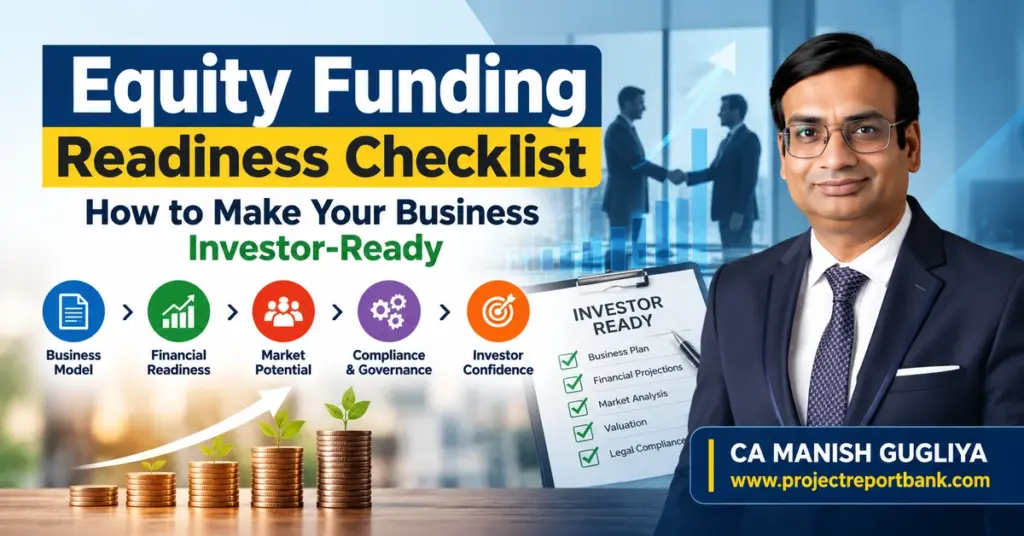
Key Takeaways
- Investor readiness goes far beyond having a profitable business or attractive revenue projections. It requires a validated business model, realistic financial projections, clean compliance records and organised documentation that can withstand due diligence.
- A structured 15-point equity funding readiness checklist helps promoters systematically assess gaps across market demand, financial preparedness, legal compliance, governance, project feasibility and investment documentation before approaching potential investors.
- Manufacturing and industrial projects require particular attention to project cost estimation, means of finance, working capital analysis, technical feasibility and capacity utilisation assumptions.
- Financial preparedness is crucial for investor confidence – investors examine cash flow, working capital cycles and funding mix, not just projected profits.
- Project Report Bank, led by CA Manish Gugliya (FCA, DISA), supports businesses with investor-ready DPRs, financial modelling, valuation analysis and equity funding preparation, without promising or guaranteeing investment outcomes.
Introduction: Why Equity Funding Readiness Matters Before You Talk to Investors
Most entrepreneurs assume that a profitable business, a promising project idea or an attractive projected ROI is just what they need to attract equity funding. In practice, investors evaluate much more: the sustainability of the business model, market demand, promoter credibility, financial projections, governance, compliance and exit potential. Without structured preparation, approaching angel networks, venture capital firms or strategic investors often leads to slow responses, repeated information requests, prolonged due diligence or outright rejections.
This is why a practical equity funding readiness checklist matters. It provides a systematic framework to evaluate how investor ready your business actually is before you begin the fund raising process.
Equity funding involves selling ownership stakes to investors in exchange for capital. Unlike debt funding, which requires repayment with interest over time and creates repayment obligations on the business, equity brings growth capital and strategic support – but also ownership dilution and higher expectations on reporting, governance and growth. A funding readiness checklist covers six key areas: market, financial, legal, operational, governance and documentation. Ideally, businesses should start preparing their checklist 6–12 months before fundraising.
This article walks through a comprehensive 15-point checklist, financial and valuation readiness, project feasibility, due diligence documentation, common mistakes and professional support for raising capital effectively.
What Is Equity Funding Readiness?
Equity funding readiness, in simple terms, is the stage where a business can present a clear, credible and well-documented investment opportunity to equity investors – supported by numbers, evidence and governance rather than optimism alone.
There is a meaningful difference between having attractive business plans and being truly investment-ready. Many startups and established businesses have compelling ideas but cannot answer basic questions about their cash flow, customer base, shareholding structure, regulatory compliance or funding requirements with documented evidence. Investors prefer evidence-backed traction over promises. They want proof points, not just potential.
Investor readiness is not a pitch deck or a generic business plan. It includes a coherent business story, an investor-ready DPR, robust financial models, and a complete data room for due diligence. Key areas for investor readiness include corporate, legal, financial and product validation dimensions.
In the Indian context, readiness also means having a clear legal entity structure, an accurate shareholding pattern, statutory compliance (GST, income tax, MCA filings) and properly maintained accounting records. Without these foundations, even a fundamentally strong business can appear unprepared to potential investors.
Why Equity Funding Readiness Is Critical Before Approaching Investors
Advance preparation directly improves the quality of investor discussions. When a promoter can answer tough questions about unit economics, market sizing, growth strategy, funding mix and risk mitigation with documented support, the conversation moves forward instead of stalling.
Readiness strengthens investor confidence in the promoter’s capability. Clear organisational structures and experienced management teams bolster trust. Legal and compliance readiness prevents investor distrust. A well-defined market and growth strategy signals strategic direction.
Consider this: investors review over a hundred business plans monthly, and 91% of investors reject poorly written business plans. A prepared business minimises surprises during financial, legal and commercial due diligence, reducing the probability of deal failure after initial interest. For a detailed understanding of what equity investors typically evaluate, read What Do Equity Investors Look for Before Investing in a Business.
Readiness does not guarantee equity funding – investors still evaluate fit with their investment thesis, sector focus and risk appetite – but it significantly improves the probability of serious engagement.

Equity Funding Readiness Checklist – 15 Essential Requirements
This is the core practical checklist. Before reaching out to angel investors, family offices, venture capital funds or strategic investors, promoters should review all 15 areas systematically. Equity funding readiness checklists should address pitch materials, financial metrics, legal documents and intellectual property comprehensively.
| # | Readiness Area | What Investors Examine | Documents / Evidence Required | Common Red Flags |
|---|---|---|---|---|
| 1 | Business model & revenue sources | Clarity on how revenue is generated, pricing, customer segments | Business plan, revenue model documentation | Vague or untested revenue model |
| 2 | Market demand & growth | Total addressable market, serviceable available market, demand trends | Market research, industry reports, real market validation data | No evidence of demand beyond assumptions |
| 3 | Competitive positioning & scalability | Differentiation, barriers to entry, scalable business model | Competitive analysis, go to market strategy | No clear advantage over competitors |
| 4 | Promoter & management capability | Track record, complementary skills, key hires | CVs, organisational chart, employment agreements | Single-person dependency, no relevant experience |
| 5 | Historical financial performance | Revenue growth, margins, cash flow trends | Audited financials, ITRs, GST returns, bank statements | Mismatch between reported and actual numbers |
| 6 | Financial projections & cash flow | 3–5 year P&L, balance sheet, cash flow; break-even; sensitivity | Financial model (Excel), assumption notes | Unrealistic hockey-stick projections |
| 7 | Project feasibility & technical viability | Plant capacity, process, utilities, approvals | DPR, technical feasibility report, machinery quotations | No feasibility study for capital-intensive projects |
| 8 | Total project cost & capital requirement | CapEx, working capital, pre-operative expenses | Project cost breakdown, quotations, cost estimates | Underestimated or inflated project cost |
| 9 | Promoter contribution, debt-equity mix & funding gap | Promoter skin-in-the-game, funding mix, borrowing funds structure | Means of finance statement, bank sanction letters | Negligible promoter contribution |
| 10 | Business valuation & proposed equity dilution | Realistic valuation, proposed investor ownership | Valuation working, comparable analysis | Unsupported inflated valuation |
| 11 | Shareholding structure & governance | Cap table, board composition, decision-making | Share register, cap table, Board resolutions | Unrecorded equity promises, unclear ownership |
| 12 | Legal, tax & regulatory compliance | MCA filings, GST, income tax, TDS, licences | Compliance certificates, filed returns, approvals | Pending filings, undisclosed liabilities |
| 13 | Investor due diligence documents & data room | Organised, consistent, accessible documentation | Virtual data room with all categories populated | Missing or contradictory documents |
| 14 | Investment returns, risk & exit strategy | Project IRR, Equity IRR, payback, exit route | Return analysis, sensitivity, exit plan | No exit clarity, no risk assessment |
| 15 | Investor-ready DPR, business plan & pitch deck | Professional presentation of the investment opportunity | DPR, financial model, investor pitch deck | Generic templates, inconsistent numbers |
Pitch decks should detail the problem, solution, market size, business model and team, and a compelling pitch deck should condense your business plan into ten slides. Clear market sizing – including evidence-backed TAM, SAM and SOM – is essential for investment. Demonstrating traction validates market demand and reduces perceived risk; contracts and paid pilots provide tangible evidence. Revenue growth indicates that the business model can scale effectively. A complete cap table details ownership percentages across founders, employees and investors.
Comprehensive investor data rooms should include legal, financial and customer documentation. Fundraising plans require establishing a funding amount and timeline for investor engagement, and investor outreach should target relevant angels or venture capital funds in specific industries.
Financial Readiness – What Equity Investors Expect
Financial readiness is one of the strongest signals of professionalism. Investors look beyond headline profit figures to cash flow, working capital and capital structure. Financial documents should include historical profit and loss statements, balance sheets and cash flow statements for at least 2–3 years where available. Key financial highlights such as revenue trends, EBITDA margins, existing debt obligations and bank facilities are closely examined.
Realistic three-to-five-year financial projections are expected, covering projected P&L, balance sheet, cash flow statement, break-even analysis and funding requirement schedule. Financial projections should cover 3–5 years with credible data. A detailed financial model includes cash flow projections, revenue drivers and costs. Key performance indicators track metrics such as customer acquisition cost, lifetime value and churn. The funding strategy must define capital requirements, runway and allocation milestones.
The difference between accounting profitability and cash flow deserves particular attention. Consider an MSME manufacturing unit with ₹15 crore turnover in FY 2025–26 and 12% EBITDA margin, planning a 40% capacity expansion. Incremental revenue of approximately ₹6 crore may result, but working capital – driven by increased inventory and receivables – could rise by ₹1.5–2 crore. Profits may appear healthy while cash remains stretched. This is why cash runway planning and well-structured financial projections are critical for any business seeking investment.
Business Valuation, Shareholding Structure and Equity Dilution
Valuation determines how much ownership a promoter gives up for the capital raised. The core concepts are straightforward: pre-money valuation is the business value before new investment, and post-money valuation equals pre-money plus the amount raised.
Consider this illustrative example. A company is valued at ₹20 crore pre-money. It raises ₹5 crore in equity funding. Post-money valuation becomes ₹25 crore. The investor receives 20% equity (₹5 crore ÷ ₹25 crore). The promoter retains 80%. If an ESOP pool of 5% is carved out, the promoter’s effective holding reduces to 75%.
Valuation is a negotiation based on expected cash flows, market comparables, sector multiples and risk – not solely on promoter expectations. Unsupported high valuations are among the most common reasons investors reject proposals. Private equity provides growth capital to scalable businesses. Venture capital focuses on high growth startups with scalability. An initial public offering allows companies to raise capital from public markets, but that is typically a later growth stage consideration and public listing requires substantial preparation.
Equity dilution affects promoter control, decision-making and future fundraising rounds. Many businesses benefit from professional business valuation and funding mix analysis before finalising how much equity funding to raise.
Project Feasibility and Manufacturing Business Readiness
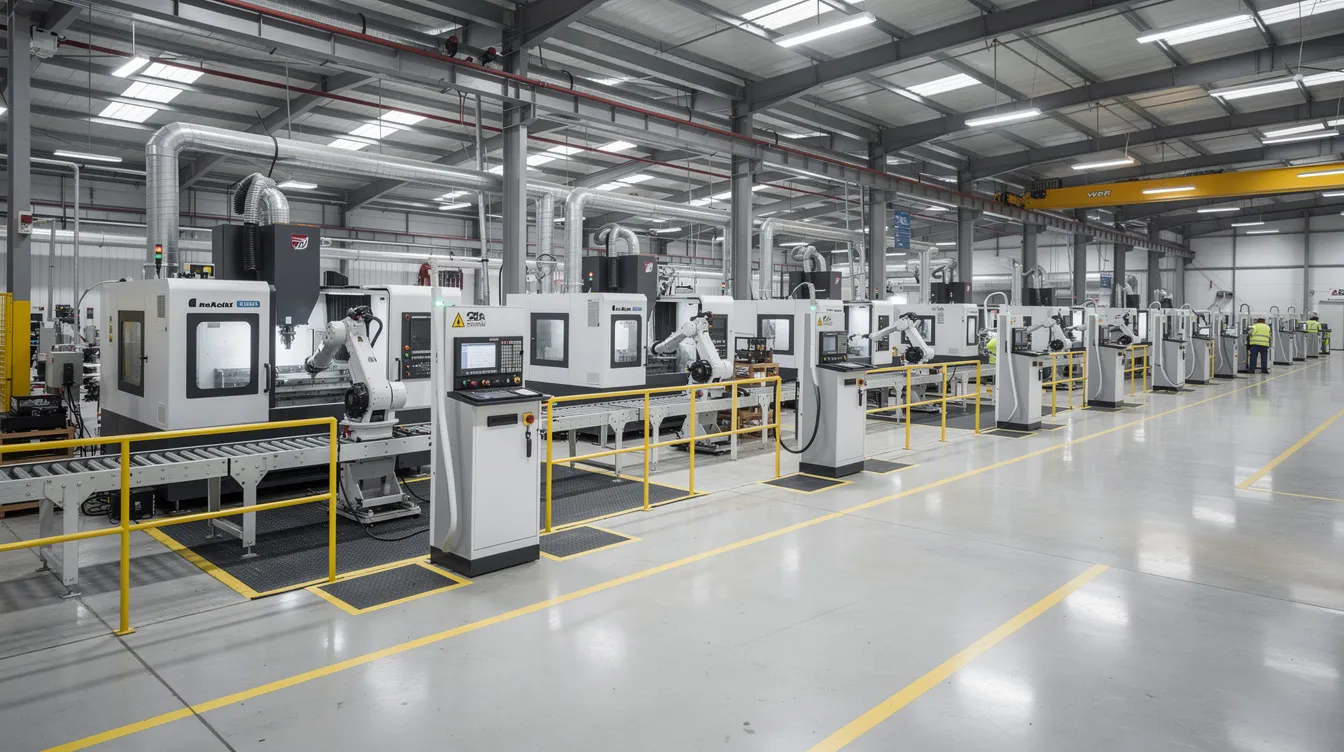
For manufacturing, agro-processing and industrial projects, investor readiness depends heavily on a robust project feasibility study covering technical, market and financial viability. Detailed project reports inform funding requirements, business viability and operational planning.
Technical feasibility includes plant and machinery selection, installed capacity, process flow, utilities (power, water, steam, effluent treatment), layout, land and building requirements, and statutory approvals. Market feasibility covers demand assessment, competition, raw material availability, pricing strategy and market access opportunities into new markets.
Financial feasibility involves project cost estimates, means of finance (promoter contribution, term loan, equity), working capital requirements, break-even capacity, project IRR and Equity IRR. Investors assess a company’s potential for high-yield returns and execution capability.
Illustrative Example – Manufacturing Expansion: An existing unit with a ₹10 crore project cost plans an additional ₹7 crore expansion. Incremental revenue may be ₹8–9 crore at full capacity. Additional working capital requirement of ₹1.5 crore is estimated. The ₹7 crore expansion might be funded through ₹2.5 crore promoter contribution, ₹3 crore term loan and ₹1.5 crore equity. The investor evaluates incremental profit, DSCR on the new loan, project IRR, and whether the promoter has adequate skin in the game.
Greenfield projects without operating history require stronger feasibility evidence, promoter track record and real market validation than expansion projects where historical performance provides proof points.
Legal, Compliance and Corporate Readiness Before Raising Equity
Investors expect a clear and compliant legal structure – typically a company under the Companies Act, 2013 for scalable equity funding, though other structures may suit certain circumstances.
Corporate readiness includes an updated Memorandum and Articles of Association, adequate authorised and paid-up capital, accurate share register, properly executed share certificates and Board/Shareholder resolutions for major decisions. Timely filing of annual returns with MCA, accurate GST and income tax filings, and TDS compliance are baseline expectations.
Proper documentation of intellectual property rights is essential for investor confidence. Clarity on ownership of key assets, land, building leases, trademarks, patents and key contracts strengthens the proposition. Disclosure of any material litigation or proprietary data disputes is expected. Investors require precise documentation for financial, operational and legal matters during due diligence.
Some requirements are statutory while others are investor preferences. Requirements vary based on business size, sector and investor type.
Investor Due Diligence Documents and Data Room Checklist
A well-organised virtual data room saves significant time during investor due diligence and strengthens confidence. Here is a practical documentation checklist:
| Document Category | Examples | Why Investors Review |
|---|---|---|
| Corporate documents | Certificate of Incorporation, MOA/AOA, Board resolutions | Legal existence, governance structure |
| Shareholding & cap table | Share register, allotment records, ESOP details | Ownership clarity, dilution history |
| Historical financials | Audited accounts (2–3 years), management accounts | Past performance, trends |
| Tax filings | ITRs, GST returns, TDS compliance | Compliance, hidden liabilities |
| Banking & loans | Bank statements, sanction letters, loan agreements | Debt obligations, cash flow patterns |
| DPR & financial model | PDF report, Excel model with assumptions | Project economics, return analysis |
| Business plan & pitch deck | Investor presentation, executive summary | Business strategy overview |
| Customer & supplier contracts | Key agreements, pilot orders, LOIs | Revenue quality, supply risk |
| Licences & approvals | Factory licence, pollution control, FSSAI | Regulatory risk |
| Property & assets | Title documents, lease agreements | Asset ownership verification |
Material inconsistencies between documents – for example, revenue projections not matching audited statements, or shareholding in MCA filings differing from internal cap tables – create serious investor concerns. For a deeper document-by-document guide, refer to the Investor Due Diligence Checklist.
How to Assess Your Business’s Investor Readiness
A simple self-assessment framework helps promoters evaluate their current preparedness. Score each of the 15 checklist requirements on a scale of 0 to 2:
- 0 = Not prepared at all
- 1 = Partially prepared
- 2 = Well-prepared with documented evidence
Maximum possible score is 30. Interpretation: 0–10 indicates early stages of preparation with significant gaps; 11–20 suggests moderate readiness with identifiable areas needing attention; 21–30 reflects strong readiness with refinements needed.
This is an illustrative self-assessment framework – not a rating recognised by SEBI, banks or investors. A high overall score does not guarantee funding. Critically, a score of 0 on financial projections, means of finance or legal compliance should be treated as a blocking issue regardless of the total score. Convert this into a spreadsheet, mark current status, and create an action plan before actively approaching investors.
Common Mistakes That Make Businesses Unattractive to Investors
Unrealistic revenue projections without market validation are perhaps the most frequent problem. Investors seek a clear market opportunity backed by data, not aspirational numbers. Corrective action: build projections from operational assumptions – capacity, utilisation, pricing, costs.
Unsupported high valuations and reluctance to dilute reasonable equity stall many deals. Seek professional advice on comparable valuations before quoting numbers.
Incomplete or outdated financial records immediately raise concerns. Engage a CA to clean up books, reconcile bank statements and complete pending filings. Remember that 91% of investors reject poorly written business plans.
Unclear use of investment proceeds and lack of a clear growth plan makes investors question business strategy and strategic direction. A strong management team is crucial for attracting investors – weak or single-person management teams reduce confidence.
Over-dependence on a few customers, ignoring working capital and cash flow risks, and inconsistent information across the investor pitch, business plan, DPR and financial model are among the most damaging common mistakes. A strong customer proposition should focus on benefits over features, and investors focus on the potential for meaningful growth within the target market. For more on why investors reject proposals, understanding these patterns is essential.
Step-by-Step Process to Make Your Business Investor-Ready
Begin with an initial equity funding readiness assessment using the 15-point checklist and scoring model. Identify gaps across financial, operational, market and compliance areas with clear priority.
Validate your business model, customer proposition and market demand through surveys, pilot orders or early traction – investors want to see you prove traction. Prepare realistic financial projections and funding requirement analysis, including capital expenditure, working capital and cash runway. Undertake a formal project feasibility study where relevant, especially for manufacturing expansion or new projects.
Plan the capital structure and funding mix between promoter contribution, debt and equity; assess the funding gap. Review valuation and proposed investor stake with professional support to avoid extreme dilution.
Organise legal, financial and operational documents into a structured data room. Prepare an investor-ready DPR, detailed business plan and concise investor presentation aligned with each other. For financial modelling support, consider engaging professional financial modelling services.
Only then start contacting suitable investors whose mandate matches your sector, growth stage and ticket size – whether angel networks, the Indian Angel Network, private equity funds or venture capital firms.
How an Investor-Ready DPR Strengthens Equity Fundraising
An investor-ready Detailed Project Report prepared by a professional Chartered Accountant typically contains: business overview, promoter profile, market analysis, technical details (for manufacturing), project cost, means of finance, financial projections, profitability analysis, DSCR, IRR, sensitivity analysis and risk assessment.
The DPR, financial model and pitch deck serve different purposes. The DPR is a detailed document for deep evaluation and due diligence. The financial model is an Excel-based tool for projections, funding mix and scenario analysis. The pitch deck is a concise visual summary for initial meetings. For manufacturing, MSME and industrial projects, a strong investor-ready DPR provides evidence on capacity planning, machinery sizing, working capital cycle and project economics. For the coverage an investor-ready DPR should include, see the Investor-Ready DPR Checklist.
Project Report Bank focuses on customised DPRs – not generic templates – with assumptions, cost estimates and cash flows prepared project-wise.
Professional Equity Funding Readiness and DPR Advisory Services by Project Report Bank
With more than 20 years of professional experience in project finance, bankable DPRs, feasibility studies, financial projections and equity funding preparation, I work with Indian entrepreneurs and MSMEs to make your business ready for serious investor engagement.
The advisory support through ProjectReportBank.com includes: comprehensive equity funding readiness assessment using the checklist and scoring model; customised investor-ready DPR preparation for new projects and expansions; detailed financial modelling and sensitivity analysis aligned with investor needs; business valuation support and guidance on shareholding and equity dilution scenarios; structuring of project cost, means of finance and funding mix; and preparation of investor pitch deck and supporting investment documentation.
Project Report Bank does not guarantee equity funding, does not pool investor money, and does not provide capital directly. The focus is on preparing businesses to present professionally to potential investors and lenders with long term growth discipline.
Planning to Raise Equity Funding for Your Business or Manufacturing Project?
Prepare your business with realistic financial projections, a professionally structured investor-ready DPR and properly organised investment documentation.
Consult CA Manish Gugliya – ProjectReportBank.com
Explore Investor-Ready DPR & Fundraising Assistance
Frequently Asked Questions
Can very early-stage businesses without historical financials use the equity funding readiness checklist?
Yes. Businesses at early stages without operating history can still apply the checklist – the emphasis shifts towards business model clarity, market potential, promoter capability, feasibility study and financial projections. Many tech startups and greenfield manufacturing projects raise funding based on feasibility evidence and promoter track record rather than audited financials. Angel investors and certain venture capital firms may accept management accounts or internal MIS at seed stage, though expectations increase with ticket size.
How long does it typically take in India to become investor-ready once gaps are identified?
It depends on the nature and number of gaps. Cleaning up compliance, preparing a robust financial model and organising a data room can take 3–6 months for a reasonably established business. For businesses at earlier stages needing market validation, business model refinement and new investment planning, 6–12 months of preparation is realistic. Rushing the process often creates inconsistencies that surface during due diligence.
Is a DPR necessary for service-sector or technology businesses, not just manufacturing?
While DPRs are more commonly associated with manufacturing and infrastructure projects, any business seeking investment benefits from a structured document covering market opportunity, business economics, capital requirements, financial projections and risk assessment. For service and technology businesses, a detailed business plan with a financial model and investor presentation may serve a similar purpose, though the terminology differs.
How should a promoter decide between debt funding and equity funding?
The choice depends on cash flow predictability, growth ambitions, existing borrowing capacity and willingness to dilute ownership. Debt funding suits businesses with stable, predictable cash flows that can service loans. Equity funding is more appropriate for businesses in the growth stage requiring substantial capital where borrowing funds would create excessive strain. Most businesses use a combination – the funding mix should align with project risk, return profile and promoter resources. Seeking professional advice before finalising the structure is recommended.
Do all investors require audited financial statements?
Not universally. Angel investors and early-stage funds may accept unaudited management accounts for very early businesses, but they still expect consistency and accuracy. As the ticket size and investor sophistication increase – particularly with private equity funds – audited financial statements become essential. Clean, reliable financial records strengthen market potential perception and reduce due diligence friction regardless of investor type.