Key Takeaways
- Equity investors evaluate promoter credibility, market potential, financial viability, risk-return profile and realistic exit possibilities before committing capital to any business.
- Unlike bank loans, equity investment carries no fixed returns and higher risk-investors expect significant upside through cash flow growth, value creation and eventual liquidity via IPO, trade sale or secondary exit.
- Investors focus on governance, disciplined financials and defensible valuation, not just attractive ideas or optimistic projections. Investment evaluation assesses an asset’s profitability and risk profile through rigorous analysis.
- Indian entrepreneurs and MSMEs must ensure compliance (ROC, GST, income tax), maintain organised documentation and present a professionally prepared, bankable Detailed Project Report (DPR) to be taken seriously.
- Project Report Bank, a CA-led advisory practice, helps promoters become investor-ready through customised DPRs, financial modelling, business valuation and fundraising preparation.
Introduction: What Do Equity Investors Look for Before Investing?
Equity investors look for credible promoters with relevant experience, scalable business models with clear revenue logic, robust cash flow potential, disciplined financial management, acceptable investment risk, and well-defined exit options. Before committing funds, they analyse a company’s financial health and business fundamentals to determine whether the opportunity justifies the capital at stake. In simple terms, shares represent partial ownership in a company, and equity investors are buying a stake in the future performance of that business-not lending money for fixed returns.
This makes equity investment fundamentally different from bank loans, mutual funds or fixed-income instruments. Equity mutual funds invest primarily in listed market securities with daily liquidity. Futures and options are derivative contracts based on underlying stocks. Arbitrage schemes exploit price differences across markets for profit. Alternative investment funds include hedge funds and real estate trusts. But direct equity investment in private companies-whether by individual investors, angel networks, venture capital firms, or private equity investors-involves illiquid capital, no guaranteed returns, and dependence on long-term business performance. The liquidity risk is real: investors may not be able to exit for several years.
In India, equity investors span several categories. Angel investors typically deploy smaller amounts (₹10–50 lakh to a few crores) at early stages, focusing on the founding team and product potential. Venture capital firms invest at seed through growth stages with deeper diligence on metrics and scalable models. Private equity investors work with mature businesses, emphasising EBITDA, margins and exit paths. Strategic and corporate investors look for synergies, while family offices may invest across stages with patient capital. Each applies similar core principles but with different depth, ticket size and risk tolerance.
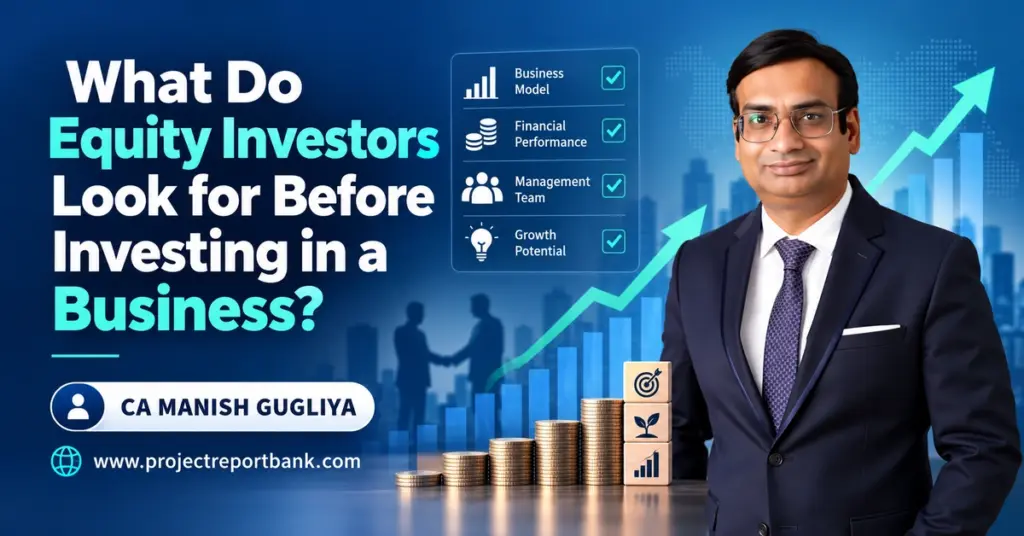
This article, written from the practical perspective of CA Manish Gugliya at Project Report Bank-a Chartered Accountant-led project finance and investor-advisory practice-examines the key factors investors evaluate, the financial metrics and valuation methods they use, special considerations for manufacturing and pre-revenue businesses, documentation requirements, common rejection triggers, and a practical investor-evaluation checklist.

Why Do Equity Investors Evaluate Businesses Before Investing?
Equity investors deploy risk capital with the expectation of generating returns significantly above what fixed-income instruments or public markets might offer. Since their upside depends entirely on business success-and their downside includes potential loss of the entire investment-a thorough evaluation before committing funds is not optional. The evaluation process includes analysing financial statements and market conditions, assessing management capability, and stress-testing assumptions about future performance.
The core concerns driving this evaluation are capital protection (minimising the probability of total loss), risk-adjusted return expectations (typically targeting IRR of 20–35% depending on stage and sector), liquidity risk (the difficulty of exiting a private investment), and alignment with the investor’s thesis, including sector focus, deal size, geography and existing investment portfolio exposure. Unlike debt, there are no fixed EMIs, no collateral security in most cases, and the investor’s returns depend on the company’s growth in equity value and eventual exit-not on interest rates or repayment schedules. Investors therefore rely on financial models projecting revenue, profit, cash flow and valuation multiples, rather than DSCR as their primary assessment lens.
Private equity funds and institutional investors typically have investment committees, internal risk frameworks and minimum IRR targets. This makes their assessment more stringent than informal funding from friends or family. In India, institutional investors also factor in regulatory considerations-the Companies Act, 2013, SEBI regulations where applicable, FEMA compliance for foreign capital-alongside their existing portfolio exposure before proceeding to detailed due diligence.
15 Important Factors Equity Investors Look for Before Investing
The following fifteen factors represent the core of what investors look for before investing in a business. Each section explains what investors examine, why it matters, common warning signs, and what promoters should prepare.
1. Promoter Credibility, Integrity and Experience
Investors scrutinise promoters for domain expertise, track record in relevant industries, personal integrity and past successes or failures. A promoter with demonstrated experience in the sector carries far more weight than one presenting an idea without operational background. Many private investors have backgrounds as successful entrepreneurs themselves, and they evaluate founders through that lens. Red flags include past companies with legal or tax defaults, adverse audit reports, or opaque decision-making. Promoters should prepare a clear professional profile, references, and documentation of prior achievements.
2. Strength and Capability of the Management Team
Management quality and corporate governance impact investment decisions significantly. Investors evaluate whether the management team can execute the plan-technical competence, commercial sense, ability to hire and retain talent. A business overly dependent on a single individual poses concentration risk. Promoters should demonstrate a capable leadership team with clearly defined roles and relevant experience.
3. Business Model Clarity, Revenue Sources and Unit Economics
A clear business model-explaining how the company earns revenue, what the cost structure looks like, and what the unit economics are-is fundamental. For a SaaS company, investors look at customer acquisition cost (CAC), lifetime value (LTV), payback period and churn. For manufacturing, the focus shifts to raw material costs, economies of scale, capacity utilisation and operating leverage. Red flags include vague revenue assumptions, unproven pricing models, or a revenue story that does not connect logically with operations.
4. Market Size, Demand Visibility and Growth Potential
Market size and growth potential are considered in every investment evaluation. Investors expect realistic estimates of Total Addressable Market (TAM), Serviceable Addressable Market (SAM) and Serviceable Obtainable Market (SOM). Industry trends can affect a company’s growth and profitability prospects, so investors look for sectors with visible demand drivers. A start-up claiming to address a ₹50,000 crore market but projecting only ₹10 crore revenue in five years-without explaining the penetration logic-raises questions rather than confidence.
5. Competitive Advantage, Differentiation and Entry Barriers
A company’s competitive advantage can include brand loyalty, high switching costs, patented technology, regulatory licences, distribution networks or cost leadership. Without defensible unique advantages, growth is often competed away. Investors want to understand what prevents competitors from replicating the business, and how sustainable the market share position is. Smaller companies without a clear moat face greater risk of margin erosion.
6. Historical Financial Performance and Financial Discipline
Investors assess financial performance using revenue growth and profit margins over the past 2–5 years. They look for consistent improvement, margin stability, working capital discipline and transparency in accounting. Key metrics include Price-to-Earnings ratio and Return on Equity, particularly for established companies. Investment evaluation identifies discrepancies between the price being asked and the intrinsic value supported by historical performance. Red flags: volatile margins, unexplained adjustments, frequent related-party transactions, or missing audited statements.
7. Future Revenue, Profitability and Cash Flow Projections
Projections should follow from operational assumptions-capacity, pricing, utilisation, cost structure-not arbitrary growth rates. Investors test whether financial projections and models are defensible under reasonable assumptions. The Discounted Cash Flow method forecasts future cash flows for valuation, and investors use DCF analysis as one of several methods to assess whether projected returns justify the investment risk. Overly optimistic projections without vendor quotes, market evidence or operational backing are among the most common rejection triggers.
8. Valuation, Equity Dilution and Justification of Funding Ask
Valuation must be grounded in financial reality. A higher valuation benefits the promoter in terms of lower dilution but reduces the investor’s upside. Investors use a mix of methods-discounted cash flow, comparable companies, revenue or EBITDA multiples and qualitative judgement-to arrive at a valuation range. In India, manufacturing multiples typically range between 7×–12× EBITDA for strong businesses, while technology companies may command significantly higher multiples depending on growth rates.
9. Return Potential, IRR and Realistic Exit Opportunities
Private investors often seek high returns on equity investments, and institutional funds typically target IRR of 20–35% depending on stage and risk. Exit routes-IPO, strategic acquisition, secondary sale-must be realistic. If a company operates in a niche where no comparable exits have occurred, or where the market value at exit cannot reasonably support the targeted returns, the investment opportunity loses attractiveness. Investors plan for a 4–6 year investment horizon with exit triggers built into shareholder agreements.
10. Existing Debt, Off-Balance-Sheet Liabilities and Guarantees
Debt-to-Equity ratios are used to assess a company’s financial risk. High fixed obligations reduce free cash flow available for equity returns. Investors examine existing term loans, working capital facilities, guarantees given, and contingent liabilities. An overleveraged balance sheet signals that the company may need more money just to service existing obligations rather than to fund growth.
11. Legal, Taxation and Regulatory Compliance
The regulatory environment can affect a company’s market risks and investment potential. Investors check ROC filings, GST compliance, income tax returns, pending litigation, environmental approvals and sector-specific licences. Non-compliance-even in seemingly minor areas-signals poor governance and creates contingent risk. Social and political changes can also impact business performance, making regulatory preparedness important.
12. Scalability, Operational Efficiency and Execution Capabilities
Can the business scale without proportional increase in costs? Investors evaluate operational capacity, supply chain resilience, technology infrastructure and process repeatability. Value creation at scale requires systems, not just individual effort. Such companies that demonstrate operational efficiency alongside growth potential attract stronger investor interest.
13. Promoter’s Own Capital at Risk and Alignment of Interests
Investors want to see that the promoter has meaningful financial security tied to the business. A promoter who has invested personal capital demonstrates conviction. If the founding team has little at risk, investors question alignment. Effective capital allocation decisions can increase shareholder value over time, and investors want confidence that the promoter will make disciplined deployment choices.
14. Quality of DPR, Business Plan, Financial Model and Documentation
The quality of documentation reflects the seriousness and preparedness of the promoter. A professionally prepared investor-ready DPR with clear assumptions, consistent financials, market analysis and risk assessment creates confidence. Generic templates, inconsistent numbers across documents, or missing key sections are immediate red flags. For manufacturing and capital-intensive projects, a Detailed Project Report is not optional-it is the foundation of the entire investment thesis.
15. Risk Identification, Sensitivity Analysis and Mitigation Planning
Stress testing evaluates potential risks and worst-case scenarios. Investors expect promoters to identify various factors that could go wrong-market volatility, raw material price spikes, currency risk from exchange rate fluctuations, customer concentration, technology disruption-and explain how these risks are mitigated. Market risk can lead to losses due to economic downturns, and performance risk affects stocks not meeting investor expectations. A credible risk framework, including sensitivity analysis on revenue, margins and cash flow, demonstrates maturity. Global factors such as interest rates, supply chain disruptions and geopolitical uncertainty also feature in investor risk assessments.
What Financial Ratios and Business Metrics Do Equity Investors Evaluate?
Equity investors use a mix of quantitative key metrics and qualitative judgement. The specific valuation metrics differ between early stage businesses, growth-stage companies and mature or capital-intensive manufacturing businesses.
| Metric | What It Indicates | Typical Investor Focus | Comments for Indian MSMEs |
|---|---|---|---|
| Revenue Growth Rate | Top-line momentum | 20–50%+ YoY for growth stage; 10–15% for mature | Must be linked to capacity, not arbitrary |
| Gross Margin | Pricing power, cost efficiency | 40–70% (SaaS), 20–35% (manufacturing) | Raw material costs drive this in manufacturing |
| EBITDA Margin | Operating profitability | Improving trajectory matters more than absolute level | Industry averages vary-compare with similar companies |
| Operating Cash Flow | Cash generation ability | Positive or approaching positive | High receivables reduce cash despite profits |
| Cash Conversion Cycle | Working capital efficiency | Lower is better | Critical for manufacturing with long inventory cycles |
| ROCE / ROIC | Return on capital deployed | 15–25%+ for established companies | Measures whether capital is earning adequate returns |
| Debt-to-Equity | Financial leverage risk | Below 1.5× preferred for most sectors | High leverage limits equity investor upside |
| Customer Concentration | Revenue dependency risk | Top customer <20–25% of revenue | Diversified customer base reduces risk |
| Churn / Retention | Revenue stickiness | Net retention >100% is strong (SaaS) | Relevant for subscription and recurring models |
| EV/EBITDA or Price-to-Sales | Relative valuation | Compared to comparable listed and unlisted peers | Context matters-growth rate justifies premium |
Investors evaluate expected IRR and MOIC across a 5–7 year horizon. For example: if an investor puts ₹5 crore into a company at a pre money valuation of ₹15 crore (post-money ₹20 crore, acquiring 25% ownership), and the company is valued at ₹60 crore after five years, the investor’s stake is worth ₹15 crore-a 3× MOIC and approximately 24–25% annualised IRR. These return calculations shape whether the investment opportunity meets the fund’s threshold.
While mutual funds and public-market investors focus on quarterly results, trading liquidity and price to earnings ratios, private equity investors concentrate on long-term cash flow and eventual exit routes-strategic sale, secondary sale or IPO. For capital-intensive manufacturing and infrastructure-linked projects, investors also analyse DSCR and project debt capacity, even though these are secondary to equity return metrics. Technical analysis of financial ratios is combined with commercial and qualitative assessment to arrive at informed decisions.

What Do Investors Look for in New Manufacturing and Greenfield Projects?
Manufacturing and industrial projects in India involve significant capex, long gestation periods and multiple regulatory interfaces. Equity investors focus on project feasibility and viability before making investment decisions, and they rely heavily on a Detailed Project Report and project feasibility study to assess the investment.
Key aspects investors examine include: land and location advantages, industrial zoning and pollution-control approvals, utility availability; technology and machinery selection, vendor credentials and quoted machinery costs; planned production capacity, realistic capacity-utilisation ramp-up, and economies of scale; raw material availability, price volatility and long-term supply arrangements; manpower planning, technical know-how and dependency on key experts; project cost estimation, means of finance (term loan–equity split), and working capital assessment; cash flow projections, IRR, payback period and sensitivity to volume and price changes; and implementation schedule with contingency provisions.
For instance, an investor evaluating a dairy processing plant project would examine whether the DPR includes verifiable milk procurement arrangements, realistic capacity utilisation (perhaps starting at 40–50% and scaling over three years), machinery quotations from credible vendors, and financial projections that tie logically to processing capacity, product mix, pricing and seasonal variations. Serious investors expect realistic assumptions backed by quotations and regulatory clarity rather than generic templated projections.
Can Pre-Revenue, New or Loss-Making Businesses Attract Equity Investors?
Many early stage companies and technology startups receive equity funding before profitability-and sometimes before significant revenue. Private investors typically invest in startups needing immediate capital and focus heavily on qualitative and traction-related factors. Investment amounts from private investors can vary greatly, from a few lakhs to several crores, depending on the stage and opportunity.
For pre-revenue or loss-making businesses, investors examine: market validation through pilots, early adopters or beta users; strength of the founding team and advisory network; product development status and IP (if any); unit economics at projected scale, even if current costs are high; scalability and repeatability of sales with a clear go-to-market plan; and defined milestones for the next 12–24 months tied to the proposed use of funds. Pre-revenue valuations assess startups based on market potential and team strength rather than historical financials.
At the very early stages, discounted cash flow is sometimes replaced by alternative approaches. The Berkus Method values startups up to $2.5 million based on qualitative risk factors. The Revenue Multiple Method estimates startup value using industry comparables. The VC Method targets returns of 20–35% for early-stage investments, working backward from expected exit value. Venture capitalists and angel investors also use qualitative scorecards to supplement quantitative methods.
Promoters should not hide losses but should clearly explain the path to breakeven, required capital, milestones and risk mitigation to potential investors.
How Do Equity Investors Evaluate Business Valuation and Equity Dilution?
Valuation is central to what investors look for before investing in a business. Too high a valuation reduces the investor’s potential upside and may signal unrealistic expectations. Too low a valuation may misalign interests or suggest the promoter undervalues the company. Both outcomes deter serious engagement.
Pre money valuation is the company’s assessed value before the new investment. Post-money valuation is pre-money plus the new capital. Each round reshapes ownership for promoters and other investors through dilution. For example: if an investor invests ₹5 crore at a pre-money valuation of ₹15 crore, the post-money valuation becomes ₹20 crore. The investor owns 25% (₹5 crore ÷ ₹20 crore), and the promoter’s stake dilutes from 100% to 75%. If additional rounds follow, the cap table evolves further, and earlier shareholders face further dilution unless they participate.
Investors in India use a mix of methods to arrive at a valuation range: the Discounted Cash Flow method, which calculates the present value of expected future cash flows; revenue or EBITDA multiples benchmarked against comparable companies or similar companies in the sector; comparable transactions involving other investors in recent deals; and qualitative judgement considering market conditions, competitive positioning and team. The net present value derived from DCF analysis is typically cross-checked against market value indicators from comparable deals. No single method produces a “correct” number-valuation is ultimately a negotiated outcome.
Promoters should consider obtaining a professional business valuation before entering serious negotiations to understand their defensible valuation range.
Documents Investors Usually Request Before Making an Investment Decision
Investor due diligence in India follows a structured process. The documentation requirements differ between initial screening and detailed due diligence.
Initial Screening Documents:
- Investor pitch deck (10–15 slides covering problem, solution, business model, team, market, financial highlights)
- Brief business note or executive summary
- High-level financial projections (3–5 years)
- Basic shareholding pattern and promoter background
Detailed Due Diligence Documents:
- Last 3–5 years audited financial statements and income tax returns
- Management accounts, MIS and ageing reports for debtors and creditors
- Detailed Project Report (for new or expansion projects)
- Detailed financial model with clearly stated assumptions and cash flow statements
- Company incorporation documents, MOA/AOA, board minutes and share registers
- Major customer and supplier contracts, loan agreements and lease documents
- IP documentation, licences and regulatory approvals
- Litigation summary, notices received and contingent liabilities
- HR policies, key employment contracts and ESOP details
An institutional investor may also request promoter background checks, credit reports, GST compliance verification, and ROC filing status under the Companies Act, 2013. Organised documentation and transparent disclosures create confidence, reduce delays, and communicate that the promoter takes governance seriously. Poor documentation quality is one of the most frequent reasons otherwise promising deals stall during due diligence.
Common Reasons Equity Investors Reject Business Funding Proposals
Rejections typically relate to information quality, risk profile and misalignment rather than simply “no funds available.” Understanding these triggers helps promoters address weaknesses before approaching investors.
Weak promoter story: Lack of domain experience, unclear roles among co-founders, or inconsistent personal narrative. Unclear business model: Revenue logic that does not connect to operations or market reality, or unrealistic market assumptions about penetration rates. Overly optimistic projections: Aggressive revenue growth without detailed basis-no vendor quotes, no capacity linkage, no market evidence. Unsupported valuation: Demanding multiples far above what comparable deals in the sector support, ignoring industry averages for similar companies. Poor financial hygiene: Missing audited statements, deferred tax filings, inconsistent margins, unexplained adjustments-undermining the company’s financial health. Excessive debt or stressed cash flow: An overleveraged business where new equity may simply service existing obligations. Unresolved legal or regulatory issues: Pending litigation, environmental non-compliance, or FEMA issues for businesses with foreign investment. No credible exit scenario: No realistic path to IPO, trade sale or secondary exit within a reasonable time frame. Misalignment with investor mandate: The proposal may be sound but outside the investor’s sector focus, geography or ticket size range.
Many proposals in India fail at the documentation stage itself-incomplete DPRs, generic templates, or projections that do not tie logically to capacity, pricing and costs. Promoters should treat investor feedback seriously, refine their proposals, and obtain professional help where needed in financial modelling and project feasibility.
How to Make Your Business Investor-Ready Before Approaching Equity Investors
A practical 10-step preparation roadmap for Indian promoters:
- Clarify funding objective: Define the amount required, planned use of funds, and expected timeline for deployment.
- Clean up statutory compliance: Ensure ROC records, GST filings, income tax returns and company records are current and accurate.
- Formalise accounting: Close books promptly, reconcile key balances, and maintain MIS that can withstand scrutiny.
- Prepare realistic financial projections: Build cash flow statements and profit projections from operational assumptions, not arbitrary growth targets.
- Conduct project feasibility and stress-test assumptions: Test base, best and worst-case scenarios to understand resilience.
- Get a professional view on valuation: Understand your defensible valuation range and acceptable dilution before negotiations.
- Prepare a comprehensive pitch deck and investor-ready DPR: Ensure consistency, clarity and professional presentation across all documents.
- Implement basic governance systems: Board processes, reporting frameworks, audit committees and related-party disclosure protocols.
- Align the promoter team: Clarify roles, future commitment, compensation expectations and willingness to invest more money if required.
- Identify suitable investor categories: Match your business stage, sector and scale with appropriate investor profiles. Understanding how to identify the right investors and whether your business meets equity funding eligibility criteria helps avoid wasted effort.
Private investments can provide expertise and contacts for startups beyond just capital, so matching with the right investor matters. Methodical preparation improves the probability of serious engagement but never guarantees investment.
Equity Investor Evaluation Checklist – Summary Table
This table provides a quick-reference summary of what equity investors look for before investing.
| Evaluation Area | What Investors Check | Documents / Evidence Required | Common Red Flags |
|---|---|---|---|
| Promoter & Team | Domain experience, integrity, track record | Promoter CVs, references, past venture records | Legal defaults, opaque backgrounds |
| Market Opportunity | TAM/SAM/SOM, demand drivers, industry growth | Market research, industry reports | Inflated market size, no SAM/SOM logic |
| Business Model & Unit Economics | Revenue model, margins, CAC, LTV | Financial model, customer data | Unproven pricing, unclear revenue logic |
| Financial Performance | Revenue growth, margins, working capital | 3–5 years audited financials, tax returns | Volatile margins, missing audits |
| Projections & Valuation | Revenue/profit forecasts, valuation basis | Financial model, DCF, comparable analysis | Unrealistic growth, unsupported multiples |
| Compliance & Legal | ROC, GST, tax, licences, litigation | Compliance certificates, legal opinions | Pending demands, expired licences |
| Operations & Scalability | Capacity, technology, supply chain | Operations manual, vendor contracts, DPR | Key-person dependency, single supplier |
| Capital Structure & Debt | Existing debt, guarantees, contingent liabilities | Balance sheet, loan agreements | Overleveraged, stressed cash flow |
| Exit Options | IPO path, strategic sale potential, secondary | Shareholder agreement, exit clauses | No comparable exits in sector |
| Risk Management | Risk register, sensitivity analysis, mitigation | Sensitivity tables, insurance, contingency plans | No risk identification, single scenario |
Promoters preparing for equity investment should use this checklist while developing their DPR, business plan and financial model to ensure comprehensive coverage of investor expectations.
Frequently Asked Questions on What Equity Investors Look For
What minimum profitability do equity investors expect before funding a business?
There is no universal minimum. Private equity investors typically expect positive EBITDA and demonstrable cash flow. Angel investors and venture capital firms may invest in loss-making or pre-revenue businesses if growth potential, team quality and unit economics at scale are compelling. The key is whether the business has a credible and measurable path to profitability within the investment horizon.
Can an MSME with high debt still raise equity investment in India?
It is possible but more difficult. Investors will evaluate whether new equity is genuinely funding growth or merely servicing existing liabilities. A clear plan for debt restructuring, improved working capital management and a compelling growth narrative can help. However, a heavily leveraged balance sheet creates greater risk for equity investors and typically results in lower valuation or more protective deal terms.
How detailed should financial projections be for equity investors?
Projections should be model-driven-linked to operational assumptions such as capacity, utilisation, pricing, costs and working capital cycles-rather than top-down percentages. Investors expect 3–5 year projections with monthly or quarterly granularity for the near term. A credible financial model with clear assumption documentation is far more valuable than elaborate spreadsheets built on arbitrary figures.
Do equity investors insist on promoter contribution and at what level?
Yes. While there is no fixed percentage, investors expect promoters to have meaningful capital at risk. For manufacturing projects, promoters may be expected to contribute 25–40% of project cost depending on scale. For startups, earlier rounds may be funded primarily by investors, but founders should demonstrate personal financial commitment that aligns their interests with investor expectations.
How long do equity investors typically stay invested before exit?
Institutional investors plan for a 4–7 year horizon. Angel investors may accept longer or shorter periods depending on the opportunity. Exit triggers and rights-drag-along, tag-along, put/call options-are typically documented in shareholder agreements. Successful investing in private companies requires patience and realistic exit planning from both sides.
What is the role of mutual funds versus private equity in providing growth capital?
Mutual fund companies primarily invest in publicly listed securities and provide portfolio-level exposure to equity markets. They do not typically fund private companies directly. Private equity investments are made in unlisted or private businesses with active involvement in governance and strategy. The distinction matters: promoters seeking growth capital for unlisted businesses should approach angel investors, venture capital funds, private equity firms or family offices, not mutual fund managers.
How does discounted cash flow analysis influence investment decisions?
DCF analysis estimates the present value of a company’s expected future cash flows, discounted at a rate reflecting investment risk. It is one of the most widely used valuation approaches, particularly for businesses with predictable cash flows. However, for early stage businesses with limited revenue history, investors may supplement or replace DCF with revenue multiples, the VC Method or qualitative scorecards. The method chosen depends on the maturity, sector and data availability of the business.
Are early stage angel investors less strict about documentation than private equity funds?
Generally, yes-angel investors may proceed with lighter documentation during initial discussions. However, even individual investors expect clean financials, a credible business plan, and basic corporate compliance before writing a cheque. Private equity funds conduct multi-stream due diligence (financial, legal, commercial, regulatory) with teams of advisors. The depth differs, but the principle of thorough evaluation applies across all investor categories. Promoters who prepare documentation early gain valuable insights into their own business while building credibility.
What are typical timelines for investor due diligence and deal closure?
Angel investments may close within 4–8 weeks from serious engagement. Venture capital investments often take 2–4 months. Private equity transactions typically require 3–6 months or longer, depending on deal complexity, regulatory approvals and negotiation dynamics. Delays are almost always caused by incomplete documentation or unresolved issues surfacing during due diligence.
Is a formal Detailed Project Report necessary for service-sector startups, or only for manufacturing?
A DPR is essential for manufacturing and capital-intensive projects where investors need to evaluate land, machinery, capacity, raw materials, utilities and project cost in detail. For service-sector and technology startups, a well-structured business plan with a robust financial model often serves a similar purpose. However, if the service business involves significant capex (e.g., setting up physical infrastructure), a project-level DPR adds substantial credibility.
Final Thoughts – Preparing a Business That Investors Can Trust
Equity investors look for a combination of trustworthy promoters, commercially viable opportunities, disciplined financials, sensible valuations and clearly articulated risks with mitigation plans. Every investment decision is ultimately a judgement call about whether the expected returns justify the risks-and whether the people running the business can be trusted to execute.
Serious equity investment decisions are based on detailed analysis of cash flow, governance standards and exit visibility, not just pitch-deck narratives or aspirational projections. Indian entrepreneurs, MSMEs and manufacturing businesses can substantially improve their chances of long term success in fundraising by investing in high-quality DPRs, rigorous financial models and honest, data-backed presentations. A financial professional can help translate a business vision into credible, investor-grade documentation.
Need an Investor-Ready DPR, Financial Projections or Business Valuation?
Project Report Bank provides professional assistance with investor-ready DPRs, financial modelling and fundraising preparation for Indian entrepreneurs, MSMEs and manufacturing businesses. Professional documentation helps investors evaluate a proposal with confidence-though it does not guarantee funding outcomes.
CA Manish Gugliya FCA, DISA (ICAI) Website: https://projectreportbank.com/ WhatsApp: +91 7389736441
FAQs
How can Project Report Bank help me prepare for meetings with equity investors?
Project Report Bank prepares customised investor-ready DPRs, financial projections, business valuations and pitch-deck support documents. The focus is on building consistent, defensible documentation that addresses what investors actually examine-cash flow, valuation, risk and returns-rather than producing generic templates. This preparation helps promoters answer investor questions with clarity and confidence.
Do I still need a bank loan project report if I am focusing on equity investment?
If your project involves both equity and debt (which most manufacturing and capex-heavy projects do), you will likely need documentation for both audiences. A bank-focused DPR emphasises repayment capacity, DSCR and collateral, while an investor-facing document emphasises growth, valuation and exit. The underlying financial data should be consistent, but the presentation and emphasis differ.
What information should I share first with potential investors and what should wait until NDA?
At the initial screening stage, share your pitch deck, executive summary, high-level financial projections and basic promoter profiles. Detailed customer lists, proprietary technical information, specific vendor contracts and sensitive commercial terms should typically be shared only after a non-disclosure agreement is in place and the investor has demonstrated serious intent to proceed.
How often should I update my DPR and financial model during a fundraising process?
Update your model whenever material assumptions change-new customer contracts, revised machinery costs, changed market conditions, or regulatory developments. A static document prepared months before an investor meeting may not reflect current realities. Ideally, maintain a working financial model that can be updated quickly and consistently across all investor-facing documents.
Can one DPR be used for both bank finance and equity investors?
A single base document can provide the foundation, but the final presentation should be tailored. Banks focus on loan repayment capacity, working capital assessment and security. Equity investors focus on growth potential, valuation, returns and exit. Using a manufacturing DPR prepared solely for bank submission-without addressing valuation, competitive positioning and investor return expectations-is unlikely to be effective for equity fundraising.