Key Takeaways
- This guide covers industrial breakfast cereals and food extrusion machinery, integrated production lines, plant layout planning, EPC cost structure and financial feasibility for automated plants in India.
- The focus is on high-output plants (500 to 3,000 kg/hour) using extrusion technology for corn flakes, multigrain breakfast cereals, fortified rice, pet food and related products; not small or domestic units.
- Correct selection of food extruder machines, dryers, coating systems and packaging lines determines consistent quality, production efficiency and commercial viability.
- Promoters should base investment decisions on a bankable DPR, realistic capacity planning, detailed EPC costing and working-capital assessment rather than machinery price alone.
- Project Report Bank, led by CA Manish Gugliya, FCA, DISA (ICAI), supports manufacturers with customised DPRs, CMA Data, financial modelling and project finance advisory for such plants.
Industrial Breakfast Cereals and Food Extrusion Machinery: Overview
Industrial breakfast cereal production spans corn flakes, multigrain flakes, puffed and shaped cereals, fortified rice kernels and pet food. Food extruder machines form the technological core of modern production lines, operating under high temperature and pressure to produce uniform food products in bulk. Extrusion cooking combines mechanical shear, heat, and moisture to transform raw cereal flours into expanded, shaped and cooked products. The global corn flakes market alone is valued at USD 2.00 billion in 2025 and is expected to reach USD 5.96 billion by 2034. Breakfast cereals can include multigrain and fortified options, and corn flakes are made from processed corn through cooking and flaking.
Not all breakfast cereal products use the same machinery. A standardized production flow includes raw material processing, extrusion, and packaging, but the upstream and downstream modules differ for each product category.
| Product Category | Core Technology | Main Machinery | Automation | Plant Considerations |
|---|---|---|---|---|
| Corn flakes | Batch cooking + flaking | Cooker, flaking rolls, toaster | Semi-auto to PLC | Separate cooking, conditioning |
| Extruded breakfast cereals | Direct extrusion cooking | Twin-screw food extruder, dryer | PLC/SCADA | High-care zoning post-extruder |
| 3D snack pellets | Extrusion + pelletising | Extruder, pellet dryer, fryer | PLC-controlled | Separate frying/expansion step |
| Instant noodles | Sheeting + cutting | Sheeter, steamer, fryer | Fully automatic | Entirely different line |
| Pet food | Extrusion cooking | Twin-screw extruder, dryer, coater | PLC/SCADA | Separate hygiene regime |
| Fortified rice | Extrusion into rice shape | Twin-screw extruder, dryer | PLC-controlled | Blending with natural rice |
Conventional flaked corn cereals require dedicated cooking and conditioning systems; for product-specific detail, refer to our industrial corn flakes manufacturing plant project report. Oat processing involves separate hydrothermal treatment and rolling equipment, covered in our industrial rolled oats processing plant project report.
Types of Industrial Food Extrusion and Cereal Processing Machinery
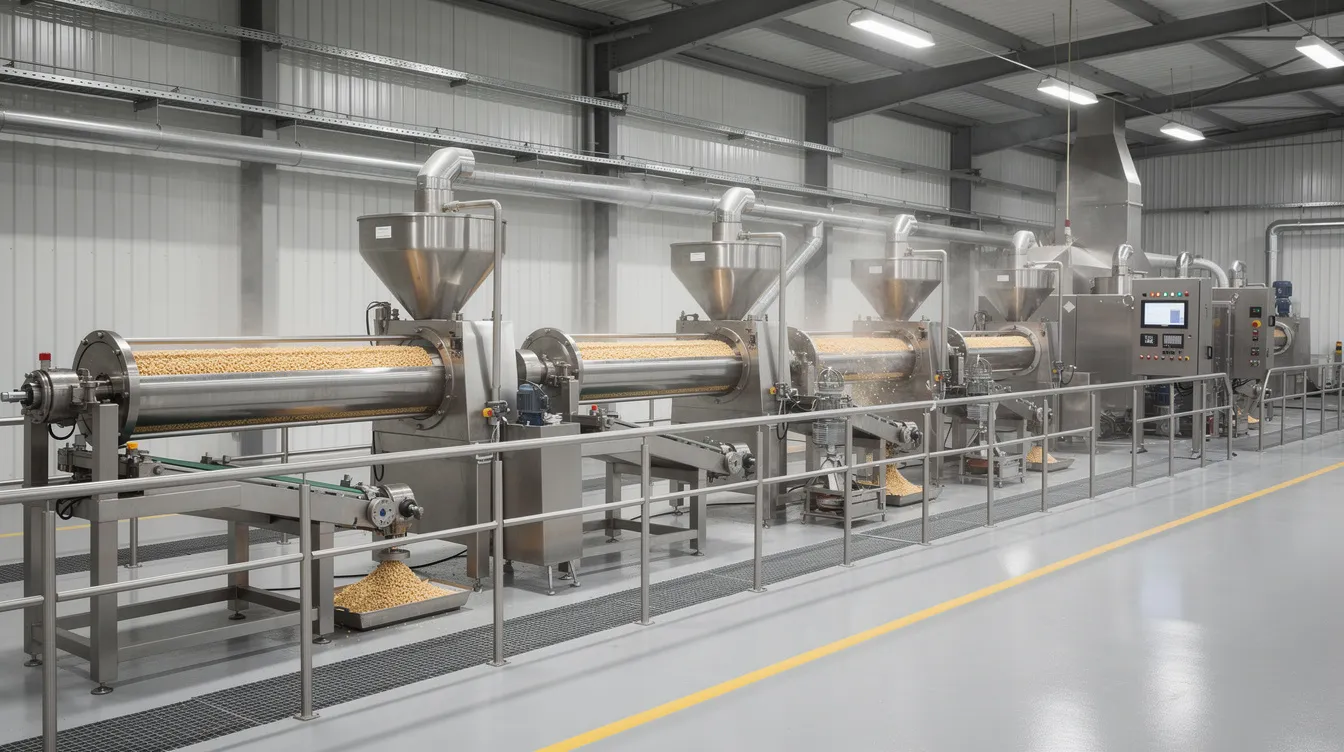
A modern breakfast cereal or snack facility is an integrated system, not a single food extruder machine. Typical industrial line capacities range from 500 to 3,000 kg/hour. Using SS304 stainless steel meets HACCP and FDA standards for food safety across contact surfaces. Configurations differ for breakfast cereals, pet food, fortified rice, 3D snack pellets and instant noodles.
Raw Material Handling and Storage
Typical raw materials include corn grits, rice flour, wheat flour, multigrain blends, sugar, cocoa, salt and vitamins. Extruded snacks can be made from corn flour and rice flour in various blends. Storage involves silos, day hoppers and big-bag stations with bucket elevators, screw conveyors and pneumatic systems sized above extruder line capacity (typically 5 to 20 tonne/hour grain intake).
Cleaning, Grading and Pre-Processing
Pre-cleaners, vibrating screens, destoners and magnetic separators remove foreign matter to protect downstream equipment. On-site milling (hammer mill or pin mill) may be required depending on whether ready flour or whole grains are procured; particle-size distribution directly affects extrusion consistency.
Ingredient Mixing and Automatic Dosing
Cereal production lines require accurate ingredient measurement and mixing systems. Loss-in-weight feeders handle major ingredients to approximately ±0.5 to 1% accuracy; micro-dosing systems handle vitamins and minerals at tighter tolerances. Ribbon blenders or continuous mixers handle dry blending of base flours, sugar, salt and functional ingredients. PLC-based recipe management enables traceability and batch reporting.
Preconditioners
Preconditioners use steam and water injection to hydrate and partially cook the cereal mix before extrusion, improving texture and reducing extruder energy consumption. Retention time and steam pressure impact starch gelatinisation for corn, rice and millet flours. Conventional corn flakes lines use separate batch cookers instead; see the industrial corn flakes manufacturing plant project report for detail.
Single-Screw and Twin-Screw Food Extruders
The food extruder is the core machine: continuous cooking, texturising and shaping of cereal dough under controlled temperature, pressure and shear. Twin-screw extrusion allows precise control over moisture and cooking. Double screw extruders enhance product quality and flexibility for multigrain cereals, fortified rice, pet food and complex shapes. Twin-screw systems can handle traditional and gluten-free grains. Twin-screw extruders can produce 120 to 250 kg/h of snacks, while extruded snacks can be produced at 120 to 250 kg/h on well-configured lines.
Single-screw extruders cost less and suit homogeneous raw materials such as corn or rice flour, but offer less flexibility for high-protein or high-fibre formulations. The correct choice depends on product portfolio, not assumption that twin-screw is always superior.
For product-specific extruded cereal feasibility, refer to the extruded breakfast cereals manufacturing plant project report. Multi-product line configurations are detailed in the integrated multi-product extruded snacks plant project report.
Key comparison parameters include installed power (kW) versus output (kg/hour), screw diameter and L/D ratio (typically 32:1 to 60:1), barrel segmentation, control system (PID versus PLC/SCADA), and cleaning/changeover time.
Flaking, Puffing and Cereal Forming
Flaking mills with precision roller gaps produce corn flakes, barley flakes and multigrain flakes. Puffed snacks can take various shapes like stars and rings through rotary cutters and face-cutters at the extruder die. Extruded snacks can include core-filled varieties with flavors using co-extrusion attachments. Extrusion machines can create various shapes of snacks and cereals through die design.
For 3D snack pellets requiring specialised shaping, refer to the industrial 3D snack pellets manufacturing plant project report. Instant noodles use sheeters and slitters rather than extrusion; see the automatic instant noodles and cup noodles manufacturing plant project report.
Industrial Dryers, Toasters and Roasting Systems
Drying processes are essential for removing moisture from extruded cereal snacks and often represent the bottleneck in production lines. Continuous belt dryers and multi-pass dryers handle final product moisture targets of 2 to 4% for ready-to-eat cereals. For a 1,000 kg/h line, dryer evaporation load is approximately 99 kg/h, requiring careful thermal sizing. Energy recovery technologies reduce thermal energy consumption in cereal production through condensate recovery and insulation.
Coating, Seasoning and Fortification
Sugar/flavor coating systems ensure even adherence of coatings to cereals through rotating drums. Flavoring systems apply oils and seasonings to enhance snack taste profiles. Micronutrient fortification uses inline dosing for vitamin and mineral premixes, requiring validation for regulatory compliance. Millet-specific coating challenges are addressed in the millet-based extruded snacks manufacturing plant project report and the ready-to-eat millet breakfast cereals manufacturing plant project report.
Cooling, Grading and Quality Inspection
Cooling conveyors bring coated products to safe packing temperatures. Grading equipment removes fines and oversize particles. Inspection systems include metal detectors, in-line moisture analysers and checkweighers. Maintaining quality control is crucial for ensuring compliance with food safety standards.
Automatic Packaging
VFFS machines with multihead weighers, carton erectors, case packers and palletising systems handle pillow pouches, stand-up pouches and cartons. Pack integrity (sealing, nitrogen flushing, leak detection) supports long shelf life. End-of-line automation drives achievable high output, especially above 1,000 kg/hour.
Industrial Breakfast Cereals and Food Extrusion Manufacturing Process
Actual process steps vary by product and supplier. Breakfast cereals can be produced using extrusion technology through a direct-expanded line:
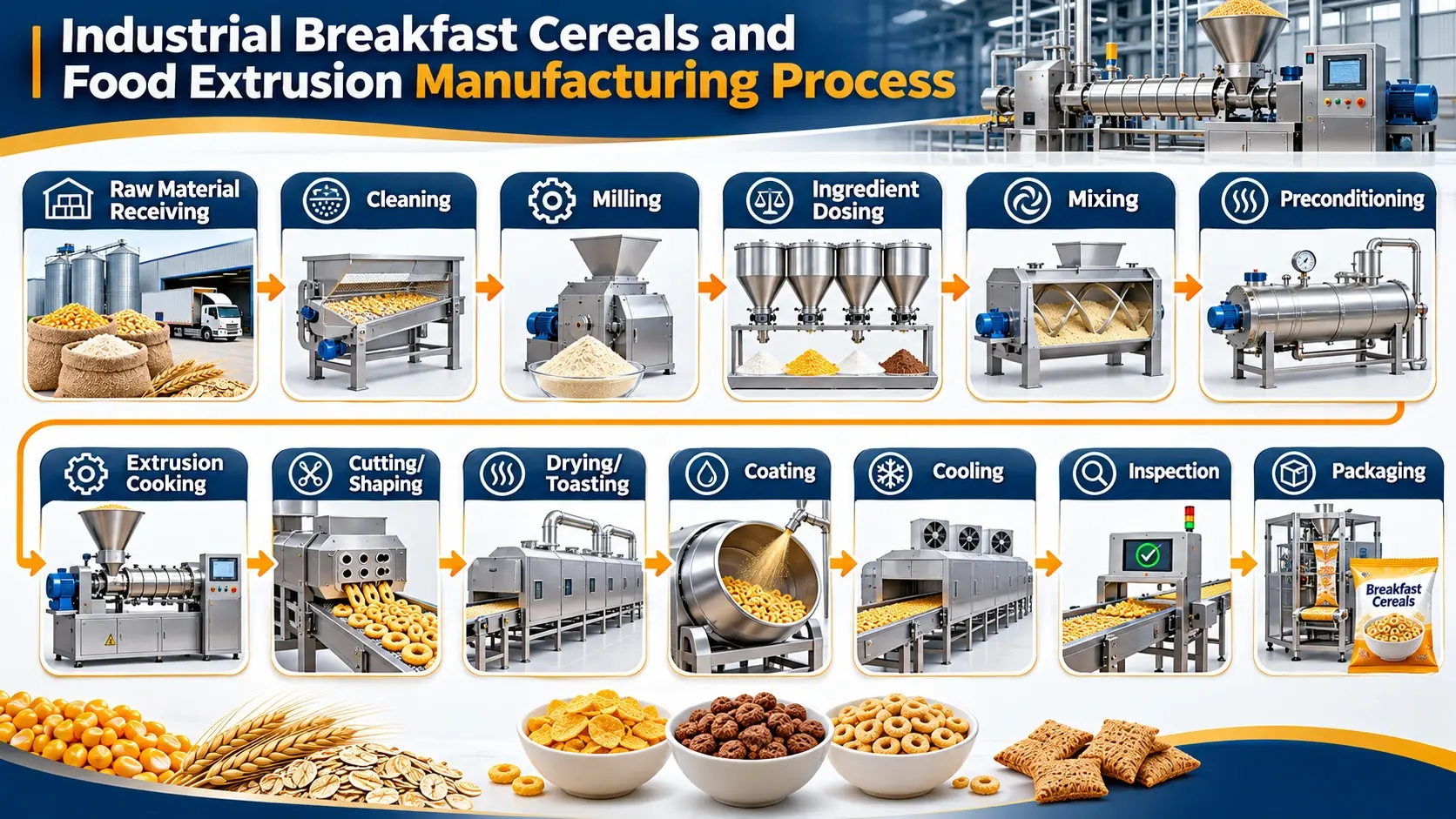
Raw Material Receiving → Cleaning → Milling → Ingredient Dosing → Mixing → Preconditioning → Extrusion Cooking → Cutting/Shaping → Drying/Toasting → Coating → Cooling → Inspection → Packaging
Direct-expanded cereal lines are suitable for multi-product flexibility and shaped cereals, with expansion occurring at the die. Pellet-based lines extrude at higher moisture for later expansion by frying or hot air. Traditional corn flakes lines involve batch cooking and high-temperature toasting with separate flaking rollers. For fortified rice, rice flour is mixed with vitamin premix, extruded into rice-like shapes, dried and blended with natural rice.
Automatic Food Extrusion Machinery: Capacity and Production Line Selection
Suppliers often quote food extruder capacities without clarifying whether the figure refers to raw feed, wet extrudate or dried packed product. Choosing the right breakfast cereal production line depends on target product and capacity. The production capacity for corn flakes ranges from 20,000 to 100,000 MT annually, depending on line size.
| Rated Capacity (kg/h) | Operating Hours/Year | Nameplate Annual (MT) | At 70% Utilisation | At 80% Utilisation |
|---|---|---|---|---|
| 500 | 6,000 | 3,000 | 2,100 | 2,400 |
| 1,000 | 6,000 | 6,000 | 4,200 | 4,800 |
| 2,000 | 6,000 | 12,000 | 8,400 | 9,600 |
| 3,000 | 6,000 | 18,000 | 12,600 | 14,400 |
First-year utilisation is typically 50 to 60%, rising to 80 to 85% in years 2 to 3. Extruder versus dryer versus packaging bottlenecks must be checked during line sizing.
Industrial Food Extrusion Plant Layout and Factory Design
Incorrect layout permanently increases handling costs and contamination risk. Linear product flow is the governing principle: raw materials enter at one end, finished packed product exits near dispatch.
For a 1,000 to 2,000 kg/hour plant, typical plot area is 10,000 to 15,000 m²; built-up area approximately 3,500 to 5,000 m². Key areas include raw material receiving, grain storage, cleaning, batching, extrusion hall (adequate height for preconditioners and dryers), coating room, hygienic packaging hall, finished goods warehouse, QC laboratory, utility block, maintenance workshop, personnel facilities and expansion reserve.
Electrical Power, Steam, Compressed Air and Utility Requirements
A 1,000 kg/h cereal line typically requires an extruder motor of approximately 200 to 250 kW, with total connected load of several hundred kW including dryers, blowers, compressors and packaging machines. Steam or thermic fluid heaters support preconditioning and drying. Compressed air (oil-free or food-grade) serves pneumatic conveying, packaging machines and instrumentation. Water treatment, HVAC and centralised PLC/SCADA round out the utility infrastructure.
Industrial Breakfast Cereals Manufacturing Plant Machinery Cost
MOFPI data indicates extrusion line modules cost approximately ₹110 to 185 lakh for 100 to 350 kg/hour lines. For a complete industrial plant at 200 kg/h, total project cost (including civil, utilities) is approximately ₹6 to 8 crore, with machinery representing roughly 25 to 35% of total investment. Corn flakes production costs are primarily driven by raw materials at 70 to 80%. Machinery costs vary with stainless-steel grade, automation level and country of origin.
Industrial cereal lines are categorized into turnkey solutions and modular lines. Supplier quotations typically exclude civil foundations, electrical panels, utility generation equipment and installation labour unless explicitly stated.
Breakfast Cereals Plant EPC Cost and Turnkey Project Investment
EPC (Engineering, Procurement and Construction) provides a single point of responsibility. Scope includes basic and detailed engineering, equipment procurement, civil and structural works, mechanical and piping installation, electrical and automation works, commissioning, documentation and training.
Contract models range from equipment supply only through partial EPC to full turnkey delivery on a performance-guarantee basis.
Total Capital Investment and Industrial Project Cost Estimation
Total project cost includes land, site development, factory buildings, process and packaging machinery, electrical infrastructure, utility equipment, material handling, engineering fees, installation, regulatory approvals, pre-operative expenses, interest during construction, contingency and initial working-capital margin. Concept-stage estimates carry ±25 to 30% uncertainty; budgetary estimates based on vendor quotes narrow this to ±15 to 20%.
Indian Versus Imported Food Extrusion Machinery
Indian equipment can be competitive for standard breakfast cereal and snack applications. Imported lines are preferred for high-complexity formulations, advanced process control or stringent export markets. Promoters should evaluate reference installations, performance guarantees, local service availability, spare-parts pricing and training support. The correct decision requires financial modelling of total cost of ownership within a robust DPR.
Food Processing Plant EPC Contractor and Machinery Supplier Selection
Selection criteria extend beyond equipment price to integration capability, engineering competence, materials of construction, control systems and commercial terms. Pre-order technical due diligence should include factory visits, product trials with intended raw materials and utility consumption documentation.
Industrial Food Extrusion Plant Installation and Project Execution Timeline
Typical stages run from feasibility and DPR through site selection, engineering, procurement, civil construction, machinery installation, commissioning and commercial production. Total timeline for a medium-to-large plant in India is typically 12 to 18 months excluding land acquisition. Key risks include delayed approvals, late machinery delivery and design changes after civil work starts.
Food Safety, Regulatory Compliance and Factory Approvals in India
Regulatory compliance is vital for food safety in cereal manufacturing environments. Mandatory requirements include FSSAI licensing, relevant food product standards, factory licence, fire NOC, Pollution Control Board consents and boiler inspector approvals where applicable. Voluntary certifications (ISO 22000, FSSC 22000, BRCGS, Halal, Kosher) add commercial value for export and modern-trade channels.
Financial Feasibility of Industrial Breakfast Cereal and Extrusion Plants
Corn flakes manufacturing has a gross profit margin of 30 to 40%. Income from cereal production can be increased by evaluating product mix and capacity utilisation. Project feasibility studies analyze economic viability for manufacturing projects through DSCR, IRR, NPV, break-even and payback period. Sensitivity analysis should test downside scenarios: 10 to 15% lower selling price, 10 to 20% higher raw material cost and capex overruns.
Bank Loan DPR, Project Finance and Investor Readiness
A bankable DPR integrates technical concept, machinery quotations, plant layout, project cost, means-of-finance structure, year-wise financial projections, DSCR analysis and sensitivity testing. CMA Data for Indian banks requires projected inventory, receivables and operating-cycle calculations. Professional advisory services can support businesses in preparing for bank finance and investments. Business valuation and financial modeling aid in assessing project worth and investment readiness.
Common Mistakes in Industrial Food Extrusion Machinery Selection
| Risk | Impact | Mitigation |
|---|---|---|
| Sizing extruder without checking dryer/packing throughput | Production bottleneck | Integrated line-balancing study |
| Assuming one line handles all products | Cross-contamination, quality issues | Product-family segregation, HACCP review |
| Under-designing utilities | Voltage drops, steam shortages | Vendor-confirmed utility specs in DPR |
| Overestimating year-1 capacity utilisation | Cash-flow stress | Conservative ramp-up in financial model |
| No performance guarantees in contracts | Disputed capacity, energy overruns | Contractual KPIs with retention clauses |
| Ignoring working-capital needs | Funding gap during operations | Full working-capital assessment in DPR |
Frequently Asked Questions
What machinery is required for an automatic breakfast cereal manufacturing plant?
A complete line includes raw material handling, cleaning, milling (if needed), ingredient batching, preconditioner, food extruder machine (or cooker-flaker for corn flakes), dryers/toasters, coating equipment, cooling conveyors, metal detector, checkweigher and automatic packaging. Exact configuration depends on product portfolio and plant capacity, which must be defined at the DPR stage.
How do I decide between a single-screw and a twin-screw food extruder?
Single-screw extruders suit simpler formulations at lower capital cost. Twin-screw machines provide greater flexibility for multigrain cereals, fortified rice, pet food and complex shapes. Consider product range, changeover frequency, energy-consumption data from vendor trials and long-term innovation plans before finalising.
What is the typical project cost range for an industrial breakfast cereal plant in India?
Total investment for serious industrial-scale lines (500 to 2,000 kg/hour) can range from approximately ₹5 to 60 crore including land, buildings, machinery, utilities and working capital. Precise figures require current supplier quotations and project-specific assumptions. Project Report Bank prepares customised financial models rather than generic estimates.
Can one extrusion line manufacture breakfast cereals, snack pellets and pet food?
Many twin-screw systems support multiple applications, but each additional product category introduces compromises in die design, dryer settings and hygiene zoning. Pet food and human food typically require separate lines to avoid cross-contamination, supported by HACCP assessment.
When should I approach banks for funding my extrusion project?
Prepare a concept note, conduct preliminary supplier discussions and commission a professional DPR before formal loan applications. Banks expect a complete DPR, CMA Data, means-of-finance plan, projected financial statements and sensitivity analysis.
How CA Manish Gugliya and Project Report Bank Can Assist
CA Manish Gugliya, FCA, DISA (ICAI), brings more than 20 years of experience in project finance, manufacturing DPRs and financial modelling. Project Report Bank provides customised DPRs integrating technical, commercial and financial analysis; capital-investment and EPC cost assessment using supplier quotations; financial projections with DSCR, IRR and sensitivity analysis; CMA Data for bank loans; and investor-ready documentation.
Engineering design, equipment performance guarantees and EPC execution remain the responsibility of qualified engineers, OEMs and contractors.
Planning a Large-Scale Breakfast Cereals or Food Extrusion Manufacturing Plant?
Contact CA Manish Gugliya at www.projectreportbank.com for a customised DPR, capital investment assessment, financial feasibility study and project finance advisory before finalising machinery orders or loan proposals.