Key Takeaways
- This article is a professional, India-focused industrial 3D snack pellets manufacturing plant project report covering machinery, capital investment, production economics and financial feasibility for investors and manufacturers.
- 3D snack pellets are semi finished, ready-to-fry products supplied in bulk to snack brands, regional fryers and export traders; this project type is distinct from direct-expanded ready-to-eat extruded snacks or a banana chips production line.
- Typical commercially viable investments in India range from approximately ₹5 crore to ₹15 crore and above, depending on capacity (250 to 1,000+ kg/h finished dried pellet output), automation level and pellet production line configuration.
- Project viability depends on extrusion technology selection, 2D and 3D pellet mix, hot air drying efficiency, raw materials economics and working capital planning.
- Project Report Bank, led by CA Manish Gugliya (FCA, DISA), prepares customised DPRs, CMA data and financial models for bank finance and investor-ready documentation.
Introduction – Investment Opportunity in Industrial 3D Snack Pellet Manufacturing
Industrial 3D snack pellets are dried, shelf-stable, starch-based half-products manufactured through extrusion and precision forming. These semi finished pellets are not consumed directly; they are shipped in bulk to downstream operators who expand them by frying, hot air puffing or another validated method, then season and package for retail sale. The core business model separates pellet manufacturing from frying, seasoning and branding, allowing each stage to specialise.
The plant supplies 3D pellet snacks to snack brands, regional fryers, contract packers, institutional buyers, private-label companies and export traders. This B2B model differs from an integrated fried namkeen operation or a potato chips production line, where raw-to-retail processing occurs under one roof. It also differs from fully ready-to-eat extruded snack manufacturing, which uses direct expansion at the extruder itself. Promoters considering integrated snack factories may find a separate project framework for multi-product extruded snack plants more relevant.
Demand drivers for industrial pellets include outsourcing by snack brands seeking consistent base products, growing consumer interest in novelty 3D shapes, expansion of modern retail private labels, and export opportunities to Africa, the Middle East and South-East Asia. Investors in India typically evaluate capacities of 250 to 1,000 kg/hour and above, factoring in land, utilities, food processing compliance, and the choice between single screw extruder and twin screw extrusion systems.
This content is authored from a financial and commercial advisory perspective by CA Manish Gugliya. Equipment specifications and vendor pricing cited here are drawn from publicly available supplier data and research; they serve as planning references, not as endorsements.
What Are 3D Snack Pellets and Ready-to-Fry Products?
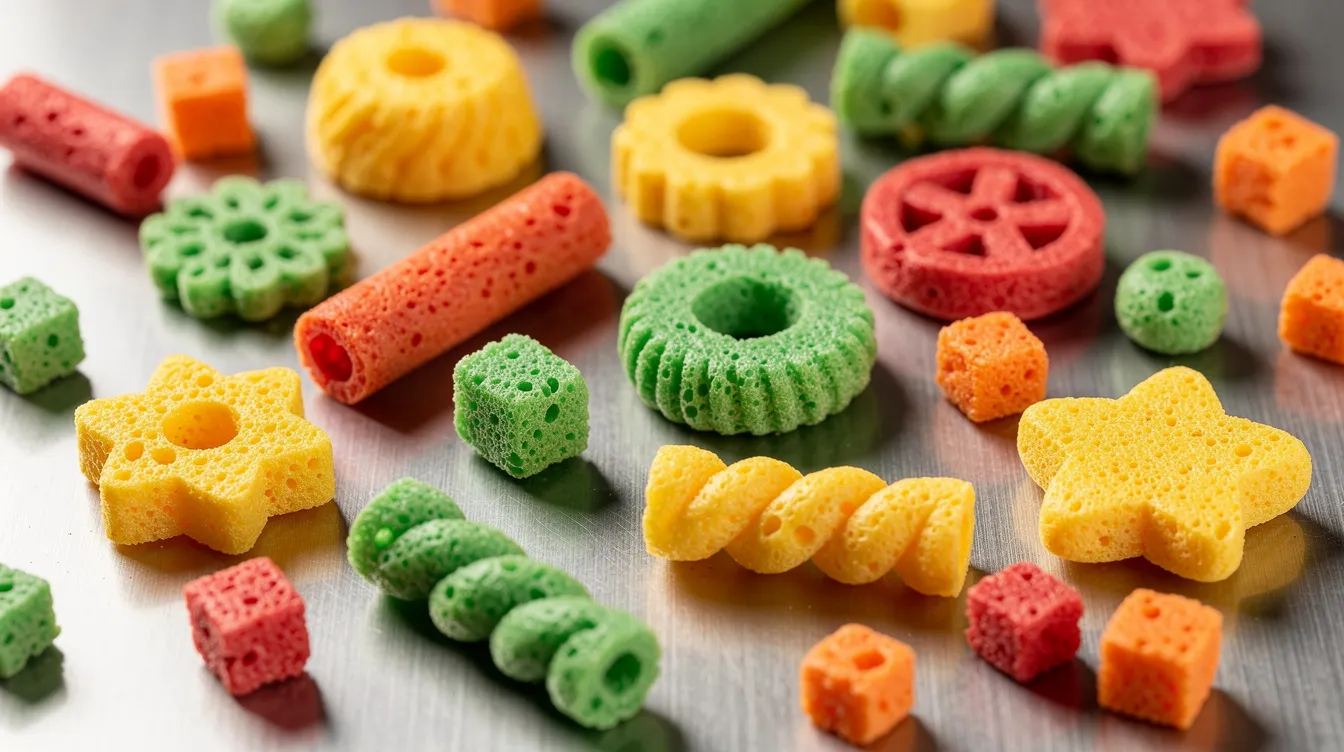
Snack pellets are shelf-stable products made from starch-based dough, processed through extrusion and drying into dense, compact shapes that expand when fried or puffed. Pellets expand by frying or hot-air puffing during processing at downstream facilities. This semi finished product model allows the pellet manufacturer to focus on formulation, extrusion and drying while leaving frying, oil management, a flavoring drum and retail packaging to the end customer.
3D pellet categories include hollow cones and bugles, multi-layer shells, pani puri or golgappa shells, tubes, spirals, wheels with depth, and animal or cartoon shapes. 2D pellets are flat shapes like rings and wheels, extruded through a simple die plate. 3D pellets have complex shapes like bugles and shells, often formed by pressing two dough sheets together using specialised die inserts and forming modules. Many commercial plants run combined 2D 3D configurations, switching between product families using interchangeable dies.
Common formulations include potato starch-based pellets (preferred for superior puff and hollowness), corn starch and corn flour blends, wheat flour combinations, rice flour and tapioca or cassava starch variants. Premium multigrain and millet-enriched pellets are emerging, though millet-based fully ready-to-eat snacks require different formulations and equipment configurations.
| Parameter | 3D Snack Pellets | 2D Pellets | Direct-Expanded RTE Snacks |
|---|---|---|---|
| Shape complexity | High (depth, hollow) | Low (flat) | Medium (puffed) |
| Moisture at dispatch | 10–12% | 10–12% | 3–5% |
| End use | Requires frying/puffing | Requires frying/puffing | Ready to eat |
| Density | High (compact) | Moderate | Low (expanded) |
| Shelf life (dried) | 6–12 months | 6–12 months | 3–6 months |
| Freight cost | Lower per unit | Lower per unit | Higher per unit |
| Core equipment | Twin screw extruder + 3D former + dryer | Extruder + die + dryer | Extruder + dryer/fryer + seasoning |
Industrial 3D Snack Pellets Manufacturing Process
The process follows a controlled sequence where each step affects the quality, expansion and shelf stability of the end product.
Raw Material Procurement and Preparation. Starches, flours and additives are received, tested for moisture and particle size, cleaned by sieving, and stored in dedicated bins. Ingredient weighing and formulation follow recipes validated for specific 3D shapes; dough rheology directly affects shape product integrity during forming.
Mixing and Moisture Conditioning. Dry ingredients are blended in a ribbon or paddle mixer, then moisture-conditioned to approximately 30–35% using controlled water addition. Uniform hydration is critical; uneven moisture creates inconsistent extrusion and weak pellet structure.
Extrusion and 3D Forming. The conditioned dough enters the extruder, where mechanical and thermal energy cook the starch under controlled temperature and pressure. Extruders can be single-screw or twin-screw types. Twin screw extruders allow for precise temperature control during cooking and handle complex formulations better than single screw alternatives. The cooked dough moves to the 3D shaping and cutting system, where die inserts and forming modules create the desired shape product. The main motor drives the screw at calibrated speeds; specific mechanical energy in pellet extrusion typically ranges from 0.01 to 0.12 kWh/kg depending on moisture, screw speed and blend composition, as documented in food science research.
Pre-Drying and Final Drying. Dryers must control moisture to prevent pellet cracking. Pre-drying removes surface moisture gently; final drying uses multi-layer or multi-pass hot air dryers at moderate temperatures to bring pellets to 10–12% moisture. Improper drying can cause case-hardening in snack pellets, where the surface hardens while the interior remains moist, leading to poor expansion and breakage during frying. Documented improvements in drying control at pellet plants have reduced rejection rates from 12% to under 4%.
Cooling, Screening and Quality Testing. Cooling conveyors stabilize pellets before packaging. Screened and graded pellets undergo quality testing; quality control parameters include moisture content, bulk density, and product expansion ratio. Frying trials on representative samples validate expansion behaviour before dispatch. Fluctuations in oil temperature lead to inconsistent snack texture during these trials; stable oil temperature is crucial for uniform expansion during frying. Continuous fryers ensure uniform expansion and crisp texture when downstream customers process the pellets, and continuous fryers provide the crispiest texture for snack pellets in commercial operations.
Metal Detection and Packaging. Pellets pass through metal detectors before automatic weighing and moisture-protective packaging in poly-lined bags or bulk sacks.
The process described above covers pellet manufacture only. Downstream frying units may add a continuous fryer, vibratory de oiling conveyor to remove excess oil and excess surface oil, and a flavoring drum for seasoning. These are separate operations, often at a different site.
Similar extrusion principles apply to breakfast cereal production, though breakfast cereals require different moisture targets, cooking parameters, shaping systems and post-extrusion treatments.
Automatic 3D Snack Pellet Production Line – Machinery and Equipment
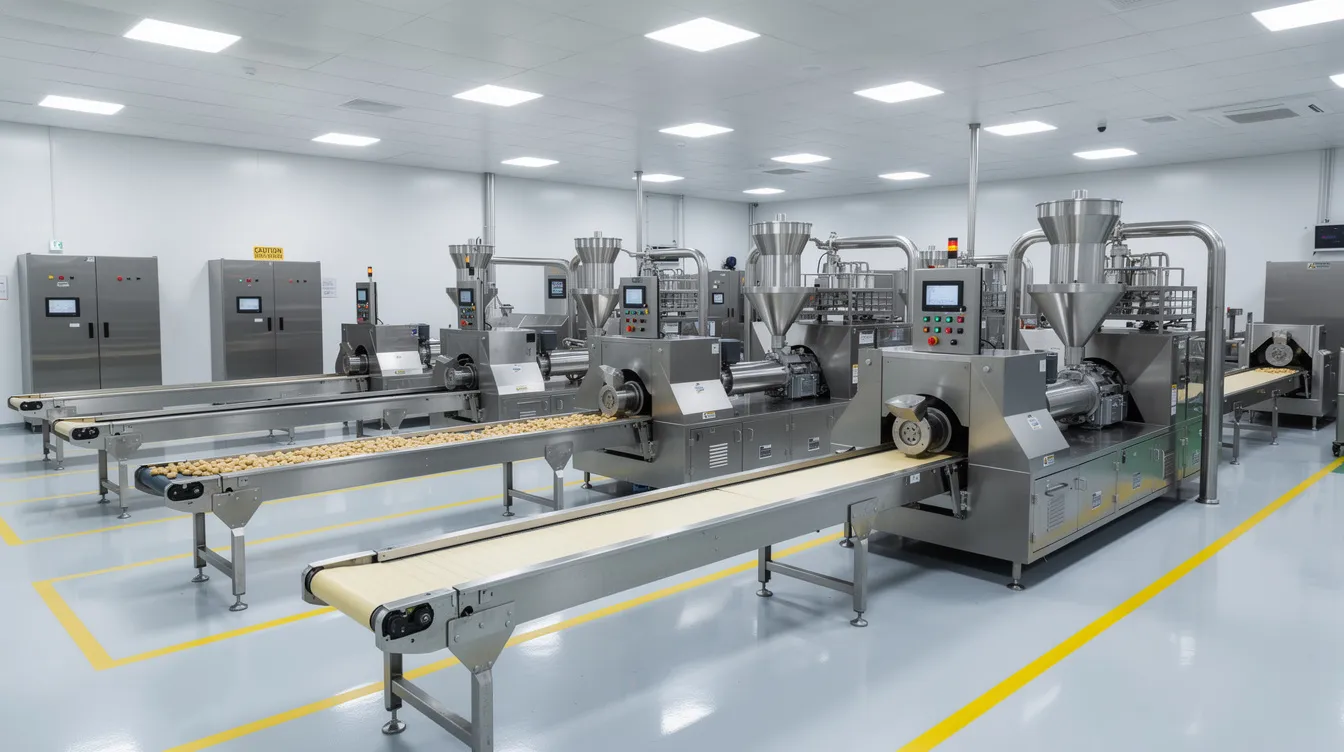
An industrial pellet plant comprises integrated core equipment and auxiliary systems rather than a single making machine. A complete snack pellet line includes mixers, extruders, and dryers, with capacity balanced across all stages. A snack pellet production line includes mixers and extruders as its foundational processing units, but the dryer often determines actual throughput.
| Equipment | Function | Selection Criteria |
|---|---|---|
| Raw material silos and bins | Bulk storage of starches and flours | Capacity matched to daily consumption |
| Cleaning and sieving units | Remove contaminants, ensure particle uniformity | Mesh size per formulation spec |
| Weighing and dosing system | Accurate batching of ingredients | Precision, automation level |
| Mixer (ribbon or paddle) | Dry blending of formulation | Batch size, mixing uniformity |
| Moisture conditioner | Controlled hydration of blend | Residence time, water metering |
| Extruder (single or twin screw) | Cooking, plasticisation, forming | Capacity, energy, product flexibility |
| 3D forming and cutting system | Shape creation using die inserts | Die design, shape complexity |
| Pre-dryer | Initial moisture reduction | Air temperature, belt speed |
| Multi-layer hot air dryer | Final drying to target moisture | Evaporation capacity, uniformity |
| Cooling conveyor | Temperature stabilisation | Length, air circulation |
| Screening and grading machine | Size sorting, fines removal | Mesh sizes, throughput |
| Metal detector | Food safety compliance | Sensitivity, reject mechanism |
| Automatic weighing and bagging | Packaging in specified weights | Speed, accuracy, bag type |
| Air compressor | Pneumatic valves, conveyors | CFM rating, pressure |
| Boiler or thermic fluid heater | Thermal energy for dryers | Fuel type, capacity |
| Dust collection system | Powder and starch dust management | CFM, filtration |
Modern production lines use PLC-based control systems for efficiency, enabling recipe storage, automated process adjustments and consistent output. Flavoring drums apply seasonings evenly to snack pellets at downstream frying facilities, though some integrated plants include them.
Fully automatic lines with continuous production lines configuration reduce labour dependency and batch variation compared to semi-automatic setups where manual interventions occur at feeding, changeover and bagging stages. All food-contact surfaces use stainless steel construction for hygiene compliance.
Machine sizing must consider finished dried pellet output, not just hourly feed rate. Vendors often specify feed capacity; de-rating for moisture loss, production losses and the planned 2D and 3D mix is essential before committing to a DPR assumption.
Plant Capacity Planning and Production Configuration
Misalignment between extruder, dryer and packing capacity creates bottlenecks or idle assets, directly affecting payback and debt service coverage. Production capacity impacts machinery investment and plant layout, making this assessment one of the first steps in project evaluation.
Three typical capacity scenarios for Indian industrial plants:
- 250–500 kg/hour (finished dried pellet output): smaller regional plants serving local and state-level fryers.
- 500–1,000 kg/hour: mainstream medium-to-large plants supplying multiple snack brands and export channels.
- Above 1,000 kg/hour: export-oriented or multi-brand contract manufacturers.
Small lines produce 80–120 kg/h of snack pellets and serve micro-enterprises; these fall outside the ₹5–15 crore investment focus of this report.
Annual output depends on shifts per day (typically 2 or 3), operating days per year (around 300), and realistic capacity utilisation. First-year utilisation assumptions of 50–60% are common for new plants, rising to 80–90% by year 3 as production stabilises and customers are onboarded.
Changeover time for 3D pellet shapes can be higher than for 2D products because die changes and forming module swaps require mechanical adjustments and trial runs. Grouping production by product family reduces changeover losses. The dryer and cooling sections often become the limiting stages because thicker 3D shapes require longer residence time than thin 2D pellets.
Land, Building, Factory Layout and Utilities
A 250–1,000 kg/hour plant typically requires 0.5 to 1.5 acres, depending on building height, expansion plans and logistics access. Actual requirements vary with local zoning norms and machinery footprint.
Major building blocks include: production hall housing the extruder, forming system and dryers; raw material warehouse with separate storage for starches, flours and additives; packaging area; finished goods warehouse; QC laboratory; utility block (DG set, compressor room, boiler); and administrative offices.
Recommended product flow runs linearly from raw material intake through mixing, extrusion, drying, cooling, screening and packing to finished pellet storage and dispatch, minimising cross-movement and contamination.
Connected power load for mid-capacity lines typically ranges from 83 to 250 kW depending on the extruder and dryer configuration, as documented by Indian machinery suppliers. Utilities include transformer and panel room, diesel generator for critical loads, water supply for process and cleaning, and compressed air distribution via a screw compressor. A screw conveyor may handle bulk powder transfer between storage and mixers.
Dust from starch and flour can cause combustible hazards in production areas. Dust collection systems, proper ventilation, hot air exhaust management from dryers, and fire safety infrastructure (hydrants, extinguishers, emergency exits) are non-negotiable.
3D Snack Pellets Manufacturing Plant Cost and Capital Investment in India
The exact 3D snack pellets manufacturing plant cost depends on capacity, automation, choice between Indian and imported machinery, land cost and utility infrastructure. All figures below are indicative planning assumptions requiring validation through current vendor quotations.
| Sr. | Cost Head | Typical Items | Notes on Variation |
|---|---|---|---|
| 1 | Land and site development | Plot, levelling, boundary, roads | Location-dependent |
| 2 | Factory building and civil works | RCC or PEB shed, flooring, offices | Height and area driven |
| 3 | Main extrusion and 3D forming line | Extruder, former, cutter, dies | Core equipment; largest single block |
| 4 | Industrial drying and cooling | Multi-layer dryer, pre-dryer, cooler | Capacity must match extruder |
| 5 | Packaging machinery | Weigher, bagger, stitcher, conveyor | Automation level driven |
| 6 | Electrical installation | Transformer, panels, cabling, earthing | Load-dependent |
| 7 | Utilities | Boiler, compressor, water, DG | Fuel type affects cost |
| 8 | Material handling and storage | Silos, bins, vibratory feeder, conveyors | Scale-dependent |
| 9 | Laboratory and QC setup | Moisture meter, expansion test, microbiology | Export plants need more |
| 10 | Installation and commissioning | Erection, trial runs, training | 5–10% of equipment cost |
| 11 | Preliminary and pre-operative expenses | Licences, consultancy, interest during construction | Often underestimated |
| 12 | Contingency and working capital margin | Buffer for cost overruns, initial WC | 5–10% provision |
As per vendor quotations, a 350 kg/h 3D pellet line from Forward Bit Engineering (Noida) is priced at approximately ₹95 lakh with installed power of about 60 kW. A 150 kg/h line from ICube Machinery is quoted at approximately ₹1.3 crore with installed power of about 83 kW. These cover core process machinery only; total project cost including land, building, utilities, installation and working capital pushes the investment into the ₹5–15 crore range for commercially viable capacities.
Projects using imported high-automation European or Chinese lines may raise initial capital cost but can offer energy and labour savings. Promoters should collect multiple quotations and evaluate life-cycle cost, not just purchase price.
Raw Material Requirements and Procurement Economics
Primary raw materials include potato starch, corn starch, tapioca (cassava starch), wheat flour, rice flour, modified starches, emulsifiers, salt and minor additives. Packaging materials comprise poly-lined bags, bulk sacks and shrink wrap.
Quality specifications for 3D pellet production cover particle size distribution, moisture limits (typically below 12–13% for starches), microbiological standards, and colour. These parameters affect extrusion stability, pellet density and proper expansion behaviour.
Procurement strategies range from long-term contracts with large agro processors to spot purchases. High potato starch content yields better puff and hollowness; corn-wheat blends are more robust but produce less expansion. Premium multigrain and millet components increase cost and reduce expansion, requiring technical validation through pilot trials.
Moisture content in raw materials directly affects effective yield. A plant must convert as-received weight to dry-solid basis when computing cost per kg of finished dried pellets. Recovered fines and off-spec pellets can partially buffer yield losses.
Raw material price volatility (particularly potato and maize) requires sensitivity analysis in the DPR, testing the effect of ±10–15% swings on contribution margin. India’s dehydrated potato product exports grew from USD 11.4 million in FY22 to approximately USD 63.3 million in FY25, indicating both growing market pull and potential price competition for potato-based raw materials.
Manufacturing Cost, Production Economics and Profitability
Cost of production per kg is central to any industrial 3D snack pellets manufacturing plant project report. It is derived from a detailed cost sheet.
Variable costs per kg include raw materials (the largest component), process loss, power and fuel for extrusion and drying, packaging materials, and direct labour.
Fixed monthly costs include management and QC salaries, repairs and maintenance, factory overhead, administrative expenses, distribution, insurance and property tax.
Contribution per kg is computed as: expected net selling price of dried pellets (ex-factory) minus variable costs. Selling price assumptions must be based on market discussions with B2B buyers, not arbitrary markup. EBITDA results from deducting fixed operating costs from total contribution. Operating profit and net profit follow after depreciation (15% WDV under the Income Tax Act for general plant and machinery) and interest.
Sensitivity analysis must test how changes in capacity utilisation (60% vs 80%), raw material prices, energy tariffs and product mix between 2D and 3D pellets alter margins. A plant producing premium 3D snack pellets for brand clients will have different economics than one selling commodity fryum pellets in wholesale markets.
Working Capital Requirements for Industrial Snack Pellet Manufacturing
Working capital represents capital locked in raw material stock, work-in-process (in mixers, extruder and dryers), finished pellets inventory, trade receivables and day-to-day cash expenses, net of supplier credit.
Key components:
- Raw material inventory: 15–30 days of consumption, depending on supply reliability
- Packaging materials: 15–20 days
- Finished stock held before dispatch: 7–15 days
- Trade receivables: 30–60 days (B2B pellet suppliers often extend credit to large snack brands and exporters)
- Trade creditors: 15–30 days
B2B credit terms of 30–60 days can lock substantial funds in receivables at higher capacities. Working capital assessment must be integrated with term-loan repayment scheduling; DSCR analysis must account for interest on both term finance and working capital borrowing.
Financial Projections, DSCR, IRR and Bank Finance Feasibility
A credible DPR for banks and investors must include 8–10 years of integrated financial projections. DPRs are used for securing bank loans and investor funding, and the quality of assumptions determines their credibility. Key financial metrics include capital expenditure and internal rate of return, along with NPV and payback period.
Required projection components:
- Projected profit and loss account
- Cash flow statement
- Projected balance sheet
- Fixed asset and depreciation schedule
- Working capital assessment
- Term loan amortisation and interest workings
DSCR (Debt Service Coverage Ratio) measures the ratio of cash accruals to annual debt service obligations. Indian banks evaluate both year-wise and average DSCR; a comfortable average DSCR, not just one strong year, supports approval.
Project IRR and equity IRR must emerge from internally consistent cash-flow projections. Sensitivity analysis evaluates the impact of changes on project viability: delayed ramp-up, buyer price pressure, or prolonged high energy costs.
Assumptions to document: capacity utilisation ramp-up, selling prices, raw material pricing, energy tariffs, manpower cost inflation, interest rate, moratorium and repayment tenure.
Larger investors evaluating multi-crore automatic 3D snack pellet production line projects may combine term loans with equity infusion. Project Report Bank’s guide on raising equity capital and attracting investors in India covers capital structuring for such scenarios.
Regulatory Approvals and Quality Control Requirements in India
Any food processing plant in India producing 3D snack pellets must operate under applicable central and state regulations. Regulatory licenses include food safety and pollution control approvals.
Statutory requirements:
- Company or firm registration and GST registration
- FSSAI central or state licence appropriate to installed capacity; a technically qualified person with a degree in food technology or science must supervise operations
- Factory licence under state Factories Act
- Labour registrations (ESI, PF where applicable)
Environmental and safety permissions:
- Consent to establish and operate from State Pollution Control Board
- Fire safety NOC
- Boiler approval if steam boiler is used
- Waste management systems are essential for handling processing byproducts including starch dust, rejected pellets and effluent from wet cleaning
Quality and food safety systems:
- GMP and GHP implementation
- HACCP plans; food-contact surfaces must meet HACCP and ISO 22000 standards
- ISO 22000 or FSSC 22000 certification for plants targeting large B2B and export customers
- Metal detection, product traceability and recall procedures
Compliance requirements change with time and vary by state. Promoters must verify current notifications and consult qualified professionals.
Market Opportunities, B2B Customers and Export Potential
Market analysis assesses demand trends for snack pellets in domestic and international markets. The global snack pellets market was valued at USD 3.35 billion in 2025, and the market is projected to grow at 4.3–5.8% CAGR through the mid-2030s. Asia-Pacific is the fastest-growing region for snack pellets. Consumer demand for lower-fat snacks is increasing, supporting pellets that can be air-puffed instead of fried.
Core customer categories include large Indian snack brands, regional fryers and namkeen manufacturers, contract manufacturers, private-label packers, institutional fryers and export traders.
3D pellet snacks command premium positioning over commodity fryums. Popular formats such as cones, wheels, animals and pani puri shells, manufactured with custom dies, can secure semi-exclusive supply arrangements with key accounts.
Export potential is strong: dried, dense half-products reduce freight cost and avoid finished-product shelf-life constraints. Key markets include Malaysia, Philippines, Indonesia, Japan, Thailand and Middle Eastern countries. Export-compliant documentation, quality audits and third-party certifications are prerequisites.
Competition from existing manufacturers and in-house lines at large snack companies exists. Market research and preliminary customer tie-ups should precede full-scale investment.
Key Project Risks and Feasibility Considerations
A professional project report includes financial projections and risk analysis. A Detailed Project Report evaluates feasibility and compliance for 3D snack pellet plants, and risk identification strengthens both lender confidence and promoter preparedness.
| Risk | Possible Impact | Mitigation |
|---|---|---|
| Raw material price volatility | Margin erosion | Multi-source procurement, sensitivity analysis |
| Extruder-dryer capacity mismatch | Bottleneck at 70% of rated output | Matched design, vendor FAT |
| Incorrect die design | Poor 3D expansion, rejections | Pilot trials before bulk production |
| Under-designed dryer | Lower throughput, case-hardening | Specify evaporation load per shape |
| High energy consumption | Elevated variable cost per kg | Energy audit, thermal recovery |
| Quality rejections by key buyer | Revenue loss, rework cost | QC protocols, frying trial validation |
| Customer concentration | Revenue risk if contract changes | Diversified buyer base |
| Working capital shortage | Cash flow stress, delayed payments | Adequate WC provisioning in DPR |
| Project commissioning delays | Interest overrun, delayed revenue | Realistic timeline, contingency |
Example: a plant sized on extruder capacity of 500 kg/h but constrained by dryer residence time for thick 3D shapes may achieve only 350 kg/h of saleable output, reducing projected revenue by 30% while fixed costs remain unchanged.
Why a Professional DPR Is Essential for a 3D Snack Pellet Manufacturing Project
Generic template-style project reports cannot address the technical and financial complexity of an automatic 3D snack pellet production line. A customised, bankable DPR prepared for a specific promoter, capacity and product mix is required. Project reports should cover operational management and staffing requirements alongside financial projections.
Areas where a Chartered Accountant-led DPR adds value:
- Project cost estimation based on actual quotations, reconciling specifications across multiple pellet production line suppliers
- Capacity and yield assessment reflecting 2D vs 3D mix and realistic drying constraints
- Phased utilisation assumptions with supporting rationale
- Working capital evaluation tied to B2B credit cycles
- DSCR and IRR analysis from internally consistent financial models
- Scenario testing across price, cost and utilisation variables
Bank documentation requirements include CMA data, projected financial statements, ratio analysis, justification for key assumptions, and clear presentation of means of finance.
Professional DPR and Financial Feasibility Services for Industrial 3D Snack Pellet Manufacturing Projects
CA Manish Gugliya (FCA, DISA, ICAI) leads Project Report Bank, a Chartered Accountant-led advisory specialising in DPR preparation, financial modelling, project feasibility and project finance advisory for Indian manufacturing and food production projects.
Services relevant to 3D snack pellet projects include customised Detailed Project Reports for bank term loans, investor-ready DPRs, detailed financial projections and sensitivity analysis, CMA data preparation, working capital assessment, and means-of-finance structuring.
The practice works with MSME and mid-sized manufacturing investments in the ₹5–15 crore and above bracket, with a clear understanding of banker expectations for DSCR, security coverage and compliance.
Serious promoters, existing snack manufacturers and industrial investors may share initial details (proposed plant capacity, desired product range, location, preliminary machinery quotations, estimated investment and funding requirement) for a tailored DPR and feasibility engagement via ProjectReportBank.com or WhatsApp. The firm does not sell generic low-cost project report downloads.
Frequently Asked Questions
What investment is required for a commercially viable 3D snack pellet plant in India?
Most commercially viable plants fall in the ₹5–15 crore total project cost range. The exact figure depends on capacity (250–1,000+ kg/h dried pellet output), choice between Indian and imported machinery, land cost, building type, utility infrastructure and working capital. Core process machinery alone, per vendor quotations, can range from approximately ₹95 lakh for a 350 kg/h line to ₹1.3 crore and above for lines with higher automation.
What core machinery does a 3D snack pellet plant require?
The snack production line includes raw material storage and handling, weighing and dosing, mixers, a moisture conditioner, an extruder (single screw extruder or twin screw extruders depending on product complexity), 3D forming and cutting equipment with interchangeable die inserts, pre-dryer, multi-layer hot air dryer, cooling conveyor, screening and grading, metal detection, and automatic packaging. Utility equipment includes an air compressor, boiler or thermic fluid heater and dust collection system.
How do 3D snack pellets differ from direct-expanded ready-to-eat snacks?
3D pellets are dense, dried, semi finished half-products dispatched at 10–12% moisture for later expansion by the buyer. Direct-expanded snacks are fully cooked and expanded at the extruder, dried to 3–5% moisture and packaged ready to eat. The manufacturing process, machinery, product form, distribution model and target market are different. Promoters interested in direct-expanded snacks should review integrated extruded snack plant projects.
Can one production line produce both 2D and 3D pellet shapes?
Yes, most lines allow switching between 2D and 3D shapes by changing die inserts and forming modules. Changeover involves mechanical adjustment and trial runs, typically consuming 1–3 hours depending on complexity. Frequent switching reduces effective capacity, so producers group orders by product family and schedule changeovers during planned maintenance windows.
What are the power and drying requirements for a 3D pellet plant?
Installed power for mid-capacity lines (200–500 kg/h) typically ranges from 60 to 250 kW. Drying is the largest thermal energy consumer; dryers use hot air at controlled temperature to reduce pellet moisture from 30–35% (post-extrusion) to 10–12%. Dryer capacity must match extruder output; under-designed dryers become the bottleneck. Energy cost per kg must be computed based on chosen dryer type, fuel source and local tariff, not assumed from generic benchmarks.
Can banks finance a large-scale pellet manufacturing project?
Banks regularly finance food processing projects in this investment bracket through term loans, subject to adequate promoter contribution (typically 25–33% of project cost), acceptable DSCR, collateral, and a professionally prepared DPR with CMA data. The loan proposal must include projected financial statements, repayment schedule and sensitivity analysis.
What should an investor verify before finalising machinery?
Key checks include: vendor track record and reference installations, capacity verification under actual operating conditions (not just nameplate rating), trial runs on the investor’s target formulations, utility requirements (power, water, compressed air, fuel), after-sales support availability, spare parts supply chain, operator training provisions, warranty terms, and annual maintenance contract options. At least two to three competitive quotations should be obtained and technically compared before the DPR is finalised.
Conclusion
Industrial 3D snack pellet manufacturing in India operates as a B2B food production business where the plant produces dried, semi finished pellets and ships them to downstream fryers and snack brands. Project viability depends on correct capacity planning, balanced production line configuration where extruder, dryer and packaging capacities are matched, accurate project cost estimation and realistic financial projections.
A professional DPR built on actual vendor quotations, validated market assumptions and transparent sensitivity analysis separates fundable projects from speculative proposals. The financial model must demonstrate adequate DSCR, reasonable IRR and sustainable working capital, presented in a format that banks and investors can evaluate.
Entrepreneurs and manufacturers planning a serious 3D snack pellet or ready-to-fry pellet manufacturing facility may contact CA Manish Gugliya through ProjectReportBank.com for customised DPR, feasibility and project finance advisory, sharing proposed capacity, location, preliminary quotations and funding requirements.