India’s grain economy is undergoing a structural transformation. As the country targets higher food security standards and expands its agro-processing and animal feed industries, the demand for scientific grain storage facilities, automated bulk handling systems, and integrated feed mill infrastructure has intensified. An industrial grain storage silos project report is no longer a routine formality-it is the foundation for planning, financing, and executing capital-intensive infrastructure investments that determine whether a project is technically sound, financially viable, and bankable.
This article provides a comprehensive technical, commercial, and financial overview of industrial grain storage silo projects, bulk grain handling infrastructure, and integrated feed mill complexes in India. It covers silo types and construction technologies, material handling equipment, process flows, project cost structures, revenue models, financial projections, risk assessment, and the critical role of professionally prepared Detailed Project Reports (DPRs) in securing bank finance and investor confidence.
Key Takeaways
- Industrial grain storage silo projects in India are capital-intensive infrastructure investments, typically ranging from ₹5 crore to ₹100 crore and above, and require integrated planning across silos, bulk grain handling, and optional feed mill facilities-fundamentally different from conventional agricultural godowns.
- The article explains technical options including flat-bottom and hopper bottom silos in galvanized steel and concrete, bulk handling equipment such as bucket elevators and conveyors, and integrated process flows designed to maintain grain quality and reduce post-harvest losses.
- A complete grain storage silo plant project report must address project cost components, bulk grain handling system project cost drivers, revenue models, project finance structuring, DSCR and IRR analysis, and bankability from an Indian lender’s perspective.
- Investors can develop standalone grain storage silo plants, bulk handling terminals, or fully integrated feed mill infrastructure, and each model carries different risk profiles, working capital requirements, and profitability drivers.
- Project Report Bank, led by CA Manish Gugliya (FCA, DISA, ICAI), prepares customised, lender-ready industrial grain storage silos project reports and industrial grain storage and handling plant feasibility studies for serious Indian and international promoters.
1. Introduction – Industrial Grain Storage Silos & Bulk Handling Infrastructure in India
India’s post-harvest grain management has historically depended on covered godowns, open-platform storage under tarpaulins, and conventional RCC or PEB warehouses. These systems suffer from moisture ingress, pest infestation, rodent damage, and labour-intensive manual handling. Research indicates that post-harvest losses can reach 30% in some regions without proper storage infrastructure. For a country that produces over 300 million tonnes of food grains annually, the economic cost of these losses is staggering. The shift towards modern silos, automated bulk handling, and scientific grain preservation is therefore not merely desirable-it is essential for improved food security and supply chain efficiency.
The global grain storage silos market reflects this urgency. The market size stands at approximately USD 1.68 billion in 2026, projected to reach USD 2.18 billion by 2031, growing at a CAGR of 4.9% from 2026 to 2033. Asia Pacific held 38.2% of revenue share in 2025, underlining the region’s role as a primary demand centre for grain storage infrastructure. India specifically plans to triple wheat storage capacity to 9 million metric tons by 2028 under cooperative and PPP-driven initiatives, representing a massive investment opportunity for private developers and industrial investors.
Modern grain silos-for wheat, maize, paddy, soybean, and other key crops-preserve grain quality through controlled aeration, temperature monitoring, and moisture management. Modern silos can cut spoilage and enhance inventory management significantly when compared to conventional warehouse storage, where losses from moisture alone can run approximately 1% versus 0.2% in silo systems. The focus of this article is on industrial-scale projects: typically 5,000 to 100,000 MT storage capacity or above, with integrated truck unloading, grain cleaning, drying, conveying, and automated controls.
Bulk grain handling systems-comprising truck tipplers, intake pits, bucket elevators, belt and chain conveyors, and automated loading spouts-are the core functions that transform a static building into an industrial infrastructure asset. These material handling equipment systems determine the facility’s throughput capacity, operational efficiency, and ultimately its economic returns.
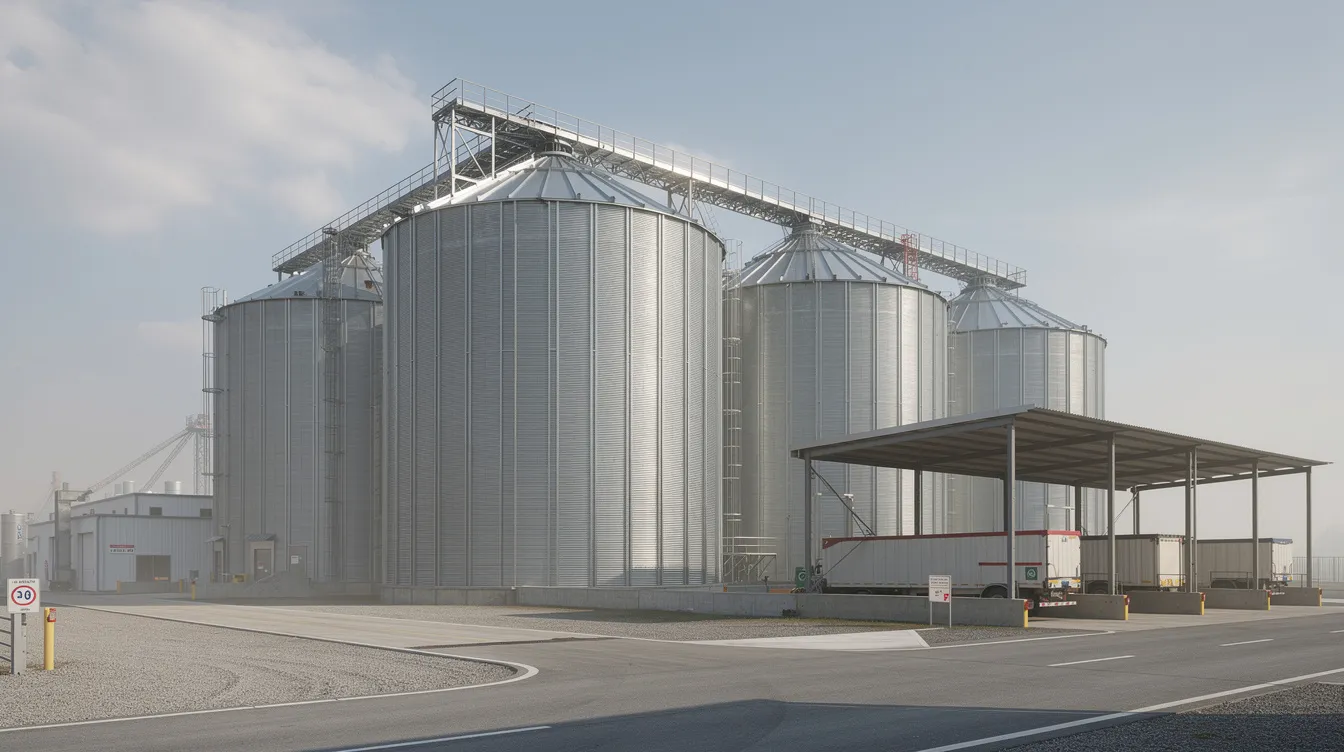
Integration opportunities exist with flour mills, rice mills, distilleries, ethanol plants, and especially large commercial feed mills. The grain storage infrastructure then serves as the raw material backbone for downstream processing, securing uninterrupted supply and reducing logistics costs. An industrial grain storage silos project report must therefore combine technical engineering, project cost assessment, and rigorous financial modelling for bank finance and private equity evaluation. Demand for scientific grain storage facilities is rising steadily, driven by the need for modern infrastructure across India’s agricultural modernization programmes.
2. Industrial Grain Storage Silos – Project Overview and Business Models
Investors entering the grain storage silos market in India and neighbouring markets in South Asia and the Middle East can choose from several industrial business models, each with distinct revenue characteristics, risk profiles, and capital requirements.
Standalone commercial grain storage facilities earn revenue from storage rental (per-MT-per-month charges), in-and-out handling charges, drying, cleaning, grading, and value-added logistics services for multiple grain buyers, traders, government agencies, and processors. These facilities serve as third-party logistics infrastructure and require strong grain procurement corridors and diversified customer bases.
Captive grain silos are built by flour mills, rice processors, breweries, starch plants, or integrated feed mills to secure raw material, ensure quality consistency, and reduce logistics costs. Captive storage directly impacts production continuity and working capital management, as the processing plant is no longer dependent on ad-hoc procurement.
Grain aggregation and bulk handling terminals, often located at railheads, inland container depots, or ports, primarily earn throughput-based fees for receiving, cleaning, blending, and dispatching large grain volumes. These are high-throughput, high-automation facilities with significant infrastructure investment in rail connectivity and loading systems.
Integrated grain storage and feed mill complexes combine silo infrastructure with downstream manufacturing, where grain stored in silos feeds directly into the feed manufacturing plant. This model changes the revenue mix from service income to product sales, alters working capital intensity substantially, and requires a combined feed mill infrastructure project report and silo DPR.
Business-model choice directly affects storage turnover (cycles per year), contract tenure (spot versus multi-year off-take), working capital intensity, and commodity price risks. A DPR must model each scenario separately, as a facility designed for commercial storage rental operates on fundamentally different assumptions than one built for captive processing. Similarly, a wheat flour mill with captive silos will evaluate project economics differently from a standalone grain terminal.
3. Grain Storage Silo Types, Construction Technologies and Capacity Planning
The choice of silo type is one of the most consequential technical decisions in any grain storage silos project. Three principal types dominate industrial applications in India: galvanized steel flat-bottom silos, hopper bottom silos, and reinforced concrete silos. Each differs materially in capital cost, grain suitability, construction timeline, maintenance requirements, and expansion flexibility.
Galvanized steel flat-bottom silos are the most widely deployed for large-volume, long-term storage of free-flowing cereals such as wheat and maize. Constructed from corrugated galvanized steel panels bolted together, they offer rapid modular construction, good vertical storage density, and relatively lower cost per tonne at larger capacities. Steel silos captured 77.65% of revenue in 2025 across the global market, reflecting their dominance in industrial applications. Flat-bottom silos accounted for 40.95% of sales in 2025. Grain reclamation typically uses sweep augers and central discharge systems. Trade-offs include steel price volatility, corrosion protection requirements, and wind and seismic design considerations in certain regions.
Hopper bottom silos are typically smaller (500–5,000 MT), with a conical floor that enables gravity discharge without sweep augers. Hopper silos are preferred for short-term storage and easy discharge, making them ideal for segregated lots, seed storage, specialty grains, or as day bins positioned above process lines in feed mills, food processing plants, and rice milling facilities. The cone-bottom construction requires more complex civil foundations, resulting in higher cost per MT at larger scales.
Concrete silos, whether reinforced or slip-formed, offer superior insulation, longer structural life, and lower corrosion maintenance. They are used in very large terminals or where harsh climatic conditions favour concrete over steel structures. However, construction timelines are longer, and civil costs are higher. In India, RCC silos exist particularly in northern states where the concrete industry is competitive.
Aluminum silos are also gaining traction in certain markets for their corrosion resistance, though they remain less common in large Indian industrial projects. Grain bins are utilized for on-farm and small-scale storage but fall outside the scope of industrial project planning.
Silo design should differentiate between flat-bottom and hopper-bottom configurations based on storage needs, grain type, discharge requirements, and downstream processing linkages. Essential technological subsystems across all silo types include aeration systems (fans and ducts), temperature and moisture monitoring cables, level sensors, fumigation arrangements, explosion prevention features, and access and safety systems.
| Parameter | Flat-Bottom Steel Silos | Hopper-Bottom Silos | Concrete Silos |
|---|---|---|---|
| Typical Capacity | 5,000–50,000+ MT per silo | 500–5,000 MT per silo | 5,000–50,000+ MT per silo |
| Construction Material | Galvanized steel panels | Galvanized steel or SS | Reinforced concrete |
| Discharge Method | Sweep auger + central outlet | Gravity (cone bottom) | Sweep auger or gravity |
| Construction Speed | Fast (modular) | Moderate | Slow (slip-form/RCC) |
| CAPEX per MT | Medium | Higher at large scale | Higher initially |
| Best Suited For | Bulk cereals, long-term storage | Specialty grains, day bins, seed storage | Large terminals, harsh climate |
| Expansion Flexibility | High (add more bins) | Moderate | Lower |
| Maintenance | Steel coating, corrosion checks | Foundation, cone integrity | Lower ongoing maintenance |
Typical storage-capacity configurations relevant for an industrial grain storage silos project report in India include 5,000 MT, 10,000 MT, 25,000 MT, 50,000 MT, and 100,000 MT or above. Technical specifications in project reports should detail silo configuration and materials used for each capacity band.
It is critical to note that storage capacity (in MT) must be differentiated from bulk grain handling throughput (in TPH) and feed mill capacity (in TPH or MT/day). Confusing these parameters in a financial model will produce misleading revenue and profitability projections.
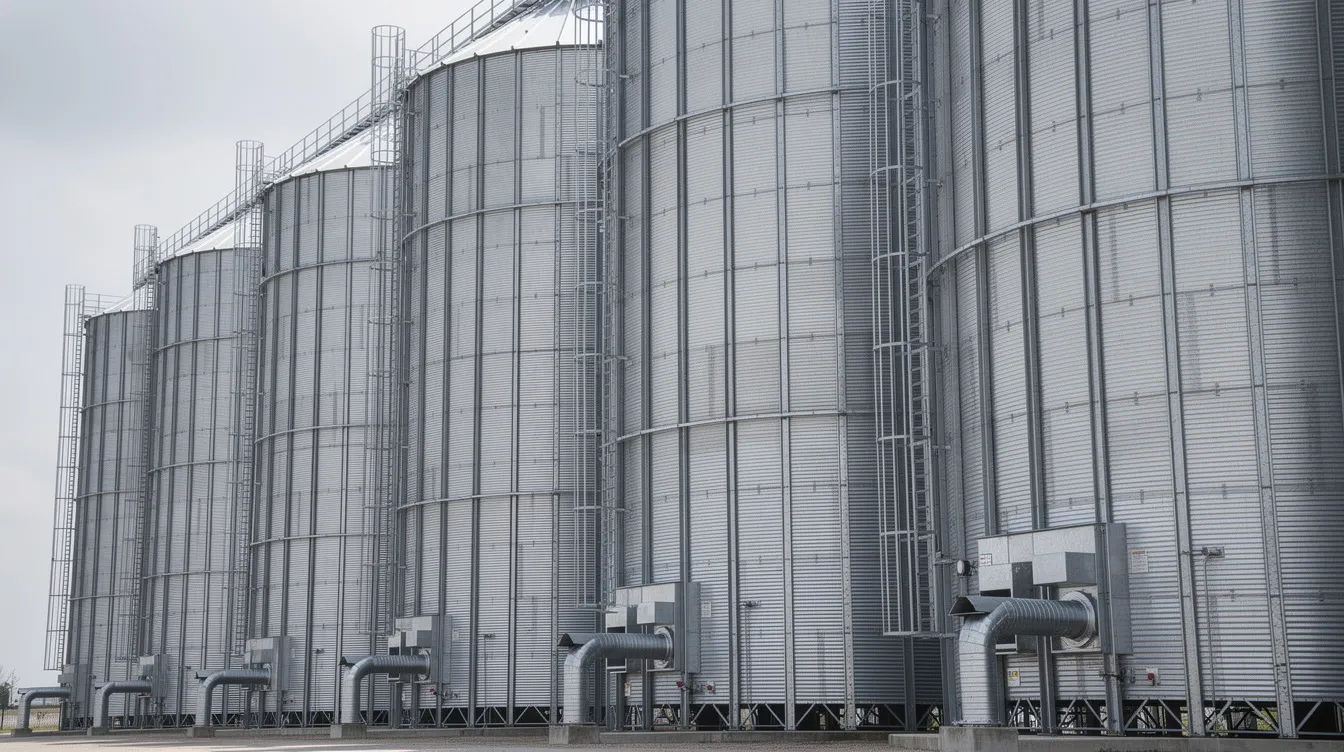
4. Industrial Bulk Grain Handling Systems – Machinery and Infrastructure
Bulk grain handling systems are the circulatory system of an industrial silo plant. The efficiency, capacity, and reliability of these systems directly influence both capital expenditure and operating costs across the project’s life.
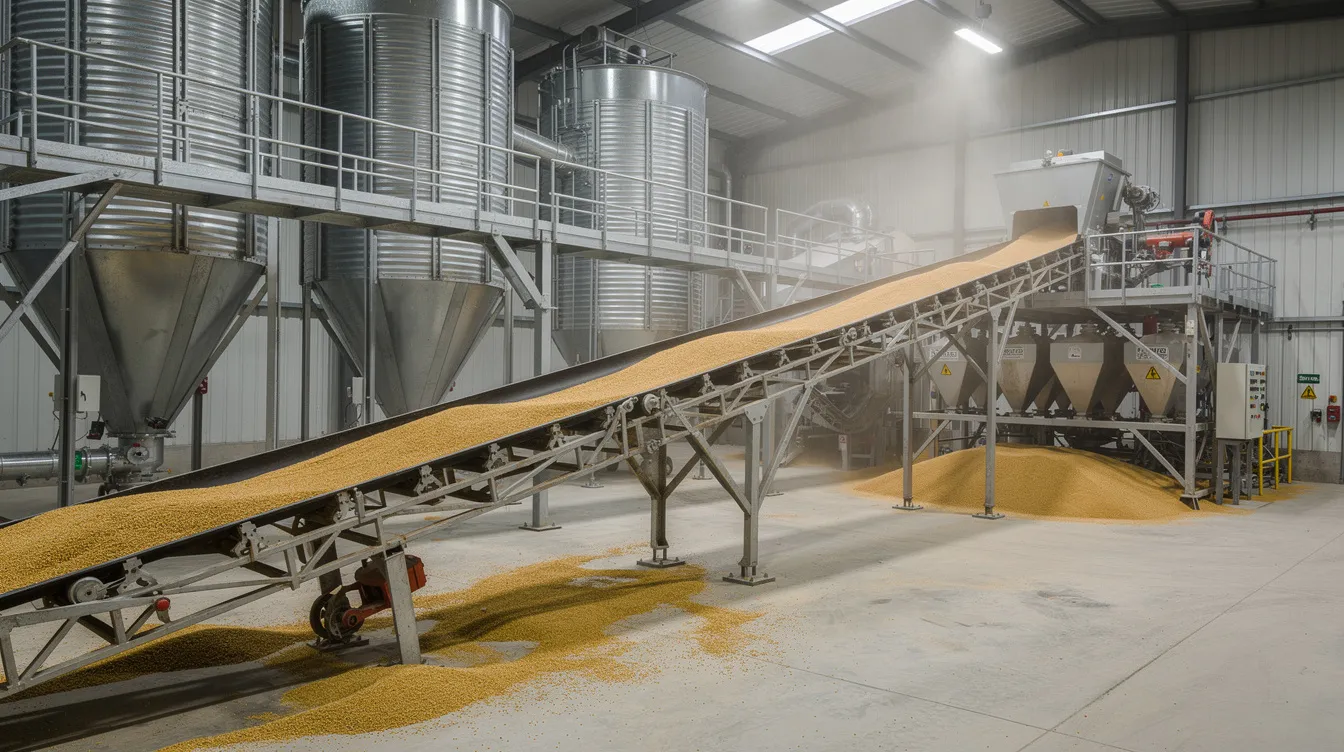
Key material handling equipment includes truck unloading systems (truck tipplers, moving-floor unloaders, intake grates), underground receiving pits, bucket elevators, belt conveyors, chain conveyors, and, where suitable, screw conveyors or pneumatic conveying systems for specific grains or short transfer distances.
Grain cleaning and protection equipment-scalper cleaners, rotary or vibrating pre-cleaners, magnetic separators, destoners, aspiration systems, and dust collectors-plays a vital role in grain quality preservation and occupational safety. Flow distribution devices such as diverter valves, slide gates, spouts, and distribution bins route grain between multiple silos and reclaim lines. Thoughtful design of these elements supports future capacity expansion and minimises cross-contamination between grain lots.
Bulk loading and dispatch systems include loading spouts, telescopic chutes, weighbridges, and bagging points where required. Integration with downstream processing plants is achieved through enclosed conveyors or galleries.
More than half of new silo orders specified at least one IoT feature in 2025, reflecting the rapid adoption of digital monitoring. Connected sensors provide real-time temperature and moisture readings, enabling proactive quality management. Automated aeration controls optimize grain storage conditions, while real-time CO₂ monitoring identifies spoilage risks earlier than conventional sampling. Predictive aeration and connected monitoring systems can reduce unplanned downtime by USD 320,000 per facility annually-a substantial impact on operating costs and grain preservation.
| Equipment | Core Function | Typical Capacity Range | EPC Cost Influence |
|---|---|---|---|
| Truck Tippler / Intake Pit | Unloading grain from trucks | 60–300 TPH | Medium–High |
| Bucket Elevators | Vertical grain transfer | 60–500 TPH | High |
| Belt / Chain Conveyors | Horizontal / inclined transfer | 60–500 TPH | Medium–High |
| Pre-Cleaners / Scalpers | Removing foreign matter | 50–300 TPH | Medium |
| Magnetic Separators / Destoners | Metal and stone removal | 50–200 TPH | Low–Medium |
| Grain Dryers | Reducing moisture content | 20–200 TPH | High |
| Dust Collection Systems | Air quality and explosion prevention | Varies | Medium |
| Weighbridges | Gross and net weight measurement | Per truck/wagon | Low–Medium |
| PLC / SCADA Systems | Process automation and monitoring | Entire plant | Medium–High |
| Loading Spouts / Chutes | Bulk dispatch to trucks or rail | 100–500 TPH | Medium |
Bottlenecks at receiving or dispatch-such as undersized elevators, insufficient truck bays, or inadequate conveyor capacity-reduce effective capacity utilisation. This directly impacts project economics and DSCR, since handling facilities limit the number of grain cycles per year and therefore revenue generation potential.
5. Industrial Grain Storage & Bulk Handling – Complete Process Flow
A typical end-to-end process flow for an industrial grain storage plant receiving grain from mandis or bulk suppliers follows a structured sequence:
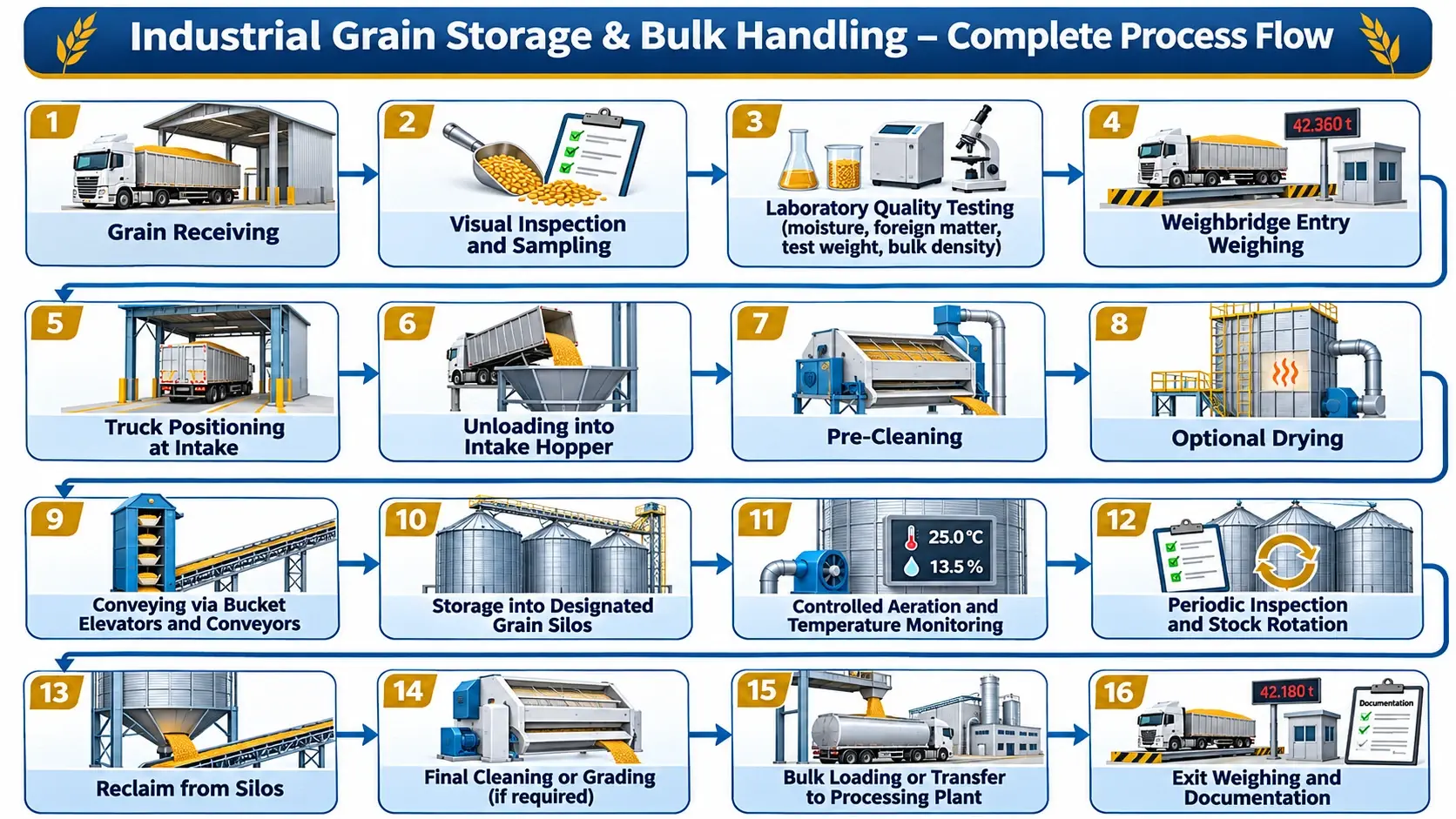
Grain Receiving → Visual Inspection and Sampling → Laboratory Quality Testing (moisture, foreign matter, test weight, bulk density) → Weighbridge Entry Weighing → Truck Positioning at Intake → Unloading into Intake Hopper → Pre-Cleaning → Optional Drying → Conveying via Bucket Elevators and Conveyors → Storage into Designated Grain Silos → Controlled Aeration and Temperature Monitoring → Periodic Inspection and Stock Rotation → Reclaim from Silos → Final Cleaning or Grading (if required) → Bulk Loading or Transfer to Processing Plant → Exit Weighing and Documentation.
Quality control systems within grain storage projects should monitor temperature and moisture at every critical stage. Moisture thresholds for safe long-term storage vary by grain-typically 12–14% for wheat, 13–14% for maize, and lower for oilseeds. Fumigation protocols, periodic sampling, and record-keeping for traceability are oriented to Indian food safety expectations and should be documented in the DPR.
Process variations exist for different key crops. Paddy, for example, may require more aggressive drying and husk management compared to wheat or maize. Projects focused on captive grain processing will have a shorter storage cycle and tighter integration with downstream plant schedules, while commercial storage operations must accommodate diverse grain lots from multiple depositors.
Operational plans in project reports should outline inbound and outbound logistics workflows clearly, as these directly affect truck turnaround time, handling throughput, and customer satisfaction. This section of the DPR should stay practical and descriptive, giving the investor a clear understanding of daily operations necessary for preparing an industrial grain storage and handling plant feasibility chapter.
6. Integrated Feed Mill Infrastructure – Technical and Investment Scope
Many promoters in India are now planning combined projects where grain storage silos feed directly into an integrated animal feed mill. Such projects require a combined feed mill infrastructure project report alongside the silo DPR, as the investment scope, revenue model, and risk profile differ materially from standalone storage.
The major functional zones of an integrated feed mill include:
- Raw grain and ingredient intake and storage bins
- Grinding sections (hammer mills)
- Batching and weighing systems
- Industrial mixers
- Steam conditioning and pelletisation lines
- Crumble production, pellet cooling, and screening
- Finished-feed storage bins and packaging lines
- Central utilities, automation, and dust control
Material flows from the grain silos through enclosed conveyors into grinding, mixing, and pelletisation lines. Dedicated hopper bottom silos and day bins positioned above batching sections provide uninterrupted feed manufacturing, ensuring that the production process is not disrupted by delays in grain replenishment. For detailed process and machinery analysis, readers may refer to the Automatic Feed Pellet Manufacturing Plant Project Report and Industrial Cattle Feed Manufacturing Plant Project Report published on Project Report Bank.
Combining grain storage with feed production fundamentally changes the revenue mix-from service revenue (storage charges) to product sales (animal feed). It also increases power demand, operating cost structure, and working capital requirement. Inventory financing for both raw material (grains, additives) and finished goods (feed products) must be reflected accurately in the financial model. The nutritional value of the stored grain directly impacts the quality and market acceptance of the finished feed product.
7. Land Requirement, Site Selection and Industrial Plant Layout
Land requirement for an industrial grain silos project depends heavily on capacity, number and diameter of silos, inclusion of feed mill or rail siding, truck circulation space, and local norms. The DPR should present case-specific calculations rather than generic acres-per-MT figures.
Critical site-selection criteria include:
- Proximity to grain-producing belts and mandis ensuring reliable grain supply
- Access to national or state highways and, where applicable, rail connectivity
- Distance from major buyers such as flour mills, feed mills, and ports
- Availability of industrial land with appropriate zoning and land-use permissions
- Soil-bearing capacity (geotechnical investigation is essential for silo foundations)
- Flood levels, drainage planning, and space for future silo lines
Site selection for grain storage facilities should consider accessibility to transportation and production hubs as a primary determinant. Land acquisition costs and timelines vary significantly across states and industrial zones.
A typical plant layout includes the weighbridge at entry, truck parking and circulation areas, receiving pits, silo clusters, conveyor galleries connecting receiving to storage and dispatch, a central control room, MCC and PLC rooms, utility blocks, transformer yard, workshop, and administrative buildings. For integrated projects, feed mill buildings and finished product warehouses are positioned to ensure smooth material flow and minimal cross-traffic between raw material and finished product movements.
For a 25,000–50,000 MT silo complex with bulk grain handling and optional feed mill, the layout should be arranged on a realistically sized industrial plot, with provision for future capacity expansion.
8. Industrial Grain Storage Silos Project Cost and Capital Investment
Capital investment for a modern industrial silo complex is highly project-specific. Projects typically fall within the multi-crore rupee range, and the grain storage silo plant project report must transparently state all assumptions, reference dates, inclusions, exclusions, and limitations.
Major cost heads in a typical industrial grain storage silos project include:
- Land acquisition or lease and site development
- Civil works-silo foundations, tunnels, buildings
- Steel or concrete silo structures
- Bulk handling and conveying systems (elevators, conveyors, tipplers)
- Grain cleaning, grading, and drying equipment
- Mechanical and electrical installation
- Automation and instrumentation (PLC, SCADA, monitoring systems)
- Fire protection and safety systems
- Electrical infrastructure, substations, and utilities (compressors, DG sets, water systems)
- Feed mill machinery and buildings, if included
- Engineering, design, EPC, and consultancy costs
- Preliminary and pre-operative expenses
- Contingencies
- Margin money for working capital
MoFPI cost norms (2020) set a baseline of approximately ₹5,900 per MT for silos inclusive of civil, electrical, and machinery works. However, for modern, automated, or rail-linked silos, actual capital expenditure per MT is significantly higher-typically ₹8,000 to ₹12,000 per MT for 25,000–50,000 MT scale projects.
Illustrative Capital Investment Breakup – 25,000 MT Standalone Steel Silo Complex (Indicative, FY 2025–26 Price Levels)
| Cost Head | Estimated Share of Total Project Cost |
|---|---|
| Land and Site Development | 5–8% |
| Civil Works and Foundations | 20–28% |
| Steel Silo Structures | 20–25% |
| Bulk Handling and Conveying Systems | 15–20% |
| Grain Cleaning and Drying Equipment | 5–8% |
| Electrical Works and Substations | 6–8% |
| Automation and Instrumentation | 3–5% |
| Fire Protection and Safety | 2–3% |
| Engineering, EPC, and Consultancy | 3–5% |
| Preliminary and Pre-Operative Expenses | 2–4% |
| Contingencies | 3–5% |
| Margin Money for Working Capital | 2–3% |
Two projects with identical storage capacities-say, 50,000 MT-can have vastly different total project costs depending on whether the facility includes truck tipplers versus direct dumping, rail sidings, drying capacity, level of automation, structural design choices, and local construction costs. For reference, the Sahnewal 50,000 MT PPP project had an estimated total project cost of approximately ₹42.37 crore, with plant and machinery accounting for about 43% and civil works about 28% of the total.
The article must emphasise that detailed cost estimation in the DPR should be based on current EPC quotations, location-specific factors, and exact technical specifications rather than outdated norms or generic estimates. Financial projections must include CAPEX and OPEX estimates for grain storage facilities prepared on a realistic, project-specific basis.
9. Operating Costs, Maintenance and Working Capital
A silo project’s viability depends not only on capital expenditure but also on recurring operating costs and working capital planning.
Typical operational costs include:
- Electricity for conveyors, elevators, aeration fans, drying, lighting, and ventilation systems
- Manpower for operations, maintenance, quality control, security, and administration
- Repairs and maintenance of mechanical, electrical, and civil infrastructure
- Insurance for stored grain and physical assets
- Fumigation and grain-protection chemicals
- Housekeeping, dust control, and utilities such as water and compressed air
Periodic maintenance tasks-inspection and replacement of elevator belts and buckets, lubrication schedules, sensor and PLC calibration, silo wall painting or coating repairs, and structural integrity inspections-must be planned and budgeted. The distinction between planned and unplanned downtime directly impacts inventory visibility and throughput efficiency.
The three principal operating models carry different cost structures:
- Commercial storage: Higher marketing and customer-service costs but diversified revenue across multiple grain depositors
- Captive storage: Tightly linked to the production cycle of the processing plant, lower marketing cost, and direct impact on production efficiency
- Integrated feed mill operations: Substantially higher power and labour consumption, but direct product revenue from feed sales
Working capital differs materially between a storage-service model (where receivables come from storage customers) and a grain-trading or feed-manufacturing model (where significant capital is tied up in raw material inventory and finished goods). Margin money for working capital appears as part of the total project cost and must be funded alongside fixed-asset investment.
10. Revenue Model and Commercial Profitability
The industrial grain storage silos project report must clearly articulate the revenue architecture based on the chosen business model, without double-counting grain volumes or services.
For a commercial silo, key revenue streams include:
- Per-MT-per-month or per-MT-per-annum storage charges
- In-and-out handling charges for reception and dispatch
- Cleaning and drying service fees
- Blending or grading charges
- Value-added logistics services such as rail loading, port loading, or bulk dispatch
Revenue capacity is influenced by storage occupancy rate (average fill level across the year), storage turnover (number of complete storage cycles per year), and the proportion of contracted versus spot business. One MT of static storage capacity can generate multiple MT of handled volume over a year if turnover is high. PPP silo projects in India have typically operated with fixed storage charges in the range of ₹1,100–₹1,400 per MT per annum for 50,000 MT silos, plus variable handling charges around 7.5% of the fixed charge.
For captive or integrated projects, revenue is implicit-realised through reduced procurement losses, lower demurrage, better plant utilisation, and reduced freight. These benefits enter the financial model as incremental cash flows rather than separate service invoices. Crop cycles and grain production patterns in the catchment area determine procurement timing and storage duration.
If a feed manufacturing plant is added, feed mill revenue should be modelled separately based on feed output volumes, selling prices, and variable costs. Readers seeking detailed feed manufacturing economics may refer to the dedicated project reports on Integrated Animal Feed Mill available on Project Report Bank.
11. Financial Projections and Bankable Feasibility Analysis
Lenders in India typically expect 7–10 year projection models for capital-intensive infrastructure such as silo complexes. Generic spreadsheets are inadequate; professional financial modelling must reflect project-specific assumptions, financing terms, and operational realities.
A comprehensive industrial grain storage project report evaluates technical, financial, and operational feasibility. Standard elements include:
- Estimation of total project cost
- Means of finance (term loan, promoter equity, and any other sources)
- Projected profit and loss account for 7–10 years
- Cash flow statement
- Projected balance sheet
- Working capital assessment
Key appraisal metrics include EBITDA, year-wise and average DSCR, project IRR, equity IRR, NPV, payback period, and break-even point in terms of capacity utilisation and revenue. Financial analysis in DPRs should include debt service coverage ratio and break-even point calculations as fundamental bankability indicators. Economic modeling in published case studies has shown internal rates of return exceeding 14% for well-structured storage investments, though actual outcomes depend entirely on project-specific assumptions.
Means of finance in project reports should address loan structuring and funding patterns. Scenario and sensitivity analysis is essential-testing the impact of lower storage occupancy, higher interest rates, delays in commissioning, or lower feed mill utilisation if integrated. Project reports must also assess local and regional grain production trends and storage deficits to validate demand assumptions.
These outcomes are not generic numbers. DSCR and IRR depend on tariffs, costs, financing terms, and the tax regime applicable to the specific project. Project Report Bank models these based on up-to-date inputs for each assignment.
12. EPC Planning, Project Implementation and Commissioning
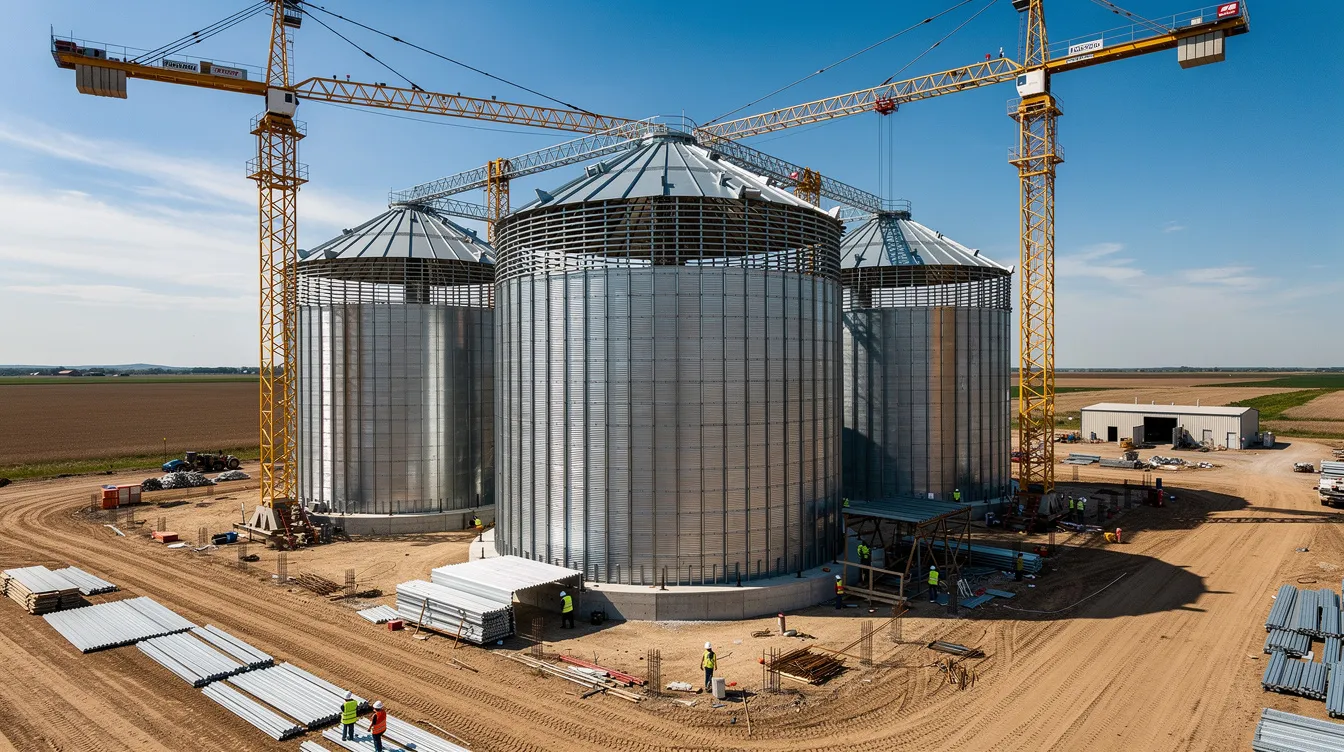
Industrial silo and bulk handling projects are typically executed via EPC (Engineering, Procurement, and Construction) or EPCM arrangements, with multiple specialised equipment suppliers coordinated under one integrator. Project implementation schedules typically outline phases from site clearance to commercial operations.
Key implementation stages include:
- Pre-feasibility and capacity planning
- Basic engineering and layout finalisation
- Vendor shortlisting and EPC tendering
- Comparative evaluation of quotations from equipment suppliers
- Technology selection (silo supplier, conveyor systems, automation platforms)
- Contract negotiation and financing arrangements
- Civil construction: foundation work, floor slabs, tunnels
- Silo erection and gallery construction
- Installation of elevators, conveyors, cleaning, and drying equipment
- Electrical and automation integration: MCC panels, cable routing, PLC/SCADA programming, field instrument calibration, and interlock testing
- Dry and wet trial runs, capacity tests for elevators and conveyors
- Testing of aeration and temperature-monitoring systems
- Trial storage of initial grain lots
- Handover including documentation and training of operating staff
Performance guarantees, equipment compatibility, and realistic project schedules are critical. Time overruns inflate interest during construction and delay revenue generation, directly affecting project feasibility.
13. Regulatory Approvals and Industrial Compliance in India
Regulatory requirements differ across Indian states and depend on whether the project is purely storage, includes food processing or feed manufacturing, or forms part of a port or rail terminal. Preparing a detailed project report ensures regulatory compliance and financial viability are addressed together.
Typical approvals may include:
- Land-use conversion or allotment in an industrial area
- Building plan and factory plan approvals from local authorities
- Electricity connection and sanctioned load approvals
- Fire safety NOC for large silo clusters
- Pollution Control Board consents (Consent to Establish and Consent to Operate) for dust emissions and generator sets
- Legal Metrology approvals for weighbridges and weighing equipment
- FSSAI registration or licence where food grains are handled for human consumption or processing is carried out
Environmental, health, and safety compliance is critical for grain storage facility projects. Dust control systems are essential in grain storage to prevent fires and explosions-a risk that increases with facility size and grain throughput. Regulatory approvals needed for projects may include pollution control and fire safety certifications. Occupational health and safety obligations under Indian labour and factory laws-including confined-space entry protocols for silos, working-at-height procedures, and electrical safety-should be outlined in a compliance roadmap within the DPR.
Approvals depend on state, location, product handled, business activity, and project configuration. The DPR should not assume a universal checklist but develop a project-specific regulatory plan.
14. Government Support, Financing and Infrastructure Investment Opportunities
Grain storage silos are considered strategic infrastructure for food security. Projects often attract interest from banks, infrastructure finance institutions, and sometimes government-backed programmes, subject to eligibility and availability.
Financing channels include:
- Commercial bank term loans
- Infrastructure finance institutions
- Consortium lending for large projects
- Private equity from strategic investors such as grain traders, logistics firms, or food processors
- Joint ventures and warehousing partnerships
The Government of India has launched programmes supporting agricultural warehousing, food security, and logistics modernisation. The “World’s Largest Grain Storage Plan in Cooperative Sector” targets decentralised scientific storage via PACS, using schemes such as the Agriculture Infrastructure Fund (AIF) and AMI. India’s cooperative grain storage plan aims to triple wheat capacity to 9 million metric tons by 2028. However, subsidy and viability gap funding schemes change frequently; the DPR should cite only current, officially notified schemes and confirm eligibility at the time of project appraisal.
Africa’s grain storage market is projected to expand at a 6.08% CAGR through 2031, and investment opportunities exist in specific corridors-major grain belts, upcoming freight corridors, inland container depots, and port hinterlands. India-based groups exploring grain storage infrastructure investments in the Middle East or Africa should similarly commission market-specific feasibility studies.
15. Technical, Operational and Financial Risks
A professional industrial grain storage silos project report should contain a structured risk assessment. Lenders scrutinise not just returns but risk mitigations. Risk assessments in project reports should identify potential spoilage and market fluctuations alongside technical and operational risks.
| Risk Category | Key Risk | Mitigation Strategy |
|---|---|---|
| Technical | High grain moisture leading to spoilage | Robust drying, aeration systems, real-time moisture monitoring |
| Technical | Insect infestation and contamination | Fumigation protocols, sealed silo design, periodic inspection |
| Technical | Dust explosions and fire | Dust collection systems, spark detection, explosion venting |
| Operational | Equipment failure (elevators, conveyors) | Preventive maintenance schedules, redundancy in critical equipment |
| Operational | Power interruptions | Backup DG sets, UPS for SCADA and controls |
| Commercial | Insufficient grain inflow | Location near grain production centres, long-term contracts |
| Commercial | Low commercial storage occupancy | Conservative tariff assumptions, diversified customer base |
| Financial | EPC cost escalation during execution | Fixed-price EPC contracts, adequate contingency |
| Financial | Commissioning delays | Realistic project scheduling, experienced EPC contractor |
| Financial | Higher-than-expected interest rates | Interest-rate sensitivity in financial model, hedging where feasible |
| Financial | Feed mill capacity underutilisation | Phased capacity addition, secured off-take agreements |
These risks and mitigations should feed directly into sensitivity scenarios in the financial model and be explicitly discussed in the bankable feasibility narrative.
16. Standalone Silos vs Integrated Bulk Handling vs Integrated Feed Mill Infrastructure
Investors must choose among three broad configurations, each with different capital intensity, complexity, and risk-return profiles. No single model is universally superior-the correct choice depends on the investor’s strategic objectives, existing facilities, market access, and risk appetite.
| Parameter | Standalone Grain Silos | Bulk Handling Terminal | Integrated Silo + Feed Mill |
|---|---|---|---|
| Business Model | Storage and handling services | Throughput-based logistics fees | Product sales (feed) + storage |
| Capital Investment | Moderate–High | Very High | Highest |
| Automation Level | Medium–High | High | High |
| Revenue Sources | Storage rental, handling, cleaning fees | Throughput charges, loading fees | Feed product sales, storage savings |
| Working Capital | Moderate (receivables) | High (fixed cost sensitivity) | Very High (raw + finished goods) |
| Operating Risk | Occupancy, grain inflow | Utilisation, rail/port delays | Feed demand, quality, throughput |
| Typical Project Size | 10,000–100,000 MT | 25,000–200,000 MT | 10,000–50,000 MT silos + feed mill |
| Likely Investor Profile | Grain traders, logistics companies | PPP contractors, port operators | Feed manufacturers, integrated agro companies |
Standalone silos suit investors seeking service-based revenue with lower manufacturing risk. Bulk handling terminals fit logistics-oriented companies with access to rail or port infrastructure. Integrated complexes serve promoters with established existing facilities in feed manufacturing or grain processing who seek captive raw material security and value addition.
17. Why a Professional DPR Is Essential for Grain Storage and Feed Mill Infrastructure Projects
Industrial silo and feed mill projects are multi-disciplinary, combining civil, mechanical, electrical, automation, and financial planning. Generic template-based reports are inadequate for serious investment or bank finance decisions.
A professionally prepared DPR supports decision-making through:
- Precise capacity planning for silos, conveyors, and handling systems
- Evaluation of technology options and vendor alternatives
- Realistic project cost estimation based on current EPC quotations
- Clear implementation scheduling and commissioning milestones
- Assessment of regional grain availability, competitor landscape, and potential customers
- Realistic tariff and service pricing assumptions
A well-structured DPR is essential for securing bank loans and investment approvals. Executive summaries in project reports should include project objectives, capacity, and profitability. Key components of an industrial grain storage silo project report include market analysis and financial projections, DSCR and IRR calculations, loan repayment planning, working capital assessment, and systematic sensitivity analysis demonstrating project robustness under adverse conditions.
A lender-ready DPR must be customised to specific project details-capacity, location, EPC scope, financing terms-which is the core value proposition of Project Report Bank led by CA Manish Gugliya.
18. Professional DPR, Project Feasibility and Financial Advisory Services by Project Report Bank
Project Report Bank is a Chartered Accountant–led industrial project advisory and DPR preparation firm specialising in manufacturing, agro-processing, and infrastructure projects across India. The firm provides customised professional advisory, financial analysis, and documentation services for entrepreneurs, project promoters, corporates, and institutional investors.
Relevant services include:
- Customised Industrial Grain Storage Silos Project Report preparation
- Grain Storage Silo Plant Project Report for bank finance
- Bulk Grain Handling System Project Cost assessment
- Feed Mill Infrastructure Project Report and techno-economic feasibility
- CMA data preparation and financial modelling
- Industrial Grain Storage and Handling Plant Feasibility studies
- Project finance advisory and loan structuring
- Investor-ready DPR and fundraising support
CA Manish Gugliya (FCA, DISA, ICAI), with more than 20 years of professional experience, leads the firm’s bankable financial projections, DSCR analysis, and loan-structuring guidance. Each DPR is customised to the project’s capacity, engineering specifications, EPC quotations, location, financing structure, and commercial model. This article is part of a broader advisory ecosystem that includes detailed resources on specialty flour plant machinery and atta chakki plant project cost for grain processing investors.
Project Report Bank does not offer generic templates. Serious industrial investors, corporates, and project promoters seeking a customised DPR and feasibility assignment for grain storage, bulk handling, or integrated feed mill infrastructure projects are invited to contact Project Report Bank to discuss scope, timelines, and professional engagement terms.
19. Frequently Asked Questions on Industrial Grain Storage Silos Projects
What is the typical investment range for an industrial grain storage silos project in India?
Capital expenditure varies widely depending on storage capacity (10,000 versus 50,000 MT), construction material (steel versus concrete), automation level, inclusion of truck tipplers, drying capacity, and whether a feed mill is integrated. Projects often fall into a broad band from a few crore rupees for smaller basic plants to ₹50–100 crore or higher for large, automated, rail-connected complexes. Any publicly available cost figures should be treated as preliminary benchmarks. Accurate bankable estimates require a customised industrial grain storage silos project report based on current EPC quotations and project-specific engineering.
How much land is required for a 50,000 MT grain storage silo project?
Land needs depend on silo configuration (number, diameter, and height of bins), inclusion of rail siding or feed mill, truck circulation space, setback requirements, and local zoning norms. Such projects often require multiple acres, but geotechnical constraints, expansion plans, and inclusion of processing facilities can modify the requirement significantly. The plant layout chapter of a project-specific DPR should provide optimised land and layout planning based on site surveys and engineering drawings.
Can grain storage silos be integrated with an animal feed mill or other processing plants?
Integration with feed mills, flour mills, rice mills, distilleries, or ethanol plants is a common and commercially attractive strategy. It improves raw material security, enhances supply chain efficiency, and can unlock better operating margins. Such integration requires synchronising silo capacities, bulk handling throughput, and process-plant capacity, and it increases both capital expenditure and project complexity. Project Report Bank’s dedicated reports on integrated animal feed mills and automatic feed pellet plants provide deeper process and investment analysis.
What are the major operating risks in a grain silo facility and how are they managed?
Key risks include grain spoilage due to high moisture, insect infestation, dust explosions, mechanical breakdown of elevators and conveyors, power outages, and lower-than-expected storage occupancy or throughput. Proper silo design incorporating aeration and monitoring systems, preventive maintenance programmes, robust quality protocols, and conservative commercial assumptions in the DPR form the primary risk-mitigation framework. These risks and mitigations should be clearly stated in the bankable feasibility study to satisfy lender requirements.
How can a promoter start the process of obtaining a customised Industrial Grain Storage Silos Project Report?
A promoter should prepare preliminary information including proposed location, intended storage capacity, target customers or captive uses, broad business model (storage-only versus integrated processing), and approximate investment appetite. Sharing these inputs with Project Report Bank enables the advisory team to design a detailed scope of work, timelines, and professional fee proposal for preparing a customised DPR and financial model. Early engagement helps avoid over- or under-sizing the project and ensures alignment with bankability and investor expectations from the outset.
20. Conclusion
Industrial grain storage silos, bulk grain handling automation, and integrated feed mill infrastructure represent strategic, long-term investments in India’s grain value chain, food processing, and animal feed industries. These projects directly address the challenge of reducing post-harvest losses, preserving grain quality through reliable storage and controlled aeration, and improving logistics efficiency across the agricultural supply chain. New silo installations across India are accelerating as both the government and private sector recognise that existing storage infrastructure, dominated by conventional godowns, is inadequate for the scale and quality standards required by modern grain processing.
Correct technology selection-whether flat-bottom galvanized steel silos, hopper bottom silos, or concrete silos-robust process design for grain handling and processing facilities, and realistic project costing based on current market conditions are critical to long-term viability and bankability. The financial and technical complexity of these projects demands professional DPR preparation, techno-economic feasibility analysis, financial modelling, and project finance advisory before committing to investments in the ₹5 crore–₹100 crore and above range.
Serious promoters, investors, and corporations planning industrial grain storage, bulk handling terminals, or integrated feed manufacturing complexes are invited to engage Project Report Bank for customised Industrial Grain Storage Silos Project Reports, Bulk Grain Handling System Project Cost analysis, and Feed Mill Infrastructure Project Reports tailored to their specific project vision, financing structure, and risk appetite.