Key Takeaways
This article outlines a comprehensive de oiled cake processing plant project report framework for entrepreneurs planning meal upgradation and value-addition units in India. De-oiled cake from soybean, mustard, rapeseed, sunflower seeds, cotton seed oil cake, groundnut and rice bran can be upgraded into higher-value animal feed ingredients and specialised products. The perspective is that of CA Manish Gugliya (Project Report Bank), focusing on project feasibility, CMA Data and bankable DPRs.
- Investment costs depend on daily processing capacity and extraction method-typical projects range from ₹5 crore to ₹30 crore depending on scale and automation.
- Raw material procurement from solvent extraction plants is the single largest cost driver, often exceeding 70% of production cost.
- DSCR of 1.25× or above is generally expected by Indian banks; conservative capacity utilisation assumptions (60% rising to 85%) strengthen bankability.
- Standalone meal-upgradation units require lower capex but carry supply risk; integrated plants offer better margins and raw material security.
- A break-even analysis is essential for evaluating project viability and profitability before committing capital.
Executive Summary and Investment Snapshot
De-oiled cake, the residue after oil extraction from oilseeds, is rich in protein and widely used in animal feed formulations across India. Profit from soybean meal often exceeds that of the oil itself, making meal upgradation a commercially significant business rather than a mere by-product operation. India’s oilseed production significantly supports the demand for de-oiled cake, with total oilseed meal production forecast at approximately 20.1 million metric tonnes for marketing year 2026/27.
An oilseed meal processing plant buys solvent-extracted meal from oil extraction units and upgrades it through cleaning, drying, grinding, grading, pelletising and blending to create standardised, higher-value products suitable for poultry, cattle and aquaculture feed manufacturers.
Key Investment Highlights:
- Typical capacities range from 50 to 500 TPD with project costs illustratively in the ₹5–30 crore range
- Major raw materials include soybean meal, mustard, rapeseed, sunflower, cottonseed and groundnut de-oiled cakes
- Well-planned plants can achieve attractive EBITDA margins if procurement, quality control and capacity utilisation are managed prudently
- De-oiled cakes, especially soybean meal and mustard DOC, are major agricultural export commodities
This article serves as a practical de oiled cake processing plant project report template that can be customised into a bankable DPR with detailed financial modelling.
What Is Industrial De-Oiled Cake Processing?
Oil cake is the solid residue left after oilseeds are pressed or processed to extract oil. A de-oiled cake processing plant extracts residual oil from oilseed cakes and upgrades the meal for commercial sale. The key distinctions are:
- Oilseed cake after mechanical pressing: Higher residual oil content (3–12%), coarser texture. Mechanical pressing yields 85–90% oil extraction efficiency, suitable for small plants.
- Solvent-extracted de-oiled meal: Residual oil typically below 1–2%. Solvent extraction can achieve 95–98% oil yield and is ideal for large-scale operations over 100 TPD. The process typically employs hexane as a food-grade solvent.
- Feed-grade meal: Standardised protein source for animal feed compounders.
- Food-grade protein ingredients: Require separate wet-processing technology, hygienic zones and FSSAI compliance-distinctly different from basic meal upgradation.
Quality parameters that matter include moisture (target 10–12%), protein content (44–49% for soybean meal depending on dehulling), residual oil content, crude fibre, ash, mycotoxin levels and anti-nutritional factors. Each processing step-controlled drying, milling, grading, pelletisation, blending and packaging-improves commercial realisation.
Types of Oilseed Meals Suitable for Industrial Upgradation
Not all oil cakes behave the same. Technical suitability, anti-nutritional factors and regulatory norms differ significantly by seed type.
| Raw Material | Processing Opportunities | Principal Applications | Key Cautions |
|---|---|---|---|
| Soybean meal | Toasting, grading, dehulling, protein improvement | Feed, protein ingredients | Trypsin inhibitors require heat treatment |
| Mustard/rapeseed meal | Conditioning, grading, detoxification | Feed, selected industrial | Glucosinolate management essential |
| Sunflower meal | Dehulling, fibre reduction | Compound feed | High fibre if unhulled |
| Cottonseed meal | Quality improvement | Animal feed within limits | Gossypol toxicity concerns |
| Groundnut meal | Grading, rigorous testing | Feed, ingredient markets | Aflatoxin contamination risk |
| Rice bran meal | Stabilisation, quality processing | Feed, industrial | Rancidity; requires rapid stabilisation |
For detailed soybean meal quality specifications and export processing, refer to our soybean meal processing and export-oriented plant project report. Cottonseed meal availability links directly to industrial cottonseed oil processing plants that generate cotton seed oil cake as a co-product.
Diversifying across multiple oil cakes can stabilise plant utilisation. Projects combining several oilseed streams may reference our industrial oilseed processing complex DPR for integrated planning.
Industrial De-Oiled Cake Processing and Value Addition Opportunities
Investors can choose from basic oilseed preparation and grading to more advanced protein-enrichment routes:
- Cleaning, screening and magnetic separation to remove stones, impurities and metallic particles
- Crushing, grinding and particle-size standardisation using hammer mills and pulverisers
- Controlled drying to target safe moisture for storage-stable animal feed
- Toasting and heating to reduce anti-nutritional factors-extrusion improves protein quality in soybean meal during processing
- Dehulling and fibre reduction for sunflower and soybeans to raise protein percentage
- Pelletisation and granulation for efficient bulk transport and feed-mill compatibility
- Blending and premix preparation to meet specific needs of poultry, cattle and aquaculture feed buyers
- Export-oriented quality enhancement including lab testing, traceability and compliant packaging
Cleaning, drying and pelletisation are relatively low-risk investments. Fermentation, protein concentrates and food-grade products require advanced technology, R&D and specialised sales channels. The de-oiled cake itself arises from crude oil production in industrial solvent extraction plants.
Manufacturing Process Flow
The standard process sequence in a de oiled cake value addition plant follows a logical progression:
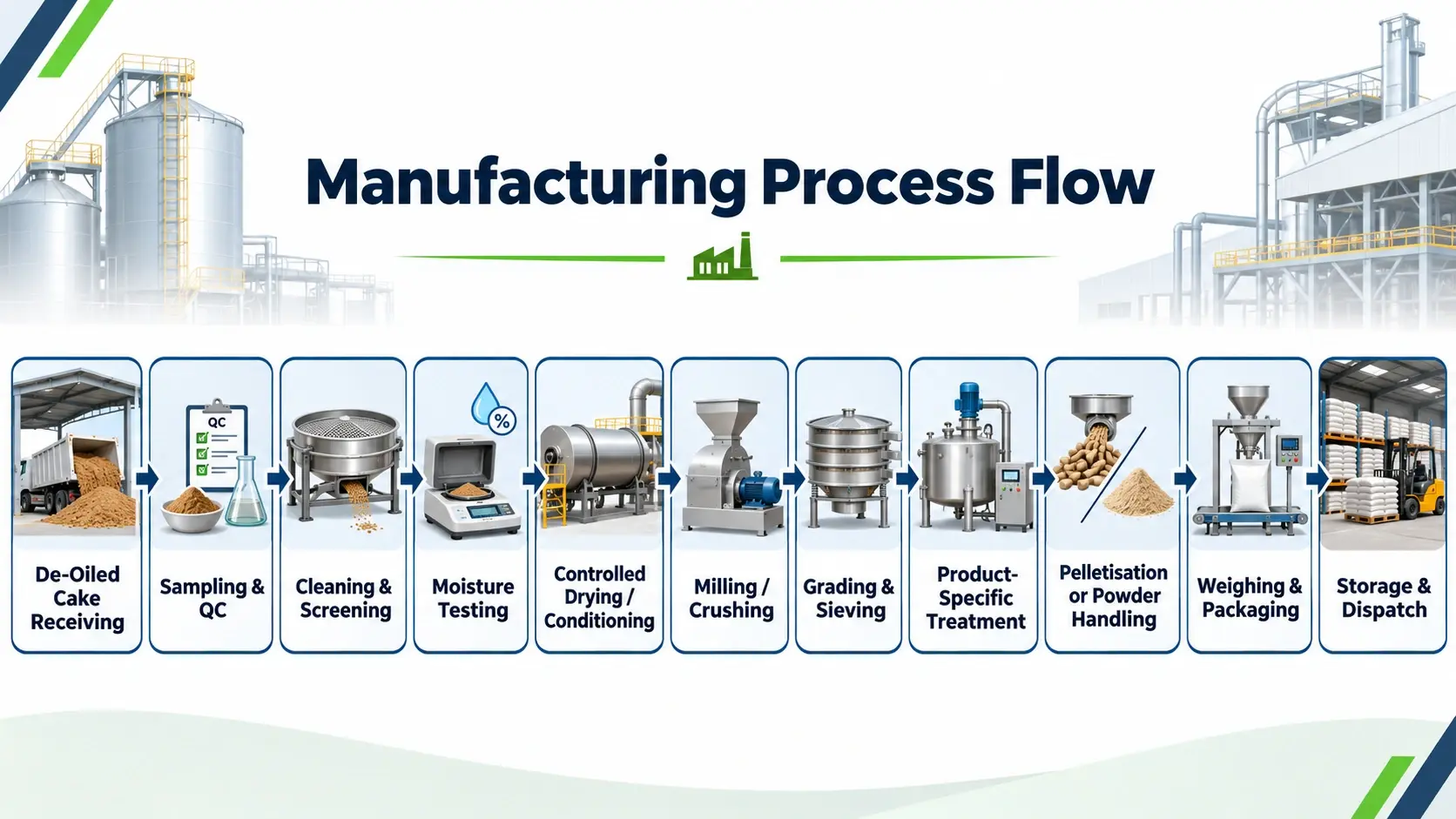
De-Oiled Cake Receiving → Sampling & QC → Cleaning & Screening → Moisture Testing → Controlled Drying/Conditioning → Milling/Crushing → Grading & Sieving → Product-Specific Treatment → Pelletisation or Powder Handling → Weighing & Packaging → Storage & Dispatch
The soybean oil manufacturing process upstream includes cleaning, cracking, cooking and extrusion before extraction. Soybeans are conditioned to adjust moisture before extrusion. Crude soybean oil undergoes further processing through refining processes including degumming, bleaching and deodorization to remove impurities.
Process flow variations include:
- Feed-grade improvement: Focus on drying, grinding and pelletisation
- High-protein upgradation: Add dehulling and classification using flaking mills and separators
- Customised pelletised ingredients: Add micro-dosing and blending systems
- Advanced protein isolates are separate wet-chemistry processes requiring distinct investment
Plant Capacity Planning
Capacity planning must align with raw material availability, market size and financing. The plant’s empty capacity should ideally target over 75% utilisation for profitability.
| Parameter | 50 TPD | 100 TPD | 250 TPD | 500 TPD |
|---|---|---|---|---|
| Annual throughput (300 days) | 15,000 MT | 30,000 MT | 75,000 MT | 150,000 MT |
| Year 1 utilisation (illustrative) | 60% | 60% | 55% | 50% |
| Year 3+ target | 80–85% | 80–85% | 80–85% | 80–85% |
Processing losses from dust, fines and moisture reduction can amount to 3–7% of intake weight. Feedstock intake differs from saleable output. For integrated plants, meal-upgradation capacity must match upstream DOC generation; our integrated soybean crushing and refining plant DPR addresses this linkage.
Plant and Machinery Requirements
Permanent machinery selection should align with product specifications and market demand. A complete edible oil processing plant requires oilseed pretreatment equipment upstream; the meal-upgradation unit downstream needs:
- Intake hoppers, belt conveyors, bucket elevators
- Vibrating screens, destoners, magnetic separators for cleaning
- Hammer mills, crushers, pulverisers for size reduction
- Rotary or fluidised-bed dryers with temperature and moisture control
- Pellet mills, crumblers, coolers for animal feed pellet production
- Ribbon blenders or paddle mixers for feed blending
- Bagging machines, electronic weighers, stitching and sealing systems
- Dust collection system-cyclones, bag filters
- Laboratory equipment for moisture, protein, fibre, aflatoxin testing
- Electrical panels, MCC and basic PLC automation
Equipment for oil extraction upstream includes solvent extractors and desolventizers. Selection criteria include energy efficiency, reliability, availability of spares from Indian suppliers, and capacity matching across all stages. Cost ranges should be confirmed through current quotations rather than assumed.
Land, Building, Utilities and Infrastructure
A typical layout includes raw material yard, main processing hall, finished-goods warehouse, utility block, laboratory and office. Illustrative land requirements range from 0.75 acres (50 TPD) to 3.0 acres (500 TPD), though actual needs depend on layout and local norms.
Key utilities include:
- Power: Varies by capacity and automation level; thermal energy needed for drying via boiler or hot-air generator as fuel source
- Water: Relatively low for dry-processing; needed for dust suppression and boiler operation
- Compressed air: For conveying, bagging and instrumentation
- Environmental provisions: Dust control, fire safety, ventilation, noise control
Infrastructure needs increase significantly for wet protein extraction or food-grade production, requiring separate hygienic zones, stainless-steel equipment, effluent treatment and cold storage.
De Oiled Cake Processing Plant Cost and Capital Investment Framework
Significant fixed capital investment is required for a de-oiled cake processing plant. Project cost structure includes:
- Land and site development
- Building and civil works
- Plant and machinery (including taxes, freight)
- Electrical installations and utilities
- Laboratory and quality-control setup
- Installation, commissioning and trial-run expenses
- Preliminary and pre-operative expenses
- Contingency margin and working capital margin
Illustrative cost bands (feed-grade upgradation, estimates only):
| Capacity | Total Project Cost (Illustrative) |
|---|---|
| 50 TPD | ₹3–7 crore |
| 100 TPD | ₹7–15 crore |
| 250 TPD | ₹15–30 crore |
Advanced dehulling or protein-upgradation plants cost more. Fully integrated crushing–solvent extraction–meal complexes require substantially higher investment. A professional DPR from Project Report Bank refines these using current vendor quotations and site-specific conditions.
Raw Material Procurement and Working Capital Planning
Raw material cost constitutes over 70% of total production cost. Proximity to oil-crushing hubs minimises costs and ensures raw material availability. Major procurement sources include regional soybean and mustard solvent extraction plants, cottonseed oil units, and sunflower and groundnut crushing plants.
Seasonal availability, price volatility linked to seed oil prices and crude oil markets, quality-linked pricing and procurement contracts all require careful plan development.
Working capital components:
- Raw material stock: 30–45 days of consumption
- Finished goods inventory: 15–30 days of sales
- Trade receivables: 30–60 days
- Supplier credit: 15–30 days
- Cash and bank balance for operations
CMA Data preparation converts these assumptions into month-wise projections and drawing power statements. Working capital is often underestimated; rapid sales growth can increase the requirement substantially.
Production Cost, Processing Margin and Profitability
Profitability depends on processing margin per tonne rather than headline selling price alone. Major cost heads include raw materials, power and fuel, direct labour, repairs, packaging, quality testing, factory overheads, and freight and selling expenses.
Moisture reduction, fines generation and handling losses affect net yield and actual margin. Higher-value products such as specially graded soybean meal may give better realisation but can have narrower markets and stricter quality demands. The processing of de-oiled cake also contributes to the reduction of agricultural waste, adding environmental value.
The DPR should present projected P&L statements for 7–10 years with sensitivity analysis for raw material cost increase, selling price decrease, capacity utilisation variation and energy cost escalation.
Financial Projections, CMA Data and Bank Finance
A detailed project report is essential for loan applications. Banks require a well-structured project report for funding approval, and project reports must meet current banking norms for loans.
Key components of a bankable de oiled cake processing plant project report include:
- Total project cost with detailed break-up and means of finance
- Projected P&L, Balance Sheet and Cash Flow for at least 5–7 years
- DSCR calculations (banks typically expect ≥1.25×), break-even analysis, IRR and payback period
- Detailed working capital assessment with proposed bank limits
- Sensitivity analysis showing impact on DSCR if DOC prices rise or sales realisation softens
Banks closely examine current ratio, debt–equity ratio, interest coverage and return on capital employed. Professional assistance improves project report quality and compliance. Project Report Bank prepares customised, lender-ready DPRs aligned with Indian banking norms.
Market Demand, Product Applications and Export Opportunities
De-oiled cakes are a cost-effective protein source for livestock feed. The demand for high-protein feed components drives the growth of the de-oiled cake market across India’s organised animal feed sector. Main demand segments include poultry feed manufacturers, cattle feed producers, aquaculture feed plants and compound feed companies requiring consistent protein specifications.
Export opportunities exist for soybean meal and select oil cakes to other countries, though export volumes have faced pressure from weak global demand. Quality standards for de-oiled cake include specifications for moisture and protein content that must meet importing countries’ norms. Oil extraction yields 95–98% of total seed oil content, with the meal becoming the primary revenue driver in many cases.
Regulatory Approvals, Quality Standards and Compliance
Environmental compliance involves securing licenses from state pollution control boards. Key approvals include:
- Company registration, PAN, GST, MSME/Udyam
- Factory licence, building plan approvals, fire and electrical safety
- State Pollution Control Board consent for air emissions and dust
- FSSAI registration if producing any food-grade ingredients
- Feed-quality standards and feeding standards that dictate specifications
- Export documentation: IEC, APEDA, country-specific regulations
Feed-grade approvals do not automatically make a product food-grade. Lab testing for protein, fibre, moisture and mycotoxins is essential, especially for groundnut and rice bran products.
Technical, Commercial and Financial Risk Analysis
A credible oilseed meal upgradation project report must include a realistic risk matrix:
Technical risks: Raw material quality variation, machinery breakdowns, underperforming yields, excessive dust and waste. Mitigation: Pre-dispatch sampling, maintenance contracts, phased commissioning.
Commercial risks: DOC and seed oil price volatility, customer concentration with large feed mills, export market disruptions, imports competition, wrong product positioning. Mitigation: Diversified suppliers and buyers from multiple countries, flexible product mix.
Financial risks: Cost overruns, delayed commissioning, insufficient working capital, DSCR stress from slower sales ramp-up. Mitigation: Conservative projections, adequate contingency, phased expansion.
Standalone Meal-Upgradation Unit vs Integrated Oilseed Complex
- Model A – Standalone unit: Sources DOC externally. Lower capex; higher supply dependence. Focus on cleaning, drying, grinding, pelletisation. Suitable for entrepreneurs entering the market.
- Model B – Attached to existing solvent extraction plant: Uses in-house de-oiled cake. Medium incremental capex with strong integration benefits on steam, power and labour. Oil extraction methods include mechanical pressing and solvent extraction at this level.
- Model C – Fully integrated complex: Highest capex but maximum value capture from soybean oil, seed oil cake, refined oils, animal feed ingredients and possibly soy lecithin from oil degumming. Edible oil processing plants convert oilseeds into refined oil alongside meal. Soybean oil extraction can achieve capacities beyond 15,000 tonnes per 24 hours at the largest scale.
The DPR should clearly justify the chosen model with financial projections and sensitivity analysis.
How to Prepare a Bankable DPR
A ready-made template is insufficient for bank finance. Lenders expect project-specific analysis. A project feasibility study should assess both financial and technical factors. Key components include:
- Promoter profile, experience and net worth
- Detailed project description with process flow, plant layout and machinery list with quotations
- Project cost estimates and implementation schedule
- Means of finance and promoter contribution planning
- Working capital assessment aligned with inventory, receivables and operating cycle
- Projected financial statements, DSCR, IRR, ROI, payback and sensitivity analysis
All assumptions-prices, yields, capacity utilisation-should be transparently documented to prepare for banker queries and customize the report to each company’s specific situation.
Professional Insights from CA Manish Gugliya
In my experience, the most common mistakes promoters make in de-oiled cake processing projects are overestimating capacity utilisation, underestimating working capital intensity and ignoring DOC price volatility.
- Always evaluate contribution per tonne-not just headline selling price-after all variable costs
- Compare debt-servicing obligations with conservative DSCR scenarios before finalising loan size
- Avoid committing to sophisticated protein products unless confirmed technical support and offtake exist
- Phase capacity expansion instead of building a very large plant from day one
- Treat quality control and laboratory setup as core investments, not optional extras
Combining technical understanding with disciplined financial modelling is essential for long-term sustainability. The market demands efficient, consistent production backed by sound business economics.

Frequently Asked Questions
What minimum capacity makes commercial sense for a de-oiled cake processing unit in India?
There is no single answer. Commercial viability depends on local raw material supply from nearby oil mills, distance from feed customers and farmers, and financing capacity. A 50 TPD unit may work well near a concentrated oilseed preparation cluster, while larger capacities of 250–500 TPD target bulk compound feed manufacturers and export sales.
Can I start with only cotton seed oil cake and later diversify into soybean or sunflower meal?
Yes, provided the machinery is designed for flexibility. However, cotton seed oil cake has specific gossypol-related constraints, and switching to soybean or canola and sunflower meal may require additional equipment such as dehullers or different screen sizes. The DPR should account for this flexibility in machinery selection.
Do banks treat de-oiled cake processing as a high-risk sector?
Banks evaluate collateral, project IRR, DSCR, management strength and market linkages rather than labelling an entire sector as high-risk. A well-structured DPR with conservative assumptions, adequate promoter contribution and demonstrated offtake potential significantly improves sanction prospects.
How long does implementation typically take for a 100–250 TPD plant?
From sanction to commissioning, expect 12–18 months covering approvals, civil work, machinery procurement and delivery, installation, electrical commissioning and trial runs. Delays in land acquisition, machinery imports or regulatory clearances can extend this timeline.
What information should I share when requesting a customised DPR?
Provide your proposed location, planned capacity, major raw material type (soybean meal, mustard meal, sunflower seed meal), target products, approximate investment budget and current project stage. This allows the financial model to be built on realistic, project-specific assumptions.
Get a Customised De Oiled Cake Processing Plant DPR & Financial Feasibility Study
Oilseed meal upgradation can produce meaningful revenue for oil mills, solvent extraction units and new investors-but commercial feasibility depends on feedstock quality, technology, processing yield, margins and capital structure.
- Project Report Bank specialises in industrial Detailed Project Reports for oilseed processing, oil cake upgradation and animal feed projects
- We provide project-specific financial modelling, CMA Data, working capital assessment, DSCR/IRR/ROI analysis and sensitivity studies
- Our advisory covers term-loan structuring, means of finance planning and preparation of bank-ready and investor-ready documentation
To discuss your project, share your proposed location, planned capacity, major raw material, target products, approximate investment budget and current stage via WhatsApp or the contact form at ProjectReportBank.com.
We support in preparing robust DPRs and finance documentation. We do not guarantee bank loan sanctions or fixed returns.
CA Manish Gugliya, FCA, DISA (ICAI) Practising Chartered Accountant Industrial DPR | Project Feasibility | CMA Data | Project Finance Advisory www.projectreportbank.com