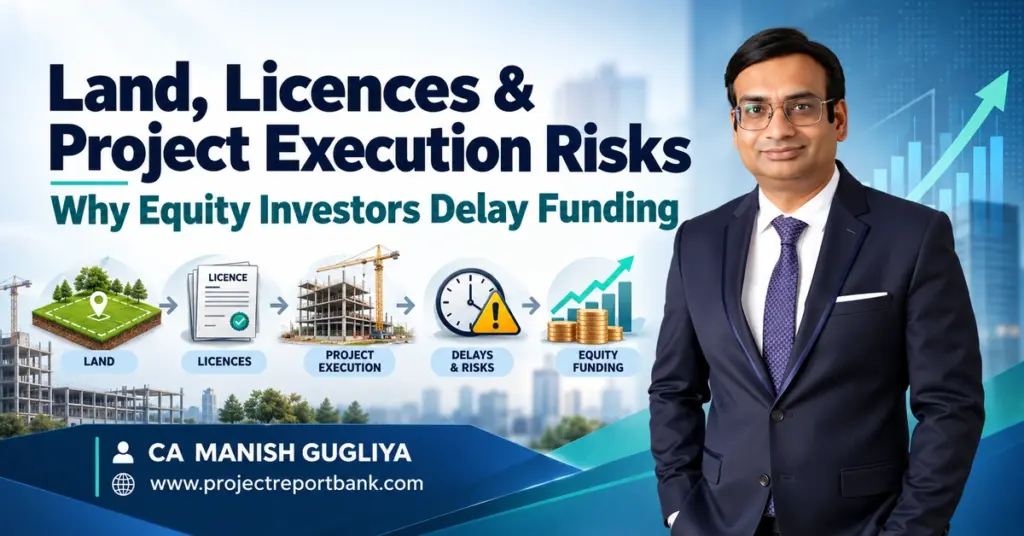
Even when a manufacturing project shows strong projected profitability, equity investors frequently delay their funding decisions. The reasons are rarely about the business model itself. They are almost always about whether the project can actually be built, approved, and commissioned within the proposed cost and schedule. This article examines the specific land, licensing, and execution risks that cause investors to hold back capital – and what promoters can do about it.
Key Takeaways
- Equity investors delay funding not because they doubt project profitability, but because unresolved land title, pending statutory approvals, and weak implementation planning create project risk that threatens timelines, costs, DSCR, and investor returns.
- Investor interest, an MoU, or a signed term sheet does not guarantee immediate fund disbursement. Serious investors first complete a structured due diligence and diligence process covering legal, technical, financial, and regulatory aspects before releasing capital.
- Delays in land possession and regulatory approvals directly increase interest during construction, reduce project IRR and equity IRR, and may require additional promoter equity – making the deal less attractive or forcing renegotiation.
- A robust Investor-Ready DPR with realistic financial projections, scenario analysis for schedule slippage, and a clear regulatory approval matrix can significantly reduce funding delays and improve investor confidence.
- For Indian manufacturing projects, project readiness – land, licences, execution plan, and risk management – is as important as financial viability in attracting and retaining equity investment.
Introduction: Why Investors Delay Funding Even When a Project Appears Profitable
Consider a ₹30 crore agro-processing plant planned in a Tier-2 Indian city. The promoter has a credible business model, favourable market demand, and projected EBITDA margins of 22–25%. An investor expresses strong interest. A non-binding term sheet is signed. Yet six months later, no equity has been disbursed. The reason is not that the project stopped being profitable. The reason is that the investor’s evaluation revealed unresolved land title questions, pending environmental clearance, and an optimistic commissioning schedule with no contingency.
This situation is common. The stages of an equity deal – initial interest, pitch deck review, indicative valuation, term-sheet negotiation, detailed due diligence, investment committee approval, definitive agreements, and actual equity disbursement – are distinct. Internal investor processes and committee approvals can cause delays in funding decisions at each stage. Equity investors delay funding decisions due to macroeconomic uncertainty, valuation disconnect, or tightening capital markets that lead investors to prioritize existing portfolio companies over new investments. Even hesitation during investment decisions can help investors avoid overpaying in competitive markets. Investors may also wait for improved economic conditions before investing in uncertain projects.
The central message is straightforward: a profitable project on paper is not necessarily an investment-ready project. Equity investors withhold or stagger capital when land, licences, construction schedules, environmental factors, and risk management are not adequately addressed.
This article is written from the perspective of CA Manish Gugliya (Project Report Bank), advising MSME and mid-sized industrial promoters on investor-ready documentation, project finance, and equity funding for manufacturing projects in India.
Why Project Execution Risks Matter to Equity Investors
Project execution risk, in the context of Indian manufacturing, refers to every uncertainty between investment commitment and commercial operations – delays in land possession, civil construction, machinery installation, utility connectivity, trial runs, and ramp-up to designed production capabilities.
Project finance risks include construction, operations, financing, and volume risks. From a risk management perspective, each of these risks involved translates into measurable financial consequences: increase in total project cost, rise in interest during construction, extended payback period, and reduction in project IRR and equity IRR.
Table 1: Project Execution Risk Matrix
| Risk | Investor Concern | Possible Financial Impact | Risk Mitigation |
|---|---|---|---|
| Land handover delay | Loss of time value; uncertain possession | Higher IDC; delayed revenue | Secure registered title and possession before fundraising |
| New regulations or environmental norms | Additional capex; compliance gaps | Increased project cost; schedule slippage | Map regulatory requirements early; build contingency |
| EPC contractor dispute or default | Construction stoppage; quality issues | Cost escalation; commissioning delay | Stronger contracts; milestone-based payments; backup vendors |
| Utility connectivity delay (power, water) | Plant cannot commission on schedule | Idle equipment; ongoing costs without revenue | Early engagement with utility authorities; documented timelines |
| Imported machinery customs delay | Installation schedule slips | Extended pre-operative period; higher working capital need | Advance import planning; buffer in schedule |
In project finance structures, even a 6–9 month delay in the commercial operations date can distort DSCR, require additional equity, and expose investors to concentration risk if they hold a dominant position in a single delayed project. This is why investors evaluate execution capability as seriously as projected profitability – understanding what equity investors look for before investing extends well beyond the financial model.
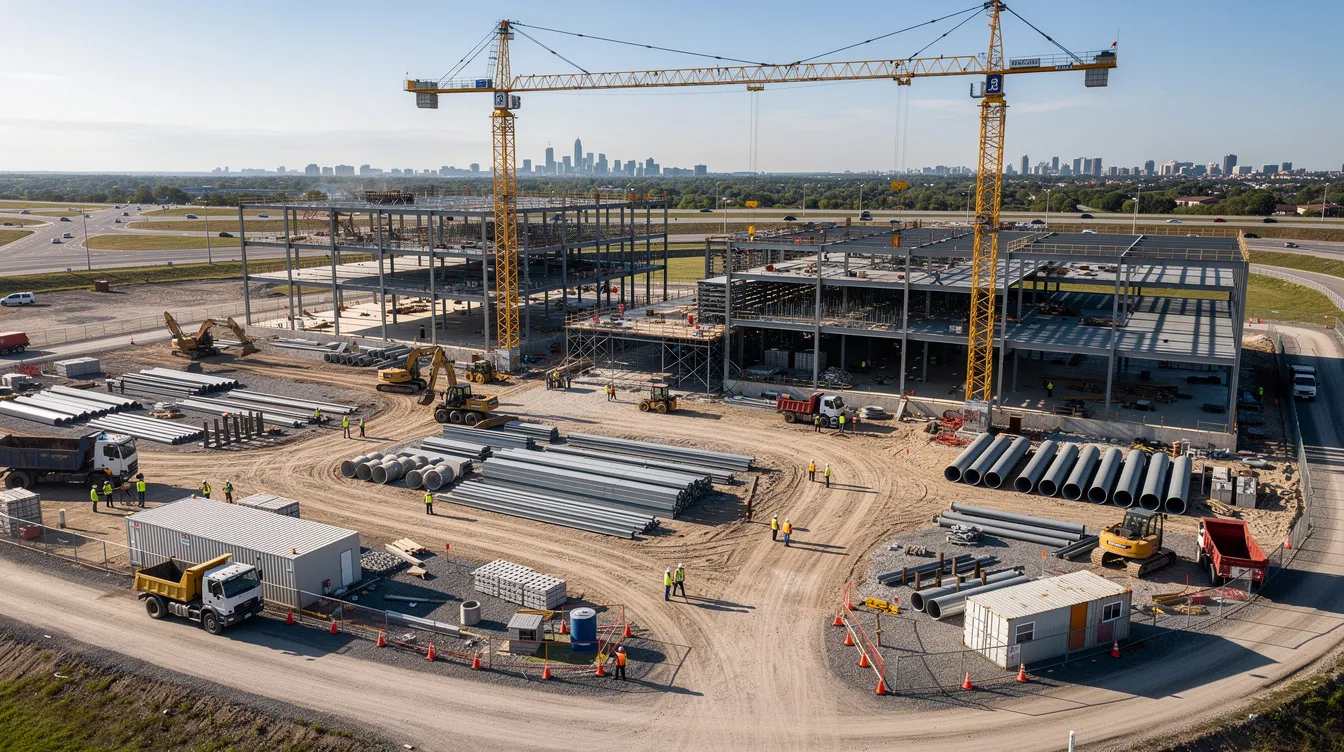
Land Acquisition and Ownership Risks That Delay Equity Funding
Industrial land is the foundational asset of any manufacturing project. Investors insist on clean title and possession clarity because unresolved land risks can jeopardise corporate ownership, collateral value, and the ability to refinance or exit the investment.
In India, land ownership is often presumptive rather than state-guaranteed. Revenue records, mutations, and registration processes are frequently incomplete. A study of 80 high-value stalled projects found that over 25% were stalled due to land disputes, with total investment at risk of approximately ₹1.93 lakh crore.
Common land-related risks in Indian manufacturing projects include:
- Unclear ownership in revenue records or missing past sale deeds
- Old mortgages or bank charges not formally released
- Family or heir disputes over inherited land
- Pending agricultural-to-industrial land conversion
- Right-of-way problems for access roads or utility corridors
- Leasehold restrictions from state industrial development corporations limiting transfer, mortgage, or sub-lease
- Environmental site assessments that identify contamination risks affecting property value
Table 2: Land Risks, Investor Concerns, and Corrective Actions
| Specific Land Risk | Why Investors Worry | Possible Financial Impact | Promoter’s Corrective Action |
|---|---|---|---|
| Pending mutation or incomplete title chain | Risk of litigation; inability to verify ownership | Project stoppage; loss of collateral value | Obtain updated encumbrance certificate; complete chain of registered deeds |
| Agricultural land not converted to industrial use | Regulatory compliance violation; closure risk | Demolition order; total loss of civil investment | Complete land conversion before approaching investors |
| Unregistered development agreement | Legal challenge to possession | Injunction; halt in construction | Register agreement; obtain possession receipt |
| Prior mortgage or charge by seller | Lien on land; risk of third-party claim | Inability to use land as security for project finance | Obtain No Objection from prior lender; verify on CERSAI |
| Access road or right-of-way dispute | Plant may not be accessible for operations | Delays in material movement; commercial viability risk | Settle access before acquisition; document easement rights |
Many serious equity funds treat unresolved land litigation or unclear title as a deal-breaker. They either delay funding until clearances are obtained or reduce the deal value to offset elevated project risk. A well-prepared DPR should clearly disclose land status and attach key documents, aligned with an Investor-Ready DPR checklist for equity funding, so that investors do not encounter surprises during legal due diligence.
Industrial Licences and Regulatory Approval Risks
Statutory approvals differ by state, industry, installed capacity, and environmental impact. Promoters must identify and map applicable approvals early rather than assuming everything can be managed later.
Key approval categories for Indian manufacturing and agro-processing units typically include:
- Land conversion and building plan approval
- Pollution Control Board consent to establish (CTE) and consent to operate (CTO)
- Environmental clearance for projects falling under specific EIA schedules
- Factory licence under the Factories Act
- Fire NOC and safety permissions
- Electricity and water connection approvals
- Sector-specific permissions (e.g., FSSAI for food processing)
Investors may postpone investment until necessary regulatory approvals are obtained, because delays in these approvals directly affect commissioning timelines. A NITI Aayog study on the chemicals sector found that approximately 89% of plants experience delays at some stage of the environmental clearance process, with average wait times of around 255 days.
Recent reforms – such as the Uniform Consent Guidelines (2026) reducing Red Category CTE processing from 120 to 90 days – are improving the regulatory landscape. However, state-level execution varies significantly. Political instability and changes in government policy can also lead to investment delays, adding political risks to the regulatory equation.
Table 3: Statutory Approvals and Investor Readiness
| Approval Category | Typical Applicability | Project Stage | Investor Consideration |
|---|---|---|---|
| Pollution Control Board CTE | Red/Orange/Green category industrial units | Before construction | Whether application filed; in-principle consent received; material conditions imposed |
| Environmental Clearance | Projects above specified capacity thresholds | Before construction | Whether ToR obtained; public hearing completed; EC granted |
| Factory Licence | All factories under the Factories Act | Before commercial operations | Whether plan approved; licence applied; inspection scheduled |
| Fire NOC | Plants with specified fire load or hazardous storage | Before commissioning | Whether plans reviewed by fire department; safety engineering measures in place |
| FSSAI Registration/Licence | Food and agro-processing units | Before commercial sale | Whether applied; category confirmed; compliance with food safety regulations |
Not every project needs every approval upfront. Investors generally expect path clarity – realistic timelines, documentary evidence that applications have been filed, and in-principle consents where obtainable. Underestimating regulatory timelines or relying on informal assurances can create problems when investors discover compliance gaps during their evaluation.
How Pending Approvals Affect Investor Funding Decisions
Approvals can be classified into three categories from a funding perspective:
- Pre-construction approvals – land conversion, building plan sanction, CTE
- Pre-commissioning approvals – CTO, factory licence, fire NOC
- Investor conditions precedent (CPs) and conditions subsequent (CS) – negotiated in shareholder or subscription agreements
For example, an investor may agree in principle to fund a ₹25 crore food-processing plant but insert a clause requiring copies of land registration documents, CTE approval, and building plan sanction before the first equity tranche is released. Another investor may release 30% equity at the land acquisition stage and the balance after financial closure with a bank and commencement of civil works.
Effective risk management requires identifying and allocating risks among the different parties involved. The conditions precedent mechanism allows the transaction to proceed contractually while protecting the investor from material regulatory and project risk. Risk management in project finance involves proper risk allocation among parties – the promoter bears responsibility for completing approvals, while the investor’s capital remains protected until those milestones are satisfied.
If several critical approvals remain highly uncertain – for example, an appeal against an environmental clearance decision or an unresolved zoning violation – investors may either delay their investment committee decision or step back entirely. These are not theoretical scenarios; they occur regularly in capital-intensive manufacturing projects across India. Promoters should understand how approvals form a standard part of the professional investor due diligence checklist in India.
Major Project Execution Risks Investors Evaluate
Beyond land and licences, investors perform a 360-degree review of construction and operational readiness, especially where project finance structures and high leverage are planned.
Major execution risks include:
- Machinery procurement delays – late delivery, import clearance issues, or vendor default
- EPC contractor performance risk – cost overruns, poor workmanship, financial distress of the contractor
- Construction cost escalation – steel, cement, and labour cost inflation affecting the balance sheet of the project
- Exchange-rate exposure – for imported plant and machinery, currency fluctuation can increase capital requirements
- Utility infrastructure delays – power substation, water pipeline, or road connectivity not delivered on time
- Technology and process risk – unproven production processes in Indian conditions
- Raw material availability – seasonal agro inputs, logistic bottlenecks affecting production capabilities
- Project management capability – whether the promoter team can manage complex civil, technical, and regulatory execution
Operational risks include supply volume and compliance risks during ramp-up. Working capital shortages during commercial ramp-up directly affect projected EBITDA, and most projects cannot achieve designed capacity utilisation immediately.
Mitigation strategies for various risks include preliminary reviews of technology readiness, equipment condition verification, and in some cases, political risk insurance to mitigate country risks in project finance – particularly relevant for projects with imported technology or foreign collaboration.
Investors often insist on independent technical due diligence and a project feasibility study before raising equity funding to validate technology selection, production capacity, engineering assumptions, and implementation schedules.
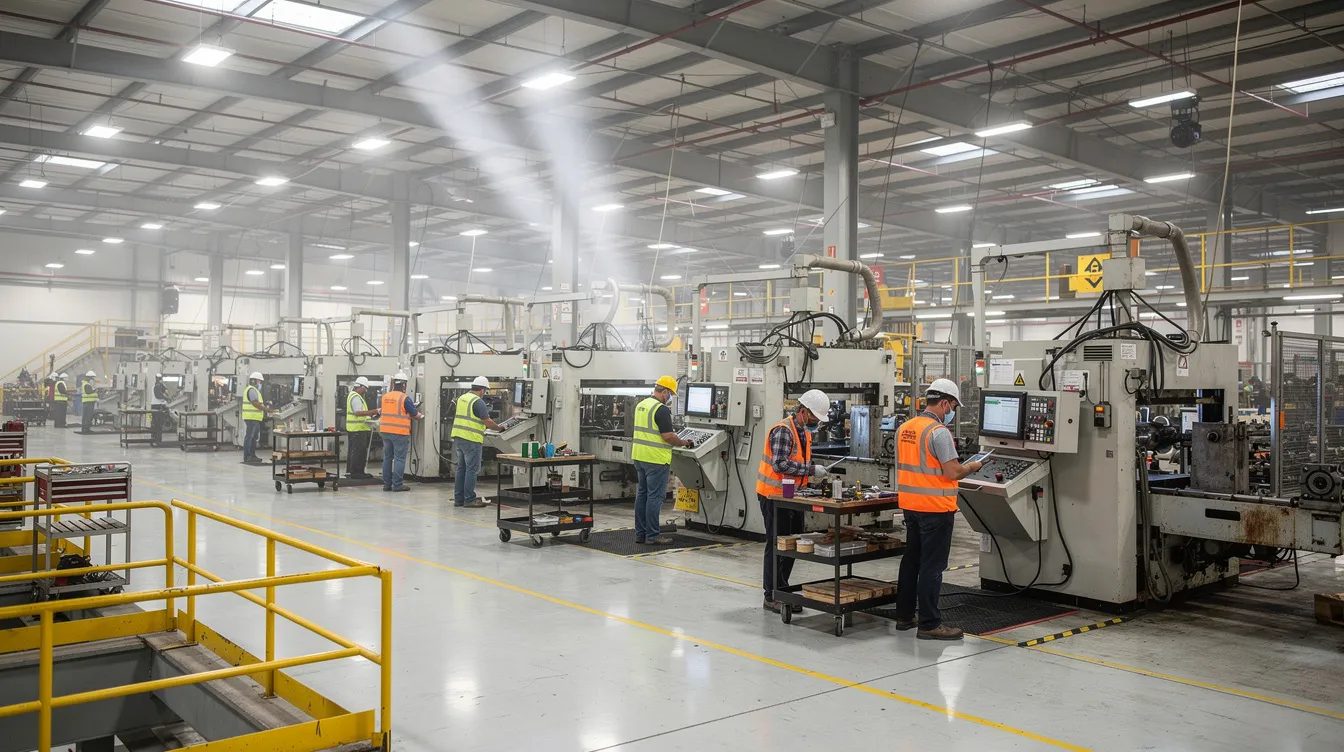
How Project Delays Affect Financial Projections and Investor Returns
Time overruns alter key financial metrics directly. Scenario analysis helps measure project risk in finance by quantifying the impact of schedule slippage on project cost, cash flows, and returns. Scenario analysis also helps measure project risk over its lifetime by testing multiple delay and cost-escalation assumptions.
Construction delays increase lenders’ interest rates on loans and raise total project cost through accumulated interest during construction. Consider a hypothetical ₹20 crore manufacturing project:
Assumptions: ₹8 crore equity, ₹12 crore term loan at 10% interest rate, 12-month construction, expected EBITDA margin 25% on projected annual revenue of ₹16 crore.
Table 4: Impact of Six-Month Delay on Financial Performance
| Financial Parameter | Original Scenario | Delayed Scenario (6 months) | Investor Implication |
|---|---|---|---|
| Total project cost | ₹20.00 crore | ₹21.10 crore (higher IDC + pre-operative expenses) | Additional equity or cost-cutting needed |
| Interest during construction | ₹0.60 crore | ₹1.15 crore | Increases project cost; affects balance sheet |
| First-year EBITDA | ₹4.00 crore (full year) | ₹2.00 crore (half year of operations) | DSCR falls below comfort level |
| DSCR (Year 1 of operations) | 1.45× | 0.95× | Lender covenant breach; may require restructuring |
| Equity IRR (10-year) | ~22% | ~17% | 500 bps reduction; may fall short of investor hurdle rate |
| Payback period | ~5.5 years | ~6.5+ years | Longer capital lock-in; weaker exit prospects |
| Additional equity required | Nil | ₹0.80–1.10 crore | Promoter dilution or funding gap |
The ongoing costs during the delay period – staff salaries, rent, maintenance, security, insurance – accumulate without revenue. The planned means of finance gets disturbed. The promoter may need to bring in more capital than originally expected, affecting the deal terms.
Promoters should present delay sensitivities transparently using professional financial projections for equity investors. Dynamic scenario analysis and stress testing are now standard requirements for serious equity funds. For complex projects, financial projections and financial modelling services can help promoters build models that provide a complete picture of downside scenarios.
Why Equity Investors Demand Stronger Project Due Diligence
Investors require deep due diligence to uncover potential risks before committing capital. Manufacturing due diligence assesses production operations before transactions, covering legal, technical, financial, tax, and regulatory aspects. The due diligence process typically takes 60 to 90 days, and diligence teams examine every material assumption in the DPR and business plan.
The stakes are high: research indicates that 70-90% of M&A deal failures are due to due diligence lapses. Technical due diligence reduces manufacturing acquisitions failures by 70-90% when conducted rigorously. Technical due diligence evaluates operational risks and compliance status, including whether the promoter holds relevant certifications – ISO 9001 and ISO 14001 certifications indicate quality management standards that investors value.
Core due diligence focus areas include:
- Land documentation and title verification to verify ownership
- Statutory approval status and regulatory compliance
- Building and layout plans with engineering specifications
- Machinery specifications, quotations, and equipment condition assessment
- Project cost, means of finance, and detailed analysis of financial statements
- Promoter contribution track record and financial capacity
- Financial projection assumptions – sales volume, pricing, raw material cost, interest rate, margin of safety
Investor Due Diligence Checklist (Summary):
- ☐ Certified land records and encumbrance certificates
- ☐ Sanctioned building plans and layout approvals
- ☐ Key licences applied for or received (CTE, factory licence, FSSAI)
- ☐ Detailed project schedule (Gantt chart) with contingency
- ☐ Signed term sheets or sanction letters from lenders
- ☐ Audited financial statements of the promoter entity
- ☐ ISO or quality certifications where applicable
- ☐ Environmental site assessment reports
When documents are incomplete, inconsistent, or outdated – when inadequate financial information is the norm – investors slow down their decision, order deeper investigations, or seek stronger protections. Fragile corporate governance can deter investors from moving forward with investments entirely. Investors want to ensure a clear exit strategy before committing capital, and incomplete documentation makes exit planning difficult.
A detailed view of information typically requested by equity funds is available in the investor due diligence checklist in India.
Investor Funding Conditions – Why Equity May Be Released in Stages
Many investors avoid releasing equity as a lump sum. Instead, they follow a milestone-based or tranche-based funding structure – especially where the project has not yet been fully funded, constructed, or approved.
Effective risk allocation among stakeholders is crucial for project success. Common conditions precedent include:
- Clear land title registered in the project company’s name
- Minimum promoter equity infused before the investor’s first tranche
- Loan sanction letters from banks confirming project finance availability
Conditions subsequent may include obtaining specific minor approvals or completing technical certifications within defined timelines after the initial equity release.
A typical single-round versus phased equity funding structure for a manufacturing project might look like:
- Tranche 1 (25%): On land registration, initial approvals, and promoter equity contribution
- Tranche 2 (35%): On financial closure with lenders and commencement of civil works
- Tranche 3 (40%): On delivery of main machinery and readiness for installation
Investors may wait for startups or project companies to achieve specific operational milestones before investing further tranches. This staged approach protects investors from major downside events while giving the project adequate capital to proceed.
Promoters must review commercial terms carefully and watch for overly restrictive or one-sided clauses. Understanding equity investment term sheet red flags is important, and promoters should know when to reject an equity investor offer if conditions are commercially unreasonable.
How Promoters Can Reduce Project Execution Risks Before Approaching Investors
Promoters should complete these preparatory steps before entering serious equity discussions:
- Complete land legal due diligence – obtain updated encumbrance certificate, verify the full chain of title, and settle any disputes
- Obtain land conversion (agricultural to industrial, where applicable) before investor discussions
- Prepare a regulatory approval matrix with realistic timelines for each applicable licence
- Finalise technical feasibility – identify technology suppliers, obtain machinery quotations, confirm production processes
- Lock in an implementation schedule with buffer for monsoon, supply chain disruption, and local conditions
- Prepare a detailed cost estimate with contingency provisions for price escalation (steel, cement, labour)
- Map working capital needs – inventory holding, receivables cycle, creditor terms
- Perform sensitivity analysis on DSCR, project IRR, and equity IRR for cost overruns and schedule slippage
- Prepare a professional DPR with scenario analysis covering concentration risk (single customer or supplier dominance) and interest rate changes
- Engage early with banks for in-principle term loan sanction – this establishes that project finance debt is achievable and the strategy for means of finance is realistic
- Document risk mitigation strategies for each key risk identified in the project
- Seek independent validation through professional project feasibility study services to confirm technical, commercial, and financial viability
Independent assessments improve operational capabilities and investment confidence. Promoters who establish a credible project foundation before approaching investors significantly reduce the probability and duration of funding delays.
Role of an Investor-Ready DPR in Reducing Funding Delays
An Investor-Ready DPR is more than a bank loan report. It is tailored to address the specific questions equity investors ask about land, licences, implementation, project risk, and expected returns.
Core components should include:
- Project background and promoter profile
- Land and infrastructure status with ownership details and possession documentation
- Manufacturing process and technology description
- Detailed project cost and means of finance
- Implementation schedule with milestones
- Regulatory approval matrix with status and timelines
- 5–10 year financial projections with sensitivity analysis
- Risk analysis covering interest rate changes, delay in commissioning, raw material price volatility, and environmental factor-driven capex
Projects with strong risk management have higher financing success rates. A well-structured DPR allows deal teams and diligence teams to quickly evaluate the planned investment, reducing friction and accelerating decision-making.
However, an Investor-Ready DPR supports faster and more confident investor evaluation – it does not replace independent legal, technical, or environmental due diligence, which institutional investors will still conduct. Promoters who need structured support can review the Investor-Ready DPR checklist for equity funding or explore Investor-Ready DPR and fundraising assistance.
When Should a Promoter Delay Fundraising Until Project Risks Are Resolved?
Timing matters. Approaching serious investors too early – when key risks remain unresolved – often leads to rejection, lower valuations, or negative market feedback that makes subsequent fundraising harder. A valuation disconnect often causes investors to postpone investing, and premature outreach can establish an unfavourable reference point.
Material unresolved risks that typically justify postponing investor outreach:
- Major land disputes or unclear title affecting the core project site
- Highly uncertain environmental clearance (e.g., pending appeal or public hearing objections)
- Absence of basic techno-economic feasibility or detailed analysis
- Unrealistic project timelines not aligned with statutory approval cycles
Manageable uncertainties that investors can typically price in:
- Minor pending licences that are procedural (e.g., trade licence, DG set installation)
- Small variations in machinery cost within normal contingency range
- Typical project execution slippage for which contingency has been built into the DPR
Promoters should perform a structured self-assessment using the readiness checklist before scheduling investor meetings. Understanding why equity investors reject business proposals can help promoters avoid the cost of approaching the market prematurely.
Pre-Investment Project Readiness Checklist for Manufacturing Promoters
Before preparing an investor presentation, promoters should be able to confirm the following:
Land and Infrastructure:
- ☐ Land title documents compiled and vetted by a legal professional
- ☐ Land use and zoning confirmed for proposed manufacturing operations
- ☐ Possession secured or clear timeline for handover documented
- ☐ Access road and utility corridor confirmed
Regulatory and Statutory:
- ☐ Key statutory approvals mapped with indicative timelines
- ☐ Preliminary discussions with regulatory consultants or state single-window portal completed
- ☐ Environmental clearance applicability determined; application filed if required
Technical and Execution:
- ☐ Machinery suppliers identified with budgetary quotations
- ☐ Basic plant layout and utilities planning completed
- ☐ EPC contractor or construction strategy planned
- ☐ Implementation schedule prepared with realistic buffers
Financial and Risk:
- ☐ DPR drafted or under preparation with realistic assumptions
- ☐ Financial projections completed with scenario analysis for delays, cost escalation, and interest rate changes
- ☐ Project cost and means of finance (equity, term loan, working capital) clearly planned
- ☐ Promoter contribution sources identified and documented
- ☐ Project risk analysis documented covering environmental factors, concentration risk, regulatory compliance, and key risks
If several high-impact items remain unticked, promoters should complete them – possibly with professional advisory support – before actively pursuing equity conversations.

Professional Assistance for Investor-Ready Manufacturing Projects
CA Manish Gugliya, FCA, DISA (ICAI) is a practising Chartered Accountant with over 20 years of experience advising Indian entrepreneurs and industrial promoters on DPR preparation, project finance, CMA Data, feasibility studies, business valuation, and investor-ready documentation.
Project Report Bank supports promoters through:
- Customised Investor-Ready DPR preparation addressing land, licences, and execution readiness
- Project feasibility analysis combining technical and financial perspectives
- Project cost and means-of-finance assessment with realistic assumptions
- Detailed financial projections and sensitivity analysis for investor evaluation
- Structured planning of implementation milestones and funding requirements
The role is advisory – helping promoters prepare professionally for bank finance and equity investment, not promising direct investor introductions or guaranteed funding approvals.
Planning a manufacturing or industrial project requiring substantial equity investment? Before approaching investors, ensure that your project economics, funding requirements, implementation assumptions, and material execution risks are properly evaluated. Contact CA Manish Gugliya through ProjectReportBank.com to discuss Investor-Ready DPR and fundraising assistance, project feasibility, and financial modelling requirements.
Promoters still evaluating basic viability should consider professional project feasibility study services before committing major capital or entering investor negotiations.
Frequently Asked Questions
Do equity investors ever fund projects before land is fully registered in the company’s name?
While some early-stage or strategic investors may accept land acquisition risk in special situations, most institutional investors in Indian manufacturing expect at least clear documentation – a registered agreement to sell, an allotment letter from the industrial authority, or SPV ownership – before disbursing substantial equity. Many investors will sign definitive agreements subject to land-related conditions precedent, but actual drawdown awaits satisfactory proof of title and possession.
How do interest rate movements affect investor views on project execution delays?
When execution delays coincide with rising interest rates on term loans or working capital, total financing cost increases and DSCR weakens. This makes investors more conservative about additional equity commitments. Promoters should include interest rate sensitivity in their financial models and openly discuss mitigation strategies – such as fixed-rate loans where possible, higher contingency provisions, and faster completion schedules – with prospective investors.
Can a strong market opportunity compensate for weak land and licence readiness?
For manufacturing and capital-intensive projects, unresolved land and statutory issues are typically non-negotiable. Even excellent demand prospects cannot fully offset the risk of legal or regulatory shutdown. Promoters should treat market attractiveness and project readiness as complementary pillars of investment attractiveness – not interchangeable. A clear understanding of both is essential for a credible investment proposition.
How is project risk different from normal business risk in the eyes of equity investors?
Project risk relates primarily to getting the plant built, approved, and commissioned on time and within cost – covering land, licences, construction, machinery, and utility connectivity. Normal business risk relates to demand, pricing, competition, and ongoing operations after the plant is running. Investors often sequence their evaluation: first ensuring project execution risk is manageable, and only then focusing on long-term competitive advantage, customer mix, and dominant position potential in the target market.
Is it necessary to have a signed term loan sanction before approaching equity investors?
While it is not always mandatory, having an in-principle or final sanction from lenders significantly strengthens the project’s credibility and reduces uncertainty around the means of finance. In some transactions, investors help negotiate debt terms after committing, but they still expect realistic debt assumptions and evidence that the project meets conventional bank appraisal norms. Projects that rely entirely on investor capital without a credible debt strategy tend to face harder scrutiny and are less likely to attract institutional investing interest.