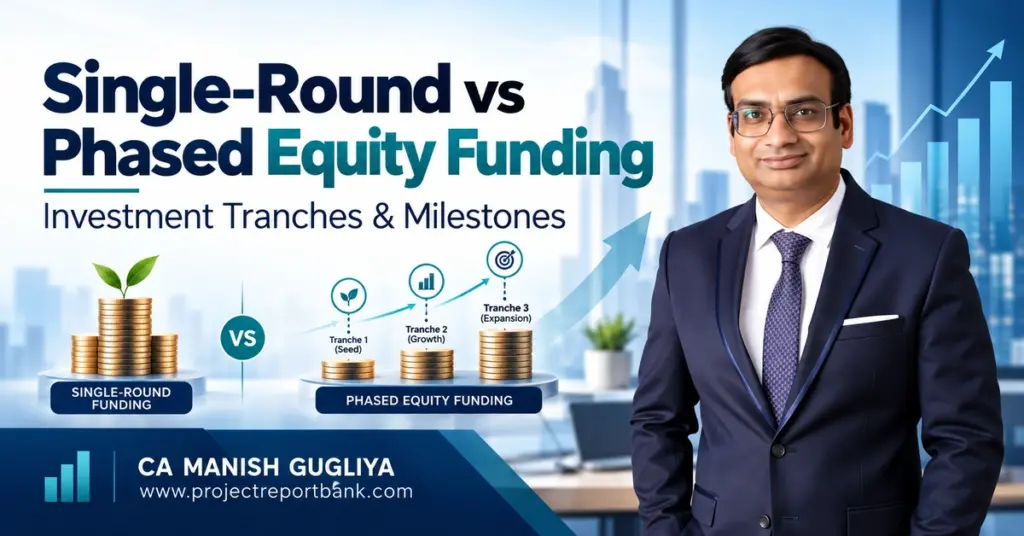
Single-Round vs Phased Equity Funding: Which Is Better for Indian Project Promoters?
Deciding how much equity to raise is only half the challenge. Equally important is deciding how and when that equity capital will flow into your project. For Indian promoters planning manufacturing units, capacity expansions or capital-intensive ventures in the ₹5–15 crore range and above, the choice between receiving the entire equity amount upfront or structuring it across milestone-linked tranches can materially affect project liquidity, investor relationships, valuation outcomes and even whether the project gets completed on schedule.
Single round vs phased equity funding represents two fundamentally different approaches to the same capital raising goal. In single-round equity funding, the investor subscribes to the full equity quantum at one go – the money arrives shortly after signing, and the promoter has complete capital certainty from day one. In phased equity funding, the investor makes one overall commitment but releases capital in defined tranches, each conditional upon the promoter achieving pre-agreed investment milestones such as completing land acquisition, commissioning machinery, or reaching a specified production threshold.
The timing and structure of equity infusion can be as important as the total quantum itself. A ₹10 crore equity commitment means little if ₹4 crore is stuck behind a disputed milestone while your machinery supplier demands payment. Conversely, ₹10 crore sitting idle in a current account for 14 months while civil construction progresses slowly represents inefficient capital deployment and unnecessary opportunity cost.
The short answer: Single-round equity funding is generally better for time-sensitive, execution-ready projects where the promoter has a strong track record, technology is proven, and lenders require full equity at financial closure. Milestone-based phased equity funding suits higher-risk, multi-stage projects with long implementation schedules – provided the investment commitment is contractually watertight, milestones are objectively defined, and tranche timing aligns with actual project cash outflows.
What Is Single-Round Equity Funding?
Single-round equity funding is an investment structure where the investor commits and disburses the full equity amount in one event. The total share subscription is paid at or near the signing of definitive agreements, after satisfying standard conditions precedent. The valuation, equity stake and capital quantum are all determined at a single point in time.
This may be the first institutional round – from a private equity firm, strategic investor, family office or angel investors – even if independent future funding rounds (Series A, Series B, etc.) may follow later. The defining characteristic is that the equity quantum under consideration in this particular commitment is delivered upfront, not phased.
Practical advantages for promoters:
- Immediate capital availability eliminates dependency on future tranche approvals
- Faster project roll-out, especially when capturing a subsidy window or market opportunity
- Simpler documentation – one share allotment, one set of filings with ROC
- Clear equity dilution and valuation determined at one point, with no re-pricing risk
Limitations to consider:
- Risk of idle cash during long construction or implementation periods (12–24 months)
- Weaker utilisation oversight from the investor’s perspective after disbursement
- Temptation for promoters to divert funds or over-order without phased discipline
- Potential mismatch between capital availability and actual capex schedule
Consider a ₹20 crore dairy processing plant where the investor brings ₹8 crore upfront to match the bank’s term loan disbursement and satisfy the lender’s equity contribution requirement at financial closure. The promoter gains full certainty and bargaining power with vendors, but ₹3–4 crore may remain underutilised for the first 8–10 months while civil work progresses.
- Even in single-round equity investment, detailed planning of capital expenditure and working capital remains essential to ensure funds are deployed efficiently across project phases.
What Is Phased Equity Funding?
Phased equity funding is a structure where the investor agrees to a total equity commitment and valuation framework upfront, but disburses the capital in multiple tranches. Each tranche release is conditional upon the promoter achieving specific, pre-agreed investment milestones – operational, financial, regulatory or construction-related targets that signal meaningful project progress.
It is critical to distinguish this from multiple independent funding rounds (seed funding, Series A, Series B, series C funding). In phased equity funding under one commitment, the total capital quantum and valuation mechanism are defined in a single Share Subscription Agreement (SSA) and Shareholders’ Agreement (SHA). The investor is contractually committed to the full amount; only the timing of disbursement is staged. In contrast, separate future rounds involve independent negotiations, potentially different investors, and fresh valuations each time.
Key terminology: the individual portions are called tranches, the conditions are called milestones or conditions precedent for tranche release, and the overall arrangement is sometimes described as milestone based funding, staged equity investment or equity capital disbursement in phases.
Common structural features:
- Pre-agreed total commitment (e.g. ₹10 crore across 3–4 tranches)
- Scheduled tranche percentages (e.g. 20%–30%–30%–20%)
- Objective conditions precedent for each tranche (statutory approvals, construction completion, machinery delivery)
- Verification and reporting requirements – utilisation certificates, site inspections, progress reports
Benefits for the promoter:
- Reduced idle cash – funds arrive closer to when they are actually needed
- Higher investor comfort, especially for early stage companies or first-generation promoters
- Better alignment of equity infusion with actual capex stages
- Potential to negotiate investor value-add (mentorship, industry connections, strategic support) alongside funding
Benefits for the investor:
- Capital deployed in line with risk reduction – the first tranche carries highest risk, subsequent tranches only if project demonstrates measurable progress
- Better visibility through structured reporting and utilisation controls
- Ability to pause or restructure if serious project deviations emerge
Startups benefit from phased funding when the business model is unproven, and they need to test assumptions. A well-known example is the Unacademy seed round, which was raised in three tranches: ₹50 lakh at signing, ₹50 lakh upon reaching 50,000 users, and ₹1 crore upon achieving ₹5 lakh in monthly revenue – each tranche tied to a specific measurable milestone. Similarly, investor-studio models like HyKr invest ₹2–4 crore per company and release equity in milestone-linked tranches tailored to stage and risk.
- A phased investment strategy must still ensure firm contractual commitment so that the promoter is not left with partial equity and an unfinished plant. Without binding obligations, phased funding can leave the promoter dangerously exposed.
Single-Round vs Phased Equity Funding – Key Differences at a Glance
Both structures can work for Indian projects, but they diverge across several decisive dimensions. The comparison below captures the practical differences that matter most when evaluating funding options for manufacturing, expansion or capital-intensive ventures.
| Factor | Single-Round Equity Funding | Phased Equity Funding (Milestone-Based) |
|---|---|---|
| Timing of equity infusion | 100% upfront at or near signing | 2–4 tranches over 12–24 months |
| Nature of investor commitment | Full capital disbursed immediately | Full capital committed but released conditionally |
| Cash flow impact | Large cash buffer from day one; risk of idle funds | Capital arrives as needed; risk of cash crunch if tranche delayed |
| Valuation & dilution | Fixed at one point; dilution determined upfront | Typically fixed upfront for all tranches; some structures allow re-pricing |
| Investor control & oversight | Relies on board rights and reporting; limited tranche leverage | Active milestone verification gives investor structured checkpoints |
| Documentation complexity | Single share allotment; simpler compliance | Multiple allotments; requires ROC filings and Board resolutions per tranche |
| Implementation risk allocation | Promoter bears execution discipline; investor has limited interim exit points | Investor can pause deployment if milestones missed; promoter must perform to unlock capital |
| Suitability | Short-duration, high-certainty projects; experienced promoters | Multi-stage greenfield projects; longer timelines; higher regulatory or technology risk |
| Distinction from multiple rounds | One round, one commitment, one disbursement | One round, one commitment, multiple disbursements (not separate rounds like Series A, B, C) |
Phased equity funding reduces idle cash and investor risk but can create execution challenges if milestones or documentation are not designed carefully. Single-round equity funding maximises certainty and speed but demands stronger internal capital discipline from the promoter.
Decisive Factor 1: Capital Availability, Cash Flows & Runway
Projects fail not just due to lack of capital, but due to receiving capital at the wrong time. The timing of equity infusion directly affects whether a promoter can meet vendor payment deadlines, service pre-operative expenses and maintain a working capital buffer during construction and early operations.
Single-round funding provides maximum certainty. The full equity sits in the company’s account from the start, allowing the promoter to schedule expenditures, negotiate better terms with contractors and handle unexpected delays without waiting for tranche approvals. The downside: if the project spends ₹10 crore over 18 months but receives all funds at month zero, a significant portion earns minimal interest in a bank account while the promoter’s effective cost of equity remains high. Single Round Equity Funding provides a large cash buffer for long-term planning and scaling, but capital efficiency suffers.
Phased equity funding improves capital efficiency by releasing funds closer to when they are actually consumed. However, it introduces liquidity risk. If milestone confirmation takes 6–8 weeks due to documentation reviews, site inspections or interpretation disputes, the promoter may face a cash crunch at precisely the moment heavy payments fall due – machinery down payments, contractor bills, or working capital for trial runs. Milestone-based funding reduces risk of premature cash depletion, but only if tranche timing genuinely matches the expenditure schedule. Raising phased funding helps startups limit the capital commitment to only what is needed for each stage.
Understanding when to raise equity funding and how to plan cash runway is essential before committing to either structure.
Winner: Single-round funding wins on capital certainty and liquidity comfort. Phased equity wins on capital efficiency. The trade-off is real: promoters with disciplined financial management can benefit from upfront funding, while those in longer-gestation projects may prefer staged infusions – provided contingency buffers are built into the plan.
Decisive Factor 2: Project Implementation Risk & Control
Implementation risk is especially acute in greenfield manufacturing projects. Land acquisition can stall for months. Statutory approvals – pollution control board clearances, factory licences, electricity connections – follow unpredictable timelines. Machinery delivery and installation may be delayed by import procedures, customs or shipping disruptions. Each of these dependencies sits outside the promoter’s direct control.
Single-round funding places primary reliance on the promoter’s discipline and bank monitoring to ensure funds are utilised as planned. The investor, having already disbursed the full amount, has limited leverage beyond board-level governance and contractual reporting obligations. If the project derails, the investor’s capital is already deployed.
Phased equity funding gives the investor structured checkpoints to mitigate risk. If land approvals are delayed or construction quality is poor, the investor can withhold the next tranche until the issue is resolved. This protects the investor’s capital and incentivises the promoter to maintain execution discipline. Investors can monitor progress through predefined milestones, and milestone-based funding aligns investor confidence with startup progress.
However, this control mechanism can itself create problems. Contractors and suppliers may hesitate to commit resources if they know equity tranches are uncertain. Banks may require proof of committed future equity before sanctioning full term loan limits. Phased funding allows adaption to high market risk and testing of critical assumptions before significant investments, but it can make third parties nervous.
Winner: Phased equity is generally better where implementation risk is high and there is time to verify milestones. Single-round funding wins when quick execution capability exists and the promoter’s track record gives investors confidence to deploy capital upfront.
Decisive Factor 3: Valuation, Equity Dilution & Negotiating Power
Valuation and equity dilution are central to every promoter’s decision. The way equity is structured – single tranche or multiple – directly affects how much ownership the promoter retains.
There is an important distinction to understand. In phased equity funding under a single agreement, the valuation and total committed amount are typically locked in from the start. Whether the investor pays ₹10 crore in one shot or four tranches, the agreed percentage stake can remain identical if the SSA specifies a fixed valuation for all tranches. The number of tranches alone does not automatically increase dilution.
However, some phased structures include conditional valuation adjustments. The NISM milestone valuation framework illustrates this: in a ₹30 crore total commitment, the first tranche of ₹12 crore might be priced at a ₹60 crore pre-money valuation, while the second tranche of ₹18 crore is priced at ₹150 crore pre-money if milestones are met – or ₹90 crore if they are not. The resulting investor stake: approximately 25.6% if milestones are achieved versus 30.56% if they are missed. Phased Equity Funding allows for valuation growth with each subsequent tranche of funding, but milestone failure can increase promoter dilution because the second tranche is priced less favourably.
This contrasts with separate future fundraising rounds (Series A, Series B), where each round involves fresh negotiation, new investors potentially, and independent valuation. If early valuations are low, multiple fully priced future rounds can dilute significantly. Phased funding is preferable when a startup expects its valuation to increase after milestone achievements, because the upside can be captured within the same committed arrangement.
For deeper analysis of how shareholding patterns, business valuation and equity dilution interact, promoters should model cap tables under both scenarios before signing.
Winner: For clarity and predictability of dilution, a well-drafted phased structure with fixed valuation wins. For promoters confident of strong performance who want to re-price at higher valuations later, independent future rounds may offer more upside – but with correspondingly more uncertainty and negotiation effort.
How Investment Tranches and Milestones Work in Practice
The mechanics of milestone based equity funding revolve around one central document structure: the investor signs a Share Subscription Agreement (SSA) and Shareholders’ Agreement (SHA) – sometimes combined as an SSHA – committing the total capital. The agreement specifies the tranche schedule, conditions precedent for each release, verification requirements and consequences of non-achievement.
Typical structure:
- Signing date: SSA/SHA executed, first tranche conditions precedent listed (e.g. regulatory approvals, board resolutions, Articles of Association amendments)
- First tranche release: Upon satisfaction of initial CPs – typically within 15–30 days of signing
- Subsequent tranches: Each tied to objective milestones with defined timelines (e.g. “Tranche 2 released within 15 working days of investor receiving evidence that civil construction has reached plinth level”)
- Final tranche: Often linked to commissioning, trial production or initial capacity utilisation
Conditions precedent are specific requirements that must be fulfilled before a tranche is released – such as production of invoices, CA-certified utilisation certificates, site inspection reports or statutory approval copies. Conditions subsequent are obligations that must be satisfied after tranche release – such as filing allotment returns with ROC or delivering share certificates.
Common verification mechanisms:
- CA-certified utilisation certificates showing how previous tranche funds were deployed
- Progress reports with photographic evidence of construction or installation
- Third-party site inspections by investor-appointed engineers or consultants
- Bank statements confirming expenditure patterns
- Purchase orders, invoices and delivery receipts for major equipment
Designing robust reporting and controls is critical. Guidance on structuring investor capital deployment and fund utilisation controls can help both promoters and investors agree on practical, workable verification systems.
Although shares may be allotted at each tranche – requiring Board resolutions and ROC filings at every stage under the Companies Act – the commercial valuation and percentage ownership are typically defined in the original agreements, unless the structure explicitly provides for re-pricing.
Investment Milestones for Manufacturing & Industrial Projects
In industrial projects, milestones must be aligned with the actual project implementation schedule and vendor payment terms. Generic milestones borrowed from startup or technology ventures rarely work for manufacturing. Critical milestones should reflect the capital-intensive, approval-dependent, sequential nature of industrial project execution.
Key typical project milestones for manufacturing:
- Land identification, acquisition and registration completed
- Sanction of building plans and key statutory approvals (pollution control board, factory licence, electricity connection)
- Completion of civil construction up to plinth level or superstructure
- Placement of confirmed orders for plant and machinery with down payments made
- Receipt of major machinery at project site
- Installation and erection of machinery completed
- Trial runs and commissioning completed
- Commercial production achieved with specified minimum capacity utilisation (e.g. 40–60% of installed capacity)
These milestones must align with the capital expenditure plan and contractor or supplier payment stages. If the equity tranche for machinery arrives two months after the supplier’s payment deadline, the promoter faces a serious funding gap.
Working capital requirements and initial losses in the first few months of production must also be factored into tranche design. Many promoters underestimate the cash needed to fund raw material purchases, labour costs and overheads before revenue stabilises. Phased Equity Funding keeps founders focused on hitting measurable milestones, but those milestones must include provision for operational ramp-up, not just construction completion.
Banks also release term loan in stages tied to construction and machinery delivery. Equity tranches must coordinate with bank disbursement schedules and subsidy timelines to avoid cash mismatches that can stall the entire project.
Practical Example: ₹10 Crore Equity Funding – Single-Round vs Four Tranches
Consider a hypothetical Indian food processing project with a total project cost of ₹25 crore, funded through a term loan of ₹15 crore and promoter/investor equity of ₹10 crore. The implementation schedule spans 18 months from land acquisition to commercial production.
Option A: Single-Round – Entire ₹10 Crore Upfront
The investor disburses ₹10 crore at financial closure. The promoter has full capital availability from month one.
Option B: Four Tranches – ₹10 Crore Committed, Released Against Milestones
| Tranche | % of Total | Amount (₹ Crore) | Key Milestone | Expected Timing | Primary Utilisation |
|---|---|---|---|---|---|
| 1st | 20% | 2.00 | Land acquired, building plan sanctioned | Month 1–2 | Land, approvals, initial civil work |
| 2nd | 30% | 3.00 | Civil construction completed to superstructure | Month 6–8 | Building completion, utility connections |
| 3rd | 30% | 3.00 | Machinery delivered and installation begun | Month 10–13 | Machinery payment, erection, electrical work |
| 4th | 20% | 2.00 | Commissioning completed, trial production achieved | Month 15–18 | Working capital, initial operations, testing |
Implications compared:
- Option A provides strong liquidity comfort – the promoter never waits for tranche approval. However, ₹6–7 crore may sit in a current or fixed deposit account for 6–10 months, earning modest interest while representing deployed equity with associated return expectations. Founders spend less time fundraising with Single Round Equity Funding, allowing focus on operations.
- Option B improves capital efficiency and gives the investor confidence that funds are being absorbed productively. But if civil construction is delayed by monsoon or the pollution control board clearance takes 4 extra months, the second tranche release stalls – and the promoter may need to make vendor payments from bridge sources or face project interruption.
- Cost overruns are easier to absorb under Option A (surplus funds available) but may require tranche restructuring or additional capital under Option B.
- Working capital projections and cash flow timing should be modelled tranche-wise; financial projections and modelling help both parties agree on realistic schedules and contingency buffers.
In this example, Option B still operates under one valuation and one overall investment round. The multiple tranches do not automatically create separate valuations unless the agreement explicitly includes re-pricing provisions.
Advantages and Disadvantages of Single-Round Equity Funding
Many Indian promoters instinctively prefer a single-round, upfront funding structure because it feels safer and more decisive. That instinct has merit – but the preference needs structured analysis against the project’s specific risk profile.
Advantages for promoters:
- High funding certainty and stronger bargaining power with banks, suppliers and contractors
- Freedom to adjust sequencing of expenditures without renegotiating milestones with the investor
- Reduced administrative work – no tracking of multiple tranche conditions, no repeated verification cycles
- Ability to capture time-sensitive opportunities (subsidy deadlines, equipment availability, favourable exchange rates for imported machinery)
Disadvantages for promoters:
- Pressure to demonstrate disciplined utilisation to maintain investor confidence post-disbursement
- Higher risk of funds sitting idle or being diverted to side projects or non-priority expenses
- Possibility of overestimating project cost and raising more equity than needed, resulting in unnecessary dilution
- Single Round Equity Funding can result in high initial ownership dilution for founders, especially if the business idea is at an early stage and valuation is modest
From the investor’s perspective:
- Easier once-and-done disbursement with simpler administrative tracking
- But weaker utilisation control after funds are released – the investor relies heavily on board governance and periodic reporting
- Greater exposure if the project underperforms or the promoter lacks execution discipline
Single-round equity funding works best when the DPR, capex schedule and management systems are robust, the investor has high trust in the promoter’s track record, and the project timeline is relatively short and predictable.
Advantages and Risks of Milestone-Based Phased Equity Funding
Phased equity funding addresses several of the weaknesses of upfront disbursement, but introduces its own set of challenges.
Advantages:
- Better match between equity infusion and project cash outflows – each tranche funds the next phase of construction or operations
- Encourages disciplined progress and prevents uncontrolled scope changes without investor discussion
- Provides comfort to investors joining higher-risk projects, backing first-time promoters, or providing capital to early stage startups with unproven business models
- Phased Equity Funding reduces risk exposure for investors by committing smaller initial amounts initially, with subsequent capital conditional on measurable progress
- Founders can preserve strategic flexibility by using phased funding to change strategies as they learn about the market
- Startups benefit from a clear roadmap of objectives to achieve through milestone achievements
Risks and challenges:
- Ambiguous or unrealistic milestones causing disputes between promoter and investor – e.g. disagreement over whether “substantial completion” of civil work has occurred
- Potential interruption of construction or operations if tranche release is delayed due to documentation reviews, investor unavailability or milestone interpretation differences
- Bankers and suppliers may insist on proof of committed future equity before extending full credit terms, creating a chicken-and-egg problem
- Inadequate contingency arrangements if costs rise but milestones are not adjusted – the promoter gets squeezed between higher expenses and fixed tranche amounts
- Phased Equity Funding can lead to higher transaction costs due to multiple funding events – legal fees, valuation reports, compliance filings at each tranche
- External dependencies (statutory approvals, supply chain delays) may be beyond promoter control but still block tranche release
Strong documentation, clear quantitative criteria, well-defined cure periods and grace periods help mitigate these risks. Phased funding is typically superior for multi-stage, high-risk, long-gestation projects where the investor needs structured oversight and the promoter benefits from step-by-step capital discipline.
Impact on Business Valuation and Equity Dilution
The relationship between funding structure and dilution is often misunderstood. Many promoters assume that receiving equity in multiple tranches automatically means more dilution. This is not necessarily true.
Fixed valuation, phased disbursement: If the SSA specifies that the investor will receive 25% of the company for ₹10 crore – whether paid in one shot or four tranches – the promoter’s dilution is identical under both structures. The total committed amount and the valuation determine dilution, not the number of tranches.
Conditional valuation with milestone adjustment: This is where dilution risk changes. Consider a structure where:
- First tranche: ₹4 crore at a pre-money valuation of ₹16 crore (investor gets 20%)
- Second tranche: ₹6 crore at a pre-money valuation of ₹30 crore if revenue targets are met (investor gets an additional ~16.7%)
- If revenue targets are missed, second tranche at ₹20 crore pre-money (investor gets ~23.1% additional)
The promoter’s final ownership differs materially depending on milestone performance. This illustrates that milestone failure can significantly increase dilution when the agreement includes conditional re-pricing.
Key lessons for promoters:
- Dilution depends more on valuation and total committed amount than on the number of tranches. A well-drafted phased structure with locked-in valuation preserves promoter ownership just as effectively as a single round.
- Multiple fully priced future independent rounds can dilute significantly if early valuations are low. Each funding round – whether seed funding, Series A or Series B – brings new dilution at potentially different valuations.
- Promoters must model the cap table under both single-round and phased scenarios before signing. Understanding the impact on shareholding pattern, business valuation and equity dilution is non-negotiable before committing to any structure.
In India, startups raised over USD 42 billion in funding last year. Across this dynamic landscape, each funding round is crucial for moving a company to its next growth stage – from pre seed funding through seed stage to Series A and beyond. Seed funding is the first official fundraising round for startups, and seed funding can range from ₹25 lakh to ₹5 crores in India. Series A funding typically raises between $5 million and $15 million. Series B funding is used to expand market reach and infrastructure. Series C funding focuses on scaling and acquiring other companies. Understanding where milestone based funding fits within this progression helps promoters make informed decisions about capital raising strategy.
Investment Agreements, Tranche Conditions & Investor Protection
The legal drafting of definitive agreements is critical when using phased equity funding in India. Poorly drafted milestone definitions or ambiguous tranche conditions are the single most common source of investor-promoter disputes in staged funding arrangements.
Typical agreements and documents:
- Share Subscription Agreement (SSA): Details the total consideration, valuation, share price per tranche, tranche schedule, conditions precedent and representations and warranties
- Shareholders’ Agreement (SHA): Governs ongoing rights, obligations, governance structure, reserved matters, information rights, transfer restrictions and exit provisions
- Ancillary documents: Board resolutions for each allotment, share certificates, filings with ROC under Section 62 (Private Placement), PAS-4 offer letters, PAS-5 private placement records
Key contractual elements for tranche structures:
- Objective, measurable milestone definitions with specified data sources and evidence requirements (e.g. “certified copy of factory licence issued by [specified authority]” rather than “all necessary approvals obtained”)
- Defined timeframes within which the investor must review documentation and either release the tranche or raise specific objections
- Cure periods for minor deviations or delays caused by external factors – e.g. 30–60 days for regulatory delays beyond promoter control
- Default and termination consequences if milestones are not achieved within extended timelines or if capital is materially misused
- Dispute resolution mechanisms – arbitration clauses, expert determination for technical milestones
Investor protection clauses commonly include reserved matters (major decisions requiring investor consent), anti-dilution protections, liquidation preferences, information and audit rights, and utilisation reporting requirements. Understanding what venture capital firms and private equity firms expect in terms of governance is essential for promoters entering these negotiations.
Investors also conduct thorough verification before committing. An investor due diligence checklist helps promoters prepare comprehensive documentation that satisfies both initial and ongoing investor expectations.
While these clauses reflect common Indian practice in venture capital and private equity deals, specific legal structures should always be finalised with qualified legal counsel familiar with the Companies Act, FEMA regulations and applicable tax provisions.
How to Prepare a Phased Equity Funding Plan
Preparing a credible phased equity funding plan requires integrated analysis – not just a rough milestone list. This is where strategic financial planning meets project execution reality.
Preparatory steps:
- Prepare a detailed project implementation schedule with month-wise capex breakdown and key milestones. Every milestone proposed to the investor should correspond to an actual project activity with verifiable outputs.
- Develop a comprehensive Detailed Project Report (DPR) with realistic assumptions on cost, construction phasing, revenue ramp-up and market conditions. An investor-ready DPR must reflect the same funding structure being negotiated – if you are proposing four tranches, the DPR’s cash flow projections must show tranche-wise inflows and corresponding expenditure.
- Build integrated financial projections showing cash flows, debt service coverage ratio (DSCR), term loan drawdown schedule and equity tranche timing under both base-case and stress scenarios. CA-led financial modelling with sensitivity analysis helps both parties agree on realistic and safe tranche schedules.
- Conduct funding gap and contingency analysis to determine what happens if a tranche is delayed by 2–3 months, costs rise by 10–15%, or commissioning takes longer than expected. This analysis should explicitly address promoter contribution, debt-equity mix and funding gaps.
- Plan working capital requirements before finalising the tranche structure. Many promoters design tranches around construction milestones but forget that commercial operations require raw material inventory, labour payments and overheads before revenue stabilises. Working capital planning before equity funding prevents this common oversight.
- Align tranche releases with bank term loan disbursements. Banks also release term loans in stages tied to construction progress. If the equity tranche for machinery arrives in month 10 but the bank expects equity to be fully deployed by month 8, there is a structural mismatch that can delay the entire project.
In my experience, when investors see promoters with credible DPRs, verified vendor quotes, month-wise project implementation schedules and realistic capacity utilisation projections, the perceived milestone risk is lower. Such promoters may even secure more favourable tranche terms – or convince investors to provide a larger first tranche with fewer subsequent conditions.
When Should a Business Choose Single-Round or Phased Equity Funding?
The right choice depends on project risk profile, promoter experience, investor expectations and practical constraints. Here is a decision framework:
Conditions favouring single-round equity funding:
- Project implementation period is short (under 9–12 months) with well-known technology and established suppliers
- Promoter team has a strong track record and the investor has high confidence in execution capability
- Project requires rapid execution to capture a market opportunity, subsidy window or favourable exchange rate for imports
- Banks or financial institutions require full equity contribution upfront for term loan sanction and disbursement
- The business concept is proven and the company has operational history – reducing the need for milestone-based oversight
Conditions favouring phased, milestone-based equity funding:
- Project extends over 18–36 months with multiple regulatory, construction and technical dependencies
- Investor is joining at a relatively early concept or seed stage and wants to de-risk capital deployment progressively
- There is significant uncertainty in final project cost, technology performance or market acceptance
- Promoters want to demonstrate milestone achievements before drawing the full equity – potentially securing higher valuations for later tranches
- The investment involves venture capitalists or private equity firms with structured deployment mandates
Many practical deals use a hybrid approach: a larger first tranche (40–50%) to secure land, begin construction and place critical machinery orders, followed by smaller milestone-linked tranches. This provides the promoter with a solid foundation of capital while giving the investor structured oversight during later phases. Angel investors and early investors often find this balanced approach acceptable for providing capital to ventures where execution risk is moderate but not negligible.
Common Mistakes Promoters Should Avoid
Many funding disputes and project delays arise from avoidable structuring mistakes in the funding process. Based on patterns I observe across industrial project advisory work, promoters should watch for:
- Agreeing to vague or subjective milestones like “substantial progress” or “major approvals obtained” instead of specifiable, measurable criteria with defined evidence requirements
- Underestimating time for statutory approvals – pollution control, factory licence, power connection – leading to repeated extensions and stress with investors who interpret delays as performance failure
- Ignoring working capital requirements and assuming equity tranches will automatically cover initial operating losses, inventory build-up and early-stage cash burn
- Not having backup sources of funds if tranches are delayed – resulting in stalled construction, default with banks or penalty interest on term loans
- Allowing ambiguity in valuation and dilution if future tranches are subject to renegotiation rather than committed pricing
- Failing to align equity infusion schedule with term loan drawdown and vendor payment obligations – creating cash flow gaps that threaten project viability
- Neglecting regulatory compliance for multiple share allotments – each tranche requires proper Board resolutions, ROC filings and adherence to Companies Act provisions
Professional DPR preparation, realistic project planning and comprehensive funding-gap analysis can prevent most of these issues.
Single-Round vs Phased Equity Funding: Which Should You Choose?
No single model is universally superior. The right equity funding structure depends on your project’s risk profile, implementation timeline, promoter experience, investor expectations and the broader debt financing context.
- Choose single-round equity funding if your project has a predictable implementation schedule, your DPR and capex planning are robust, your lender requires full equity upfront for sanction, and you need maximum speed and flexibility to execute without milestone-related interruptions.
- Choose phased equity funding in multiple tranches if your project is high-risk, long-gestation, or dependent on multiple external approvals, and your investor is willing to commit larger capital provided critical milestones are clearly defined and verification mechanisms are objective.
- Run both structures through detailed financial models – tranche-wise cash flows, DSCR projections, IRR calculations and sensitivity analysis for delays and cost overruns – before committing. The numbers will often reveal which structure creates less liquidity stress and better alignment between capital inflows and project expenditure.
- Regardless of the structure chosen, invest in proper documentation. The term sheet, SSA, SHA, utilisation reporting framework and milestone definitions are the foundation that protects both promoter and investor interests.
Frequently Asked Questions on Single-Round vs Phased Equity Funding
These FAQs address common practical doubts from Indian promoters and investors evaluating equity funding structures for their projects.
1. What is phased equity funding in India?
Phased equity funding means one overall equity commitment, agreed at a defined valuation, disbursed in multiple tranches based on the promoter achieving pre-specified milestones. It differs from separate independent funding rounds (seed funding, Series A, Series B), where each round involves fresh negotiation and potentially different investors and valuations. In phased funding, the commitment is binding under one agreement.
2. Can an investor release equity investment in multiple tranches under a single agreement?
Yes, this is common practice in Indian private equity and venture capital transactions. The SSA defines the total subscription amount, tranche schedule, conditions precedent for each release and share allotment mechanics. Shares are allotted at each tranche as per the agreed terms, with proper Board resolutions and ROC filings completed at every stage.
3. Is milestone-based phased funding better than upfront single-round equity funding?
Neither is inherently better. Phased funding offers superior risk control and capital efficiency – milestone-based funding releases capital in stages based on achievements, aligning investor confidence with project progress. Single-round funding provides greater certainty and speed, allowing the promoter to focus entirely on execution. The right choice depends on the project’s risk profile, timeline, investor expectations and the promoter’s operational efficiency and track record.
4. Does phased equity funding automatically increase promoter dilution?
Not necessarily. Dilution is determined primarily by the valuation and total committed equity amount. If the SSA specifies a fixed valuation across all tranches, the promoter’s dilution is identical whether ₹10 crore is paid in one instalment or four. Dilution increases only if subsequent tranches are re-priced at a lower valuation due to missed milestones – which is a feature of conditional valuation structures, not of phasing itself.
5. What happens if an investment milestone is delayed or partially achieved?
The outcome depends entirely on the investment agreement. Well-drafted agreements include cure periods (e.g. 30–60 days for external delays), provisions for partial tranche release, investor obligations to respond within defined timeframes, and dispute resolution mechanisms. Promoters should negotiate clear, objective milestone definitions and ensure fallback planning for scenarios where external dependencies – such as regulatory approvals or supply chain delays – are beyond their control.
6. How should manufacturing projects plan equity tranches with banks and term loans?
Tranche planning must align with bank term loan disbursement conditions, vendor payment schedules and working capital needs. Banks release term loans in stages tied to construction progress and equity contribution milestones. If the bank expects equity to be fully deployed before releasing a tranche of debt, the equity release schedule must accommodate this. Detailed DPR preparation and tranche-wise financial modelling are essential for avoiding timing mismatches.
7. Can a single investment commitment involve multiple share allotments over time?
Yes. This is standard practice in phased equity funding. Shares are allotted at each tranche release, with each allotment requiring Board resolution, shareholder approval where applicable under Section 62 (Private Placement), PAS-4 offer letters, PAS-5 records and filings with the Registrar of Companies. The valuation and total stake are governed by the original SSA/SHA, ensuring consistency across allotments.
Professional Guidance & Next Steps for Promoters
Designing the right equity funding structure – whether single-round or phased – requires integrated analysis of project cost, implementation schedule, cash flow projections, bank financing conditions and investor expectations. The choice between upfront capital and milestone-based tranches is not merely a financial preference; it is a strategic decision that affects project execution, promoter ownership, investor relationships and long-term profit potential.
As a practising Chartered Accountant with over two decades of experience in industrial project advisory, I work with promoters to develop customised DPRs, conduct funding-gap analysis, build tranche-wise cash flow projections, prepare sensitivity-tested financial models and create investor-ready documentation that clearly reflects the proposed equity funding structure. Whether you are evaluating a single-round investment for a brownfield expansion or negotiating milestone-based phased funding for a greenfield manufacturing project, professional financial analysis strengthens your negotiating position and reduces the risk of structural mismatches.
If you are a serious promoter planning to raise capital for a manufacturing, processing or industrial expansion project, I invite you to contact Project Report Bank via the website or WhatsApp for investor-ready DPR preparation, financial projections, feasibility assessment and equity funding documentation. You can also explore our Investor-Ready DPR & Fundraising Assistance services for further details.
Professional preparation does not guarantee funding – but it ensures that when the right investor evaluates your project, the numbers, structure and documentation reflect the rigour and clarity that credible investors expect.
Author: CA Manish Gugliya, FCA, DISA (ICAI) Website: www.projectreportbank.com