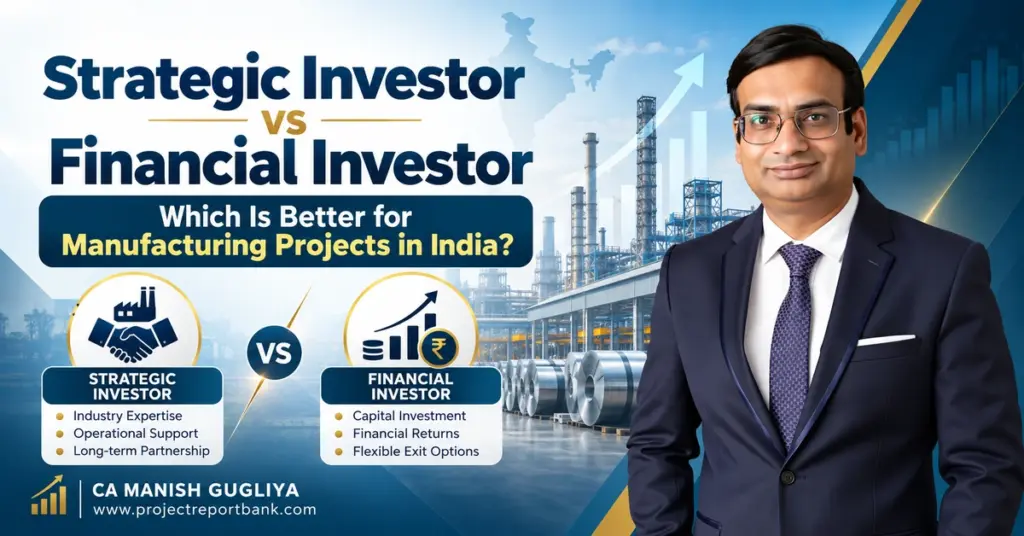
Introduction: Strategic Investor vs Financial Investor – The Verdict First
Selecting the right equity investor for a manufacturing project is often as consequential as securing the capital itself. The investor you bring onto your cap table will shape not only your ownership structure but also your technology roadmap, customer relationships, governance framework, exit options and long-term scalability. For Indian manufacturing promoters evaluating projects in the ₹5–100 crore range, the choice between a strategic investor and a financial investor is rarely straightforward – and getting it wrong can constrain growth for years.
A strategic investor is an operating business – a corporate, OEM, technology provider, key customer or supplier – that invests equity for both financial return and direct business advantage such as supply chain security, market access or technology localisation. A financial investor – a private equity fund, venture capital firm, family office, HNI or AIF – invests primarily for risk-adjusted financial returns and a defined exit within a set timeframe. For most manufacturing projects, a financial investor offers cleaner, more flexible capital suited to independent growth; a strategic investor is the better fit when clear industrial synergy, proprietary technology or assured demand is central to project viability.
Which type suits your project depends on how you weigh control, technology needs, market access and exit expectations – not only on who offers the highest business valuation. As a practising Chartered Accountant with over two decades of experience in project finance and feasibility analysis, I help manufacturing promoters at Project Report Bank evaluate these trade-offs through investor-ready DPRs, financial modelling and structured advisory support.
What Is a Strategic Investor in an Indian Manufacturing Context?
A strategic investor is an entity already engaged in a related operating business – manufacturing, distribution, technology development or supply chain management – that takes an equity stake in your company to unlock synergies beyond pure financial returns. Unlike a passive capital provider, a strategic buyer typically has a commercial rationale: securing a reliable supplier, entering new markets, localising technology, achieving backward or forward integration, or sharing production capacity.
Common strategic investor profiles in Indian manufacturing include large Indian industrial corporates, multinational OEMs seeking India-based component suppliers, global manufacturers pursuing China+1 diversification, major customers wanting supply-chain control, and technology licensors looking to participate in domestic production economics. Strategic investors often consider secondary financial impacts secondary to broader strategic value – they invest to strengthen their core business strategy.
It is important to distinguish a true strategic equity investor from an ordinary commercial counterparty. A customer placing large orders or a supplier offering favourable terms is not the same as a corporate partner holding minority equity, sitting on your board and sharing governance rights. Strategic investments often come with commercial agreements attached – offtake contracts, technical collaboration arrangements, licensing deals, tolling agreements or raw-material supply commitments – alongside equity or compulsorily convertible instruments.
Key Characteristics of Strategic Investors
Strategic investors bring a distinct set of behaviours and expectations to the table. Here are the defining traits promoters should understand:
- Long-term industry alignment over pure IRR. Strategic investors aim to acquire long-term operational synergies and proprietary technology. They may accept moderate financial returns if the partnership secures capacity, supply or market entry over a 10+ year horizon – functioning as patient capital rather than return-maximising funds.
- Focus on synergies and integration. Strategic investors often seek deep operational integration and technology sharing with the startups or manufacturers they back. This can include joint process development, shared quality standards, co-investment in R&D and integrated production planning.
- Influence over product mix, sourcing and markets. They typically seek vetoes or consent rights on decisions that directly affect their strategic interests – which customers you serve, which raw materials you source, and which geographies you sell into.
- Exclusivity requirements. Strategic investors may require exclusivity in certain geographies or product categories, restricting your ability to supply competitors or enter particular markets independently.
- Hands-on operational involvement. Expect technical teams visiting your plant, quality audits aligned to their global standards, joint machinery selection and sometimes direct input into production planning and workforce training.
- Slower decision cycles, deeper commitment. Strategic investors may introduce bureaucracy into decision-making, resulting in slower processes – investment committee approvals may route through global headquarters. However, once committed, they typically provide stable, long-term demand and considerable industry credibility.
- Commercial agreements alongside equity. Working with a strategic investor can provide access to existing customer bases and distribution channels, but the investment is almost always accompanied by offtake agreements, technical assistance contracts or licensing terms that bind both parties commercially.
What Is a Financial Investor for Manufacturing Businesses?
A financial investor – whether a private equity fund, VC fund, family office, HNI or registered AIF – invests primarily for measurable financial returns and a planned liquidity event within a defined timeframe. Financial investors primarily seek high financial returns and liquidity events within a specified timeframe, typically 5–7 years. Their focus is on enterprise value creation: revenue growth, margin expansion, working capital efficiency and a clear exit strategy through IPO, secondary sale, strategic buy-out or promoter buy-back.
Financial investors can still add meaningful value beyond capital. They bring governance discipline, professionalised reporting, corporate finance expertise, network introductions to customers and partners, and board-level guidance on strategy and acquisitions. However, they do not typically demand deep operational integration and rarely bring proprietary manufacturing technology or captive demand.
Financial investors concentrate on financial restructuring and governance oversight, driving the management team toward disciplined execution against agreed milestones. Financial investors typically possess streamlined decision-making processes for faster capital deployment – once a fund’s investment committee approves, capital can flow within weeks rather than months.
Types of Financial Investors Relevant to Indian Manufacturing
- Growth-stage private equity funds: Target profitable, mid-market companies with demonstrated EBITDA and clear scaling potential. These funds often seek 2.5–3× return multiples and net IRR in the mid-to-high teens (~16–18% at APAC level) over a 5–6 year hold period.
- Sector-focused or MSME-focused funds: Specialised vehicles targeting manufacturing verticals – auto components, specialty chemicals, food processing, engineering goods or cleantech. For example, Global South Capital recently set up a manufacturing-focused PE fund with an INR 2.5 billion target, led by a GP with prior industrial deal experience.
- HNIs and family offices: High-net-worth individuals and family investment offices that invest in minority stakes in stable, cash-generating industrial businesses – often with lighter governance expectations and longer time horizons than institutional PE.
- Venture capital funds in hardware, cleantech and EV manufacturing: VC firms backing early stage, technology-driven manufacturing startups where risk is higher but the growth trajectory targets rapid scale – relevant for sectors like EV components, energy storage or AI infrastructure-driven production.
Strategic Investor vs Financial Investor – Detailed Comparison at a Glance
Before diving into factor-by-factor analysis, here is a concise comparison table – a practical reference for manufacturing promoters evaluating both options side by side. The table captures how each investor type typically behaves across the dimensions that matter most for industrial projects.
| Factor | Strategic Investor | Financial Investor |
|---|---|---|
| Main investment objective | Business synergy + financial return; leverage synergies across operations | Primarily financial return; drive growth in enterprise value |
| Expected return & exit horizon | Long-term or outright acquisition; may accept moderate IRR if strategic value is strong | Medium-term (5–7 years); financial buyers aim for high returns within five to seven years |
| Industry/technical expertise | Deep domain knowledge; hands on involvement in plant operations and technology | Broad corporate finance expertise; less manufacturing-specific knowledge |
| Level of operational influence | High – product mix, quality, sourcing, customer decisions | Moderate – financial covenants, reporting, capex discipline |
| Valuation approach | May factor in synergy premium; strategic buyers often pay higher premiums than financial buyers | Formulaic – comparables, DCF, projected multiples; disciplined by valuation multiples and cash flow projections |
| Technology and process support | Often provides proprietary technology, certifications, R&D collaboration | Enables promoter-led technology development through capital and network |
| Impact on supply/offtake relationships | Direct – offtake agreements, supply contracts, distribution access | Indirect – supports diversified customer and supplier development |
| Reporting & governance expectations | Focused on strategic alignment, quality standards, commercial compliance | Focus heavily on metrics and reporting standards to ensure financial growth; monthly MIS, budgets |
| Flexibility for future fund-raises | May restrict – non-compete, ROFR, exclusivity clauses can discourage other investors | Generally structured to allow co-investors, future rounds, and premium exits |
| Conflicts of interest / dependency risk | Higher – pricing pressure, exclusivity, information asymmetry with parent business | Lower – neutral capital, but exit pressure can create tension |
| Suitability: greenfield vs expansion | Strong for greenfield when project directly serves investor’s supply chain | Prefers brownfield/expansion with existing EBITDA; selective on greenfield with strong DPR |
The headline pattern: Strategic investors suit synergy-heavy, technology-dependent manufacturing plays where commercial alignment is central to project viability. Financial investors suit promoters seeking independent growth, operational control and flexibility to build diversified businesses.
Decisive Factor 1: Capital Objectives and Return Expectations
Understanding what your investor expects as return – and over what timeline – is critical because it shapes your project’s capital structure, debt capacity, promoter exit options and even day-to-day operational pressure.
Strategic investors may accept moderate financial returns if the partnership delivers strong strategic benefits – securing raw material supply, locking in production capacity for their products, or entering the Indian market. Investment horizon for strategic investors is usually long-term or outright acquisition. An OEM investing in a vendor to de-risk its supply chain might plan a 10–15 year partnership with returns secondary to supply continuity. Strategic investors expect both financial returns and business benefits, but when forced to rank priorities, the business advantage often wins.
Financial investors operate differently. PE funds in India now demand returns of 25–30% from their investments, with clear milestones for EBITDA growth, margin improvement and timely exit. Financial investors often focus on achieving defined financial milestones within fixed timeframes. A ₹50 crore engineering components project backed by PE would face structured expectations: achieve a certain amount of revenue and margin improvement within 3–4 years and prepare for exit in 5–7 years – whether through IPO, secondary sale or promoter buy-back.
Winner: It depends on your priority. Financial investors win for transparent, well-defined return logic and predictable timelines – ideal for promoters comfortable with execution pressure. Strategic investors win if you prioritise long-term stability, patient capital and commercial assurance over aggressive exit deadlines.
Decisive Factor 2: Control, Governance and Operational Influence
Governance and control rights directly determine how much freedom you retain as promoter – over board decisions, product lines, customer relationships, hiring, capital expenditure and related-party transactions. Getting these terms wrong can mean losing effective control even while holding majority equity.
Strategic investors typically seek vetoes on decisions affecting their supply or market interests – which competitors you can serve, what raw materials you source, quality and process standards your plant must follow, and whether you can bring in other investors. Strategic investors may impose restrictions that limit a startup’s future partnership flexibility. The governance is purpose-driven: they want to protect the commercial rationale that motivated their investment. This can include a right of first refusal on any future sale or new equity issuance.
Financial investors focus more on financial governance: board representation, affirmative vote rights for reserved matters (capex above a threshold, changes in business plan, new debt, related-party transactions), information and audit rights, anti-dilution and transfer restrictions. Financial investors can range from minority to majority stakes focusing on financial governance. Their intervention in commercial decisions is generally lighter – unless the company materially underperforms agreed projections.
In Indian private limited companies, these rights are documented through shareholders’ agreements (SHAs) specifying board seat nominations, reserved matter lists, ROFR/ROFO mechanisms, tag-along and drag-along provisions. The critical difference: strategic investor SHAs often contain commercially restrictive clauses alongside financial governance, while financial investor SHAs focus primarily on protecting investment value and exit rights.
Winner: Financial investors – for promoters wanting maximum operational independence and the freedom to pursue any customer, supplier or market opportunity. Strategic investors are preferable only when you genuinely need and want deep technical guidance, assured demand, and are comfortable accepting commercial constraints on your operations.
Decisive Factor 3: Technology, Market Access and Supply Chain Support
In capital-intensive manufacturing – whether auto components, specialty chemicals, food processing or precision engineering – technology, process know-how, certifications and market access can determine whether a project succeeds or fails. This is where strategic and financial investors diverge most sharply.
Strategic investors can provide proprietary technology licences, machinery selection expertise, standard operating procedures aligned to global OEM requirements, quality system certifications, export market channels and long-term offtake contracts. Strategic investors provide operational expertise and access to industry connections. Consider a food processing plant tied to a large retail chain: the strategic buyer offers guaranteed procurement volumes, co-developed product specifications and access to the chain’s distribution infrastructure – transforming the plant’s bankability.
Financial investors typically do not own proprietary technology or captive distribution networks. However, they enable promoters to independently build these capabilities using capital, hire specialist talent, invest in R&D, develop diversified customer relationships and pursue certifications on their own terms. An engineered components manufacturer backed by PE, for example, retains full freedom to pursue multiple OEM qualifications and export to new markets without any restriction.
Winner: Strategic investors clearly win on technology, supply chain support and market access – when genuine, deep alignment exists between the investor’s operations and your manufacturing project. But the trade-off is real: you accept dependence on a single relationship. If the strategic partner shifts production strategy, renegotiates pricing aggressively or exits the relationship, your project’s viability may be at risk.
Decisive Factor 4: Flexibility for Future Funding and Exit
Manufacturing businesses often require phased capital – Phase I commissioning, working capital scaling, Phase II expansion, backward integration. Your initial investor’s terms will either enable or constrain your ability to raise future funds, bring in new partners, or exit on your terms.
Strategic investors sometimes embed non-compete clauses, rights of first refusal, or restrictive commercial arrangements into their agreements. These can actively discourage other investors – both financial and strategic – from participating in future rounds. A PE fund evaluating a co-investment opportunity will scrutinise whether existing strategic restrictions limit the company’s addressable market or customer base. Strategic investors may also resist selling to competitors, narrowing your exit options if you eventually want a strategic sale.
Financial investors usually structure their rights specifically to preserve future flexibility. Pro rata rights for follow-on investment, provisions allowing new co-investors at agreed terms, and explicit exit mechanisms (IPO, secondary sale, buy-back at formula-linked valuations) are standard. In 2025, nearly 48% of total PE/VC exit value in India came from strategic sales – corporate buyers acquiring PE-backed portfolio companies – demonstrating that financial investors actively facilitate strategic exits when the time is right.
Winner: Financial investors generally win on flexibility for future funding and exits. However, promoters must still carefully review exit-related clauses – drag-along rights, IPO timeline deadlines and minimum return thresholds – to avoid unpleasant surprises.
Advantages and Disadvantages of Strategic Investors for Manufacturing Projects
Strategic investors can fundamentally transform a manufacturing project’s feasibility – particularly where synergies in technology, demand or supply chain are strong. But these benefits come with structural dependencies that promoters must evaluate soberly.
Advantages:
- Assured demand or offtake agreements that improve bankability, strengthen DSCR projections and reduce market risk – often making the difference in bank loan sanctions for greenfield projects.
- Access to proprietary technology, processes, certifications and R&D – critical in precision manufacturing, pharmaceutical intermediates, automotive components and regulated industries.
- Stronger bargaining power with suppliers and logistics providers through group-level volumes, established vendor relationships and consolidated procurement.
- Faster market penetration using the investor’s brand, distribution channels and existing customer base – bypassing years of independent market development.
- Co-planned capacity expansion based on group demand forecasts, reducing the risk of over-investment or under-utilisation.
- Industry credibility – association with a reputed corporate or OEM enhances your reputation with banks, customers and regulatory bodies.
Disadvantages:
- Exclusivity clauses restricting sales to the investor’s competitors or specific markets – limiting your revenue diversification and growth options.
- High concentration risk from dependence on a single customer or supply relationship – if the strategic partner reduces orders or exits, your cash flow projections may collapse.
- Information asymmetry and conflict of interest – the strategic partner may have superior market knowledge and use it in pricing or product-mix negotiations to their advantage.
- Blocking future sales – strategic investors may discourage or contractually prevent future acquisition by competing corporates, narrowing your exit options.
- Negotiation power imbalance – when commercial terms come up for renewal (pricing, volumes, quality norms), the strategic partner often holds greater leverage.
- Slower processes – strategic investors may introduce bureaucracy into decision-making, with approvals routing through layers of corporate hierarchy.
Advantages and Disadvantages of Financial Investors for Manufacturing Business
Financial investors bring discipline, neutral capital and professional governance to manufacturing businesses – but they expect measurable performance and clear exit pathways.
Advantages:
- Neutral capital without tying the project to any single customer, supplier or market – preserving commercial independence and optionality.
- Governance professionalisation – support in building robust systems for budgeting, MIS, cost control, balance sheet management and professional management practices.
- Capital structure optimisation – expertise in structuring debt-equity mix, bank finance negotiations, working capital management and corporate finance strategy.
- Better positioning for future fund-raises – clean cap table, transparent governance and documented performance enable subsequent rounds at higher valuations.
- Board-level strategic guidance on acquisitions, entry into new markets, IPO planning and talent hiring – leveraging the fund’s experience across portfolio companies.
Disadvantages:
- Intense focus on profitability, growth rate and timelines – creating sustained pressure on the management team to deliver against agreed financial milestones.
- Promoter restrictions – insistence on minimum promoter shareholding, non-compete undertakings and lock-in periods that constrain promoter flexibility.
- Demanding reporting requirements – monthly MIS, quarterly board reviews, budget-versus-actual variance analysis, and compliance with financial covenants. Financial investors focus heavily on metrics and reporting standards to ensure financial growth.
- Exit-driven governance – drag-along rights, IPO timeline obligations and put-option mechanisms that promoters must understand thoroughly before signing. Financial investors focus on medium-term investment horizons designed around exit strategies.
- Financial buyers typically use up to 80% debt for acquisitions in buyout-style deals, which can load the balance sheet with leverage if the financial structure is aggressive.
Which Investor Is Better for a New Greenfield Manufacturing Project?
Greenfield manufacturing projects present unique challenges: land acquisition, plant construction, machinery installation, regulatory and environmental approvals, long gestation periods, initial operating losses and uncertain ramp-up timelines. The risk profile is fundamentally different from an established profit making business with demonstrated cash flow.
Strategic investors may back a greenfield project at an early stage if the plant directly serves their supply chain, product plans or market-entry strategy – especially where critical technology transfer, proprietary inputs or specialised processes are involved. An automotive OEM investing in a dedicated components plant, for instance, may absorb construction-period risk because the finished plant directly serves its production requirements. Strategic investors typically expect ongoing business operations for value realization, but they can accept delayed returns when the strategic rationale is compelling.
Financial investors are historically more cautious with greenfield projects due to construction risk, regulatory uncertainty and the absence of operating history. However, financial investors are increasingly willing to consider manufacturing deals given government incentives like Production-Linked Incentive (PLI) schemes, improved infrastructure and global supply chain disruptions. The key conditions: a robust Detailed Project Report, clear market validation, credible promoter track record, sanctioned bank finance and well-structured risk mitigation. In 2024, Kotak Strategic Situations Fund invested ₹400 crore in BiORAD Medisys – a medical devices company – funding new plant establishment, debt repayment and working capital, demonstrating that financial investors will back manufacturing when fundamentals and growth potential align.
Verdict: For greenfield capacity built primarily around one anchor customer or a specific technology, a strategic investor is often the stronger fit. For independent brands or diversified customer-base projects, financial investors can work well – provided the DPR and financial projections are bulletproof.
Which Investor Is Better for Manufacturing Expansion or Diversification?
Expansion scenarios – brownfield capacity addition, product diversification, backward or forward integration, entry into new geographies – present a fundamentally different risk-return profile. Existing plants have operating history, audited financials, demonstrated EBITDA, established customer relationships and proven execution capability.
Strategic investors are well-suited for expansions that tightly align with a larger group’s sourcing or market strategy: scaling OEM parts production, adding contract manufacturing capacity for a major retail or FMCG brand, or integrating backward into raw material processing that feeds the strategic partner’s own plants. Strategic buyers seek synergies for operational improvements – if your expansion directly amplifies those synergies, the strategic investor’s commitment and commercial support can accelerate scale.
Financial investors prefer exactly this profile – scaling a proven manufacturing platform with established EBITDA, where the promoter wants to maintain independence and potentially bring in a strategic partner later at a premium valuation. PE/VC investments in India totalled US$60.7 billion across ~1,475 deals in 2025, with manufacturing and industrial investments rising significantly year-on-year. Financial investors see brownfield expansion as lower-risk deployment with clearer return visibility.
Guidance: A mid-sized auto-component exporter looking to double capacity for global OEMs should seriously evaluate strategic investment from a key customer. A local FMCG manufacturer building its own distribution network and brand equity is better served by financial investors who preserve independence and position the company for a premium exit or IPO.
Strategic vs Financial Investor – Practical ₹30 Crore Manufacturing Project Example
All figures below are hypothetical and purely illustrative. They are intended to demonstrate how the two approaches differ in structure and impact – not to represent current market benchmarks or actual investor terms.
Project definition:
- Total project cost: ₹30 crore (land & building, plant & machinery, pre-operative expenses, margin money for working capital)
- Planned bank term loan: ₹18 crore (based on DSCR-supported projections in the DPR)
- Total equity requirement: ₹12 crore
- Promoter contribution: ₹7 crore
- Equity gap requiring investor funding: ₹5 crore
Strategic Investor Proposal
- Pre-money valuation: ₹15 crore (implied)
- Investment: ₹5 crore for 25% equity (post-money valuation: ₹20 crore)
- Commercial offtake agreement: minimum 60% plant capacity purchase for 5 years at formula-linked pricing
- Key conditions: two board seats, quality and process standards compliance, restriction on supplying to three named competitors, right of first refusal on future equity issuance
Financial Investor Proposal
- Pre-money valuation: ₹17.5 crore (implied)
- Investment: ₹5 crore for ~22.2% equity (post-money valuation: ₹22.5 crore)
- No customer exclusivity; promoter free to sell to any buyer
- Key conditions: one board seat, reserved-matter vetoes on capex above ₹2 crore, quarterly MIS and audit, exit via promoter buy-back or strategic sale in 6–7 years at formula-linked valuation, drag-along right if exit not achieved by Year 8
Comparison Summary
| Parameter | Strategic Investor | Financial Investor |
|---|---|---|
| Promoter shareholding post-investment | 75% | ~77.8% |
| Investor shareholding | 25% | ~22.2% |
| Bank term loan | ₹18 crore | ₹18 crore |
| Offtake / demand assurance | Yes – 60% capacity for 5 years | None – market-driven |
| Customer restrictions | Cannot supply 3 named competitors | No restrictions |
| Exit mechanism | ROFR on any future sale | Buy-back or strategic sale by Year 7 |
| Future investor flexibility | Limited by ROFR and exclusivity | Open – can bring in co-investors |
Impact analysis:
- Promoter ownership: The financial investor offer preserves slightly higher promoter equity (77.8% vs 75%) due to the higher implied valuation.
- Bank comfort: The strategic investor’s offtake agreement significantly strengthens DSCR projections, potentially making bank sanction smoother and reducing perceived market risk.
- Future options: The financial investor path keeps the company’s customer base, market positioning and cap table flexible for Phase II expansion, follow-on rounds, or an eventual acquisition at premium valuation. The strategic path locks in stable demand but constrains future partnerships.
How Strategic and Financial Investors Evaluate Manufacturing Projects
Both investor types demand robust project feasibility analysis and detailed financial modelling before committing capital. While their emphasis differs, the underlying due diligence is thorough and data-driven.
Common evaluation areas include:
- Technical feasibility: Plant layout, machinery selection, process flow, installed capacity, utility requirements and technology validation.
- Market analysis: Demand-supply gap, competitive landscape, pricing power, customer concentration risk and export potential.
- Promoter profile: Manufacturing experience, execution track record, skin in the game (promoter equity contribution) and management team capability.
- Total project cost and means of finance: Balanced debt-equity structure, adequate contingency provisions, realistic promoter contribution levels.
- Projected revenue, gross margin and EBITDA: With conservative ramp-up assumptions and realistic capacity utilisation curves.
- Working capital cycle: Inventory holding, receivable days, payable terms and their impact on operating cash flow.
- DSCR and cash flow sufficiency: Ability to service bank debt and meet investor return expectations simultaneously.
- Project IRR vs equity IRR: Sensitivity to key variables – volume, selling price, input cost, commissioning delays and foreign exchange (for import-dependent projects).
- Legal, regulatory and environmental compliances: Land title verification, building approvals, pollution clearances, FSSAI/BIS/other industry-specific licences.
- Scalability and expansion potential: Scope for future capacity additions, product line extensions and regional diversification.
A professionally prepared, investor-ready DPR with robust financial projections is the single most important document in this process. Whether you are pitching to a PE fund or a multinational OEM, incomplete or unrealistic project documentation is the fastest route to rejection.
Investor Valuation, Equity Dilution and Promoter Control
Understanding valuation mechanics is essential before entering any investor negotiation.
Pre-money valuation is the agreed value of your company before the investment. Post-money valuation equals pre-money plus the investment amount. Equity dilution – the reduction in promoter percentage – is directly determined by these numbers. In the hypothetical example above, a ₹5 crore investment at ₹15 crore pre-money valuation results in 25% dilution, while the same ₹5 crore at ₹17.5 crore pre-money results in ~22.2% dilution.
Strategic and financial investors approach valuation differently. Strategic investors may factor in synergy value – the economic benefit of integrating your plant into their supply chain – but they also negotiate hard when they are the only serious bidder, potentially discounting the valuation by arguing that their non-financial contributions (technology, demand, credibility) substitute for market risk. They often pay higher premiums than financial investors when competitive tension exists. Financial investors benchmark comparable deals, apply sector-specific revenue or EBITDA multiples (2–4× for commodity manufacturing, 4–6× for specialty or branded products), and build DCF models anchored in projected cash flow.
Governance rights that directly affect promoter control include:
- Board seats and observer rights – determining who influences strategic decisions.
- Reserved matter vetoes – capex thresholds, new debt, related-party contracts, management changes, changes in business plan.
- Tag-along, drag-along, anti-dilution and pre-emptive rights – standard in Indian shareholders’ agreements and critical to understand before signing.
A higher valuation offer is not always the better deal. An investor offering ₹20 crore pre-money but demanding exclusivity, heavy vetoes and onerous exit covenants may leave you worse off than an investor at ₹17 crore pre-money with clean, flexible terms. Use a structured financial model and professional valuation analysis to compare offers on total economic impact, not headline numbers alone.
How to Choose the Right Investor for a Manufacturing Business in India
Investor selection should follow a structured framework – not just valuation negotiation. Choosing between strategic and financial investors requires assessing long-term goals and operational needs against specific, measurable criteria.
Decision checklist for manufacturing promoters:
- ☐ Primary objective clarity – Are you seeking capital only, or do you need technology, market access or an eventual strategic sale? (Judgement-based)
- ☐ Minimum acceptable promoter shareholding and control rights post-investment. (Non-negotiable – define this before any discussion)
- ☐ Tolerance for customer, supplier or geographic exclusivity. (Judgement-based – model the revenue impact of restrictions)
- ☐ Comfort with exit commitments in 5–7 years vs open-ended partnership. (Judgement-based)
- ☐ Need for operational hand-holding in technology, quality and systems vs existing strong in-house capability. (Judgement-based)
- ☐ Future capital requirements for Phase II/III expansion and whether chosen investor can support follow-on rounds. (Non-negotiable for high-growth plans)
- ☐ Alignment with the seller’s goals – does the investor’s vision for the company match your own 10-year plan? (Non-negotiable)
Simple decision matrix: Score each investor type on a 1–5 scale across dimensions like control preservation, synergy value, flexibility, speed of decision, valuation and strategic fit. The side with the higher total score better fits your priorities – but ensure no single “non-negotiable” criterion scores below 3.
For a detailed framework on how to approach investors in India and structure your pitch around investor-specific priorities, review our comprehensive guide.
Common Mistakes Manufacturing Promoters Make While Selecting Investors
Many investor-related problems arise not from choosing the wrong investor type, but from misalignment in expectations and weak documentation.
- Choosing purely on highest valuation without analysing terms affecting control, exit and future capital. A premium valuation means nothing if accompanied by drag-along rights that force you out at the investor’s timeline.
- Ignoring shareholder agreement clauses – especially reserved-matter vetoes, exit obligations and anti-dilution provisions. Many promoters sign without fully understanding the implications.
- Entering restrictive supply, offtake or non-compete arrangements without financial stress-testing their impact on revenue, margins and growth under adverse scenarios.
- Approaching investors with weak DPRs – unrealistic revenue projections, understated project costs, missing regulatory assessments and incomplete market analysis. This is the single most common reason for rejection.
- Under-estimating working capital needs – leading to cash flow strain, delayed vendor payments and disputes with investors post-funding.
- Failing to align family or promoter-group expectations on dilution, management roles, remuneration and succession before entering negotiations.
- Not planning for divergent exit timelines – the scenario where your investor wants out in Year 5 but you need 10 more years of committed capital.
- Assuming all investors within a category behave identically – every PE fund, every corporate and every family office has unique priorities, risk appetite and deal preferences.
When Should Manufacturing Promoters Seek Professional DPR and Financial Advisory Support?
Serious equity investors – whether strategic or financial – expect bankable documentation, realistic projections and thorough feasibility analysis. The cost of getting this wrong is not just a rejected pitch; it is months of wasted effort and potential reputational damage with investor networks.
Professional advisory is particularly valuable when:
- Greenfield plants exceed ₹10–15 crore capex – where a small error in capacity utilisation assumptions, input pricing or commissioning timeline materially impacts viability and DSCR.
- Complex projects involving imported plant & machinery, multi-stage processing or export markets – where technical, regulatory and financial modelling must be integrated seamlessly.
- Transactions involving both debt and equity – where project IRR, equity IRR, DSCR and cash flow timing must be finely balanced to satisfy both bankers and equity investors.
- Negotiations with global corporates or PE funds – where promoters unfamiliar with term sheets, governance rights and exit mechanisms risk accepting unfavourable terms.
At Project Report Bank, we provide investor-ready DPR preparation, robust financial projections, sensitivity analysis, business valuation support and structured advisory inputs for manufacturing promoters. For guidance on presenting your project effectively, refer to our article on how to pitch a manufacturing project to investors.
Frequently Asked Questions on Strategic vs Financial Investors in India
What is the basic difference between a strategic investor and a financial investor?
A strategic investor is an operating business that invests for both business synergy and financial return – for example, an OEM investing in a component supplier to secure its supply chain. A financial investor – PE fund, family office, HNI – invests primarily for financial return and a planned exit. Strategic investors seek synergies to enhance their operations; financial investors seek value creation through growth and governance improvements.
Which investor type is better for a manufacturing startup in India?
It depends on your business model. If your startup is a contract manufacturer built around one anchor customer or a specific licensed technology, a strategic investor offering demand assurance and technical support may be more suitable. If you are building an independent brand or targeting a diversified customer base, a financial investor preserves freedom and flexibility. Entrepreneurs should match investor type to their commercial strategy, not choose based on who approaches first.
Do strategic investors always demand equity ownership?
Not always. Many strategic relationships are purely contractual – supply agreements, licensing, distribution partnerships. However, strategic investors as discussed in this article specifically take equity stakes (minority or majority) alongside commercial arrangements. In Indian SMEs, strategic minority stakes commonly range from 15–35%, though the exact stake depends on deal-specific factors.
Can private equity or financial investors fund greenfield manufacturing projects?
Yes, but with conditions. Financial investors typically require a strong DPR, validated market demand, credible promoter track record, sanctioned bank finance and well-structured risk mitigation. Some funds specialise in growth capital for manufacturing; others prefer brownfield expansion with existing EBITDA. Corporate venture capital appears in roughly one in five US venture deals, and similar interest in manufacturing is growing in India.
Do strategic investors usually require higher management control?
Strategic investors typically target controlling stakes to integrate the target company into their operations, though many Indian deals involve minority positions with specific vetoes. They seek influence over decisions affecting their synergies – product specifications, quality norms, customer restrictions – but need not control day-to-day operations. Promoters should carefully negotiate the scope of reserved matters and information-sharing obligations. For tips on handling investor questions and objections during these negotiations, see our dedicated guide.
Can a manufacturing company have both strategic and financial investors?
Yes. Mixed cap tables are common – a PE fund as lead financial investor and one or more strategic partners as minority co-investors. The critical requirement is aligning governance rights so that one class of investor does not block the other’s exit or create conflicting commercial obligations. Shareholders’ agreements in such structures must carefully delineate reserved matters, exit mechanisms and transfer restrictions for each investor class.
What documents should promoters prepare before approaching equity investors in India?
Key documents include a detailed project report (DPR), financial model with projected financial statements, business plan, promoter profile and track record summary, key licences and regulatory approvals, and a clear articulation of funding requirements and proposed terms. Review our investor-ready DPR checklist for a comprehensive preparation guide.
Conclusion – Strategic Investor vs Financial Investor: What Should Manufacturing Promoters Choose?
Neither strategic investors nor financial investors are universally superior. The right choice depends on your project’s economics, the strength of available commercial synergies, your technology and market-access requirements, your tolerance for governance constraints, and your long-term vision for the business.
Prioritise a strategic investor when your manufacturing project depends on specific proprietary technology, requires assured offtake to achieve bankable DSCR, benefits directly from integration with a larger industrial group’s supply chain, and you are comfortable accepting commercial constraints in exchange for demand stability and technical support.
Prioritise a financial investor when you want to retain full operational independence, build a diversified customer base, maintain a flexible cap table for future fund-raises, and are prepared to deliver strong financial performance against defined milestones and exit timelines.
In either case, base your decision on a robust DPR, realistic financial projections, thorough understanding of shareholder agreement terms, and honest self-assessment of your priorities – not on headline valuation alone.
Need an Investor-Ready DPR or Financial Feasibility Study for Your Manufacturing Project?
Project Report Bank, led by CA Manish Gugliya (FCA, DISA), provides professional support for investor-ready DPR preparation, financial modelling, feasibility assessment, business valuation and investor documentation for manufacturing projects across India. If you are a serious industrial promoter planning a project of ₹5 crore or above and need robust, bankable documentation, connect with us through ProjectReportBank.com or our official WhatsApp contact.