
Key Takeaways
- Besan plant capacity planning is a strategic decision that directly affects fixed investment, working capital, per-kg operating cost and loan repayment ability. An oversized plant with weak off-take creates more financial risk than a smaller, well-utilised unit.
- A “1 tonne/hour” rating can refer to raw material input or finished gram flour output capacity. Misinterpreting this distinction leads to over- or under-sized plants and unrealistic financial projections.
- Entrepreneurs should start from realistic market demand and work backwards to calculate required besan production capacity per day and per hour, rather than beginning with a supplier quotation and hoping sales will follow.
- Balanced capacities across cleaning, grinding, sieving and packing stages, combined with practical capacity utilisation assumptions, matter far more than simply installing the largest available besan manufacturing plant.
- Project Report Bank, led by CA Manish Gugliya, FCA, DISA (ICAI), prepares customised Detailed Project Reports, CMA Data and financial projections for besan plant projects based on project-specific capacity choices.
Introduction: Why Besan Plant Capacity Planning Matters
India’s besan market is valued at approximately ₹32,000 Cr, and branded packaged besan grows at 12–15% annually. Besan is a staple in daily household consumption across India, and chickpea flour demand remains consistent year-round with additional surges during festive and wedding periods. These numbers suggest opportunity, but actual profitability depends heavily on selecting the right besan manufacturing plant capacity, not merely on entering the market.
The production scale a promoter selects influences every financial parameter: total fixed investment in a flour mill setup, per-kg operating cost, working capital tied in stock and receivables, and the monthly sales volume needed just to break even. A larger besan plant does not automatically produce better returns. An oversized unit with low off-take can be riskier than a smaller, well-utilised one, particularly for MSME entrepreneurs depending on bank term loans where DSCR must be maintained at 1.25 or above.
Capacity planning is therefore a combined business and financial decision. It must reflect realistic market research, raw materials availability, technical capability of the operating team and the funding that promoters can reliably mobilise. The sections that follow examine each of these dimensions in practical detail.
What “Besan Plant Capacity” Actually Means
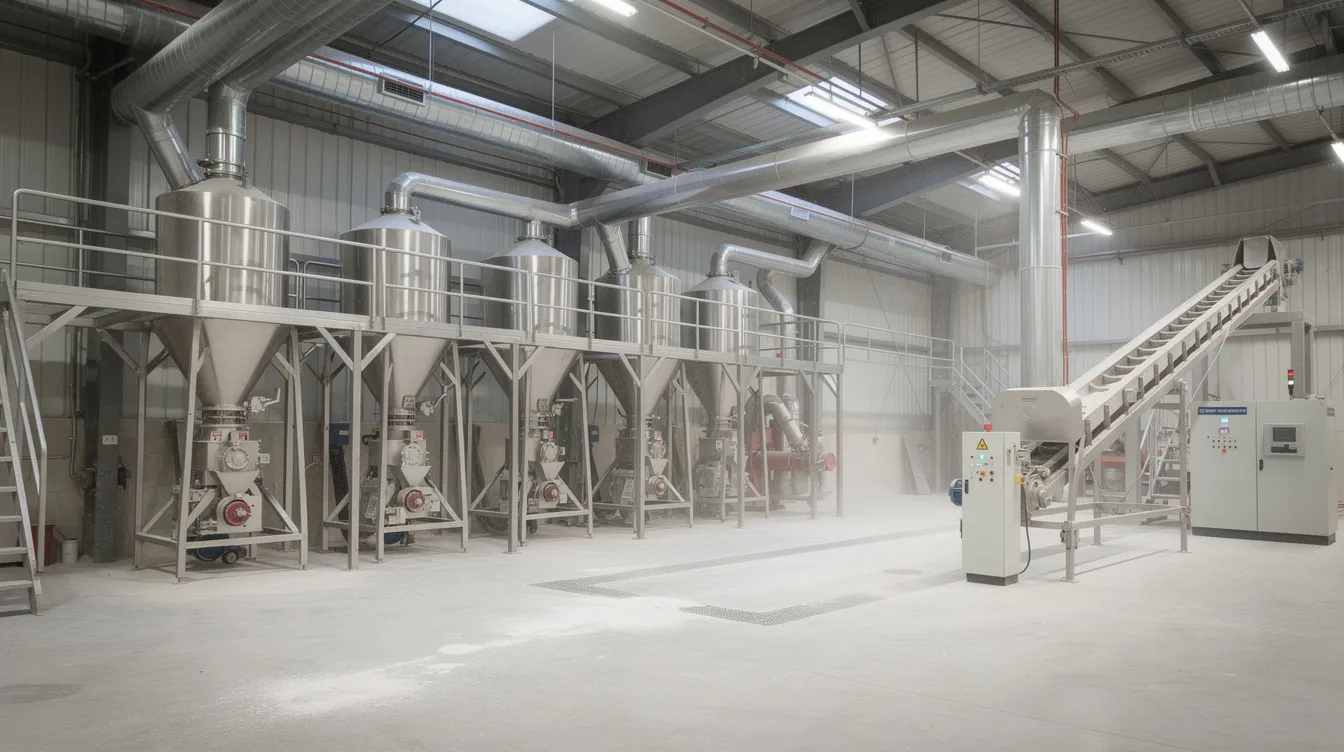
Besan manufacturing plant capacity is the maximum sustainable production of saleable gram flour under specified operating conditions. It is not a marketing label. Understanding what a capacity figure actually represents is the foundation of any meaningful capacity planning exercise.
Key distinctions every promoter must understand:
- Raw material input capacity: The weight of chana dal or whole gram that feeds into the plant per hour (kg/hr). This is not the same as finished output.
- Finished besan output capacity: The weight of saleable besan produced per hour after grinding, sieving and recirculation of coarse particles. Besan production requires approximately 1.1–1.15 kg of chana dal per kg of besan, so input-to-output ratios always show some processing loss.
- Saleable packed output: Further reduced by sieving rejects, moisture changes and packing losses. Maintaining a 95% to 98% material recovery rate is typical for well-designed plants using chana dal as input and factors directly into production capacity calculations.
The difference between rated machinery capacity (the nameplate rating from the manufacturer under ideal conditions) and practical operating capacity (adjusted for downtime, moisture variation, power cuts and operator skill) is substantial. Supplier quotations must clearly specify: material type, target mesh or fineness, assumed moisture, operating hours per day, and whether the rating refers to input or finished besan output.
Illustrative conversion: A plant rated at 500 kg/hour of finished besan, running 8 hours per day for 25 working days per month at 75% effective utilisation:
500 × 8 × 25 × 0.75 = 75,000 kg per month (75 tonnes)
This step-by-step conversion is needed before any capacity decision.
Illustrative Production Scales: 250 kg/hour to 2 tonnes/hour
The following table compares common besan production capacity selections purely for illustration. These are not recommended capacities or guaranteed performance figures. All ratings refer to finished besan output per operating hour, assuming an 8-hour shift and 25 working days per month.
| Parameter | 250 kg/hr | 500 kg/hr | 1,000 kg/hr | 2,000 kg/hr |
|---|---|---|---|---|
| Theoretical daily output (100%) | 2,000 kg | 4,000 kg | 8,000 kg | 16,000 kg |
| Daily output at 60% utilisation | 1,200 kg | 2,400 kg | 4,800 kg | 9,600 kg |
| Daily output at 80% utilisation | 1,600 kg | 3,200 kg | 6,400 kg | 12,800 kg |
| Monthly output at 60% (25 days) | 30 tonnes | 60 tonnes | 120 tonnes | 240 tonnes |
| Monthly output at 80% (25 days) | 40 tonnes | 80 tonnes | 160 tonnes | 320 tonnes |
A 250 kg/hour unit may suit local wholesale and nearby retailers. A besan plant operating at 1–2 tonnes/hour requires wider distribution, stronger branding or institutional contracts to sustain utilisation. A 500 kg/day besan plant requires an investment of approximately ₹20–45 lakh, while higher capacities require proportionally larger capital. Basic besan grinding machines cost around ₹55,000 each, while automatic besan making machines are priced at approximately ₹2,25,000 each, but total project cost depends on the complete line configuration, civil works and utilities.
For a detailed understanding of how investment scales with capacity, refer to the guide on besan manufacturing plant setup cost in India.
Market Research Before Selecting Besan Plant Capacity
Market demand assessment must precede any decision on besan production capacity selection, especially for debt-funded projects. Assumptions should be documented in the business plan or DPR, not left as mental estimates.
Key customer segments to analyse include local wholesalers, kirana and modern retail, namkeen and snack manufacturers, sweet manufacturers, institutional buyers such as canteens and caterers, and private-label or contract manufacturing clients. Each segment has different volume, credit terms and pricing dynamics. Understanding the distinction between bulk supply vs branded retail besan is important for setting realistic sales targets.
Critically, promoters should distinguish between:
- Simple enquiries and informal interest
- Sample or trial orders
- Initial small repeat orders
- Stable repeat orders or written purchase commitments
Only the latter category should determine long-term capacity. Approximately 70% of the besan market is held by unorganised local mills, which means a new entrant competes on distribution strength and quality, not just price.
Demand surges often occur during festive seasons and wedding periods, while base demand for besan remains consistent. Customer concentration risk, typical credit periods of 15–60 days, and distributor inventory all affect dispatch patterns. The reverse calculation approach works well: start from realistic monthly sales volume in kg, then work backwards to see which besan plant production scale can be viably sold.
Calculating the Required Besan Production Capacity
Entrepreneurs should convert planned monthly sales and inventory targets into an objective capacity calculation. Planning production capacity requires a balance between market demand and operational constraints.
Formula:
Required rated finished-output capacity (kg/hour) = Target monthly saleable production (kg) ÷ [Working days × Production hours per day × Effective utilisation factor]
The target monthly saleable production should reflect projected sales plus any planned change in finished-goods inventory (for instance, building stock before festivals). The effective utilisation factor (e.g., 0.65 or 0.75) already includes normal maintenance, minor breakdowns, cleaning and product changeovers. Avoid separately deducting each downtime item on top of this factor to prevent double-counting.
Worked example:
- Target: 120 tonnes/month of saleable besan
- Working days: 26 per month
- Production hours: 8 per day
- Effective utilisation: 75%
1,20,000 kg ÷ (26 × 8 × 0.75) = 1,20,000 ÷ 156 = 769 kg/hour (rated finished-output capacity)
Standard project guidelines recommend initial capacity utilisation of 50% to 60% in the first year, rising gradually. If a vendor quotes capacity on a raw material input basis, the promoter must apply the applicable recovery factor. Since besan production requires 1.1–1.15 kg of chana dal per kg of besan, a machine rated at 800 kg/hour input may deliver only about 700 kg/hour of finished output.
Raw Materials: Chana Dal vs Whole Gram and Capacity Impact
Besan can be produced either by grinding purchased chana dal or via an integrated plant that processes whole gram (chickpeas) into dal and then into gram flour. Both routes influence capacity planning differently.
- Purchased chana dal route: Simpler process, fewer machines, closer alignment between dal input and besan output. Chana dal is the primary input for besan production. Besan is milled from cleaned chana dal with minimal processing loss during cleaning and grading. However, the plant depends on external dal millers for supply consistency. Learn more about this approach in the article on besan manufacturing from chana dal.
- Whole gram integration: Additional stages including cleaning, dehusking and splitting. Dal mills remove husk from chana, which is crucial for besan production. This route offers potential by-product revenue but requires a larger investment envelope and more complex line balancing. Details are covered in the integrated gram processing and besan plant project report.
Chickpeas are sourced from farmers or agricultural cooperatives, with seasonal arrivals requiring bulk buying and adequate storage. Raw material price volatility is a primary business risk, and chana dal costs 65–75% of total production costs. Raw material availability significantly influences plant capacity and operational efficiency. It is essential to maintain sufficient raw material storage to manage supply chain fluctuations, typically 7–15 days of consumption depending on scale and origin of procurement.
Recovery assumptions should be developed project-wise based on actual trials, not optimistic uniform figures. For the chana dal vs whole gram for besan manufacturing comparison, the choice affects equipment needs, space and financial projections.
Balancing Capacities Across the Production Line
Overall gram flour plant capacity is determined by the slowest stage in the production line, not by the highest-rated individual machine. Capacity is constrained by the slowest component in the processing line. Bottleneck analysis ensures the production line is balanced across all stages.
Key process sections whose capacities must be matched:
- Cleaning and destoning: Removes stone, dust and foreign matter from incoming material
- Dehusking and splitting (where whole gram is used)
- Grinding and milling: Flour mills grind split chana into besan powder. Finer flour reduces milling throughput and increases energy consumption per kg
- Sieving and grading: Recirculation of coarse particles reduces effective hourly output
- Material handling: Elevators and conveyors move grain and flour between processes
- Packing: Packaging machines fill besan in packs from 250 g to 50 kg
Packaging line capacity should match milling throughput to avoid dispatch delays. For example, a packing machine rated at 15 packs per minute filling 1 kg pouches produces 900 kg/hour, which may bottleneck a plant rated at 1,000 kg/hour of finished besan. Capacity planning must account for supply chain dynamics and mechanical throughput at every stage.
For detailed machinery information, refer to the guide on besan manufacturing machinery and the besan manufacturing process overview.
Single-Shift vs Double-Shift Besan Plant Operations
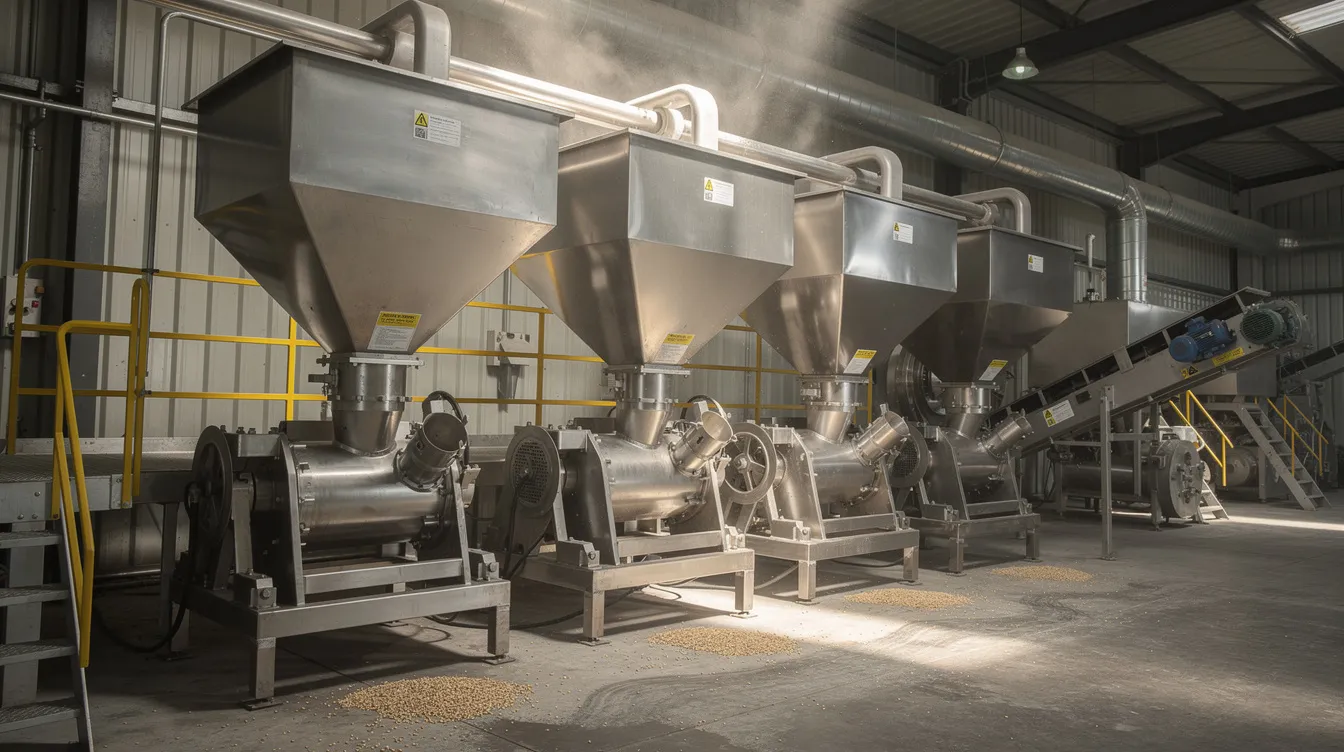
Many promoters debate whether to install a larger besan plant running one shift or a smaller unit operating two shifts. This is more a commercial than a purely technical decision.
Moving from one shift to two introduces additional labour costs (especially skilled operators and supervisors), increased wear and tear, reduced maintenance windows, and potentially higher power tariffs for evening consumption in some states. Doubling nominal operating hours does not guarantee exactly double saleable output because of higher cumulative downtime and cleaning time between batches. Production schedules should account for maintenance and cleaning downtime in both scenarios.
Early-stage besan manufacturing units typically stabilise in a single shift with moderate capacity utilisation, then gradually extend working hours only after demand and working capital support are proven. From a project finance perspective, bank projections should show a realistic ramp-up over the first 2–3 years, not an immediate jump to full double-shift operation. Manual operations such as quality sampling and dispatch coordination also become more challenging across shifts.
Infrastructure, Utilities and Space for Capacity Planning
Infrastructure must be designed to support the selected besan plant capacity and potential expansion, not just accommodate the initial set of machines. The foundation and construction should account for future requirements.
Key space areas to estimate:
- Machinery hall for the flour mill line
- Raw material godowns for chana dal or whole gram
- Finished goods storage for packed besan
- Packaging material store
- Quality control lab and administrative office
- Loading, unloading and internal circulation areas
Power supply requirements are critical for equipment like pulverizers and collection systems. Higher capacities may require dedicated transformers or three phase material connections at high tension, affecting both cost and timelines. Electrical load planning should cover grinder motors, compressors, packing machines and dust extraction.
Food safety compliance requires appropriate infrastructure for dust control and quality testing. Quality checks must integrate into capacity planning to ensure product safety and quality, including arrangements for ventilation, proper ducting and safe powder handling. Plant layout should allow smooth material flow with space reserved for installing additional machines when besan plant expansion planning becomes relevant.
Capacity, Investment and Working Capital Requirements
The chosen besan production capacity per day drives both fixed capital investment and ongoing working capital, which banks appraise separately.
- Fixed capital: Land, building, plant and machinery, electrical installations, setting up utilities
- Working capital: Raw materials inventory, packaging (costing ₹0.8–1.5 per kg of finished product), wages, power bills, finished stock, trade debtors minus supplier credit
Larger capacities require more chana dal inventory, larger packaging stock and the financial strength to extend credit to more buyers. A technically sound gram flour plant may remain underutilised if sanctioned working capital limits are inadequate. This is why effective capacity planning ensures machinery is fully utilised and avoids costly bottlenecks, but it also requires adequate funding to meet day-to-day operational needs.
Capacity Utilisation, Break-even and Repayment Ability
Lenders and investors look closely at projected capacity utilisation, break-even volume and DSCR to judge whether a besan plant business plan is financially viable. Banks require DSCR of 1.25 or above for manufacturing loans, and CMA data is mandatory for loans above ₹10 lakh.
Lower-than-planned utilisation increases fixed cost per kg, squeezing contribution margin and reducing surplus available for loan repayment.
Break-even formula:
Operating break-even volume (kg) = Relevant fixed operating costs ÷ Contribution per kg
Contribution per kg equals selling price minus all variable costs (raw materials, packing, power, variable labour, transport). Break-even point analysis is crucial for loan applications.
Sensitivity analysis should test what happens to profit and DSCR if utilisation drops 10–20%, raw material prices rise, or selling prices soften. Financial projections should show a realistic ramp-up: 40–50% utilisation in Year 1, gradually rising to 70–75% by Year 3. A bank-ready DPR includes CMA data and financial projections with these realistic assumptions. Promoters should approach capacity planning with confidence in their numbers, supported by market insights and documented demand.
Phased Capacity Expansion Strategy
Starting with a commercially prudent capacity and building in the ability to expand once stable demand, quality consistency and cash flows are demonstrated is a sound strategy for any business entering this field.
Practical methods include selecting besan manufacturing machinery models that can be paralleled, leaving space in the layout for additional grinders or sifters, and designing dust collection and electrical systems with headroom. Additional packing capacity is often the lowest-cost way to debottleneck a growing plant compared to replacing core milling equipment.
Expansion decisions should be based on sustained repeat demand, satisfactory utilisation levels, timely collections and a positive track record with existing lenders. Entrepreneurs considering a broader product range may also explore the multiproduct pulse flour plant project report as a step toward diversification.
Common Besan Plant Capacity Planning Mistakes
Many capacity issues observed during project appraisals arise from avoidable planning mistakes made before ordering machinery:
- Choosing capacity only because a supplier or manufacturer offers an attractive discount or has ready stock, without validating whether monthly sales can support that scale
- Confusing raw material throughput with finished besan output when comparing quotations from different equipment suppliers
- Assuming full utilisation from the first month. Most new gram flour plants go through a period of market development, process fine-tuning and working capital stabilisation
- Ignoring apparent bottlenecks such as limited packing speed, restricted godown space or slow dispatch logistics
- Using inconsistent assumptions on working days, shift hours, recovery and credit periods across DPR sections
- Planning expansion before confirming stable repeat demand from distributors and retailers
Capacity Planning Checklist for a Besan Manufacturing Plant
Before establishing any besan manufacturing plant capacity, promoters should verify:
- [ ] Confirmed realistic monthly demand from multiple customer segments, documented with market demand assessment involving target segments and geographic reach
- [ ] Decision made between chana dal and whole gram routes, with recovery assumptions justified
- [ ] Target capacity utilisation ramp-up defined for the first 3 years
- [ ] Validated access to required working capital limits from banks or promoter funds
- [ ] All main machines (cleaner, grinder, sifter, elevators, packing) are capacity-balanced
- [ ] Electrical load and building space verified for both current and next-phase machines
- [ ] Logistics and labour availability confirmed for planned shifts
- [ ] All numeric assumptions reconciled across business plan, DPR and CMA Data to create a consistent information set that covers every aspect banks may examine
- [ ] Revenue projections linked to capacity, utilisation, yield and realistic selling prices
Promoters should document these items formally and use them when discussing the project with lenders, investors and technical suppliers. Banks require a specific DPR format for PMEGP applications, so ensuring consistency across all documents is essential. A besan mill project report prepared on a project-specific basis can offer a comprehensive starting point.
Conclusion and Professional Assistance from Project Report Bank
Successful besan plant capacity planning aligns three aspects: market demand validated through research and trial orders, technically balanced plant and machinery sized to produce the required gram flour output, and financial resources sufficient to fund both fixed assets and working capital. India’s besan market generates approximately ₹32,000 Cr in annual demand, but each project must be evaluated on its location, customer base, raw material access and the promoter’s financial strength and risk appetite. There is no one-size-fits-all besan production capacity selection.
Project Report Bank, under the leadership of CA Manish Gugliya, FCA, DISA (ICAI), with more than 20 years of professional experience, provides customised Detailed Project Reports, financial projections, sensitivity analysis, CMA Data and bank loan proposals for besan plants and other food processing projects across India. A detailed project report can be prepared efficiently and made available as a download in PDF format, tailored to the specific project.
Serious entrepreneurs and MSME owners planning to start a besan plant are welcome to contact the firm through the Project Report Bank website and its WhatsApp enquiry option for assistance with capacity assessment, DPR preparation and bank finance proposals.
Frequently Asked Questions
How can I revise my chosen besan plant capacity if my market grows faster than expected?
If demand exceeds initial projections, promoters can consider adding a second grinding line, upgrading key machines such as sifters or packing equipment, or extending to double-shift operations. Before expansion, verify that utility connections, building space and dust extraction systems can handle the additional load. A phased approach, validated by sustained repeat orders and adequate working capital, is more prudent than reactive over-investment.
What documentation should I prepare to convince banks that my capacity assumptions are realistic?
Banks typically require a well-structured DPR with realistic capacity utilisation ramps, CMA Data with consistent assumptions, machinery quotations from suppliers, and ideally sample contracts or MoUs with buyers. Financial projections should show a gradual increase from 50–60% utilisation in Year 1 to 70–75% by Year 3. For markets like Kolkata or other major consumption centres, documented distribution arrangements strengthen the proposal.
How do product mix changes affect practical besan plant capacity?
Adding premium fine besan (higher mesh) reduces milling throughput because the machine processes material more slowly and recirculation increases. Coarser grades allow higher hourly output. If a promoter plans multiple grades, financial projections should use a weighted-average throughput figure and the sieving section should have adequate capacity for the finest grade offered.
Is it better to start with contract manufacturing before investing in my own full-scale besan plant?
Contract manufacturing reduces initial capital risk and allows the promoter to develop a customer base and brand before committing to a full-scale plant. However, it offers limited control over quality, cost and scheduling. The experience gained in distribution, pricing and customer credit management is valuable for informing eventual capacity selection and preparing a stronger DPR for bank finance.