Key Takeaways
- Besan manufacturing machinery must be selected based on the production route (purchased chana dal, whole gram, or multi-product), target fineness, and business model rather than on quoted price or advertised capacity alone.
- The choice of besan grinding machine, sifting system, and dust collection arrangement directly determines product quality, energy consumption, and actual saleable output from any besan plant.
- Automation level – manual, semi-automatic, or automatic besan plant – affects initial investment, labour cost, product consistency, and overall project bankability.
- Entrepreneurs should insist on supplier performance trials, verify demonstrated capacity at required fineness, and compare quotations on a normalised scope basis before committing to machinery investment.
- Project Report Bank, led by CA Manish Gugliya, provides professional support in preparing Detailed Project Reports, financial projections, CMA Data, and bank loan proposals for besan mill plant and gram flour projects across India.
Introduction: Why Besan Manufacturing Machinery Choice Matters More Than Tag Price
Many Indian entrepreneurs approach besan manufacturing machinery selection by comparing quoted prices or advertised hourly capacities – for example, a machine labelled “500 kg/hr” – and selecting the cheapest option. This approach frequently leads to underperforming projects where actual output falls short, energy costs exceed projections, and product quality fails to meet buyer expectations.
Besan, produced by grinding dried and decuticled Bengal gram, is a staple ingredient in Indian food manufacturing. Finely ground besan is used for various culinary applications including sweets and snacks, which means the machinery must deliver consistent fineness, controlled temperature, and hygienic processing. The production of besan follows a multi-stage industrial or semi-automatic process involving cleaning, grinding, sifting, and packaging. Factors to consider when selecting equipment therefore include production capacity, energy efficiency, and maintenance ease – not just the purchase price.
From a Chartered Accountant’s perspective, besan manufacturing machinery choices directly affect project cost, debt service coverage ratio, break-even point, and overall viability. This article addresses equipment selection, automation decisions, and their financial implications. For a detailed breakdown of overall project investment, refer to the guide on besan manufacturing plant setup cost in India.
Define the Production Route Before Selecting Any Besan Plant Machinery
The first decision is the production route, which determines the exact machinery list and automation level for any besan making plant.
Route 1: Besan from purchased chana dal. This is the most common model for MSMEs. Cleaned, dehusked chana dal is procured and ground directly into gram flour, requiring a simpler machinery line focused on cleaning, grinding, sifting, and packing. For detailed economics of this approach, see the guide on besan manufacturing from chana dal.
Route 2: Integrated gram processing. Whole gram is cleaned, graded, and processed through de-husking machines that remove the outer skin of chickpeas to produce split dal, which is then ground into besan. This route requires additional upstream equipment. The integrated gram processing and besan plant project report covers the machinery and investment implications.
Route 3: Multi-product pulse flour facility. Manufacturing besan along with flours from moong, urad, turmeric, and other pulses or grains requires changeover-friendly equipment. The multi-product pulse flour plant project report addresses flexibility and changeover considerations.
Product mix (bulk besan, branded retail packs, other pulse flours) and target customers (wholesalers, institutions, retailers) influence specific equipment choices – from packing machines to sifter designs and cleaning systems. A separate article on chana dal vs whole gram for besan manufacturing compares the raw material routes and their investment implications in detail.
Core Besan Manufacturing Machinery List and Functions
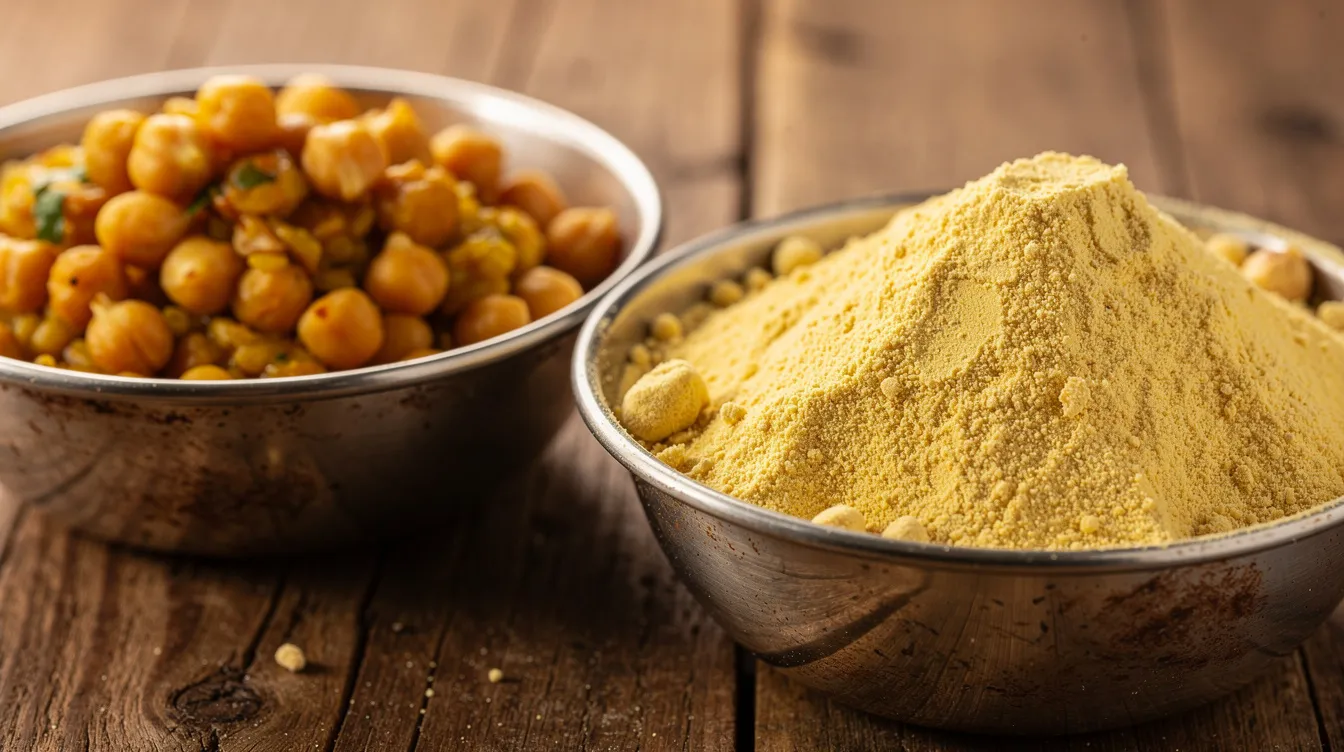
Not every besan plant needs every machine listed below. De-husking and dal splitting equipment, for example, is required only for integrated whole-gram processing. The table covers besan plant machinery for configurations ranging from a basic chana dal route to a fully automatic besan plant.
| Equipment | Main Function | When Required | Key Selection Considerations |
|---|---|---|---|
| Receiving hoppers and feeding systems | Accept and regulate raw material flow into the line | All plants | Capacity matching with downstream machines; dust-tight design |
| Pre-cleaners and grading sieves | Remove dust, sticks, oversized and undersized particles | All plants | Mesh sizes suited to chana dal or gram; throughput |
| Destoners | Separate stones and heavy impurities | All plants | Three phase stone size separation efficiency; maintenance access |
| Magnetic separators | Remove metal particles from raw material | All plants; essential for retail and export | Magnet strength; ease of cleaning |
| Conditioning and dehusking equipment | Temper and remove husk from whole gram | Only Route 2 (whole gram) | Not needed when purchasing cleaned chana dal |
| Dal splitting and separation | Split dehusked gram into dal | Only Route 2 | Not needed for purchased dal |
| Grinding mills (hammer mill, pin mill, impact pulverizer, besan pulverizer machine) | Grinding machines pulverize chickpea dal into fine flour | All plants – core equipment | Fineness range, throughput at target mesh, heat generation, wear parts |
| Centrifugal machines and vibro sifters | Sifting equipment screens milled flour to ensure uniformity in particle size | All plants | Mesh count, oversize recirculation, cleaning ease |
| Cyclones, bag filters, and dust collection system | Capture airborne dust, recover product, reduce fire and health risk | All plants | Ducting layout, airlock valve design, interlock with mills |
| Elevators, screw conveyors, and pneumatic conveying system | Material handling between process stages | Semi-automatic and automatic plants | Capacity, food-grade construction, cleaning access |
| Intermediate storage bins | Buffer between grinding, sifting, and packing | Medium and large plants | Level sensors; material of construction |
| Metal detector | Detect and reject metal contaminants in finished flour | Retail, institutional, and export markets | Sensitivity; integration with packing line |
| Weighing, filling, sealing, and coding machines | Packaging machines fill and seal besan into bags for distribution | All plants | Pack sizes; operation mode (semi-auto vs auto); coding features |
| Electrical panels, VFDs, control panel, and PLC/HMI | Motor control, interlocks, monitoring, and automation | Scale-dependent | Phase power consumption monitoring; expansion provision |
| Basic lab and QC equipment | Besan production includes quality checks for flour fineness, color, and moisture content | All plants | Moisture meter, test sieves, temperature sensors |
Cleaning machines remove impurities like dust, stones, and husks from chickpeas during processing, making the cleaning section essential even when using purchased chana dal. Manufacturing besan from chickpeas involves cleaning, de-husking (where applicable), grinding, sifting, and packaging – and the machinery list must reflect the chosen route.
Grinding Equipment Selection for Besan
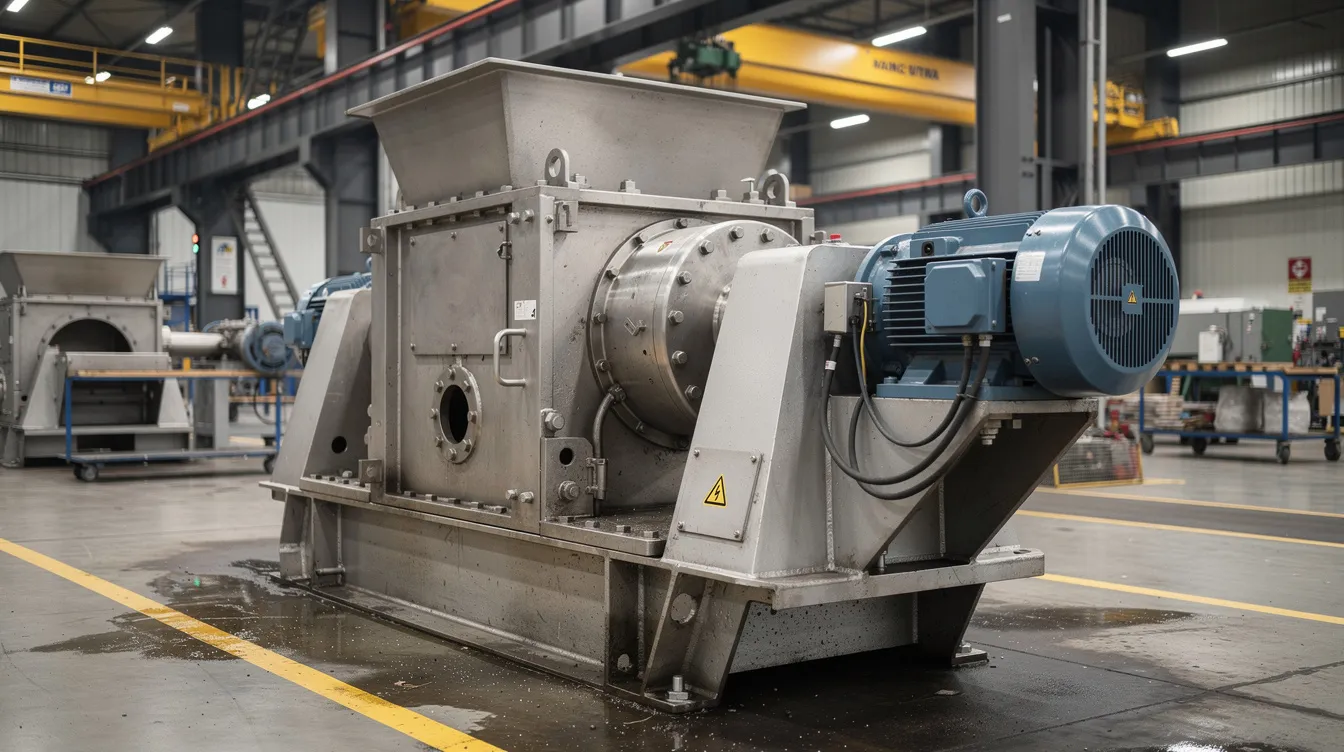
The besan grinding machine is the heart of the production line. Grinding machines pulverize chickpea dal into a fine flour, and the choice between hammer mill, pin mill, and impact pulverizer designs shapes the output quality and operating cost of the entire besan mill.
- Hammer mills use high-speed hammers to impact the material through screens. They are robust, lower in capital cost, and handle coarse grinding well. However, they generate more heat at fine grinding settings and produce a wider particle size distribution.
- Pin mills use intermeshing pins on opposing discs (rotor and stator), offering finer and more uniform particle sizes with potentially lower heat generation – but at higher initial cost and tighter mechanical tolerances.
- Impact pulverizers and two-stage systems (coarse grind followed by fine finishing) are commonly used in gram flour manufacturing machinery setups, particularly where high quality besan with narrow fineness specification is required.
Temperature control during grinding is critical to maintain the flour’s aroma and quality. Excessive heat can darken besan, degrade flavour, and reduce nutritional value. Dust-tight covers and effective dust extraction near the grinding zone are essential for worker safety and product recovery.
No single mill type is universally superior. Entrepreneurs should insist on supplier trials using their actual chana dal, with measured capacity at specified fineness, power draw (kWh per tonne), and temperature rise – documented in writing. From a project finance perspective, an overly cheap mill that increases energy consumption, rework, and downtime will erode contribution margins, which must be quantified in the DPR and financial model.
Capacity Planning, Line Balancing and Practical Output Calculation
Besan plants can process 100 kg/hr to 2000 kg/hr, but advertised capacities can be misleading unless defined clearly. A “500 kg/hr” specification might refer to raw material input, grinding throughput at coarse settings, or saleable besan output at the required fineness – these are different numbers.
Practical capacity planning requires distinguishing:
- Raw material input capacity (kg/hr of chana dal fed)
- Grinding capacity (kg/hr the pulverizer handles at target mesh)
- Finished saleable besan output (after sifting losses, oversize recirculation, dust)
- Packing capacity (bags or kg/hr the packing station can process)
Common bottlenecks include undersized sifters, manual bagging stations, or slow changeovers limiting effective daily production even when the grinding machine is powerful. A 500 kg per hour besan plant is available for purchase, but the actual daily output depends on operating hours and utilisation:
Effective daily output = demonstrated hourly output × scheduled operating hours × operating utilisation factor
For example: 500 kg/hr × 16 hours × 0.75 utilisation = 6,000 kg/day. The 0.75 factor accounts for scheduled cleaning, maintenance, changeovers, and unplanned stoppages. It is important to distinguish between downtime or utilisation losses (machine not running) and material recovery losses (bran, fines, dust) – these are different cost categories and should not be confused in financial planning.
Realistic capacity utilisation assumptions – for instance, a ramp-up from 50% to 75% over the first two to three years – should be used in the Detailed Project Report rather than assuming full utilisation from day one.
Manual, Semi-Automatic and Fully Automatic Besan Plants
Besan plants can be fully automatic or semi-automatic, and the automation level chosen affects every aspect of the project.
| Parameter | Manual | Semi-Automatic | Fully Automatic |
|---|---|---|---|
| Initial investment | Lowest | Moderate | Highest |
| Material handling | Manual lifting, carrying | Partial conveyors, manual packing | Conveyors, pneumatic systems, automated packing |
| Labour requirement | High | Moderate | Lower per tonne |
| Product consistency | Operator-dependent | Improved | Most consistent |
| Cleaning and changeovers | Time-consuming | Moderate | Designed for faster turnaround |
| Maintenance skills | Basic | Moderate | Requires trained technicians |
| Expansion flexibility | Limited | Moderate | Better if planned at design stage |
| Suitable scale | Micro and small units | Small to medium | Medium to large, organised retail and export |
Fully automatic besan plants reduce labor and energy consumption per tonne, but still require manual work in raw material receiving, quality inspection, preventive maintenance, and dispatch. Automatic besan plants include cleaning, milling, and packaging processes within their scope, but the term “fully automatic” must be cross-checked against the supplier’s actual scope: which operations are truly automated and which remain manual.
A semi-automatic besan setup costs approximately Rs 2,50,000 at the lower end, while an automatic besan plant is priced at Rs 7,50,000 for smaller configurations. A fully automatic besan plant costs approximately Rs 30,00,000 for capacities ranging around 200 kg/hr, and larger configurations with higher throughput cost proportionally more.
Matching the automation level to current and projected scale, product range, and labour availability is essential. Overspecifying automation can lengthen payback if utilisation remains low.
Automation Features Worth Evaluating in Besan Plant Machinery
Automation is not only about eliminating manual labour. Even relatively modest features can materially improve safety, consistency, and energy use:
- Controlled feeding with interlocks prevents overloading pulverizers and reduces wear
- VFD-based motor control allows fine-tuning of feeder, blower, and centrifugal machine speeds, adjusting motor power to actual load
- PLC/HMI monitoring tracks parameters such as motor currents, bin levels, and alarms, supporting batch and production record logging
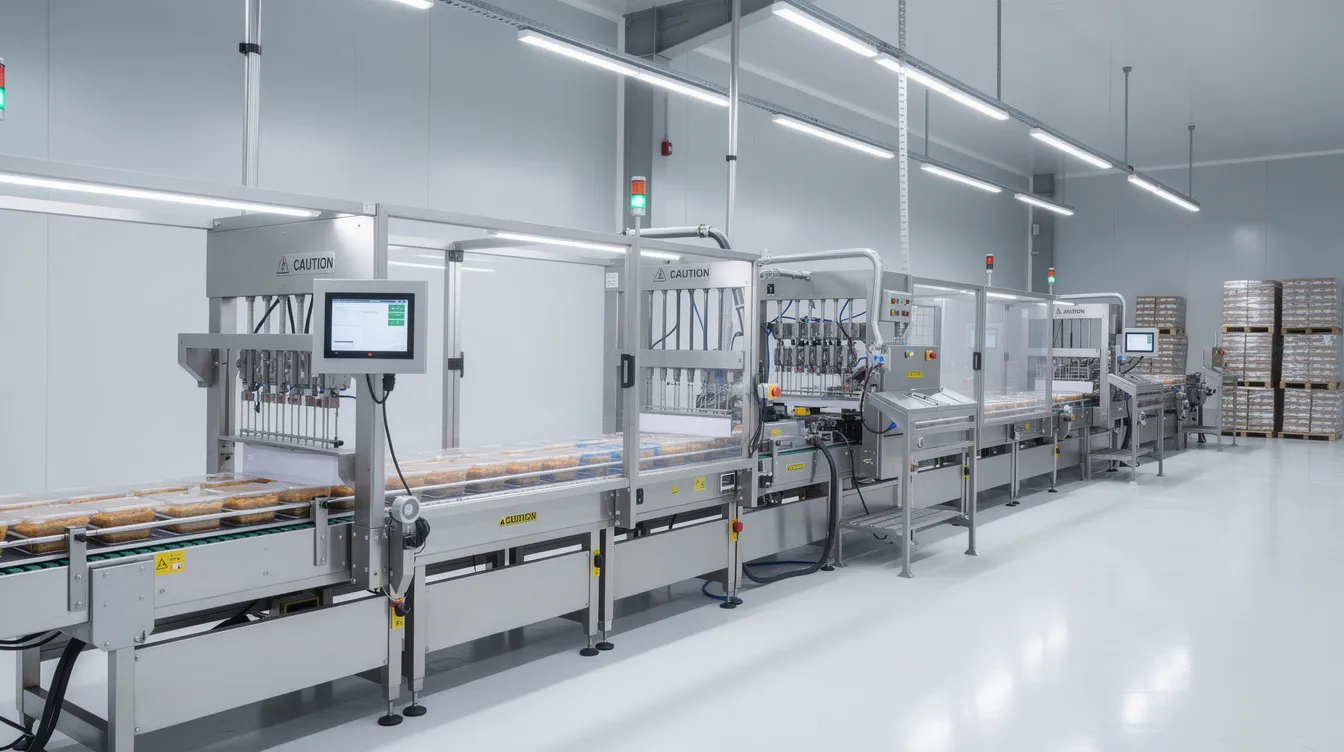
- Automated weighing and packing – from semi-automatic weigh-fill-seal units to fully automatic form-fill-seal machines – reduces labour per tonne and improves consistency in retail packs
- Dust extraction interlocks prevent the mill from starting if the dust collection system is off, addressing both safety and product recovery
- Energy monitoring features track kWh per tonne for ongoing cost control
Entrepreneurs should separate operationally useful features from additions that may not justify their cost at low production volumes. Every automation element adds to project cost and should be evaluated in the DPR and payback analysis.
Besan Plant Machinery Cost and Quotation Comparison
The cost of besan plant machinery is influenced by capacity, automation grade, material of construction, and scope of supply. Prices change over time, and no generic rate per kg/hr should be assumed without current written quotations.
Market price points from various sources and suppliers indicate a wide range. The price for a besan making plant starts from approximately Rs 27,60,000 for mid-range configurations. The cost of besan plant machinery reaches Rs 30,00,000 for a fully automatic besan plant with a capacity of 200 kg/hr. Besan plant machinery can also operate at 150 kg/hr capacity at lower price points. Suppliers such as PCK Food Tech Solutions offer configurations up to 1500 kg/hr for larger fully automatic besan plants. A Rajasthan Agricultural Competitiveness Project study documented main plant and machinery cost of approximately ₹11.25 lakh for a 4 TPD unit and approximately ₹2.64 crore for a 50 TPD fully automatic mill plant.
Besan plants are made from heavy-duty stainless steel and MS structure, and the choice between mild steel body with SS contact parts versus full stainless steel construction affects cost significantly. Construction mild steel warranty terms should be verified alongside material specifications.
Quotation comparison checklist:
- Machines with model, capacity, and make
- Motors, gearboxes, electrical panels, cables
- Foundation bolts, ducting, dust collection system
- Elevators, conveyors, support structures
- Civil foundation requirements
- Installation and commissioning charges
- Freight, insurance, GST
- Operator training and initial spares
- Performance guarantees at specified fineness
Project Report Bank does not sell machinery but can help clients interpret quotations, normalise them for scope differences, and reflect realistic machinery cost and contingencies in a bankable project report.
Power Consumption and Operating Economics of a Besan Plant
Lenders and investors examine ongoing operating costs, not just installed capacity. The distinction between connected load (total kW of all motors installed) and actual electricity consumption (kWh used during operation) is important. What matters for financial projections is kWh per tonne of saleable output under realistic load factors.
Key operating cost components per tonne include:
- Electricity: typically ₹1,500–2,500 per tonne depending on tariff and phase power consumption
- Direct labour: operators, helpers, packing staff
- Wear parts: hammers, pins, liners, sieves for pulverizers and sifters requiring easy maintenance schedules
- Packing materials: bags, pouches, labels, cartons
- Scheduled maintenance and cleaning downtime
These cost assumptions must be aligned with the actual machinery configuration, planned automation level, and realistic shift pattern in the DPR rather than copied from generic templates. Improving machinery efficiency – better dust collection targeting near zero waste, optimised fine grinding parameters – directly improves contribution margin and DSCR, and should be modelled in financial projections.
Hygiene, Dust Control and Maintenance in Besan Processing Machinery
Besan is a food product manufactured in India under food safety regulations. Food-grade materials must be used in machines that come into contact with the flour to prevent contamination. Smooth, cleanable surfaces without dead pockets where product can accumulate are essential for maintaining high quality besan.
Dust control measures – local exhaust hoods, bag filters, cyclones, and proper ducting – reduce worker exposure, improve plant cleanliness, and recover sellable product. Fine flour dust in enclosed areas presents occupational and fire risks; consultation with qualified safety professionals for ventilation, earthing, and explosion relief is recommended.
Preventive maintenance planning should include regular inspection of hammers, pins, liners, sieves, and bearings, with lubrication schedules and critical spares kept in stock. Planned shutdowns for low maintenance routines should be built into capacity utilisation assumptions. The choice of material of construction – mild steel body with SS contact parts versus full SS – should be based on product requirements, target customers (bulk supply vs branded retail besan), regulatory requirements, and budget, evaluated within the DPR.
Machinery Selection by Business Model and Product Strategy
A besan mill serving bulk buyers in 25–50 kg bags has very different machinery priorities from a brand focused on retail packs or a multi-product facility. Equipment needs differ by:
- Bulk supply: emphasis on high throughput, robust grinding, simple packing – lower automation in packing acceptable
- Branded retail packs: requires precise filling, sealing, batch coding, metal detection, and consistent product quality with excellent quality range
- Institutional supply: demands coming from snack and sweet manufacturers require specific fineness and timely delivery commitments
- Multi-product pulse flour manufacturing: requires quick-clean sifters, dedicated bins, clear changeover procedures, and possibly separate packing lines
Target markets affect capacity decisions – starting smaller for local branded retail versus larger bulk capacity for B2B – which should be reflected in production capacity planning and loan documentation. Aligning machinery selection with the business model reduces idle investment, improves utilisation, and supports better financial ratios. For related machinery considerations in flour processing, the specialty flour plant machinery and equipment cost guide provides additional context.
Supplier Due Diligence, Performance Trials and Technical Evaluation
Because besan plant machine investment is a long-term capital commitment, verifying supplier capability is essential before committing funds. A leading manufacturer or supplier should be evaluated on:
- Number of successfully installed besan plants and references from existing users
- Willingness to conduct performance trials using the buyer’s own chana dal or gram
- Documentation: GA drawings, utility requirements (electricity connection, compressed air), foundation drawings, and detailed inclusions/exclusions
- Warranty period, exclusions (wear parts), service response time, spare-parts availability pan India, and provision for operator training
Motor power or nameplate capacity alone is insufficient for comparison. Buyers should compare demonstrated capacity at specified fineness and product, with measured energy consumption (kWh per tonne) and temperature rise. These verified figures – not catalogue claims or product brochure specifications – should form the basis of DPR and bank projections. The country of origin and make of critical components (motors, bearings, screens) should also be verified for additional information on reliability and spares access.
Financial Evaluation of Automation and Machinery Choices
From a Chartered Accountant’s perspective, automation decisions must be financially justified through incremental investment and measurable savings, not just by technical appeal. The evaluation should define:
- Additional investment in automation (cost difference between semi-automatic and fully automatic besan plant)
- Annual labour and operating savings (fewer operators, lower rework, reduced wastage)
- Any additional maintenance, software, or technical support costs
- Changes in working capital requirements from higher throughput
Simple payback period = additional automation investment ÷ annual net operating savings
For illustration: if upgrading from semi-automatic to fully automatic configuration requires an additional ₹20 lakh and generates net annual savings of ₹6 lakh (after accounting for additional maintenance), the simple payback is approximately 3.3 years. This is an illustrative example only – actual figures depend on specific machinery, scale, and utilisation.
Financial evaluation should also consider utilisation sensitivity: automation may not pay back quickly if the plant runs at 40–50% utilisation. Machinery and automation choices influence DSCR, break-even sales volume, IRR, and payback period, all of which banks and investors examine closely. Project Report Bank can assist in building project-specific financial models reflecting different automation scenarios.
Common Besan Machinery Purchase Mistakes to Avoid
- Selecting machines based on lowest price without verifying performance at required fineness
- Oversizing plant capacity well beyond realistic demand, leading to idle investment
- Underestimating dust extraction, electrical panel, and cabling costs – these are not optional extras
- Ignoring packing as a bottleneck that limits effective daily output
- Buying unnecessary upstream dal milling equipment when purchasing cleaned chana dal
- Accepting “automatic besan plant” labels without clarity on what is actually automated
- Ignoring after-sales service capability, minimum order quantity for spares, and response time
- Not budgeting for commissioning, operator training, and initial spares
- Assuming constant year-round full utilisation without seasonal or ramp-up adjustments
- Failing to document machinery scope and performance guarantees before placing orders
Promoters should plan capacity and automation in phases where possible, with each phase evaluated in a structured DPR and expansion roadmap – especially when term loans and collateral are involved.
Conclusion and Professional Assistance for Besan Plant Projects
Correct besan manufacturing machinery selection must start from the production route and business model, then move to detailed evaluation of grinding, sifting, dust control, packing, and automation features. Current trends in organised retail and export demand continuously upgrading standards of hygiene, consistency, and traceability – which machinery choices must support.
Verifying practical capacity, power consumption, and maintenance implications rather than relying solely on catalogue figures or headline automation claims is essential. Sound machinery and automation choices improve project viability, profitability, and bankability when supported by realistic projections in a well-prepared DPR.
Project Report Bank, led by CA Manish Gugliya (FCA, DISA, ICAI), provides professional support in preparing Detailed Project Reports, financial projections, CMA Data, loan proposals, and investment analysis for besan plant and gram flour projects across India. Entrepreneurs with serious project plans may initiate a discussion via WhatsApp or email to explore project-specific DPR and financial modelling requirements. No guaranteed finance or profits are implied – the objective is realistic, defensible financial planning.
FAQs on Besan Manufacturing Machinery and Automation
The following answers address common practical queries on machinery scope, automation, and financial assessment for besan plant projects.
FAQ 1: Can I start with a semi-automatic besan plant and upgrade to higher automation later?
Many units begin with semi-automatic configurations – manual feeding and packing, mechanised grinding and sifting – and later add conveyors, automatic feeders, pneumatic systems, and packing machines as volume and cash flow grow. Future expansion should be considered during initial layout and electrical planning: adequate space for additional machines, panel capacity, and dust collection provisions reduce disruption and cost during upgrades. From a financial viewpoint, the DPR and projections can be structured in phases, showing banks how phase-wise automation will be funded and how capacities ranging upward will improve revenue and DSCR.
FAQ 2: Is it advisable to buy second-hand besan plant machinery to reduce initial investment?
Second-hand machinery can lower upfront cost but carries risks: unknown wear, higher maintenance, outdated safety or hygiene design, lack of documentation, and difficulty obtaining spares. Thorough technical inspection, verification of make, model, and age, trial runs where possible, and a realistic allowance for refurbishment in the project cost are recommended. Banks may require valuation reports and may not finance very old or unbranded used machinery, which should be confirmed with the lender before finalising the financing structure.
FAQ 3: Do I need food safety certification-ready machinery for selling besan under my own brand?
Machinery is only one part of food safety. What matters is overall plant hygiene, cleaning practices, layout, pest control, and documentation as required under Indian food safety regulations such as FSSAI guidelines. Many suppliers offer food-grade besan processing equipment with suitable materials and cleanable designs, but promoters must also plan for proper building finishes, storage, quality control, and record-keeping. Consulting food safety professionals in addition to machinery suppliers is advisable when designing a branded retail besan facility.
FAQ 4: How frequently should wear parts in besan grinding and sifting machines be replaced?
Replacement frequency of hammers, pins, liners, and sieves depends on hours of usage application, hardness of raw material, target fineness, and machine design – it varies widely between plants. Following the manufacturer’s maintenance guidelines initially, then refining intervals based on inspection, vibration, noise, or quality changes, and keeping records to estimate average cost per tonne over time is the practical approach. A realistic annual budget for wear parts and maintenance should be included in financial projections rather than assuming negligible maintenance cost.
FAQ 5: Can one besan making plant be used to process other pulses into flour without major changes?
Many besan making machines – pulverizers, sifters, conveyors – can physically handle other pulses, but changeovers require thorough cleaning to avoid cross-contamination and adjustment of grinding settings for different hardness and moisture levels. Multi-product plants benefit from design features like easy-open sifters, additional bins, and clear product changeover procedures planned at the design stage. Financial feasibility for a multi-product pulse flour plant should account for additional cleaning labour, downtime, and possibly separate packing lines, which can be modelled in a dedicated DPR.