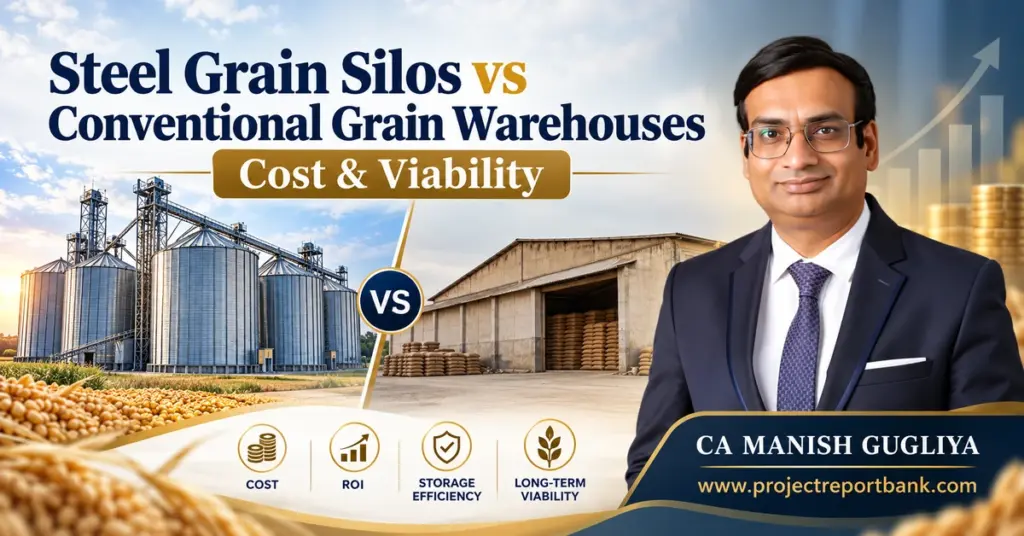
Steel Grain Silos vs Conventional Grain Warehouses: Quick Verdict for Indian Investors
For promoters evaluating commercial grain storage projects in the 10,000–25,000 MT capacity range with anchor contracts or assured utilisation, steel grain silos typically deliver stronger financial performance over a 10–20 year horizon. Higher storage density, lower post harvest losses, superior grain quality preservation and automation-driven operational efficiency combine to produce project IRR in the range of 14–18% and payback periods of 7–9 years, assuming utilisation above 70–80% and reasonable storage tariffs. When land costs are moderate to high and the commodity suits bulk handling (wheat, maize, paddy), silos emerge as the financially stronger investment.
Conventional grain warehouses, however, remain the practical choice when storage capacity requirements are smaller (5,000–10,000 MT), land is inexpensive, commodities are mixed or bagged, or the promoter needs flexibility to handle diverse agricultural produce and seasonal demand. Warehouses offer lower upfront costs and simpler operations, making them accessible for grain traders, APMC operators and smaller agri-businesses. On a per-MT CAPEX basis, grain silo vs warehouse cost in India typically shows silos at ₹5,000–₹9,000/MT versus ₹3,500–₹6,500/MT for warehouses (excluding land). Yet on grain silo vs warehouse ROI, a well-contracted 25,000 MT steel silo can outperform a similarly sized warehouse in IRR terms once land savings, loss reduction and throughput are factored in.
The “better” investment depends on scale, commodity type, storage duration, location, land cost and the nature of commercial contracts – whether FCI PPP, private processor tie-ups, or open-market storage services. This article provides a detailed, financially grounded comparison to help promoters, investors, FPOs and warehouse developers make an informed choice. ProjectReportBank.com, led by CA Manish Gugliya (FCA, DISA ICAI), is a project-finance advisory platform that prepares Detailed Project Reports, feasibility studies and financial models for grain storage infrastructure – this analysis draws on real DPR experience, not generic templates.
What Are Steel Grain Silos?
Steel grain silos are vertical bulk storage systems constructed from galvanised corrugated steel sheets, designed to store large quantities of food grains such as wheat, maize, paddy and pulses. In India, grain storage silos for commercial use typically range from 5,000 MT to 50,000 MT in storage capacity and are gaining traction as the backbone of modern agricultural infrastructure projects. Steel silos can store thousands of tons of grain within a small footprint, utilising vertical space for efficient grain storage that traditional warehouses simply cannot match.
Construction and Design Features of Steel Grain Silos
Steel grain silos are assembled using galvanised corrugated steel sheets with bolted or welded construction, reinforced by vertical and horizontal stiffeners to withstand wind, seismic and grain pressure loads. Foundations – typically raft or pile type – are engineered for Indian climatic conditions, including monsoon humidity, extreme heat and occasional seismic activity. Roof structures are usually conical with ventilated ridge caps, and the entire shell receives galvanisation treatment for corrosion resistance and longevity.
Two primary silo configurations are used in Indian projects. Flat bottom silos have a large diameter with gravity discharge and are suited for long term storage of bulk cereals – they form the core of most large capacity commercial grain storage facilities. Hopper bottom silos feature a funnel-shaped base that enables faster, gravity-assisted discharge; these are commonly used as buffer or dispatch silos where rapid turnaround is needed, though they cost more per MT due to their structural complexity.
Standard accessories on a well-designed grain silo include level sensors, aeration ducts and fans, manholes, roof vents, safety ladders and cages, catwalks and lightning protection. The typical design life for steel silos in India is 25–30 years, provided periodic maintenance – repainting, seal replacement, galvanisation touch-ups – is carried out consistently, especially in high-humidity coastal or monsoon-prone zones.
Storage Technology, Handling Systems and Automation
Modern silo facilities are highly automated. Integrated grain elevators, chain conveyors, belt conveyors and bucket elevators move grain from truck unloading pits through cleaning and grading equipment into the silo bins. The entire grain storage process flow and bulk handling system is designed for high throughput with minimal manual handling.
Aeration systems with temperature monitoring cables and moisture monitoring sensors maintain grain quality during storage. Fumigation capability – typically phosphine-based – enables effective pest control in sealed silo environments. Silos allow effective fumigation for long term storage, and silo systems can reduce spoilage to under 1% during storage when properly operated.
Automation extends to sampling, weighing, stock records and gate access control. Some newer projects integrate IoT-based monitoring systems with GSM transmission for remote surveillance. Silo systems reduce manual handling of grain, which directly lowers labor costs and reduces human error in operations – a critical advantage for projects targeting operational efficiency at scale.
What Are Conventional Grain Warehouses?
Conventional grain warehouses – commonly referred to as godowns in India – are covered storage facilities designed primarily for bagged grain storage. Built using RCC (reinforced cement concrete), PEB (pre-engineered building) steel frames or traditional brick masonry, these storage facilities are used extensively by traders, commission agents, FCI, state procurement agencies and private warehouse operators for storing wheat, rice, pulses, fertilisers and other agricultural commodities.
Types of Conventional Grain Warehouses in India
RCC godowns feature concrete walls, heavy plinth flooring and either RCC slab or sheet metal roofing. They offer high structural durability but require significant civil construction cost and longer build times.
PEB steel sheds use prefabricated steel frames with insulated or uninsulated metal cladding. They are faster to construct and lighter, though thermal insulation may be limited unless specifically designed.
Traditional brick structures with asbestos or metal roofing are still common in regional markets and rural mandis, but often suffer from roof leakages, poor ventilation and inadequate pest control.
Scientific warehouses incorporate modern features: raised plinths (to prevent moisture migration from the ground), concrete or murram flooring, ridge vents for passive ventilation, rat-proofing measures and perimeter drainage. These features substantially improve grain quality preservation over basic godown construction.
Storage, Handling and Operational Practices in Warehouses
Warehouse operations require more manual involvement than silo-based systems. Food grains are stored in 50 kg or 100 kg jute or HDPE bags, stacked on wooden pallets or directly on dunnage on the floor. Stacking patterns follow prescribed norms with aisle spacing for movement of labour and material-handling equipment.
Loading and unloading rely on manual labour, forklifts and pallet trucks. Warehouse storage requires more horizontal space as capacity increases, and conventional grain warehouses require significantly more land area for the same volume of grain. Fumigation is conducted using phosphine tablets or blankets under tarpaulin covers, with periodic moisture checks. Temperature and moisture control is largely passive – relying on ventilation and roof vents – which means warehouse conditions are often more difficult to control than in sealed silo environments.
Conventional warehouses require intensive pest management across large flat surfaces. However, conventional warehouses offer greater flexibility for diverse agricultural needs than steel silos – they can be adapted for various agricultural commodities, mixed lots and seasonal requirements, which is why they remain entrenched in India’s grain storage warehouse infrastructure.
Steel Grain Silos vs Conventional Grain Warehouses: Technical Comparison at a Glance
Before diving into financial analysis, the following table summarises the key technical and operational differences between steel grain silos and traditional warehouses. This side-by-side view helps promoters quickly identify which storage system aligns with their project requirements.
| Factor | Steel Grain Silos | Conventional Warehouses |
|---|---|---|
| Initial Investment per MT | Higher: ₹5,000–₹9,000/MT | Lower: ₹3,500–₹6,500/MT |
| Storage Density & Land | High density; vertical storage; ~50–70% less land | Lower density; larger plinth area; more acreage needed |
| Civil Works | Foundations + steel superstructure; precision engineering required | Heavier civil walls, floors, roofing; simpler construction |
| Machinery & Equipment | Conveyors, elevators, aeration, monitoring systems, automation | Basic equipment; forklifts; minimal mechanisation |
| Labour Intensity | Lower; skilled supervision; fewer workers | Higher; manual stacking/unstacking; more labour |
| Handling Type | Bulk handling; high throughput | Bagged handling; lower throughput per MT |
| Moisture & Temperature Control | Active aeration, sensors, sealed environment | Mostly passive; ventilation-dependent |
| Storage Losses | ≤0.5% annually in well-operated silos | 2–5% or more depending on conditions |
| Automation Level | High: loading, monitoring, record-keeping | Low to moderate; manual processes dominate |
| Loading/Unloading Speed | Fast; bulk transit reduces turnaround | Slower; bagged handling, more truck time |
| Maintenance | Periodic steel/seal maintenance; specialised AMC | Roof repairs, pest control, frequent structural fixes |
| Commodity Versatility | Best for free-flowing bulk cereals | Better for mixed commodities, small lots, bagged goods |
| Expected Operating Life | 25–30 years with proper maintenance | 20–30 years (structure); interior may degrade faster |
Steel silos are clearly stronger in quality preservation, loss reduction, efficient storage density and throughput speed. Conventional warehouses hold the advantage in flexibility, lower entry cost and suitability for multi-commodity, bagged or seasonal operations. Neither technology is universally superior – the right choice depends on the project’s commercial model and scale.
Steel Grain Silo vs Warehouse Setup Cost in India (5,000–50,000 MT)
All cost figures presented below are illustrative planning assumptions derived from market trends, equipment manufacturing benchmarks and DPR experience. They are not supplier quotations and will vary by design specification, location, automation level and prevailing material prices.
Cost Components – What Goes Into Each Type of Project
Both grain silo and warehouse projects share common cost heads: land acquisition or lease, land development (levelling, drainage, compaction), civil works (foundations, plinths, internal roads, boundary wall), storage structure, machinery and equipment, electrical works and DG sets, fire-fighting and safety systems, weighbridges, utilities (water, power), office and laboratory buildings, pre-operative expenses (licenses, permits, consultancy), interest during construction, contingencies and initial working capital.
The cost distribution, however, differs substantially. For steel silos, the heaviest expenditure falls on the steel superstructure, galvanisation, bulk handling machinery (elevators, conveyors), aeration and monitoring systems, and automation – these components together can constitute 55–65% of total project cost. For warehouses, civil works dominate: plinth and flooring, walls, roofing trusses, insulation and large covered areas absorb the majority of investment, while machinery costs remain modest.
For a detailed breakdown of how these cost heads are structured in a bankable format, refer to the grain storage project cost and means of finance framework.
Illustrative Cost Comparison by Capacity (5,000, 10,000, 25,000 & 50,000 MT)
| Capacity | Steel Silo Total Cost (excl. land) | Silo Cost/MT | Warehouse Total Cost (excl. land) | Warehouse Cost/MT | Comments |
|---|---|---|---|---|---|
| 5,000 MT | ₹25–45 Cr | ₹5,000–₹9,000 | ₹18–30 Cr | ₹4,000–₹6,000 | Warehouse significantly cheaper at this scale |
| 10,000 MT | ₹50–90 Cr | ₹5,000–₹9,000 | ₹40–70 Cr | ₹3,500–₹7,000 | Silo begins to show scale efficiencies |
| 25,000 MT | ₹135–225 Cr | ₹5,400–₹9,000 | ₹110–160 Cr | ₹4,400–₹6,400 | Gap narrows when land cost and losses factored in |
| 50,000 MT | ₹260–450 Cr | ₹5,200–₹9,000 | ₹200–320 Cr | ₹4,000–₹6,400 | Silo often more cost-effective at total life-cycle level |
These ranges assume semi-urban North Indian industrial land. In key regions near metros, large ports or major mandis, land cost can add substantially and tilt economics further in favour of silos. The Ministry of Food Processing Industries (MoFPI) has published approved cost norms for subsidy eligibility: ₹4,900/MT for dry warehouses, ₹5,900/MT for PEB warehouses, and ₹5,900/MT for silos (inclusive of civil, electrical and plant & machinery).
At 5,000 MT, warehouse storage may appear less expensive initially – and it genuinely is. But beyond 10,000 MT, the per-MT cost gap narrows. At 25,000–50,000 MT, when you account for the land savings (a 50,000 MT silo project in Madhya Pradesh required only ~7 acres versus 18–20 acres for an equivalent warehouse), lower operating costs, and dramatically lower storage losses, silos frequently become the more viable investment. For further cost benchmarks, see the detailed analysis on grain silo and warehouse setup cost in India.
CAPEX and OPEX Comparison: Life-Cycle Cost View
Investors who compare only construction costs make a common mistake. The financially relevant question is total cost of ownership – CAPEX plus multi-year OPEX – because a project with higher upfront investment can deliver lower operating costs and stronger returns over its useful life.
Capital Expenditure (CAPEX): Where the Money Goes Upfront
Steel silos typically require a larger initial investment due to the cost of steel plates, galvanisation, precision fabrication, heavy foundations for vertical loads, and sophisticated bulk handling machinery. Steel price volatility, transport costs and specialised engineering for construction all contribute to CAPEX sensitivity. Steel silos require specialized engineering for construction that is more demanding than standard warehouse civil work.
Warehouses concentrate CAPEX in civil works: extensive plinth and flooring areas, load-bearing walls, long-span roof trusses and roofing materials. At larger capacities, warehouses need expensive structural steel for wider roof spans, which partially offsets their per-MT cost advantage.
From a taxation perspective, the higher plant and machinery component in silo projects attracts faster depreciation rates, which benefits post-tax cash flows even though accounting profits appear lower in initial years. This distinction between accounting profit and cash-flow impact matters significantly in project IRR and equity return modelling.
Operating Expenses (OPEX): Annual Cost to Run Each System
Typical annual OPEX heads include labour, electricity, repairs and maintenance, fumigation and pest control, insurance, administrative overheads, and periodic calibration or AMC for automation systems.
Steel silos incur higher electricity costs (aeration fans, sensors, conveyor motors) and require specialised maintenance of steel structures, seals, automation hardware and monitoring systems. However, silo systems improve operational efficiency through automation, reducing the labour force needed for daily operations. Silo systems can keep spoilage under 1%, while grain bins may see up to 5% loss if not managed carefully – this difference in storage losses translates directly into revenue protection.
Warehouse operations require more manual involvement. Labor costs can become significant in warehouse operations due to stacking, unstacking and manual movement of bagged grain. Warehouse storage often incurs higher long-term expenses due to labor costs, quality restoration requirements, and more frequent roof and structural repairs. Long-term operating costs for silos are generally lower than warehouses when measured per MT of grain effectively preserved.
Over a 20–30 year project life, the higher-CAPEX, lower-OPEX profile of silos can produce superior cumulative returns, particularly when storage losses are quantified. National cereal post-harvest losses in India are estimated at around 10% annually, with storage-related losses contributing a significant share. For detailed modelling of life-cycle returns, see the grain silo ROI, IRR, payback and sensitivity analysis.
Revenue Models and Commercial Opportunities in Grain Storage
Revenue structures vary significantly between private warehouse operations, PPP silo projects and integrated agri-business models – and this variation directly influences which storage technology is financially viable for a given promoter.
Typical Revenue Streams for Grain Warehouses
Private grain warehouses earn primarily through bagged grain storage rental income, charged per MT per month. Rates vary by region, commodity and service level – wheat and paddy storage in North India may command ₹35–₹50/MT/month, while premium services or strategic locations can push rates higher.
Ancillary revenues include handling charges for inbound and outbound loading, value-added services such as sorting, cleaning, re-bagging and weighing, and warehousing services linked to electronic Negotiable Warehouse Receipts (e-NWR) once WDRA-registered. These multiple smaller revenue streams provide diversification but can also fragment operations. For a comprehensive view of warehouse income potential, refer to the grain warehouse revenue model and rental income profitability analysis.
Typical Revenue Streams for Steel Grain Silos
Steel silo projects typically earn through bulk storage fees – structured as per MT per month charges, throughput-based handling fees, or fixed annual concession/annuity payments under long-term contracts. Storage tariffs for well-specified silos tend to be higher (₹60–₹70/MT/month or more) reflecting the superior quality preservation and efficient grain storage they deliver.
Under FCI PPP models (DBFOO/DBFOT), private operators receive predictable annuity-type cash flows over 20–30 year concession periods. The Punjab 50,000 MT steel silo project, for example, was awarded to a private concessionaire on a 30-year concession basis. These arrangements significantly de-risk the investment. Private commercial models include integrated handling hubs serving flour mills, rice mills and feed mills, and port-based silos charging handling and storage fees. For details on FCI grain silo PPP investment models, see our dedicated analysis.
Reliable long-term contracts or anchor clients substantially de-risk both silo and warehouse investments, but the effect is more pronounced for capital-intensive silo projects where high capacity utilisation is essential to achieve target returns.
Financial Viability Comparison: 10,000 MT Silo vs 10,000 MT Warehouse
The following comparison uses internally consistent assumptions to illustrate how the two technologies perform financially at the same capacity. This is not a promise of returns – every actual project requires a customised DPR with location-specific inputs.
Key Assumptions for Both Project Scenarios
| Parameter | 10,000 MT Steel Silo | 10,000 MT Warehouse |
|---|---|---|
| Total Project Cost (excl. land) | ~₹70 Cr | ~₹50 Cr |
| Debt : Equity | 70 : 30 | 70 : 30 |
| Interest Rate | ~12.5% p.a. | ~12.5% p.a. |
| Loan Tenure | 10 years | 10 years |
| Storage Tariff | ₹65/MT/month | ₹45/MT/month |
| Average Annual Utilisation | 75% | 70% |
| Annual Storage Losses | <0.5% | ~3% |
| Location | Tier-2 city, North India | Tier-2 city, North India |
Tariffs may be higher under government contracts and lower in purely competitive regional markets.
Projected Profitability, ROI and IRR
| Financial Indicator | 10,000 MT Steel Silo | 10,000 MT Warehouse |
|---|---|---|
| Annual Revenue (approx.) | ₹5.85 Cr | ₹3.78 Cr |
| Annual OPEX (approx.) | ₹1.50 Cr | ₹1.30 Cr |
| EBITDA (approx.) | ₹4.35 Cr | ₹2.48 Cr |
| Net Profit Margin | ~25–30% | ~15–20% |
| Simple ROI (Profit/Investment) | ~5.5–6.5% p.a. | ~4.0–5.0% p.a. |
| Project IRR (approx.) | 13–16% | 9–12% |
| Equity IRR (approx.) | 18–24% | 12–16% |
The silo’s higher CAPEX is offset by higher per-MT tariff, much lower storage losses and greater throughput efficiency. The warehouse can still deliver acceptable returns when built on cheap land with consistently high occupancy, but its margins are thinner. Steel silos often provide stronger long-term returns due to this combination of lower losses and higher realisations. The distinction between project IRR and equity IRR is important: leverage amplifies equity returns but also increases risk if cash flows are volatile.
Debt Servicing, DSCR and Payback Period
Debt Service Coverage Ratio (DSCR) is computed as net cash accruals divided by annual debt service (principal + interest). Banks typically expect an average DSCR of 1.25 or above over the loan tenure.
| Metric | 10,000 MT Steel Silo | 10,000 MT Warehouse |
|---|---|---|
| Average DSCR | 1.45–1.65 | 1.20–1.45 |
| Minimum DSCR (early years) | 1.15–1.30 | 1.05–1.20 |
| Payback Period | ~7–9 years | ~10–12 years |
A highly automated silo project may show slightly tighter DSCR in its first 2–3 years due to higher interest and depreciation burden, but can outperform a warehouse over the full project life once occupancy stabilises and contracts mature. For detailed DSCR and cash-flow modelling, see grain storage financial projections, working capital and DSCR.
Land Requirements and On-Site Infrastructure
Land cost and configuration can tilt the decision strongly towards silos in high-land-cost zones and towards warehouses where agricultural land is abundantly available at low rates.
Comparative Land Requirement: Silos vs Warehouses
| Capacity | Steel Silo (approx. acres) | Warehouse (approx. acres) |
|---|---|---|
| 10,000 MT | 2–3 acres | 4–6 acres |
| 50,000 MT | 7–10 acres | 15–20 acres |
Silos utilize vertical space for efficient grain storage, achieving high capacity within a dramatically smaller footprint. Silo systems often provide superior land utilization for storage, leaving more room for truck parking, railway sidings, office buildings, laboratories and future expansion. A 50,000 MT steel silo project in Madhya Pradesh required approximately 7 acres of land, while a conventional warehouse of equivalent capacity would have needed 18–20 acres.
Warehouses demand larger roofed plinth areas and wider internal roads for forklift movement, especially when multiple godown blocks are built. Warehouse storage requires more horizontal space as capacity increases, which compounds land cost in locations near mandis, logistics hubs or urban centres.
Common Infrastructure Needs for Both Options
Both types of grain storage facilities require: approach road connectivity, internal RCC roads with proper drainage, boundary wall, weighbridge(s), security arrangements, office and laboratory buildings, power supply (transformer, DG backup), water supply and firefighting water storage systems.
Design must accommodate safe truck circulation with adequate turning radius and segregation of incoming and outgoing traffic to prevent operational bottlenecks. Future expansion should be built into the initial plant layout – an aspect that is easier to accommodate in silo projects due to their compact footprint. For layout planning guidance, see grain silo capacity planning from 5,000 to 50,000 MT.
Bank Loan and Project Financing Considerations
Banks assess the promoter, project economics, collateral and repayment capacity before financing either grain silo or warehouse projects. A well-structured financing proposal significantly improves approval prospects for both technologies.
What Banks Evaluate in Grain Storage Projects
Key evaluation parameters include: promoter’s financial profile and track record, detailed project cost with transparent means of finance, nature and strength of commercial contracts (FCI PPP, long-term private contracts, or open-market storage), projected cash flows and DSCR over the loan tenure, implementation schedule, and collateral security – typically mortgage of project land and building, hypothecation of plant and machinery, and assignment of receivables.
Banks do not rely on generic templates. They expect project-specific DPRs with realistic, location-grounded assumptions that demonstrate financial viability under conservative scenarios.
Role of DPR, CMA Data and Financial Modelling
A Detailed Project Report (DPR) presents the technical design, cost estimates, means of finance, implementation timeline and financial projections that form the backbone of any bank loan proposal. CMA Data – the Credit Monitoring Arrangement format mandated by banks – provides working capital assessment and projected financial statements covering at least 3 years, which is especially important for warehouse operations with significant ongoing labour, handling and consumable costs.
For promoters planning grain storage projects and seeking professional assistance with bankable loan proposals, DPR preparation and CMA Data, explore bank finance DPR and loan proposal assistance.
Government Schemes, FCI Opportunities and WDRA Registration
Government schemes and PPP opportunities can meaningfully improve project viability, but eligibility depends on technical specifications, capacity thresholds, location criteria and prevailing policy – none of which should be assumed without verification.
Government Support and Subsidy for Warehouses and Silos
Several central and state government schemes – including those administered through NABARD, MoFPI and state agricultural infrastructure missions – have historically provided credit-linked capital subsidies for grain storage facilities including warehouses and silos. Eligibility typically requires compliance with prescribed technical standards, minimum capacity thresholds and specific location criteria. Given that schemes are periodically revised, promoters should verify current eligibility and application status from official sources. For the latest details, refer to the grain warehouse and silo subsidy, bank loan and government schemes overview.
FCI Silo PPP Models and Tender-Based Opportunities
FCI’s silo modernisation programme uses DBFOO (Design, Build, Finance, Own, Operate) and DBFOT (Design, Build, Finance, Operate, Transfer) models to engage private-sector partners. These FCI grain silo PPP projects provide predictable annuity-type cash flows over concession periods of 20–30 years, but investors must participate in competitive bidding, meet stringent eligibility norms, accept specified performance standards and partner with experienced technical firms. India’s Government aims to replace a large portion of traditional godown capacity with steel silos under its food security and FCI modernisation plans.
WDRA Registration, e-NWR and Regulatory Compliance
WDRA (Warehouse Development and Regulatory Authority) registration enables storage facilities – both conventional warehouses and modern silos – to issue electronic Negotiable Warehouse Receipts (e-NWR). This facility allows depositors to access pledge finance, increases market credibility and brings standardisation to grain storage operations. Registration requires compliance with structural safety norms, record-keeping protocols, security arrangements and operational standards. For detailed compliance requirements, see WDRA warehouse registration and e-NWR compliance.
Risk and Sensitivity Analysis for Silo and Warehouse Investments
Even technically well-designed projects can underperform if occupancy, tariffs or costs deviate significantly from planning assumptions. Sensitivity analysis should be integral to every investment decision.
Key Risks Common to Both Technologies
Major risks include: lower-than-expected storage occupancy, delayed tie-ups with FCI or private clients, tariff pressure from emerging competition in regional markets, escalation in construction costs (especially steel price volatility for silos), higher-than-expected interest rates, and delayed project implementation.
Operational risks encompass pest infestation, moisture damage (both systems require effective moisture management to prevent storage losses), accidents, regulatory non-compliance and technology failures. The effective management of moisture and temperature is crucial for both steel silos and conventional warehouses, though modern silos provide a more controlled storage environment.
Sensitivity Scenarios and Impact on DSCR and IRR
Scenario 1: 10% drop in utilisation – For a capital-intensive silo project, revenue falls proportionally while fixed costs (depreciation, interest) remain unchanged, potentially pushing minimum DSCR below 1.2 in initial years. Warehouses, with lower fixed costs, absorb this slightly better in absolute terms but their already thinner margins erode faster in percentage terms.
Scenario 2: 10% increase in project cost – Steel silos are more sensitive to CAPEX escalation because their base investment is higher. A 10% cost overrun on a ₹70 Cr silo project adds ₹7 Cr to equity or debt requirement, extending payback and reducing IRR by 1.5–2 percentage points.
Scenario 3: 1–2 percentage point increase in interest rate – This affects both options but hits the higher-debt silo project harder in early-year DSCR calculations.
In general, capital-intensive silos are more sensitive to cost escalation and utilisation shortfalls, while low-margin warehouses are more vulnerable to tariff cuts and rising labor costs. For comprehensive sensitivity modelling, refer to the sensitivity analysis for grain silo projects.
When Should Investors Choose Steel Silos vs Conventional Warehouses?
This section translates the preceding analysis into practical, segmented recommendations for different promoter profiles – because the right storage solution depends on who is investing and why.
Situations Where Steel Grain Silos Make More Financial Sense
- Large integrated grain handling hubs (25,000–50,000 MT+) where throughput, quality preservation and bulk handling efficiency drive profitability. Grain storage silos are designed for large-scale commercial storage at this level.
- FCI PPP projects requiring DBFOO/DBFOT participation with long-term annuity contracts.
- Ports, rail-linked logistics parks and large-scale storage solutions where supply chain integration and rapid dispatch matter.
- Flour mills, rice mills and feed mills requiring bulk grain availability and scientific storage to protect processing input quality. Wheat quality can be preserved more effectively in silos than in open-ventilation godowns.
- High land-cost locations (near metros, large ports, major mandis) where the small footprint of silos is a decisive advantage.
- Projects with strong anchor contracts or committed volumes where high capacity utilisation unlocks automation-driven lower operating costs and superior IRR.
Situations Where Conventional Warehouses Are More Suitable
- Small and medium private warehouse operators (up to 5,000–10,000 MT) where lower upfront costs and simpler operations reduce entry barriers.
- Grain traders in APMC markets and rural mandis with low land cost, seasonal demand and mixed commodities.
- Businesses needing to store diverse products – pulses, spices, fertilisers, seeds, food processing inputs – where bagged, flexible storage is essential. Conventional warehouses can be adapted for various agricultural commodities beyond just cereals.
- Short term storage or transit storage operations where the lower CAPEX of warehouses clearly outweighs the technological advantages of silos.
- Promoters on smaller farms or with limited capital where incremental capacity expansion matters more than large capacity automation.
Hybrid Models: Combining Silos and Warehouses
Some of the most commercially robust grain storage projects combine bulk silos for long term buffer stock storage with adjacent warehouses for bagging, small-lot dispatch, non-grain items and value-added services. This hybrid approach optimises both CAPEX and commercial flexibility.
An integrated facility might include grain cleaning, grading and drying equipment feeding into both bulk silo storage and bagged warehouse dispatch – creating a complete grain cleaning, grading, drying and storage plant. Such configurations are increasingly popular among large processors and logistics infrastructure developers operating in the competitive landscape of India’s food industry.
CA Manish Gugliya’s Perspective: Which Grain Storage Investment Is Financially Better?
Why Lowest Construction Cost Does Not Mean Highest IRR
In my experience as a practising Chartered Accountant advising on hundreds of agri-infrastructure projects, I have seen promoters make decisions based purely on construction costs – and regret it within three years. A conventional warehouse built for ₹50 Cr at 55% utilisation, generating ₹40/MT/month tariff and suffering 3–4% annual grain losses can produce a project IRR of barely 8–9%. Meanwhile, a steel silo project costing ₹70 Cr at 80% utilisation, charging ₹65/MT/month and holding losses below 0.5% can deliver 15–16% IRR. The CAPEX difference of ₹20 Cr pales in comparison to the cumulative revenue and loss-reduction advantage over 15–20 years.
Payback and DSCR behaviour over time – not just year-one construction savings – should drive investment decisions. A silo project may look stressed in Year 1 and Year 2 as occupancy ramps up, but if commercial contracts are in place, it outperforms the warehouse from Year 4 onwards in every meaningful financial metric.
Key Factors Promoters Must Prioritise Before Choosing
Based on real DPR work and bank financing experience, I recommend promoters weigh these factors before committing capital:
- Land location and cost – if land is expensive, silos almost always win on economics.
- Assured customer contracts – FCI PPP, long-term processor agreements or FPO commitments de-risk silo investment.
- Type of commodity – steel silos are better suited for bulk storage of free-flowing grains like wheat and corn; for mixed or specialty commodities, warehouses may be preferable.
- Storage duration – long term storage of more grain favours silos; short-term transit favours warehouses.
- Availability of experienced technical partners – silo projects need competent equipment manufacturing partners and O&M contractors.
- Financing terms – leverage increases equity returns but also risk; the DSCR profile must be stress-tested.
- Promoter’s risk appetite – silos demand higher initial commitment but reward disciplined operators with steady growth in returns.
My nuanced conclusion: for large capacity, contract-backed operations, steel silos frequently emerge as the financially superior investment. But conventional warehouses remain relevant – and sometimes preferable – for flexible, smaller, multi-purpose or multi-commodity operations. There is no universal answer.
For promoters serious about making an informed investment, I strongly recommend commissioning a customised DPR and feasibility study rather than relying on generic comparisons. Explore our project feasibility study services in India to discuss your specific project.
Frequently Asked Questions on Steel Grain Silos vs Conventional Grain Warehouses
Are steel grain silos cheaper than conventional warehouses in India?
Per MT CAPEX is typically higher for silos (₹5,000–₹9,000/MT) compared to warehouses (₹3,500–₹6,500/MT) at smaller capacities. However, at larger capacities (25,000 MT+), the gap narrows significantly when land savings, lower storage losses and higher throughput efficiency are factored in. The total cost of ownership over 20–30 years can favour silos.
What is the approximate cost of a 10,000 MT steel grain silo project in India?
An indicative total project cost (excluding land) for a 10,000 MT steel grain silo project ranges from approximately ₹50–₹90 Cr, depending on automation level, site conditions and equipment specifications. These are planning assumptions – actual quotations vary by design, location and market conditions at the time of procurement.
Which is more profitable in the long run: a grain silo or a warehouse?
Profitability depends on utilisation, storage tariff, land cost and quality of commercial contracts. For large, assured-volume operations with long term storage requirements, silos often show better IRR (14–18% vs 9–12% for warehouses under comparable assumptions). Warehouses can match or exceed silo returns only if built on very cheap land with consistently high occupancy.
What is the storage cost per MT for grain silos compared to warehouses?
Steel silo storage tariffs typically range from ₹60–₹70/MT/month for well-specified commercial grain storage projects. Warehouse storage rates tend to be lower, around ₹35–₹50/MT/month. Rates vary with location, commodity type, contract structure and service level. Silo systems can reduce storage losses significantly, which effectively lowers the real cost of storage for depositors.
Can banks finance steel grain silo projects and warehouse projects?
Yes, banks finance both types of projects subject to demonstrated viability, adequate promoter contribution (typically 25–30% equity), acceptable DSCR, collateral security and a professionally prepared DPR with realistic financial projections. For professional assistance with loan proposals, consider engaging specialists in DPR and CMA Data preparation.
Are government subsidies available for grain warehouses and silos?
Some central and state schemes provide credit-linked capital subsidies for agricultural infrastructure including grain storage. Eligibility criteria, subsidy rates and scheme status change periodically. Promoters should verify current guidelines from official sources rather than assuming eligibility.
What is the typical payback period for a grain silo project in India?
For a well-utilised grain silo project (70–80% average utilisation) with reasonable tariffs, the indicative payback period is approximately 7–9 years. Specific projects may vary widely depending on CAPEX, financing terms, occupancy and tariff levels. Projects with poor utilisation or delayed commercial tie-ups may see payback stretch beyond 10–12 years.
Can conventional warehouses obtain WDRA registration and issue e-NWR?
Yes. Many conventional warehouses across India are WDRA-registered and actively issue electronic Negotiable Warehouse Receipts (e-NWR), provided they meet prescribed structural, operational and security standards.
Are steel grain silos suitable for rice and wheat storage in Indian conditions?
Steel silos are widely used for wheat storage across India and are increasingly adopted for paddy and rice, provided adequate pre-storage drying and moisture control are implemented. Grain storage in conventional warehouses is more prone to moisture problems than in silos, making silos particularly effective for maintaining grain quality during extended storage in humid climatic zones.
What should be included in a bankable DPR for a grain storage project?
A comprehensive DPR should include: technical design and capacity planning, site and layout details, detailed cost estimates, means of finance, implementation schedule, revenue model and tariff assumptions, financial projections (P&L, balance sheet, cash flow), sensitivity and risk analysis, and DSCR computation. Banks expect project-specific data, not generic templates.
Conclusion and Professional Advisory CTA
Steel grain silos and conventional grain warehouses serve fundamentally different segments of India’s grain storage ecosystem. On cost per MT, warehouses hold an edge at smaller scales. On land utilisation, storage losses, quality preservation and throughput, silos are demonstrably superior – silo systems can reduce spoilage to under 1% during storage, while grain bins may experience up to 5% spoilage if not managed properly. On long-term financial performance, well-contracted silos with high capacity utilisation consistently deliver stronger IRR, shorter payback periods and healthier DSCR profiles.
Neither technology is automatically the right choice. The decision depends on project scale, commodity mix, location-specific land costs, availability of anchor contracts, promoter experience and financing structure. For India’s increasing agricultural output and the growing grain storage silo market, both smart storage solutions have their place – increasingly, hybrid models combining bulk silos with flexible warehouse dispatch are optimising both CAPEX and commercial reach.
For promoters, FPOs, MSMEs, food processing companies and corporate investors planning grain storage investments, the next step before committing capital should be a project-specific feasibility assessment. ProjectReportBank.com offers professional services including Detailed Project Report preparation, financial modelling, CMA Data preparation, bank loan proposal assistance and comprehensive project finance advisory for grain silo and warehouse projects across India.
Reach out via WhatsApp (preferred) or through our website to discuss your grain storage project requirements.
About the Author: CA Manish Gugliya is a practising Chartered Accountant (FCA, DISA ICAI) with over 20 years of professional experience in project reports, financial feasibility studies, CMA Data preparation, project finance and business advisory. He leads ProjectReportBank.com, a specialised platform for Detailed Project Reports and industrial project finance advisory across India.