By CA Manish Gugliya
Key Takeaways
- WDRA warehouse registration is mandatory only for warehouses issuing negotiable warehouse receipts, including e-NWRs – not for every godown or storage facility in India.
- The Warehousing Development and Regulatory Authority was established on 26.10.2010 under the Warehousing (Development and Regulation) Act, 2007, and the 2017 Registration Rules govern the registration process. Since 1st August 2019, all registered warehouses must issue only e-NWRs.
- Registration fees range from Rs 5,000 to Rs 35,000 based on capacity. Under the August 2026 notification (No. T-30/5/2020-Technical-Part(2)), initial registration does not require a fixed security deposit for new applicants; instead, an advance dynamic security deposit applies before e-NWR issuance begins.
- Warehouse registration enhances access to financing from banks, and legal recognition boosts confidence among clients and investors. Registration may help warehouses qualify for institutional storage arrangements and supply-chain financing programs.
- If you are planning a grain warehouse or silo project and need a bankable DPR, financial projections or CMA Data, connect with CA Manish Gugliya via the WhatsApp enquiry link on Project Report Bank.
Introduction – Why WDRA Registration Matters for Grain Warehouses and Silo Projects
India loses significant grain volumes annually due to inadequate post-harvest storage. Scientific warehousing under a regulated framework directly addresses this problem. The WDRA encourages scientific storage practices to improve depositor confidence and access to finances, and registration helps attract business opportunities by linking warehouses to national trading platforms like eNAM.
There is an important distinction between constructing a warehouse, operating it commercially, and obtaining WDRA registration. Building a modern food grain warehouse requires compliance with local building codes, fire safety and pollution norms. WDRA registration is a separate, additional layer – it authorises the warehouse to issue negotiable warehouse receipts and participate in the regulated warehousing ecosystem.
The WDRA supports farmers by preventing distress sales through access to finance against stored goods. For warehouse promoters, FPOs, PACS and grain traders, understanding WDRA warehouse registration requirements is essential before committing capital.
What Is WDRA and What Is Its Role in Warehouse Regulation?
The Warehousing Development and Regulatory Authority (WDRA) was established on 26.10.2010 for warehouse regulation under the Warehousing (Development and Regulation) Act, 2007. The WDRA regulates scientific warehousing under this Act, with core functions including registration of warehouses, regulation of negotiable warehouse receipts, depositor protection and promotion of scientific storage standards.
The Warehousing (Development and Regulation) Registration of Warehouses Rules, 2017 form the primary framework for eligibility criteria, infrastructure, documents and the registration process. Online registration for warehouses started on 26.09.2017 through the WDRA portal. Two accredited repositories – NERL and CCRL – were registered to manage electronic warehouse receipts. Registered warehouses can issue negotiable warehouse receipts (NWRs), and since 1st August 2019, registered warehouses must issue only e-NWRs.
WDRA registration does not replace municipal approvals, fire NOCs, GST, FSSAI or pollution-control clearances. These remain separately applicable.
Is WDRA Registration Mandatory for All Grain Warehouses?
WDRA registration is mandatory for warehouses intending to issue negotiable warehouse receipts. Warehouses used only for captive storage or issuing non-negotiable receipts may not require it.
There are six types of warehouses in India that provide context for applicability. Public warehouses are available for rental by companies and individuals. Government warehouses are operated by state or central authorities, often through a state warehousing corporation. Co-operative warehouses serve a limited group for mutual benefit. Bonded warehouses store duty-free goods until dispatched. Special warehouses handle storage of hazardous materials. Private commercial warehouses round out the categories.
For modern grain silo projects or commercial godowns planning to offer warehousing services with pledge financing, WDRA registration becomes practically necessary.
WDRA Warehouse Registration Eligibility and Infrastructure Requirements
WDRA examines both entity-level eligibility and warehouse-level infrastructure before granting a registration certificate. The eligibility criteria and standards summarised below are based on the 2017 Rules; applicants should confirm current requirements from WDRA’s website.
Legal and Financial Eligibility
Eligible applicants include proprietorships, partnerships, LLPs, companies, cooperatives, FPOs and PACS that own or have effective control over warehouse premises, demonstrated through a title deed or lease deed. The applicant must be a fit and proper person – no convictions, insolvency or unsound-mind declarations for key managerial persons.
Financial soundness is assessed through minimum net-worth requirements specified in the Seventh Schedule of the 2017 Rules, with the maximum cap recently rationalised to ₹50 crores. For FPOs and cooperatives, a positive net worth is sufficient. Identity proof, address proof, PAN, entity registration documents and a net-worth certificate from a Chartered Accountant are typically required documents.
Warehouse Infrastructure and Storage Standards
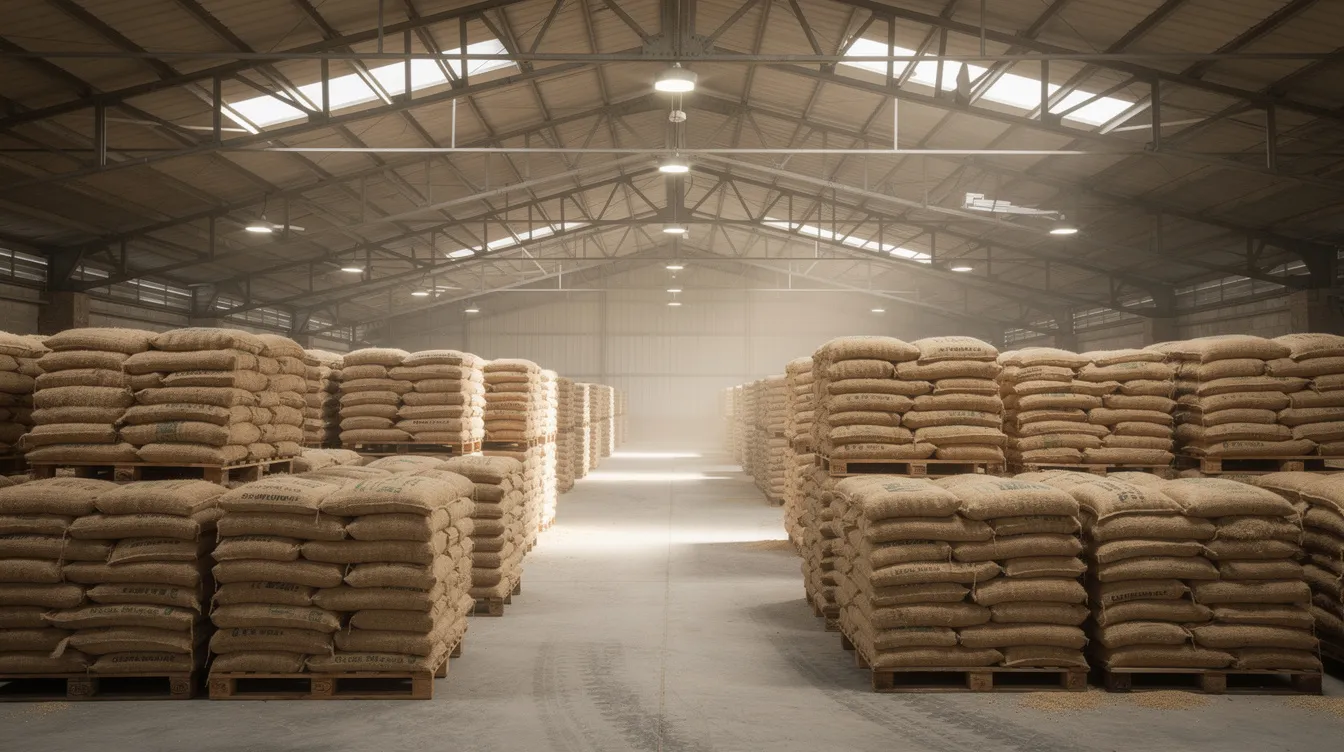
Warehouses must comply with Bureau of Indian Standards and safety regulations to register with WDRA. Core requirements include pucca construction, moisture-resistant flooring, adequate plinth height, proper ventilation, drainage and layout planning conforming to BIS, CWC and FCI specifications.
Equipment requirements include weighbridges, handling and grading equipment, sampling tools, moisture meters and pest-management systems. Fire safety facilities, CCTV, boundary walls, security manpower and an office for records are expected. Standard operating procedures covering receipt, storage, fumigation and grievance redressal must be documented.
Scientific Grain Preservation Requirements
Scientific grain preservation involves proper drying, stacking, moisture control, aeration, temperature monitoring and periodic inspection. Fumigation must follow safe protocols with qualified operators, PPE and detailed recordkeeping. Hygiene practices – rodent control, cleanliness, prevention of water ingress – are continuously assessed. These practices directly support both WDRA compliance and quality retention.
Documents Required for WDRA Warehouse Registration
Registration requires submission of an application and relevant documents. Proper documentation is crucial for WDRA registration, including ownership proof and safety clearances. The application form is filed online via the WDRA portal.
| Document | Purpose | Applicability |
|---|---|---|
| PAN, CIN, registration certificate | Entity identity proof | All applicants |
| Title deed or lease agreement | Ownership or effective control of warehouse premises | All applicants |
| Layout plan and capacity details | Storage capacity verification | All applicants |
| Audited financials / net-worth certificate | Financial eligibility | All (CA certificate for non-audited entities) |
| Insurance policies | Coverage of stored goods against fire, theft, flood | Mandatory |
| SOPs for storage, fumigation, safety | Operational compliance | All applicants |
| Fire NOC / safety equipment details | Safety and quality standards | All applicants |
| Staff details and experience certificates | Manpower and competence | All applicants |
| Board/cooperative resolution | Authorisation to apply | Companies, cooperatives, FPOs |
WDRA Warehouse Registration Online – Step-by-Step Process
The WDRA registration process is conducted entirely online through the official WDRA Portal. All procedures in the WDRA registration process should be handled directly by applicants without third-party agents.
- Assess whether WDRA registration is needed and verify eligibility.
- Prepare infrastructure and organise required documents.
- Create user credentials on the WDRA portal; submit the application form with warehouse details, GPS coordinates, storage capacity and insurance status.
- Upload scanned documents and pay the applicable registration fee.
- WDRA examines the application within 10 working days for completeness.
- Warehouse inspections are conducted by empanelled agencies to verify safety and infrastructure adherence.
- Address any deficiencies raised during inspection.
- The WDRA issues a Certificate of Registration upon successful application and inspection of a warehouse. The registration certificate is valid for 10 years and requires periodic renewal.
- Coordinate with a repository (NERL or CCRL) for e-NWR onboarding.
Common delays arise from incomplete uploads, mismatched capacity data, missing insurance policies and inconsistent ownership or lease records.
WDRA Registration Fees, Insurance and Security Deposit Requirements in 2026
Fee structures for WDRA registration depend on the warehouse’s storage capacity and type of commodities stored. Registration fees range from Rs 5,000 to Rs 35,000 based on capacity. No fee is required for Agriculture Godown registration. A security fee is also required for warehouse registration.
Insurance coverage against stock damage is a requirement for WDRA registration, reducing liability risks. Registered warehouses must maintain insurance policies covering stored goods against risks like fire and theft.
Under WDRA Notification No. T-30/5/2020-Technical-Part(2), dated 20.08.2026, initial registration does not require a fixed security deposit for new applicants under recent WDRA rules. Instead, an advance dynamic security deposit must be placed before commencing e-NWR issuance – a minimum of ₹1 lakh per warehouse for general applicants and ₹50,000 per warehouse for qualifying FPOs, PACS and SHGs. The deposit is linked to outstanding e-NWR value and is refundable, not an operating expense. It should be budgeted as blocked funds in project financial planning.
What Is e-NWR? Meaning, Features and Benefits
An electronic Negotiable Warehouse Receipt (e-NWR) is a dematerialised record of title to commodities stored in a WDRA-registered warehouse. All registered warehouses must issue electronic Negotiable Warehouse Receipts. WDRA-accredited facilities are recognised for compliance with scientific storage standards, enhancing trust among stakeholders.
Key features include unique receipt ID, commodity and quality details, depositor information, warehouse location and pledge status – all maintained digitally in repositories (NERL and CCRL). Compared to paper receipts, e-NWRs offer transparency, resistance to forgery and ease of transfer and pledge.
How Does the e-NWR Issuance Process Work?
The process flow works as follows: a depositor delivers commodities to the warehouse, where inspection, assaying and grading are performed. After weighing and stock entry, the warehouse operator logs details into the repository system and generates the e-NWR in the depositor’s account. The depositor can then hold, transfer or pledge the e-NWR. Upon loan repayment, the pledge is released and goods can be withdrawn.
Bank Loan Against e-NWR – Warehouse Receipt Financing Explained
Farmers can secure bank loans against stored commodities using e-NWRs. Banks and financial institutions create a pledge over the e-NWR in the repository system, apply a margin (typically 20–40%), and lend against the remaining value.
Hypothetical example: A farmer deposits 100 MT of wheat valued at ₹2,500 per quintal (₹25 lakh total). With a 30% margin, the bank may finance up to ₹17.5 lakh for a 6-month tenor. At 9% interest, the approximate interest cost would be around ₹79,000. This is illustrative only – actual terms depend on bank policies and credit appraisal.
Risks include commodity price volatility triggering margin calls and storage losses from poor maintenance. Availability of loans is subject to lender approval and applicable RBI norms. For structuring bankable proposals, a professionally prepared DPR and loan proposal can be valuable. Details on government schemes and subsidies are covered separately.
WDRA Registration for FPO, PACS and Cooperative Warehouses
FPOs, PACS and cooperatives are central to rural grain storage and collective marketing. Eligible FPOs and PACS can register with WDRA, subject to proper registration under the Cooperative or Companies Act, governance structures and resolutions authorising warehouse registration.
Under 2026 rules, these entities enjoy a concessional dynamic security deposit minimum of ₹50,000 per warehouse and positive net-worth sufficiency instead of full threshold requirements. Governance, stock segregation and transparent recordkeeping assume particular importance during WDRA inspections.
A professionally prepared PACS and FPO warehouse DPR helps structure viable, WDRA-ready projects with realistic financial projections.
WDRA Warehouse Compliance Requirements After Registration
Registration is not a one-time event. Registered warehouses must comply with government safety standards on an ongoing basis.
| Compliance Area | Key Requirement | Frequency |
|---|---|---|
| Infrastructure maintenance | Repairs, plinth, roofing, drainage | Continuous |
| Stock records | Daily registers, physical verification, e-NWR reconciliation | Daily/periodic |
| Quality preservation | Fumigation logs, moisture registers, sampling records | As required |
| Insurance | Active policies, updated sum insured | Annual renewal |
| WDRA reporting | Responding to queries, facilitating inspections | As triggered |
| Security deposit | Maintain adequate balance linked to e-NWR exposure | Ongoing |
Non-compliance can lead to suspension or cancellation of registration, bar on issuing e-NWRs, and legal liabilities towards depositors and lenders.
WDRA Compliance Cost and Its Impact on Grain Warehouse Project Feasibility
From a financial planning perspective, WDRA compliance adds measurable capital and operating costs: enhanced construction for scientific storage, fire-fighting and security systems, assaying equipment, insurance premiums, repository connectivity and the opportunity cost of blocked security deposits.
Hypothetical illustration: A 10,000 MT grain warehouse with ₹8 crore construction cost, ₹12 lakh annual insurance, ₹3 lakh compliance and inspection costs, and ₹5 lakh blocked as dynamic security deposit. At 65% occupancy and ₹60/MT/month storage tariff, annual revenue would be approximately ₹46.8 lakh. WDRA-related costs directly affect DSCR and payback period – details that must feature in financial projections. Detailed project cost analysis and setup cost estimation are essential at the planning stage.
Role of a Detailed Project Report in WDRA-Compliant Warehouse Investment
Promoters should plan WDRA eligibility, infrastructure standards and security-deposit funding at DPR stage – not after construction. A WDRA-oriented DPR includes location analysis, capacity planning in MT, layout aligned to WDRA norms, equipment costs, staffing, projected P&L, cash flow, DSCR and sensitivity analysis for occupancy scenarios.
A DPR supports decision-making and bank finance; it does not guarantee WDRA warehouse registration, which remains subject to WDRA’s independent evaluation. A thorough feasibility study integrates compliance requirements with commercial viability.
If you are planning a WDRA-compliant warehouse or silo project, CA Manish Gugliya assists with customised DPRs, CMA Data and project finance advisory. Contact via the WhatsApp link on Project Report Bank.
Common Mistakes to Avoid While Planning WDRA Registration
- Assuming every warehouse must register with WDRA, or confusing it with basic shop or GST registration.
- Designing warehouses without considering WDRA infrastructure norms, leading to costly retrofits.
- Incomplete lease or ownership documents, missing cooperative resolutions, or outdated insurance.
- Using outdated fee or security-deposit information instead of checking current WDRA notifications.
- Overestimating warehouse occupancy and underestimating compliance, maintenance and working-capital costs in financial projections.
- Ignoring repository onboarding timelines after obtaining registration.
Frequently Asked Questions About WDRA and e-NWR
The following answers are based on regulations available as of October 2026. Readers should reconfirm critical details from official WDRA sources.
What is WDRA warehouse registration?
WDRA warehouse registration is the formal process under the Warehousing (Development and Regulation) Act, 2007, and the 2017 Rules, through which eligible warehouses obtain authority to operate as regulated warehousing facilities and issue negotiable warehouse receipts, including e-NWRs, via accredited repositories.
Is WDRA registration mandatory for every warehouse?
No. WDRA registration is mandatory for warehouses issuing negotiable warehouse receipts. Warehouses used only for captive storage, internal logistics or non-negotiable receipts may not require it, unless specific scheme or contractual requirements apply.
What security deposit is required under the 2026 WDRA rules?
Under the 20.08.2026 notification, no fixed security deposit is required at initial registration for qualifying new applicants. An advance dynamic security deposit – minimum ₹1 lakh per warehouse (₹50,000 for eligible FPOs, PACS and SHGs) – must be placed before commencing e-NWR issuance, linked to outstanding e-NWR exposure. Verify exact figures from the Gazette notification.
Can farmers obtain bank loans against e-NWR?
Yes. Many banks and financial institutions provide pledge finance against eligible e-NWRs. Loan availability depends on bank policies, eligible commodity lists, credit appraisal and RBI norms. An e-NWR alone does not guarantee loan sanction.
What happens if a warehouse fails WDRA inspection?
WDRA may seek rectification of deficiencies and keep registration pending, or refuse registration. For already-registered warehouses, serious non-compliance can lead to suspension or cancellation of registration and a bar on issuing e-NWRs, along with potential forfeiture of security deposit.
Conclusion – Building a Compliant and Financially Viable Grain Warehouse
WDRA warehouse registration, scientific storage practices and the e-NWR system together enhance depositor trust, reduce post-harvest losses and open access to warehouse receipt financing. For warehouse promoters, the regulatory framework provides credibility – but compliance investment must be balanced with commercial viability through realistic financial planning.
WDRA rules and security-deposit norms continue to evolve, as demonstrated by the 2026 changes. Serious investors should regularly track official updates and adjust their project plans accordingly.
Planning a Grain Warehouse or Silo Project in India?
CA Manish Gugliya, FCA, DISA (ICAI), with 20+ years of professional experience, assists entrepreneurs and investors in preparing bankable Detailed Project Reports, CMA Data, financial projections, project feasibility studies and financing proposals for grain warehouses and silo projects. Contact through the WhatsApp enquiry link on Project Report Bank for professional DPR and project finance advisory.