A modified starch manufacturing plant project report is a foundational document for any entrepreneur or existing starch manufacturer evaluating downstream value addition in India. This article provides a structured, technically grounded guide covering industry context, plant configuration, machinery, raw materials, capital expenditure, operating costs, profitability, bank finance planning, and DPR preparation for modified starch production.
Key Takeaways
- This guide serves as a comprehensive modified starch manufacturing plant project report framework for India, covering industry overview, plant setup, machinery, raw materials, capital investment, operating expenses, profitability analysis, DPR preparation, and bank loan planning.
- Modified starch plants can operate as standalone conversion units purchasing native starch or as integrated units attached to a maize starch or wet milling facility – this choice fundamentally affects project cost, raw material strategy, working capital, and risk.
- The article reflects the professional perspective of CA Manish Gugliya (Project Report Bank), emphasising realistic capacity planning, financial projections, DSCR, ROI, IRR, and what banks actually evaluate while appraising such projects.
- Exact project cost, machinery quotations, and profit margins are highly project-specific; the article provides structured frameworks and illustrative tables rather than fabricated universal figures.
- Readers will also find guidance on licences, regulatory requirements, risk factors, and how Project Report Bank can assist with a bankable DPR, CMA Data, and project finance advisory.
Modified Starch Manufacturing Plant Project Report – Industry Overview
Modified starch is native starch – most commonly maize starch in India – that has been physically, chemically, or enzymatically altered to enhance specific functional properties such as viscosity, stability, texture, and gelatinisation behaviour. These starch derivatives serve as critical functional ingredients and industrial auxiliaries across food processing, paper and packaging, the textile industry, adhesives, pharmaceuticals, and specialty chemicals.
A modified starch manufacturing plant differs fundamentally from a basic starch processing plant or maize wet milling plant. Upstream facilities extract native starch from grain; a modified starch manufacturing unit takes that native starch and transforms it into tailored, higher-value products through controlled reactions. The India modified starch market was estimated at approximately USD 536.5 million in 2025, with growth primarily driven by processed foods, paper-based packaging, textile sizing, and emerging applications in biodegradable plastics and oil drilling muds. Global demand for modified starch is around 4 million tonnes annually, while Indian demand for modified starch was approximately 75,000 tonnes last year, with the global corn starch market projected to reach 109.38 million tonnes by 2034.
An entrepreneur must choose between two project configurations: (a) a standalone modified starch conversion plant purchasing native starch from external suppliers, or (b) an integrated modification unit attached to a maize starch manufacturing plant or integrated maize wet milling facility. Each configuration carries different implications for capital expenditure, raw material security, quality control, and working capital.
The core questions a serious investor must answer include technical feasibility, raw material availability, market demand across end use industries, realistic project cost, profitability under conservative assumptions, and bankability. A professional Detailed Project Report is essential to answer these rigorously. Detailed project reports help identify financial viability and market potential for new projects, and are necessary for funding applications and regulatory compliance.
Project Report Bank, led by CA Manish Gugliya, FCA, DISA (ICAI), prepares customised, bankable DPRs grounded in project-specific assumptions – not generic templates.
What Is Modified Starch and How Is It Manufactured?
Modified starch is derived from natural starch sources through controlled treatments that alter the starch molecule to achieve targeted functional improvements. Common methods for starch modification include esterification, etherification, and oxidation. Chemical modification introduces functional groups to change solubility and processing behaviour. Physical methods include heat-moisture treatment and pre-gelatinization. Enzymatic treatments allow precise control over starch molecular weight.
Temperature and pH control are critical during the modification of starch. Modified starches improve stability under heat, acid, and shear conditions – properties that raw starch simply cannot deliver. Each modified starch grade is developed for a narrow performance window, so plant design and product slate must be carefully aligned.
| Parameter | Native Starch | Modified Starch |
|---|---|---|
| Processing behaviour | Limited tolerance to heat, acid, shear | Engineered for specific processing conditions |
| Functionality | Basic thickening agent, gelling | Tailored viscosity, stability, film-forming, binding |
| Typical applications | Commodity food, basic industrial uses | Paper sizing, textile finishing, sauces, dairy, pharma |
| Price level | Lower, commodity-driven | Premium based on performance grade |
| Plant complexity | Extraction and drying | Reaction systems, chemical handling, QC lab |
| Quality tolerance | Broader specifications | Tight customer-specific limits |
| Customer qualification | Minimal | Often requires pilot trials and audits |
Types of Modified Starch and Their Industrial Applications
Not all modified starches are alike. An investor must select a focused product basket of two to five grades based on target industries and realistic technical capability. Attempting every type in one plant without proven process control usually leads to operational complexity and unsold inventory.
Oxidized Starch
Produced by treating starch slurry with approved oxidising agents under controlled pH and temperature, oxidized starch offers lower viscosity and improved film-forming properties. It is widely used in the paper industry for surface sizing and coating, some textile finishing, and adhesive formulations. Corrosion-resistant reactors and accurate chemical dosing are essential, along with effluent treatment for oxidant residues.
Cationic Starch
Cationic starch is produced by introducing positively charged quaternary ammonium groups onto the starch molecule via etherification. It plays a critical role in paper wet-end retention, internal sizing, and drainage improvement. Manufacturing requires precise process parameters and strict handling of cationising agents. Plants typically need strong technical collaboration with paper mills.
Pregelatinized Starch
This physically modified starch is cooked and dried so it disperses in cold water without additional heating. Applications include convenience foods, instant soups, pharmaceutical tablets, and industrial adhesives. Equipment typically involves drum dryers or extruders, with emphasis on precise thermal history rather than chemical complexity. It aligns well with clean-label positioning in the food industry.
Cross-Linked Starch
Cross-linked starch is chemically modified to form covalent links between starch chains, improving shear, acid, and heat stability. Applications include canned and retort foods, sauces, and bakery fillings. Careful control of cross-linking agent dosage, pH, and reaction time is required, with subsequent washing to meet regulatory substitution limits for food-grade products.
Acid-Modified Starch
Acid-modified or thin-boiling starch is partially depolymerised using hydrochloric acid or similar mineral acids to reduce viscosity while maintaining gel strength. Applications include confectionery jellies, textile sizing, and adhesives. Corrosion-resistant equipment and effluent treatment for acidic chemical waste are necessary.
Food-Grade Specialty Modified Starch
Higher-value food-grade modified starches include stabilisers for dairy products, fat-replacer starches for low-fat dressings, and freeze-thaw-stable starches for ready to eat meals. Modified starches enhance stability in sauces and dairy products. They serve as emulsifiers in food and pharmaceuticals. Compliance with FSSAI regulations – including specific INS numbers and permitted food categories – is mandatory. HACCP-compliant manufacturing, food-grade chemicals, and comprehensive quality assurance documentation are essential.
| Modified Starch Type | Modification Method | Major End Uses | Key Commercial Considerations |
|---|---|---|---|
| Oxidized | Chemical (oxidation) | Paper sizing, adhesives | High-volume, moderate value-add |
| Cationic | Chemical (etherification) | Paper wet-end, packaging | Customer-specific, near-mill plants |
| Pregelatinized | Physical (cooking/drying) | Food, pharma, adhesives | Clean-label potential, lower chemical risk |
| Cross-linked | Chemical (cross-linking) | Retort foods, sauces | Strict QC, tight specifications |
| Acid-modified | Chemical (acid hydrolysis) | Confectionery, textiles | Cost-competitive, corrosion management |
| Food-grade specialty | Combined/enzymatic | Dairy, frozen foods, low-fat | FSSAI compliance, pilot trials required |
Modified starches are also used as thickeners in food products, in biodegradable plastics and packaging, and carboxymethyl starch finds application in oil drilling mud. Modified starch is increasingly used in sustainable materials applications including biodegradable packaging.
Modified Starch Market Demand and Business Opportunities in India
India’s modified starch consumption is linked to the growth of packaged and processed foods, tissue and packaging paper, technical textiles, the pharmaceutical and beverage industry, adhesives, and specialty chemical segments. Market analysis should assess demand across sectors such as food processing and pharmaceuticals. The demand for modified starch is primarily driven by industries needing stabilizers, thickeners, and binding agents. Food applications remain the largest market segment for modified starch globally.
Consumer demand drivers include expansion of QSR chains, rising consumption of convenience foods, the shift toward recyclable paper-based packaging, and import substitution of specialty modified starches currently sourced from multinational suppliers. Major demand clusters include paper and packaging hubs in Gujarat and Maharashtra, textile belts in Gujarat and Tamil Nadu, food processing clusters in UP, Maharashtra, Punjab, and Telangana.
The difference between selling commodity maize starch and selling industrial or food-grade modified starch is significant. Commodity starch sells on price with thinner margins; modified starch commands better value addition through customer approvals, consistent quality, and technical service – but carries higher entry barriers.
Opportunities exist for new standalone units near end-use clusters, existing starch plants adding downstream modification, and niche producers focusing on two to three high-performance grades. This is among the large-scale manufacturing business ideas gaining attention from serious industrial investors.
Modified Starch Manufacturing Plant Capacity Planning
Plant capacity is typically expressed in TPD or TPA of saleable modified starch at specified moisture content. Typical capacity bands: small-scale units (5–20 TPD), medium-scale plants (30–80 TPD), and large plants (100+ TPD). Plant capacity planning must consider expected utilization rates and production yields, including the impact of multi-grade production on changeover time and effective capacity utilisation.
| Parameter | Illustrative Medium Plant (50 TPD) |
|---|---|
| Installed capacity | 50 TPD / ~15,000 TPA |
| Operating days | 300–330 per year |
| Year 1 utilisation | 50–60% (~7,500–9,000 TPA) |
| Year 3+ utilisation | 80–85% (~12,000–12,750 TPA) |
| Multi-grade impact | 5–10% capacity loss from changeovers |
Capacity planning should be linked to confirmed market demand and validated with equipment suppliers, not based purely on aspirational thinking.
Raw Materials Required for Modified Starch Manufacturing
The primary raw material is native starch – most commonly maize starch in India, with optional use of tapioca or potato starch where applications justify it. The selection of raw materials affects product performance and conversion yield in modified starch production. Quality parameters for procurement include moisture content, ash, protein, pH, whiteness, and microbial load, as these influence reaction performance and starch granules behaviour.
Modifying agents vary by grade: oxidising agents, acids/alkalis, cross-linking agents, esterification and etherification reagents, cationising agents, and enzymes for enzymatically modified starch production. Auxiliary materials include process water, boiler fuel, packaging materials (multi-wall bags, bulk containers, liners), and pH controllers.
Raw materials account for 65–75% of operating expenses in starch manufacturing. Sourcing strategy should include vendor diversification, rate contracts, and consideration of captive supply from an integrated facility. Food-grade requirements demand FSSAI-compliant raw materials and food-grade chemicals, distinct from technical-grade inputs for paper or textile markets.
Modified Starch Manufacturing Process and Flow Chart
The production process for most chemically modified starch grades follows a wet chemical modification route. Wet milling is the most common starch extraction method upstream. Modified starch production uses physical, chemical, or enzymatic methods depending on the target grade. Continuous reactors enhance efficiency in modified starch production for high-volume grades.
Representative process flow:
- Native starch reception and silo storage
- Starch slurry preparation (controlled solids concentration)
- pH and temperature conditioning
- Controlled addition of modifying agent in reactor
- Reaction under monitored temperature, pH, and time
- Sampling and reaction completion endpoint control
- Neutralisation or quenching where applicable
- Washing and solid–liquid separation (centrifuges or filters)
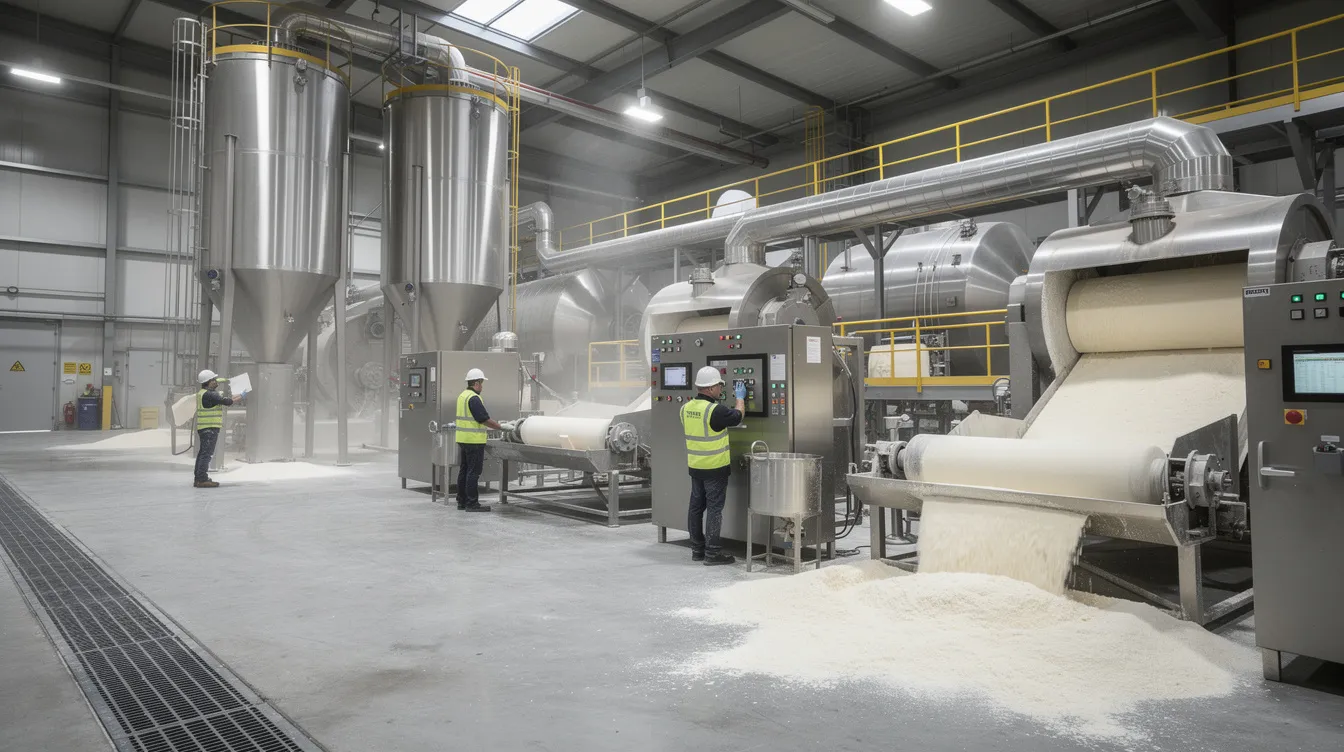
- Drying – spray dryers or flash dryers are used for starch drying to achieve target moisture and uniform particle size
- Milling and sieving for particle size control
- Quality control testing
- Packaging and finished-goods storage
Choosing suitable packaging materials is essential for modified starch products, especially in food applications.
For physically modified starch such as pregelatinized grades, the process differs – relying on thermal and mechanical equipment like drum dryers, extruders, or fluidised bed dryers rather than chemical reactions in steeping tanks or reactors.
Yield losses occur through starch solids lost in wash liquor, fines in dust collection, and moisture balance across dryers. These losses directly affect true production cost per tonne and must be accounted for in financial projections.
Modified Starch Plant Machinery and Equipment Cost
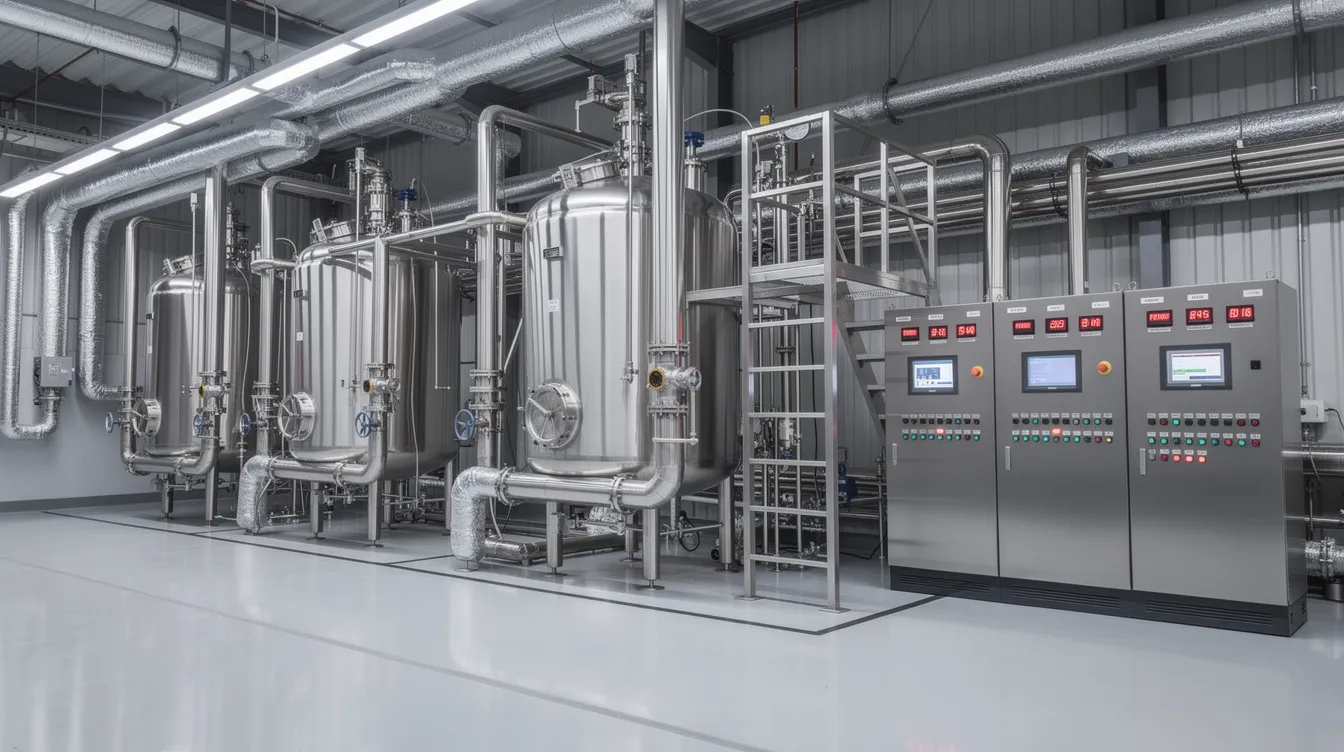
Machinery selection depends on target capacity, product slate, level of automation, and hygiene requirements. Key equipment typically required includes native starch silos, screw conveyors, slurry preparation tanks, agitators, modification reactors with heating/cooling and instrumentation, chemical storage and dosing systems, centrifuges or filters, flash or spray dryers, mills/sieves, packing machines, boilers, water treatment plant, air compressor, ETP, and quality control laboratory instruments.
| Equipment | Function | Key Selection Considerations |
|---|---|---|
| Modification reactors | Controlled chemical/enzymatic reaction | SS304/316 MOC, temperature/pH instrumentation |
| Chemical dosing systems | Precise reagent addition | Corrosion resistance, metering accuracy |
| Centrifuges/filters | Solid-liquid separation | Capacity, wash efficiency, MOC |
| Flash/spray dryers | Moisture removal | Energy consumption, outlet temperature control |
| Mills and sieves | Particle size control | Uniform particle size output, cleaning ease |
| Boiler | Steam generation | Fuel type, capacity, statutory compliance |
| ETP | Effluent treatment | BOD/COD design, CPCB norms |
| QC lab instruments | Viscosity, moisture, purity testing | Viscometers, moisture analysers, pH meters |
Food-grade plants require higher-spec stainless steel contact parts, CIP systems, and hygienic design, raising machinery and installation cost. Quality assurance for modified starch production includes testing for viscosity, moisture, and purity. Corn starch plant setup costs include both capital and operating expenses.
Land, Building and Plant Layout Requirements
Land and building requirements depend on capacity, product chemistry, layout philosophy, and statutory norms. A medium-scale plant may require several thousand square metres including provision for future expansion and ETP. Key built-up areas include raw starch storage, chemical storage with segregation, process block, drying and packing areas, QC lab, utilities block, ETP, and administrative building.
Site preparation must accommodate unidirectional material flow, separate personnel and forklift pathways, bulk truck movement, and fire safety compliance. Integrated units within existing facilities can leverage common utilities but require careful layout planning.
Modified Starch Manufacturing Plant Project Cost in India
Total project cost extends well beyond machinery price. It includes land and site preparation, civil construction materials, plant and machinery, utilities and electricals, ETP and environmental compliance systems, laboratory, pre-operative expenses, interest during construction, contingency, and margin for working capital.
| Cost Component | Relative Importance |
|---|---|
| Land and site development | Moderate (location-dependent) |
| Buildings and civil works | 15–20% of project cost |
| Plant and machinery | 35–45% (largest component) |
| Utilities and electricals | 8–12% |
| ETP and environmental systems | 3–6% |
| Laboratory and QC | 2–4% |
| Pre-operative and IDC | 5–8% |
| Contingency | 5–7% |
| Working capital margin | 8–12% |
A standalone conversion plant (Option A) has lower capital investment in upstream equipment but higher recurring expenditure on purchased native starch. An integrated plant (Option B) attached to a wet milling facility has higher capital expenditure but can offer better raw material control, by-product revenue, and potentially lower long-term variable costs.
Manufacturing costs must include all relevant operational expenses such as raw materials, labor, and utilities. The financial section of a project report should include capital investment estimates and funding sources.
Promoters should obtain indicative machinery quotations and civil estimates, then work with a professional consultant to refine assumptions and produce a realistic, bank-acceptable capital cost estimate. Readers planning a customised modified starch plant DPR with detailed project cost and means-of-finance analysis can contact Project Report Bank via WhatsApp for a professional discussion.
Means of Finance and Bank Loan Planning
Typical funding for Indian manufacturing projects of ₹10 crore+ combines promoter equity and term loans from banks, sometimes supplemented by subsidies. Banks evaluate promoter track record, technology clarity, raw material linkage, confirmed customers, realistic expenditure projections, DSCR, and environmental compliance when appraising a modified starch project.
Businesses may require project development documentation to support investor funding and bank loans. Project finance advisory is important for term loan applications and investment documentation. Term-loan repayment periods for such industrial projects typically range from six to eight years, though bank policies vary.
CMA Data – a structured financial statement pack showing projected balance sheets, P&L, fund-flow, and working capital assessments – is integral to bank submissions. Project Report Bank provides CMA Data preparation services aligned with bank formats, alongside bank finance DPR and loan proposal assistance.
Modified Starch Plant Working Capital Requirements
Even a technically sound project can face stress if working capital is underestimated. Financial models should account for cash flow cycles and working capital needs based on customer credit terms. Key current-asset components include inventory of native starch and chemicals, work-in-progress, finished goods stock, and trade receivables. Current liabilities include supplier credit, outstanding wages, and short-term provisions.
| Component | Typical Holding Period | Notes |
|---|---|---|
| Native starch inventory | 15–30 days | Depends on sourcing distance |
| Chemicals and auxiliaries | 30–45 days | Multiple grades needed |
| Work-in-progress | 2–5 days | Batch cycle dependent |
| Finished goods | 10–20 days | Multiple grades in stock |
| Trade receivables | 30–90 days | B2B credit to paper/food companies |
| Trade creditors | 15–30 days | Partially offsets requirement |
Factors that lengthen working capital include supplying large customers with extended credit, holding multiple grades, and distribution costs for geographically dispersed markets.
Modified Starch Plant Financial Projections and Profitability
Professional financial projections typically cover five to seven years using an assumption-driven financial model. Financial projections should include sales forecasts, break-even analysis, and return on investment calculations. Financial projections assess ROI and long term sustainability of projects.
Core elements include capacity utilisation by year, grade-wise production volumes and selling prices, raw material and chemical consumption norms per tonne, utility costs, manpower, and financing costs. Revenue is calculated as the sum of grade-wise quantity multiplied by realisable price; variable costs scale with production while fixed costs behave independently.
Gross profit margins for corn starch processing plants range from 20–30%, but actual margins for modified starch depend on product mix – commodity-like oxidized or thin-boiling grades yield moderate margins, while specialised cationic or food-grade products can deliver higher but more volatile returns. Effective OPEX management is crucial for modified starch profitability. Sensitivity analysis helps gauge the project’s financial resilience under various scenarios.
Project Report Bank builds integrated financial models linking production, pricing, cost, and financing assumptions to enable sensitivity testing before promoters commit capital.
Modified Starch Plant DSCR, ROI, IRR and Payback Period
Beyond basic profitability, investors and bankers evaluate projects using DSCR, ROI, IRR, payback period, and break-even analysis to understand risk and return.
Debt Service Coverage Ratio (DSCR)
DSCR equals net cash accruals available for debt service divided by total debt obligations (interest plus principal) for the year. It indicates the project’s capacity to meet term-loan instalments, particularly during initial years when capacity utilisation is lower. Banks usually expect average DSCR comfortably above 1.25–1.50. A bankable DPR demonstrates acceptable DSCR under reasonable stress scenarios, not just the base case.
Return on Investment (ROI)
ROI measures average annual profit relative to total capital employed, indicating whether the investment is attractive compared to alternative uses of capital. It can be calculated pre-tax and post-tax. Higher value-added product mix and efficient operations improve ROI over time, but over-optimistic assumptions can mislead decision-making.
Internal Rate of Return (IRR)
IRR is the discount rate at which NPV of project cash flows becomes zero. Many institutional investors classify risk-return profiles based on IRR. Calculations should use realistic implementation periods, ramp-up phases, and stabilised cash flows.
Payback Period
Payback period is the time required to recover initial capital investment from net cash inflows. It shortens with higher capacity utilisation and better contribution margins but lengthens when raw material or energy consumption costs rise unexpectedly.
Break-Even Analysis
Break-even point is where total revenue equals total costs. Break-Even Quantity equals Fixed Costs divided by Contribution per Unit. For a modified starch plant, this helps promoters understand the minimum capacity utilisation they must sustain under realistic pricing conditions.
These metrics should be generated by an integrated financial model and checked under multiple scenarios before finalising the project.
Modified Starch Project Feasibility Study and Viability Assessment
Technical, commercial, financial, and regulatory feasibility must all be satisfied simultaneously for long term sustainability. A project report for modified starch manufacturing should cover technical process design and financial feasibility. The project report should define the type of modified starch and its intended applications.
Key feasibility checklist:
- Availability of native starch at required purity
- Access to skilled operators and chemists
- Effluent treatment requirements and environmental impact assessment
- Proximity to major customers
- Sensitivity of financial results to raw material and selling-price changes
Promoters should compare standalone vs integrated configurations for risk-adjusted returns. Project Report Bank’s feasibility services include realistic financial models and sensitivity analysis, complementing process engineering inputs. Independent validation through customer trial reports or pilot-plant data significantly strengthens bankability.
Licences, Registrations and Regulatory Requirements in India
A modified starch plant must comply with central and state regulations. Regulatory compliance includes obtaining necessary licenses and permits from local authorities. General approvals include company incorporation, UDYAM/MSME registration, factory licence, and labour law registrations.
Environmental management plans must address wastewater, air emissions, and waste disposal for starch plants. Environmental and safety requirements include Consent to Establish and Consent to Operate from the State Pollution Control Board, ETP design approvals, hazardous chemical storage permissions, fire NOC, and boiler registration.
For food-grade modified starch, FSSAI licensing is mandatory. Specific modified starch types must be verified against permitted INS numbers and allowed usage levels in intended food categories. ISO 22000, HACCP, and BIS certifications enhance credibility. Exact approvals depend on plant location, chemistry, scale, and intended applications.
Industrial Challenges and Risk Factors
Modified starch manufacturing is technically attractive but competitive and capital-intensive. Project risk analysis should identify potential issues like raw-material price volatility and environmental non-compliance.
| Key Risk | Possible Mitigation |
|---|---|
| Native starch price volatility | Long-term contracts, multiple suppliers, integrated supply |
| Inconsistent input starch properties | Incoming QC protocols, supplier qualification |
| Off-spec batch rejection | Robust quality control, process automation |
| High water and energy consumption | Water reuse, energy-efficient dryers |
| Environmental compliance costs | Conservative ETP design, biogas recovery |
| Customer approval delays | Pilot trials, application-lab support |
| Working capital stress | Conservative credit policy, adequate bank limits |
| Under-utilisation in initial years | Phased capacity ramp-up, secured initial offtake |
Sensitivity analysis is important for understanding the financial impact of changing market conditions. A thorough risk analysis with scenario modelling should be incorporated into every DPR.
Business Opportunities for Existing Maize Starch Manufacturers
Existing maize starch or wet milling plant owners have natural advantages for downstream modified starch manufacturing: captive supply of native starch with known quality, shared utilities (boilers, water-treatment, labs), and common logistics infrastructure.
Additional requirements include investment in reactors, chemical handling, ETP upgrades, application labs, and marketing capability. Existing manufacturers can explore allied starch derivatives including liquid glucose, maltodextrin, and dextrose monohydrate as part of a broader value-chain strategy. Shifting a portion of native starch output to higher-value modified grades can improve average contribution per tonne, though it increases technical complexity and risk management requirements.
How to Prepare a Bankable Modified Starch Manufacturing Plant DPR
A high-quality DPR is both a decision-making tool and a financing document. Essential sections include: project overview, promoter profile, product and grade descriptions, market analysis, manufacturing technology, plant capacity and layout, raw material and utility planning, capital cost estimate, means of finance, implementation schedule, working capital assessment, projected financial statements, CMA Data, DSCR and repayment schedule, break-even and IRR analysis, risk and sensitivity analysis, and regulatory considerations.
Each section should be grounded in evidence – machinery quotations, civil estimates, utility tariffs, and documented assumptions for selling prices and raw material rates. Detailed project reports are necessary for funding applications and compliance with regulatory approvals. A professional DPR can also support investor discussions and strategic partnerships.
How CA Manish Gugliya Can Assist with Modified Starch Plant DPR and Project Finance Planning
CA Manish Gugliya and Project Report Bank provide Chartered Accountant-led project finance advisory for modified starch and agro-processing projects. Core services include customised DPR preparation for bank finance and investors, CMA Data and bank loan proposal assistance, financial projections and sensitivity modelling, project cost and means-of-finance planning, DSCR and repayment structuring, and project feasibility analysis.
The firm focuses on financial and commercial structuring, working alongside technology licensors and machinery suppliers rather than replacing them. All financial models and reports are customised to specific assumptions and bank or investor requirements.
To discuss your modified starch manufacturing plant project report requirements, share your basic project details – location, capacity, product mix, and planning stage – via WhatsApp for a professional consultation on DPR scope, timelines, and fees.
Frequently Asked Questions
How long does it typically take to set up and commission a modified starch manufacturing plant in India?
A typical timeline includes three to four months for detailed planning, DPR preparation, and bank sanction, followed by six to ten months for procurement, civil construction, and installation depending on capacity, plus one to two months for trial runs and stabilisation. Overlapping activities and strong project management can compress the schedule.
Is it necessary to run pilot trials before finalising a modified starch product slate?
Serious industrial or food-grade suppliers usually need pilot or semi-commercial trials to validate product performance, reduce risk of rejection, and refine process conditions before scaling up. Very small or low-risk projects sometimes proceed without formal pilot work, but this increases commercial risk.
Can a new modified starch plant in India practically target export markets?
Exports are possible, especially to nearby regions, but require competitive delivered cost, consistent quality, compliance with buyer-country regulations, and often third-party certifications. Most new plants initially focus on building stable demand with domestic customers while developing export capabilities.
What key technical staff are required to operate a medium-scale modified starch plant?
A typical staffing pattern includes a plant manager with chemical or process engineering background, production and shift engineers, QC and QA chemists, ETP and utility supervisors, safety officer, skilled operators, and maintenance technicians. Exact numbers scale with capacity and automation level.
How does using tapioca or potato starch instead of maize starch affect a modified starch project?
Different botanical sources produce distinct starch type characteristics including granule size, viscosity profiles, and weaving process performance in textile applications. Switching the base starch can change product performance, formulation costs, and raw material logistics, so any such shift should be evaluated through trials and updated financial analysis before incorporation into the DPR.
Conclusion – Planning a Commercially Viable Modified Starch Manufacturing Project
A commercially viable modified starch project requires disciplined selection of product grades, reliable native starch supply, strong customer relationships, and investment decisions grounded in realistic techno-financial analysis. Project viability depends on accurate estimation of capital investment and working capital, conservative financial projections, and clear visibility on DSCR, IRR, and payback under multiple scenarios.
Regulatory compliance – particularly environmental requirements and FSSAI standards for food-grade production – and robust risk-mitigation planning remain integral parts of any bankable manufacturing plant project report. The starch industry offers attractive opportunities, but success requires treating the DPR as a genuine decision-making instrument.
Serious entrepreneurs, MSME promoters, and existing starch manufacturers planning a modified starch project can connect with CA Manish Gugliya and Project Report Bank via WhatsApp for customised DPR, feasibility study, financial modelling, and bank loan advisory support – before finalising machinery orders or land purchases.